

The DOI matches its Crossref record; 75 of the 76 references it cites were found in a registry or an index.
Using multiple genetic variants as instrumental variables for modifiable risk factors
Open accessAbstract
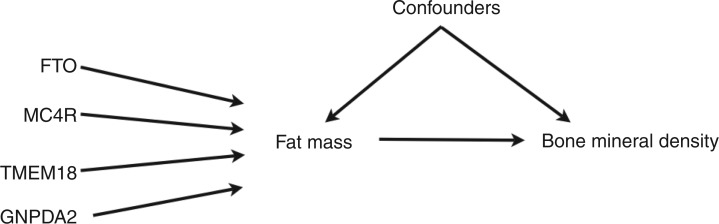
Mendelian randomisation analyses use genetic variants as instrumental variables (IVs) to estimate causal effects of modifiable risk factors on disease outcomes. Genetic variants typically explain a small proportion of the variability in risk factors; hence Mendelian randomisation analyses can require large sample sizes. However, an increasing number of genetic variants have been found to be robustly associated with disease-related outcomes in genome-wide association studies. Use of multiple instruments can improve the precision of IV estimates, and also permit examination of underlying IV assumptions. We discuss the use of multiple genetic variants in Mendelian randomisation analyses with continuous outcome variables where all relationships are assumed to be linear. We describe possible violations of IV assumptions, and how multiple instrument analyses can be used to identify them. We present an example using four adiposity-associated genetic variants as IVs for the causal effect of fat mass on bone density, using data on 5509 children enrolled in the ALSPAC birth cohort study. We also use simulation studies to examine the effect of different sets of IVs on precision and bias. When each instrument independently explains variability in the risk factor, use of multiple instruments increases the precision of IV estimates. However, inclusion of weak instruments could increase finite sample bias. Missing data on multiple genetic variants can diminish the available sample size, compared with single instrument analyses. In simulations with additive genotype-risk factor effects, IV estimates using a weighted allele score had similar properties to estimates using multiple instruments. Under the correct conditions, multiple instrument analyses are a promising approach for Mendelian randomisation studies. Further research is required into multiple imputation methods to address missing data issues in IV estimation.
Overview
The claims and statistics of this paper haven’t been checked yet.
Run the check — free, no account needed. It reads the open-access text and checks the sources it cites.
Integrity signals
Registry
Cites
Statistics
Figures
Verification
Claims the paper makes
The claims and statistics of this paper haven’t been checked yet.
Run the check — free, no account needed. It reads the open-access text and checks the sources it cites.
Claims other papers make about this one
Each is checked against this paper’s own text: does it say what the citing paper says it does?
The cited source doesn’t support the claim as written.
In the citing paper
“All three of these SNPs have previously been shown to be strong instruments for MR analysis as measured by F-statistics > 10 [8,18]”
From Associations of genetically determined iron status across the phenome: A mendelian randomization study (2019) · cites this paper as [18]
Checked by a reasoning model — may be wrong.
Experimental — accuracy not yet measuredIn the citing paper
“Interpretation of results from MR studies relies on four conditions.12,24”
From Mendelian randomization (2022) · cites this paper as [24]
Self-check
Percentages, sums and reported differences re-computed from the paper’s own numbers.
The self-check needs the paper’s full text.
Citations
Cites
(2001) · RePEc: Research Papers in Economics · Cited by 27,577
Specification Tests in Econometrics
Hausman, J. A. (1978) · Econometrica · doi:10.2307/1913827 · Cited by 18,820
Statistical Analysis With Missing Data
Lahiff, M., Little, R. J. A., & Rubin, D. B. (1989) · Journal of the American Statistical Association · doi:10.2307/2289883 · Cited by 17,385
Large Sample Properties of Generalized Method of Moments Estimators
Hansen, L. P. (1982) · Econometrica · doi:10.2307/1912775 · Cited by 13,467
Genome-wide association study of 14,000 cases of seven common diseases and 3,000 shared controls
The Wellcome Trust Case Control Consortium, Management Committee, Burton, P. R., Clayton, D. G., Cardon, L. R., Craddock, N., Deloukas, P., Duncanson, A., Kwiatkowski, D. P., McCarthy, M. I., et al. (2007) · Nature · doi:10.1038/nature05911 · Cited by 9,442
Self-citationStatistical Analysis with Missing Data
Little, R. J. A., & Rubin, D. B. (2002) · Wiley Series in Probability and Statistics · doi:10.1002/9781119013563 · Cited by 8,473
Genetics of Food Intake Self-Regulation in Childhood: Literature Review and Research Opportunities
Faith, M. S., Carnell, S., & Kral, T. V. E. (2013) · Human Heredity · doi:10.1159/000353879 · Cited by 7,633
Instrumental Variables Regression with Weak Instruments
Staiger, D., & Stock, J. H. (1997) · Econometrica · doi:10.2307/2171753 · Cited by 7,081
Lippa, N. C., & Sanderson, S. C. (2013) · Human Heredity · doi:10.1159/000353712 · Cited by 6,095
Davey Smith, G., & Ebrahim, S. (2003) · International Journal of Epidemiology · doi:10.1093/ije/dyg070 · Cited by 5,882
Research works printed but not linked: 3
- Youngman LD, 2000, Circulation, 102, 31
- Pierce BL, 2010, Int J Epidemiol
- Davey Smith G, 2010, Genes Nutr
Cited by
Sorted by citations
Mendelian Randomization Analysis With Multiple Genetic Variants Using Summarized Data
Burgess, S., Butterworth, A., & Thompson, S. G. (2013) · Genetic Epidemiology · doi:10.1002/gepi.21758 · Cited by 6,050
“This problem can be partially redressed by the use of multiple genetic variants [Palmer et al., 2011].”
BackgroundMendelian Randomization as an Approach to Assess Causality Using Observational Data
Sekula, P., Del Greco M, F., Pattaro, C., & Köttgen, A. (2016) · Journal of the American Society of Nephrology · doi:10.1681/asn.2016010098 · Cited by 2,351
Sanderson, E., Glymour, M. M., Holmes, M. V., Kang, H., Morrison, J., Munafò, M. R., Palmer, T., Schooling, C. M., Wallace, C., Zhao, Q., et al. (2022) · Nature Reviews Methods Primers · doi:10.1038/s43586-021-00092-5 · Cited by 2,229
Self-citationA review of instrumental variable estimators for Mendelian randomization
Burgess, S., Small, D. S., & Thompson, S. G. (2015) · Statistical Methods in Medical Research · doi:10.1177/0962280215597579 · Cited by 1,769
Detecting pleiotropy in Mendelian randomisation studies with summary data and a continuous outcome
Greco M, F. D., Minelli, C., Sheehan, N. A., & Thompson, J. R. (2015) · Statistics in Medicine · doi:10.1002/sim.6522 · Cited by 1,700
“When using data on G − X and G − Y that was collected on the same subjects, formal testing of pleiotropy can be performed using the Sargan test [13], an over-identification test associated with the two-stage regression that tests the null hypothesis that all instruments provide the same MR estimate [12].”
BackgroundMethodSelf-citation
Metadata
- Authors
- Palmer, T. M., Lawlor, D. A., Harbord, R. M., Sheehan, N. A., Tobias, J. H., Timpson, N. J., Smith, G. D., & Sterne, J. A.
- Affiliations
- University of Bristol (GB)
- University of Leicester (GB)
- School of Clinical Sciences, University of Bristol, Bristol, UK
- Corresponding author
- Palmer, Tom M
- ORCID
- Venue
- Statistical Methods in Medical Research
- Publisher
- SAGE Publications
- Published
- 2011-01-07
- Volume
- 21
- Issue
- 3
- Pages
- 223-242
- ISSN
- 0962-2802 (ISSN-L)
- 1477-0334
- PMC
- PMC3917707
- OpenAlex
- W2151096860
- Cited by
- 1,289
- References
- 76
- Citations by year
- 2026: 92 · 2025: 240 · 2024: 394 · 2023: 164 · 2022: 83 · 2021: 67 · 2020: 44 · 2019: 33 · 2018: 22 · 2017: 20 · 2016: 27 · 2015: 44 · 2014: 20 · 2013: 19 · 2012: 14
- FWCI
- 11.61
- Type
- journal article
- Language
- en
- Open access
- green
- www.ncbi.nlm.nih.gov
- Locations
- Statistical Methods in Medical Research (publishedVersion)
- Europe PMC (PubMed Central) (publishedVersion, cc-by)
- PubMed Central (publishedVersion, cc-by)
- PubMed (publishedVersion)
- Adelaide Research & Scholarship (AR&S) (University of Adelaide) (submittedVersion)
- Lancaster EPrints (Lancaster University) (submittedVersion)
- Figshare (submittedVersion, cc-by)
- Leicester Research Archive (University of Leicester) (submittedVersion, cc-by)
- Bristol Research (University of Bristol) (submittedVersion, cc-by)
- Funders
- Wellcome Trust (G0600705, 092731)
- University of Bristol (G0600705)
- Medical Research Council (G0600705)
- Economic and Social Research Council (ES/E00234X/1)
- Topics
- Life Sciences › Biochemistry, Genetics and Molecular Biology › Genetics › Genetic Associations and Epidemiology
- Physical Sciences › Mathematics › Statistics and Probability › Advanced Causal Inference Techniques
- Life Sciences › Biochemistry, Genetics and Molecular Biology › Genetics › Genetics and Physical Performance
- Keywords
- Mendelian randomization, modifiable risk factors, weak instruments, finite-sample bias, fat mass, bone mineral density, children, causal effect estimation, continuous outcomes
- MeSH terms
- Female, Genotype, Humans, Male, Risk Factors, Genetic Variation, Mendelian Randomization Analysis
About these checks
Registry, retraction, Cites and statistics results are computed, not judged, with one exception: a printed reference that no index lists is read once by a model before it counts as a citation error. Claims are extracted by a model and kept only when their quote appears verbatim in the text; each cited source is then checked, with a model’s help, for whether it says what the claim relies on. Those verdicts can be wrong — read the claim’s quote and the cited source before relying on one.
Statistics and arithmetic are recomputed, not judged.
Confidence bands are shown only for fields calibrated on our annotated test set. None is calibrated yet, so no band is shown.
What counts as a claim ›How we measure confidence ›How we check this ›
Are you an author, or do you see a problem with this page? Request a review
