

Toward a Participatory Digital Ethnography of Blockchain Governance
Open accessThe DOI matches its Crossref record; 36 of the 37 references it cites were found in a registry or an index, and 1 are not checked yet; none of the 14 sources its claims cite is checked for support yet.
Abstract
Blockchain governance occurs through a combination of social and technical activities, involving smart contracts, deliberation within a group, and voting. These processes are significant as they demonstrate how governance of distributed infrastructures is evolving. While typologies of blockchain governance can be constructed by gathering on-chain interactions and formal rules, other aspects are more difficult to observe, including governance interactions occurring inside discussion forums. In this article, we discuss a participatory digital ethnography technique, whereby participants and researchers use a bespoke bot to identify governance interactions occurring within project forums (on Discord). The technique is designed to be used in conjunction with the analysis of software for the purpose of mapping and understanding the “governance surface” of different protocols. We describe our tools and methods for understanding automated futures through a case study of the SourceCred community, an organization using, developing, and maintaining open source software called SourceCred. The SourceCred codebase is also used by other decentralized communities for various organizational functions, including reputation and compensation.
Checked 2026-11-22 · 1 reference not checked yet
Overview
CoChat Summary
TL;DR
The paper proposes a participatory digital ethnography for blockchain governance, using a case study of SourceCred and a custom Telescope bot to collect and consent Discord comments into the MetaEth channel and Govbase. It argues that embedding research tools inside decentralised communities can co-create datasets, surface governance interactions, and make researchers participants in the systems they study.
Key findings
- A bot-mediated consent workflow was workable: community members tagged comments with a telescope emoji; authors approved or declined inclusion, and approximately 20% of requests were declined. After a community suggestion, consent was changed to an “opt in once” design.
- The Telescope/MetaEth setup gave the community visibility over collected data and turned observation into dialogue; members used it to point researchers to historical events, meetings, and cross-platform discussions, and researchers’ questions reopened governance discussions (e.g., a proposed algorithm scoring change described as “existential”).
- The paper argues existing platform governance concepts are insufficient for decentralised systems and advances the “governance surface”—narrowly the parameters under human oversight, broadly the actions a software system makes available to affect its policies—as a way to analyse blockchain governance.
- It concludes that participatory, partly automated ethnography can help understand decentralised futures and may focus attention in governance processes, though it is too early to say whether the approach impacts governance.
Methods
- Qualitative, participatory digital ethnography / case study of SourceCred, an open-source blockchain community using Discord, Discourse, GitHub, and SourceCred’s CredRank algorithm.
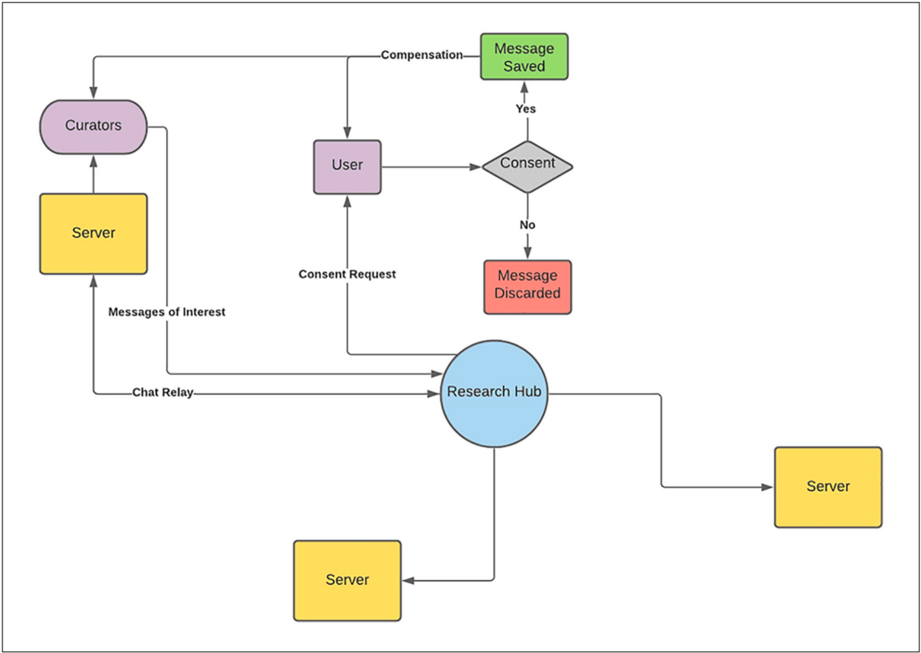
- Researchers created a bridge between SourceCred’s Discord and their own server, added a Telescope bot, and opened a MetaEth channel; anyone could tag comments, the bot requested author consent, approved comments appeared in a feed and could be exported to Govbase with metadata (timestamp, author if provided, community name, researcher context).
- Analysis was ethnographic and iterative: comments and metadata were used to develop cases and relate on-chain rules to informal governance spaces; the consent process was modified to opt-in once after community feedback.
Limitations
- Stated: it is too early to say whether the approach might impact governance; the onus remains on researchers to understand context and analyse data in relation to the broader system.
- Stated: automation can obscure governance processes (e.g., bot-generated comments could not consent), and high conversation volume, fast-moving text chat, and participant turnover made ensuring awareness difficult.
- Evident: the paper is a single case study of SourceCred, and the authors note the same systems would likely generate different outcomes in a different group and governance system; no comparative or outcome data are reported.
Model-written summary. Check it against the paper before relying on it.
Integrity signals
Registry
Cites
Statistics
Figures
Verification
Claims the paper makes
0 Valid · 18 Not valid · 13 Not checked · 69 Own results and interpretations
A result the paper states — it cites no source for it, so there is none to check. The quote shows it is in the paper.
In the paper
“Aside from ameliorating the challenges of data collection on and across platforms, these tools enabled the co-creation of datasets, illuminated issues and moments that we might otherwise have missed, and helped to turn observation into dialogue.”
plainstates a cause- Asserted: passes — The authors put it forward as true.
- Checkable: passes — It can be checked against evidence.
- Load-bearing: passes — The paper’s conclusions depend on it.
- Based: passes — The paper gives a reason why it holds.
A result the paper reports from its own data — it cites no other source for it, so there is none to check. The quote shows it is in the paper.
In the paper
“Similarly, their requests to us, such as the change to the consent process as well as suggestions that we ask more questions, are shifting our research practice.”
plainstates a cause- Asserted: passes — The authors put it forward as true.
- Checkable: passes — It can be checked against evidence.
- Load-bearing: passes — The paper’s conclusions depend on it.
- Based: passes — The paper gives a reason why it holds.
16 more claims
Create a free account to see all 100 claims and to verify the 1 reference still open.
- Probably not a substantial claim. 72
- It may state two separate claims as one. 26
Citations
Cites
The anatomy of a large-scale hypertextual Web search engine
Brin, S., & Page, L. (1998) · Computer Networks and ISDN Systems · doi:10.1016/s0169-7552(98)00110-x · Cited by 16,004 · cited 2×
“Their CredRank algorithm was adapted from Google’s PageRank algorithm (first developed by Larry Page and Sergey Brin at Stanford (Brin & Page, 1998)) which “computes “impor-tance” of nodes in a graph based on the “importance” of nodes connected to it” (Miyazono, 2020; see also Zargham, 2019, who…”
MethodEthnography in/of the World System: The Emergence of Multi-Sited Ethnography
Marcus, G. E. (1995) · Annual Review of Anthropology · doi:10.1146/annurev.an.24.100195.000523 · Cited by 8,885 · cited 1×
“As with other studies of online communities, observing governance within block-chain communities entails a shift from “intimate knowledge of face-to-face communities and groups” to looking at communities who may be networked, emergent, and changing (Burrell, 2009; Marcus, 1995).”
BackgroundFoucault, M. (1982) · Critical Inquiry · doi:10.1086/448181 · Cited by 8,496
Kooiman, J. (2003) · doi:10.4135/9781446215012 · Cited by 2,656
Ananny, M., & Crawford, K. (2018) · New Media & Society · doi:10.1177/1461444816676645 · Cited by 1,836 · cited 1×
“While the temptation is to see this purely as a problem of transparency, others look instead to the material and ideo-logical influences that may be at play in the use of algorithms (Ananny & Crawford, 2018).”
Digital Ethnography: Principles and Practice
Pink, S., Horst, H. A., Postill, J., Hjorth, L., Lewis, T., & Tacchi, J. (2015) · Cited by 1,157
Networked privacy: How teenagers negotiate context in social media
Marwick, A. E., & boyd, D. (2014) · New Media & Society · doi:10.1177/1461444814543995 · Cited by 954 · cited 1×
“For instance, ethnography has revealed how “boundary work” (Nippert-Eng, 2008) is performed by users to delineate and manage social connections, privacy, and information sharing within or despite the rules set by platforms (Marwick & boyd, 2014).”
BackgroundPolymedia: Towards a new theory of digital media in interpersonal communication
Madianou, M., & Miller, D. (2013) · International Journal of Cultural Studies · doi:10.1177/1367877912452486 · Cited by 853
Gillespie, T. (2019) · doi:10.12987/9780300235029 · Cited by 806
Governance without government: order and change in world politics
Paterson, M. (1992) · International Affairs · doi:10.2307/2622748 · Cited by 726
(2019) · doi:10.1080/1369118x.2019.1573914 · Cited by 719
Two Bits: The Cultural Significance of Free Software
(2008) · Choice Reviews Online · doi:10.5860/choice.46-2158 · Cited by 709
Multi-Sited Ethnography: Theory, Praxis and Locality in Contemporary Research
Falzon, M.-A. (2012) · Cited by 696
The Stack: On Software and Sovereignty
Bratton, B. H. (2016) · doi:10.7551/mitpress/9780262029575.001.0001 · Cited by 574
Multi-Sited Ethnography : Theory, Praxis and Locality in Contemporary Research
Falzon, M. (2009) · doi:10.4324/9781315596389 · Cited by 512
Galloway, A. (2012) · doi:10.5860/choice.50-4259 · Cited by 449
Decentralized autonomous organization
Hassan, S., & De Filippi, P. (2021) · Internet Policy Review · doi:10.14763/2021.2.1556 · Cited by 383
The Field Site as a Network: A Strategy for Locating Ethnographic Research
Burrell, J. (2009) · Field Methods · doi:10.1177/1525822x08329699 · Cited by 334
Girard, R. (1976) · Johns Hopkins University Press eBooks · doi:10.56021/9780801802201 · Cited by 329
Human-Machine Collaboration for Content Regulation: The Case of Reddit Automoderator
Jhaver, S., Birman, I., Gilbert, E., & Bruckman, A. (2019) · ACM Transactions on Computer-Human Interaction · doi:10.1145/3338243 · Cited by 289
Lawless: The Secret Rules That Govern Our Digital Lives
Suzor, N. P. (2019) · doi:10.1017/9781108666428 · Cited by 236
Trust, but Verify: Why the Blockchain Needs the Law
Werbach, K. (2018) · Berkeley Technology Law Journal · doi:10.15779/z38h41jm9n · Cited by 235
Andrejevic, M. (2019) · doi:10.4324/9780429242595 · Cited by 217
Home and Work: Negotiating Boundaries Through Everyday Life.
Copp, M., & Nippert-Eng, C. E. (1997) · Social Forces · doi:10.1093/sf/75.4.1482 · Cited by 201
Home and Work: Negotiating Boundaries Through Everyday Life.
Copp, M., & Nippert-Eng, C. E. (1997) · Social Forces · doi:10.2307/2580689 · Cited by 195
Suzor, N. (2018) · Social Media + Society · doi:10.1177/2056305118787812 · Cited by 171
Ethnography for the Internet: Embedded, Embodied and Everyday
Hine, C. (2020) · Routledge eBooks · doi:10.4324/9781003085348 · Cited by 158
Seaver, N. (2019) · Princeton University Press eBooks · doi:10.2307/j.ctvc77mp9.30 · Cited by 152
Technologies of Speculation: The Limits of Knowledge in a Data-Driven Society
Hong, S.-H. (2020) · doi:10.18574/nyu/9781479860234.001.0001 · Cited by 96
Colebatch, H. K. (2014) · Policy and Society · doi:10.1016/j.polsoc.2014.10.001 · Cited by 77 · cited 1×
“They are also governed in the organizational governance sense—“a sort of constitutional law of the firm” (Colebatch, 2014, p. 309)—entailing rules, standards, and policies.”
BackgroundChantal Mouffe: Hegemony, Radical Democracy and the Political
Inston, K. (2018) · The European Legacy · doi:10.1080/10848770.2018.1559562 · Cited by 52
Tacchi, J. (2015) · The SAGE Handbook of Action Research · doi:10.4135/9781473921290.n22 · Cited by 31
Burgess, J., Angus, D. J., Carah, N., Andrejevic, M., Hawker, K., Lewis, K., Obeid, A. K., Smith, A., Tan, J., Fordyce, R., et al. (2021) · SocArXiv (OSF Preprints) · doi:10.31235/osf.io/2cwsu · Cited by 23
Self-citationUsers as Co-Designers of Software-Based Media: The Co-Construction of Internet Relay Chat
Latzko-Toth, G. (2014) · Canadian Journal of Communication · doi:10.22230/cjc.2014v39n4a2783 · Cited by 15 · cited 1×
“Others have examined how users can shape platforms through the creation of roles with specific governance functions (Gillespie, 2018) or by deploying bespoke, externally created bots to enforce rules, manage spam, or monitor conversations on some platforms (Latzko-Toth, 2014).”
Background(2018) · Jugend Medien Schutz-Report · doi:10.5771/0170-5067-2018-newsletter-1-n1 · Cited by 1
Falzon, J. (n.d.) · Bank Performance, Risk and Securitisation · doi:10.1057/9781137332097.0005
Seaver, N. (2019) · digitalSTS · doi:10.1515/9780691190600-028
Research works printed but not linked: 4
- Baguley, J. (2019). Gates and channels: An ANT-oriented approach to understanding fan community behavior and identity on a Discord chat server. Thesis submitted in fulfilment of the degree of Bachelor of Arts (Media & Communications) (Honours).
- Daian P., 2019, ArXiv
- Kozinets, R. (2020) Netnography The Essential Guide to Qualitative Social Media Research, 3rd Edition. Sage Publications.
- Mané D. (2020). SourceCred: A social algorithm. Sustain Web3 conference. https://www.youtube.com/watch?v=yVTqRLekRl4&t=1s
Cited by
Calzada, I. (2022) · Smart Cities · doi:10.3390/smartcities5030057 · Cited by 203
Disruptive Technologies for e-Diasporas: Blockchain, DAOs, Data Cooperatives, Metaverse, and ChatGPT
Calzada, I. (2023) · Futures · doi:10.1016/j.futures.2023.103258 · Cited by 71
“…systems in peer-to-peer interactions, with a particular focus on blockchain (Tapscott & Tapscott, 2016; Zook, 2023), DAOs (Buterin, 2022; Mathew, 2016; Monsees, 2019; Rennie et al., 2022; Rodima-Taylor & Grimes, 2019), and data cooperatives (Bühler et al., 2023a; Spelliscy et al., 2023).”
BackgroundWhy airdrop cryptocurrency tokens?
Allen, D. W. E., Berg, C., & Lane, A. M. (2023) · Journal of Business Research · doi:10.1016/j.jbusres.2023.113945 · Cited by 77
Blockchain-driven digital nomadism in the Basque e-Diaspora
Calzada, I. (2023) · Globalizations · doi:10.1080/14747731.2023.2271216 · Cited by 32
“…perspectives, resulting in an emerging body of literature on decentralized systems in peer-to-peer interactions involving blockchain, DAOs, and data co-operatives (Bauwens et al., 2019; Buterin, 2022; Calzada, 2020; Mathew, 2016; Monsees, 2019; Rennie et al., 2022; Rodima-Taylor & Grimes, 2019).”
Calzada, I. (2024) · Big Data and Cognitive Computing · doi:10.3390/bdcc8030026 · Cited by 31
“This reaction has led to the development of an emerging body of literature on decentralized systems in peer-to-peer interactions [74], encompassing (i) blockchain [15,56], (ii) DAOs [28,29,31,74,85,86], and (iii) data cooperatives [13,20,34,35,37,56,73,87–91].”
Background
Metadata
- Authors
- Rennie, E., Zargham, M., Tan, J., Miller, L., Abbott, J., Nabben, K., & De Filippi, P.
- Affiliations
- RMIT University (AU)
- Vienna University of Economics and Business (AT)
- University of Oxford (GB)
- Metagov, Brookline, USA
- National Centre of Scientific Research, Paris, Île-de-France, France
- Corresponding author
- Rennie, Ellie
- Venue
- Qualitative Inquiry
- Publisher
- SAGE Publications
- Published
- 2022-06-05
- Volume
- 28
- Issue
- 7
- Pages
- 837-847
- ISSN
- 1077-8004 (ISSN-L)
- 1552-7565
- OpenAlex
- W4281854821
- Semantic Scholar
- d658bcdd0a530c50f5a779d1edfe9d187865ae47
- Cited by
- 34
- References
- 26
- Citations by year
- 2026: 1 · 2025: 16 · 2024: 9 · 2023: 7 · 2022: 1
- FWCI
- 5.75
- Type
- journal article
- Language
- en
- Open access
- green
- hal.science
- Licence
- Locations
- Qualitative Inquiry (publishedVersion)
- HAL (submittedVersion, other-oa)
- RePEc: Research Papers in Economics (submittedVersion)
- RMIT Research Repository (RMIT University Library) (submittedVersion)
- Figshare (submittedVersion)
- Funders
- Australian Research Council (FT190100372)
- Topics
- Physical Sciences › Computer Science › Information Systems › Blockchain Technology Applications and Security
- Social Sciences › Sociology and Political Science › Focus Groups and Qualitative Methods
- Social Sciences › General Social Sciences › Computational and Text Analysis Methods
- Keywords
- blockchain governance, Discord bot, online forums, decentralized communities, reputation systems, smart contracts, voting, open source software governance
About these checks
Registry, retraction, Cites and statistics results are computed, not judged, with one exception: a printed reference that no index lists is read once by a model before it counts as a citation error. Claims are extracted by a model and kept only when their quote appears verbatim in the text; each cited source is then checked, with a model’s help, for whether it says what the claim relies on. Those verdicts can be wrong — read the claim’s quote and the cited source before relying on one.
A language model drew the claims from the paper on 2026-10-10, under version 3 of the claim definition (model deepseek-v4.1-flash, prompt extract-v3).
A second model labelled each claim on 2026-10-10 (model jev-1.13-20260917, definition revision gold-guideline-v0.2).
Statistics and arithmetic are recomputed, not judged.
Confidence bands are shown only for fields calibrated on our annotated test set. None is calibrated yet, so no band is shown.
What counts as a claim ›How we measure confidence ›How we check this ›
Are you an author, or do you see a problem with this page? Request a review
Data sources
Bibliographic data: Semantic Scholar, OpenAlex, Crossref.
Contains information from the Semantic Scholar Academic Graph Datasets, made available under the ODC Attribution License (ODC-BY 1.0).
Semantic Scholar’s data is described in: Kinney, R., et al. (2023). The Semantic Scholar Open Data Platform. arXiv:2301.10140.
