

Validation of the Mind Excessively Wandering Scale and the Relationship of Mind Wandering to Impairment in Adult ADHD
Open accessThe DOI matches its Crossref record; 33 of the 33 references it cites were found in a registry or an index.
Abstract
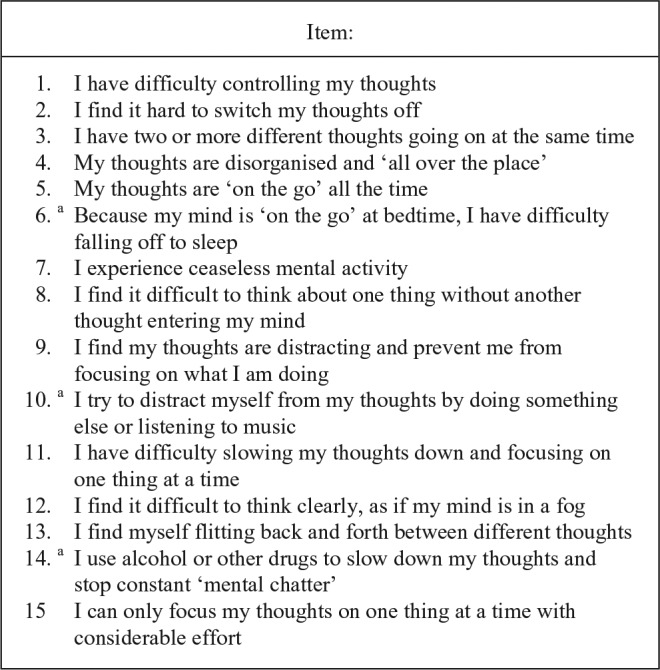
Objective: This study investigates excessive mind wandering (MW) in adult ADHD using a new scale: the Mind Excessively Wandering Scale (MEWS). Method: Data from two studies of adult ADHD was used in assessing the psychometric properties of the MEWS. Case-control differences in MW, the association with ADHD symptoms, and the contribution to functional impairment were investigated. Results: The MEWS functioned well as a brief measure of excessive MW in adult ADHD, showing good internal consistency (α > .9), and high sensitivity (.9) and specificity (.9) for the ADHD diagnosis, comparable with that of existing ADHD symptom rating scales. Elevated levels of MW were found in adults with ADHD, which contributed to impairment independently of core ADHD symptom dimensions. Conclusion: Findings suggest excessive MW is a common co-occurring feature of adult ADHD that has specific implications for the functional impairments experienced. The MEWS has potential utility as a screening tool in clinical practice to assist diagnostic assessment.
Overview
The claims and statistics of this paper haven’t been checked yet.
Free: it reads the open-access text and checks the first 5 claims that cite a source we can check. Create a free account to check every claim.
Integrity signals
Registry
Cites
Statistics
Figures
Verification
Claims the paper makes
The claims and statistics of this paper haven’t been checked yet.
Free: it reads the open-access text and checks the first 5 claims that cite a source we can check. Create a free account to check every claim.
Claims other papers make about this one
Each is checked against this paper’s own text: does it say what the citing paper says it does?
The cited source doesn’t support the claim as written.
In the citing paper
“Increased mind wandering is negatively correlated with ADHD symptom severity8,9.”
From Effects of l-theanine–caffeine combination on sustained attention and inhibitory control among children with ADHD: a proof-of-concept neuroimaging RCT (2020) · cites this paper as [9]
Checked by a reasoning model — may be wrong.
Experimental — accuracy not yet measuredThe source backs part of the claim, not all of it — or backs it for a different population, condition or comparison.
In the citing paper
“Impaired sustained attention and inhibitory control in patients with ADHD is associated with increased task-associated mind wandering8–12.”
From Effects of l-theanine–caffeine combination on sustained attention and inhibitory control among children with ADHD: a proof-of-concept neuroimaging RCT (2020) · cites this paper as [9]
Experimental — accuracy not yet measured
Self-check
Percentages, sums and reported differences re-computed from the paper’s own numbers.
The self-check needs the paper’s full text.
Citations
Cites
Diagnostic and Statistical Manual of Mental Disorders
American Psychiatric Association (2013) · doi:10.1176/appi.books.9780890425596 · Cited by 116,369
A wandering mind is an unhappy mind
Killingsworth, M. A., & Gilbert, D. T. (2010) · Science · doi:10.1126/science.1192439 · Cited by 2,575 · cited 2×
“…human experience; individuals in the general population are estimated to spend between 24% and 50% of their waking hours engaging in self-generated thoughts unrelated to their external environment (Kane et al., 2007; Killingsworth & Gilbert, 2010; Smallwood & Schooler, 2015; Song & Wang, 2012).”
BackgroundChristoff, K., Gordon, A. M., Smallwood, J., Smith, R., & Schooler, J. W. (2009) · Proceedings of the National Academy of Sciences · doi:10.1073/pnas.0900234106 · Cited by 1,769 · cited 1×
“…rating scales, as reported here, as well as experience sampling during daily life (Killingsworth & Gilbert, 2010), or during sustained attention tasks (Shaw & Giambra, 1993) and neuroimaging studies (Baird, Smallwood, Lutz, & Schooler, 2014; Christoff, Gordon, Smallwood, Smith, & Schooler, 2009).”
BackgroundThe Science of Mind Wandering: Empirically Navigating the Stream of Consciousness
Smallwood, J., & Schooler, J. W. (2015) · Annual Review of Psychology · doi:10.1146/annurev-psych-010814-015331 · Cited by 1,685 · cited 4×
“…human experience; individuals in the general population are estimated to spend between 24% and 50% of their waking hours engaging in self-generated thoughts unrelated to their external environment (Kane et al., 2007; Killingsworth & Gilbert, 2010; Smallwood & Schooler, 2015; Song & Wang, 2012).”
BackgroundInfluentialCross-national prevalence and correlates of adult attention-deficit hyperactivity disorder
Fayyad, J., De Graaf, R., Kessler, R., Alonso, J., Angermeyer, M., Demyttenaere, K., De Girolamo, G., Haro, J. M., Karam, E. G., Lara, C., et al. (2007) · British Journal of Psychiatry · doi:10.1192/bjp.bp.106.034389 · Cited by 1,321 · cited 1×
“For these analyses, we fixed the z value threshold for affection status corresponding to 3.4% prevalence of ADHD in adults (Fayyad et al., 2007).”
MethodInfluentialMaximum Likelihood Estimation of the Polychoric Correlation Coefficient
Olsson, U. (1979) · Psychometrika · doi:10.1007/bf02296207 · Cited by 1,127 · cited 1×
“Convergent validity of the MEWS in relation to ADHD symptom scales was assessed using polyserial correlations to provide unbiased estimates of cross-variable correlations in case-control samples (Olsson, 1979).”
MethodKane, M. J., Brown, L. H., McVay, J. C., Silvia, P. J., Myin-Germeys, I., & Kwapil, T. R. (2007) · Psychological Science · doi:10.1111/j.1467-9280.2007.01948.x · Cited by 979
Fox, K. C. R., Spreng, R. N., Ellamil, M., Andrews-Hanna, J. R., & Christoff, K. (2015) · NeuroImage · doi:10.1016/j.neuroimage.2015.02.039 · Cited by 690
Reaction time variability in ADHD: A meta-analytic review of 319 studies
Kofler, M. J., Rapport, M. D., Sarver, D. E., Raiker, J. S., Orban, S. A., Friedman, L. M., & Kolomeyer, E. G. (2013) · Clinical Psychology Review · doi:10.1016/j.cpr.2013.06.001 · Cited by 648 · cited 3×
“It will also be advantageous to see how it relates to various cognitive measures such as omission and commission errors (Losier, McGrath, & Klein, 1996), and RTV (Kofler et al., 2013), which may reveal further information about the underlying neurobiology of ADHD.”
BackgroundInfluentialKorolczuk, I., Burle, B., Coull, J. T., & Śmigasiewicz, K. (2021) · Journal of Cognitive Neuroscience · doi:10.1162/jocn_a_01795 · Cited by 528
Research works printed but not linked: 2
- Barkley R. A. (1998). A clinical workbook: Attention-deficit hyperactivity disorder. New York, NY: Guilford Press.
- Conners C. K. Erhardt D. Sparrow E. (1999). Conner’s Adult ADHD Rating Scales: Technical Manual. Toronto, Ontario, Canada: Multi-Health Systems.
Cited by
Updated European Consensus Statement on diagnosis and treatment of adult ADHD
Kooij, J. J. S., Bijlenga, D., Salerno, L., Jaeschke, R., Bitter, I., Balázs, J., Thome, J., Dom, G., Kasper, S., Nunes Filipe, C., et al. (2019) · European Psychiatry · doi:10.1016/j.eurpsy.2018.11.001 · Cited by 686
“In ADHD it can be measured using the Mind Excessively Wandering Scale [116,118,120] (Table 1).”
BackgroundMethodSelf-citationAdult attention-deficit hyperactivity disorder: key conceptual issues
Asherson, P., Buitelaar, J., Faraone, S. V., & Rohde, L. A. (2016) · The Lancet Psychiatry · doi:10.1016/s2215-0366(16)30032-3 · Cited by 347
Self-citationMind wandering perspective on attention-deficit/hyperactivity disorder
Bozhilova, N. S., Michelini, G., Kuntsi, J., & Asherson, P. (2018) · Neuroscience & Biobehavioral Reviews · doi:10.1016/j.neubiorev.2018.07.010 · Cited by 182
Self-citationRubia, K., Criaud, M., Wulff, M., Alegria, A., Brinson, H., Barker, G., Stahl, D., & Giampietro, V. (2019) · NeuroImage · doi:10.1016/j.neuroimage.2018.11.055 · Cited by 111
“…poor deactivation of the DMN during cognitive task performance based on fMRI studies is in line with behavioural studies showing abnormally increased mind-wandering in ADHD patients as shown in self-ratings on mind-wandering scales (Biederman et al., 2017; Mowlem et al., 2016; Seli et al., 2015).”
Increasing participant motivation reduces rates of intentional and unintentional mind wandering
Seli, P., Schacter, D. L., Risko, E. F., & Smilek, D. (2019) · Psychological Research · doi:10.1007/s00426-017-0914-2 · Cited by 80
Metadata
- Authors
- Mowlem, F. D., Skirrow, C., Reid, P., Maltezos, S., Nijjar, S. K., Merwood, A., Barker, E., Cooper, R., Kuntsi, J., & Asherson, P.
- Affiliations
- King's College London (GB)
- Corresponding author
- Asherson, Philip
- ORCID
- Venue
- Journal of Attention Disorders
- Publisher
- SAGE Publications
- Published
- 2016-06-02
- Volume
- 23
- Issue
- 6
- Pages
- 624-634
- ISSN
- 1087-0547 (ISSN-L)
- 1557-1246
- PMC
- PMC6429624
- OpenAlex
- W2415390687
- Cited by
- 156
- References
- 32
- Citations by year
- 2026: 20 · 2025: 15 · 2024: 21 · 2023: 24 · 2022: 26 · 2021: 10 · 2020: 18 · 2019: 6 · 2018: 9 · 2017: 5 · 2016: 2
- FWCI
- 6.52
- Type
- journal article
- Language
- en
- Open access
- hybrid
- doi.org
- Licence
- cc-by
- journals.sagepub.com/page/policies/text-and-data-mining-license (tdm)
- Locations
- Journal of Attention Disorders (publishedVersion, cc-by)
- Europe PMC (PubMed Central) (publishedVersion, cc-by)
- PubMed Central (publishedVersion, cc-by)
- PubMed (publishedVersion)
- Explore Bristol Research (publishedVersion, other-oa)
- Greenwich Academic Literature Archive (University of Greenwich) (acceptedVersion)
- UCL Discovery (University College London) (submittedVersion)
- Research Portal (King's College London) (submittedVersion, cc-by)
- Funders
- Vifor Pharma (PADWUDB)
- National Institute for Health Research (RCPG0308-10245)
- Topics
- Health Sciences › Medicine › Psychiatry and Mental health › Attention Deficit Hyperactivity Disorder
- Life Sciences › Neuroscience › Cognitive Neuroscience › Mind wandering and attention
- Social Sciences › Psychology › Experimental and Cognitive Psychology › Anxiety, Depression, Psychometrics, Treatment, Cognitive Processes
- Keywords
- mind wandering, adult ADHD, scale validation, functional disability, ADHD screening, psychometric properties
- MeSH terms
- Adult, Attention, Attention Deficit Disorder with Hyperactivity, Female, Humans, Male, Memory, Short-Term, Case-Control Studies, Wandering Behavior, Executive Function, Mindfulness
About these checks
Registry, retraction, Cites and statistics results are computed, not judged, with one exception: a printed reference that no index lists is read once by a model before it counts as a citation error. Claims are extracted by a model and kept only when their quote appears verbatim in the text; each cited source is then checked, with a model’s help, for whether it says what the claim relies on. Those verdicts can be wrong — read the claim’s quote and the cited source before relying on one.
Statistics and arithmetic are recomputed, not judged.
Confidence bands are shown only for fields calibrated on our annotated test set. None is calibrated yet, so no band is shown.
What counts as a claim ›How we measure confidence ›How we check this ›
Are you an author, or do you see a problem with this page? Request a review
Data sources
Bibliographic data: Semantic Scholar, OpenAlex, Crossref.
Contains information from the Semantic Scholar Academic Graph Datasets, made available under the ODC Attribution License (ODC-BY 1.0).
Semantic Scholar’s data is described in: Kinney, R., et al. (2023). The Semantic Scholar Open Data Platform. arXiv:2301.10140.
