

Pre-test Cortisol Levels in Predicting Short Synacthen Test Outcome: A Retrospective Analysis
Open accessThe DOI matches its Crossref record; 22 of the 22 references it cites were found in a registry or an index.
Abstract
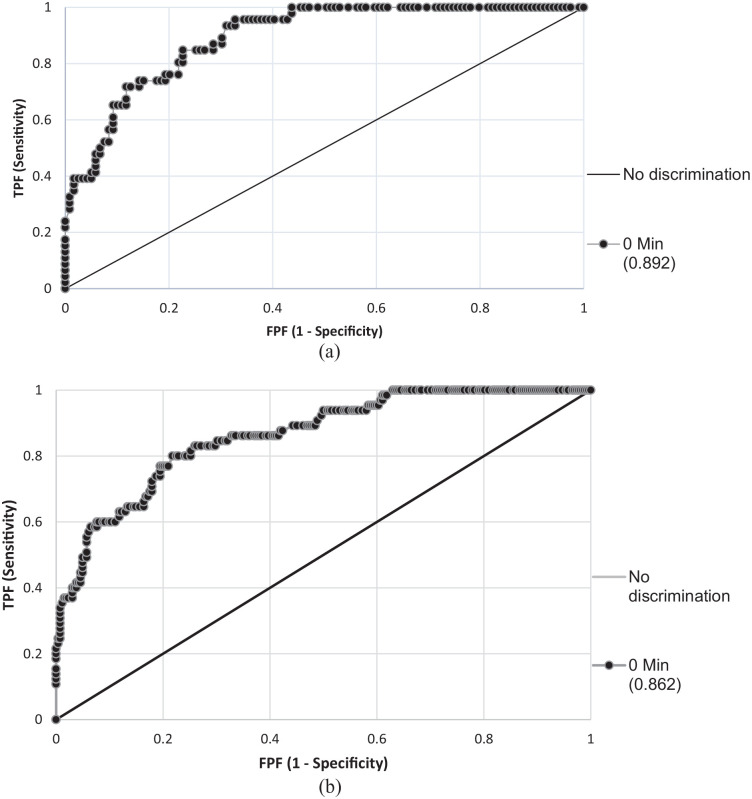
Objective: Short Synacthen tests (SSTs) are expensive, dependent on Synacthen availability, and need supervision. To reduce SST testing, we examined the utility of pre-test cortisol (Cort0) and related parameters in predicting outcome. Design and Measurements: We retrospectively examined the following in all SSTs; (i) Cort0 (ii) indications (iii) and time and place of testing. Receiver operated characteristic (ROC) curves were devised for Cort0 to obtain the best cut-off for outcome prediction in those who had SSTs between 8 and 10 am (Group 1) and at other times (Group 2). Results: Of 506 SSTs, 13 were unsuitable for analysis. 111/493 SSTs (22.5%) were abnormal. (1) ROC curves predicted – (a) SST failure with 100% specificity when Cort0 was ⩽124 nmol/L (Group 1), or ⩽47 (Group 2); (b) a normal SST with 100% sensitivity when Cort0 ⩾314 nmol/L (Group 1) and ⩾323 nmol/L (Group 2). (2) There was significant correlation between Cort0 and 30-minute cortisol ( r s = 0.65-0.78, P < .001). (3) Median Cort0 was lower in those who failed SSTs compared to those who passed (147 vs 298 nmol/L respectively, P < .001). (4) SST failure was commoner in Group 1 vs 2 ( P = .001). (5) There was no difference in outcome between out-patient and inpatient SSTs. (6) SST failure was most common for ‘steroid related’ indications (39.6%, P < .001). Conclusions: This study indicates that (1) Cort0 ⩾ 323 (Group1) and ⩾314 nmol/L (Group 2) predicted a normal SST with 100% sensitivity; (2) Using these cut offs 141/493 (28.6%) tests may have been avoided; (3) supporting evidence should be considered in those with a lower pre-test predictability of failure.
Overview
The claims and statistics of this paper haven’t been checked yet.
Free: it reads the open-access text and checks the first 5 claims that cite a source we can check. Create a free account to check every claim.
Integrity signals
Registry
Cites
Statistics
Figures
Verification
Claims the paper makes
The claims and statistics of this paper haven’t been checked yet.
Free: it reads the open-access text and checks the first 5 claims that cite a source we can check. Create a free account to check every claim.
Claims other papers make about this one
Each is checked against this paper’s own text: does it say what the citing paper says it does?
The source backs part of the claim, not all of it — or backs it for a different population, condition or comparison.
In the citing paper
“cortisol at baseline ≤ 4.49 μg/dL (124 nmol/L) predicts the failure to reach the peak at the test in 100% of the patients, while a cortisol ≥ 11.38 μg/dL (314 nmol/L) predicts a successful response.”
From ACTH Stimulation Test for the Diagnosis of Secondary Adrenal Insufficiency: Light and Shadow (2023) · cites this paper as [13]
Experimental — accuracy not yet measuredThe source backs part of the claim, not all of it — or backs it for a different population, condition or comparison.
In the citing paper
“In this study, an immunoassay using monoclonal antibodies was used to detect the cortisol levels, and the local laboratory established as a cutoff for the ACTH test failure a cortisol value ≤ 16.3 μg/dL (450 nmol/L) at 30 min after the injection of the corticotropin analog.”
From ACTH Stimulation Test for the Diagnosis of Secondary Adrenal Insufficiency: Light and Shadow (2023) · cites this paper as [13]
Experimental — accuracy not yet measuredThe check wasn’t confident either way, so it gives no verdict — never disputed.
In the citing paper
“Available techniques for measuring serum cortisol listed from least to most accurate methods are immunoassays using polyclonal antibodies, immunoassays using more specific monoclonal antibody to cortisol, and liquid chromatography-tandem mass spectrometry (57, 94, 95).”
From European Society of Endocrinology and Endocrine Society Joint Clinical Guideline: Diagnosis and Therapy of Glucocorticoid-induced Adrenal Insufficiency (2024) · cites this paper as [95]
Experimental — accuracy not yet measuredIn the citing paper
“cortisol at baseline ≤ 4.49 μg/dL (124 nmol/L) predicts the failure to reach the peak at the test in 100% of the patients, while a cortisol ≥ 11.38 μg/dL (314 nmol/L) predicts a successful response.”
From ACTH Stimulation Test for the Diagnosis of Secondary Adrenal Insufficiency: Light and Shadow (2023) · cites this paper as [13]
In the citing paper
“According to the results of this study, if the cortisol evaluation is made with immunoassays using monoclonal antibodies, the grey range of 2016 guidelines potentially tighten even more allowing to identify of a narrower population to test [13].”
From ACTH Stimulation Test for the Diagnosis of Secondary Adrenal Insufficiency: Light and Shadow (2023) · cites this paper as [13]
1 more claim about this paper
Create a free account to see every claim other papers make about this one.
Self-check
Percentages, sums and reported differences re-computed from the paper’s own numbers.
The self-check needs the paper’s full text.
Citations
Cites
Bornstein, S. R., Allolio, B., Arlt, W., Barthel, A., Don-Wauchope, A., Hammer, G. D., Husebye, E. S., Merke, D. P., Murad, M. H., Stratakis, C. A., et al. (2016) · The Journal of Clinical Endocrinology & Metabolism · doi:10.1210/jc.2015-1710 · Cited by 1,769 · cited 1×
“17 We acknowledge that this strategy may result in between 7% and12% false positive results (which normalise in the 60 minute post Synacthen sample in the 60 minute SST) but have done so in line with local practice and pragmatic reasons.”
Corticotropin tests for hypothalamic-pituitary- adrenal insufficiency: a metaanalysis
Kazlauskaite, R., Evans, A. T., Villabona, C. V., Abdu, T. A. M., Ambrosi, B., Atkinson, A. B., Choi, C. H., Clayton, R. N., Courtney, C. H., Gonc, E. N., et al. (2008) · The Journal of Clinical Endocrinology & Metabolism · doi:10.1210/jc.2008-0710 · Cited by 385
Woods, C. P., Argese, N., Chapman, M., Boot, C., Webster, R., Dabhi, V., Grossman, A. B., Toogood, A. A., Arlt, W., Stewart, P. M., et al. (2015) · European Journal of Endocrinology · doi:10.1530/eje-15-0608 · Cited by 152
Hurel, S. J., Thompson, C. J., Watson, M. J., Harris, M. M., Baylis, P. H., & Kendall‐Taylor, P. (1996) · Clinical Endocrinology · doi:10.1046/j.1365-2265.1996.555381.x · Cited by 138 · cited 5×
“ity; (2) Using these cut offs 141/493 (28.”
BackgroundMethodInfluentialAdrenocorticotropic Effects of a Synthetic Polypeptide—β1–24-Corticotropin—in Man
LANDON, J., JAMES, V. H. T., CRYER, R. J., WYNN, V., & FRANKLAND, A. W. (1964) · The Journal of Clinical Endocrinology & Metabolism · doi:10.1210/jcem-24-11-1206 · Cited by 100 · cited 1×
“We used the 30-minute cortisol cut off as it is validated against the insulin tolerance test, 2,16 although the Endocrine Society accepts both 30 and 60-minute post Synacthen samples as valid.”
Sbardella, E., Isidori, A. M., Woods, C. P., Argese, N., Tomlinson, J. W., Shine, B., Jafar‐Mohammadi, B., & Grossman, A. B. (2017) · Clinical Endocrinology · doi:10.1111/cen.13232 · Cited by 89
The Value of Dehydroepiandrosterone Sulfate Measurements in the Assessment of Adrenal Function
Nasrallah, M. P., & Arafah, B. M. (2003) · The Journal of Clinical Endocrinology & Metabolism · doi:10.1210/jc.2003-030449 · Cited by 87 · cited 1×
“While most studies report no influence of the timing of testing on SST outcome, 3,19,20 1 study reported a higher failure rate in the afternoon.”
Technical details influence the diagnostic accuracy of the 1 μg ACTH stimulation test
Wade, M., Baid, S., Calis, K., Raff, H., Sinaii, N., & Nieman, L. (2010) · European Journal of Endocrinology · doi:10.1530/eje-09-0746 · Cited by 83 · cited 1×
“21 We cannot explain why our study is different, although 2 factors may be pertinent – (a) the proportion of patients with ‘steroid related’ indications (who had a higher failure rate) is not a plausible explanation as this was similar in Group 1 and Group 2 (P = .094); (ii) higher cortisol levels…”
Is a 0900-h serum cortisol useful prior to a short Synacthen test in outpatient assessment?
le Roux, C., Meeran, K., & Alaghband-Zadeh, J. (2002) · Annals of Clinical Biochemistry: International Journal of Laboratory Medicine · doi:10.1258/0004563021901919 · Cited by 77
The short cosyntropin test revisited: new normal reference range using LC-MS/MS
Ueland, G. Å., Methlie, P., Øksnes, M., Thordarson, H. B., Sagen, J., Kellmann, R., Mellgren, G., Ræder, M., Dahlqvist, P., Dahl, S. R., et al. (2018) · The Journal of Clinical Endocrinology & Metabolism · doi:10.1210/jc.2017-02602 · Cited by 71 · cited 1×
“While most studies report no influence of the timing of testing on SST outcome, 3,19,20 1 study reported a higher failure rate in the afternoon.”
Struja, T., Briner, L., Meier, A., Kutz, A., Mundwiler, E., Huber, A., Müeller, B., Bernasconi, L., & Schüetz, P. (2017) · Endocrine Practice · doi:10.4158/ep171861.or · Cited by 54
Yo, W. S., Toh, L., Brown, S. J., Howe, W. D., Henley, D. E., & Lim, E. M. (2014) · Clinical Endocrinology · doi:10.1111/cen.12373 · Cited by 47 · cited 1×
“(5) There was no difference in outcome between out-patient and inpatient”
BackgroundCho, H. Y., Kim, J. H., Kim, S. W., Shin, C. S., Park, K. S., Kim, S. W., Jang, H., & Kim, S. Y. (2014) · Clinical Endocrinology · doi:10.1111/cen.12397 · Cited by 46
The Role of Morning Basal Serum Cortisol in Assessment of Hypothalamic Pituitary-Adrenal Axis
Yip, C.-E., Stewart, S. A., Imran, F., Clarke, D. B., Mokashi, A. S., Kaiser, S., & Imran, S. A. (2013) · Clinical and investigative medicine · doi:10.25011/cim.v36i4.19955 · Cited by 37
Butt, M. I., Alzuhayri, N., Amer, L. G., Riazuddin, M., Aljamei, H. S., Khan, M. S., Abufarhaneh, M., Alrajhi, E., Alnassar, A., AlAhmed, R. S., et al. (2020) · Medicine · doi:10.1097/md.0000000000022621 · Cited by 24 · cited 1×
“18 Cortisol Assay: During the period under study, serum cortisol was assayed using a single assay, the Architect Assay (Abbott Diagnostics, North Illinois, Chicago, USA).”
Kumar, R., Carr, P., & Wassif, W. (2022) · Postgraduate Medical Journal · doi:10.1136/postgradmedj-2020-138514 · Cited by 23
Mackenzie, S. D., Gifford, R. M., Boyle, L. D., Crane, M. S., Strachan, M. W. J., & Gibb, F. W. (2019) · Clinical Endocrinology · doi:10.1111/cen.14071 · Cited by 22
Munro, V., Elnenaei, M., Doucette, S., Clarke, D. B., & Imran, S. A. (2018) · Clinical Biochemistry · doi:10.1016/j.clinbiochem.2018.02.010 · Cited by 20 · cited 3×
“(3) Gender and median cortisol values – There was no difference in median Cort0 between males and females”
BackgroundInfluentialCan a random serum cortisol reduce the need for short synacthen tests in acute medical admissions?
Kadiyala, R. U., Kamath, C., Baglioni, P., Geen, J., & Okosieme, O. E. (2010) · Annals of Clinical Biochemistry International Journal of Laboratory Medicine · doi:10.1258/acb.2010.010008 · Cited by 19
Brown, S. J., Hadlow, N. C., Badshah, I., & Henley, D. (2017) · Clinical Endocrinology · doi:10.1111/cen.13405 · Cited by 17
Spot and Morning Cortisol in Comparison to Low Dose Short Synacthen® Test
Cheung, K. K.-T., So, W., Ronald, C. W., Kong, A. P. S., & Chow, F. C. (2015) · Journal of the ASEAN Federation of Endocrine Societies · doi:10.15605/jafes.030.02.10 · Cited by 2
Aji, A., Colyer, S., Burn, S., Dimitri, P., Wright, N. P., Krone, N. P., & Elder, C. J. (2018) · Endocrine Abstracts · doi:10.1530/endoabs.58.oc2.2 · Cited by 2
Research works printed but not linked: 1
- Wong C Moran C. Short synacthen test requests may be reduced by considering test indication and identifying a 9am cortisol value that predicts test result. Endocr Abst. 2017;50 P013. doi: 10.1530/endoabs.50.P013z · doi:10.1530/endoabs.50.p013z
Cited by
Beuschlein, F., Else, T., Bancos, I., Hahner, S., Hamidi, O., van Hulsteijn, L., Husebye, E. S., Karavitaki, N., Prete, A., Vaidya, A., et al. (2024) · The Journal of Clinical Endocrinology & Metabolism · doi:10.1210/clinem/dgae250 · Cited by 172
Beuschlein, F., Else, T., Bancos, I., Hahner, S., Hamidi, O., van Hulsteijn, L. T., Husebye, E. S., Karavitaki, N., Prete, A., Vaidya, A., et al. (2024) · European Journal of Endocrinology · doi:10.1093/ejendo/lvae029 · Cited by 157
ACTH Stimulation Test for the Diagnosis of Secondary Adrenal Insufficiency: Light and Shadow
Birtolo, M. F., Antonini, S., Saladino, A., Zampetti, B., Lavezzi, E., Chiodini, I., Mazziotti, G., Lania, A. G. A., & Cozzi, R. (2023) · Biomedicines · doi:10.3390/biomedicines11030904 · Cited by 19
“According to the results of this study, if the cortisol evaluation is made with immunoassays using monoclonal antibodies, the grey range of 2016 guidelines potentially tighten even more allowing to identify of a narrower population to test [13].”
ResultBirtolo, M. F., Giannini, E., Antonini, S., Lavezzi, E., Lasio, G. B., Rin, G. D., Mazziotti, G., & Lania, A. G. (2024) · Pituitary · doi:10.1007/s11102-023-01368-7 · Cited by 6
“Ravindran et al. suggested a higher basal cutoff, ≥ 11.38 µg/dL (314 nmol/L), during the ACTH test for the prediction of a normal HPA axis [38].”
InfluentialSheikh‐Ahmad, M., Rosenblat, I., Salameh, S., Dakwar, B., Shalata, A., Yosefia, S., Rabani, H., Jovanovic, K., & Saiegh, L. (2026) · BMC Endocrine Disorders · doi:10.1186/s12902-026-02170-9 · Cited by 2
“…normal SST. Additionally, in a cohort of 165 patients referred for diverse endocrine indications, and evaluated using Cort30 threshold of 16.3 µg/dL (450 nmol/L) to define an adequate response, an MSC threshold of 11.4 µg/dL (315 nmol/L) demonstrated 100% specificity for predicting normal SST [11].”
Influential
Metadata
- Authors
- Ravindran, R., Carter, J. L., Kumar, A., Capatana, F., Khan, I. N., Adlan, M. A., & Premawardhana, L. D.
- Affiliations
- Ysbyty Ystrad Fawr (GB)
- Corresponding author
- Ravindran, Ravikumar
- Venue
- Clinical Medicine Insights Endocrinology and Diabetes
- Publisher
- SAGE Publications
- Published
- 2022-01
- Volume
- 15
- Pages
- 11795514221093316-11795514221093316
- ISSN
- 1178-1173 (ISSN-L)
- 1179-5514
- PMC
- PMC9087228
- OpenAlex
- W4285245211
- Cited by
- 17
- References
- 22
- Citations by year
- 2026: 4 · 2025: 8 · 2024: 4 · 2023: 1
- FWCI
- 2.41
- Type
- journal article
- Language
- en
- Open access
- gold
- doi.org
- Licence
- Locations
- Clinical Medicine Insights Endocrinology and Diabetes (publishedVersion, cc-by-nc)
- PubMed Central (publishedVersion, cc-by-nc)
- PubMed (publishedVersion)
- ORCA Online Research @Cardiff (Cardiff University) (submittedVersion)
- DOAJ (DOAJ: Directory of Open Access Journals) (submittedVersion, cc-by-sa)
- Topics
- Health Sciences › Medicine › Endocrinology, Diabetes and Metabolism › Adrenal Hormones and Disorders
- Life Sciences › Neuroscience › Behavioral Neuroscience › Stress Responses and Cortisol
- Health Sciences › Medicine › Endocrinology, Diabetes and Metabolism › Pituitary Gland Disorders and Treatments
- Keywords
- ACTH stimulation test, adrenal insufficiency diagnosis, test failure
About these checks
Registry, retraction, Cites and statistics results are computed, not judged, with one exception: a printed reference that no index lists is read once by a model before it counts as a citation error. Claims are extracted by a model and kept only when their quote appears verbatim in the text; each cited source is then checked, with a model’s help, for whether it says what the claim relies on. Those verdicts can be wrong — read the claim’s quote and the cited source before relying on one.
Statistics and arithmetic are recomputed, not judged.
Confidence bands are shown only for fields calibrated on our annotated test set. None is calibrated yet, so no band is shown.
What counts as a claim ›How we measure confidence ›How we check this ›
Are you an author, or do you see a problem with this page? Request a review
Data sources
Bibliographic data: Semantic Scholar, OpenAlex, Crossref.
Contains information from the Semantic Scholar Academic Graph Datasets, made available under the ODC Attribution License (ODC-BY 1.0).
Semantic Scholar’s data is described in: Kinney, R., et al. (2023). The Semantic Scholar Open Data Platform. arXiv:2301.10140.
