

The DOI matches its Crossref record, with a small difference in title or year; 45 of the 46 references it cites were found in a registry or an index.
Evaluating barriers to adopting telemedicine worldwide: A systematic review
Open accessAbstract
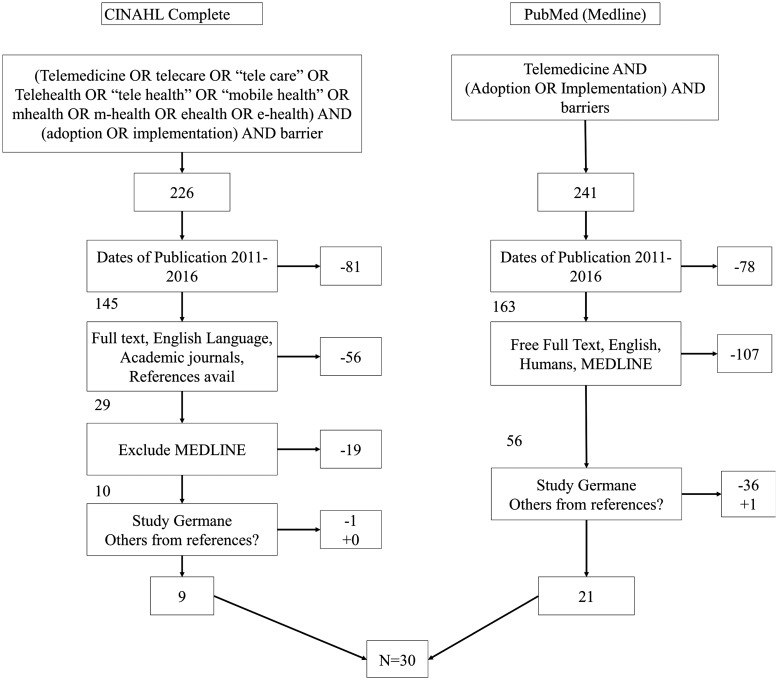
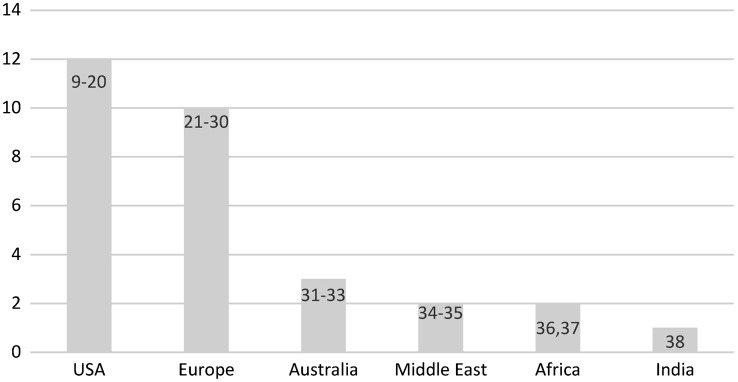
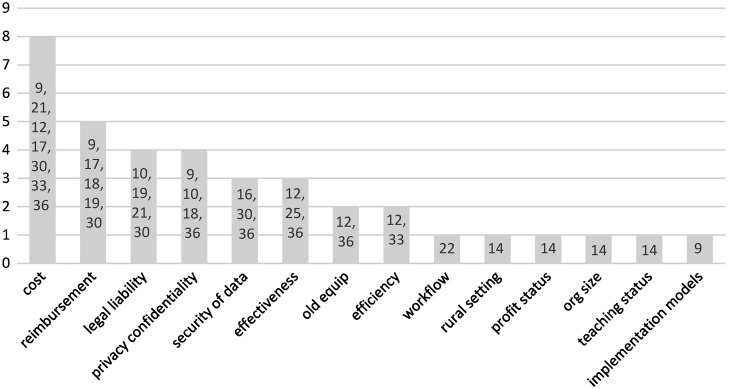
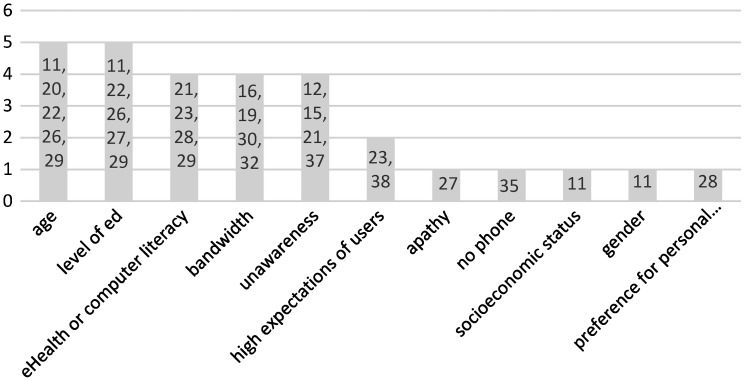
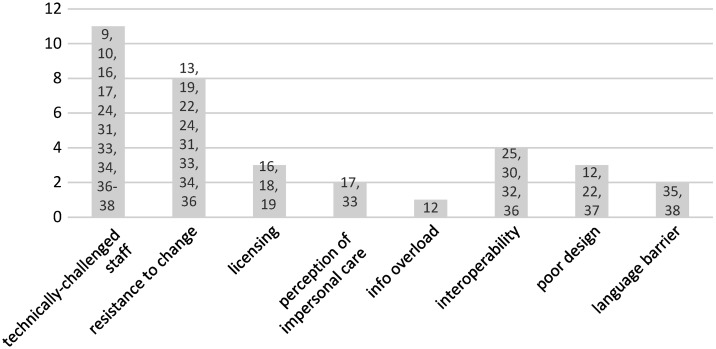
Introduction and objective: Studies on telemedicine have shown success in reducing the geographical and time obstacles incurred in the receipt of care in traditional modalities with the same or greater effectiveness; however, there are several barriers that need to be addressed in order for telemedicine technology to spread. The aim of this review is to evaluate barriers to adopting telemedicine worldwide through the analysis of published work. Methods: The authors conducted a systematic literature review by extracting the data from the Cumulative Index of Nursing and Allied Health Literature (CINAHL) and PubMed (MEDLINE) research databases. The reviewers in this study analysed 30 articles (nine from CINAHL and 21 from Medline) and identified barriers found in the literature. This review followed the checklist from Preferred Reporting Items for Systematic Reviews and Meta-Analyses (PRISMA) 2009. The reviewers organized the results into one table and five figures that depict the data in different ways, organized by: barrier, country-specific barriers, organization-specific barriers, patient-specific barriers, and medical-staff and programmer-specific barriers. Results: The reviewers identified 33 barriers with a frequency of 100 occurrences through the 30 articles. The study identified the issues with technically challenged staff (11%), followed by resistance to change (8%), cost (8%), reimbursement (5%), age of patient (5%), and level of education of patient (5%). All other barriers occurred at or less than 4% of the time. Discussion and conclusions: Telemedicine is not yet ubiquitous, and barriers vary widely. The top barriers are technology-specific and could be overcome through training, change-management techniques, and alternating delivery by telemedicine and personal patient-to-provider interaction. The results of this study identify several barriers that could be eliminated by focused policy. Future work should evaluate policy to identify which one to lever to maximize the results.
Overview
The claims and statistics of this paper haven’t been checked yet.
Run the check — free, no account needed. It reads the open-access text and checks the sources it cites.
Integrity signals
Registry
Cites
Statistics
Figures
Verification
Claims the paper makes
The claims and statistics of this paper haven’t been checked yet.
Run the check — free, no account needed. It reads the open-access text and checks the sources it cites.
Claims other papers make about this one
Each is checked against this paper’s own text: does it say what the citing paper says it does?
The source backs part of the claim, not all of it — or backs it for a different population, condition or comparison.
In the citing paper
“Consistencies with synchronous telemedicine include providing time and cost savings for patients, 51–53 and evidence suggesting a lack of guidance for use of both makes confidentiality a concern. 14,54”
From Effectiveness and safety of asynchronous telemedicine consultations in general practice: a systematic review (2024) · cites this paper as [54]
Experimental — accuracy not yet measuredThe check wasn’t confident either way, so it gives no verdict — never disputed.
In the citing paper
“The pandemic has accelerated the adoption of digital health services.”
From Acceptance and perceived usefulness of digital health services in the management of chronic urticaria: a survey of patients and physicians (2025) · cites this paper as [37]
Experimental — accuracy not yet measuredIn the citing paper
“Little is currently known about how to successfully spread and scale up video consulting for sustained use across settings [23-25].”
From Spread, Scale-up, and Sustainability of Video Consulting in Health Care: Systematic Review and Synthesis Guided by the NASSS Framework (2021) · cites this paper as [24]
In the citing paper
“There was a gap in the papers reviewed, on the relevance of interorganizational networking for supporting and sustaining the spread and scale-up of video consulting [24].”
From Spread, Scale-up, and Sustainability of Video Consulting in Health Care: Systematic Review and Synthesis Guided by the NASSS Framework (2021) · cites this paper as [24]
In the citing paper
“They also indicate that the same things that interfere with implementation at one site [eg, 48] are also seen as interfering with spread and scale-up [5,7,17,24], although this may be an artifact of how spread is commonly studied as the sum of multiple implementations.”
From Spread, Scale-up, and Sustainability of Video Consulting in Health Care: Systematic Review and Synthesis Guided by the NASSS Framework (2021) · cites this paper as [24]
In the citing paper
“Findings also raised a number of challenges including the following: technically challenged staff, resistance to change, cost, reimbursement, and patient characteristics [24], as well as project management, patient recruitment, leadership involvement, funding, absence of a long-term strategic plan, resistance to change, workflow changes, lack of resources, and liability [64-66].”
From Spread, Scale-up, and Sustainability of Video Consulting in Health Care: Systematic Review and Synthesis Guided by the NASSS Framework (2021) · cites this paper as [24]
In the citing paper
“There are gaps in the existing evidence on the spread and scale-up of video consulting. This was particularly the case in relation to interorganizational networking, which is critical in enabling and sustaining innovation [24,30,64], and yet is not explored in-depth.”
From Spread, Scale-up, and Sustainability of Video Consulting in Health Care: Systematic Review and Synthesis Guided by the NASSS Framework (2021) · cites this paper as [24]
In the citing paper
“Prior reviews have also focused exclusively on the technical aspects of video consulting technology [7]; considered technologies at any stage of implementation, rather than technologies with widespread adoption [24]; or restricted the types of articles included in the review to randomized control trials [78].”
From Spread, Scale-up, and Sustainability of Video Consulting in Health Care: Systematic Review and Synthesis Guided by the NASSS Framework (2021) · cites this paper as [24]
In the citing paper
“This was particularly the case in relation to interorganizational networking, which is critical in enabling and sustaining innovation [24,30,64], and yet is not explored in-depth.”
From Spread, Scale-up, and Sustainability of Video Consulting in Health Care: Systematic Review and Synthesis Guided by the NASSS Framework (2021) · cites this paper as [24]
In the citing paper
“Additionally, reviews have focused on telemedicine or eHealth in general without focusing on video consulting [24,77], with which our findings are consistent.”
From Spread, Scale-up, and Sustainability of Video Consulting in Health Care: Systematic Review and Synthesis Guided by the NASSS Framework (2021) · cites this paper as [24]
In the citing paper
“Other frameworks do exist that might support spread and scale-up (see [24] for an overview) but they have yet to be taken up in the context of expanding video consulting.”
From Spread, Scale-up, and Sustainability of Video Consulting in Health Care: Systematic Review and Synthesis Guided by the NASSS Framework (2021) · cites this paper as [24]
In the citing paper
“Broader barriers for patients include unfamiliarity and difficulties in technology access due to generational differences (where older patients experiences more difficulties in interacting with new technologies) and poor digital literacy, [9] and poor internet connectivity. [10]”
From Use of telemonitoring in patient self-management of chronic disease: a qualitative meta-synthesis (2023) · cites this paper as [9]
Self-check
Percentages, sums and reported differences re-computed from the paper’s own numbers.
The self-check needs the paper’s full text.
Citations
Cites
Preferred Reporting Items for Systematic Reviews and Meta-Analyses: the PRISMA statement
Moher, D., Liberati, A., Tetzlaff, J., Altman, D. G., & for the PRISMA Group (2009) · BMJ · doi:10.1136/bmj.b2535 · Cited by 83,823
Preferred Reporting Items for Systematic Reviews and Meta-Analyses: The PRISMA Statement
Moher, D., Liberati, A., Tetzlaff, J., Altman, D. G., & The PRISMA Group (2009) · PLoS Medicine · doi:10.1371/journal.pmed.1000097 · Cited by 64,042
Wang, G., Ma, R., Qiao, G., Wada, K., Aizawa, Y., & Satoh, T. (2015) · Integrative Medicine International · doi:10.1159/000368408 · Cited by 18,762
Kontos, E., Blake, K. D., Chou, W.-Y. S., & Prestin, A. (2014) · Journal of Medical Internet Research · doi:10.2196/jmir.3117 · Cited by 917
The European Health Psychologist
Todorova, I. L. G., Araújo‐Soares, V., & Sniehotta, F. F. (2005) · European Health Psychologist · Cited by 777
Mohr, D. C., Burns, M. N., Schueller, S. M., Clarke, G., & Klinkman, M. (2013) · General Hospital Psychiatry · doi:10.1016/j.genhosppsych.2013.03.008 · Cited by 693 · cited 4×
“Author(s) Barriers Country of origin Molfenter et al.9 Cost, reimbursement, technology-challenged staff, implementation models, confidentiality USA Petersen and DeMuro10 Privacy, legal, and technically challenged staff USA Kontos et al.11 Age, socioeconomic status, gender, level of education USA Levine et al.12 Info o…”
BackgroundInfluentialMair, F. S., May, C., O’Donnell, C., Finch, T., Sullivan, F., & Murray, E. (2012) · Bulletin of the World Health Organization · doi:10.2471/blt.11.099424 · Cited by 553 · cited 4×
“User expectations, computer literacy, and privacy concerns UK Mair et al.(24) Resistance to change, technically challenged staff, time consuming UK May et al.”
BackgroundInfluentialSanders, C., Rogers, A., Bowen, R., Bower, P., Hirani, S., Cartwright, M., Fitzpatrick, R., Knapp, M., Barlow, J., Hendy, J., et al. (2012) · BMC Health Services Research · doi:10.1186/1472-6963-12-220 · Cited by 450
Adoption of telemedicine: from pilot stage to routine delivery
Zanaboni, P., & Wootton, R. (2012) · BMC Medical Informatics and Decision Making · doi:10.1186/1472-6947-12-1 · Cited by 344
Kruse, C. S., Argueta, D. A., Lopez, L., & Nair, A. (2015) · Journal of Medical Internet Research · doi:10.2196/jmir.3703 · Cited by 327
Talib, Z. M., Kiguli-Malwadde, E., Wohltjen, H., Derbew, M., Mulla, Y., Olaleye, D. O., & Sewankambo, N. K. (2015) · Human Resources for Health · doi:10.1186/1478-4491-13-1 · Cited by 227
Integrating telecare for chronic disease management in the community: What needs to be done?
May, C. R., Finch, T. L., Cornford, J., Exley, C., Gately, C., Kirk, S., Jenkings, K. N., Osbourne, J., Robinson, A. L., Rogers, A., et al. (2011) · BMC Health Services Research · doi:10.1186/1472-6963-11-131 · Cited by 220
VA Telemedicine: An Analysis of Cost and Time Savings
Russo, J. E., McCool, R. R., & Davies, L. (2015) · Telemedicine Journal and e-Health · doi:10.1089/tmj.2015.0055 · Cited by 209
Amoakoh‐Coleman, M., Borgstein, A. B. J., Sondaal, S. F. V., Grobbee, D. E., Miltenburg, A. S., Verwijs, M., Ansah, E., Browne, J. L., & Klipstein‐Grobusch, K. (2016) · Journal of Medical Internet Research · doi:10.2196/jmir.5533 · Cited by 189
The Status of Telestroke in the United States
Silva, G. S., Farrell, S., Shandra, E., Viswanathan, A., & Schwamm, L. H. (2012) · Stroke · doi:10.1161/strokeaha.111.645861 · Cited by 184
Internet Skills Performance Tests: Are People Ready for eHealth?
van Deursen, A. J. A. M., & van Dijk, J. A. G. M. (2011) · Journal of Medical Internet Research · doi:10.2196/jmir.1581 · Cited by 163
LeRouge, C., & Garfield, M. J. (2013) · International Journal of Environmental Research and Public Health · doi:10.3390/ijerph10126472 · Cited by 159
Rutledge, C., Haney, T. S., Bordelon, M., Renaud, M., & Fowler, C. N. (2014) · International Journal of Nursing Education Scholarship · doi:10.1515/ijnes-2013-0061 · Cited by 131
Trends in telemedicine use in addiction treatment
Molfenter, T. D., Boyle, M., Holloway, D., & Zwick, J. (2015) · Addiction Science & Clinical Practice · doi:10.1186/s13722-015-0035-4 · Cited by 127
Adoption of ICU Telemedicine in the United States
Kahn, J. M., Cicero, B. D., Wallace, D. J., & Iwashyna, T. J. (2013) · Critical Care Medicine · doi:10.1097/ccm.0b013e3182a6419f · Cited by 122
Telerehabilitation, Virtual Therapists, and Acquired Neurologic Speech and Language Disorders
Cherney, L., & van Vuuren, S. (2012) · Seminars in Speech and Language · doi:10.1055/s-0032-1320044 · Cited by 117
Medhanyie, A. A., Little, A., Yebyo, H., Spigt, M., Tadesse, K., Blanco, R., & Dinant, G.-J. (2015) · Human Resources for Health · doi:10.1186/1478-4491-13-2 · Cited by 114
Online Mental Health Resources in Rural Australia: Clinician Perceptions of Acceptability
Sinclair, C., Holloway, K., Riley, G. J., & Auret, K. A. (2013) · Journal of Medical Internet Research · doi:10.2196/jmir.2772 · Cited by 103
Staff Acceptance of Tele-ICU Coverage
Young, L. B., Chan, P. S., & Cram, P. M. (2010) · CHEST Journal · doi:10.1378/chest.10-1795 · Cited by 103
Reasons and Barriers for Using a Patient Portal: Survey Among Patients With Diabetes Mellitus
Ronda, M. C. M., Dijkhorst-Oei, L.-T., & Rutten, G. E. H. M. (2014) · Journal of Medical Internet Research · doi:10.2196/jmir.3457 · Cited by 97
El.Mahalli, A. A., El-Khafif, S. H., & Al-Qahtani, M. F. (2012) · PubMed Central · Cited by 96
Scholl, J., Syed-Abdul, S., & Ahmed, L. A. (2011) · Journal of Biomedical Informatics · doi:10.1016/j.jbi.2011.07.008 · Cited by 83
DeMuro, P. R., & Petersen, C. C. (2015) · Applied Clinical Informatics · doi:10.4338/aci-2014-09-r-0082 · Cited by 73
Spotlight on the January 5 Issue
Gross, R. A. (2016) · Neurology · doi:10.1212/wnl.0000000000002233 · Cited by 67
Ross, J., Stevenson, F., Lau, R., & Murray, E. (2015) · BMJ Open · doi:10.1136/bmjopen-2014-006773 · Cited by 64
Robben, S. H., Perry, M., Huisjes, M., van Nieuwenhuijzen, L., Schers, H., van Weel, C., Rikkert, M. G. M. O., van Achterberg, T., Heinen, M. M., & Melis, R. J. F. (2012) · BMC Health Services Research · doi:10.1186/1472-6963-12-251 · Cited by 52
Levine, M., Richardson, J. E., Granieri, E. C., & Reid, M. C. (2013) · Pain Medicine · doi:10.1111/pme.12323 · Cited by 52
Improving diabetes management with electronic health records and patients’ health records
Benhamou, P. (2011) · Diabetes & Metabolism · doi:10.1016/s1262-3636(11)70966-1 · Cited by 51
A Pilot Project to Improve Access to Telepsychotherapy at Rural Clinics
Adler, G., Pritchett, L. R., Kauth, M. R., & Nadorff, D. (2014) · Telemedicine and e-Health · doi:10.1089/tmj.2013.0085 · Cited by 48
Telemedicine services in the Republic of Ireland: An evolving policy context
MacFarlane, A. E., Murphy, A. W., & Clerkin, P. (2005) · Health Policy · doi:10.1016/j.healthpol.2005.06.006 · Cited by 47
Bigna, J. J., Noubiap, J. J., Plottel, C. S., Kouanfack, C., & Koulla‐Shiro, S. (2014) · BMC Health Services Research · doi:10.1186/s12913-014-0523-3 · Cited by 38
Cota, A., Tarchala, M., Parent‐Harvey, C., Engel, V., Berry, G. K., Reindl, R., & Harvey, E. J. (2016) · Telemedicine Journal and e-Health · doi:10.1089/tmj.2016.0030 · Cited by 37
Cancer Care Management through a Mobile Phone Health Approach: Key Considerations
Mohammadzadeh, N., Safdari, R., & Rahimi, A. (2013) · Asian Pacific Journal of Cancer Prevention · doi:10.7314/apjcp.2013.14.9.4961 · Cited by 34
Developing national eHealth infrastructures--results and lessons from Europe.
Stroetmann, K. A., Artmann, J., & Stroetmann, V. N. (2011) · PubMed · Cited by 31
Plaete, J., Crombez, G., DeSmet, A., Deveugele, M., Verloigne, M., & Bourdeaudhuij, I. D. (2015) · BMC Family Practice · doi:10.1186/s12875-014-0214-5 · Cited by 26
Lycett, K., Wittert, G., Gunn, J. M., Hutton, C., Clifford, S. A., & Wake, M. A. (2014) · BMC Medical Informatics and Decision Making · doi:10.1186/1472-6947-14-61 · Cited by 26
E-Health readiness in outback communities: an exploratory study
Schwarz, F., Ward, J., & Willcock, S. (2014) · Rural and Remote Health · doi:10.22605/rrh2871 · Cited by 23
Hatcher-Martin, J. M., Anderson, E., & Factor, S. A. (2016) · Neurology · doi:10.1212/wnl.86.16_supplement.p1.022 · Cited by 14
Comparing mothers’ postpartum concerns in two clinical trials 18 years apart
Hannan, J., Brooten, D. A., Youngblut, J. M., & Galindo, A. M. (2016) · Journal of the American Association of Nurse Practitioners · doi:10.1002/2327-6924.12384 · Cited by 10
Plaete, J., Verloigne, M., Crombez, G., & Bourdeaudhuij, I. D. (2014) · European Health Psychologist · Cited by 2
Moher (2009) · doi:10.1371/journal.pmed1000097
Research works printed but not linked: 6
- World Health Organization (WHO), 2010, Telemedicine: opportunities and developments in Member States: report on the second global survey on eHealth
- Plaete J, 2014, European Health Psychologist, 16, 889
- Stroetmann KA, 2011, AMIA Annu Symp Proc, 2011, 1347
- Schwarz F, 2014, Rural Remote Health, 14, 2871
- Medhanyie AA, 2015, Hum Resour Health, 13, 1
- El-Mahalli AA, 2012, Perspect Health Inf Manag, 9
Cited by
Sorted by citations
Digitalization to achieve sustainable development goals: Steps towards a Smart Green Planet
Mondéjar, M. E., Avtar, R., Díaz, H. L. B., Dubey, R. K., Esteban, J., Gómez‐Morales, A., Hallam, B. J., Mbungu, N. T., Okolo, C. C., Prasad, K. A., et al. (2021) · The Science of The Total Environment · doi:10.1016/j.scitotenv.2021.148539 · Cited by 988
Kamal, S. A., Shafiq, M., & Kakria, P. (2019) · Technology in Society · doi:10.1016/j.techsoc.2019.101212 · Cited by 1,039
Kichloo, A., Albosta, M. S., Dettloff, K., Wani, F., El‐amir, Z., Singh, J., Aljadah, M. M., Chakinala, R. C., Kanugula, A. K., Solanki, S., et al. (2020) · Family Medicine and Community Health · doi:10.1136/fmch-2020-000530 · Cited by 790
Impact of the digital divide in the age of COVID-19
Ramsetty, A., & Adams, C. (2020) · Journal of the American Medical Informatics Association · doi:10.1093/jamia/ocaa078 · Cited by 599
Alexander, G. C., Tajanlangit, M., Heyward, J., Mansour, O., Qato, D. M., & Stafford, R. S. (2020) · JAMA Network Open · doi:10.1001/jamanetworkopen.2020.21476 · Cited by 461
Metadata
- Authors
- Scott Kruse, C., Karem, P., Shifflett, K., Vegi, L., Ravi, K., & Brooks, M.
- Affiliations
- Texas State University, Texas, USA
- Texas State University (US)
- ORCID
- Brooks, Matthew
- Venue
- Journal of Telemedicine and Telecare
- Publisher
- SAGE Publications
- Published
- 2016-10-16
- Volume
- 24
- Issue
- 1
- Pages
- 4-12
- ISSN
- 1357-633X (ISSN-L)
- 1758-1109
- PMC
- PMC5768250
- OpenAlex
- W2532031923
- Cited by
- 1,735
- References
- 45
- Citations by year
- 2026: 147 · 2025: 221 · 2024: 210 · 2023: 277 · 2022: 323 · 2021: 304 · 2020: 183 · 2019: 49 · 2018: 16 · 2017: 2 · 2016: 2
- FWCI
- 3.44
- Type
- journal article
- Language
- en
- Open access
- hybrid
- doi.org
- Locations
- Journal of Telemedicine and Telecare (publishedVersion, cc-by-nc)
- Europe PMC (PubMed Central) (publishedVersion, cc-by-nc)
- PubMed Central (publishedVersion, cc-by-nc)
- PubMed (publishedVersion)
- Topics
- Health Sciences › Medicine › Public Health, Environmental and Occupational Health › Telemedicine and Telehealth Implementation
- Health Sciences › Medicine › Geriatrics and Gerontology › Technology Use by Older Adults
- Health Sciences › Medicine › Public Health, Environmental and Occupational Health › Healthcare Systems and Technology
- Keywords
- telemedicine, barriers to adoption, technology adoption, resistance to change, employee training, cost, reimbursement, patient age, patient education, change management, health policy
- MeSH terms
- Age Factors, Attitude of Health Personnel, Diffusion of Innovation, Humans, Health Knowledge, Attitudes, Practice, Socioeconomic Factors, Global Health, Telemedicine
About these checks
Registry, retraction, Cites and statistics results are computed, not judged, with one exception: a printed reference that no index lists is read once by a model before it counts as a citation error. Claims are extracted by a model and kept only when their quote appears verbatim in the text; each cited source is then checked, with a model’s help, for whether it says what the claim relies on. Those verdicts can be wrong — read the claim’s quote and the cited source before relying on one.
Statistics and arithmetic are recomputed, not judged.
Confidence bands are shown only for fields calibrated on our annotated test set. None is calibrated yet, so no band is shown.
What counts as a claim ›How we measure confidence ›How we check this ›
Are you an author, or do you see a problem with this page? Request a review
