

Does sex influence the diagnostic evaluation of autism spectrum disorder in adults?
Open accessThe DOI matches its Crossref record; 48 of the 49 references it cites were found in a registry or an index, and 1 are not checked yet.
Abstract
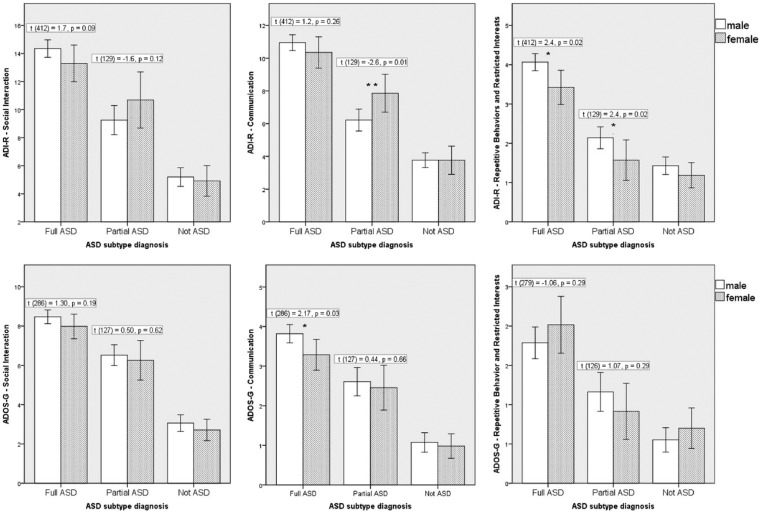
It is unknown whether sex influences the diagnostic evaluation of autism spectrum disorder, or whether male and female adults within the spectrum have different symptom profiles. This study reports sex differences in clinical outcomes for 1244 adults (935 males and 309 females) referred for autism spectrum disorder assessment. Significantly, more males (72%) than females (66%) were diagnosed with an autism spectrum disorder of any subtype (x 2 = 4.09; p = 0.04). In high-functioning autism spectrum disorder adults (IQ > 70; N = 827), there were no significant sex differences in severity of socio-communicative domain symptoms. Males had significantly more repetitive behaviours/restricted interests than females ( p = 0.001, d = 0.3). A multivariate analysis of variance indicated a significant interaction between autism spectrum disorder subtype (full-autism spectrum disorder/partial-autism spectrum disorder) and sex: in full-autism spectrum disorder, males had more severe socio-communicative symptoms than females; for partial-autism spectrum disorder, the reverse was true. There were no sex differences in prevalence of co-morbid psychopathologies. Sex influenced diagnostic evaluation in a clinical sample of adults with suspected autism spectrum disorder. The sexes may present with different manifestations of the autism spectrum disorder phenotype and differences vary by diagnostic subtype. Understanding and awareness of adult female repetitive behaviours/restricted interests warrant attention and sex-specific diagnostic assessment tools may need to be considered.
Overview
The claims and statistics of this paper haven’t been checked yet.
Free: it reads the open-access text and checks the first 5 claims that cite a source we can check. Create a free account to check every claim.
Integrity signals
Registry
Cites
Statistics
Figures
Verification
Claims the paper makes
The claims and statistics of this paper haven’t been checked yet.
Free: it reads the open-access text and checks the first 5 claims that cite a source we can check. Create a free account to check every claim.
Claims other papers make about this one
Each is checked against this paper’s own text: does it say what the citing paper says it does?
The source backs part of the claim, not all of it — or backs it for a different population, condition or comparison.
In the citing paper
“Diagnostic services tended to report a male-female ratio of 2-3 to 1 (e.g. Happé et al., 2016; Rutherford, McKenzie, Johnson, et al., 2016; Wilson et al., 2016).”
From Diagnosis of autism in adulthood: A scoping review (2020) · cites this paper as Wilson et al., 2016
Experimental — accuracy not yet measuredThe cited source says what the claim attributes to it.
In the citing paper
“A potential explanation is that clinical measures are insufficiently sensitive to the presentation of autistic traits in women (Wilson et al., 2016), especially considering women's reported use of camouflaging strategies (Bargiela et al., 2016).”
From Diagnosis of autism in adulthood: A scoping review (2020) · cites this paper as Wilson et al., 2016
The cited source says what the claim attributes to it.
In the citing paper
“Co- occurring mental illnesses are similarly common across genders.”
From Diagnosis of autism in adulthood: A scoping review (2020) · cites this paper as Wilson et al. (2016)
The cited source says what the claim attributes to it.
In the citing paper
“More men than women received an autism diagnosis.”
From Diagnosis of autism in adulthood: A scoping review (2020) · cites this paper as Wilson et al. (2016)
The cited source says what the claim attributes to it.
In the citing paper
“Men scored higher in 'repetitive behaviours/restricted interests' domain.”
From Diagnosis of autism in adulthood: A scoping review (2020) · cites this paper as Wilson et al. (2016)
2 more claims about this paper
Create a free account to see every claim other papers make about this one.
Self-check
Percentages, sums and reported differences re-computed from the paper’s own numbers.
The self-check needs the paper’s full text.
Citations
Cites
Journal of Clinical Psychiatry
(2018) · Journal of Clinical Psychiatry · doi:10.5505/kpd · Cited by 13,651
Lord, C., Rutter, M., & Le Couteur, A. (1994) · Journal of Autism and Developmental Disorders · doi:10.1007/bf02172145 · Cited by 9,065 · cited 2×
“They reported that girls showed more social and communication symptoms on the Autism Diagnostic Observation Schedule–Generic (ADOS-G; Lord et al., 2000) and had fewer repetitive behaviour symptoms on the Autism Diagnostic Interview–Revised (ADI-R; Lord et al., 1994).”
BackgroundInfluentialLord, C., Risi, S., Lambrecht, L., Cook, E. H., Leventhal, B. L., DiLavore, P. C., Pickles, A., & Rutter, M. (2000) · Journal of Autism and Developmental Disorders · doi:10.1023/a:1005592401947 · Cited by 7,520 · cited 1×
“They reported that girls showed more social and communication symptoms on the Autism Diagnostic Observation Schedule–Generic (ADOS-G; Lord et al., 2000) and had fewer repetitive behaviour symptoms on the Autism Diagnostic Interview–Revised (ADI-R; Lord et al., 1994).”
BackgroundKessler, R. C., Petukhova, M., Sampson, N. A., Zaslavsky, A. M., & Wittchen, H. (2012) · International Journal of Methods in Psychiatric Research · doi:10.1002/mpr.1359 · Cited by 2,947 · cited 1×
“…of certain common psychiatric conditions – in particular mood and anxiety disorders – are higher in women than men in the general adult population (Kessler et al., 2012), but it is unclear whether sex differences translate to the autistic spectrum, or whether additional mental health…”
BackgroundEpidemiology of Pervasive Developmental Disorders
Fombonne, E. (2009) · Pediatric Research · doi:10.1203/pdr.0b013e31819e7203 · Cited by 1,971 · cited 1×
“Males are diagnosed approximately four times more often than females in childhood (Fombonne, 2005, 2009) although this ratio varies with IQ and is reportedly as low as 2:1 when ASD is comorbid with intellectual disability, and as high as 6–8:1 in high-functioning populations (Fombonne, 2005).”
BackgroundSex/Gender Differences and Autism: Setting the Scene for Future Research
Lai, M.-C., Lombardo, M. V., Auyeung, B., Chakrabarti, B., & Baron-Cohen, S. (2015) · Journal of the American Academy of Child & Adolescent Psychiatry · doi:10.1016/j.jaac.2014.10.003 · Cited by 1,120 · cited 5×
“Additional future investigations could focus on developmental differences between males and females on the spectrum across the lifespan (Lai et al., 2015).”
BackgroundInfluentialPsychiatric and psychosocial problems in adults with normal-intelligence autism spectrum disorders
Hofvander, B., Delorme, R., Chaste, P., Nydén, A., Wentz, E., Ståhlberg, O., Herbrecht, E., Stopin, A., Anckarsäter, H., Gillberg, C., et al. (2009) · BMC Psychiatry · doi:10.1186/1471-244x-9-35 · Cited by 812 · cited 2×
“Second, co-morbid psychiatric conditions are common in ASD (Hofvander et al., 2009; Joshi et al., 2013; Russell et al., 2005, 2015) and symptoms of ASD are often difficult to disentangle from additional or alternative conditions (Mazzone et al.”
Background(2005) · PubMed · Cited by 775
Mandy, W., Chilvers, R., Chowdhury, U., Salter, G., Seigal, A., & Skuse, D. (2012) · Journal of Autism and Developmental Disorders · doi:10.1007/s10803-011-1356-0 · Cited by 715 · cited 1×
“Additionally, males and females may present with different ASD phenotypes (Howe et al., 2015; Mandy et al., 2012; Van Wijngaarden-Cremers et al., 2014); this may affect diagnostic rates since the female profile is less well understood and hence less easily detected (Kirkovski et al., 2013).”
BackgroundA behavioral comparison of male and female adults with high functioning autism spectrum conditions
Lai, M.-C., Lombardo, M. V., Pasco, G., Ruigrok, A. N. V., Wheelwright, S. J., Sadek, S. A., Chakrabarti, B., MRC AIMS Consortium, & Baron-Cohen, S. (2011) · PLoS ONE · doi:10.1371/journal.pone.0020835 · Cited by 650 · cited 3×
“…as a whole is in line with a review by Van Wijngaarden-Cremers et al. (2013), but contrasts with studies reporting that females have more (Carter et al., 2007; Frazier et al., 2014; Hartley and Sikora, 2009; Lord et al., 1982; McLennan et al., 1993) or less (Lai et al., 2011) symptoms than males.”
BackgroundResult
Research works printed but not linked: 4
- Her Majesty's Government (2009) Autism Act . London: HMSO.
- National Institute for Health and Clinical Excellence (NICE) (2012) Autism: Recognition, Referral, Diagnosis and Management of Adults on the Autism Spectrum (CG142) . London: NICE.
- Wechsler D (1999) Wechsler Abbreviated Scale of Intelligence. Harcourt Assessments . San Antonio, TX: Psychological Corporation.
- World Health Organization (WHO) (1993) The ICD-10 Classification of Mental and Behavioural Disorders: Diagnostic Criteria for Research . Geneva: WHO.
Cited by
Items 101–129 of 129
Towards the equal recognition of autism in girls and women
Cary, A. E. (2026) · BMJ · doi:10.1136/bmj.s120 · Cited by 1
Mazzola, C. (2017) · RIT Scholar Works (Rochester Institute of Technology)
Utilisation and outcomes of treatment in Autism Spectrum Disorder
Houghton, R. (2021) · Research Publications (Maastricht University) · doi:10.26481/dis.20210304rh
Sex/Gender and Repetitive and Restrictive Behaviors in Autism Spectrum Disorder
Shulman, C., & Bing, O. (2021) · Autism and child psychopathology series · doi:10.1007/978-3-030-66445-9_7 · Cited by 1
van Berckelaer‐Onnes, I. (2017) · Bohn Stafleu van Loghum eBooks · doi:10.1007/978-90-368-0931-3_29
Important Knowledge for Diagnosing Autistic Patients
Bennett, M., & Goodall, E. (2022) · Emerald Group Publishing Limited eBooks · doi:10.1108/978-1-80382-463-520221009
Heady, N. (2023) · Cronfa (Swansea University) · doi:10.23889/suthesis.63857
Gabrielsen, T. P., Begay, K. K., Campbell, K. M., Hahn, K., & Harrington, L. T. (2023) · Springer eBooks · doi:10.1007/978-3-031-33969-1_5
Differential or Co-occurring? Other Common Diagnoses Prior to Autism Assessment
Gabrielsen, T. P., Begay, K. K., Campbell, K. M., Hahn, K., & Harrington, L. T. (2023) · Springer eBooks · doi:10.1007/978-3-031-33969-1_8
Aspectos comportamentais e neuroquímicos do modelo de autismo induzido por ácido valpróico em ratas
Manes, M. (2023) · Digital Library of Theses and Dissertations (Universidade de São Paulo) · doi:10.11606/t.10.2023.tde-16052023-163046
IMPLICAÇÕES DO DIAGNÓSTICO TARDIO DO TRANSTORNO DO ESPECTRO AUTISTA
BARBOSA, M. H., Simionato, B. B., de Morais, G. H. D., Santana, R. C. D. S., & de Aquino, É. C. (2023) · doi:10.58871/conbrasca.v4.26
Chen, Y.-C., Chien, Y., Chiu, Y., Tsai, W., & Gau, S. S. (2024) · Autism in Adulthood · doi:10.1089/aut.2023.0205
Perich, E. (2024) · Queensland University of Technology · doi:10.5204/thesis.eprints.254565 · Cited by 1
Catala, A. (2025) · Oxford University Press eBooks · doi:10.1093/9780197776353.003.0007
Persistent Verbal Fluency Challenges in Autistic Adults
Coria, S. A. C., & Braden, B. B. (2025) · Springer eBooks · doi:10.1007/978-3-031-40858-8_456-1
Impact of camouflaging on females with autism
Janicki-Menzie, C. (2021) · Scholars Archive - University at Albany (University at Albany, State University of New York) · doi:10.54014/h8g5-3ph0
Applying Phenomenology in Education. The Case of Special Educational Needs
Ghigi, N., Brencio, F., Bizzari, V., & Sannipoli, M. (2025) · Phänomenologische Erziehungswissenschaft · doi:10.1007/978-3-658-47518-5_15 · Cited by 1
Ghigi, N., Bizzari, V., & Sannipoli, M. (2025) · Contributions to phenomenology · doi:10.1007/978-3-031-87968-5_3
Perspectives d’avenir dans l’évaluation et le traitement des troubles du spectre de l’autisme
Smith, I. C., Pugliese, C. E., Corbett, B. A., & White, S. W. (2020) · Elsevier eBooks · doi:10.1016/b978-2-294-76574-2.00015-3
Kerr‐Gaffney, J., Hayward, H., Jones, E. J. H., Halls, D., Murphy, D., & Tchanturia, K. (2021) · Figshare · doi:10.6084/m9.figshare.14889427
Self-citationKerr‐Gaffney, J., Hayward, H., Jones, E. J. H., Halls, D., Murphy, D., & Tchanturia, K. (2021) · Figshare · doi:10.6084/m9.figshare.14889430
Self-citationRomeo, V., Levante, A., Lecciso, F., & Fabio, R. A. (2026) · Research in Autism · doi:10.1016/j.reia.2026.202799 · Cited by 1
Burns, H. E., Taylor, R. D., & Jones, S. (2026) · Advances in Autism · doi:10.1108/aia-07-2025-0076
Richter, M. (2019) · theses.fr (ABES) · doi:10.70675/52ffb913z2cedz405ez94c3z122c7728942f · Cited by 1
“Recent studies (Kreiser & White, 2014; Rynkiewicz & Łucka, 2018; Wilson et al., 2016; Zwaigenbaum et al., 2012) examine this gender difference and indicate that an underidentification of ASD in females may exist.”
BackgroundFrigaux, A. (2021) · theses.fr (ABES) · doi:10.70675/c1f05173zf1c3z4430z82d9z1c1e681db730 · Cited by 2
Diagnostic inflation in autism spectrum disorder: an epistemological and methodological reappraisal
Croce, L., & Fusaro, I. (2026) · Frontiers in Psychiatry · doi:10.3389/fpsyt.2026.1847929 · Cited by 1
“One of the most important research advances of the past fi fteen years is the recognition of the female phenotype as a systematically different clinical presentation from the male phenotype, historically under-recognised (40).”
Parker, J., Thompson, E., Mandy, W., McCabe, R., Stark, E. A., & Barnicot, K. (2026) · Autism in Adulthood · doi:10.1177/25739581261486817
Validity and Reliability of the Turkish Version of the Adult Autism Subthreshold Spectrum Scale
Alıcı, Y. H., Özbaran, N. B., Köse, S., Görmez, A., Kandeğer, A., Algedik, P., Erbaş, S., Yenice, H., Çalışır, Ö. M., Hasanlı, J., et al. (2026) · Intellectual and developmental disabilities · doi:10.1080/19349491.2026.2734441
Metadata
- Authors
- Wilson, C. E., Murphy, C. M., McAlonan, G., Robertson, D. M., Spain, D., Hayward, H., Woodhouse, E., Deeley, P. Q., Gillan, N., Ohlsen, J. C., Zinkstok, J., Stoencheva, V., Faulkner, J., Yildiran, H., Bell, V., Hammond, N., Craig, M. C., & Murphy, D. G.
- Affiliations
- King's College London (GB)
- King’s College London, UK
- South London and Maudsley NHS Foundation Trust (GB)
- Corresponding author
- Wilson, C Ellie
- ORCID
- Venue
- Autism
- Publisher
- SAGE Publications
- Published
- 2016-07-09
- Volume
- 20
- Issue
- 7
- Pages
- 808-819
- ISSN
- 1362-3613 (ISSN-L)
- 1461-7005
- PMC
- PMC5363500
- OpenAlex
- W2319586993
- Cited by
- 129
- References
- 48
- Citations by year
- 2026: 12 · 2025: 11 · 2024: 8 · 2023: 15 · 2022: 15 · 2021: 19 · 2020: 8 · 2019: 10 · 2018: 11 · 2017: 15 · 2016: 5
- FWCI
- 8.70
- Type
- journal article
- Language
- en
- Open access
- hybrid
- doi.org
- Licence
- cc-by
- journals.sagepub.com/page/policies/text-and-data-mining-license (tdm)
- Locations
- Autism (publishedVersion, cc-by)
- PubMed Central (publishedVersion, cc-by)
- PubMed (publishedVersion)
- UCL Discovery (University College London) (submittedVersion)
- Research Portal (King's College London) (submittedVersion, cc-by)
- Funders
- South London and Maudsley NHS Foundation Trust
- National Institute for Health and Care Research (RP-PG-0606-1045)
- King's College London (115300)
- European Commission (115300, 267226)
- Junta de Andalucía (267226)
- Medical Research Council (115300, MR/N026063/1)
- Topics
- Life Sciences › Neuroscience › Cognitive Neuroscience › Autism Spectrum Disorder Research
- Health Sciences › Medicine › Psychiatry and Mental health › Child Nutrition and Feeding Issues
- Life Sciences › Biochemistry, Genetics and Molecular Biology › Genetics › Genetics and Neurodevelopmental Disorders
- Keywords
- autism spectrum disorder, sex differences, autistic adults, diagnostic assessment, repetitive behavior, restricted interests, comorbid psychopathology
- MeSH terms
- Autism Spectrum Disorder, Adolescent, Adult, Aged, Female, Humans, Male, Middle Aged, Sex Factors, Young Adult
About these checks
Registry, retraction, Cites and statistics results are computed, not judged, with one exception: a printed reference that no index lists is read once by a model before it counts as a citation error. Claims are extracted by a model and kept only when their quote appears verbatim in the text; each cited source is then checked, with a model’s help, for whether it says what the claim relies on. Those verdicts can be wrong — read the claim’s quote and the cited source before relying on one.
Statistics and arithmetic are recomputed, not judged.
Confidence bands are shown only for fields calibrated on our annotated test set. None is calibrated yet, so no band is shown.
What counts as a claim ›How we measure confidence ›How we check this ›
Are you an author, or do you see a problem with this page? Request a review
Data sources
Bibliographic data: Semantic Scholar, OpenAlex, Crossref.
Contains information from the Semantic Scholar Academic Graph Datasets, made available under the ODC Attribution License (ODC-BY 1.0).
Semantic Scholar’s data is described in: Kinney, R., et al. (2023). The Semantic Scholar Open Data Platform. arXiv:2301.10140.
