

Does sex influence the diagnostic evaluation of autism spectrum disorder in adults?
Open accessThe DOI matches its Crossref record; 48 of the 49 references it cites were found in a registry or an index, and 1 are not checked yet.
Abstract
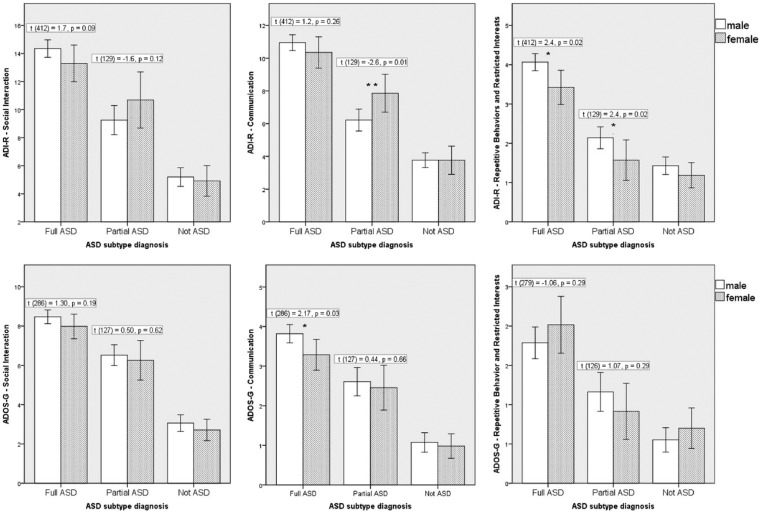
It is unknown whether sex influences the diagnostic evaluation of autism spectrum disorder, or whether male and female adults within the spectrum have different symptom profiles. This study reports sex differences in clinical outcomes for 1244 adults (935 males and 309 females) referred for autism spectrum disorder assessment. Significantly, more males (72%) than females (66%) were diagnosed with an autism spectrum disorder of any subtype (x 2 = 4.09; p = 0.04). In high-functioning autism spectrum disorder adults (IQ > 70; N = 827), there were no significant sex differences in severity of socio-communicative domain symptoms. Males had significantly more repetitive behaviours/restricted interests than females ( p = 0.001, d = 0.3). A multivariate analysis of variance indicated a significant interaction between autism spectrum disorder subtype (full-autism spectrum disorder/partial-autism spectrum disorder) and sex: in full-autism spectrum disorder, males had more severe socio-communicative symptoms than females; for partial-autism spectrum disorder, the reverse was true. There were no sex differences in prevalence of co-morbid psychopathologies. Sex influenced diagnostic evaluation in a clinical sample of adults with suspected autism spectrum disorder. The sexes may present with different manifestations of the autism spectrum disorder phenotype and differences vary by diagnostic subtype. Understanding and awareness of adult female repetitive behaviours/restricted interests warrant attention and sex-specific diagnostic assessment tools may need to be considered.
Overview
The claims and statistics of this paper haven’t been checked yet.
Free: it reads the open-access text and checks the first 5 claims that cite a source we can check. Create a free account to check every claim.
Integrity signals
Registry
Cites
Statistics
Figures
Verification
Claims the paper makes
The claims and statistics of this paper haven’t been checked yet.
Free: it reads the open-access text and checks the first 5 claims that cite a source we can check. Create a free account to check every claim.
Claims other papers make about this one
Each is checked against this paper’s own text: does it say what the citing paper says it does?
The source backs part of the claim, not all of it — or backs it for a different population, condition or comparison.
In the citing paper
“Diagnostic services tended to report a male-female ratio of 2-3 to 1 (e.g. Happé et al., 2016; Rutherford, McKenzie, Johnson, et al., 2016; Wilson et al., 2016).”
From Diagnosis of autism in adulthood: A scoping review (2020) · cites this paper as Wilson et al., 2016
Experimental — accuracy not yet measuredThe cited source says what the claim attributes to it.
In the citing paper
“A potential explanation is that clinical measures are insufficiently sensitive to the presentation of autistic traits in women (Wilson et al., 2016), especially considering women's reported use of camouflaging strategies (Bargiela et al., 2016).”
From Diagnosis of autism in adulthood: A scoping review (2020) · cites this paper as Wilson et al., 2016
The cited source says what the claim attributes to it.
In the citing paper
“Co- occurring mental illnesses are similarly common across genders.”
From Diagnosis of autism in adulthood: A scoping review (2020) · cites this paper as Wilson et al. (2016)
The cited source says what the claim attributes to it.
In the citing paper
“More men than women received an autism diagnosis.”
From Diagnosis of autism in adulthood: A scoping review (2020) · cites this paper as Wilson et al. (2016)
The cited source says what the claim attributes to it.
In the citing paper
“Men scored higher in 'repetitive behaviours/restricted interests' domain.”
From Diagnosis of autism in adulthood: A scoping review (2020) · cites this paper as Wilson et al. (2016)
2 more claims about this paper
Create a free account to see every claim other papers make about this one.
Self-check
Percentages, sums and reported differences re-computed from the paper’s own numbers.
The self-check needs the paper’s full text.
Citations
Cites
Journal of Clinical Psychiatry
(2018) · Journal of Clinical Psychiatry · doi:10.5505/kpd · Cited by 13,651
Lord, C., Rutter, M., & Le Couteur, A. (1994) · Journal of Autism and Developmental Disorders · doi:10.1007/bf02172145 · Cited by 9,065 · cited 2×
“They reported that girls showed more social and communication symptoms on the Autism Diagnostic Observation Schedule–Generic (ADOS-G; Lord et al., 2000) and had fewer repetitive behaviour symptoms on the Autism Diagnostic Interview–Revised (ADI-R; Lord et al., 1994).”
BackgroundInfluentialLord, C., Risi, S., Lambrecht, L., Cook, E. H., Leventhal, B. L., DiLavore, P. C., Pickles, A., & Rutter, M. (2000) · Journal of Autism and Developmental Disorders · doi:10.1023/a:1005592401947 · Cited by 7,520 · cited 1×
“They reported that girls showed more social and communication symptoms on the Autism Diagnostic Observation Schedule–Generic (ADOS-G; Lord et al., 2000) and had fewer repetitive behaviour symptoms on the Autism Diagnostic Interview–Revised (ADI-R; Lord et al., 1994).”
BackgroundKessler, R. C., Petukhova, M., Sampson, N. A., Zaslavsky, A. M., & Wittchen, H. (2012) · International Journal of Methods in Psychiatric Research · doi:10.1002/mpr.1359 · Cited by 2,947 · cited 1×
“…of certain common psychiatric conditions – in particular mood and anxiety disorders – are higher in women than men in the general adult population (Kessler et al., 2012), but it is unclear whether sex differences translate to the autistic spectrum, or whether additional mental health…”
BackgroundEpidemiology of Pervasive Developmental Disorders
Fombonne, E. (2009) · Pediatric Research · doi:10.1203/pdr.0b013e31819e7203 · Cited by 1,971 · cited 1×
“Males are diagnosed approximately four times more often than females in childhood (Fombonne, 2005, 2009) although this ratio varies with IQ and is reportedly as low as 2:1 when ASD is comorbid with intellectual disability, and as high as 6–8:1 in high-functioning populations (Fombonne, 2005).”
BackgroundSex/Gender Differences and Autism: Setting the Scene for Future Research
Lai, M.-C., Lombardo, M. V., Auyeung, B., Chakrabarti, B., & Baron-Cohen, S. (2015) · Journal of the American Academy of Child & Adolescent Psychiatry · doi:10.1016/j.jaac.2014.10.003 · Cited by 1,120 · cited 5×
“Additional future investigations could focus on developmental differences between males and females on the spectrum across the lifespan (Lai et al., 2015).”
BackgroundInfluentialPsychiatric and psychosocial problems in adults with normal-intelligence autism spectrum disorders
Hofvander, B., Delorme, R., Chaste, P., Nydén, A., Wentz, E., Ståhlberg, O., Herbrecht, E., Stopin, A., Anckarsäter, H., Gillberg, C., et al. (2009) · BMC Psychiatry · doi:10.1186/1471-244x-9-35 · Cited by 812 · cited 2×
“Second, co-morbid psychiatric conditions are common in ASD (Hofvander et al., 2009; Joshi et al., 2013; Russell et al., 2005, 2015) and symptoms of ASD are often difficult to disentangle from additional or alternative conditions (Mazzone et al.”
Background(2005) · PubMed · Cited by 775
Mandy, W., Chilvers, R., Chowdhury, U., Salter, G., Seigal, A., & Skuse, D. (2012) · Journal of Autism and Developmental Disorders · doi:10.1007/s10803-011-1356-0 · Cited by 715 · cited 1×
“Additionally, males and females may present with different ASD phenotypes (Howe et al., 2015; Mandy et al., 2012; Van Wijngaarden-Cremers et al., 2014); this may affect diagnostic rates since the female profile is less well understood and hence less easily detected (Kirkovski et al., 2013).”
BackgroundA behavioral comparison of male and female adults with high functioning autism spectrum conditions
Lai, M.-C., Lombardo, M. V., Pasco, G., Ruigrok, A. N. V., Wheelwright, S. J., Sadek, S. A., Chakrabarti, B., MRC AIMS Consortium, & Baron-Cohen, S. (2011) · PLoS ONE · doi:10.1371/journal.pone.0020835 · Cited by 650 · cited 3×
“…as a whole is in line with a review by Van Wijngaarden-Cremers et al. (2013), but contrasts with studies reporting that females have more (Carter et al., 2007; Frazier et al., 2014; Hartley and Sikora, 2009; Lord et al., 1982; McLennan et al., 1993) or less (Lai et al., 2011) symptoms than males.”
BackgroundResultJacquemont, S., Coe, B. P., Hersch, M., Duyzend, M. H., Krumm, N., Bergmann, S., Beckmann, J. S., Rosenfeld, J. A., & Eichler, E. E. (2014) · The American Journal of Human Genetics · doi:10.1016/j.ajhg.2014.02.001 · Cited by 605 · cited 2×
“It has been proposed that females require a greater assault at the genetic level in order to develop ASD (Jacquemont et al., 2014; Levy and Perry, 2011), and that ASD in females may be less frequently diagnosed because females tend to be better at compensating for their difficulties (Attwood, 2007; Lai et al.”
BackgroundVan Wijngaarden-Cremers, P. J. M., van Eeten, E., Groen, W. B., Van Deurzen, P. A., Oosterling, I. J., & Van der Gaag, R. J. (2014) · Journal of Autism and Developmental Disorders · doi:10.1007/s10803-013-1913-9 · Cited by 547
Outcomes in adolescents and adults with autism: A review of the literature
Levy, A., & Perry, A. (2011) · Research in Autism Spectrum Disorders · doi:10.1016/j.rasd.2011.01.023 · Cited by 423 · cited 1×
“It has been proposed that females require a greater assault at the genetic level in order to develop ASD (Jacquemont et al., 2014; Levy and Perry, 2011), and that ASD in females may be less frequently diagnosed because females tend to be better at compensating for their difficulties (Attwood, 2007;…”
BackgroundJoshi, G., Wozniak, J., Petty, C., Martelon, M. K., Fried, R., Bolfek, A., Kotte, A., Stevens, J., Furtak, S. L., Bourgeois, M., et al. (2013) · Journal of Autism and Developmental Disorders · doi:10.1007/s10803-012-1679-5 · Cited by 419 · cited 2×
“Second, co-morbid psychiatric conditions are common in ASD (Hofvander et al., 2009; Joshi et al., 2013; Russell et al., 2005, 2015) and symptoms of ASD are often difficult to disentangle from additional or alternative conditions (Mazzone et al.”
BackgroundFrazier, T. W., Georgiades, S., Bishop, S. L., & Hardan, A. Y. (2014) · Journal of the American Academy of Child & Adolescent Psychiatry · doi:10.1016/j.jaac.2013.12.004 · Cited by 409 · cited 6×
“, 2012), adaptive skills (Frazier et al., 2014), autobiographical memory (Goddard et al.”
BackgroundResultInfluentialA Review of the Role of Female Gender in Autism Spectrum Disorders
Kirkovski, M., Enticott, P. G., & Fitzgerald, P. B. (2013) · Journal of Autism and Developmental Disorders · doi:10.1007/s10803-013-1811-1 · Cited by 389 · cited 1×
“Additionally, males and females may present with different ASD phenotypes (Howe et al., 2015; Mandy et al., 2012; Van Wijngaarden-Cremers et al., 2014); this may affect diagnostic rates since the female profile is less well understood and hence less easily detected (Kirkovski et al., 2013).”
BackgroundThe Complete Guide to Asperger’s Syndrome
Attwood, T. (2007) · Jessica Kingsley Publishers eBooks · doi:10.5040/9781805014300 · Cited by 357
Hartley, S. L., & Sikora, D. M. (2009) · Journal of Autism and Developmental Disorders · doi:10.1007/s10803-009-0810-8 · Cited by 355 · cited 3×
“…as a whole is in line with a review by Van Wijngaarden-Cremers et al. (2013), but contrasts with studies reporting that females have more (Carter et al., 2007; Frazier et al., 2014; Hartley and Sikora, 2009; Lord et al., 1982; McLennan et al., 1993) or less (Lai et al., 2011) symptoms than males.”
BackgroundResultAutism Symptoms and Internalizing Psychopathology in Girls and Boys with Autism Spectrum Disorders
Solomon, M., Miller, M., Taylor, S. L., Hinshaw, S. P., & Carter, C. S. (2012) · Journal of Autism and Developmental Disorders · doi:10.1007/s10803-011-1215-z · Cited by 326 · cited 4×
“This is widely consistent with previous research (Bolte et al., 2011; McLennan et al., 1993; Mandy et al., 2011; Park et al., 2012; Solomon et al., 2012; Van Wijngaarden-Cremers et al., 2013) although contrasts with recent evidence from young children (Howe et al.”
ResultInfluentialHoltmann, M., Bölte, S., & Poustka, F. (2007) · Developmental Medicine & Child Neurology · doi:10.1111/j.1469-8749.2007.00361.x · Cited by 308 · cited 2×
“, 1998) and the other included a group without intellectual disability aged 5–20 years (Holtmann et al., 2007).”
BackgroundLord, C., Schopler, E., & Revicki, D. (1982) · Journal of Autism and Developmental Disorders · doi:10.1007/bf01538320 · Cited by 303 · cited 2×
“In agreement with Frazier et al. (2014), some studies have reported that girls have more socio-communication symptoms and lower cognitive and language ability (Carter et al., 2007; Lord et al., 1982).”
Result[Wechsler Adult Intelligence Scale-III (WAIS-III)].
Yamamoto, D., Kazui, H., & Takeda, M. (2011) · PubMed · Cited by 300
The Complete Guide to Asperger's Syndrome
Powis, S. (2008) · Tizard Learning Disability Review · doi:10.1108/13595474200800006 · Cited by 289 · cited 3×
“, 2014; Levy and Perry, 2011), and that ASD in females may be less frequently diagnosed because females tend to be better at compensating for their difficulties (Attwood, 2007; Lai et al., 2011).”
BackgroundPrevalence of Parent-Reported ASD and ADHD in the UK: Findings from the Millennium Cohort Study
Russell, G., Rodgers, L. R., Ukoumunne, O. C., & Ford, T. (2014) · Journal of Autism and Developmental Disorders · doi:10.1007/s10803-013-1849-0 · Cited by 269 · cited 1×
“Email: cwilson@us.es estimating prevalence at between 1% (Brugha et al., 2012) and 1.7% (Russell et al., 2014).”
BackgroundInfluentialSex Differences in Toddlers with Autism Spectrum Disorders
Carter, A. S., Black, D. O., Tewani, S., Connolly, C. E., Kadlec, M. B., & Tager-Flusberg, H. (2007) · Journal of Autism and Developmental Disorders · doi:10.1007/s10803-006-0331-7 · Cited by 262 · cited 4×
“…ASD group as a whole is in line with a review by Van Wijngaarden-Cremers et al. (2013), but contrasts with studies reporting that females have more (Carter et al., 2007; Frazier et al., 2014; Hartley and Sikora, 2009; Lord et al., 1982; McLennan et al., 1993) or less (Lai et al., 2011) symptoms…”
BackgroundResultInfluentialObsessions and compulsions in Asperger syndrome and high-functioning autism
Russell, A. J., Mataix-Cols, D., Anson, M., & Murphy, D. G. M. (2005) · British Journal of Psychiatry · doi:10.1192/bjp.186.6.525 · Cited by 233 · cited 1×
“Second, co-morbid psychiatric conditions are common in ASD (Hofvander et al., 2009; Joshi et al., 2013; Russell et al., 2005, 2015) and symptoms of ASD are often difficult to disentangle from additional or alternative conditions (Mazzone et al., 2012; Rydén and Bejerot, 2008).”
BackgroundSelf-citationSex differences in higher functioning people with autism
McLennan, J. D., Lord, C., & Schopler, E. (1993) · Journal of Autism and Developmental Disorders · doi:10.1007/bf01046216 · Cited by 231 · cited 4×
“…restricted interests/repetitive behaviours domain has been replicated in several previous studies with children and adolescents (Bölte et al., 2011; McLennan et al., 1993; Mandy et al., 2011; Park et al., 2012; Solomon et al., 2012; for a review, see Van Wijngaarden-Cremers et al., 2014) although…”
BackgroundResultInfluentialEriksson, J. M., Andersen, L. M., & Bejerot, S. (2013) · Molecular Autism · doi:10.1186/2040-2392-4-49 · Cited by 224 · cited 1×
“There is clear overlap between symptoms of social anxiety and ASD; for example, behaviours common to both include social withdrawal and being quiet in social situations (Eriksson et al., 2013).”
BackgroundCognition in males and females with autism: similarities and differences
Lai, M.-C., Lombardo, M. V., Ruigrok, A. N. V., Chakrabarti, B., Wheelwright, S. J., Auyeung, B., Allison, C., MRC AIMS Consortium, & Baron-Cohen, S. (2012) · PLoS ONE · doi:10.1371/journal.pone.0047198 · Cited by 217 · cited 2×
“…including executive functioning (e.g. Bölte et al., 2011; Lai et al., 2012; Lemon et al., 2011), perceptual attention to detail and motor function (Lai et al., 2012), adaptive skills (Frazier et al., 2014), autobiographical memory (Goddard et al., 2014) and sleep habits (Hartley et al., 2009).”
BackgroundPsychiatric comorbidities in Asperger syndrome and high functioning autism: diagnostic challenges
Mazzone, L., Ruta, L., & Reale, L. (2012) · Annals of General Psychiatry · doi:10.1186/1744-859x-11-16 · Cited by 213 · cited 1×
“Second, co-morbid psychiatric conditions are common in ASD (Hofvander et al., 2009; Joshi et al., 2013; Russell et al., 2005, 2015) and symptoms of ASD are often difficult to disentangle from additional or alternative conditions (Mazzone et al., 2012; Rydén and Bejerot, 2008).”
BackgroundKopp, S., & Gillberg, C. (1992) · European Child & Adolescent Psychiatry · doi:10.1007/bf02091791 · Cited by 193 · cited 1×
“One possibility is that girls are more likely to have socially accepted special interests that may mask the atypical nature of the interest (Kopp and Gillberg, 1992; Lai et al., 2015).”
BackgroundLauterbach, M., & Benjamin, S. (2016) · Focus · doi:10.1176/appi.focus.20160024 · Cited by 187
Pilowsky, T., Yirmiya, N., Shulman, C., & Dover, R. (1998) · Journal of Autism and Developmental Disorders · doi:10.1023/a:1026092632466 · Cited by 175 · cited 2×
“Of these, two reported no significant sex differences in any domain: one included a sample with intellectual disability aged 3–30 years (Pilowsky et al., 1998) and the other included a group without intellectual disability aged 5–20 years (Holtmann et al.”
BackgroundBölte, S., Duketis, E., Poustka, F., & Holtmann, M. (2011) · Autism · doi:10.1177/1362361310391116 · Cited by 168 · cited 4×
“…to males on the restricted interests/repetitive behaviours domain has been replicated in several previous studies with children and adolescents (Bölte et al., 2011; McLennan et al., 1993; Mandy et al., 2011; Park et al., 2012; Solomon et al., 2012; for a review, see Van Wijngaarden-Cremers et…”
ResultInfluentialRussell, A. J., Murphy, C. M., Wilson, E., Gillan, N., Brown, C., Robertson, D. M., Craig, M. C., Deeley, Q., Zinkstok, J., Johnston, K., et al. (2016) · Autism · doi:10.1177/1362361315604271 · Cited by 142
Self-citationFountoulakis, K. (2005) · Annals of General Psychiatry · doi:10.1186/1744-859x-4-3 · Cited by 119
Social anxiety in adult autism spectrum disorder
Bejerot, S., Eriksson, J. M., & Mörtberg, E. (2014) · Psychiatry Research · doi:10.1016/j.psychres.2014.08.030 · Cited by 111 · cited 1×
“By contrast, adults with ASD may lack knowledge about how to act appropriately in social situations, and they may or may not have insight into this deficit (Bejerot et al., 2014).”
BackgroundLemon, J. M., Gargaro, B., Enticott, P. G., & Rinehart, N. J. (2011) · Journal of Autism and Developmental Disorders · doi:10.1007/s10803-010-1039-2 · Cited by 105 · cited 1×
“…differences between males and females in several specific domains including executive functioning (e.g. Bölte et al., 2011; Lai et al., 2012; Lemon et al., 2011), perceptual attention to detail and motor function (Lai et al., 2012), adaptive skills (Frazier et al., 2014), autobiographical…”
BackgroundToward specifying pervasive developmental disorder-not otherwise specified
Mandy, W., Charman, T., Gilmour, J., & Skuse, D. (2011) · Autism Research · doi:10.1002/aur.178 · Cited by 103 · cited 3×
“One study examined symptom presentation in a sample of high-functioning children referred for an ASD assessment (Mandy et al., 2011) and reported that relatively more males were diagnosed with a full-ASD subtype and relatively more females were diagnosed with a partial-ASD subtype although the…”
BackgroundResultComparison of ICD-10R, DSM-IV-TR and DSM-5 in an Adult Autism Spectrum Disorder Diagnostic Clinic
Wilson, C. E., Gillan, N., Spain, D., Robertson, D., Roberts, G., Murphy, C. M., Maltezos, S., Zinkstok, J., Johnston, K., Dardani, C., et al. (2013) · Journal of Autism and Developmental Disorders · doi:10.1007/s10803-013-1799-6 · Cited by 99 · cited 3×
“…analysing clinic outcomes retrospectively for 150 adults suggested that 44% of participants that met criteria for any ASD using the ICD-10R, and 22% that met DSM-IV-TR criteria for Asperger syndrome/autistic disorder, would not qualify for a diagnosis of ASD under the DSM-5 (Wilson et al., 2013).”
BackgroundMethodInfluentialSelf-citationGoddard, L., Dritschel, B., & Howlin, P. (2014) · Journal of Autism and Developmental Disorders · doi:10.1007/s10803-014-2109-7 · Cited by 95 · cited 2×
“…including executive functioning (e.g. Bölte et al., 2011; Lai et al., 2012; Lemon et al., 2011), perceptual attention to detail and motor function (Lai et al., 2012), adaptive skills (Frazier et al., 2014), autobiographical memory (Goddard et al., 2014) and sleep habits (Hartley et al., 2009).”
BackgroundMurphy, D., Beecham, J. K., Craig, M., & Ecker, C. (2010) · Brain Research · doi:10.1016/j.brainres.2010.10.042 · Cited by 70 · cited 2×
“…referrals were accurate – that is, assessment confirmed the suspected ASD diagnosis – this is a substantial improvement on the 50% accuracy rate (Murphy et al., 2011) and 56% accuracy rate (Russell et al., 2015) that were reported from the same national clinic with data from 4 years ago and…”
BackgroundResultSelf-citationPark, S., Cho, S. C., Cho, I. H., Kim, B., Kim, J.-W., Shin, M., Chung, U., Park, T. W., Son, J.-W., & Yoo, H. J. (2012) · Research in Autism · doi:10.1016/j.rasd.2011.11.006 · Cited by 67 · cited 4×
“This is widely consistent with previous research (Bolte et al., 2011; McLennan et al., 1993; Mandy et al., 2011; Park et al., 2012; Solomon et al., 2012; Van Wijngaarden-Cremers et al., 2013) although contrasts with recent evidence from young children (Howe et al.”
ResultInfluential(2008) · Örebro University Library (Örebro University) · Cited by 63
Female Autism Phenotypes Investigated at Different Levels of Language and Developmental Abilities
Howe, Y. J., O’Rourke, J. A., Yatchmink, Y., Viscidi, E. W., Jones, R. N., & Morrow, E. M. (2015) · Journal of Autism and Developmental Disorders · doi:10.1007/s10803-015-2501-y · Cited by 62 · cited 3×
“Additionally, males and females may present with different ASD phenotypes (Howe et al., 2015; Mandy et al., 2012; Van Wijngaarden-Cremers et al., 2014); this may affect diagnostic rates since the female profile is less well understood and hence less easily detected (Kirkovski et al., 2013).”
BackgroundResultHarrop, C., Shire, S. Y., Gulsrud, A. C., Chang, Y., Ishijima, E., Lawton, K., & Kasari, C. L. (2014) · Journal of Autism and Developmental Disorders · doi:10.1007/s10803-014-2234-3 · Cited by 61 · cited 1×
“A recent paper demonstrated that boys and girls on the spectrum that were matched for overall level of coresymptomology contrasted in terms of what factors were associated with play skills (Harrop et al., 2014).”
BackgroundMosolov, S. N., Potapov, A. V., & Ushakov, U. V. (2012) · Annals of General Psychiatry · doi:10.1186/1744-859x-11-1 · Cited by 54
Ellie Wilson, C., Roberts, G., Gillan, N., Ohlsen, C., Robertson, D., & Zinkstok, J. (2013) · Advances in Mental Health and Intellectual Disabilities · doi:10.1108/amhid-05-2013-0035 · Cited by 34 · cited 1×
“This report has implications for ASD services that continue to evolve in the wake of the Autism Act (Her Majesty’s Government, 2009) and National Institute for Clinical Excellence guidelines (NICE, 2012; Wilson et al., 2014).”
BackgroundSelf-citationBarbero (2014) · doi:10.1016/j · Cited by 1
Research works printed but not linked: 4
- Her Majesty's Government (2009) Autism Act . London: HMSO.
- National Institute for Health and Clinical Excellence (NICE) (2012) Autism: Recognition, Referral, Diagnosis and Management of Adults on the Autism Spectrum (CG142) . London: NICE.
- Wechsler D (1999) Wechsler Abbreviated Scale of Intelligence. Harcourt Assessments . San Antonio, TX: Psychological Corporation.
- World Health Organization (WHO) (1993) The ICD-10 Classification of Mental and Behavioural Disorders: Diagnostic Criteria for Research . Geneva: WHO.
Cited by
Quantifying and exploring camouflaging in men and women with autism
Lai, M.-C., Lombardo, M. V., Ruigrok, A. N., Chakrabarti, B., Auyeung, B., Szatmari, P., Happé, F., Baron-Cohen, S., & MRC AIMS Consortium (2017) · Autism · doi:10.1177/1362361316671012 · Cited by 705
“…often diagnosed at later ages (Begeer et al., 2013; Giarelli et al., 2010; Rutherford et al., 2016; Shattuck et al., 2009) and less easily than males with autism (Russell et al., 2011; Wilson et al., 2016), unless there are concurrent behavioural or cognitive challenges (Dworzynski et al., 2012).”
The Female Autism Phenotype and Camouflaging: a Narrative Review
Hull, L., Petrides, K. V., & Mandy, W. (2020) · Review Journal of Autism and Developmental Disorders · doi:10.1007/s40489-020-00197-9 · Cited by 614
Barriers to Autism Spectrum Disorder Diagnosis for Young Women and Girls: a Systematic Review
Lockwood Estrin, G., Milner, V., Spain, D., Happé, F., & Colvert, E. (2021) · Review Journal of Autism and Developmental Disorders · doi:10.1007/s40489-020-00225-8 · Cited by 444
“2013), or the duration of assessment (Wilson et al. 2016).”
BackgroundSelf-citationWhat about the girls? Sex-based differences in autistic traits and adaptive skills
Ratto, A. B., Kenworthy, L., Yerys, B. E., Bascom, J., Wieckowski, A. T., White, S. W., Wallace, G. L., Pugliese, C., Schultz, R. T., Ollendick, T. H., et al. (2018) · Journal of Autism and Developmental Disorders · doi:10.1007/s10803-017-3413-9 · Cited by 342
“Some prior studies have also found that even when presenting with comparable levels of socio-communicative impairment females are less likely than males to be diagnosed with ASD and are more likely to be able to “camouflage” their social impairments on performance-based measures (Dworzynski et al. 2012; Lai et al. 201…”
BackgroundHowes, O. D., Rogdaki, M., Findon, J. L., Wichers, R. H., Charman, T., King, B. H., Loth, E., McAlonan, G. M., McCracken, J. T., Parr, J. R., et al. (2018) · Journal of Psychopharmacology · doi:10.1177/0269881117741766 · Cited by 342
Self-citation
Metadata
- Authors
- Wilson, C. E., Murphy, C. M., McAlonan, G., Robertson, D. M., Spain, D., Hayward, H., Woodhouse, E., Deeley, P. Q., Gillan, N., Ohlsen, J. C., Zinkstok, J., Stoencheva, V., Faulkner, J., Yildiran, H., Bell, V., Hammond, N., Craig, M. C., & Murphy, D. G.
- Affiliations
- King's College London (GB)
- King’s College London, UK
- South London and Maudsley NHS Foundation Trust (GB)
- Corresponding author
- Wilson, C Ellie
- ORCID
- Venue
- Autism
- Publisher
- SAGE Publications
- Published
- 2016-07-09
- Volume
- 20
- Issue
- 7
- Pages
- 808-819
- ISSN
- 1362-3613 (ISSN-L)
- 1461-7005
- PMC
- PMC5363500
- OpenAlex
- W2319586993
- Cited by
- 129
- References
- 48
- Citations by year
- 2026: 12 · 2025: 11 · 2024: 8 · 2023: 15 · 2022: 15 · 2021: 19 · 2020: 8 · 2019: 10 · 2018: 11 · 2017: 15 · 2016: 5
- FWCI
- 8.70
- Type
- journal article
- Language
- en
- Open access
- hybrid
- doi.org
- Licence
- cc-by
- journals.sagepub.com/page/policies/text-and-data-mining-license (tdm)
- Locations
- Autism (publishedVersion, cc-by)
- PubMed Central (publishedVersion, cc-by)
- PubMed (publishedVersion)
- UCL Discovery (University College London) (submittedVersion)
- Research Portal (King's College London) (submittedVersion, cc-by)
- Funders
- South London and Maudsley NHS Foundation Trust
- National Institute for Health and Care Research (RP-PG-0606-1045)
- King's College London (115300)
- European Commission (115300, 267226)
- Junta de Andalucía (267226)
- Medical Research Council (115300, MR/N026063/1)
- Topics
- Life Sciences › Neuroscience › Cognitive Neuroscience › Autism Spectrum Disorder Research
- Health Sciences › Medicine › Psychiatry and Mental health › Child Nutrition and Feeding Issues
- Life Sciences › Biochemistry, Genetics and Molecular Biology › Genetics › Genetics and Neurodevelopmental Disorders
- Keywords
- autism spectrum disorder, sex differences, autistic adults, diagnostic assessment, repetitive behavior, restricted interests, comorbid psychopathology
- MeSH terms
- Autism Spectrum Disorder, Adolescent, Adult, Aged, Female, Humans, Male, Middle Aged, Sex Factors, Young Adult
About these checks
Registry, retraction, Cites and statistics results are computed, not judged, with one exception: a printed reference that no index lists is read once by a model before it counts as a citation error. Claims are extracted by a model and kept only when their quote appears verbatim in the text; each cited source is then checked, with a model’s help, for whether it says what the claim relies on. Those verdicts can be wrong — read the claim’s quote and the cited source before relying on one.
Statistics and arithmetic are recomputed, not judged.
Confidence bands are shown only for fields calibrated on our annotated test set. None is calibrated yet, so no band is shown.
What counts as a claim ›How we measure confidence ›How we check this ›
Are you an author, or do you see a problem with this page? Request a review
Data sources
Bibliographic data: Semantic Scholar, OpenAlex, Crossref.
Contains information from the Semantic Scholar Academic Graph Datasets, made available under the ODC Attribution License (ODC-BY 1.0).
Semantic Scholar’s data is described in: Kinney, R., et al. (2023). The Semantic Scholar Open Data Platform. arXiv:2301.10140.
