

The DOI matches its Crossref record; 60 of the 60 references it cites were found in a registry or an index.
‘I never realised everybody felt as happy as I do when I am around autistic people’: A thematic analysis of autistic adults’ relationships with autistic and neurotypical friends and family
Open accessPublished version of a preprint
Abstract
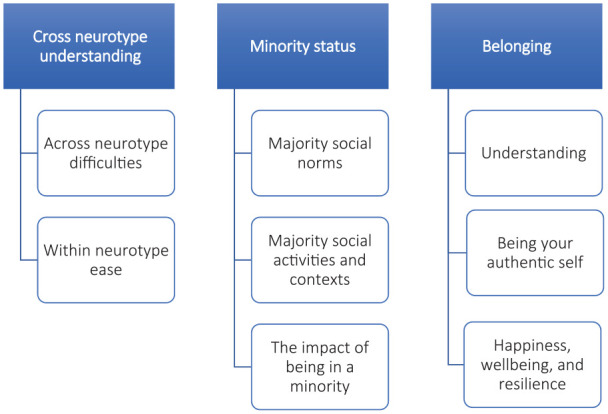
Many autistic people are motivated to have friends, relationships and close family bonds, despite the clinical characterisation of autism as a condition negatively affecting social interaction. Many first-hand accounts of autistic people describe feelings of comfort and ease specifically with other autistic people. This qualitative research explored and contrasted autistic experiences of spending social time with neurotypical and autistic friends and family. In total, 12 autistic adults (10 females, aged 21–51) completed semi-structured interviews focused on time spent with friends and family; positive and negative aspects of time spent with neurotypical and autistic friends and family; and feelings during and after spending time together. Three themes were identified: cross-neurotype understanding, minority status and belonging. Investigation of these themes reveals the benefits of autistic people creating and maintaining social relationships with other autistic people, in a more systematic way than previous individual reports. They highlight the need for autistic-led social opportunities and indicate benefits of informal peer support for autistic adults. Lay abstract Although autistic people may struggle to interact with others, many autistic people have said they find interacting with other autistic people more comfortable. To find out whether this was a common experience, we did hour-long interviews with 12 autistic adults. We asked them questions about how it feels when spending time with their friends and family, and whether it felt different depending on whether the friends and family were autistic or neurotypical. We analysed the interviews and found three common themes in what our participants said. First, they found spending with other autistic people easier and more comfortable than spending time with neurotypical people, and felt they were better understood by other autistic people. Second, autistic people often felt they were in a social minority, and in order to spend time with neurotypical friends and family, they had to conform with what the neurotypical people wanted and were used to. Third, autistic people felt like they belonged with other autistic people and that they could be themselves around them. These findings show that having time with autistic friends and family can be very beneficial for autistic people and played an important role in a happy social life.
Overview
The claims and statistics of this paper haven’t been checked yet.
Run the check — free, no account needed. It reads the open-access text and checks the sources it cites.
Integrity signals
Registry
Cites
Statistics
Figures
Verification
Claims the paper makes
The claims and statistics of this paper haven’t been checked yet.
Run the check — free, no account needed. It reads the open-access text and checks the sources it cites.
Claims other papers make about this one
Each is checked against this paper’s own text: does it say what the citing paper says it does?
The cited source says what the claim attributes to it.
In the citing paper
“It is imperative to keep in mind that even Autistic people who lack fluency in “neurotypical” social skills can engage in successful interactions and form meaningful, reciprocal social bonds with others on and off the spectrum (Chen et al., 2021; Crompton et al., 2020; Davis & Crompton, 2021; Heasman & Gillespie, 2019).”
From Neurodiversity and Autism Intervention: Reconciling Perspectives Through a Naturalistic Developmental Behavioral Intervention Framework (2022) · cites this paper as Crompton et al., 2020
The cited source says what the claim attributes to it.
In the citing paper
“The double empathy problem further highlights that communication differences between autistic and non-autistic people are reciprocal, emerging through mismatches in how meaning is expressed and understood (Milton, 2012; Crompton et al., 2020; Davis and Crompton, 2021)”
From The system-level organisational design framework: a neuro-cognitive trait interaction approach to workplace inclusion for autistic people (2026) · cites this paper as Crompton et al., 2020
Self-check
Percentages, sums and reported differences re-computed from the paper’s own numbers.
The self-check needs the paper’s full text.
Citations
Cites
Using thematic analysis in psychology
Braun, V., & Clarke, V. (2006) · Qualitative Research in Psychology · doi:10.1191/1478088706qp063oa · Cited by 194,414
Diagnostic and Statistical Manual of Mental Disorders
American Psychiatric Association (2013) · doi:10.1176/appi.books.9780890425596 · Cited by 116,369
Meyer, I. H. (2003) · Psychological Bulletin · doi:10.1037/0033-2909.129.5.674 · Cited by 14,736
Social Relationships and Health
House, J. S., Landis, K. R., & Umberson, D. (1988) · Science · doi:10.1126/science.3399889 · Cited by 7,073
Baron-Cohen, S., Wheelwright, S., Skinner, R., Martin, J., & Clubley, E. (2001) · Journal of Autism and Developmental Disorders · doi:10.1023/a:1005653411471 · Cited by 6,450
Social Relationships and Health.
Cohen, S. (2004) · American Psychologist · doi:10.1037/0003-066x.59.8.676 · Cited by 4,852
Perceived discrimination and health: A meta-analytic review.
Pascoe, E. A., & Smart Richman, L. (2009) · Psychological Bulletin · doi:10.1037/a0016059 · Cited by 4,427
Kawachi, I. I. (2001) · Journal of Heredity · doi:10.1093/jurban/78.3.458 · Cited by 3,565
Introducing Qualitative Research in Psychology
Willig, C. (2001) · Cited by 3,012
Racism as a stressor for African Americans: A biopsychosocial model.
Clark, R., Anderson, N. B., Clark, V. R., & Williams, D. R. (1999) · American Psychologist · doi:10.1037/0003-066x.54.10.805 · Cited by 2,830
Research works printed but not linked: 3
- Crompton C. J., 2019, International Society for Autism Research Annual Conference
- Iemmi V., 2017, The autism dividend: Reaping the rewards of better investment
- Wechsler D., 2011, WASI-II: Wechsler Abbreviated Scale of Intelligence–Second edition
Cited by
Sorted by citations
Items 201–300 of 349
Experiences of friendship among autistic adults: a scoping review
Tian, W., & Wang, D.-C. (2025) · Frontiers in Psychiatry · doi:10.3389/fpsyt.2025.1523506 · Cited by 2
Szechy, K. A., & O’Donnell, L. A. (2025) · Autism in Adulthood · doi:10.1089/aut.2024.0261 · Cited by 1
Effects of Neurotype and Neurotype Matching on Conversational Rapport and Masking.
Wolford, G. W. (2025) · American Journal of Speech-Language Pathology · doi:10.1044/2025_ajslp-24-00463 · Cited by 2
Nor weak ties, nor strong ties: Personal support networks and relations between autistic peers
Courcy, I., Cusson, N., & Jeanneret, N. (2025) · Autism · doi:10.1177/13623613251369908 · Cited by 2
An exploratory study on autistic socialization in VRChat’s social virtual environments
Grillo, V. D., & Venuti, P. (2025) · Research in Developmental Disabilities · doi:10.1016/j.ridd.2025.105105 · Cited by 4
How the ASCENT model can help optimize exposure therapies for Autistic clients
Brook, A. (2025) · Frontiers in Psychiatry · doi:10.3389/fpsyt.2025.1569882 · Cited by 2
Ciric, T., White, L., Allison-Duncan, C., Maloney, E., & Gillespie‐Smith, K. (2025) · Autism · doi:10.1177/13623613251407765 · Cited by 2
Laet, H. D., Nijhof, A., & Wiersema, J. (2026) · Research in Autism · doi:10.1016/j.reia.2026.202814 · Cited by 3
Jones, B. M., Hayden‐Evans, M., Afsharnejad, B., Lee, E. A. L., Milbourn, B. T., Bölte, S., & Girdler, S. J. (2026) · Research in Autism · doi:10.1016/j.reia.2026.202825 · Cited by 2
Matyjek, M., Dziobek, I., Hamilton, A. F. D. C., & Wheatley, T. P. (2026) · Autism in Adulthood · doi:10.1177/25739581251375249 · Cited by 3
Foster, S. J., Dunn, D. H., Patel, S. D., Pinkham, A. E., Ackerman, R. A., & Sasson, N. J. (2026) · Autism · doi:10.1177/13623613251415129 · Cited by 3
Cooper, S., Doherty, M., & Shaw, S. C. K. (2026) · PLoS ONE · doi:10.1371/journal.pone.0345156 · Cited by 2
Minnell, H., Waddington, H. L., Jordan, P., Noble, B., & Bowden, C. J. (2026) · Autism · doi:10.1177/13623613261451898 · Cited by 2
Figueroa, K., Baczewski, L. M., & Kasari, C. L. (2022) · Autism and child psychopathology series · doi:10.1007/978-3-030-98507-3_22 · Cited by 3
Hutchins, T. L. (2022) · Seminars in Speech and Language · doi:10.1055/s-0042-1750814 · Cited by 2
Chapple, M., Davis, P. M., Billington, J., & Corcoran, R. (2023) · Frontiers in Psychology · doi:10.3389/fpsyg.2023.1001268 · Cited by 2
Halverson, M. M., & Lowmaster, S. E. (2024) · Focus on Autism and Other Developmental Disabilities · doi:10.1177/10883576231221781 · Cited by 2
Emotions: Investigating the Vital Role of Tactile Interaction
Chen, X., & Zhang, M. T. (2024) · Lecture notes in computer science · doi:10.1007/978-3-031-60405-8_21 · Cited by 2
Alhusayni, A., Sheppard, E., & Marsh, L. (2024) · Autism in Adulthood · doi:10.1089/aut.2024.0107 · Cited by 2
Stim culture: Outlining anime's appeal to the autistic community
Rose, M. C., Galbraith, P. W., & Thomas-Parr, G. (2024) · International Journal of Cultural Studies · doi:10.1177/13678779241293159 · Cited by 2
Autism and the Pseudoscience of Mind
LaCroix, T. (2025) · Psychological Inquiry · doi:10.1080/1047840x.2025.2605590 · Cited by 2
Loo, B. R. Y., Teo, T. J. Y., Liang, M. J., Leong, D.-J., Tan, D. W., Zhuang, S., Hull, L., Livingston, L. A., Mandy, W., Happe, F. G. E., et al. (2021) · doi:10.31219/osf.io/cg8ak · Cited by 2
Keates, N. (2022) · Comedy Studies · doi:10.1080/2040610x.2022.2091902 · Cited by 1
Gréaux, M., Katsos, N., & Gibson, J. L. (2023) · doi:10.31234/osf.io/6wj2p · Cited by 2
Cultural Humility, a Path to Equity
Wright, P. I., & Murphy, J. (2022) · Autism and child psychopathology series · doi:10.1007/978-3-030-98507-3_12 · Cited by 2
Hammond, K. (2024) · Developing Academic Practice · doi:10.3828/dap.2024.14 · Cited by 1
A pilot study of Chinese parents’ perceptions of friendships in autistic children
Fu, W., Ma, Z., Xu, F., Gu, P., Si-ting, H., Yang, L., Zhang, Y., & Zhou, W. (2024) · International Journal of Developmental Disabilities · doi:10.1080/20473869.2024.2428896 · Cited by 1
Brief report: Social relationships among autistic young adults with varying cognitive abilities
Gohari, D., Park, J., Schiltz, H. K., & Lord, C. (2024) · Research in Autism · doi:10.1016/j.rasd.2024.102524 · Cited by 1
Firouzeh, P., Hlyva, O., Freeman, M., Jang, H., & Rezze, B. D. (2025) · Disability and Rehabilitation · doi:10.1080/09638288.2025.2450768 · Cited by 1
Edge, J. J., & Parker, S. C. (2025) · SN Social Sciences · doi:10.1007/s43545-025-01048-2 · Cited by 1
Thakur, A., Vemuri, D., & Gledhill, M. (2025) · Social Psychiatry and Psychiatric Epidemiology · doi:10.1007/s00127-025-02884-6 · Cited by 1
Perceived Neurotype of the Other May Affect Self/Other-Representation in Autistic People
Moseley, R., Hung, K., & Sui, J. (2025) · Neurodiversity · doi:10.1177/27546330251339560 · Cited by 1
Waddington, H. L., Minnell, H., Wallace, H., Patrick, L., Moriah, C., Noble, B., & Wallace-Watkin, C. (2025) · Autism in Adulthood · doi:10.1089/aut.2024.0337 · Cited by 1
Wilks, C. E. H., Foster, S. J., Dodd, M., Fletcher‐Watson, S., Lages, M., Ropar, D., Sasson, N. J., & Crompton, C. J. (2025) · PLoS ONE · doi:10.1371/journal.pone.0329825 · Cited by 1
Self-citationRethinking Face‐to‐Face Interaction: Lessons from Studies of “Autistic Sociality”
Johannessen, L. E. F. (2025) · Symbolic Interaction · doi:10.1002/symb.70017 · Cited by 1
Brake, J. (2025) · Sociological Forum · doi:10.1111/socf.70005 · Cited by 1
Schiltz, H. K., Su, D., Lerner, J. E., Mazefsky, C. A., & Lord, C. (2025) · Journal of Autism and Developmental Disorders · doi:10.1007/s10803-025-07005-5 · Cited by 1
Streamlining Adult Autism Diagnosis: High-yield DSM-5-TR Predictors and Sex-Based Considerations
Whaling, K. M., Crehan, E. T., & Loftin, R. L. (2025) · Journal of Autism and Developmental Disorders · doi:10.1007/s10803-025-07101-6 · Cited by 1
Lois-Mosquera, M., Zhong, Y., Mandy, W., & Dimitriou, D. (2025) · Research in Neurodiversity · doi:10.1016/j.rin.2025.100008 · Cited by 1
Exploring Neurodiversity’s Influence on Chronic Misfit
Follmer, E. H. (2025) · Springer eBooks · doi:10.1007/978-981-96-8208-9_8 · Cited by 1
Dinishak, J. (2025) · The Monist · doi:10.1093/monist/onaf025 · Cited by 1
Social Evaluation of Neurotype-Dependent Media Contents in Autistic and Non-Autistic Adults
Alexandrovsky, M., Ai, W., Yu, J. X., Cunningham, W. A., & Lai, M.-C. (2026) · Autism in Adulthood · doi:10.1177/25739581261416455 · Cited by 1
Crafting Livable Worlds: Sensory, Creative, and Nonhuman Supports in Autistic Adults’ Everyday Lives
Rose, M. C., & Lupton, D. (2026) · Autism in Adulthood · doi:10.1177/25739581261426633 · Cited by 1
Growing-up autistic: Sharing autistic children’s experiences and insights
Mullally, S. L., Wood, A. E., Edwards, C. C., Connolly, S. E., Constable, H., Watson, S., Rodgers, J., Rose, K., & King, N. (2026) · Autism · doi:10.1177/13623613261427795 · Cited by 16
Encouraging Interpersonal Motor Synchrony Benefits Children with Autism
Galbraith, C., Sturges, M., & Gray, T. L. (2026) · Current Developmental Disorders Reports · doi:10.1007/s40474-026-00350-9 · Cited by 1
White, E.-M., & Fox, L. (2026) · Research in Neurodiversity · doi:10.1016/j.rin.2026.100028 · Cited by 1
Rum, Y., Feldman, N., Genzer, S., Allison, C. L., Golan, O., Perry, A., & Baron‐Cohen, S. (2026) · Molecular Autism · doi:10.1186/s13229-026-00723-2 · Cited by 1
Longhurst, P., Burnette, C. B., Cascio, M. A., Maloney, E., & Tylka, T. L. (2026) · Body Image · doi:10.1016/j.bodyim.2026.102140 · Cited by 1
“Just Believe Me”: Autistic Students’ Descriptions of School Inclusion in Nova Scotia
Lawy, N., & Barker, C. (2026) · Canadian Journal of School Psychology · doi:10.1177/08295735261472157 · Cited by 1
Social Behavior and Social Interventions for Adults on the Autism Spectrum
Moody, C. T., & Laugeson, E. A. (2022) · Autism and child psychopathology series · doi:10.1007/978-3-030-98507-3_20 · Cited by 1
Short Report on Effectiveness of an Autistic-Delivered Peer Support Program: Preliminary Results
Song, W., Salzer, M. S., Kaplan, K., Wong, M.-Y., Uppal, D., & Shea, L. (2023) · Community Mental Health Journal · doi:10.1007/s10597-023-01174-2 · Cited by 2
The interaction between social and communication skills in individuals with intellectual disability
Channell, M. M., & Mattie, L. J. (2023) · International review of research in developmental disabilities · doi:10.1016/bs.irrdd.2023.08.001 · Cited by 1
Cognitive Science Today, What is it to You?
Jaegher, H. D. (2023) · Journal of Consciousness Studies · doi:10.53765/20512201.30.11.214 · Cited by 1
Lisdahayati, L., Rustiati, N., Yunike, Y., & Kusumawaty, I. (2023) · Journal of Telenursing (JOTING) · doi:10.31539/joting.v5i2.5340 · Cited by 1
Self-Diagnosis of Autism: What Is the Speech-Language Pathologist's Role?
Coburn, K. L. (2024) · Perspectives of the ASHA Special Interest Groups · doi:10.1044/2024_persp-24-00110 · Cited by 1
Neurodiversity and Social Inclusion
Kumagaya, S. (2024) · Japanese Sociological Review · doi:10.4057/jsr.74.697 · Cited by 1
Asperger writers’ attention and awareness in written production
Zhong, Y. (2025) · Language Awareness · doi:10.1080/09658416.2025.2556937 · Cited by 1
Mimicry is associated with procedural learning, not social bonding, neural systems in autismPreprint
Tunçgenç, B., Koch, C., Herstic, A., Eigsti, I., & Mostofsky, S. H. (2020) · bioRxiv (Cold Spring Harbor Laboratory) · doi:10.1101/2020.09.16.299370 · Cited by 1
Hudson, M., Santavirta, S., Putkinen, V., Seppälä, K., Sun, L., Karjalainen, T., Karlsson, H. K., Hirvonen, J., & Nummenmaa, L. (2022) · bioRxiv (Cold Spring Harbor Laboratory) · doi:10.1101/2022.03.24.485704 · Cited by 1
Jones, R. (2023) · Cronfa (Swansea University) · doi:10.23889/suthesis.63767 · Cited by 1
The Why-When-How-What Model: Autistic Persons Advise Parents on Diagnosis DisclosurePreprint
Almog, N., Keren, E. H., Gabai, T., & Kassel, O. (2023) · Research Square · doi:10.21203/rs.3.rs-3173767/v1 · Cited by 1
Autistic Space: Definition and History
Dinishak, J., & Akhtar, N. (2024) · Springer eBooks · doi:10.1007/978-3-031-40858-8_19-1 · Cited by 1
Harada, N., Pellicano, E., Kumagaya, S., Ayaya, S., Asada, K., & Senju, A. (2024) · doi:10.31234/osf.io/my3r9 · Cited by 1
“A difference in typical values”: autistic perspectives on autistic social communicationPreprint
Sutherland, H. E. A., Fletcher‐Watson, S., Long, J., & Crompton, C. J. (2024) · doi:10.31219/osf.io/2us8a · Cited by 1
Self-citationDark, J. (2026) · Frontiers in Psychology · doi:10.3389/fpsyg.2026.1826284
Hidalgo, N., Sjöwall, D., Agius, H., Byström, C., Brar, A., Borg, J., & Hirvikoski, T. (2021) · Research Square · doi:10.21203/rs.3.rs-1121143/v1
Development of stigma-related support for autistic adults: insights from the autism communityPreprint
Han, E. K. L., Scior, K., Heath, E. L., Umagami, K., & Crane, L. (2022) · doi:10.31219/osf.io/qf4rb
Scoping Review of the Factors Influencing Compatibility of Autistic Roommates
Bailey, A., & Mullins, L. E. (2022) · Current Developmental Disorders Reports · doi:10.1007/s40474-022-00264-2
Zhuang, S., Tan, D. W., Reddrop, S., Dean, L., Maybery, M. T., & Magiati, I. (2023) · doi:10.31219/osf.io/cgzbu
Autistic Friendships in Mainstream Primary Schools
Adams, G. (2023) · Psych-Talk · doi:10.53841/bpstalk.2023.1.104.4
DOROSŁOŚĆ OSÓB W SPEKTRUM ZABURZEŃ AUTYSTYCZNYCH – ANALIZA WYBRANYCH OBSZARÓW
Buchholz, A., & Czerwińska, K. (2023) · Forum Pedagogiczne · doi:10.21697/fp.2023.1.03
Interpreting Female Social Relationships: Autism Friendships and Pragmatic Language
Gabrielsen, T. P., Begay, K. K., Campbell, K. M., Hahn, K., & Harrington, L. T. (2023) · Springer eBooks · doi:10.1007/978-3-031-33969-1_6
McDonald, T. A. M. (2023) · Springer eBooks · doi:10.1007/978-3-031-42383-3_15
O’Shea, D., Lisiecka, D., & McGarty, P. (2024) · Advances in Communication and Swallowing · doi:10.3233/acs-230010 · Cited by 1
Echoes of Understanding: An In-Depth Exploration of Autism Awareness and Community Support Initia
Beigh, S., Alzahrani, S. M., Fahad, N., Alghamdi, Y. A., Jabbar, A., Babiker, W. A. M., Al-Shehri, M. S., Abdalla, B. A. E., Nour, L. M., & Ahmad, R. M. (2024) · Natural Resources for Human Health · doi:10.53365/nrfhh/188176
Sutherland, H. E. A., Axbey, H., Sharp, M., Ropar, D., Fletcher‐Watson, S., & Crompton, C. J. (2024) · doi:10.31219/osf.io/pt942
Self-citationEnhancing Peer Greeting Skills in Early Childhood Children with ASD Through SST
Shafa, Q. F., & Susetyo, B. (2024) · Proceeding of International Conference on Special Education in South East Asia Region · doi:10.57142/picsar.v3i1.538
Sutherland, H. E. A., Crompton, C. J., Long, J., & Fletcher‐Watson, S. (2024) · doi:10.31219/osf.io/kn2wr
Self-citationNeurodiversity-affirming clinical care for adults with intellectual and developmental disabilities
Brandsen, S., Chandrasekhar, T., & Franz, L. (2024) · International review of research in developmental disabilities · doi:10.1016/bs.irrdd.2024.08.001
Wigham, S., Welsh, P., Ingham, B., Wilson, C., Fisher-Rogers, A., Lees, R., McConnell, O., Nedyalkova, A., Nicholson, L., Couteur, A. S. L., et al. (2024) · Autism in Adulthood · doi:10.1089/aut.2023.0079
Levy, B. (2024) · Murmurations Journal of Transformative Systemic Practice · doi:10.28963/7.2.1
Community Social Well-Being Inclusivity with Disability
Ntinda, K., & Reed, B. (2024) · Springer eBooks · doi:10.1007/978-981-97-0821-5_101-1
Music and Autism: Time for a Reappraisal?
Heaton, P. F. (2024) · Springer eBooks · doi:10.1007/978-3-031-70403-1_4
Using Photovoice to Capture the Quality of Life of the Australian Autistic Community
Kuzminski, R., Black, M. H., Bölte, S., Lawson, W. B., Falkmer, M., Philips, S., Girdler, S. J., & Milbourn, B. T. (2025) · Autism in Adulthood · doi:10.1089/aut.2023.0178 · Cited by 1
Jolliffe, R., Adams, D., & Simpson, K. (2025) · Research in Autism · doi:10.1016/j.reia.2025.202552
Emergence and Persistence of Loneliness Among Autistic Adults: A Theoretical Framework
Schiltz, H. K., & Lord, C. (2025) · Autism in Adulthood · doi:10.1089/aut.2024.0149
Enhancing Parental Psychological Well-Being in Autism: The Role of Social Support and Religiosity
Fatimah, S., & Fitriati, S. (2025) · KnE Social Sciences · doi:10.18502/kss.v10i7.18355
Rum, Y., Dolev, A., Reichmann, O., Zachor, D. A., Avni, E., Ilan, M., Meiri, G., & Koller, J. (2025) · Frontiers in Psychology · doi:10.3389/fpsyg.2025.1568110
Autistic Space: Definition and History
Dinishak, J., & Akhtar, N. (2025) · Springer eBooks · doi:10.1007/978-3-031-40858-8_19-2
Miotti, S. (2025) · IGI Global eBooks · doi:10.4018/979-8-3373-4445-4.ch002
Dufresne, S., & Crehan, E. T. (2025) · IGI Global eBooks · doi:10.4018/979-8-3693-8920-1.ch003
The Autistic Advantage as an Researcher in Autism
Whitney, E. (2025) · IGI Global eBooks · doi:10.4018/979-8-3693-8044-4.ch017
Allen, L. L., Syed, N. Y., & Daou, N. (2025) · IGI Global eBooks · doi:10.4018/979-8-3373-6350-9.ch006
Do we have more empathy for people who are similar to us? New research suggests it’s not that simple
Hargitai, L. D., Shah, P., & Livingston, L. A. (2024) · doi:10.64628/ab.7pdr4uq7g
Henman, I. (2025) · Journal of Widening Participation and Lifelong Learning · doi:10.5456/wpll.27.2.176
The Self–Other Imbalance Hypothesis of Autism: An Empirical Investigation
Galvin, J. (2025) · Autism in Adulthood · doi:10.1177/25739581251370469
Li, J., & Shum, K. K. (2025) · Journal of Autism and Developmental Disorders · doi:10.1007/s10803-025-07039-9 · Cited by 2
Autistic and non-autistic prosocial decision-making: The impact of recipient neurotype
Rush, P., Keating, C. T., Lugtmeijer, S., Allmark, E., Davis, A. L., Beejadhur, A., Tarling, A., Hannon, S., Todd, K., Iddles, A., et al. (2025) · Research in Autism · doi:10.1016/j.reia.2025.202710
When music rethinks empathy in autism: A commentary on Heaton (2025)
Zhong, Y. (2025) · Research in Neurodiversity · doi:10.1016/j.rin.2025.100005
Metadata
- Authors
- Crompton, C. J., Hallett, S., Ropar, D., Flynn, E., & Fletcher-Watson, S.
- Affiliations
- University of Edinburgh (GB)
- Autistic Mutual Aid Society Edinburgh, UK
- University of Nottingham (GB)
- Queen's University Belfast (GB)
- The University of Edinburgh, UK
- Corresponding author
- Crompton, Catherine J
- Venue
- Autism
- Publisher
- SAGE Publications
- Published
- 2020-03-07
- Volume
- 24
- Issue
- 6
- Pages
- 1438-1448
- ISSN
- 1362-3613 (ISSN-L)
- 1461-7005
- PMC
- PMC7376620
- OpenAlex
- W3009630179
- Cited by
- 351
- References
- 60
- Citations by year
- 2026: 54 · 2025: 74 · 2024: 78 · 2023: 56 · 2022: 57 · 2021: 27 · 2020: 5
- FWCI
- 19.35
- Type
- journal article
- Language
- en
- Open access
- hybrid
- doi.org
- Licence
- Locations
- Autism (publishedVersion, cc-by-nc)
- PubMed Central (publishedVersion, cc-by-nc)
- PubMed (publishedVersion)
- Repository@Nottingham (University of Nottingham) (acceptedVersion, other-oa)
- OSF Preprints (OSF Preprints) (acceptedVersion)
- Repository@Nottingham (University of Nottingham) (submittedVersion, cc-by-nc-nd)
- Edinburgh Research Explorer (University of Edinburgh) (submittedVersion, cc-by-nc)
- Research Portal (Queen's University Belfast) (submittedVersion, cc-by-nc)
- OSF Preprints (OSF Preprints) (submittedVersion, cc-by)
- Funders
- Templeton World Charity Foundation (TWCF0200)
- Topics
- Life Sciences › Neuroscience › Cognitive Neuroscience › Autism Spectrum Disorder Research
- Social Sciences › Psychology › Clinical Psychology › Family and Disability Support Research
- Social Sciences › Sociology and Political Science › Disability Rights and Representation
- Keywords
- autistic adults, interpersonal relationships, family relationships, minority status, sense of belonging, peer support, social interaction
- MeSH terms
- Autism Spectrum Disorder, Adult, Autistic Disorder, Emotions, Happiness, Humans, Friends
About these checks
Registry, retraction, Cites and statistics results are computed, not judged, with one exception: a printed reference that no index lists is read once by a model before it counts as a citation error. Claims are extracted by a model and kept only when their quote appears verbatim in the text; each cited source is then checked, with a model’s help, for whether it says what the claim relies on. Those verdicts can be wrong — read the claim’s quote and the cited source before relying on one.
Statistics and arithmetic are recomputed, not judged.
Confidence bands are shown only for fields calibrated on our annotated test set. None is calibrated yet, so no band is shown.
What counts as a claim ›How we measure confidence ›How we check this ›
Are you an author, or do you see a problem with this page? Request a review
