

The DOI matches its Crossref record; 60 of the 60 references it cites were found in a registry or an index.
‘I never realised everybody felt as happy as I do when I am around autistic people’: A thematic analysis of autistic adults’ relationships with autistic and neurotypical friends and family
Open accessPublished version of a preprint
Abstract
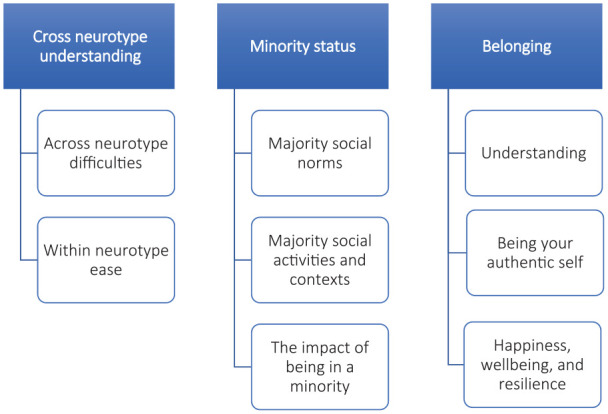
Many autistic people are motivated to have friends, relationships and close family bonds, despite the clinical characterisation of autism as a condition negatively affecting social interaction. Many first-hand accounts of autistic people describe feelings of comfort and ease specifically with other autistic people. This qualitative research explored and contrasted autistic experiences of spending social time with neurotypical and autistic friends and family. In total, 12 autistic adults (10 females, aged 21–51) completed semi-structured interviews focused on time spent with friends and family; positive and negative aspects of time spent with neurotypical and autistic friends and family; and feelings during and after spending time together. Three themes were identified: cross-neurotype understanding, minority status and belonging. Investigation of these themes reveals the benefits of autistic people creating and maintaining social relationships with other autistic people, in a more systematic way than previous individual reports. They highlight the need for autistic-led social opportunities and indicate benefits of informal peer support for autistic adults. Lay abstract Although autistic people may struggle to interact with others, many autistic people have said they find interacting with other autistic people more comfortable. To find out whether this was a common experience, we did hour-long interviews with 12 autistic adults. We asked them questions about how it feels when spending time with their friends and family, and whether it felt different depending on whether the friends and family were autistic or neurotypical. We analysed the interviews and found three common themes in what our participants said. First, they found spending with other autistic people easier and more comfortable than spending time with neurotypical people, and felt they were better understood by other autistic people. Second, autistic people often felt they were in a social minority, and in order to spend time with neurotypical friends and family, they had to conform with what the neurotypical people wanted and were used to. Third, autistic people felt like they belonged with other autistic people and that they could be themselves around them. These findings show that having time with autistic friends and family can be very beneficial for autistic people and played an important role in a happy social life.
Overview
The claims and statistics of this paper haven’t been checked yet.
Run the check — free, no account needed. It reads the open-access text and checks the sources it cites.
Integrity signals
Registry
Cites
Statistics
Figures
Verification
Claims the paper makes
The claims and statistics of this paper haven’t been checked yet.
Run the check — free, no account needed. It reads the open-access text and checks the sources it cites.
Claims other papers make about this one
Each is checked against this paper’s own text: does it say what the citing paper says it does?
The cited source says what the claim attributes to it.
In the citing paper
“It is imperative to keep in mind that even Autistic people who lack fluency in “neurotypical” social skills can engage in successful interactions and form meaningful, reciprocal social bonds with others on and off the spectrum (Chen et al., 2021; Crompton et al., 2020; Davis & Crompton, 2021; Heasman & Gillespie, 2019).”
From Neurodiversity and Autism Intervention: Reconciling Perspectives Through a Naturalistic Developmental Behavioral Intervention Framework (2022) · cites this paper as Crompton et al., 2020
The cited source says what the claim attributes to it.
In the citing paper
“The double empathy problem further highlights that communication differences between autistic and non-autistic people are reciprocal, emerging through mismatches in how meaning is expressed and understood (Milton, 2012; Crompton et al., 2020; Davis and Crompton, 2021)”
From The system-level organisational design framework: a neuro-cognitive trait interaction approach to workplace inclusion for autistic people (2026) · cites this paper as Crompton et al., 2020
Self-check
Percentages, sums and reported differences re-computed from the paper’s own numbers.
The self-check needs the paper’s full text.
Citations
Cites
Using thematic analysis in psychology
Braun, V., & Clarke, V. (2006) · Qualitative Research in Psychology · doi:10.1191/1478088706qp063oa · Cited by 194,414
Diagnostic and Statistical Manual of Mental Disorders
American Psychiatric Association (2013) · doi:10.1176/appi.books.9780890425596 · Cited by 116,369
Meyer, I. H. (2003) · Psychological Bulletin · doi:10.1037/0033-2909.129.5.674 · Cited by 14,736
Social Relationships and Health
House, J. S., Landis, K. R., & Umberson, D. (1988) · Science · doi:10.1126/science.3399889 · Cited by 7,073
Baron-Cohen, S., Wheelwright, S., Skinner, R., Martin, J., & Clubley, E. (2001) · Journal of Autism and Developmental Disorders · doi:10.1023/a:1005653411471 · Cited by 6,450
Social Relationships and Health.
Cohen, S. (2004) · American Psychologist · doi:10.1037/0003-066x.59.8.676 · Cited by 4,852
Perceived discrimination and health: A meta-analytic review.
Pascoe, E. A., & Smart Richman, L. (2009) · Psychological Bulletin · doi:10.1037/a0016059 · Cited by 4,427
Kawachi, I. I. (2001) · Journal of Heredity · doi:10.1093/jurban/78.3.458 · Cited by 3,565
Introducing Qualitative Research in Psychology
Willig, C. (2001) · Cited by 3,012
Racism as a stressor for African Americans: A biopsychosocial model.
Clark, R., Anderson, N. B., Clark, V. R., & Williams, D. R. (1999) · American Psychologist · doi:10.1037/0003-066x.54.10.805 · Cited by 2,830
Research works printed but not linked: 3
- Crompton C. J., 2019, International Society for Autism Research Annual Conference
- Iemmi V., 2017, The autism dividend: Reaping the rewards of better investment
- Wechsler D., 2011, WASI-II: Wechsler Abbreviated Scale of Intelligence–Second edition
Cited by
Sorted by citations
Autistic peer-to-peer information transfer is highly effective
Crompton, C. J., Ropar, D., Evans-Williams, C. V., Flynn, E. G., & Fletcher-Watson, S. (2020) · Autism · doi:10.1177/1362361320919286 · Cited by 524
Self-citationUnderstanding Stigma in Autism: A Narrative Review and Theoretical Model
Turnock, A., Langley, K., & Jones, C. R. G. (2022) · Autism in Adulthood · doi:10.1089/aut.2021.0005 · Cited by 490
Crompton, C. J., Sharp, M., Axbey, H., Fletcher‐Watson, S., Flynn, E., & Ropar, D. (2020) · Frontiers in Psychology · doi:10.3389/fpsyg.2020.586171 · Cited by 299
Self-citationA capabilities approach to understanding and supporting autistic adulthood
Pellicano, E., Fatima, U., Hall, G., Heyworth, M., Lawson, W., Lilley, R., Mahony, J., & Stears, M. (2022) · Nature Reviews Psychology · doi:10.1038/s44159-022-00099-z · Cited by 237
Schuck, R. K., Tagavi, D. M., Baiden, K. M. P., Dwyer, P., Williams, Z. J., Osuna, A., Ferguson, E. F., Jimenez Muñoz, M., Poyser, S. K., Johnson, J. F., et al. (2022) · Journal of Autism and Developmental Disorders · doi:10.1007/s10803-021-05316-x · Cited by 208
Loneliness in autistic adults: A systematic review
Umagami, K., Remington, A., Lloyd‐Evans, B., Davies, J., & Crane, L. (2022) · Autism · doi:10.1177/13623613221077721 · Cited by 218
‘Anything but the phone!’: Communication mode preferences in the autism community
Howard, P. L., & Sedgewick, F. (2021) · Autism · doi:10.1177/13623613211014995 · Cited by 177
Suicidality in autistic youth: A systematic review and meta-analysis
O'Halloran, L., Coey, P., & Wilson, C. (2022) · Clinical Psychology Review · doi:10.1016/j.cpr.2022.102144 · Cited by 146
Reconsidering autistic ‘camouflaging’ as transactional impression management
Ai, W., Cunningham, W. A., & Lai, M.-C. (2022) · Trends in Cognitive Sciences · doi:10.1016/j.tics.2022.05.002 · Cited by 140
Chapman, L., Rose, K., Hull, L., & Mandy, W. (2022) · Research in Autism · doi:10.1016/j.rasd.2022.102069 · Cited by 171
Davis, R., & Crompton, C. J. (2021) · Perspectives on Psychological Science · doi:10.1177/1745691620958010 · Cited by 136
Self-citationRivera, R. A., & Bennetto, L. (2023) · Frontiers in Psychiatry · doi:10.3389/fpsyt.2023.1243657 · Cited by 128
Inclusive Practices for Neurodevelopmental Research
Fletcher‐Watson, S., Brook, K., Hallett, S., Murray, F., & Crompton, C. J. (2021) · Current Developmental Disorders Reports · doi:10.1007/s40474-021-00227-z · Cited by 114
Self-citationMutual (Mis)understanding: Reframing Autistic Pragmatic “Impairments” Using Relevance Theory
Williams, G., Wharton, T., & Jagoe, C. (2021) · Frontiers in Psychology · doi:10.3389/fpsyg.2021.616664 · Cited by 104
Cooper, K., Russell, A., Lei, J., & Smith, L. G. E. (2022) · Autism · doi:10.1177/13623613221118351 · Cited by 127
Experiences of Friendships for Individuals on the Autism Spectrum: A Scoping Review
Black, M. H., Kuzminski, R., Wang, J., Ang, J., Lee, C., Hafidzuddin, S., & McGarry, S. (2022) · Review Journal of Autism and Developmental Disorders · doi:10.1007/s40489-022-00332-8 · Cited by 118
Social identities and mental well-being in autistic adults
Maitland-Warne, C., Rhodes, S., O'Hare, A. E., & Stewart, M. E. (2021) · Autism · doi:10.1177/13623613211004328 · Cited by 96
Pellicano, E., Lawson, W. B., Hall, G., Mahony, J., Lilley, R., Heyworth, M., Clapham, H., & Yudell, M. (2021) · Autism in Adulthood · doi:10.1089/aut.2021.0039 · Cited by 106
Zhuang, S., Tan, D. W., Reddrop, S., Dean, L., Maybery, M., & Magiati, I. (2023) · Clinical Psychology Review · doi:10.1016/j.cpr.2023.102335 · Cited by 90
Chen, Y., Schneider, M., & Patten, K. K. (2021) · Autism · doi:10.1177/13623613211046158 · Cited by 93
Gender differences in mental health prevalence in autism
Sedgewick, F., Leppänen, J., & Tchanturia, K. (2020) · Advances in Autism · doi:10.1108/aia-01-2020-0007 · Cited by 108
Autistic identity: A systematic review of quantitative research
Davies, J., Cooper, K., Killick, E., Sam, E., Healy, M., Thompson, G. A., Mandy, W., Redmayne, B. J. M., & Crane, L. (2024) · Autism Research · doi:10.1002/aur.3105 · Cited by 112
Corden, K., Brewer, R., & Cage, E. (2021) · Frontiers in Psychology · doi:10.3389/fpsyg.2021.699335 · Cited by 123
Botha, M., Dibb, B., & Frost, D. M. (2022) · Autism · doi:10.1177/13623613221080248 · Cited by 99
Crompton, C. J., Fotheringham, F., Cebula, K. R., Webber, C., Foley, S., & Fletcher‐Watson, S. (2024) · Neurodiversity · doi:10.1177/27546330241275248 · Cited by 86
Self-citationChen, Y.-L., Senande, L. L., Thorsen, M., & Patten, K. (2021) · Autism · doi:10.1177/13623613211005918 · Cited by 161
Investigating Markers of Rapport in Autistic and Nonautistic Interactions
Rifai, O., Fletcher-Watson, S., Jiménez-Sánchez, L., & Crompton, C. J. (2021) · Autism in Adulthood · doi:10.1089/aut.2021.0017 · Cited by 70
Self-citationCrompton, C. J., Hallett, S., Axbey, H., McAuliffe, C., & Cebula, K. R. (2022) · Autism · doi:10.1177/13623613221081189 · Cited by 80
Self-citationOredipe, T., Kofner, B., Riccio, A., Cage, E., Vincent, J., Kapp, S. K., Dwyer, P. S. R., & Gillespie‐Lynch, K. (2022) · Autism · doi:10.1177/13623613221086700 · Cited by 69
Autistic parents’ views and experiences of talking about autism with their autistic children
Crane, L., Lui, L. M., Davies, J., & Pellicano, E. (2021) · Autism · doi:10.1177/1362361320981317 · Cited by 63
Seeing and inviting participation in autistic interactions
Jaegher, H. D. (2021) · Transcultural Psychiatry · doi:10.1177/13634615211009627 · Cited by 58
Crompton, C. J., Hallett, S., McAuliffe, C., Stanfield, A. C., & Fletcher‐Watson, S. (2022) · Frontiers in Psychology · doi:10.3389/fpsyg.2022.831628 · Cited by 65
Self-citationDouble Empathy: Why Autistic People Are Often Misunderstood
Crompton, C. J., DeBrabander, K. M., Heasman, B., Milton, D. E. M., & Sasson, N. J. (2021) · Frontiers for Young Minds · doi:10.3389/frym.2021.554875 · Cited by 54
Self-citationGillespie-Smith, K., Hendry, G., Anduuru, N., Laird, T., & Ballantyne, C. (2021) · Research in Developmental Disabilities · doi:10.1016/j.ridd.2021.104081 · Cited by 52
Black, M. H., Clarke, P., Deane, E., Smith, D., Wiltshire, G., Yates, E., Lawson, W. B., & Chen, N. T. M. (2022) · Research in Autism · doi:10.1016/j.rasd.2022.102090 · Cited by 48
Jones, D. R., Botha, M., Ackerman, R. A., King, K., & Sasson, N. J. (2023) · Autism · doi:10.1177/13623613231219743 · Cited by 61
O’Connor, R., van den Bedem, N. P., Blijd-Hoogewys, E. M. A., Stockmann, L., & Rieffe, C. J. (2022) · Autism · doi:10.1177/13623613211073448 · Cited by 53
Cage, E., Cranney, R., & Botha, M. (2022) · Autism in Adulthood · doi:10.1089/aut.2021.0096 · Cited by 55
Dropping the mask: It takes two
Cook, J. M., Crane, L., & Mandy, W. (2023) · Autism · doi:10.1177/13623613231183059 · Cited by 59
McAuliffe, C., Walsh, R. J., & Cage, E. (2022) · Autism in Adulthood · doi:10.1089/aut.2021.0074 · Cited by 53
Autistic People's Experience of Empathy and the Autistic Empathy Deficit Narrative
Kimber, L., Verrier, D. B., & Connolly, S. (2023) · Autism in Adulthood · doi:10.1089/aut.2023.0001 · Cited by 54
Information transfer within and between autistic and non-autistic people
Crompton, C. J., Foster, S. J., Wilks, C. E. H., Dodd, M., Efthimiou, T. N., Ropar, D., Sasson, N. J., Lages, M., & Fletcher‐Watson, S. (2025) · Nature Human Behaviour · doi:10.1038/s41562-025-02163-z · Cited by 45
Self-citationWatts, G., Crompton, C. J., Grainger, C., Long, J. J., Botha, M., Somerville, M., & Cage, E. (2024) · Autism · doi:10.1177/13623613241255811 · Cited by 48
Self-citationA Reflective Analysis on Neurodiversity and Student Wellbeing
Spaeth, E., & Pearson, A. (2023) · Journal of Perspectives in Applied Academic Practice · doi:10.56433/jpaap.v11i2.517 · Cited by 60
Towards autistic flow theory: A non‐pathologising conceptual approach
Heasman, B., Williams, G., Charura, D., Hamilton, L., Milton, D. E. M., & Murray, F. (2024) · Journal for the Theory of Social Behaviour · doi:10.1111/jtsb.12427 · Cited by 45
Chapple, M., Davis, P. M., Billington, J., Myrick, J. A., Ruddock, C., & Corcoran, R. (2021) · Frontiers in Psychology · doi:10.3389/fpsyg.2021.708375 · Cited by 47
Pavlopoulou, G., Usher, C., & Pearson, A. (2022) · British Journal of Developmental Psychology · doi:10.1111/bjdp.12424 · Cited by 41
Development of stigma-related support for autistic adults: Insights from the autism community
Han, E. K. L., Scior, K., Heath, E., Umagami, K., & Crane, L. (2023) · Autism · doi:10.1177/13623613221143590 · Cited by 44
Szechy, K. A., Turk, P. D., & O’Donnell, L. A. (2023) · Autism in Adulthood · doi:10.1089/aut.2023.0046 · Cited by 43
Jones, D. R., Morrison, K. E., DeBrabander, K. M., Ackerman, R. A., Pinkham, A. E., & Sasson, N. J. (2021) · Frontiers in Psychology · doi:10.3389/fpsyg.2021.739147 · Cited by 36
Wilson, R. B., Thompson, A. R., Rowse, G., & Freeth, M. (2023) · Research in Autism · doi:10.1016/j.rasd.2023.102135 · Cited by 33
Promotion of Communication Access, Choice, and Agency for Autistic Students
Donaldson, A. L., corbin, E., Zisk, A. H., & Eddy, B. S. (2022) · Language Speech and Hearing Services in Schools · doi:10.1044/2022_lshss-22-00031 · Cited by 42
Nimbley, E., Gillespie‐Smith, K., Duffy, F., Maloney, E., Ballantyne, C. J., & Sharpe, H. (2023) · Journal of Eating Disorders · doi:10.1186/s40337-023-00813-z · Cited by 33
Social motor synchrony in autism spectrum conditions: A systematic review
Glass, D., & Yuill, N. (2023) · Autism · doi:10.1177/13623613231213295 · Cited by 39
What’s in a name? The costs and benefits of a formal autism diagnosis
Fletcher‐Watson, S. (2023) · Autism · doi:10.1177/13623613231213300 · Cited by 44
Self-citationWoods, S. E. O., & Estes, A. M. (2023) · Frontiers in Psychiatry · doi:10.3389/fpsyt.2023.1264516 · Cited by 41
Ferenc, K., Płatos, M., Byrka, K., & Król, M. E. (2022) · Autism · doi:10.1177/13623613221135818 · Cited by 41
Williams, G. (2021) · Journal of Pragmatics · doi:10.1016/j.pragma.2021.04.032 · Cited by 23
Autistic identity, culture, community, and space for well-being
Farahar, C. (2022) · Routledge eBooks · doi:10.4324/9781003056577-23 · Cited by 27
Peachey, M., & Crane, L. (2024) · Autism in Adulthood · doi:10.1089/aut.2023.0071 · Cited by 29
Dark, J. (2024) · Frontiers in Psychology · doi:10.3389/fpsyg.2024.1326536 · Cited by 26
A systematic review of autistic children’s prosocial behaviour
Ryan-Enright, T., O’Connor, R., Bramham, J., & Taylor, L. K. (2022) · Research in Autism · doi:10.1016/j.rasd.2022.102023 · Cited by 29
Mcpeake, E., Lamore, K., Boujut, É., Khoury, J. E., Pellenq, C., Plumet, M., & Cappe, É. (2023) · Research in Autism · doi:10.1016/j.rasd.2023.102172 · Cited by 26
Social self-efficacy and mental well-being in autistic adults: Exploring the role of social identity
Camus, L., Rajendran, G., & Stewart, M. (2023) · Autism · doi:10.1177/13623613231195799 · Cited by 28
Friedman, A., Paltoglou, A. E., & Sorte, R. (2024) · Neurodiversity · doi:10.1177/27546330241307828 · Cited by 28
Wigham, S., Ingham, B., Couteur, A. S. L., Wilson, C., Ensum, I., & Parr, J. R. (2022) · Autism · doi:10.1177/13623613221097502 · Cited by 25
Understanding Autistic Adults' Use of Social Media
van Driel, M., Vines, J., Pena, B. B., & Koteyko, N. (2023) · Proceedings of the ACM on Human-Computer Interaction · doi:10.1145/3610048 · Cited by 23
O'Connor, R. A. G., Doherty, M., Ryan-Enright, T., & Gaynor, K. (2023) · Autism · doi:10.1177/13623613231215026 · Cited by 21
Schuck, R. K., & Fung, L. K. (2024) · Frontiers in Psychiatry · doi:10.3389/fpsyt.2023.1250895 · Cited by 29
McNaughton, K. A., Moss, A., Yarger, H. A., & Redcay, E. (2024) · Autism · doi:10.1177/13623613241238269 · Cited by 22
Rapport in same and mixed neurotype groups of autistic and non-autistic adults
Foster, S. J., Ackerman, R. A., Wilks, C. E. H., Dodd, M., Calderon, R. M., Ropar, D., Fletcher‐Watson, S., Crompton, C. J., & Sasson, N. J. (2025) · Autism · doi:10.1177/13623613251320444 · Cited by 21
Self-citationThe Kind of Friend I Think I Am: Perceptions of Autistic and Non-autistic Young Adults
Finke, E. H. (2022) · Journal of Autism and Developmental Disorders · doi:10.1007/s10803-022-05573-4 · Cited by 29
Heyworth, M., Brett, S., den Houting, J., Magiati, I., Steward, R., Urbanowicz, A., Stears, M., & Pellicano, E. (2022) · Autism in Adulthood · doi:10.1089/aut.2021.0097 · Cited by 23
Lilley, R., Lawson, W. B., Hall, G., Mahony, J., Clapham, H., Heyworth, M., Arnold, S. R. C., Trollor, J. N., Yudell, M., & Pellicano, E. (2022) · Journal of Autism and Developmental Disorders · doi:10.1007/s10803-022-05667-z · Cited by 33
Glass, D., & Yuill, N. (2023) · Journal of Autism and Developmental Disorders · doi:10.1007/s10803-023-05917-8 · Cited by 28
Diversity in Autistic Play: Autistic Adults' Experiences
Pritchard-Rowe, E., de Lemos, C., Howard, K., & Gibson, J. L. (2023) · Autism in Adulthood · doi:10.1089/aut.2023.0008 · Cited by 32
Marocchini, E., & Baldin, I. (2024) · International Journal of Language & Communication Disorders · doi:10.1111/1460-6984.13095 · Cited by 27
Toward feeling, understanding, and caring: The development of empathy in young autistic children
Li, B., Blijd-Hoogewys, E. M. A., Stockmann, L., Vergari, I., & Rieffe, C. J. (2022) · Autism · doi:10.1177/13623613221117955 · Cited by 27
Access Points: Understanding Special Interests Through Autistic Narratives
Long, R.-E. M. (2024) · Autism in Adulthood · doi:10.1089/aut.2023.0157 · Cited by 19
Loo, B. R. Y., Teo, T. J. Y., Liang, M. J., Leong, D.-J., Tan, D. W., Zhuang, S., Hull, L., Livingston, L. A., Mandy, W., Happe, F. G. E., et al. (2023) · Autism · doi:10.1177/13623613231180075 · Cited by 25
“I have to charge my social battery”: Perspectives from autistic young adults on Quality of Life
Øverland, E., Hauge, Å. L., Orm, S., Øie, M. G., Skogli, E. W., Pellicano, E., & Andersen, P. N. (2024) · Autism · doi:10.1177/13623613241245578 · Cited by 21
Camouflaging Autism in Pursuit of Friendship and Intimate Relationships: A Systematic Review
Ridgway, K., Cooke, K., Demmer, D. H., Hooley, M., Westrupp, E. M., & Stokes, M. A. (2024) · Autism in Adulthood · doi:10.1089/aut.2023.0160 · Cited by 18
Autistic-Delivered Peer Support: A Feasibility Study
Shea, L., Wong, M.-Y., Song, W., Kaplan, K., Uppal, D., & Salzer, M. S. (2022) · Journal of Autism and Developmental Disorders · doi:10.1007/s10803-022-05816-4 · Cited by 19
Watson, E. J., Fletcher‐Watson, S., & Kirkham, E. (2023) · BMC Medical Ethics · doi:10.1186/s12910-023-00961-6 · Cited by 26
Self-citationFinke, E. H., & Dunn, D. H. (2023) · Disability & Society · doi:10.1080/09687599.2023.2295802 · Cited by 22
Friendship interventions and measurements in children with ASD: A systematic review
Chang, Y., & Dean, M. (2022) · Research in Autism · doi:10.1016/j.rasd.2022.101947 · Cited by 17
Fotheringham, F., Cebula, K. R., Fletcher‐Watson, S., Foley, S., & Crompton, C. J. (2023) · Neurodiversity · doi:10.1177/27546330231205770 · Cited by 22
Self-citationDindar, K., Loukusa, S., Leinonen, E., Mäkinen, L., Mämmelä, L., Mattila, M., Ebeling, H. E., & Hurtig, T. M. (2022) · Autism · doi:10.1177/13623613221136003 · Cited by 18
Albaum, C. S., Sellitto, T., Vashi, N., Bohr, Y. M., & Weiss, J. A. (2023) · Journal of Autism and Developmental Disorders · doi:10.1007/s10803-023-06083-7 · Cited by 16
Plank, I. S., Koehler, J. C., Bierlich, A. M., Koutsouleris, N., & Falter‐Wagner, C. M. (2023) · Frontiers in Psychiatry · doi:10.3389/fpsyt.2023.1257569 · Cited by 16
Autistic Traits and Psychosocial Predictors of Depressive Symptoms
Camus, L., Jones, K., O’Dowd, E., Bonnie Auyeung, B., Rajendran, G., & Stewart, M. E. (2024) · Journal of Autism and Developmental Disorders · doi:10.1007/s10803-024-06361-y · Cited by 18
Autism and Social Interaction: A Discursive Psychological Study
Henderson, G. (2021) · Open Access Victoria University of Wellington | Te Herenga Waka (Figshare) · doi:10.26686/wgtn.15050349.v1 · Cited by 16
More than noise: Lived experiences of autistic people in real-life acoustic environments
Rosas-Pérez, C., Galbrun, L., Payne, S. R., Dickson, A., & Stewart, M. E. (2025) · Applied Acoustics · doi:10.1016/j.apacoust.2025.110581 · Cited by 19
Song, W., Salzer, M. S., Nonnemacher, S. L., Miller, K. H. K., & Shea, L. (2022) · Research in Developmental Disabilities · doi:10.1016/j.ridd.2022.104213 · Cited by 15
A critical hit: Dungeons and Dragons as a buff for autistic people
Atherton, G., Hathaway, R., Visuri, I., & Cross, L. (2024) · Autism · doi:10.1177/13623613241275260 · Cited by 16
Challenging Empathic Deficit Models of Autism Through Responses to Serious Literature
Chapple, M., Davis, P. M., Billington, J., Williams, S., & Corcoran, R. (2022) · Frontiers in Psychology · doi:10.3389/fpsyg.2022.828603 · Cited by 26
Speech-Language Pathologist's Role in Understanding and Promoting Self-Advocacy in Autistic Adults
Santhanam, S. P., & Bellon-Harn, M. L. (2022) · American Journal of Speech-Language Pathology · doi:10.1044/2021_ajslp-21-00223 · Cited by 16
Game Changer: Exploring the Role of Board Games in the Lives of Autistic People
Cross, L., Belshaw, F., Piovesan, A., & Atherton, G. (2024) · Journal of Autism and Developmental Disorders · doi:10.1007/s10803-024-06408-0 · Cited by 17
Social motor synchrony and interactive rapport in autistic, non-autistic, and mixed-neurotype dyads
Efthimiou, T. N., Wilks, C. E. H., Foster, S. J., Dodd, M., Sasson, N. J., Ropar, D., Lages, M., Fletcher‐Watson, S., & Crompton, C. J. (2025) · Autism · doi:10.1177/13623613251319585 · Cited by 16
Self-citationMerrington, H., Gibbs, V., Haas, K., Clark, T., Robinson, A., Ansari, M. A., & Pellicano, E. (2024) · Autism in Adulthood · doi:10.1089/aut.2023.0127 · Cited by 13
Metadata
- Authors
- Crompton, C. J., Hallett, S., Ropar, D., Flynn, E., & Fletcher-Watson, S.
- Affiliations
- University of Edinburgh (GB)
- Autistic Mutual Aid Society Edinburgh, UK
- University of Nottingham (GB)
- Queen's University Belfast (GB)
- The University of Edinburgh, UK
- Corresponding author
- Crompton, Catherine J
- Venue
- Autism
- Publisher
- SAGE Publications
- Published
- 2020-03-07
- Volume
- 24
- Issue
- 6
- Pages
- 1438-1448
- ISSN
- 1362-3613 (ISSN-L)
- 1461-7005
- PMC
- PMC7376620
- OpenAlex
- W3009630179
- Cited by
- 351
- References
- 60
- Citations by year
- 2026: 54 · 2025: 74 · 2024: 78 · 2023: 56 · 2022: 57 · 2021: 27 · 2020: 5
- FWCI
- 19.35
- Type
- journal article
- Language
- en
- Open access
- hybrid
- doi.org
- Licence
- Locations
- Autism (publishedVersion, cc-by-nc)
- PubMed Central (publishedVersion, cc-by-nc)
- PubMed (publishedVersion)
- Repository@Nottingham (University of Nottingham) (acceptedVersion, other-oa)
- OSF Preprints (OSF Preprints) (acceptedVersion)
- Repository@Nottingham (University of Nottingham) (submittedVersion, cc-by-nc-nd)
- Edinburgh Research Explorer (University of Edinburgh) (submittedVersion, cc-by-nc)
- Research Portal (Queen's University Belfast) (submittedVersion, cc-by-nc)
- OSF Preprints (OSF Preprints) (submittedVersion, cc-by)
- Funders
- Templeton World Charity Foundation (TWCF0200)
- Topics
- Life Sciences › Neuroscience › Cognitive Neuroscience › Autism Spectrum Disorder Research
- Social Sciences › Psychology › Clinical Psychology › Family and Disability Support Research
- Social Sciences › Sociology and Political Science › Disability Rights and Representation
- Keywords
- autistic adults, interpersonal relationships, family relationships, minority status, sense of belonging, peer support, social interaction
- MeSH terms
- Autism Spectrum Disorder, Adult, Autistic Disorder, Emotions, Happiness, Humans, Friends
About these checks
Registry, retraction, Cites and statistics results are computed, not judged, with one exception: a printed reference that no index lists is read once by a model before it counts as a citation error. Claims are extracted by a model and kept only when their quote appears verbatim in the text; each cited source is then checked, with a model’s help, for whether it says what the claim relies on. Those verdicts can be wrong — read the claim’s quote and the cited source before relying on one.
Statistics and arithmetic are recomputed, not judged.
Confidence bands are shown only for fields calibrated on our annotated test set. None is calibrated yet, so no band is shown.
What counts as a claim ›How we measure confidence ›How we check this ›
Are you an author, or do you see a problem with this page? Request a review
