

Participatory video from a distance: co-producing knowledge during the COVID-19 pandemic using smartphones
Open accessThe DOI matches its Crossref record; 45 of the 45 references it cites were found in a registry or an index.
Abstract
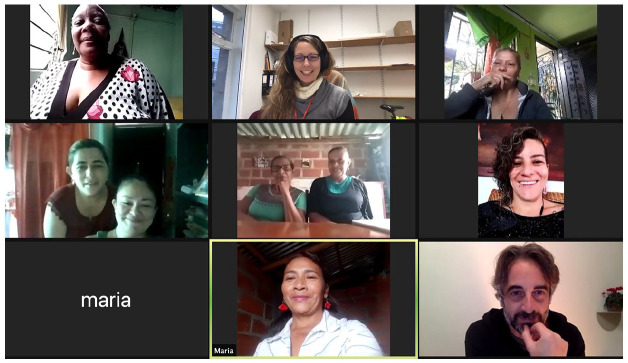
In this paper, I outline an innovative remote participatory video (PV) methodology that makes use of participants’ smartphones. It was developed as an alternative to co-production research and can be employed when face-to-face contact is impossible or undesirable. Because of the COVID-19 pandemic, face-to-face research interactions have been disrupted or become impossible. Yet it is vital to reach those who are most affected by emergencies and to include their voices. The research reported here was a collaboration between women in Medellín, Colombia, and a team of filmmakers and researchers. We developed an innovative remote PV methodology using participants’ smartphones, researching how women from poorer neighbourhoods were affected by the pandemic in their everyday lives. Here, I reflect on the strengths and weaknesses of the remote PV methodology, arguing that it offers new avenues for participants to take control of the filming and editing process, and builds technical skills and capacities that have value beyond the timeframe of the project. I conclude that the remote PV method has great potential as a stand-alone method, moving the landscape of co-production research away from a requirement for geographical co-presence and potentially shifting power and ownership towards local co-researchers and participants.
Overview
The claims and statistics of this paper haven’t been checked yet.
Free: it reads the open-access text and checks the first 5 claims that cite a source we can check. Create a free account to check every claim.
Integrity signals
Registry
Cites
Statistics
Figures
Verification
Claims the paper makes
The claims and statistics of this paper haven’t been checked yet.
Free: it reads the open-access text and checks the first 5 claims that cite a source we can check. Create a free account to check every claim.
Claims other papers make about this one
Each is checked against this paper’s own text: does it say what the citing paper says it does?
The check wasn’t confident either way, so it gives no verdict — never disputed.
In the citing paper
“Gathering quantitative data is an option, particularly in the tradition of participatory statistics 51 .”
From Participatory action research (2023) · cites this paper as [51]
Experimental — accuracy not yet measured
Self-check
Percentages, sums and reported differences re-computed from the paper’s own numbers.
The self-check needs the paper’s full text.
Citations
Cites
COVID-19: the gendered impacts of the outbreak
Wenham, C., Smith, J., & Morgan, R. (2020) · The Lancet · doi:10.1016/s0140-6736(20)30526-2 · Cited by 1,701
Participatory Action Research Approaches and Methods
(2007) · Routledge eBooks · doi:10.4324/9780203933671 · Cited by 1,239 · cited 5×
“…developed the remote PV method in collaboration with Colombian women participants by using digital tools, and how we at the same time followed action research principles of collaboration, education, action and reflection to co-produce knowledge (Kindon et al., 2007b; Pain, 2014; Pain et al., 2011).”
BackgroundMethodInfluentialHowlett, M. (2022) · Qualitative Research · doi:10.1177/1468794120985691 · Cited by 472 · cited 1×
“This new fieldwork landscape leads many researchers to seek alternative ways to start or continue their data collection and sometimes prompts them to change previously planned research designs (Howlett, 2021).”
BackgroundThe Personal is Political: Developing new subjectivities through participatory action research
Cahill, C. (2007) · Gender, Place & Culture · doi:10.1080/09663690701324904 · Cited by 352 · cited 4×
“These critiques suggest a mismatch between the theory and practice of co-production research, reinforcing traditional researcher– researched hierarchies (Cahill, 2007; Shaw, 2016) that the idea and ideal of PV is intended to challenge.”
BackgroundInfluentialParticipatory video in geographic research: a feminist practice of looking?
Kindon, S. (2003) · Area · doi:10.1111/1475-4762.00236 · Cited by 304 · cited 8×
“It forefronts the voices of those who are systematically excluded in the knowledge production process and encourages participants to reflect on and negotiate their realities in democratic spaces of dialogue (Kindon, 2003; Pearce, 2010).”
BackgroundMethodInfluentialCunsolo Willox, A., Harper, S. L., Edge, V. L., Lab, ‘. W. S. A. D. M., & Government, R. I. C. (2013) · Qualitative Research · doi:10.1177/1468794112446105 · Cited by 281
Ebola, gender and conspicuously invisible women in global health governance
Harman, S. (2016) · Third World Quarterly · doi:10.1080/01436597.2015.1108827 · Cited by 219 · cited 3×
“Since then, we have conducted the research remotely, shifted PV workshops into an online space and decided to focus on the impact of the pandemic on the women’s lives in order to amplify the voices of those who are rarely heard in emergency settings (Bradshaw, 2015; Harman, 2016).”
BackgroundGeographies of impact: power, participation and potential
Pain, R., Kesby, M., & Askins, K. (2011) · Area · doi:10.1111/j.1475-4762.2010.00978.x · Cited by 200 · cited 5×
“co-production research that involves participants in the whole research process, from the development of the research question to the dissemination of the results (Pain et al., 2011) is limited.”
BackgroundMethodInfluentialParticipatory Action Research: Origins, approaches and methods
(2007) · Participatory Action Research Approaches and Methods · doi:10.4324/9780203933671-13 · Cited by 189
Handbook of Participatory Video
Milne, E.-J., Mitchell, C., & de Lange, N. (2012) · Rowman & Littlefield Publishers eBooks · doi:10.5771/9780759121157 · Cited by 187
Research works printed but not linked: 4
- Freire P (1997) Pedagogy of the Oppressed. New York: Continuum.
- Kinyanjui N (2020) COVID-19: a double burden for women in conflict settings. The LSE Women, Peace and Security blog.
- Lunch N Lunch C (2006) Insights into Participatory Video: A Handbook for the Field, InsightShare.
- Wheeler J (2009) The life that we don’t want: using participatory video in researching violence. IDS Bulletin, 40.
Cited by
Cornish, F., Breton, N., Moreno-Tabarez, U., Delgado, J., Rua, M., de-Graft Aikins, A., & Hodgetts, D. (2023) · Nature Reviews Methods Primers · doi:10.1038/s43586-023-00214-1 · Cited by 743
“For instance, Marzi 51 in a participatory video project, used role swapping to distribute the leadership roles of chairing meetings, choosing themes for focus and editing, among all the participants.”
Interviews in the social sciences
Knott, E., Rao, A. H., Summers, K., & Teeger, C. (2022) · Nature Reviews Methods Primers · doi:10.1038/s43586-022-00150-6 · Cited by 519
Scher, B. D., Scott-Barrett, J., Hickman, M., & Chrisinger, B. W. (2023) · Journal of Participatory Research Methods · doi:10.35844/001c.74807 · Cited by 62
Sanz, C. S., Alencar, A. P., & Verhoeven, E. (2023) · Learning Media and Technology · doi:10.1080/17439884.2023.2166528 · Cited by 36
“…Lives Research Project , we not only aimed to identify the various ways in which refugee migrants use technologies to create a sense of place, but we also delved into how digital technologies provide new opportunities to access refugee ‘ in situ and in real-time ’ experiences (Marzi 2021, 3).”
BackgroundMethodInfluentialKostis, A., Lidström, J., Nair, S., & Holmström, J. (2024) · IEEE Transactions on Engineering Management · doi:10.1109/tem.2024.3484750 · Cited by 33
“Similar to other studies adopting PAR [47], there was a need to start our inquiry by having close and frequent discussions with entrepreneurs to define together what GenAI means for the entrepreneurial processes, what challenges it poses, and in what areas can be fruitful and how.”
ResultEvaluating a women's digital inclusion and storytelling initiative through the lens of empowerment
Richardson, P. E., & Wilson, S. (2024) · Digital Geography and Society · doi:10.1016/j.diggeo.2024.100092 · Cited by 30
When “Home” Becomes the “Field”: Ethical Considerations in Digital and Remote Fieldwork
Konken, L. C., & Howlett, M. (2022) · Perspectives on Politics · doi:10.1017/s1537592722002572 · Cited by 29
“…researchers have been able to attend in real-time without the travel and clearances required to be physically present.5 Likewise, participatory video technology can serve as an alternative means of interviewing, allowing study participants to record themselves on their smartphones (Marzi 2021).”
BackgroundCo‐producing impact‐in‐process with participatory audio‐visual research
Marzi, S. (2023) · Area · doi:10.1111/area.12851 · Cited by 20
Self-citationBörner, S., Kraftl, P., & Giatti, L. L. (2023) · Qualitative Research · doi:10.1177/14687941231165882 · Cited by 21
“…experiences of PAR researchers during COVID-19 have raised questions of power and ownership – often calling into question the possibility of conducting research entirely online while simultaneously shifting ownership to local communities and research partners (Marzi, 2021; Hall et al., 2021).”
BackgroundMethodInfluentialConducting Sensitive Interviews Online
Kähäri, O., & Edelman, K. (2023) · Symbolic Interaction · doi:10.1002/symb.674 · Cited by 22
Interviews in the social sciences
Knott, E., Rao, A. H., Summers, K., & Teeger, C. (2022) · Nature Reviews Methods Primers · doi:10.1038/s43586-022-00166-y · Cited by 49
WhatsApp as a Tool for Researching the Everyday Lives of Venezuelan Refugees Settling in Brazil
Alencar, A. P., & Camargo, J. F. (2022) · Media and Communication · doi:10.17645/mac.v10i3.5468 · Cited by 18
“A growing number of studies have identified that mobile instant messaging apps can widen participation of population groups that are hard to reach or involve in research given their vulnerable social and economic situ‐ ation (Kaufmann, 2018; Marzi, 2021).”
BackgroundInfluentialStop-motion storytelling: Exploring methods for animating the worlds of rare genetic disease
Gorman, R., Farsides, B., & Gammidge, T. (2022) · Qualitative Research · doi:10.1177/14687941221110168 · Cited by 19
“Using video can open up new styles of expression, perception and understanding, providing different modalities of knowledge (re)presentation, production and dissemination (Blazek and Hra ˇ nov´a, 2012; Marzi, 2021; Parr, 2007).”
BackgroundCommunity-Driven Research with People Who Use Drugs: A Virtual Project During Multiple Epidemics
Brothers, S., Simon, C., & Vincent, L. (2024) · Sociological Methodology · doi:10.1177/00811750241281063 · Cited by 13
“…on research with online communities united by interests instead of geography, digital approaches to knowledge coproduction with marginalized groups (Lane and Lingel 2022; Marzi 2023; Small 2022), and methodologic approaches concerning representation (Jerolmack, Murphy, and Reyes 2024; Rios 2015).”
Film Dokumenter Sebagai Metode Alternatif Penelitian Komunikasi
Jati, R. P. (2021) · Avant Garde · doi:10.36080/ag.v9i2.1552 · Cited by 31
“Masa pandemi Covid-19 mendorong banyak peneliti mencari metode alternatif untuk memulai ataupun melanjutkan pengumpulan data, bahkan terkadang muncul pilihan untuk mengubah rencana penelitian (Howlett, 2021; Marzi, 2021).”
BackgroundPotts, A., Fattal, L., & Kolli, H. (2022) · Evidence & Policy · doi:10.1332/174426421x16420949265777 · Cited by 15
Crean, M., Moore, B., Devine, D., Symonds, J. E., Sloan, S., & Sainz, G. M. (2024) · International Journal of Research & Method in Education · doi:10.1080/1743727x.2024.2341707 · Cited by 11
Using participatory video in environmental research
Nawrath, M., Fisher, J. C., Arotoma‐Rojas, I., Davies, Z. G., Elsey, H., Cooke, P. A., Mistry, J., & Dallimer, M. (2024) · People and Nature · doi:10.1002/pan3.10646 · Cited by 11
Farizi, S. A., & Harmawan, B. N. (2023) · Cogent Social Sciences · doi:10.1080/23311886.2023.2267743 · Cited by 13
“Apart from that, the idea of co-producing can provide the innovation needed to minimize the negative impact of COVID-19 on vulnerable groups (Marzi, 2023).”
BackgroundApprivoiser la distance : un défi paradoxal, une expérience exigeante, un cadre revisité
Bourrier, M., & Kimber, L. R. (2022) · Socio-anthropologie · doi:10.4000/socio-anthropologie.11019 · Cited by 20
Horn, P., & Casagrande, O. (2023) · Qualitative Research · doi:10.1177/14687941231176942 · Cited by 10
“Unlike previous research that highlights the bene fi ts of moving to the virtual when in-situ constructions of a shared co-presence becomes undesirable (Howlett, 2021; Marzi, 2021), we offer a more nuanced account.”
BackgroundResultInfluentialBielska, B., Kalinowska, K., Męcfal, S., & Surmiak, A. (2024) · Qualitative Sociology Review · doi:10.18778/1733-8077.20.4.04 · Cited by 9
‘Volviendo a Vivir’ (coming back to life): Urban trauma, activism and building emancipatory futures
Marzi, S., & Pain, R. (2023) · Urban Studies · doi:10.1177/00420980231213730 · Cited by 10
Self-citationSpies, M., Schick, A., Шарифович, К. Ш., Bakokhoja, B., Zikriyokhon, K., Jobirov, S., Bloch, R., & Ibisch, P. L. (2021) · Frontiers in Sustainable Food Systems · doi:10.3389/fsufs.2021.750252 · Cited by 8
Participatory Video (remote, online): Participatory research methods for sustainability ‐ toolkit #2
Richardson‐Ngwenya, P. (2022) · GAIA - Ecological Perspectives for Science and Society · doi:10.14512/gaia.31.2.4 · Cited by 8
Welford, J., Sandhu, J., Collinson, B., & Blatchford, S. (2022) · Methodological Innovations · doi:10.1177/20597991221114570 · Cited by 8
“Mobile research methods have become increasingly relevant given the restrictions placed on face-toface research during the COVID-19 pandemic (see e.g. Marzi, 2021).”
Researching from Home, Inside, and the Online: Methodological Lessons from the Pandemic
Monnier-Reyna, M. (2024) · The Professional Geographer · doi:10.1080/00330124.2023.2295343 · Cited by 5
“Digital qualitative methods have flourished in reaction to the pandemic (Arya and Henn 2021; Lobe, Morgan, and Hoffman 2020; Hall, Gaved, and Sargent 2021; Marzi 2021; Tremblay et al. 2021; Willis et al. 2021; Pauls, Kelly, and Adorjan 2022).”
Qualitative Remote Data Collection Guidance 2024
Boardman, F., Roberts, J. L., Clark, C. C. A., Onuegbu, C. M., Harris, B., Seers, K., Staniszewska, S. H., Aktas, P., & Griffiths, F. E. (2024) · University of Warwick · doi:10.31273/9781911675174 · Cited by 6
Valiquette, T., & Su, Y. (2024) · Journal of Participatory Research Methods · doi:10.35844/001c.123790 · Cited by 4
Barley, R., Carter, C., & Omar, A. (2025) · Qualitative Research · doi:10.1177/14687941251317710 · Cited by 4
“Researchers have been creative in adapting and developing established participatory tools for working online in this context for example using smart-phones to facilitate remote participatory video methods (Marzi, 2023).”
Community Digital Storytelling for Locally Led Adaptation: Practice, opportunities and challenges
Theocharis, A. (2026) · Environmental Science & Policy · doi:10.1016/j.envsci.2026.104359 · Cited by 4
Schwarz, K. C. (2023) · Social visualities · doi:10.1007/978-3-031-25259-4_7 · Cited by 4
Delta voices of climate crisis: Community Digital Storytelling in Bangladesh and Vietnam
Theocharis, A. (2024) · Visual Studies · doi:10.1080/1472586x.2024.2351065 · Cited by 4
“Related to Participatory Video (PV), CDST entails a script-less video production method, guided by a collaborative team engaging in repeated cycles of shooting and reviewing video content according to the worldviews and requirements of the participants (Marzi 2023; Roberts and Muñiz 2020).”
Affektive Ethnografie. Zum Erforschen von Atmosphären des Exklusiven während der Pandemie
von Bose, K. (2023) · Forum qualitative Sozialforschung · doi:10.17169/fqs-24.3.4006 · Cited by 12
Rudling, A., Sesay, M. G., Wiebelhaus‐Brahm, E., & Rettberg, A. (2024) · Qualitative Research · doi:10.1177/14687941241264677 · Cited by 3
“…modes need to be found to replace face-to-face research, or ethnographers need to reskill as they shift their research away from in-person interaction ” (Eggeling, 2023: 2; see also Boéri and Giustini, 2024; DeHart, 2020; Hjalmarson et al., 2020; Howlett, 2022; Kim et al., 2023; Marzi, 2023).”
Męcfal, S., Bielska, B., Kalinowska, K., & Surmiak, A. (2023) · Studia Socjologiczne · doi:10.24425/sts.2023.147159 · Cited by 3
Mai, N. (2024) · Critical Criminology · doi:10.1007/s10612-024-09804-1 · Cited by 3
Mbatha, N. L., & Mokwena, K. (2024) · NURTURE · doi:10.55951/nurture.v18i4.799 · Cited by 2
“Mobile messaging applications offer a less intrusive and more convenient means of data collection and can provide valuable insight that can be difficult to collect through traditional methods (Alencar & Camargo, 2022; Marzi, 2023).”
MethodGeometries of control: Co-producing knowledge in a refugee context
Dalrymple, K. A., & Irankunda, E. (2024) · Human Organization · doi:10.1080/00187259.2024.2435617 · Cited by 2
Sustainable development goals through participatory video and digital storytelling
Rohmah, Z., Makrakis, V., Kostoulas‐Makrakis, N., Hidayati, L., Fitriyanto, N. A., Projosasmito, S. R., Auwibi, B. R., & Prijambada, I. D. (2024) · Sustainable Social Development · doi:10.54517/ssd3183 · Cited by 2
Marshall, E. A., Okatch, H., Novak, E., Cottiers, K., & Trotter, L. J. (2025) · SSM - Qualitative Research in Health · doi:10.1016/j.ssmqr.2025.100648 · Cited by 2
Henley, L. J., Stanley‐Clarke, N., Acharya, A., Khadka, S., & Olsson, Å. (2022) · Evaluation · doi:10.1177/13563890221137610 · Cited by 2
“Many funders and providers delayed and/or cancelled many in-person evaluations, requiring alternate approaches to be considered (Marzi, 2021).”
BackgroundWhitley, R., & Arias, K. (2024) · Canadian Journal of Community Mental Health · doi:10.7870/cjcmh-2024-019 · Cited by 1
Ending participatory research projects: Entangled temporalities, endy moments and afterlives
Cornish, F., Cowan, H., Parmanand, S., & Summers, K. (2026) · Qualitative Research · doi:10.1177/14687941261458717 · Cited by 1
Being Participatory Through the Use of App-Based Research Tools
Hadfield‐Hill, S., & Zara, C. (2024) · Springer eBooks · doi:10.1007/978-3-031-47787-4_8 · Cited by 1
Frąckowiak, M., Rogowski, Ł., & Sommer, V. (2022) · Qualitative Research · doi:10.1177/14687941221098923
PechaKucha-Based Participatory Video for Organizational Research
Madden, T. M., Madden, L. T., & Smith, A. D. (2022) · Research methodology in strategy and management · doi:10.1108/s1479-838720220000014008
4. What Does Good Community Engagement Design Look, Sound, and Feel Like?
Luca, E. D. (2022) · American Public Health Association eBooks · doi:10.2105/9780875533315ch04
Balaguer, J. (2023) · Revista de la Asociación Española de Investigación de la Comunicación · doi:10.24137/raeic.10.19.6
Editorial: Digital/Online Networks in Everyday Life During Pandemics
Lacasa, P., Zagalo, N., & Emmer, M. (2022) · Frontiers in Computer Science · doi:10.3389/fcomp.2022.887604
“They apply different methodologies, both quantitative and qualitative, and the need to look for new methods to replace personal contact with other forms of data collection is highlighted (Marzi, 2021).”
BackgroundAcross Mobile Online and Offline Spaces: Reflections on Methods, Practices, and Ethics
(2022) · Media and Communication · doi:10.17645/mac.i317
Participatory Video and Impact: Analysis of the Living Cultures Indigenous Fellowship
Balaguer, J. (2024) · European Journal of Development Research · doi:10.1057/s41287-023-00609-6 · Cited by 1
“According to Marzi (2021), collaboration in PV projects can erode hierarchies and increase participants’ learning (p. 13).”
Medellín como modelo de ecosistema de ciencia, tecnología e innovación: una revisión de literatura
Sánchez-Guzmán, L. A., & Betancur-Hinestroza, I. C. (2025) · Activos · doi:10.15332/25005278.10858
Howlett, M., & Konken, L. C. (2025) · PS Political Science & Politics · doi:10.1017/s1049096525000447
“As a cost-saving measure and for ease of access, interviews and focus groups are also now regularly conducted on communicative platforms such as Zoom, WhatsApp, and Microsoft Teams (Colom 2022; Gibson 2020; Howlett 2022b; Marzi 2023).”
Youth temporalities in identity boxes: own objects as embodiments of past and future transitions
Pizzolati, M., & Giorgi, A. (2025) · Journal of Youth Studies · doi:10.1080/13676261.2025.2541105 · Cited by 1
“This has been particularly impact-ful for participatory methods (Hall, Gaved, and Sargent 2021; Marzi 2021) as well as art-based and embodied approaches (e.g. Lomax et al. 2022; Vaughan et al. 2022).”
Marzi, S., Pain, R., & Tarr, J. (2025) · Routledge eBooks · doi:10.4324/9781003606192-3
Self-citationHigh, C., Teleman, H., Нарвселіус, Е., & Boshi, B. (2025) · Journal of Participatory Research Methods · doi:10.35844/001c.141333 · Cited by 1
“Hall et al. (2021) and Fouqueray et al. (2023) argue that practical, scientific and ethical challenges remain for remote research, while Marzi (2021) and Shamsuddin et al. (2021) point to some of the difficulties in developing participatory practice in online environments, mentioning time…”
Co-production in Refugee Research: Navigating Power Dynamics
Moussa, F. A. H., & Hart, C. (2025) · Emerald Group Publishing Limited eBooks · doi:10.1108/978-1-83608-678-920251014
Gray, A. (2024) · Theseus (Ammattikorkeakoulujen)
5. Uluslararası Medya ve Toplum Sempozyumu Bildiri Tam Metin Kitabı
Güler, Ö. R., & Büyükyüksel, N. A. (2025) · doi:10.55094/holistence.565
Flipping the Lens: Using Instagram for Photovoice and Videovoice With LGBTQ+ Migrants in São Paulo
Valiquette, T., & Su, Y. (2026) · Qualitative Inquiry · doi:10.1177/10778004261417671
“…and videovoice have focused on the equalizing power relationships between researcher and participant, and despite these methods offering potential to amplify the voices of marginalized communities, power relationships between researcher and participant can remain unbalanced (Marzi, 2021).”
InfluentialBezaleel, M., Desi, D., Sudjito, D. N., Nugroho, R. A. B., Nau, N. U. W., Martono, Y., & Cahyaningrum, D. C. (2026) · Karunia Jurnal Hasil Pengabdian Masyarakat Indonesia · doi:10.58192/karunia.v5i1.4183
“Marzi (2023) mendokumentasikan bagaimana PV dapat diadaptasi menjadi metode jarak jauh menggunakan smartphone milik warga.”
Perera, K., & Nilaweera, L. (2026) · Qualitative Research · doi:10.1177/14687941261442122
Dunleavy, P., & Monteath, T. (2026) · LSE Press eBooks · doi:10.31389/lsepress.dos.i
Picot, L. E., Sarpong, B., Obeng, A. A., Mensah, F. K., Anim-Adjei, K., & Adjei, R. K. (2026) · Qualitative Research · doi:10.1177/14687941261451387
Remote Qualitative Fieldwork in Conflict-Affected Mindanao
Kelly, L. M., Ragandang, P. I. C., Ware, A., Moner, Y., & Barton, G. (2026) · International Journal of Qualitative Methods · doi:10.1177/16094069261449009
Román, V. C. V., Fracassi, P., & Laurentiis, M. D. (2026) · Development in Practice · doi:10.1080/09614524.2026.2691844
Morales, L. A., de Carvalho, B. F., de Almeida, V. C. T., de Toledo, R. F., Gutberlet, J., & Giatti, L. L. (2026) · Journal of Participatory Research Methods · doi:10.35844/001c.159481
Video diaries as a technique to approach social practices
Giacoman, C., Joustra, C., & Concha, C. N. (2026) · Qualitative Research · doi:10.1177/14687941261466577
Sisodia, R., & Conn, C. (2026) · Journal of Participatory Research Methods · doi:10.35844/001c.167228
Liu, Y. (2026) · International Journal of Qualitative Methods · doi:10.1177/16094069261493811
Metadata
- Authors
- Marzi, S.
- Affiliations
- London School of Economics and Political Science (GB)
- Corresponding author
- Marzi, Sonja
- ORCID
- Marzi, Sonja
- Venue
- Qualitative Research
- Publisher
- SAGE Publications
- Published
- 2021-08-20
- Volume
- 23
- Issue
- 3
- Pages
- 509-525
- ISSN
- 1468-7941 (ISSN-L)
- 1741-3109
- PMC
- PMC10230305
- OpenAlex
- W3183747804
- Cited by
- 65
- References
- 43
- Citations by year
- 2026: 12 · 2025: 7 · 2024: 16 · 2023: 11 · 2022: 17 · 2021: 2
- FWCI
- 15.94
- Type
- journal article
- Language
- en
- Open access
- gold
- doi.org
- Locations
- Qualitative Research (publishedVersion, cc-by)
- PubMed Central (publishedVersion, cc-by)
- PubMed (publishedVersion)
- ENLIGHTEN (Jurnal Bimbingan dan Konseling Islam) (submittedVersion, cc-by-sa)
- London School of Economics and Political Science Research Online (London School of Economics and Political Science) (submittedVersion)
- Radboud Repository (Radboud University) (submittedVersion)
- London School of Economics and Political Science Theses Online (London School of Economics and Political Science) (submittedVersion)
- Funders
- London School of Economics and Political Science (KEI Project no. 106199)
- Topics
- Social Sciences › Sociology and Political Science › Participatory Visual Research Methods
- Social Sciences › Sociology and Political Science › Qualitative Research Methods and Ethics
- Social Sciences › Sociology and Political Science › Children's Rights and Participation
- Keywords
- participatory video, COVID-19 pandemic, smartphones, women's poverty, Medellín, collaborative filmmaking, everyday life during pandemic
About these checks
Registry, retraction, Cites and statistics results are computed, not judged, with one exception: a printed reference that no index lists is read once by a model before it counts as a citation error. Claims are extracted by a model and kept only when their quote appears verbatim in the text; each cited source is then checked, with a model’s help, for whether it says what the claim relies on. Those verdicts can be wrong — read the claim’s quote and the cited source before relying on one.
Statistics and arithmetic are recomputed, not judged.
Confidence bands are shown only for fields calibrated on our annotated test set. None is calibrated yet, so no band is shown.
What counts as a claim ›How we measure confidence ›How we check this ›
Are you an author, or do you see a problem with this page? Request a review
Data sources
Bibliographic data: Semantic Scholar, OpenAlex, Crossref.
Contains information from the Semantic Scholar Academic Graph Datasets, made available under the ODC Attribution License (ODC-BY 1.0).
Semantic Scholar’s data is described in: Kinney, R., et al. (2023). The Semantic Scholar Open Data Platform. arXiv:2301.10140.
