

Effects of a Video Sequence Based Intervention on Anxiety, Fatigue and Depression in Cancer Patients: Results of a Randomized Controlled Trial.
Open accessThe DOI matches its Crossref record; 52 of the 52 references it cites were found in a registry or an index; 14 of the 34 sources its claims cite were checked for support.
Abstract
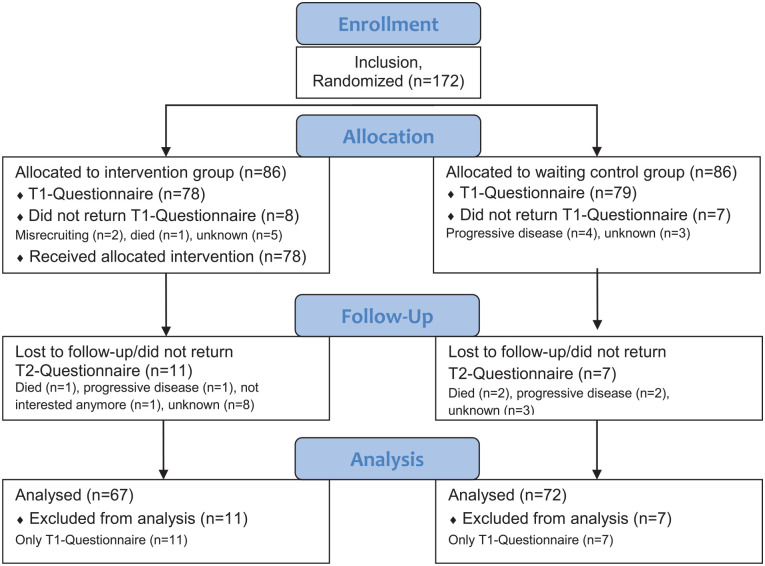
Background: Cancer patients often suffer from psychological symptoms and need psychological support. Especially during the COVID-19 pandemic, eHealth interventions might be helpful to overcome the obstacles of the pandemic. This study evaluates the effectiveness of a video sequence-based eHealth intervention on anxiety, fatigue, and depression in cancer patients. Methods: Patients (N = 157) with different tumor entities were randomly assigned to the video intervention group (IG) and the waiting control group (CG). Patients in the IG received a video intervention comprising 8 video sequences over 4 weeks. The videos included psychoeducation on distress and psychological symptoms, Acceptance and Commitment Therapy elements, and Yoga and Qigong exercises. Patients' anxiety and fear of progression (primary outcomes) and secondary outcomes were assessed before randomization (T1) and after the end of the intervention for IG or the waiting period for CG (T2) using self-reported questionnaires (GAD-7, PA-F-KF, EORTC QLQ-FA12, PHQ-8). Results: Patients of the IG showed no significant improvement in anxiety (GAD-7; P = .75), fear of progression (FoP-QSF; P = .29), fatigue (EORTC QLQ-FA12; P = .72), and depression (PHQ-8; P = .95) compared to patients in the waiting CG. However, symptoms of anxiety, fatigue, and depression decreased in both groups. Exploratory subgroup analysis regarding sex, therapy status, therapy goal, and tumor entity showed no effects. Overall, the intervention had a high level of acceptance. Conclusions: The video intervention was ineffective in reducing the psychological burden compared to a waiting CG. The findings support prior observations of the value of therapeutic guidance and promoting self-management for improving patients' psychological burdens. Further studies are required to evaluate the effectiveness of psycho-oncological eHealth delivered through video sequences.
Overview
CoChat Summary
## TL;DR
This randomized controlled trial found that an 8-video, 4-week eHealth intervention for cancer patients did not improve anxiety, fear of progression, fatigue, or depression compared with a waiting control group. Despite the null effects, the intervention was well accepted and adherence was high.
## Key findings
- In the intervention group versus waiting control group, there were no significant improvements in anxiety (GAD-7; P = .75), fear of progression (FoP-Q-SF; P = .29), fatigue (EORTC QLQ-FA12; P = .72), or depression (PHQ-8; P = .95).
- Symptoms of anxiety, fatigue, and depression decreased in both groups from T1 to T2, but the between-group differences were not significant.
- Exploratory subgroup analyses by sex, therapy status, therapy goal, and tumor entity showed no effects / no significant between-group differences.
- Acceptance of the intervention was high: 93.9% said expectations were at least more likely fulfilled, 88.2% would be at least likely to participate again, 98.5% would recommend it, and 83% of intervention-group participants watched all video sequences at least once.
## Methods
- Single-center, prospective, randomized controlled intervention study with a waiting control group at the University Hospital of Würzburg / CCCMF; patients were randomized 1:1 after baseline assessment.
- Participants: N = 157 cancer patients with diverse tumor entities; 69% female, mean age 56 years (SD = 12.4); common tumor entities were hematologic malignancies (32%) and breast cancer (30%).
- Intervention: 8 videos over 4 weeks (about 10 to 30 minutes each), covering psychoeducation, ACT elements, and yoga/Qigong/relaxation exercises; outcomes measured at T1 and T2 using self-report questionnaires (GAD-7, FoP-Q-SF, EORTC QLQ-FA12, PHQ-8), with change scores compared between groups and exploratory subgroup analyses.
## Limitations
- The paper states several limitations: a waiting-only control group, no blinding, no control of adherence because videos were watched at home, limited generalizability to all tumor entities, no screening for psychological burden, and the use of multiple therapeutic tools, making it impossible to identify which element was most effective.
- Evident from the text: the intervention period was only 4 weeks and the control group also later received the intervention, so long-term comparative effects were not assessed in the main analysis.
Model-written summary. Check it against the paper before relying on it.
Integrity signals
Registry
Cites
Statistics
Figures
Verification
Claims the paper makes
6 Valid · 1 Not valid · 4 Not checked · 27 Own results and interpretations
The cited sources support only part of this claim — read each source’s verdict below.
In the paper
“Unlike most other studies in this field, this study included a very heterogeneous population, which corresponds to the need for studies on a broader range of cancer patients.”
§ Effects of a Video Sequence Based Intervention on Anxiety, Fatigue and Depression in Cancer Patients: Results of a Randomized Controlled Trial > Discussion This study showed no improvement in anxiety, fatigue, and depression after a 4-week eHealth intervention in video sequences compared to a waiting CG. A follow-up study 3 months after the end of the intervention will examine the possible long-term changes. Though the results of IG and CG did not significantly differ, there was a high recommendation rate of the intervention among the participants of the IG. Unlike most other studies in this field, this study included a very heterogeneous population, which corresponds to the need for studies on a broader range of cancer patients.50 Participants were not pre-selected regarding their initial symptom burden compared to another study that used similar yoga exercises.40 Another difference from previous studies is the digital setting. Patients cannot benefit from interaction with a group leader or a possible group effect as they could in the previous studies using similar exercises.35,40 Compared to other, more effective interventions, it is noticeable that professional support is often associated with better outcomes.15,51 Results fit with studies that found no effect with an eHealth intervention without professional support.9,18 Since this study aimed to reach as many patients as possible without the risk of infection and as the participants should incorporate the intervention individually into their daily routine, video sequences were the medium of choice. This study supports the importance of the interpersonal aspect in psycho-oncology. Given the decay in eHealth use over time,52 we designed the study with a brief duration. Longer-duration interventions seem to be more effective.53 Overall, the literature on eHealth interventions is still very heterogeneous,14 and there is a great need for research in this area. Future studies should include innovative adaptive designs to create personalized psychosocial eHealth interventions.19,54 The study has several limitations that need to be considered. First, the trial had a waiting-only CG that received no treatment. Participants were not blind to the allocated intervention. Second, there was no possibility of controlling intervention adherence as the participants watched the videos at home. Third, the results of this trial are not generalizable to all tumor entities. However, we included patients with subjective needs for psycho-oncological support. Fourth, we conducted no screening concerning psychological burden. More significant changes might have been achieved in cancer patients with higher symptom severity. Finally, we used different therapeutic tools to create the intervention. Therefore, it is impossible to determine which of the methods used have the highest potential to reduce the symptom burden for each objective in each patient.
What the sources say
- Partly supportedcites [50] Penedo FJ Oswald LB Kronenfeld JP Garcia SF Cella D Yanez B. The increasing value of eHealth in the delivery of patient-centred cancer care. Lancet Oncol. 2020; 21:e240-e251. PMC7643123 32359500 sourceExperimental — accuracy not yet measured
The ‘Diverse and hard-to-reach cancer survivorship populations’ section says most eHealth research has focused on non-Hispanic white, English-speaking patients and calls for studies including more diverse patients. It supports the need for broader representation, but does not establish that the citing authors’ own study included a very heterogeneous population. (LLM, conf=0.85)
plain- Asserted: passes — The authors put it forward as true.
- Checkable: passes — It can be checked against evidence.
- Load-bearing: passes — The paper’s conclusions depend on it.
- Based: passes — The paper gives a reason why it holds.
- Partly supported
The cited sources that could be checked couldn’t confirm or dispute this claim.
In the paper
“Compared to other, more effective interventions, it is noticeable that professional support is often associated with better outcomes.”
§ Effects of a Video Sequence Based Intervention on Anxiety, Fatigue and Depression in Cancer Patients: Results of a Randomized Controlled Trial > Discussion This study showed no improvement in anxiety, fatigue, and depression after a 4-week eHealth intervention in video sequences compared to a waiting CG. A follow-up study 3 months after the end of the intervention will examine the possible long-term changes. Though the results of IG and CG did not significantly differ, there was a high recommendation rate of the intervention among the participants of the IG. Unlike most other studies in this field, this study included a very heterogeneous population, which corresponds to the need for studies on a broader range of cancer patients.50 Participants were not pre-selected regarding their initial symptom burden compared to another study that used similar yoga exercises.40 Another difference from previous studies is the digital setting. Patients cannot benefit from interaction with a group leader or a possible group effect as they could in the previous studies using similar exercises.35,40 Compared to other, more effective interventions, it is noticeable that professional support is often associated with better outcomes.15,51 Results fit with studies that found no effect with an eHealth intervention without professional support.9,18 Since this study aimed to reach as many patients as possible without the risk of infection and as the participants should incorporate the intervention individually into their daily routine, video sequences were the medium of choice. This study supports the importance of the interpersonal aspect in psycho-oncology. Given the decay in eHealth use over time,52 we designed the study with a brief duration. Longer-duration interventions seem to be more effective.53 Overall, the literature on eHealth interventions is still very heterogeneous,14 and there is a great need for research in this area. Future studies should include innovative adaptive designs to create personalized psychosocial eHealth interventions.19,54 The study has several limitations that need to be considered. First, the trial had a waiting-only CG that received no treatment. Participants were not blind to the allocated intervention. Second, there was no possibility of controlling intervention adherence as the participants watched the videos at home. Third, the results of this trial are not generalizable to all tumor entities. However, we included patients with subjective needs for psycho-oncological support. Fourth, we conducted no screening concerning psychological burden. More significant changes might have been achieved in cancer patients with higher symptom severity. Finally, we used different therapeutic tools to create the intervention. Therefore, it is impossible to determine which of the methods used have the highest potential to reduce the symptom burden for each objective in each patient.
What the sources say
- Could not verifycites [15] Nissen ER O'Connor M Kaldo V, et al. Internet-delivered mindfulness-based cognitive therapy for anxiety and depression in cancer survivors: a randomized controlled trial. Psychooncology. 2020; 29: 68- 75. 31600414 PMC7004073 sourceExperimental — accuracy not yet measured
The Methods (Procedure; page unavailable) describe therapist feedback in the internet-delivered intervention, but the trial did not compare professionally supported and unsupported interventions. The Results (Treatment adherence; page unavailable) found no statistically significant association between therapist time spent and improvements in anxiety or depression. These passages do not establish the broader claim that professional support is often associated with better outcomes. (LLM, conf=0.75)
- Could not verifycites [51] Tauber NM O'Toole MS Dinkel A, et al. Effect of psychological intervention on fear of cancer recurrence: a systematic review and meta-analysis. J Clin Oncol. 2019; 37: 2899- 2915. 31532725 PMC6823887 sourceExperimental — accuracy not yet measured
The Discussion reports numerically larger effects for face-to-face interventions than for telephone- or Web-based interventions, but says the delivery-method moderation analysis was not statistically significant and only three studies used other delivery methods. Our copy does not assess whether professional support within eHealth interventions is associated with better outcomes (searched: professional support, therapist guidance, guided online interventions). (LLM, conf=0.75)
hedgedstates an association- Asserted: passes — The authors put it forward as true.
- Checkable: passes — It can be checked against evidence.
- Load-bearing: passes — The paper’s conclusions depend on it.
- Based: passes — The paper gives a reason why it holds.
- Could not verify
The cited sources support only part of this claim — read each source’s verdict below.
In the paper
“Results fit with studies that found no effect with an eHealth intervention without professional support.”
§ Effects of a Video Sequence Based Intervention on Anxiety, Fatigue and Depression in Cancer Patients: Results of a Randomized Controlled Trial > Discussion This study showed no improvement in anxiety, fatigue, and depression after a 4-week eHealth intervention in video sequences compared to a waiting CG. A follow-up study 3 months after the end of the intervention will examine the possible long-term changes. Though the results of IG and CG did not significantly differ, there was a high recommendation rate of the intervention among the participants of the IG. Unlike most other studies in this field, this study included a very heterogeneous population, which corresponds to the need for studies on a broader range of cancer patients.50 Participants were not pre-selected regarding their initial symptom burden compared to another study that used similar yoga exercises.40 Another difference from previous studies is the digital setting. Patients cannot benefit from interaction with a group leader or a possible group effect as they could in the previous studies using similar exercises.35,40 Compared to other, more effective interventions, it is noticeable that professional support is often associated with better outcomes.15,51 Results fit with studies that found no effect with an eHealth intervention without professional support.9,18 Since this study aimed to reach as many patients as possible without the risk of infection and as the participants should incorporate the intervention individually into their daily routine, video sequences were the medium of choice. This study supports the importance of the interpersonal aspect in psycho-oncology. Given the decay in eHealth use over time,52 we designed the study with a brief duration. Longer-duration interventions seem to be more effective.53 Overall, the literature on eHealth interventions is still very heterogeneous,14 and there is a great need for research in this area. Future studies should include innovative adaptive designs to create personalized psychosocial eHealth interventions.19,54 The study has several limitations that need to be considered. First, the trial had a waiting-only CG that received no treatment. Participants were not blind to the allocated intervention. Second, there was no possibility of controlling intervention adherence as the participants watched the videos at home. Third, the results of this trial are not generalizable to all tumor entities. However, we included patients with subjective needs for psycho-oncological support. Fourth, we conducted no screening concerning psychological burden. More significant changes might have been achieved in cancer patients with higher symptom severity. Finally, we used different therapeutic tools to create the intervention. Therefore, it is impossible to determine which of the methods used have the highest potential to reduce the symptom burden for each objective in each patient.
What the sources say
- Partly supportedcites [9] Seiler A Klaas V Tröster G Fagundes CP. eHealth and mHealth interventions in the treatment of fatigued cancer survivors: a systematic review and meta-analysis. Psychooncology. 2017; 26: 1239- 1253. 28665554 sourceExperimental — accuracy not yet measured
Our copy addresses professional support only through a moderator comparison in Section 5.1 (Effects of eHealth interventions on fatigue): 'therapist-guided interventions were more efficacious than self-guided (r = .58; P < 0.001)'. That supports a relative disadvantage of unsupported (self-guided) eHealth interventions, but the paper nowhere reports that unsupported interventions produced NO effect; indeed the pooled eHealth effect on fatigue was significant (r = .2664, 95% CI [.1109–.4218], P < .01, Section 5.1) and clinically significant fatigue improvement was reported in 6 of 9 studies (Section 4.4). The 'no effect' absolute is therefore not attributed by this source, and the finding is the review's own meta-regression rather than separate primary 'studies'. (LLM, conf=0.72)
- Not checked — no full text of the sourcecites [18] van Helmondt SJ van der Lee ML van Woezik RAM Lodder P de Vries J. No effect of CBT-based online self-help training to reduce fear of cancer recurrence: first results of the CAREST multicenter randomized controlled trial. Psychooncology. 2020; 29: 86- 97. 31595627 source
plain- Asserted: passes — The authors put it forward as true.
- Checkable: passes — It can be checked against evidence.
- Load-bearing: passes — The paper’s conclusions depend on it.
- Based: passes — The paper gives a reason why it holds.
- Partly supported
The sources with a verdict support this claim; the rest weren’t checked yet, have no full text we could read, or their verdicts aren’t rated yet.
In the paper
“Additionally, we included complementary and alternative medicine elements that affected the target variables, such as Yoga34-37 and Qigong.38,39”
§ Effects of a Video Sequence Based Intervention on Anxiety, Fatigue and Depression in Cancer Patients: Results of a Randomized Controlled Trial > Introduction
What the sources say
- Supportedcites [34] Gonzalez M Pascoe MC Yang G, et al. Yoga for depression and anxiety symptoms in people with cancer: a systematic review and meta-analysis. Psychooncology. 2021; 30: 1196- 1208. 33763925 source
The paper’s meta-analysis reports significant reductions in depressive and anxiety symptoms with yoga interventions in people with cancer (Author Manuscript, passages 2 and 7). In the citing sentence, the yoga and Qigong examples have separate citations; this source supports the yoga example, not the separately cited Qigong example. (LLM, conf=0.92)
- Not checked — no full text of the sourcecites [35] Hardoerfer K Jentschke E. Effect of yoga therapy on symptoms of anxiety in cancer patients. Oncol Res Treat. 2018; 41: 526- 532. 30086538 source
- Supportedcites [36] Armer JS Lutgendorf SK. The impact of yoga on fatigue in cancer survivorship: a meta-analysis. JNCI Cancer Spectr. 2020; 4:z098. PMC7190209 32368719 source
The citation to this paper is attached to Yoga, not Qigong. In the Results (Synthesis of Results), the meta-analysis reports that yoga was associated with a statistically significant decrease in fatigue compared with a control group; it also reports a decrease in depression. This supports the attributed point that yoga affected outcomes examined by the paper. (LLM, conf=0.91)
- Not checked — no full text of the sourcecites [37] Dong B Xie C Jing X Lin L Tian L. Yoga has a solid effect on cancer-related fatigue in patients with breast cancer: a meta-analysis. Breast Cancer Res Treat. 2019; 177: 5- 16. 31127466 source
- Supportedcites [38] Wayne PM Lee MS Novakowski J, et al. Tai Chi and Qigong for cancer-related symptoms and quality of life: a systematic review and meta-analysis. J Cancer Surviv. 2018; 12: 256- 267. 29222705 PMC5958892 source
The citation to this paper is attached to Qigong, not Yoga. The Results (Outcome measures; page unavailable) report beneficial effects of the pooled Tai Chi/Qigong interventions on cancer-related fatigue, sleep difficulty, and depression, supporting the broad claim that Qigong affected the target variables. (LLM, conf=0.86)
- Not checked — no full text of the sourcecites [39] Zeng Y Xie X Cheng ASK. Qigong or Tai Chi in cancer care: an updated systematic review and meta-analysis. Curr Oncol Rep. 2019; 21: 48. 30955106 source
plainstates a cause- Asserted: passes — The authors put it forward as true.
- Checkable: passes — It can be checked against evidence.
- Load-bearing: passes — The paper’s conclusions depend on it.
- Based: passes — The paper gives a reason why it holds.
- Supported
A result the paper reports from its own data — it cites no other source for it, so there is none to check. The quote shows it is in the paper.
In the paper
“IG and CG showed no significant differences in the mean change in fatigue (EORTC QLQ-FA12) or depression (PHQ8), respectively.”
- Also stated in: § Results: · plain
“Patients of the IG showed no significant improvement in anxiety (GAD-7; P = .75), fear of progression (FoP-Q-SF; P = .29), fatigue (EORTC QLQ-FA12; P = .72), and depression (PHQ-8; P = .95) compared to patients in the waiting CG.”
§ Effects of a Video Sequence Based Intervention on Anxiety, Fatigue and Depression in Cancer Patients: Results of a Randomized Controlled Trial > Results > Intervention Effects on Primary and Secondary Outcomes
plain- Asserted: passes — The authors put it forward as true.
- Checkable: passes — It can be checked against evidence.
- Load-bearing: passes — The paper’s conclusions depend on it.
- Based: passes — The paper gives a reason why it holds.
- Also stated in: § Results: · plain
21 more claims
Create a free account to see all 38 claims and to verify the 5 references still open.
- Probably not a substantial claim. 9
- It may state two separate claims as one. 6
Claims other papers make about this one
Each is checked against this paper’s own text: does it say what the citing paper says it does?
The source backs part of the claim, not all of it — or backs it for a different population, condition or comparison.
In the citing paper
“Anxiety symptomatology showed a decrease in four studies (Cox, 2022;Neubert et al., 2023;Robertson et al., 2022;Urech, Grossert, Alder, et al., 2018)”
From Internet-delivered Acceptance and Commitment Therapy for Cancer Patients and Survivors: A Systematic Review (2024) · cites this paper as Neubert et al., 2023
Experimental — accuracy not yet measuredThe cited source says what the claim attributes to it.
In the citing paper
“The sample size calculation of the previous study [26] determined the sample size.”
From Changes of Symptoms of Anxiety, Depression, and Fatigue in Cancer Patients 3 Months after a Video-Based Intervention (2023) · cites this paper as [26]
The cited source says what the claim attributes to it.
In the citing paper
“However, this randomized controlled trial (RCT) showed no significant effects in terms of reported symptoms compared to a waiting control group at the end of treatment [26].”
From Changes of Symptoms of Anxiety, Depression, and Fatigue in Cancer Patients 3 Months after a Video-Based Intervention (2023) · cites this paper as [26]
The check wasn’t confident either way, so it gives no verdict — never disputed.
In the citing paper
“no pre-registered protocol was found for others (Cox, 2022;Kinner et al., 2018;Neubert et al., 2023;Robertson et al., 2022).”
From Internet-delivered Acceptance and Commitment Therapy for Cancer Patients and Survivors: A Systematic Review (2024) · cites this paper as Neubert et al., 2023
Experimental — accuracy not yet measuredIn the citing paper
“As regards fear of relapse, a reduction was shown, although it was not significant (Neubert et al., 2023).”
From Internet-delivered Acceptance and Commitment Therapy for Cancer Patients and Survivors: A Systematic Review (2024) · cites this paper as Neubert et al., 2023
7 more claims about this paper
Create a free account to see every claim other papers make about this one.
Citations
Cites
The PHQ-8 as a measure of current depression in the general population
Kroenke, K., Strine, T. W., Spitzer, R. L., Williams, J. B. W., Berry, J. T., & Mokdad, A. H. (2009) · Journal of Affective Disorders · doi:10.1016/j.jad.2008.06.026 · Cited by 5,121
Löwe, B., Decker, O., Müller, S., Brähler, E., Schellberg, D., Herzog, W., & Herzberg, P. Y. (2008) · Medical Care · doi:10.1097/mlr.0b013e318160d093 · Cited by 4,527 · cited 1×
“Watched all video sequences 55 (83) Watched video sequences multiple times ≤2 times0 34 (51) 3-5 times 10 (15) >5 times 1 (2) Exercised during the intervention No 5 (8) Partly 28 (42) 1-2 times a week 19 (28) 3-5 times a week 13 (19) Daily 2 (3) Planned to continue exercising after the end of the intervention No 4 (6)…”
BackgroundThe outbreak of COVID-19 coronavirus and its impact on global mental health
Torales, J., O’Higgins, M., Castaldelli-Maia, J. M., & Ventriglio, A. (2020) · International Journal of Social Psychiatry · doi:10.1177/0020764020915212 · Cited by 3,013 · cited 1×
“Watched all video sequences 55 (83) Watched video sequences multiple times ≤2 times0 34 (51) 3-5 times 10 (15) >5 times 1 (2) Exercised during the intervention No 5 (8) Partly 28 (42) 1-2 times a week 19 (28) 3-5 times a week 13 (19) Daily 2 (3) Planned to continue exercising after the end of the intervention No 4 (6)…”
BackgroundAdherence in Internet Interventions for Anxiety and Depression
Christensen, H., Griffiths, K. M., & Farrer, L. (2009) · Journal of Medical Internet Research · doi:10.2196/jmir.1194 · Cited by 1,133
Faller, H., Schuler, M., Richard, M., Heckl, U., Weis, J., & Küffner, R. (2013) · Journal of Clinical Oncology · doi:10.1200/jco.2011.40.8922 · Cited by 912
Tauber, N. M., O’Toole, M. S., Dinkel, A., Galica, J., Humphris, G., Lebel, S., Maheu, C., Ozakinci, G., Prins, J., Sharpe, L., et al. (2019) · Journal of Clinical Oncology · doi:10.1200/jco.19.00572 · Cited by 402 · cited 1×
“Watched all video sequences 55 (83) Watched video sequences multiple times ≤2 times0 34 (51) 3-5 times 10 (15) >5 times 1 (2) Exercised during the intervention No 5 (8) Partly 28 (42) 1-2 times a week 19 (28) 3-5 times a week 13 (19) Daily 2 (3) Planned to continue exercising after the end of the intervention No 4 (6)…”
BackgroundJacobsen, P. B., & Jim, H. S. (2008) · CA: A Cancer Journal for Clinicians · doi:10.3322/ca.2008.0003 · Cited by 382
Mehnert, A., Herschbach, P., Berg, P., Henrich, G., & Koch, U. (2006) · Zeitschrift für Psychosomatische Medizin und Psychotherapie · doi:10.13109/zptm.2006.52.3.274 · Cited by 365
Fear of progression in chronic diseases
Herschbach, P., Berg, P., Dankert, A., Duran, G., Engst-Hastreiter, U., Waadt, S., Keller, M., Ukat, R., & Henrich, G. (2005) · Journal of Psychosomatic Research · doi:10.1016/j.jpsychores.2005.02.007 · Cited by 312
Prevalence of Fatigue in Patients With Cancer: A Systematic Review and Meta-Analysis
Al Maqbali, M., Al Sinani, M., Al Naamani, Z., Al Badi, K., & Tanash, M. I. (2021) · Journal of Pain and Symptom Management · doi:10.1016/j.jpainsymman.2020.07.037 · Cited by 288
Research works printed but not linked: 2
- Kowollik R Buttmann-Schweiger N. Krebs in Deutschland für 2015/2016. 12. Ausgabe. Robert-Koch-Institut; 2019.
- Feuerabendt S. Heilkraft Yoga: 100 Übungen für Ihre Gesundheit. Knaur; 2008.
Cited by
Zhang, T., Ren, Z., Wakefield, C. E., Hui, B. P. H., Akechi, T., Shi, C., Du, X., Chen, W., Lai, L., Zhao, C., et al. (2024) · Clinical Psychology Review · doi:10.1016/j.cpr.2024.102520 · Cited by 49
Johnson, E., Corrick, S., Isley, S., Vandermeer, B., Dolgoy, N., Bates, J., Godfrey, E., Soltys, C., Muir, C., Vohra, S., et al. (2024) · PLOS Digital Health · doi:10.1371/journal.pdig.0000435 · Cited by 24
Chen, J., Liu, L., Wang, Y., Qin, H., & Liu, C. (2024) · Journal of Psychosomatic Research · doi:10.1016/j.jpsychores.2024.111609 · Cited by 32
Nezenega, Z. S., Aychiluhm, S. B., Ross, A. G., Kassa, Z. Y., Bore, M. G., Leshargie, C. T., Allan, J., Thapa, S., Astawesegn, F. H., Mahmood, S., et al. (2025) · npj Digital Medicine · doi:10.1038/s41746-025-02266-x · Cited by 13
Dong, M., Huang, Y., Zhang, X., Wu, L., Ghazal, L., & Cao, F. (2025) · Psycho-Oncology · doi:10.1002/pon.70166 · Cited by 16
Schlecht, S., Neubert, S., Meng, K., Rabe, A., & Jentschke, E. (2023) · International Journal of Environmental Research and Public Health · doi:10.3390/ijerph20206933 · Cited by 7
“Focusing on post-intervention, symptoms of anxiety, depression, and fatigue were stable, while the fear of progression declined.”
BackgroundSelf-citationCorrick, S., Johnson, E., Isley, S., Vandermeer, B., Dolgoy, N. D., Bates, J., Godfrey, E., Soltys, C., Muir, C., Tegg, N. L., et al. (2024) · PLOS mental health. · doi:10.1371/journal.pmen.0000048 · Cited by 7
The Effects of Online Yoga Practice on Cancer Patients: A Systematic Review
Gatti, F., Perego, G., Milano, F., Calleri, G., Giurioli, B., & Mattei, V. E. D. (2025) · Healthcare · doi:10.3390/healthcare13030225 · Cited by 6
“Lastly, one study found no significant differences between the intervention and control groups, with depression scores decreasing in both groups but no significant difference in the mean change ( p = 0.954) [32].”
InfluentialIsley, S., Johnson, E., Corrick, S., Hyde, A. M., Vandermeer, B., Dolgoy, N. D., Tabert, N., Pituskin, E., & Tandon, P. (2025) · PLOS Digital Health · doi:10.1371/journal.pdig.0000878 · Cited by 5
“A sub-group analysis assessed the impact on fatigue of interventions that offered personnel support (n = 10) [53,54,57,59,62,65–69] and those that were self-guided (n = 7) [55,56,58,60,61,63,64] (S4 Appendix).”
InfluentialGarcía-Torres, F., García-Carmona, M., Moreno, E., Jurado-González, F., & Aguilera-Martín, Á. (2024) · SAGE Open · doi:10.1177/21582440241297591 · Cited by 1
“Moreover, two other studies did not outline the method used to blind the assessors (Cox, 2022; Neubert et al., 2023).”
InfluentialQin, F., Zhu, Y., Wang, S., Zhang, L., Wang, Z., & Wan, H. (2025) · Supportive Care in Cancer · doi:10.1007/s00520-024-09126-6 · Cited by 6
Interventions to Reduce Fear of Cancer Recurrence Among People With Cancer: Scoping Review
Li, N., Wensley, C. J., Reynolds, L., Baraza, W., Leyton, T. O., & Jull, A. (2026) · JMIR Cancer · doi:10.2196/81579 · Cited by 2
Wang, T., Chen, L., Tang, C., Guo, Y., Zhao, K., Duan, L., Xu, Q., & Zhu, S. (2026) · Psycho-Oncology · doi:10.1002/pon.70509 · Cited by 1
Yang, X., Wei, F., Li, Q., Chen, M., Zhang, S., & Lin, Q. (2023) · doi:10.2196/preprints.49971
Ren, C., Li, Y., Du, P., Zhang, X., Xue, W., & Zhang, C. (2024) · BMC Medical Ethics · doi:10.1186/s12910-024-01077-1
“Of the 48 randomized controlled studies included in Q2, 95.83% (46/48) manuscripts mentioned that their research had been registered on the website, 91.67% (44/48) of which gave registration numbers, 4.17% (2/48) manuscripts [19, 20] did not contain the information about trial registration.”
BackgroundInfluentialJu, Q.-M., Soh, K. L., Yubbu, P., & Liu, Y. (2025) · Psycho-Oncologie · doi:10.18282/po3744
Saadatifar, B., Ameneh, A., Sarabandi, A., et al. (2025) · Journal of Breast Disease · doi:10.61186/ijbd.18.2.53
Meng, K., Reis, J. M., Kruse, A., van der Lee, I., Ballweg, A., Wallis, M., Rücker, V., Heuschmann, P. U., & Jentschke, E. (2025) · Trials · doi:10.1186/s13063-025-09211-z · Cited by 1
“Furthermore, training adherence and treat-ment satisfaction are evaluated using a self-developed questionnaire based on further studies (e.g., [27, 28]).”
Self-citationZhang, X. P., Wang, Z., Xu, Z., Wang, L., Liu, Q., & Qin, G. (2025) · Psycho-Oncologie · doi:10.18282/po4691
Qian, J., Wang, R., Jevitt, C., Sun, S., Wang, M., Sun, Y., Sun, X., & Yu, X. (2026) · Cancer Nursing · doi:10.1097/ncc.0000000000001565 · Cited by 1
Metadata
- Authors
- Neubert, S., Schlecht, S., Meng, K., Rabe, A., & Jentschke, E.
- Affiliations
- University of Würzburg (DE)
- Corresponding author
- Jentschke, Elisabeth
- Venue
- Integrative Cancer Therapies
- Publisher
- SAGE Publications
- Published
- 2023-01
- Volume
- 22
- Pages
- 15347354231153172-15347354231153172
- ISSN
- 1534-7354 (ISSN-L)
- 1552-695X
- PMC
- PMC9940180
- OpenAlex
- W4321164992
- Semantic Scholar
- 163b6595b4c490a51e09b0184afd2d7efd01f387
- Cited by
- 20
- References
- 52
- Citations by year
- 2026: 3 · 2025: 9 · 2024: 6 · 2023: 2
- FWCI
- 2.43
- Type
- journal article
- Language
- en
- Open access
- gold
- doi.org
- Locations
- Integrative Cancer Therapies (publishedVersion, cc-by)
- PubMed Central (publishedVersion, cc-by)
- PubMed (publishedVersion)
- Online Publication Service of Würzburg University (Würzburg University) (submittedVersion, cc-by)
- DOAJ (DOAJ: Directory of Open Access Journals) (submittedVersion, cc-by-sa)
- Funders
- University of Wuerzburg
- Topics
- Health Sciences › Medicine › Oncology › Cancer survivorship and care
- Social Sciences › Psychology › Applied Psychology › Digital Mental Health Interventions
- Health Sciences › Medicine › Public Health, Environmental and Occupational Health › Telemedicine and Telehealth Implementation
- Keywords
- video-based intervention, e-health, cancer patients, anxiety, fatigue, depression, fear of progression, acceptance and commitment therapy, yoga, qigong, psychoeducation, psychological distress, psycho-oncology, COVID-19 pandemic, self-management
- MeSH terms
- COVID-19, Anxiety, Depression, Fatigue, Humans, Neoplasms, Quality of Life, Pandemics, Acceptance and Commitment Therapy
About these checks
Registry, retraction, Cites and statistics results are computed, not judged, with one exception: a printed reference that no index lists is read once by a model before it counts as a citation error. Claims are extracted by a model and kept only when their quote appears verbatim in the text; each cited source is then checked, with a model’s help, for whether it says what the claim relies on. Those verdicts can be wrong — read the claim’s quote and the cited source before relying on one.
The claim verdicts this report counts are experimental: their accuracy is not yet measured.
A language model drew the claims from the paper on 2026-10-11, under version 3 of the claim definition (model deepseek-v4.1-flash, prompt extract-v3).
A second model labelled each claim on 2026-10-11 (model jev-1.13-20260917, definition revision gold-guideline-v0.2).
Cited sources are checked with a language model’s help (gpt-6-sol and qwen3.8-omni-flash).
Statistics and arithmetic are recomputed, not judged.
Confidence bands are shown only for fields calibrated on our annotated test set. None is calibrated yet, so no band is shown.
What counts as a claim ›How we measure confidence ›How we check this ›
Are you an author, or do you see a problem with this page? Request a review
Data sources
Bibliographic data: Semantic Scholar, OpenAlex, Crossref.
Contains information from the Semantic Scholar Academic Graph Datasets, made available under the ODC Attribution License (ODC-BY 1.0).
Semantic Scholar’s data is described in: Kinney, R., et al. (2023). The Semantic Scholar Open Data Platform. arXiv:2301.10140.
