

The DOI matches its Crossref record; 124 of the 126 references it cites were found in a registry or an index.
Signs of Social Class: The Experience of Economic Inequality in Everyday Life
Open accessPublished version of a preprint
Abstract
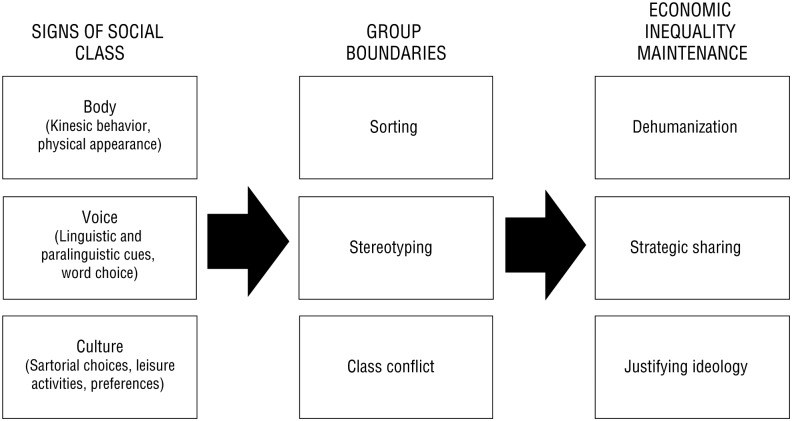
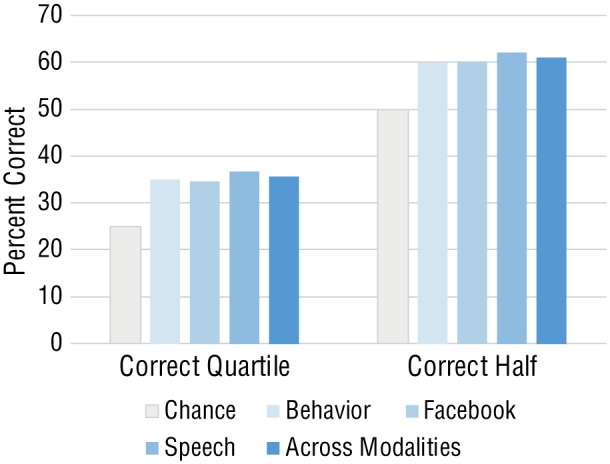
By some accounts, global economic inequality is at its highest point on record. The pernicious effects of this broad societal trend are striking: Rising inequality is linked to poorer health and well-being across countries, continents, and cultures. The economic and psychological forces that perpetuate inequality continue to be studied, and in this theoretical review, we examine the role of daily experiences of economic inequality-the communication of social class signals between interaction partners-in this process. We theorize that social class signals activate social comparison processes that strengthen group boundaries between the haves and have nots in society. In particular, we argue that class signals are a frequent, rapid, and accurate component of person perception, and we provide new data and analyses demonstrating the accuracy of class signaling in 60-s interactions, Facebook photographs, and isolated recordings of brief speech. We suggest that barriers to the reduction of economic inequality in society arise directly from this class signaling process through the augmentation of class boundaries and the elicitation of beliefs and behaviors that favor the economic status quo.
Overview
The claims and statistics of this paper haven’t been checked yet.
Run the check — free, no account needed. It reads the open-access text and checks the sources it cites.
Integrity signals
Registry
Cites
Statistics
Figures
Verification
Claims the paper makes
The claims and statistics of this paper haven’t been checked yet.
Run the check — free, no account needed. It reads the open-access text and checks the sources it cites.
Claims other papers make about this one
Each is checked against this paper’s own text: does it say what the citing paper says it does?
The cited source says what the claim attributes to it.
In the citing paper
“Kraus, Park, and Tan (2017) found that when Americans were asked to judge a speaker's social class from just seven spoken words, the accuracy of their judgments was again above chance”
From The psychology of social class: How socioeconomic status impacts thought, feelings, and behaviour (2018) · cites this paper as Kraus, Park, and Tan (2017)
Self-check
Percentages, sums and reported differences re-computed from the paper’s own numbers.
The self-check needs the paper’s full text.
Citations
Cites
A theory of social comparison processes
Festinger, L. (1954) · Human Relations · doi:10.1177/001872675400700202 · Cited by 20,926
Distinction: A Social Critique of the Judgement of Taste*
Bourdıeu, P. (2018) · Routledge eBooks · doi:10.4324/9781315680347-10 · Cited by 20,325
Distinction: A Social Critique of the Judgement of Taste.
Warner, M., Bourdieu, P., & Nice, R. (1985) · MLN · doi:10.2307/2905454 · Cited by 14,110
The case for motivated reasoning.
Kunda, Z. (1990) · Psychological Bulletin · doi:10.1037/0033-2909.108.3.480 · Cited by 9,022
Stereotype threat and the intellectual test performance of African Americans.
Steele, C. M., & Aronson, J. (1995) · Journal of Personality and Social Psychology · doi:10.1037/0022-3514.69.5.797 · Cited by 9,020
Fiske, S. T., Cuddy, A. J. C., Glick, P., & Xu, J. (2002) · Journal of Personality and Social Psychology · doi:10.1037/0022-3514.82.6.878 · Cited by 7,364
Confirmation Bias: A Ubiquitous Phenomenon in Many Guises
Nickerson, R. S. (1998) · Review of General Psychology · doi:10.1037/1089-2680.2.2.175 · Cited by 7,267
Adler, N. E., Epel, E. S., Castellazzo, G., & Ickovics, J. R. (2000) · Health Psychology · doi:10.1037/0278-6133.19.6.586 · Cited by 5,080
A standard international socio-economic index of occupational status
Ganzeboom, H. B. G., de Graaf, P. M., & Treiman, D. J. (1992) · Social Science Research · doi:10.1016/0049-089x(92)90017-b · Cited by 3,120
The Social Stratification of English in New York City.
Crockett, H. J., & Labov, W. (1968) · American Sociological Review · doi:10.2307/2092899 · Cited by 3,078
Research works printed but not linked: 11
- Bjornsdottir R. T., 2016, Presentation at the Emerging Psychology of Social Class Pre-Conference of the Society for Personality and Social Psychology
- 10.1037/0022-3514.34.3.405 · DOI
- 10.2307/2575202 · DOI
- Fiske S. T., 2012, Facing social class
- Labov W., 1972, New York City department stores, 4, 43
- Lareau A., 2008, Social class: How does it work?
- 10.4159/9780674915565 · DOI
- Shaw G. B., 2012, Pygmalion
- Steele C. M., 2011, Whistling Vivaldi: And other clues to how stereotypes affect us (issues of our time)
- Veblen T., 1973, The theory of the leisure class
- Wolfram W., 2006, American English: Dialects and variation
Cited by
Sorted by citations
The psychology of social class: How socioeconomic status impacts thought, feelings, and behaviour
Manstead, A. S. R. (2018) · British Journal of Social Psychology · doi:10.1111/bjso.12251 · Cited by 831
“…and Rheinschmidt-Same (2017) found that people’s social class could be judged with above-chance accuracy from uploaded Facebook photographs, while Kraus, Park, and Tan (2017) found that when Americans were asked to judge a speaker’s social class from just seven spoken words, the accuracy of…”
BackgroundTan, J. J. X., Kraus, M. W., Carpenter, N. C., & Adler, N. E. (2020) · Psychological Bulletin · doi:10.1037/bul0000258 · Cited by 644
Self-citationThe visibility of social class from facial cues.
Bjornsdottir, R. T., & Rule, N. O. (2017) · Journal of Personality and Social Psychology · doi:10.1037/pspa0000091 · Cited by 185
Davidai, S. (2018) · Journal of Experimental Social Psychology · doi:10.1016/j.jesp.2018.07.012 · Cited by 190
Voice-only communication enhances empathic accuracy
Kraus, M. W. (2017) · American Psychologist · doi:10.1037/amp0000147 · Cited by 162
Metadata
- Authors
- Kraus, M. W., Park, J. W., & Tan, J. J. X.
- Affiliations
- Yale University (US)
- University of California, San Francisco (US)
- Corresponding author
- Kraus, Michael W.
- Venue
- Perspectives on Psychological Science
- Publisher
- SAGE Publications
- Published
- 2017-05
- Volume
- 12
- Issue
- 3
- Pages
- 422-435
- ISSN
- 1745-6916 (ISSN-L)
- 1745-6924
- PMC
- PMC5453398
- OpenAlex
- W2618394217
- Cited by
- 288
- References
- 126
- Citations by year
- 2026: 20 · 2025: 31 · 2024: 40 · 2023: 33 · 2022: 35 · 2021: 49 · 2020: 28 · 2019: 34 · 2018: 11 · 2017: 7
- FWCI
- 56.03
- Type
- journal article
- Language
- en
- Open access
- hybrid
- doi.org
- Locations
- Perspectives on Psychological Science (publishedVersion, cc-by-nc)
- Europe PMC (PubMed Central) (publishedVersion, cc-by-nc)
- PubMed Central (publishedVersion, cc-by-nc)
- PubMed (publishedVersion)
- Singapore Management University Institutional Knowledge (InK) (Singapore Management University) (submittedVersion)
- OSF Preprints (OSF Preprints) (submittedVersion)
- PsyArXiv (OSF Preprints) (submittedVersion)
- PsyArXiv (OSF Preprints) (submittedVersion, public-domain)
- Funders
- Yale University, School of Management
- Topics
- Social Sciences › Sociology and Political Science › Social and Intergroup Psychology
- Social Sciences › Sociology and Political Science › Social Power and Status Dynamics
- Social Sciences › Sociology and Political Science › Cultural Capital and Social Class
- Keywords
- economic inequality, social comparison, person perception, class boundaries, everyday life, speech recordings, group boundaries
- MeSH terms
- Humans, Quality of Life, Social Class, Socioeconomic Factors, Health Status Disparities
About these checks
Registry, retraction, Cites and statistics results are computed, not judged, with one exception: a printed reference that no index lists is read once by a model before it counts as a citation error. Claims are extracted by a model and kept only when their quote appears verbatim in the text; each cited source is then checked, with a model’s help, for whether it says what the claim relies on. Those verdicts can be wrong — read the claim’s quote and the cited source before relying on one.
Statistics and arithmetic are recomputed, not judged.
Confidence bands are shown only for fields calibrated on our annotated test set. None is calibrated yet, so no band is shown.
What counts as a claim ›How we measure confidence ›How we check this ›
Are you an author, or do you see a problem with this page? Request a review
