

The DOI matches its Crossref record; 124 of the 126 references it cites were found in a registry or an index.
Signs of Social Class: The Experience of Economic Inequality in Everyday Life
Open accessPublished version of a preprint
Abstract
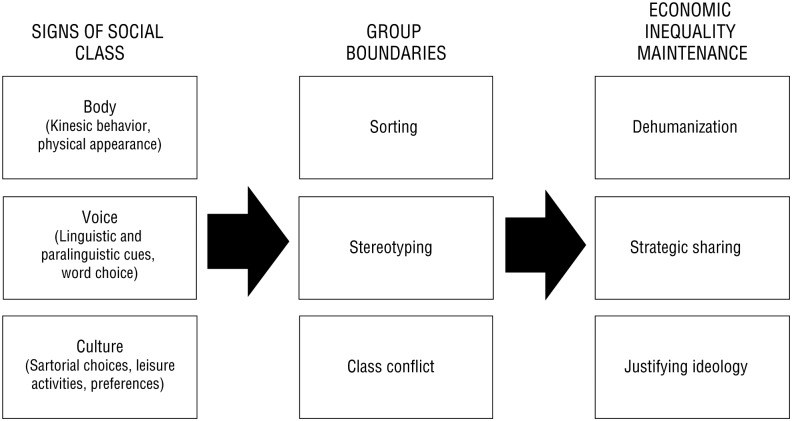
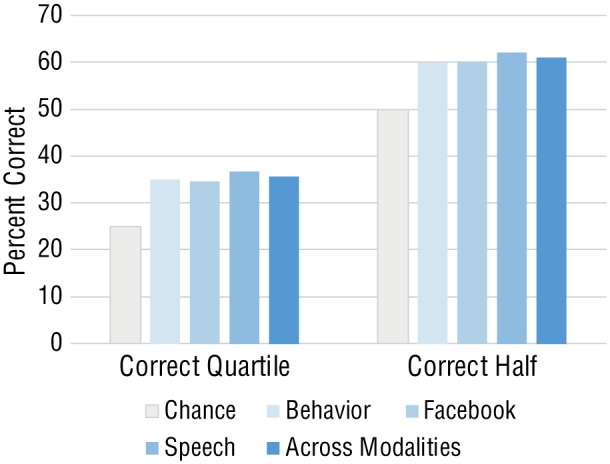
By some accounts, global economic inequality is at its highest point on record. The pernicious effects of this broad societal trend are striking: Rising inequality is linked to poorer health and well-being across countries, continents, and cultures. The economic and psychological forces that perpetuate inequality continue to be studied, and in this theoretical review, we examine the role of daily experiences of economic inequality-the communication of social class signals between interaction partners-in this process. We theorize that social class signals activate social comparison processes that strengthen group boundaries between the haves and have nots in society. In particular, we argue that class signals are a frequent, rapid, and accurate component of person perception, and we provide new data and analyses demonstrating the accuracy of class signaling in 60-s interactions, Facebook photographs, and isolated recordings of brief speech. We suggest that barriers to the reduction of economic inequality in society arise directly from this class signaling process through the augmentation of class boundaries and the elicitation of beliefs and behaviors that favor the economic status quo.
Overview
The claims and statistics of this paper haven’t been checked yet.
Run the check — free, no account needed. It reads the open-access text and checks the sources it cites.
Integrity signals
Registry
Cites
Statistics
Figures
Verification
Claims the paper makes
The claims and statistics of this paper haven’t been checked yet.
Run the check — free, no account needed. It reads the open-access text and checks the sources it cites.
Claims other papers make about this one
Each is checked against this paper’s own text: does it say what the citing paper says it does?
The cited source says what the claim attributes to it.
In the citing paper
“Kraus, Park, and Tan (2017) found that when Americans were asked to judge a speaker's social class from just seven spoken words, the accuracy of their judgments was again above chance”
From The psychology of social class: How socioeconomic status impacts thought, feelings, and behaviour (2018) · cites this paper as Kraus, Park, and Tan (2017)
Self-check
Percentages, sums and reported differences re-computed from the paper’s own numbers.
The self-check needs the paper’s full text.
Citations
Cites
A theory of social comparison processes
Festinger, L. (1954) · Human Relations · doi:10.1177/001872675400700202 · Cited by 20,926
Distinction: A Social Critique of the Judgement of Taste*
Bourdıeu, P. (2018) · Routledge eBooks · doi:10.4324/9781315680347-10 · Cited by 20,325
Distinction: A Social Critique of the Judgement of Taste.
Warner, M., Bourdieu, P., & Nice, R. (1985) · MLN · doi:10.2307/2905454 · Cited by 14,110
The case for motivated reasoning.
Kunda, Z. (1990) · Psychological Bulletin · doi:10.1037/0033-2909.108.3.480 · Cited by 9,022
Stereotype threat and the intellectual test performance of African Americans.
Steele, C. M., & Aronson, J. (1995) · Journal of Personality and Social Psychology · doi:10.1037/0022-3514.69.5.797 · Cited by 9,020
Fiske, S. T., Cuddy, A. J. C., Glick, P., & Xu, J. (2002) · Journal of Personality and Social Psychology · doi:10.1037/0022-3514.82.6.878 · Cited by 7,364
Confirmation Bias: A Ubiquitous Phenomenon in Many Guises
Nickerson, R. S. (1998) · Review of General Psychology · doi:10.1037/1089-2680.2.2.175 · Cited by 7,267
Adler, N. E., Epel, E. S., Castellazzo, G., & Ickovics, J. R. (2000) · Health Psychology · doi:10.1037/0278-6133.19.6.586 · Cited by 5,080
A standard international socio-economic index of occupational status
Ganzeboom, H. B. G., de Graaf, P. M., & Treiman, D. J. (1992) · Social Science Research · doi:10.1016/0049-089x(92)90017-b · Cited by 3,120
The Social Stratification of English in New York City.
Crockett, H. J., & Labov, W. (1968) · American Sociological Review · doi:10.2307/2092899 · Cited by 3,078
Research works printed but not linked: 11
- Bjornsdottir R. T., 2016, Presentation at the Emerging Psychology of Social Class Pre-Conference of the Society for Personality and Social Psychology
- 10.1037/0022-3514.34.3.405 · DOI
- 10.2307/2575202 · DOI
- Fiske S. T., 2012, Facing social class
- Labov W., 1972, New York City department stores, 4, 43
- Lareau A., 2008, Social class: How does it work?
- 10.4159/9780674915565 · DOI
- Shaw G. B., 2012, Pygmalion
- Steele C. M., 2011, Whistling Vivaldi: And other clues to how stereotypes affect us (issues of our time)
- Veblen T., 1973, The theory of the leisure class
- Wolfram W., 2006, American English: Dialects and variation
Cited by
Sorted by citations
The psychology of social class: How socioeconomic status impacts thought, feelings, and behaviour
Manstead, A. S. R. (2018) · British Journal of Social Psychology · doi:10.1111/bjso.12251 · Cited by 831
“…and Rheinschmidt-Same (2017) found that people’s social class could be judged with above-chance accuracy from uploaded Facebook photographs, while Kraus, Park, and Tan (2017) found that when Americans were asked to judge a speaker’s social class from just seven spoken words, the accuracy of…”
BackgroundTan, J. J. X., Kraus, M. W., Carpenter, N. C., & Adler, N. E. (2020) · Psychological Bulletin · doi:10.1037/bul0000258 · Cited by 644
Self-citationThe visibility of social class from facial cues.
Bjornsdottir, R. T., & Rule, N. O. (2017) · Journal of Personality and Social Psychology · doi:10.1037/pspa0000091 · Cited by 185
Davidai, S. (2018) · Journal of Experimental Social Psychology · doi:10.1016/j.jesp.2018.07.012 · Cited by 190
Voice-only communication enhances empathic accuracy
Kraus, M. W. (2017) · American Psychologist · doi:10.1037/amp0000147 · Cited by 162
Unpacking the Inequality Paradox: The Psychological Roots of Inequality and Social Class
Piff, P. K., Kraus, M. W., & Keltner, D. J. (2017) · Advances in experimental social psychology · doi:10.1016/bs.aesp.2017.10.002 · Cited by 181
Self-citationKuppens, T., Spears, R., Manstead, A. S. R., Spruyt, B., & Easterbrook, M. J. (2018) · Journal of Experimental Social Psychology · doi:10.1016/j.jesp.2017.11.001 · Cited by 164
Job Seeking: The Process and Experience of Looking for a Job
Wanberg, C. R., Ali, A. A., & Csillag, B. (2019) · Annual Review of Organizational Psychology and Organizational Behavior · doi:10.1146/annurev-orgpsych-012119-044939 · Cited by 187
Economic status cues from clothes affect perceived competence from faces
Oh, D., Shafir, E. B., & Todorov, A. T. (2019) · Nature Human Behaviour · doi:10.1038/s41562-019-0782-4 · Cited by 116
Perceiving economic inequality in everyday life decreases tolerance to inequality
García‐Castro, J. D., Rodríguez‐Bailón, R., & Willis, G. B. (2020) · Journal of Experimental Social Psychology · doi:10.1016/j.jesp.2020.104019 · Cited by 119
Jetten, J., Peters, K., Álvarez, B., Casara, B. G. S., Dare, M., Kirkland, K., Sánchez‐Rodríguez, Á., Selvanathan, H. P., Sprong, S. L., Tanjitpiyanond, P., et al. (2021) · Political Psychology · doi:10.1111/pops.12800 · Cited by 135
Sociolinguistics and modes of social class signalling: African perspectives
Banda, F. (2020) · Journal of Sociolinguistics · doi:10.1111/josl.12409 · Cited by 105
Economic Inequality Increases Status Anxiety Through Perceived Contextual Competitiveness
Melita, D., Willis, G. B., & Rodríguez‐Bailón, R. (2021) · Frontiers in Psychology · doi:10.3389/fpsyg.2021.637365 · Cited by 114
Korous, K. M., Causadías, J. M., Bradley, R. H., Luthar, S. S., & Levy, R. (2020) · Psychological Reports · doi:10.1177/0033294120984127 · Cited by 109
Socioeconomic status and the structure of the self‐concept
Easterbrook, M. J., Kuppens, T., & Manstead, A. S. R. (2020) · British Journal of Social Psychology · doi:10.1111/bjso.12334 · Cited by 91
The longstanding view of workers as objects: antecedents and consequences of working objectification
Baldissarri, C., Andrighetto, L., & Volpato, C. (2021) · European Review of Social Psychology · doi:10.1080/10463283.2021.1956778 · Cited by 86
Local exposure to inequality raises support of people of low wealth for taxing the wealthy
Sands, M., & de Kadt, D. (2020) · Nature · doi:10.1038/s41586-020-2763-1 · Cited by 85
Evidence for the reproduction of social class in brief speech
Kraus, M. W., Torrez, B., Park, J. W., & Ghayebi, F. (2019) · Proceedings of the National Academy of Sciences · doi:10.1073/pnas.1900500116 · Cited by 87
Self-citationHow economic inequality shapes social class stereotyping
Tanjitpiyanond, P., Jetten, J., & Peters, K. (2021) · Journal of Experimental Social Psychology · doi:10.1016/j.jesp.2021.104248 · Cited by 77
Social Class and Work: A Review and Organizing Framework
Kish-Gephart, J. J., Moergen, K. J. N., Tilton, J., & Gray, B. (2022) · Journal of Management · doi:10.1177/01492063221076822 · Cited by 87
Social Class—Not Income Inequality—Predicts Social and Institutional Trust
Kim, Y., Sommet, N., Na, J., & Spini, D. (2021) · Social Psychological and Personality Science · doi:10.1177/1948550621999272 · Cited by 71
Wang, Z., Jetten, J., & Steffens, N. K. (2019) · European Journal of Social Psychology · doi:10.1002/ejsp.2620 · Cited by 69
Emotional Intelligence and Job Performance of Academicians in Malaysia
Chong, S. C., Falahat, M., & Lee, Y. S. (2019) · International Journal of Higher Education · doi:10.5430/ijhe.v9n1p69 · Cited by 63
Diniz, E., Castro, P., Bousfield, A. B. D. S., & Bernardes, S. F. (2019) · British Journal of Health Psychology · doi:10.1111/bjhp.12399 · Cited by 63
Social Class Competence Stereotypes Are Amplified by Socially Signaled Economic Inequality
Connor, P., Varney, J., Keltner, D. J., & Chen, S. (2020) · Personality and Social Psychology Bulletin · doi:10.1177/0146167220916640 · Cited by 61
Working-Class Legislators and Perceptions of Representation in Latin America
Barnes, T. D., & Saxton, G. W. (2019) · Political research quarterly · doi:10.1177/1065912919829583 · Cited by 42
Restless in an Unequal World: Economic Inequality Fuels the Desire for Wealth and Status
Wang, Z., Jetten, J., & Steffens, N. K. (2022) · Personality and Social Psychology Bulletin · doi:10.1177/01461672221083747 · Cited by 59
Inequality is in the air: contextual psychosocial effects of power and social class
Rodríguez‐Bailón, R., Sánchez‐Rodríguez, Á., García‐Sánchez, E., Petkanopoulou, K., & Willis, G. B. (2019) · Current Opinion in Psychology · doi:10.1016/j.copsyc.2019.07.004 · Cited by 55
García‐Sánchez, E., Correia, I. F., Pereira, C. R., Willis, G. B., Rodríguez‐Bailón, R., & Vala, J. (2021) · Personality and Social Psychology Bulletin · doi:10.1177/01461672211002366 · Cited by 62
Economic Inequality Increases the Preference for Status Consumption
Velandia-Morales, A., Rodríguez‐Bailón, R., & Martínez, R. (2022) · Frontiers in Psychology · doi:10.3389/fpsyg.2021.809101 · Cited by 51
An intersectional approach to understanding how race and social class affect intergroup processes
Moore‐Berg, S. L., & Karpinski, A. (2018) · Social and Personality Psychology Compass · doi:10.1111/spc3.12426 · Cited by 50
Bøe, T., Petrie, K. J., Sivertsen, B., & Hysing, M. (2019) · SSM - Population Health · doi:10.1016/j.ssmph.2019.100471 · Cited by 44
Inequality in People's MindsPreprint
Phillips, L. T., Tepper, S. J., Goya‐Tocchetto, D., Davidai, S., Ordabayeva, N., Mirza, M. U., Szászi, B., Day, M. V., Hauser, O., & Jachimowicz, J. (2020) · doi:10.31234/osf.io/vawh9 · Cited by 44
The Support for Economic Inequality Scale: Development and adjudication
Wiwad, D., Mercier, B., Maraun, M. D., Robinson, A. R., Piff, P. K., Aknin, L. B., & Shariff, A. (2019) · PLoS ONE · doi:10.1371/journal.pone.0218685 · Cited by 45
Phillips, L. T., Martín, S., & Belmi, P. R. V. (2020) · Social and Personality Psychology Compass · doi:10.1111/spc3.12560 · Cited by 47
Martín, S., & Harrison, S. H. (2022) · Academy of Management Journal · doi:10.5465/amj.2020.1550 · Cited by 41
The perception of economic inequality in everyday life: My friends with the most and least money
García‐Castro, J. D., García‐Sánchez, E., Montoya‐Lozano, M., & Rodríguez‐Bailón, R. (2021) · Asian Journal Of Social Psychology · doi:10.1111/ajsp.12476 · Cited by 40
Browman, A. S., Destin, M., & Miele, D. B. (2021) · Asian Journal Of Social Psychology · doi:10.1111/ajsp.12481 · Cited by 39
Melita, D., Rodríguez‐Bailón, R., & Willis, G. B. (2023) · British Journal of Social Psychology · doi:10.1111/bjso.12641 · Cited by 38
Socioeconomic status and access to psychotherapy
Niemeyer, H., & Knaevelsrud, C. (2022) · Journal of Clinical Psychology · doi:10.1002/jclp.23449 · Cited by 45
Advancing developmental intergroup perspectives on social class
Mistry, R. S., Elenbaas, L., Griffin, K. M., Nenadal, L., & Yassine, A. (2021) · Child Development Perspectives · doi:10.1111/cdep.12431 · Cited by 43
Dog whistle mascots: Native American mascots as normative expressions of prejudice
Kraus, M. W., Brown, X., & Swoboda, H. (2019) · Journal of Experimental Social Psychology · doi:10.1016/j.jesp.2019.04.008 · Cited by 38
Self-citationInterwealth Contact and Young Children's Concern for Equity
Elenbaas, L. (2018) · Child Development · doi:10.1111/cdev.13157 · Cited by 34
A psychology of power that is embedded in societal structures
Kraus, M. W., & Torrez, B. (2019) · Current Opinion in Psychology · doi:10.1016/j.copsyc.2019.07.018 · Cited by 35
Self-citationDiniz, E., Bernardes, S. F., & Castro, P. (2019) · Review of General Psychology · doi:10.1177/1089268019880889 · Cited by 34
Bak, H., & Yi, Y. (2020) · Psychology and Marketing · doi:10.1002/mar.21369 · Cited by 34
García‐Castro, J. D., González, R., Frigolett, C., Jiménez‐Moya, G., Rodríguez‐Bailón, R., & Willis, G. B. (2022) · The Journal of Social Psychology · doi:10.1080/00224545.2021.2006126 · Cited by 35
Economic inequality and socioeconomic ranking inform attitudes toward redistribution
Brown-Iannuzzi, J. L., Lundberg, K. B., & McKee, S. E. (2021) · Journal of Experimental Social Psychology · doi:10.1016/j.jesp.2021.104180 · Cited by 33
The economic inequality as normative information model (EINIM)
Sánchez‐Rodríguez, Á., Rodríguez‐Bailón, R., & Willis, G. B. (2023) · European Review of Social Psychology · doi:10.1080/10463283.2022.2160555 · Cited by 33
Standing at the Intersection of Race and Class in Music Education
Bates, V. C. (2019) · Action Criticism and Theory for Music Education · doi:10.22176/act18.1.117 · Cited by 50
Chebbi, H., Selma, M. B., Bouzinab, K., Papadopoulos, A., Labouze-Nasica, A., & Desmarteau, R. H. (2022) · Review of International Business and Strategy · doi:10.1108/ribs-12-2021-0174 · Cited by 37
The context of low socioeconomic status can undermine people’s motivation for financial success
Laurin, K., & Engstrom, H. R. (2019) · Current Opinion in Psychology · doi:10.1016/j.copsyc.2019.07.016 · Cited by 32
Peck, T. C., Good, J. J., & Seitz, K. R. (2021) · IEEE Transactions on Visualization and Computer Graphics · doi:10.1109/tvcg.2021.3067767 · Cited by 32
Make way for the wealthy? Autonomous vehicles, markets in mobility, and social justice
Sparrow, R., & Howard, M. (2020) · Mobilities · doi:10.1080/17450101.2020.1739832 · Cited by 31
The structural dynamics of social class
Kraus, M. W., & Park, J. W. (2017) · Current Opinion in Psychology · doi:10.1016/j.copsyc.2017.07.029 · Cited by 33
Self-citationLaurin, K., Engstrom, H. R., & Alic, A. (2018) · Perspectives on Psychological Science · doi:10.1177/1745691618788875 · Cited by 34
Implicit Evaluative Biases Toward Targets Varying in Race and Socioeconomic Status
Mattan, B. D., Kubota, J. T., Li, T., Venezia, S. A., & Cloutier, J. (2019) · Personality and Social Psychology Bulletin · doi:10.1177/0146167219835230 · Cited by 39
The Moderating Role of Culture in the Generalizability of Psychological Phenomena
Schimmelpfennig, R., Spicer, R., White, C., Gervais, W. M., Norenzayan, A., Heine, S. J., Henrich, J., & Muthukrishna, M. (2024) · Advances in Methods and Practices in Psychological Science · doi:10.1177/25152459231225163 · Cited by 33
Inequality viewed through the mirror of COVID-19 ( La desigualdad ante el espejo del COVID-19 )
Rodríguez‐Bailón, R. (2020) · International Journal of Social Psychology Revista de Psicología Social · doi:10.1080/02134748.2020.1796298 · Cited by 26
ESG-driven ecopreneur selection in European financial institutions: entropy and TOPSIS analysis
Ragazou, K., Lemonakis, C., Passas, I., Zopounidis, C., & Garefalakis, A. E. (2024) · Management Decision · doi:10.1108/md-12-2023-2425 · Cited by 28
Melita, D., Velandia-Morales, A., Iruela-Toros, D., Willis, G. B., & Rodríguez‐Bailón, R. (2020) · International Journal of Social Psychology Revista de Psicología Social · doi:10.1080/02134748.2020.1721050 · Cited by 25
Casara, B. G. S., Filippi, S., Suitner, C., Dollani, E., & Maass, A. (2022) · British Journal of Social Psychology · doi:10.1111/bjso.12555 · Cited by 26
Spencer, R., McCormack, M. J., Drew, A. L., Gowdy, G., & Keller, T. E. (2021) · Journal of Community Psychology · doi:10.1002/jcop.22737 · Cited by 25
Social Sampling, Perceptions of Wealth Distribution, and Support for Redistribution
Dawtry, R. J., Sutton, R. M., & Sibley, C. G. (2019) · Springer eBooks · doi:10.1007/978-3-030-28856-3_24 · Cited by 23
People from lower social classes elicit greater prosociality: Compassion and deservingness matter
Doesum, N. J. V., Lange, P. A. M. V., Tybur, J. M., Leal, A. L., & van Dijk, E. (2021) · Group Processes & Intergroup Relations · doi:10.1177/1368430220982072 · Cited by 24
Harvey, P. F. (2022) · American Journal of Sociology · doi:10.1086/719406 · Cited by 23
Fram, M. S., & Frongillo, E. A. (2018) · Advances in Nutrition · doi:10.1093/advances/nmx008 · Cited by 24
Bowman, N. A., Logel, C. R., LaCosse, J., Canning, E. A., Emerson, K. T. U., & Murphy, M. C. (2023) · AERA Open · doi:10.1177/23328584231209957 · Cited by 29
Conspicuous consumption in Chinese young adults: The role of dark tetrad and gender
Zhu, X., Geng, Y.-G., Pan, Y.-L., & Shi, L.-P. (2022) · Current Psychology · doi:10.1007/s12144-022-03129-4 · Cited by 19
García‐Castro, J. D., García‐Sánchez, E., Willis, G. B., Castillo, J. C., & Rodríguez‐Bailón, R. (2022) · Social Psychology · doi:10.1027/1864-9335/a000498 · Cited by 29
Intersectional Complexity in Stereotype Content
Heiserman, N. (2023) · American Journal of Sociology · doi:10.1086/728051 · Cited by 27
Income Is a Stronger Predictor of Subjective Social Class in More Economically Unequal Places
Kim, Y., & Sommet, N. (2023) · Personality and Social Psychology Bulletin · doi:10.1177/01461672231210772 · Cited by 22
Overcoming Resource Scarcity: Consumers’ Response to Gifts Intending to Save Time and Money
Lee-Yoon, A., Donnelly, G. E., & Whillans, A. V. (2020) · Journal of the Association for Consumer Research · doi:10.1086/709887 · Cited by 18
Highlander, A., & Jones, D. J. (2021) · Clinical Child and Family Psychology Review · doi:10.1007/s10567-021-00369-x · Cited by 19
Representasi Kelas Sosial Dalam Film Gundala (Analisis Semiotika Roland Barthes)
Prasetya, L. T. (2022) · Jurnal Audiens · doi:10.18196/jas.v3i3.12697 · Cited by 19
Workplace trust as a mechanism of employee (dis)advantage: The case of employee socioeconomic status
Pitesa, M., Thau, S., & Pillutla, M. M. (2017) · Research in Organizational Behavior · doi:10.1016/j.riob.2017.10.006 · Cited by 21
Bernardes, S. F., Tomé-Pires, C., Brandão, T., Campos, L., Teixeira, F., & Goubert, L. (2021) · Pain · doi:10.1097/j.pain.0000000000002278 · Cited by 18
Socioeconomic Diversity of Economics PhDsPreprint
Schultz, R., & Stansbury, A. (2022) · SSRN Electronic Journal · doi:10.2139/ssrn.4068831 · Cited by 18
A social identity threat perspective on being the target of generosity from a higher status other
Sandstrom, G. M., Schmader, T., Croft, A., & Kwok, N. (2019) · Journal of Experimental Social Psychology · doi:10.1016/j.jesp.2018.12.004 · Cited by 19
Brandão, T., Campos, L., de Ruddere, L., Goubert, L., & Bernardes, S. F. (2019) · Pain Medicine · doi:10.1093/pm/pnz148 · Cited by 17
Deep Pockets and Poor Results: The Effect of Wealth Cues on First Offers in Negotiation
Maaravi, Y., & Hameiri, B. (2018) · Group Decision and Negotiation · doi:10.1007/s10726-018-9599-1 · Cited by 16
A social identity analysis of how pay inequality divides the workplace
Tanjitpiyanond, P., Jetten, J., & Peters, K. (2022) · Group Processes & Intergroup Relations · doi:10.1177/13684302221074550 · Cited by 16
Lisnek, J. A., Caluori, N., Brown-Iannuzzi, J. L., & Oishi, S. (2024) · Personality and Social Psychology Bulletin · doi:10.1177/01461672241234787 · Cited by 16
Prejudice against members of a ridiculed working‐class group
Vázquez, A., & Lois, D. (2020) · British Journal of Social Psychology · doi:10.1111/bjso.12373 · Cited by 15
García‐Sánchez, E., García‐Castro, J. D., Willis, G. B., & Rodríguez‐Bailón, R. (2021) · Revista de Estudios Sociales · doi:10.7440/res79.2022.01 · Cited by 15
Thomas, K. (2022) · Poetics · doi:10.1016/j.poetic.2022.101669 · Cited by 17
Filippi, S., Casara, B. G. S., Peters, K., Maass, A., Feraco, T., & Suitner, C. (2024) · European Journal of Work and Organizational Psychology · doi:10.1080/1359432x.2024.2415127 · Cited by 14
Martínez, J. M. A., León, F. G., Darias, J., & Mestas, L. (2019) · Computers in Human Behavior · doi:10.1016/j.chb.2019.106156 · Cited by 14
The links among relative financial scarcity, thinking style, fatalism, and well‐being
Caballero, A., Fernández, I., Aguilar, P., & Carrera, P. (2022) · PsyCh Journal · doi:10.1002/pchj.566 · Cited by 18
Local exposure to inequality among the poor increases support for taxing the richPreprint
Sands, M., & de Kadt, D. (2019) · doi:10.31235/osf.io/9ktg2 · Cited by 15
Public Opinion and Social Justice in China
Bao-bin, M., Tan, Q., & Du, P. (2021) · Journal of Chinese Political Science · doi:10.1007/s11366-021-09761-4 · Cited by 13
Do American children automatically encode cues to wealth?
Legaspi, J., Pareto, H. G., Korroch, S. L., Tian, Y., & Mandalaywala, T. M. (2023) · Journal of Experimental Child Psychology · doi:10.1016/j.jecp.2023.105706 · Cited by 18
How does economic inequality shape conspiracy theories? Empirical evidence from China
Zeng, Z., Tian, C., Mao, J., van Prooijen, J., Zhang, Y., Yang, S., Xie, X., & Guo, Y. (2023) · British Journal of Social Psychology · doi:10.1111/bjso.12689 · Cited by 13
Blue Helmets, Red Flags: Institutional, Societal, and Military Determinants of Peacekeeping Abuses
Rodriguez, M., & Kinne, B. J. (2019) · International Studies Quarterly · doi:10.1093/isq/sqz020 · Cited by 13
Moya, M., Willis, G. B., Páez, D., Pérez, J. A., Gómez, Á., Cameselle, J. M. S., Álzate, M., Hur, D. U., Rodríguez, A., Extremera, N., et al. (2020) · doi:10.31234/osf.io/fdn32 · Cited by 13
Shoss, M. K., & Ciarlante, K. E. (2022) · Technology Mind and Behavior · doi:10.1037/tmb0000078 · Cited by 13
West, T. V., & Mendes, W. B. (2023) · Advances in experimental social psychology · doi:10.1016/bs.aesp.2022.11.002 · Cited by 12
Filippi, S., Casara, B. G. S., Pirrone, D., Yerkes, M. A., & Suitner, C. (2023) · Royal Society Open Science · doi:10.1098/rsos.230187 · Cited by 19
Casali, N., Filippi, S., & Feraco, T. (2024) · Journal of Happiness Studies · doi:10.1007/s10902-024-00751-w · Cited by 12
Mattan, B. D., Barth, D. M., Thompson, A., FeldmanHall, O., Cloutier, J., & Kubota, J. T. (2020) · PLoS ONE · doi:10.1371/journal.pone.0232369 · Cited by 13
Metadata
- Authors
- Kraus, M. W., Park, J. W., & Tan, J. J. X.
- Affiliations
- Yale University (US)
- University of California, San Francisco (US)
- Corresponding author
- Kraus, Michael W.
- Venue
- Perspectives on Psychological Science
- Publisher
- SAGE Publications
- Published
- 2017-05
- Volume
- 12
- Issue
- 3
- Pages
- 422-435
- ISSN
- 1745-6916 (ISSN-L)
- 1745-6924
- PMC
- PMC5453398
- OpenAlex
- W2618394217
- Cited by
- 288
- References
- 126
- Citations by year
- 2026: 20 · 2025: 31 · 2024: 40 · 2023: 33 · 2022: 35 · 2021: 49 · 2020: 28 · 2019: 34 · 2018: 11 · 2017: 7
- FWCI
- 56.03
- Type
- journal article
- Language
- en
- Open access
- hybrid
- doi.org
- Locations
- Perspectives on Psychological Science (publishedVersion, cc-by-nc)
- Europe PMC (PubMed Central) (publishedVersion, cc-by-nc)
- PubMed Central (publishedVersion, cc-by-nc)
- PubMed (publishedVersion)
- Singapore Management University Institutional Knowledge (InK) (Singapore Management University) (submittedVersion)
- OSF Preprints (OSF Preprints) (submittedVersion)
- PsyArXiv (OSF Preprints) (submittedVersion)
- PsyArXiv (OSF Preprints) (submittedVersion, public-domain)
- Funders
- Yale University, School of Management
- Topics
- Social Sciences › Sociology and Political Science › Social and Intergroup Psychology
- Social Sciences › Sociology and Political Science › Social Power and Status Dynamics
- Social Sciences › Sociology and Political Science › Cultural Capital and Social Class
- Keywords
- economic inequality, social comparison, person perception, class boundaries, everyday life, speech recordings, group boundaries
- MeSH terms
- Humans, Quality of Life, Social Class, Socioeconomic Factors, Health Status Disparities
About these checks
Registry, retraction, Cites and statistics results are computed, not judged, with one exception: a printed reference that no index lists is read once by a model before it counts as a citation error. Claims are extracted by a model and kept only when their quote appears verbatim in the text; each cited source is then checked, with a model’s help, for whether it says what the claim relies on. Those verdicts can be wrong — read the claim’s quote and the cited source before relying on one.
Statistics and arithmetic are recomputed, not judged.
Confidence bands are shown only for fields calibrated on our annotated test set. None is calibrated yet, so no band is shown.
What counts as a claim ›How we measure confidence ›How we check this ›
Are you an author, or do you see a problem with this page? Request a review
