

The DOI matches its Crossref record; 124 of the 126 references it cites were found in a registry or an index.
Signs of Social Class: The Experience of Economic Inequality in Everyday Life
Open accessPublished version of a preprint
Abstract
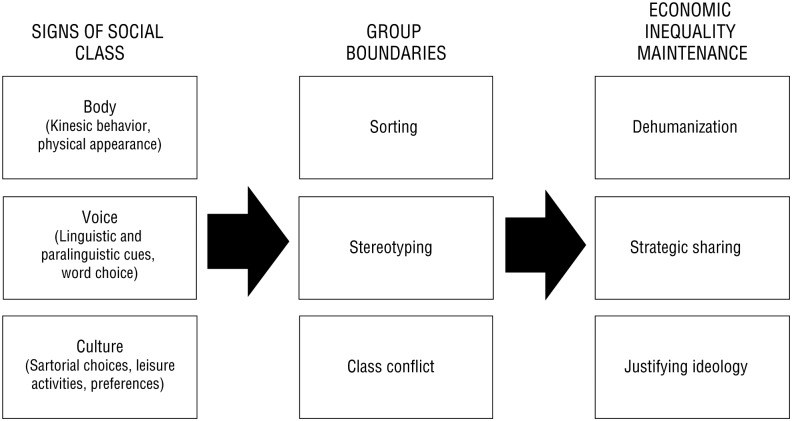
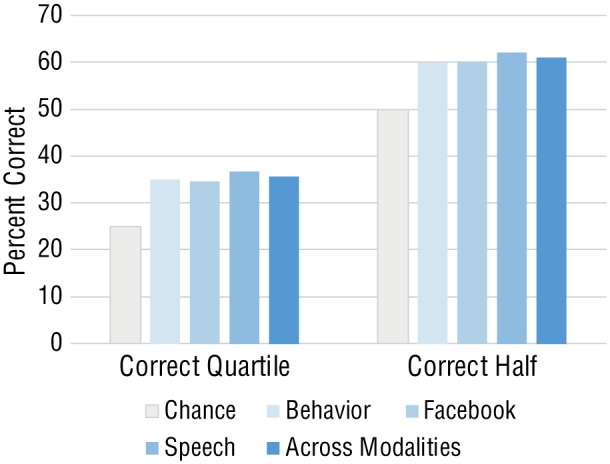
By some accounts, global economic inequality is at its highest point on record. The pernicious effects of this broad societal trend are striking: Rising inequality is linked to poorer health and well-being across countries, continents, and cultures. The economic and psychological forces that perpetuate inequality continue to be studied, and in this theoretical review, we examine the role of daily experiences of economic inequality-the communication of social class signals between interaction partners-in this process. We theorize that social class signals activate social comparison processes that strengthen group boundaries between the haves and have nots in society. In particular, we argue that class signals are a frequent, rapid, and accurate component of person perception, and we provide new data and analyses demonstrating the accuracy of class signaling in 60-s interactions, Facebook photographs, and isolated recordings of brief speech. We suggest that barriers to the reduction of economic inequality in society arise directly from this class signaling process through the augmentation of class boundaries and the elicitation of beliefs and behaviors that favor the economic status quo.
Overview
The claims and statistics of this paper haven’t been checked yet.
Run the check — free, no account needed. It reads the open-access text and checks the sources it cites.
Integrity signals
Registry
Cites
Statistics
Figures
Verification
Claims the paper makes
The claims and statistics of this paper haven’t been checked yet.
Run the check — free, no account needed. It reads the open-access text and checks the sources it cites.
Claims other papers make about this one
Each is checked against this paper’s own text: does it say what the citing paper says it does?
The cited source says what the claim attributes to it.
In the citing paper
“Kraus, Park, and Tan (2017) found that when Americans were asked to judge a speaker's social class from just seven spoken words, the accuracy of their judgments was again above chance”
From The psychology of social class: How socioeconomic status impacts thought, feelings, and behaviour (2018) · cites this paper as Kraus, Park, and Tan (2017)
Self-check
Percentages, sums and reported differences re-computed from the paper’s own numbers.
The self-check needs the paper’s full text.
Citations
Cites
A theory of social comparison processes
Festinger, L. (1954) · Human Relations · doi:10.1177/001872675400700202 · Cited by 20,926
Distinction: A Social Critique of the Judgement of Taste*
Bourdıeu, P. (2018) · Routledge eBooks · doi:10.4324/9781315680347-10 · Cited by 20,325
Distinction: A Social Critique of the Judgement of Taste.
Warner, M., Bourdieu, P., & Nice, R. (1985) · MLN · doi:10.2307/2905454 · Cited by 14,110
The case for motivated reasoning.
Kunda, Z. (1990) · Psychological Bulletin · doi:10.1037/0033-2909.108.3.480 · Cited by 9,022
Stereotype threat and the intellectual test performance of African Americans.
Steele, C. M., & Aronson, J. (1995) · Journal of Personality and Social Psychology · doi:10.1037/0022-3514.69.5.797 · Cited by 9,020
Fiske, S. T., Cuddy, A. J. C., Glick, P., & Xu, J. (2002) · Journal of Personality and Social Psychology · doi:10.1037/0022-3514.82.6.878 · Cited by 7,364
Confirmation Bias: A Ubiquitous Phenomenon in Many Guises
Nickerson, R. S. (1998) · Review of General Psychology · doi:10.1037/1089-2680.2.2.175 · Cited by 7,267
Adler, N. E., Epel, E. S., Castellazzo, G., & Ickovics, J. R. (2000) · Health Psychology · doi:10.1037/0278-6133.19.6.586 · Cited by 5,080
A standard international socio-economic index of occupational status
Ganzeboom, H. B. G., de Graaf, P. M., & Treiman, D. J. (1992) · Social Science Research · doi:10.1016/0049-089x(92)90017-b · Cited by 3,120
The Social Stratification of English in New York City.
Crockett, H. J., & Labov, W. (1968) · American Sociological Review · doi:10.2307/2092899 · Cited by 3,078
Cognitive consequences of forced compliance.
Festinger, L., & Carlsmith, J. M. (1959) · The Journal of Abnormal and Social Psychology · doi:10.1037/h0041593 · Cited by 2,945
Dehumanization: An integrative review
Haslam, N. (2006) · Personality and Social Psychology Review · doi:10.1207/s15327957pspr1003_4 · Cited by 2,919 · cited 1×
“This mix of social judgments leads perceivers to scorn extremely low status groups in society (Fiske, 2011) and to discount their mental states and human characteristics (Cikara, Bruneau, & Saxe, 2011)—a pattern we and others refer to as dehumanization (Haslam, 2006).”
BackgroundJost, J. T., Banaji, M. R., & Nosek, B. A. (2004) · Political Psychology · doi:10.1111/j.1467-9221.2004.00402.x · Cited by 2,883
Changing Highbrow Taste: From Snob to Omnivore
Peterson, R. A., & Kern, R. M. (1996) · American Sociological Review · doi:10.2307/2096460 · Cited by 2,418
Socioeconomic status and health: The challenge of the gradient
Adler, N. E., Boyce, T., Chesney, M. A., Cohen, S., Folkman, S., Kahn, R. L., & Syme, S. L. (1994) · American Psychologist · doi:10.1037/0003-066x.49.1.15 · Cited by 2,383
The influence of social hierarchy on primate health
Sapolsky, R. M. (2005) · Science · doi:10.1126/science.1106477 · Cited by 2,113 · cited 4×
“…to fiddler crabs, individuals across species signal their broadly defined social status with nonverbal behaviors (Hall, Coats, & LeBeau, 2005; Sapolsky, 2005; Sergio et al., 2011), vocalizations (Dunbar & Burgoon, 2005; Gregory & Webster, 1996; Ko, Sadler, & Galinsky, 2015), and social…”
InfluentialThe Social Stratification of English in New York City
Labov, W. (2006) · Cambridge University Press eBooks · doi:10.1017/cbo9780511618208 · Cited by 1,927
Gilens, M. (1999) · University of Chicago Press eBooks · doi:10.7208/chicago/9780226293660.001.0001 · Cited by 1,803
Income inequality and population health: A review and explanation of the evidence
Wilkinson, R. G., & Pickett, K. E. (2005) · Social Science & Medicine · doi:10.1016/j.socscimed.2005.08.036 · Cited by 1,786
(2013) · Cited by 1,704
The intersection of sex and social class in the course of linguistic change
Labov, W. (1990) · Language Variation and Change · doi:10.1017/s0954394500000338 · Cited by 1,472
Social class, solipsism, and contextualism: How the rich are different from the poor.
Kraus, M. W., Piff, P. K., Mendoza-Denton, R., Rheinschmidt, M. L., & Keltner, D. (2012) · Psychological Review · doi:10.1037/a0028756 · Cited by 1,397
Self-citationGallo, L. C., & Matthews, K. A. (2003) · Psychological Bulletin · doi:10.1037/0033-2909.129.1.10 · Cited by 1,366
Social comparison activity under threat: Downward evaluation and upward contacts.
Taylor, S. E., & Lobel, M. (1989) · Psychological Review · doi:10.1037/0033-295x.96.4.569 · Cited by 1,352
The Handicap Principle: A Missing Piece of Darwin's Puzzle
Zehavi, A., & Zahavi, A. (1997) · Cited by 1,179
Social Comparison Processes: Theoretical and Empirical Perspectives.
Pettigrew, T. F., Suls, J. M., & Miller, R. L. (1979) · Contemporary Sociology A Journal of Reviews · doi:10.2307/2066199 · Cited by 1,164
Building a Better America—One Wealth Quintile at a Time
Norton, M. I., & Ariely, D. (2011) · Perspectives on Psychological Science · doi:10.1177/1745691610393524 · Cited by 1,119
Adolescents' Perceptions of Social Status: Development and Evaluation of a New Indicator
Goodman, E., Adler, N. E., Kawachi, I. I., Frazier, A. L., Huang, B., & Colditz, G. A. (2001) · PEDIATRICS · doi:10.1542/peds.108.2.e31 · Cited by 1,118
The measurement of SES in health research: current practice and steps toward a new approach
Oakes, J. M., & Rossi, P. H. (2003) · Social Science & Medicine · doi:10.1016/s0277-9536(02)00073-4 · Cited by 1,116
Ambady, N., & Rosenthal, R. (1993) · Journal of Personality and Social Psychology · doi:10.1037/0022-3514.64.3.431 · Cited by 1,059
Dehumanizing the Lowest of the Low: Neuroimaging Responses to Extreme Out-Groups
Harris, L. T., & Fiske, S. T. (2006) · Psychological Science · doi:10.1111/j.1467-9280.2006.01793.x · Cited by 985
Beliefs About Inequality: American's Views of What Is and What Ought To Be
Alwin, D. F., Kluegel, J. R., & Smith, E. R. (1987) · Contemporary Sociology A Journal of Reviews · doi:10.2307/2071506 · Cited by 960
Piketty, T., & Saez, E. (2014) · Science · doi:10.1126/science.1251936 · Cited by 960
Social class, sense of control, and social explanation.
Kraus, M. W., Piff, P. K., & Keltner, D. (2009) · Journal of Personality and Social Psychology · doi:10.1037/a0016357 · Cited by 956
Self-citationWhites' opposition to busing: Symbolic racism or realistic group conflict?
Bobo, L. (1983) · Journal of Personality and Social Psychology · doi:10.1037/0022-3514.45.6.1196 · Cited by 945
Income Inequality and Social Dysfunction
Wilkinson, R. G., & Pickett, K. E. (2009) · Annual Review of Sociology · doi:10.1146/annurev-soc-070308-115926 · Cited by 916
Nonverbal Behavior and the Vertical Dimension of Social Relations: A Meta-Analysis.
Hall, J. A., Coats, E. J., & LeBeau, L. S. (2005) · Psychological Bulletin · doi:10.1037/0033-2909.131.6.898 · Cited by 860
A Primer of Signal Detection Theory
McNicol, D. (2005) · Psychology Press eBooks · doi:10.4324/9781410611949 · Cited by 856
Is actual similarity necessary for attraction? A meta-analysis of actual and perceived similarity
Montoya, R. M., Horton, R. S., & Kirchner, J. (2008) · Journal of Social and Personal Relationships · doi:10.1177/0265407508096700 · Cited by 855
Croizet, J.-C., & Claire, T. (1998) · Personality and Social Psychology Bulletin · doi:10.1177/0146167298246003 · Cited by 851
Signal Detection Theory and ROC Analysis in Psychology and Diagnostics: Collected Papers
Swets, J. A. (1996) · Medical Entomology and Zoology · Cited by 782
Trends and Variation in Assortative Mating: Causes and Consequences
Schwartz, C. R. (2013) · Annual Review of Sociology · doi:10.1146/annurev-soc-071312-145544 · Cited by 725
Us and Them: Intergroup Failures of Empathy
Cikara, M., Bruneau, E. G., & Saxe, R. R. (2011) · Current Directions in Psychological Science · doi:10.1177/0963721411408713 · Cited by 725
Stephens, N. M., Hamedani, M. G., & Destin, M. (2014) · Psychological Science · doi:10.1177/0956797613518349 · Cited by 708
Social Class: How Does it Work?
Lareau, A. P., & Conley, D. (2008) · Cited by 662
Social Comparison Affects Reward-Related Brain Activity in the Human Ventral Striatum
Fließbach, K., Weber, B., Trautner, P., Dohmen, T., Sunde, U., Elger, C. E., & Falk, A. (2007) · Science · doi:10.1126/science.1145876 · Cited by 646
The spontaneous expression of pride and shame: Evidence for biologically innate nonverbal displays
Tracy, J. L., & Matsumoto, D. (2008) · Proceedings of the National Academy of Sciences · doi:10.1073/pnas.0802686105 · Cited by 637
‘Strangers in Paradise’?: Working-class Students in Elite Universities
Reay, D., Crozier, G., & Clayton, J. (2009) · Sociology · doi:10.1177/0038038509345700 · Cited by 634
You Can't Always Get What You Want: Educational Attainment, Agency, and Choice.
Snibbe, A. C., & Markus, H. R. (2005) · Journal of Personality and Social Psychology · doi:10.1037/0022-3514.88.4.703 · Cited by 614
Social Class and Belonging: Implications for College Adjustment
Ostrove, J. M., & Long, S. M. (2007) · Review of higher education/The review of higher education · doi:10.1353/rhe.2007.0028 · Cited by 586
The communication of emotion via touch
Hertenstein, M. J., Holmes, R., McCullough, M., & Keltner, D. (2009) · Emotion · doi:10.1037/a0016108 · Cited by 563
Gaining trust as well as respect in communicating to motivated audiences about science topics
Fiske, S. T., & Dupree, C. H. (2014) · Proceedings of the National Academy of Sciences · doi:10.1073/pnas.1317505111 · Cited by 539
Social Class and Parent-Child Relationships: An Interpretation
Kohn, M. L. (1963) · American Journal of Sociology · doi:10.1086/223403 · Cited by 538
Algeo, J. T. (2000) · Language · doi:10.2307/417411 · Cited by 530
A pandemic of the poor: Social disadvantage and the U.S. HIV epidemic.
Pellowski, J. A., Kalichman, S. C., Matthews, K. A., & Adler, N. E. (2013) · American Psychologist · doi:10.1037/a0032694 · Cited by 502
Gluszek, A., & Dovidio, J. F. (2010) · Personality and Social Psychology Review · doi:10.1177/1088868309359288 · Cited by 497
Beliefs about Inequality: Americans' Views of What Is and What Ought to Be
Ohsfeldt, R. L., Kluegel, J. R., & Smith, E. R. (1987) · Southern Economic Journal · doi:10.2307/1059348 · Cited by 472
Kraus, M. W., & Keltner, D. J. (2008) · Psychological Science · doi:10.1111/j.1467-9280.2008.02251.x · Cited by 455
Self-citationSocial class and arts consumption
DiMaggio, P., & Useem, M. (1978) · Theory and Society · doi:10.1007/bf01702159 · Cited by 424
Race as a Bundle of Sticks: Designs that Estimate Effects of Seemingly Immutable Characteristics
Sen, M., & Wasow, O. (2016) · Annual Review of Political Science · doi:10.1146/annurev-polisci-032015-010015 · Cited by 422
Class Advantage, Commitment Penalty
Rivera, L. A., & Tilcsik, A. (2016) · American Sociological Review · doi:10.1177/0003122416668154 · Cited by 409
Social Differentiation in Musical Taste Patterns
van Eijck, K. (2001) · Social Forces · doi:10.1353/sof.2001.0017 · Cited by 407
School choice, social class and distinction: the realization of social advantage in education
Ball, S. J., Bowe, R., & Gewirtz, S. (1996) · Journal of Education Policy · doi:10.1080/0268093960110105 · Cited by 406
Compassion, pride, and social intuitions of self-other similarity.
Oveis, C., Horberg, E. J., & Keltner, D. J. (2010) · Journal of Personality and Social Psychology · doi:10.1037/a0017628 · Cited by 401
Inequality and visibility of wealth in experimental social networks
Nishi, A., Shirado, H., Rand, D. G., & Christakis, N. A. (2015) · Nature · doi:10.1038/nature15392 · Cited by 394
Jost, J. T., Pelham, B. W., & Carvallo, M. (2002) · Journal of Experimental Social Psychology · doi:10.1016/s0022-1031(02)00505-x · Cited by 371
Evicted: Poverty and Profit in the American City
Desmond, M. (2016) · Cited by 342
How Much (More) Should CEOs Make? A Universal Desire for More Equal Pay
Kiatpongsan, S., & Norton, M. I. (2014) · Perspectives on Psychological Science · doi:10.1177/1745691614549773 · Cited by 337
Stereotype accuracy: Toward appreciating group differences.
(1995) · American Psychological Association eBooks · doi:10.1037/10495-000 · Cited by 313
Americans overestimate social class mobility
Kraus, M. W., & Tan, J. J. X. (2015) · Journal of Experimental Social Psychology · doi:10.1016/j.jesp.2015.01.005 · Cited by 297
Self-citationMiddle class and marginal? Socioeconomic status, stigma, and self-regulation at an elite university.
Johnson, S. E., Richeson, J. A., & Finkel, E. J. (2011) · Journal of Personality and Social Psychology · doi:10.1037/a0021956 · Cited by 296
High economic inequality leads higher-income individuals to be less generous
Côté, S., House, J., & Willer, R. (2015) · Proceedings of the National Academy of Sciences · doi:10.1073/pnas.1511536112 · Cited by 295
Nations' income inequality predicts ambivalence in stereotype content: How societies mind the gap
Durante, F., Fiske, S. T., Kervyn, N. O., Cuddy, A. J. C., Akande, A., Adetoun, B. E., Adewuyi, M. F., Tserere, M. M., Ramiah, A. A., Mastor, K. A., et al. (2012) · British Journal of Social Psychology · doi:10.1111/bjso.12005 · Cited by 290
Antecedents and consequences of the frequency of upward and downward social comparisons at work
Brown, D. J., Ferris, D. L., Heller, D. A., & Keeping, L. M. (2006) · Organizational Behavior and Human Decision Processes · doi:10.1016/j.obhdp.2006.10.003 · Cited by 288
Social Class, Linguistic Codes and Grammatical Elements
Bernstein, B. (1962) · Language and Speech · doi:10.1177/002383096200500405 · Cited by 277
Perceptions of power and interactional dominance in interpersonal relationships
Dunbar, N. E., & Burgoon, J. K. (2005) · Journal of Social and Personal Relationships · doi:10.1177/0265407505050944 · Cited by 272
The Social Ladder: A Rank-Based Perspective on Social Class
Kraus, M. W., Tan, J. J. X., & Tannenbaum, M. B. (2013) · Psychological Inquiry · doi:10.1080/1047840x.2013.778803 · Cited by 258
Self-citationPiketty, T. (2015) · Harvard University Press eBooks · doi:10.2307/j.ctvjnrtk1 · Cited by 255
Gregory, S. W., & Webster, S. W. (1996) · Journal of Personality and Social Psychology · doi:10.1037/0022-3514.70.6.1231 · Cited by 246
Stephens, N. M., Markus, H. R., & Fryberg, S. A. (2012) · Psychological Review · doi:10.1037/a0029028 · Cited by 239
Subjective Status Shapes Political Preferences
Brown-Iannuzzi, J. L., Lundberg, K. B., Kay, A. C., & Payne, B. K. (2015) · Psychological Science · doi:10.1177/0956797614553947 · Cited by 234
Class: A Guide Through the American Status System
Fussell, P. (1983) · Medical Entomology and Zoology · Cited by 221
Building a More Mobile America—One Income Quintile at a Time
Davidai, S., & Gilovich, T. (2015) · Perspectives on Psychological Science · doi:10.1177/1745691614562005 · Cited by 220
Signal Detection Theory and ROC Analysis in Psychology and Diagnostics
Swets, J. A. (2014) · Psychology Press eBooks · doi:10.4324/9781315806167 · Cited by 209
Income Mobility Breeds Tolerance for Income Inequality: Cross-National and Experimental Evidence
Shariff, A. F., Wiwad, D., & Aknin, L. B. (2016) · Perspectives on Psychological Science · doi:10.1177/1745691616635596 · Cited by 202
Subjective socioeconomic status causes aggression: A test of the theory of social deprivation.
Greitemeyer, T., & Sagioglou, C. (2016) · Journal of Personality and Social Psychology · doi:10.1037/pspi0000058 · Cited by 202
Raptor Nest Decorations Are a Reliable Threat Against Conspecifics
Sergio, F., Blas, J., Blanco, G., Tanferna, A., López, L., Lemus, J. Á., & Hiraldo, F. (2011) · Science · doi:10.1126/science.1199422 · Cited by 194
Monsivais, P., & Drewnowski, A. (2009) · Journal of the American Dietetic Association · doi:10.1016/j.jada.2009.02.002 · Cited by 189
Envy up, scorn down: How status divides us
Fiske, S. T. (2012) · PsycEXTRA Dataset · doi:10.1037/e669402012-009 · Cited by 181
Who Is the Boss and Who Is Not? Accuracy of Judging Status
Mast, M. S., & Hall, J. A. (2004) · Journal of Nonverbal Behavior · doi:10.1023/b:jonb.0000039647.94190.21 · Cited by 170
Evicted: Poverty and Profit in the American City
Jackson, T. (2017) · Journal of American History · doi:10.1093/jahist/jax411 · Cited by 170
Envy up, scorn down: how status divides us
(2011) · Choice Reviews Online · doi:10.5860/choice.49-1165 · Cited by 168
Ližardo, O., & Skiles, S. (2015) · Poetics · doi:10.1016/j.poetic.2015.08.003 · Cited by 156
Shoes as a source of first impressions
Gillath, O., Bahns, A. J., Ge, F., & Crandall, C. S. (2012) · Journal of Research in Personality · doi:10.1016/j.jrp.2012.04.003 · Cited by 149
Paradoxical Pathways: An Ethnographic Extension of Kohn's Findings on Class and Childrearing
Weininger, E. B., & Lareau, A. P. (2009) · Journal of Marriage and the Family · doi:10.1111/j.1741-3737.2009.00626.x · Cited by 132
Kraus, M. W., & Mendes, W. B. (2014) · Journal of Experimental Psychology General · doi:10.1037/xge0000023 · Cited by 128
Self-citationThe Social Stratification of (r) in New York City Department Stores
Labov, W. (1997) · doi:10.1007/978-1-349-25582-5_14 · Cited by 126
The Handicap Principle: A Missing Piece of Darwin's Puzzle
Buchholz, R. (2000) · The Auk · doi:10.1093/auk/117.1.269 · Cited by 124
Buunk, B. P., Lloréns, R. Z., González‐Romá, V., & Ferrer, M. S. (2003) · Journal of Vocational Behavior · doi:10.1016/s0001-8791(02)00015-5 · Cited by 120
Fogel, H., & Ehri, L. C. (2000) · Contemporary Educational Psychology · doi:10.1006/ceps.1999.1002 · Cited by 107
Physical and situational inequality on airplanes predicts air rage
DeCelles, K. A., & Norton, M. I. (2016) · Proceedings of the National Academy of Sciences · doi:10.1073/pnas.1521727113 · Cited by 103
Rivera, L. A. (2016) · Princeton University Press eBooks · doi:10.1515/9781400880744 · Cited by 103
Oishi, S., & Talhelm, T. (2012) · Current Directions in Psychological Science · doi:10.1177/0963721412460675 · Cited by 98
Status Symbols and the Measurement of Status Perception
Davis, J. A. (1956) · Sociometry · doi:10.2307/2785629 · Cited by 91
Phonological Correlates of Social Stratification
Labov, W. (1964) · American Anthropologist · doi:10.1525/aa.1964.66.suppl_3.02a00120 · Cited by 89
Giles, H., & Sassoon, C. (1983) · Language & Communication · doi:10.1016/0271-5309(83)90006-x · Cited by 80
OECD (2014) · OECD factbook ... Economy, environmental and social statistics · doi:10.1787/factbook-2014-en · Cited by 80
Ko, S. J., Sadler, M. S., & Galinsky, A. D. (2014) · Psychological Science · doi:10.1177/0956797614553009 · Cited by 78
Cultural Expressions of Social Class and Their Implications for Group‐Related Beliefs and Behaviors
Becker, J. C., Kraus, M. W., & Rheinschmidt‐Same, M. (2017) · Journal of Social Issues · doi:10.1111/josi.12209 · Cited by 77
Self-citationSocial Cognition and the Normality of Prejudgment
Fiske, S. T. (2005) · doi:10.1002/9780470773963.ch3 · Cited by 75
A winning smile? Smile intensity, physical dominance, and fighter performance.
Kraus, M. W., & Chen, T.-W. D. (2013) · Emotion · doi:10.1037/a0030745 · Cited by 66
Self-citationUsing the stereotype content model to examine group depictions in Fascism: An archival approach
Durante, F., Volpato, C., & Fiske, S. T. (2009) · European Journal of Social Psychology · doi:10.1002/ejsp.637 · Cited by 59
American English: Dialects and Variation, 2nd Edition
Wolfram, W., & Schilling‐Estes, N. (2005) · Cited by 55
Attributional antecedents of verbal and vocal assertiveness.
Bugental, D. B., Henker, B. A., & Whalen, C. K. (1976) · Journal of Personality and Social Psychology · doi:10.1037//0022-3514.34.3.405 · Cited by 51
Americans Still Overestimate Social Class Mobility: A Pre-Registered Self-Replication
Kraus, M. W. (2015) · Frontiers in Psychology · doi:10.3389/fpsyg.2015.01709 · Cited by 50
Self-citationSocial Class and Political Engagement in the United States
Laurison, D. (2016) · Sociology Compass · doi:10.1111/soc4.12390 · Cited by 46
The Lifeworld of the University Student: Habitus and Social Class
Bufton, S. (2003) · Journal of Phenomenological Psychology · doi:10.1163/156916203322847146 · Cited by 45
Speech and Social Status in America
Ellis, D. S. (1967) · Social Forces · doi:10.1093/sf/45.3.431 · Cited by 42
Contentment to Resentment: Variation in Stereotype Content Across Status Systems
Oldmeadow, J. A., & Fiske, S. T. (2012) · Analyses of Social Issues and Public Policy · doi:10.1111/j.1530-2415.2011.01277.x · Cited by 35
Pedigree: How Elite Students Get Elite Jobs
Rivera, L. A. (2016) · Project Muse (Johns Hopkins University) · Cited by 34
Envy as Predicted by the Stereotype Content Model: A Volatile Ambivalence
Harris, L. T., Cikara, M., & Fiske, S. T. (2008) · Oxford University Press eBooks · doi:10.1093/acprof:oso/9780195327953.003.0008 · Cited by 29
Social Class and Race: Burdens but Also SomeBenefitsof Chronic Low Rank
Brannon, T. N., & Markus, H. R. (2013) · Psychological Inquiry · doi:10.1080/1047840x.2013.794102 · Cited by 15
Group Membership and Belief Similarity As Determinants of Interpersonal Attraction in Peru
Bergeron, A. P., & Zanna, M. P. (1973) · Journal of Cross-Cultural Psychology · doi:10.1177/002202217300400402 · Cited by 14
Social Class Clash: A Dyadic Model of Social Affiliation in Cross-Class and Same-Class InteractionsPreprint
Cote, S., Kraus, M. W., Piff, P. K., Beermann, U., & Keltner, D. J. (2014) · SSRN Electronic Journal · doi:10.2139/ssrn.2503031 · Cited by 2
Self-citation
Research works printed but not linked: 11
- Bjornsdottir R. T., 2016, Presentation at the Emerging Psychology of Social Class Pre-Conference of the Society for Personality and Social Psychology
- 10.1037/0022-3514.34.3.405 · DOI
- 10.2307/2575202 · DOI
- Fiske S. T., 2012, Facing social class
- Labov W., 1972, New York City department stores, 4, 43
- Lareau A., 2008, Social class: How does it work?
- 10.4159/9780674915565 · DOI
- Shaw G. B., 2012, Pygmalion
- Steele C. M., 2011, Whistling Vivaldi: And other clues to how stereotypes affect us (issues of our time)
- Veblen T., 1973, The theory of the leisure class
- Wolfram W., 2006, American English: Dialects and variation
Cited by
Sorted by citations
The psychology of social class: How socioeconomic status impacts thought, feelings, and behaviour
Manstead, A. S. R. (2018) · British Journal of Social Psychology · doi:10.1111/bjso.12251 · Cited by 831
“…and Rheinschmidt-Same (2017) found that people’s social class could be judged with above-chance accuracy from uploaded Facebook photographs, while Kraus, Park, and Tan (2017) found that when Americans were asked to judge a speaker’s social class from just seven spoken words, the accuracy of…”
BackgroundTan, J. J. X., Kraus, M. W., Carpenter, N. C., & Adler, N. E. (2020) · Psychological Bulletin · doi:10.1037/bul0000258 · Cited by 644
Self-citationThe visibility of social class from facial cues.
Bjornsdottir, R. T., & Rule, N. O. (2017) · Journal of Personality and Social Psychology · doi:10.1037/pspa0000091 · Cited by 185
Davidai, S. (2018) · Journal of Experimental Social Psychology · doi:10.1016/j.jesp.2018.07.012 · Cited by 190
Voice-only communication enhances empathic accuracy
Kraus, M. W. (2017) · American Psychologist · doi:10.1037/amp0000147 · Cited by 162
Metadata
- Authors
- Kraus, M. W., Park, J. W., & Tan, J. J. X.
- Affiliations
- Yale University (US)
- University of California, San Francisco (US)
- Corresponding author
- Kraus, Michael W.
- Venue
- Perspectives on Psychological Science
- Publisher
- SAGE Publications
- Published
- 2017-05
- Volume
- 12
- Issue
- 3
- Pages
- 422-435
- ISSN
- 1745-6916 (ISSN-L)
- 1745-6924
- PMC
- PMC5453398
- OpenAlex
- W2618394217
- Cited by
- 288
- References
- 126
- Citations by year
- 2026: 20 · 2025: 31 · 2024: 40 · 2023: 33 · 2022: 35 · 2021: 49 · 2020: 28 · 2019: 34 · 2018: 11 · 2017: 7
- FWCI
- 56.03
- Type
- journal article
- Language
- en
- Open access
- hybrid
- doi.org
- Locations
- Perspectives on Psychological Science (publishedVersion, cc-by-nc)
- Europe PMC (PubMed Central) (publishedVersion, cc-by-nc)
- PubMed Central (publishedVersion, cc-by-nc)
- PubMed (publishedVersion)
- Singapore Management University Institutional Knowledge (InK) (Singapore Management University) (submittedVersion)
- OSF Preprints (OSF Preprints) (submittedVersion)
- PsyArXiv (OSF Preprints) (submittedVersion)
- PsyArXiv (OSF Preprints) (submittedVersion, public-domain)
- Funders
- Yale University, School of Management
- Topics
- Social Sciences › Sociology and Political Science › Social and Intergroup Psychology
- Social Sciences › Sociology and Political Science › Social Power and Status Dynamics
- Social Sciences › Sociology and Political Science › Cultural Capital and Social Class
- Keywords
- economic inequality, social comparison, person perception, class boundaries, everyday life, speech recordings, group boundaries
- MeSH terms
- Humans, Quality of Life, Social Class, Socioeconomic Factors, Health Status Disparities
About these checks
Registry, retraction, Cites and statistics results are computed, not judged, with one exception: a printed reference that no index lists is read once by a model before it counts as a citation error. Claims are extracted by a model and kept only when their quote appears verbatim in the text; each cited source is then checked, with a model’s help, for whether it says what the claim relies on. Those verdicts can be wrong — read the claim’s quote and the cited source before relying on one.
Statistics and arithmetic are recomputed, not judged.
Confidence bands are shown only for fields calibrated on our annotated test set. None is calibrated yet, so no band is shown.
What counts as a claim ›How we measure confidence ›How we check this ›
Are you an author, or do you see a problem with this page? Request a review
