

Ketamine and esketamine in suicidal thoughts and behaviors: a systematic review
Open accessThe DOI matches its Crossref record; 97 of the 97 references it cites were found in a registry or an index.
Abstract
Background: More than 2% of the general population experience suicidal ideas each year and a large number of them will attempt suicide. Evidence-based therapeutic options to manage suicidal crisis are currently limited. Objectives: The aim of this study was to overview the findings on the use of ketamine and esketamine for the treatment of suicidal ideas and acts. Design: Systematic review. Data Sources and methods: PubMed, article references, and Clinicaltrials.gov up to June 30, 2022. Meta-analyses published within the last 2 years were also reviewed. Results: We identified 12 randomized controlled trials with reduction of suicidal ideation as the primary objective and 14 trials as secondary objectives. Intravenous racemic ketamine was superior to control drugs (placebo or midazolam) within the first 72 h, in spite of large placebo effects. Adverse events were minor and transient. In contrast, intranasal esketamine did not differ from placebo in large-scale studies. Limitations, clinical considerations, and opportunities for future research include the following points: large placebo effects when studying suicidal ideation reduction; small concerns about blinding quality due to dissociative effects; no studies on the risk/prevention of suicidal acts and mortality; lack of studies beyond affective disorders; no studies in adolescents and older people; lack of knowledge of long-term side effects, notably liability for abuse; no robust predictive markers; limited understanding of the mechanisms of ketamine on suicidal ideas; need for improved assessment of suicidal ideation in clinical trials; need for studies in outpatient settings, emergency room, and liaison consultation; need for research on ketamine administration; limited knowledge on the positive and negative effects of concomitant treatments. Conclusion: Overall, there is compelling evidence for a favorable short-term benefit-risk balance with intravenous racemic ketamine but not intranasal esketamine. The place of ketamine will have to be defined within a multimodal care strategy for suicidal patients. Caution remains necessary for clinical use, and pharmacovigilance will be essential.
Overview
The claims and statistics of this paper haven’t been checked yet.
Free: it reads the open-access text and checks the first 5 claims that cite a source we can check. Create a free account to check every claim.
Integrity signals
Registry
Cites
Statistics
Figures
Verification
Claims the paper makes
The claims and statistics of this paper haven’t been checked yet.
Free: it reads the open-access text and checks the first 5 claims that cite a source we can check. Create a free account to check every claim.
Claims other papers make about this one
Each is checked against this paper’s own text: does it say what the citing paper says it does?
The cited source says what the claim attributes to it.
In the citing paper
“However, it should be noted that a recent systematic review found that intranasal esketamine did not perform better than placebo at reducing suicidal ideation [90], though this finding may have been confounded by the high placebo response rate that exists when assessing suicidal ideation [91].”
From Ketamine in neuropsychiatric disorders: an update (2024) · cites this paper as [90]
Self-check
Percentages, sums and reported differences re-computed from the paper’s own numbers.
The self-check needs the paper’s full text.
Citations
Cites
Antidepressant effects of ketamine in depressed patients
Berman, R. M., Cappiello, A., Anand, A., Oren, D. A., Heninger, G. R., Charney, D. S., & Krystal, J. H. (2000) · Biological Psychiatry · doi:10.1016/s0006-3223(99)00230-9 · Cited by 3,856 · cited 2×
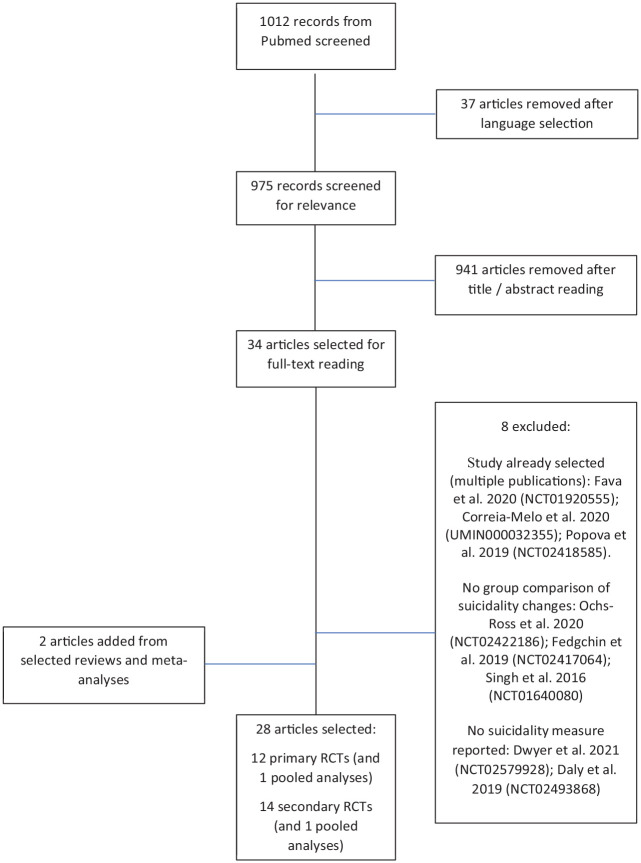
“In primary RCTs, durations were 7 days post-treatment (N = 3), 14 days (1), 28 days (1), 3 weeks (1), 6 weeks (3), and 13 weeks (3, intranasal esketamine studies).”
BackgroundMethodA randomized trial of an N-methyl-D-aspartate antagonist in treatment-resistant major depression.
Zarate, C. A., Singh, J. B., Carlson, P. J., Brutsche, N. E., Ameli, R., Luckenbaugh, D. A., Charney, D. S., & Manji, H. K. (2006) · Archives of General Psychiatry · doi:10.1001/archpsyc.63.8.856 · Cited by 3,766
Pain and emotion interactions in subregions of the cingulate gyrus
Vogt, B. A. (2005) · Nature Reviews Neuroscience · doi:10.1038/nrn1704 · Cited by 1,810
Suicide prevention strategies revisited: 10-year systematic review
Zalsman, G., Hawton, K., Wasserman, D., van Heeringen, K., Arensman, E., Sarchiapone, M., Carli, V., Höschl, C., Barzilay, R., Balazs, J., et al. (2016) · The Lancet Psychiatry · doi:10.1016/s2215-0366(16)30030-x · Cited by 1,765 · cited 2×
“Among the 14 secondary RCTs, main diagnoses were treatment-resistant depressive disorders (8), major depressive disorder (2), bipolar disorder (2), various mood disorders (mainly major depressive disorder; 1), and depressed patients undergoing orthopedic surgery (1).”
BackgroundMethodKetamine and Ketamine Metabolite Pharmacology: Insights into Therapeutic Mechanisms
Zanos, P., Moaddel, R., Morris, P. J., Riggs, L. M., Highland, J. N., Georgiou, P., Pereira, E. F. R., Albuquerque, E. X., Thomas, C. J., Zarate, C. A., et al. (2018) · Pharmacological Reviews · doi:10.1124/pr.117.015198 · Cited by 1,260
Mokdad, A. H., Forouzanfar, M. H., Daoud, F., Mokdad, A. A., El Bcheraoui, C., Moradi-Lakeh, M., Kyu, H. H., Barber, R. M., Wagner, J., Cercy, K., et al. (2016) · The Lancet · doi:10.1016/s0140-6736(16)00648-6 · Cited by 984
Kleiman, E. M., Turner, B. J., Fedor, S., Beale, E. E., Huffman, J. C., & Nock, M. K. (2017) · Journal of Abnormal Psychology · doi:10.1037/abn0000273 · Cited by 831
Zarate, C. A., Brutsche, N. E., Ibrahim, L., Franco-Chaves, J., Diazgranados, N., Cravchik, A., Selter, J., Marquardt, C. A., Liberty, V., & Luckenbaugh, D. A. (2012) · Biological Psychiatry · doi:10.1016/j.biopsych.2011.12.010 · Cited by 811
McIntyre, R. S., Rosenblat, J. D., Nemeroff, C. B., Sanacora, G., Murrough, J. W., Berk, M., Brietzke, E., Dodd, S., Gorwood, P., Ho, R., et al. (2021) · American Journal of Psychiatry · doi:10.1176/appi.ajp.2020.20081251 · Cited by 731
Wilkinson, S. T., Ballard, E. D., Bloch, M. H., Mathew, S. J., Murrough, J. W., Feder, A., Sos, P., Wang, G., Zarate, C. A., & Sanacora, G. (2018) · American Journal of Psychiatry · doi:10.1176/appi.ajp.2017.17040472 · Cited by 696
Cited by
Ketamine in neuropsychiatric disorders: an update
Johnston, J. N., Kadriu, B., Kraus, C., Henter, I. D., & Zarate, C. A. (2024) · Neuropsychopharmacology · doi:10.1038/s41386-023-01632-1 · Cited by 108
“However, it should be noted that a recent systematic review found that intranasal esketamine did not perform better than placebo at reducing suicidal ideation [90], though this fi nding may have been confounded by the high placebo response rate that exists when assessing suicidal ideation [91].”
BackgroundEsketamine Treatment for Depression in Adults: A PRISMA Systematic Review and Meta-Analysis
Fountoulakis, K. N., Saitis, A., & Schatzberg, A. F. (2025) · American Journal of Psychiatry · doi:10.1176/appi.ajp.20240515 · Cited by 90
Mental health challenges faced by autistic people
Lai, M. (2023) · Nature Human Behaviour · doi:10.1038/s41562-023-01718-2 · Cited by 100
Boudieu, L., Mennetrier, M., Llorca, P., & Samalin, L. (2023) · Pharmaceutics · doi:10.3390/pharmaceutics15122773 · Cited by 32
“The efficacy of ketamine has mainly been studied using the intravenous route in MDD patients with TRD and MDD patients with active suicidal ideation [48,49].”
BackgroundGuoweng, N. I. U., ZHENG, X., Bigao, D. E. N. G., DU, Y. S., & Mei, Y. (2024) · Minerva Anestesiologica · doi:10.23736/s0375-9393.24.17703-6 · Cited by 24
Metadata
- Authors
- Jollant, F., Colle, R., Nguyen, T. M. L., Corruble, E., Gardier, A. M., Walter, M., Abbar, M., & Wagner, G.
- Affiliations
- Inserm (FR)
- Center for Behavioral Brain Sciences (DE)
- Centre Hospitalier Universitaire de Nîmes (FR)
- Jena University Hospital (DE)
- Corresponding author
- Jollant, Fabrice
- ORCID
- Venue
- Therapeutic Advances in Psychopharmacology
- Publisher
- SAGE Publications
- Published
- 2023-01
- Volume
- 13
- Pages
- 20451253231151327-20451253231151327
- ISSN
- 2045-1253 (ISSN-L)
- 2045-1261
- PMC
- PMC9912570
- OpenAlex
- W4319349727
- Cited by
- 56
- References
- 97
- Citations by year
- 2026: 12 · 2025: 11 · 2024: 19 · 2023: 14
- FWCI
- 2.03
- Type
- journal article
- Language
- en
- Open access
- gold
- doi.org
- Licence
- Locations
- Therapeutic Advances in Psychopharmacology (publishedVersion, cc-by-nc)
- PubMed Central (publishedVersion, cc-by-nc)
- PubMed (publishedVersion)
- HAL (submittedVersion, cc-by-nc)
- DOAJ (DOAJ: Directory of Open Access Journals) (submittedVersion, cc-by-sa)
- Topics
- Health Sciences › Medicine › Pharmacology (medical) › Treatment of Major Depression
- Social Sciences › Psychology › Clinical Psychology › Suicide and Self-Harm Studies
- Health Sciences › Medicine › Psychiatry and Mental health › Electroconvulsive Therapy Studies
- Keywords
- ketamine, esketamine, suicidal ideation, suicide attempts, intravenous ketamine, intranasal esketamine, placebo effect, dissociative effects, adverse events, pharmacovigilance, suicide prevention, multimodal care
About these checks
Registry, retraction, Cites and statistics results are computed, not judged, with one exception: a printed reference that no index lists is read once by a model before it counts as a citation error. Claims are extracted by a model and kept only when their quote appears verbatim in the text; each cited source is then checked, with a model’s help, for whether it says what the claim relies on. Those verdicts can be wrong — read the claim’s quote and the cited source before relying on one.
Statistics and arithmetic are recomputed, not judged.
Confidence bands are shown only for fields calibrated on our annotated test set. None is calibrated yet, so no band is shown.
What counts as a claim ›How we measure confidence ›How we check this ›
Are you an author, or do you see a problem with this page? Request a review
Data sources
Bibliographic data: Semantic Scholar, OpenAlex, Crossref.
Contains information from the Semantic Scholar Academic Graph Datasets, made available under the ODC Attribution License (ODC-BY 1.0).
Semantic Scholar’s data is described in: Kinney, R., et al. (2023). The Semantic Scholar Open Data Platform. arXiv:2301.10140.
