

Ketamine and esketamine in suicidal thoughts and behaviors: a systematic review
Open accessThe DOI matches its Crossref record; 97 of the 97 references it cites were found in a registry or an index.
Abstract
Background: More than 2% of the general population experience suicidal ideas each year and a large number of them will attempt suicide. Evidence-based therapeutic options to manage suicidal crisis are currently limited. Objectives: The aim of this study was to overview the findings on the use of ketamine and esketamine for the treatment of suicidal ideas and acts. Design: Systematic review. Data Sources and methods: PubMed, article references, and Clinicaltrials.gov up to June 30, 2022. Meta-analyses published within the last 2 years were also reviewed. Results: We identified 12 randomized controlled trials with reduction of suicidal ideation as the primary objective and 14 trials as secondary objectives. Intravenous racemic ketamine was superior to control drugs (placebo or midazolam) within the first 72 h, in spite of large placebo effects. Adverse events were minor and transient. In contrast, intranasal esketamine did not differ from placebo in large-scale studies. Limitations, clinical considerations, and opportunities for future research include the following points: large placebo effects when studying suicidal ideation reduction; small concerns about blinding quality due to dissociative effects; no studies on the risk/prevention of suicidal acts and mortality; lack of studies beyond affective disorders; no studies in adolescents and older people; lack of knowledge of long-term side effects, notably liability for abuse; no robust predictive markers; limited understanding of the mechanisms of ketamine on suicidal ideas; need for improved assessment of suicidal ideation in clinical trials; need for studies in outpatient settings, emergency room, and liaison consultation; need for research on ketamine administration; limited knowledge on the positive and negative effects of concomitant treatments. Conclusion: Overall, there is compelling evidence for a favorable short-term benefit-risk balance with intravenous racemic ketamine but not intranasal esketamine. The place of ketamine will have to be defined within a multimodal care strategy for suicidal patients. Caution remains necessary for clinical use, and pharmacovigilance will be essential.
Overview
The claims and statistics of this paper haven’t been checked yet.
Free: it reads the open-access text and checks the first 5 claims that cite a source we can check. Create a free account to check every claim.
Integrity signals
Registry
Cites
Statistics
Figures
Verification
Claims the paper makes
The claims and statistics of this paper haven’t been checked yet.
Free: it reads the open-access text and checks the first 5 claims that cite a source we can check. Create a free account to check every claim.
Claims other papers make about this one
Each is checked against this paper’s own text: does it say what the citing paper says it does?
The cited source says what the claim attributes to it.
In the citing paper
“However, it should be noted that a recent systematic review found that intranasal esketamine did not perform better than placebo at reducing suicidal ideation [90], though this finding may have been confounded by the high placebo response rate that exists when assessing suicidal ideation [91].”
From Ketamine in neuropsychiatric disorders: an update (2024) · cites this paper as [90]
Self-check
Percentages, sums and reported differences re-computed from the paper’s own numbers.
The self-check needs the paper’s full text.
Citations
Cites
Antidepressant effects of ketamine in depressed patients
Berman, R. M., Cappiello, A., Anand, A., Oren, D. A., Heninger, G. R., Charney, D. S., & Krystal, J. H. (2000) · Biological Psychiatry · doi:10.1016/s0006-3223(99)00230-9 · Cited by 3,856 · cited 2×
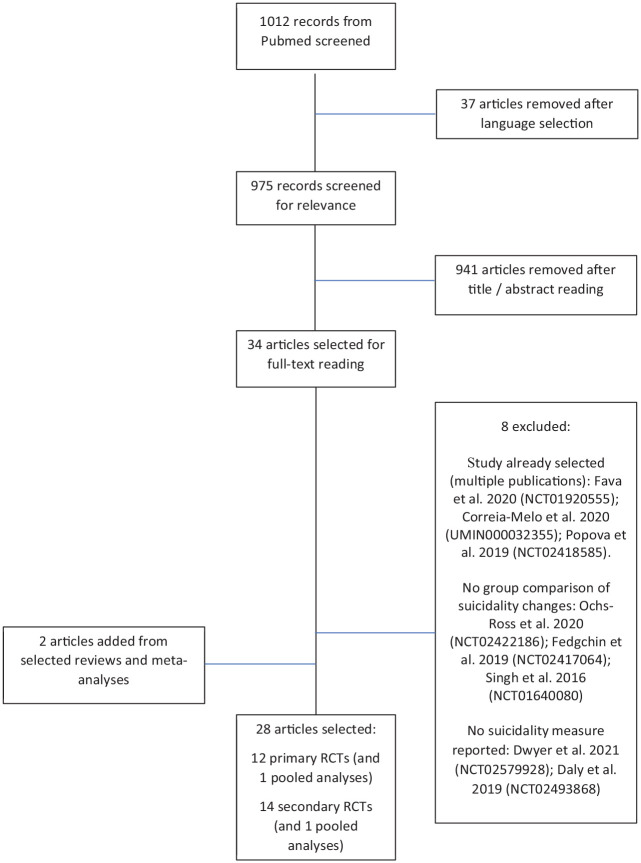
“In primary RCTs, durations were 7 days post-treatment (N = 3), 14 days (1), 28 days (1), 3 weeks (1), 6 weeks (3), and 13 weeks (3, intranasal esketamine studies).”
BackgroundMethodA randomized trial of an N-methyl-D-aspartate antagonist in treatment-resistant major depression.
Zarate, C. A., Singh, J. B., Carlson, P. J., Brutsche, N. E., Ameli, R., Luckenbaugh, D. A., Charney, D. S., & Manji, H. K. (2006) · Archives of General Psychiatry · doi:10.1001/archpsyc.63.8.856 · Cited by 3,766
Pain and emotion interactions in subregions of the cingulate gyrus
Vogt, B. A. (2005) · Nature Reviews Neuroscience · doi:10.1038/nrn1704 · Cited by 1,810
Suicide prevention strategies revisited: 10-year systematic review
Zalsman, G., Hawton, K., Wasserman, D., van Heeringen, K., Arensman, E., Sarchiapone, M., Carli, V., Höschl, C., Barzilay, R., Balazs, J., et al. (2016) · The Lancet Psychiatry · doi:10.1016/s2215-0366(16)30030-x · Cited by 1,765 · cited 2×
“Among the 14 secondary RCTs, main diagnoses were treatment-resistant depressive disorders (8), major depressive disorder (2), bipolar disorder (2), various mood disorders (mainly major depressive disorder; 1), and depressed patients undergoing orthopedic surgery (1).”
BackgroundMethodKetamine and Ketamine Metabolite Pharmacology: Insights into Therapeutic Mechanisms
Zanos, P., Moaddel, R., Morris, P. J., Riggs, L. M., Highland, J. N., Georgiou, P., Pereira, E. F. R., Albuquerque, E. X., Thomas, C. J., Zarate, C. A., et al. (2018) · Pharmacological Reviews · doi:10.1124/pr.117.015198 · Cited by 1,260
Mokdad, A. H., Forouzanfar, M. H., Daoud, F., Mokdad, A. A., El Bcheraoui, C., Moradi-Lakeh, M., Kyu, H. H., Barber, R. M., Wagner, J., Cercy, K., et al. (2016) · The Lancet · doi:10.1016/s0140-6736(16)00648-6 · Cited by 984
Kleiman, E. M., Turner, B. J., Fedor, S., Beale, E. E., Huffman, J. C., & Nock, M. K. (2017) · Journal of Abnormal Psychology · doi:10.1037/abn0000273 · Cited by 831
Zarate, C. A., Brutsche, N. E., Ibrahim, L., Franco-Chaves, J., Diazgranados, N., Cravchik, A., Selter, J., Marquardt, C. A., Liberty, V., & Luckenbaugh, D. A. (2012) · Biological Psychiatry · doi:10.1016/j.biopsych.2011.12.010 · Cited by 811
McIntyre, R. S., Rosenblat, J. D., Nemeroff, C. B., Sanacora, G., Murrough, J. W., Berk, M., Brietzke, E., Dodd, S., Gorwood, P., Ho, R., et al. (2021) · American Journal of Psychiatry · doi:10.1176/appi.ajp.2020.20081251 · Cited by 731
Wilkinson, S. T., Ballard, E. D., Bloch, M. H., Mathew, S. J., Murrough, J. W., Feder, A., Sos, P., Wang, G., Zarate, C. A., & Sanacora, G. (2018) · American Journal of Psychiatry · doi:10.1176/appi.ajp.2017.17040472 · Cited by 696
Canuso, C. M., Singh, J. B., Fedgchin, M., Alphs, L., Lane, R., Lim, P., Pinter, C., Hough, D., Sanacora, G., Manji, H., et al. (2018) · American Journal of Psychiatry · doi:10.1176/appi.ajp.2018.17060720 · Cited by 676
Improving Suicide Prevention Through Evidence-Based Strategies: A Systematic Review
Mann, J. J., Michel, C. A., & Auerbach, R. P. (2021) · American Journal of Psychiatry · doi:10.1176/appi.ajp.2020.20060864 · Cited by 655
A Consensus Statement on the Use of Ketamine in the Treatment of Mood Disorders
Sanacora, G., Frye, M. A., McDonald, W., Mathew, S. J., Turner, M. S., Schatzberg, A. F., Summergrad, P., Nemeroff, C. B., & for the American Psychiatric Association (APA) Council of Research Task Force on Novel Biomarkers and Treatments (2017) · JAMA Psychiatry · doi:10.1001/jamapsychiatry.2017.0080 · Cited by 576
DiazGranados, N., Ibrahim, L. A., Brutsche, N. E., Ameli, R., Henter, I. D., Luckenbaugh, D. A., Machado-Vieira, R., & Zarate, C. A. (2010) · The Journal of Clinical Psychiatry · doi:10.4088/jcp.09m05327blu · Cited by 564 · cited 1×
“For the 12 primary RCTs, main diagnoses were various mood disorders (N = 4), bipolar disorders only (1), major depressive disorders only (4), depressed patients with various diagnoses at the emergency room (excluding psychosis; 2), and depressed patients with a newly diagnosed cancer (1).”
BackgroundSide-effects associated with ketamine use in depression: a systematic review
Short, B., Fong, J., Galvez, V., Shelker, W., & Loo, C. K. (2018) · The Lancet Psychiatry · doi:10.1016/s2215-0366(17)30272-9 · Cited by 558
Domino, E. F., & Warner, D. S. (2010) · Anesthesiology · doi:10.1097/aln.0b013e3181ed09a2 · Cited by 520
Fava, M., Freeman, M. P., Flynn, M., Judge, H., Hoeppner, B. B., Cusin, C., Ionescu, D. F., Mathew, S. J., Chang, L. C., Iosifescu, D. V., et al. (2020) · Molecular Psychiatry · doi:10.1038/s41380-018-0256-5 · Cited by 433
Grunebaum, M. F., Galfalvy, H. C., Choo, T.-H., Keilp, J. G., Moitra, V. K., Parris, M. S., Marver, J. E., Burke, A. K., Milak, M. S., Sublette, M. E., et al. (2018) · American Journal of Psychiatry · doi:10.1176/appi.ajp.2017.17060647 · Cited by 431
Ionescu, D. F., Fu, D.-J., Qiu, X., Lane, R., Lim, P., Kasper, S., Hough, D., Drevets, W. C., Manji, H., & Canuso, C. M. (2021) · International Journal of Neuropsychopharmacology · doi:10.1093/ijnp/pyaa068 · Cited by 418
Bahji, A., Vazquez, G. H., & Zarate, C. A. (2021) · Journal of Affective Disorders · doi:10.1016/j.jad.2020.09.071 · Cited by 408
Fu, D.-J., Ionescu, D. F., Li, X., Lane, R., Lim, P., Sanacora, G., Hough, D., Manji, H., Drevets, W. C., & Canuso, C. M. (2020) · The Journal of Clinical Psychiatry · doi:10.4088/jcp.19m13191 · Cited by 376
Price, R. B., Iosifescu, D. V., Murrough, J. W., Chang, L. C., Al Jurdi, R. K., Iqbal, S. Z., Soleimani, L., Charney, D. S., Foulkes, A. L., & Mathew, S. J. (2014) · Depression and Anxiety · doi:10.1002/da.22253 · Cited by 345
Ketamine for rapid reduction of suicidal ideation: a randomized controlled trial
Murrough, J. W., Soleimani, L., DeWilde, K. E., Collins, K. A., Lapidus, K. A., Iacoviello, B. M., Lener, M., Kautz, M., Kim, J., Stern, J. B., et al. (2015) · Psychological Medicine · doi:10.1017/s0033291715001506 · Cited by 297
Gibbons, R. D., Brown, C. H., Hur, K., Davis, J. M., & Mann, J. J. (2012) · Archives of General Psychiatry · doi:10.1001/archgenpsychiatry.2011.2048 · Cited by 291
Ballard, E. D., Ionescu, D. F., Vande Voort, J. L., Niciu, M. J., Richards, E. M., Luckenbaugh, D. A., Brutsché, N. E., Ameli, R., Furey, M. L., & Zarate, C. A. (2014) · Journal of Psychiatric Research · doi:10.1016/j.jpsychires.2014.07.027 · Cited by 286
Barbui, C., Esposito, E., & Cipriani, A. (2009) · Canadian Medical Association Journal · doi:10.1503/cmaj.081514 · Cited by 275
A risk index for 12-month suicide attempts in the National Comorbidity Survey Replication (NCS-R)
BORGES, G., ANGST, J., NOCK, M. K., RUSCIO, A. M., WALTERS, E. E., & KESSLER, R. C. (2006) · Psychological Medicine · doi:10.1017/s0033291706008786 · Cited by 246
Beghi, M., Butera, E., Cerri, C. G., Cornaggia, C. M., Febbo, F., Mollica, A., Berardino, G., Piscitelli, D., Resta, E., Logroscino, G., et al. (2021) · Neuroscience & Biobehavioral Reviews · doi:10.1016/j.neubiorev.2021.04.011 · Cited by 220
The prevalence and natural history of urinary symptoms among recreational ketamine users
Winstock, A. R., Mitcheson, L., Gillatt, D. A., & Cottrell, A. M. (2012) · BJU International · doi:10.1111/j.1464-410x.2012.11028.x · Cited by 214
Witt, K., Potts, J., Hubers, A., Grunebaum, M. F., Murrough, J. W., Loo, C., Cipriani, A., & Hawton, K. (2020) · Australian & New Zealand Journal of Psychiatry · doi:10.1177/0004867419883341 · Cited by 202
Small-Dose Ketamine Improves the Postoperative State of Depressed Patients
Kudoh, A., Takahira, Y., Katagai, H., & Takazawa, T. (2002) · Anesthesia & Analgesia · doi:10.1097/00000539-200207000-00020 · Cited by 189
Community mental-health services and suicide rate in Finland: a nationwide small-area analysis
Pirkola, S., Sund, R., Sailas, E., & Wahlbeck, K. (2009) · The Lancet · doi:10.1016/s0140-6736(08)61848-6 · Cited by 187
Abbar, M., Demattei, C., El-Hage, W., Llorca, P.-M., Samalin, L., Demaricourt, P., Gaillard, R., Courtet, P., Vaiva, G., Gorwood, P., et al. (2022) · BMJ · doi:10.1136/bmj-2021-067194 · Cited by 181
Self-citationIonescu, D. F., Bentley, K. H., Eikermann, M., Taylor, N., Akeju, O., Swee, M. B., Pavone, K. J., Petrie, S. R., Dording, C., Mischoulon, D., et al. (2019) · Journal of Affective Disorders · doi:10.1016/j.jad.2018.09.037 · Cited by 179
Mechanisms of ketamine and its metabolites as antidepressants
Hess, E. M., Riggs, L. M., Michaelides, M., & Gould, T. D. (2022) · Biochemical Pharmacology · doi:10.1016/j.bcp.2021.114892 · Cited by 175
Grunebaum, M. F., Ellis, S. P., Keilp, J. G., Moitra, V. K., Cooper, T. B., Marver, J. E., Burke, A. K., Milak, M. S., Sublette, M. E., Oquendo, M. A., et al. (2017) · Bipolar Disorders · doi:10.1111/bdi.12487 · Cited by 174
Attenuation of antidepressant and antisuicidal effects of ketamine by opioid receptor antagonism
Williams, N. R., Heifets, B. D., Bentzley, B. S., Blasey, C., Sudheimer, K. D., Hawkins, J., Lyons, D. M., & Schatzberg, A. F. (2019) · Molecular Psychiatry · doi:10.1038/s41380-019-0503-4 · Cited by 174
Psychological Pain in Suicidality: A Meta-Analysis
Ducasse, D., Holden, R. R., Boyer, L., Artéro, S., Calati, R., Guillaume, S., Courtet, P., & Olié, E. (2018) · The Journal of Clinical Psychiatry · doi:10.4088/jcp.16r10732 · Cited by 162
Niesters, M., Khalili-Mahani, N., Martini, C., Aarts, L., van Gerven, J., van Buchem, M. A., Dahan, A., & Rombouts, S. (2012) · Anesthesiology · doi:10.1097/aln.0b013e31826a0db3 · Cited by 147
Hu, Y.-D., Xiang, Y.-T., Fang, J.-X., Zu, S., Sha, S., Shi, H., Ungvari, G. S., Correll, C. U., Chiu, H. F. K., Xue, Y., et al. (2016) · Psychological Medicine · doi:10.1017/s0033291715002159 · Cited by 146
Anhedonia as a clinical correlate of suicidal thoughts in clinical ketamine trials
Ballard, E. D., Wills, K., Lally, N., Richards, E. M., Luckenbaugh, D. A., Walls, T., Ameli, R., Niciu, M. J., Brutsche, N. E., Park, L., et al. (2017) · Journal of Affective Disorders · doi:10.1016/j.jad.2017.04.057 · Cited by 146
Phillips, J. L., Norris, S., Talbot, J., Hatchard, T., Ortiz, A., Birmingham, M., Owoeye, O., Batten, L. A., & Blier, P. (2020) · Neuropsychopharmacology · doi:10.1038/s41386-019-0570-x · Cited by 139
Gastaldon, C., Raschi, E., Kane, J. M., Barbui, C., & Schoretsanitis, G. (2021) · Psychotherapy and Psychosomatics · doi:10.1159/000510703 · Cited by 134
Molecular Pharmacology and Neurobiology of Rapid-Acting Antidepressants
Gould, T. D., Zarate, C. A., & Thompson, S. M. (2019) · Annual Review of Pharmacology and Toxicology · doi:10.1146/annurev-pharmtox-010617-052811 · Cited by 133 · cited 1×
“In secondary RCTs, durations of follow-up were also highly variable: 24 h (N = 1), below 30 days (9), 3 weeks (1), 4 weeks (1), 6 weeks (1), and 6 months (1).”
BackgroundDeficit of cognitive inhibition in depressed elderly: a neurocognitive marker of suicidal risk
Richard-Devantoy, S., Jollant, F., Kefi, Z., Turecki, G., J.P.Olié, Annweiler, C., Beauchet, O., & Le Gall, D. (2012) · Journal of Affective Disorders · doi:10.1016/j.jad.2012.03.006 · Cited by 128
Self-citationHallensleben, N., Spangenberg, L., Forkmann, T., Rath, D., Hegerl, U., Kersting, A., Kallert, T. W., & Glaesmer, H. (2018) · Crisis · doi:10.1027/0227-5910/a000464 · Cited by 125
Xiong, J., Lipsitz, O., Chen-Li, D., Rosenblat, J. D., Rodrigues, N. B., Carvalho, I., Lui, L. M. W., Gill, H., Narsi, F., Mansur, R. B., et al. (2021) · Journal of Psychiatric Research · doi:10.1016/j.jpsychires.2020.12.038 · Cited by 124
Acevedo-Diaz, E. E., Cavanaugh, G. W., Greenstein, D., Kraus, C., Kadriu, B., Zarate, C. A., & Park, L. T. (2020) · Journal of Affective Disorders · doi:10.1016/j.jad.2019.11.028 · Cited by 113
Swainson, J., McGirr, A., Blier, P., Brietzke, E., Richard-Devantoy, S., Ravindran, N., Blier, J., Beaulieu, S., Frey, B. N., Kennedy, S. H., et al. (2021) · The Canadian Journal of Psychiatry · doi:10.1177/0706743720970860 · Cited by 110
Ketamine: a versatile tool for anesthesia and analgesia
Barrett, W. A., Buxhoeveden, M. R., & Dhillon, S. (2020) · Current Opinion in Anaesthesiology · doi:10.1097/aco.0000000000000916 · Cited by 103 · cited 1×
“Among the 14 secondary RCTs, main diagnoses were treatment-resistant depressive disorders (8), major depressive disorder (2), bipolar disorder (2), various mood disorders (mainly major depressive disorder; 1), and depressed patients undergoing orthopedic surgery (1).”
BackgroundDean, R. L., Hurducas, C., Hawton, K., Spyridi, S., Cowen, P. J., Hollingsworth, S., Marquardt, T., Barnes, A., Smith, R., McShane, R., et al. (2021) · Cochrane Database of Systematic Reviews · doi:10.1002/14651858.cd011612.pub3 · Cited by 95
Canuso, C. M., Ionescu, D. F., Li, X., Qiu, X., Lane, R., Turkoz, I., Nash, A. I., Lopena, T. J., & Fu, D.-J. (2021) · Journal of Clinical Psychopharmacology · doi:10.1097/jcp.0000000000001465 · Cited by 88
Fan, W., Yang, H., Sun, Y., Zhang, J., Li, G., Zheng, Y., & Liu, Y. (2017) · Oncotarget · doi:10.18632/oncotarget.13743 · Cited by 87
Domany, Y., Shelton, R. C., & McCullumsmith, C. B. (2020) · Depression and Anxiety · doi:10.1002/da.22975 · Cited by 84
The abuse liability of ketamine: A scoping review of preclinical and clinical studies
Le, T. T., Cordero, I. P., Jawad, M. Y., Swainson, J., Di Vincenzo, J. D., Jaberi, S., Phan, L., Lui, L. M. W., Ho, R., Rosenblat, J. D., et al. (2022) · Journal of Psychiatric Research · doi:10.1016/j.jpsychires.2022.04.035 · Cited by 82
Assessing measures of suicidal ideation in clinical trials with a rapid-acting antidepressant
Ballard, E. D., Luckenbaugh, D. A., Richards, E. M., Walls, T. L., Brutsché, N. E., Ameli, R., Niciu, M. J., Vande Voort, J. L., & Zarate, C. A. (2015) · Journal of Psychiatric Research · doi:10.1016/j.jpsychires.2015.06.003 · Cited by 80
Animal models to improve our understanding and treatment of suicidal behavior
Gould, T. D., Georgiou, P., Brenner, L. A., Brundin, L., Can, A., Courtet, P., Donaldson, Z. R., Dwivedi, Y., Guillaume, S., Gottesman, I. I., et al. (2017) · Translational Psychiatry · doi:10.1038/tp.2017.50 · Cited by 80
Chen, M.-H., Lin, W.-C., Tu, P.-C., Li, C.-T., Bai, Y.-M., Tsai, S.-J., & Su, T.-P. (2019) · Journal of Affective Disorders · doi:10.1016/j.jad.2019.08.022 · Cited by 78
Ballard, E. D., Yarrington, J. S., Farmer, C. A., Lener, M. S., Kadriu, B., Lally, N., Williams, D., Machado-Vieira, R., Niciu, M. J., Park, L., et al. (2018) · Journal of Affective Disorders · doi:10.1016/j.jad.2018.01.027 · Cited by 74
Siegel, A. N., Di Vincenzo, J. D., Brietzke, E., Gill, H., Rodrigues, N. B., Lui, L. M. W., Teopiz, K. M., Ng, J., Ho, R., McIntyre, R. S., et al. (2021) · Journal of Psychiatric Research · doi:10.1016/j.jpsychires.2021.03.009 · Cited by 70
Perrain, R., Dardennes, R., & Jollant, F. (2021) · Journal of Affective Disorders · doi:10.1016/j.jad.2020.11.052 · Cited by 68
Self-citationBurger, J., Capobianco, M., Lovern, R., Boche, B., Ross, E., Darracq, M. A., & McLay, R. (2016) · Military Medicine · doi:10.7205/milmed-d-15-00431 · Cited by 67
New methods for assessing rapid changes in suicide risk
Ballard, E. D., Gilbert, J. R., Wusinich, C., & Zarate, C. A. (2021) · Frontiers in Psychiatry · doi:10.3389/fpsyt.2021.598434 · Cited by 63
Gifuni, A. J., Perret, L. C., Lacourse, É., Geoffroy, M., Mbékou, V., Jollant, F., & Renaud, J. (2020) · European Child & Adolescent Psychiatry · doi:10.1007/s00787-020-01550-3 · Cited by 61
Self-citationThirty Years of Publications in Suicidology: A Bibliometric Analysis
Astraud, L.-P., Bridge, J. A., & Jollant, F. (2020) · Archives of Suicide Research · doi:10.1080/13811118.2020.1746944 · Cited by 59 · cited 5×
“We additionally considered several recent reviews within the last 2 years until June 30, 2022, including (1) one systematic review of systematic reviews,11 two metaanalyses,12,13 and five reviews considered of good quality14–18 with (es)ketamine in suicidal ideation as the primary objective; (2) two reviews on interve…”
BackgroundMethodInfluentialSelf-citationCharacterizing the course of suicidal ideation response to ketamine
Ballard, E. D., Yarrington, J. S., Farmer, C. A., Richards, E., Machado-Vieira, R., Kadriu, B., Niciu, M. J., Yuan, P., Park, L., & Zarate, C. A. (2018) · Journal of Affective Disorders · doi:10.1016/j.jad.2018.07.077 · Cited by 55
The rapid anti-suicidal ideation effect of ketamine: A systematic review
Hochschild, A., Grunebaum, M. F., & Mann, J. J. (2021) · Preventive Medicine · doi:10.1016/j.ypmed.2021.106524 · Cited by 55
Saffer, B. Y., & Klonsky, E. D. (2018) · Clinical Psychology Science and Practice · doi:10.1037/h0101751 · Cited by 54
Use of ketamine and esketamine for depression: an overview of systematic reviews with meta-analyses
Lima, T. D. M., Visacri, M. B., & Aguiar, P. M. (2021) · European Journal of Clinical Pharmacology · doi:10.1007/s00228-021-03216-8 · Cited by 51
Rodrigues, N. B., McIntyre, R. S., Lipsitz, O., Cha, D. S., Lee, Y., Gill, H., Majeed, A., Phan, L., Nasri, F., Ho, R., et al. (2020) · Journal of Affective Disorders · doi:10.1016/j.jad.2020.07.083 · Cited by 50
Ketamine and other glutamate receptor modulators for depression in adults with bipolar disorder
Dean, R. L., Marquardt, T., Hurducas, C., Spyridi, S., Barnes, A., Smith, R. P., Cowen, P. J., McShane, R. H., Hawton, K. E., Malhi, G. S., et al. (2021) · Cochrane Database of Systematic Reviews · doi:10.1002/14651858.cd011611.pub3 · Cited by 48
An Update on Glutamatergic System in Suicidal Depression and on the Role of Esketamine
Berardis, D. D., Tomasetti, C., Pompili, M., Serafini, G., Vellante, F., Fornaro, M., Valchera, A., Perna, G., Volpe, U., Martinotti, G., et al. (2020) · Current Topics in Medicinal Chemistry · doi:10.2174/1568026620666200131100316 · Cited by 47
Veraart, J. K. E., Smith-Apeldoorn, S. Y., Bakker, I. M., Visser, B. A. E., Kamphuis, J., Schoevers, R. A., & Touw, D. J. (2021) · International Journal of Neuropsychopharmacology · doi:10.1093/ijnp/pyab039 · Cited by 43
Carpenter, D. J., Fong, R., Kraus, J. E., Davies, J. T., Moore, C., & Thase, M. E. (2011) · The Journal of Clinical Psychiatry · doi:10.4088/jcp.08m04927blu · Cited by 42
Feeney, A., Hock, R. S., Freeman, M. P., Flynn, M., Hoeppner, B. B., Iosifescu, D. V., Trivedi, M. H., Sanacora, G., Mathew, S. J., DeBattista, C., et al. (2021) · European Neuropsychopharmacology · doi:10.1016/j.euroneuro.2021.04.024 · Cited by 42
Domany, Y., & McCullumsmith, C. B. (2021) · Archives of Suicide Research · doi:10.1080/13811118.2021.1878078 · Cited by 37
Lascelles, K. M., Marzano, L., Brand, F., Trueman, H., McShane, R. H., & Hawton, K. E. (2019) · BMJ Open · doi:10.1136/bmjopen-2019-029108 · Cited by 36
Association between depression subtypes and response to repeated‐dose intravenous ketamine
Wang, C., Zhou, Y., Zheng, W., Liu, W., Zhan, Y., Li, H., Chen, L., Zhang, B., Walter, M., Li, M., et al. (2019) · Acta Psychiatrica Scandinavica · doi:10.1111/acps.13096 · Cited by 35
Self-citationVieira, F., Correia‐Melo, F. S., Santos‐Lima, C., Souza‐Marques, B., Leal, G. C.-G., Jesus‐Nunes, A. P., Mello, R. P., Caliman‐Fontes, A. T., Bandeira, I. D., Marback, R. F., et al. (2020) · General Hospital Psychiatry · doi:10.1016/j.genhosppsych.2020.12.011 · Cited by 34
O’Brien, B., Lijffijt, M., Wells, A., Swann, A. C., & Mathew, S. J. (2019) · Pharmaceuticals · doi:10.3390/ph12030133 · Cited by 33
Opler, L. A., Opler, M. G. A., & Arnsten, A. F. T. (2016) · CNS Spectrums · doi:10.1017/s1092852914000686 · Cited by 28
Mechanisms of ketamine-involved regulation of cytochrome P450 gene expression
Chen, J.-T., & Chen, R.-M. (2010) · Expert Opinion on Drug Metabolism & Toxicology · doi:10.1517/17425250903505108 · Cited by 27
Lengvenytė, A., Olié, É., Strumila, R., Navickas, A., González-Pinto, A. M., & Courtet, P. (2021) · The World Journal of Biological Psychiatry · doi:10.1080/15622975.2021.1907712 · Cited by 27
Ketamine-associated ulcerative cystitis: a case report and literature review.
Ho, C. C. K., Pezhman, H., Praveen, S., Eh, G., Lee, B. C., Mz, Z., & Mr, I. (2010) · Europe PMC (PubMed Central) · Cited by 26
Nikayin, S., & Sanacora, G. (2021) · CNS Drugs · doi:10.1007/s40263-021-00851-8 · Cited by 26
Jollant, F., Perreira, F., Fiori, L. M., Richard-Devantoy, S., Lutz, P.-E., Belzeaux, R., & Turecki, G. (2020) · Progress in Neuro-Psychopharmacology and Biological Psychiatry · doi:10.1016/j.pnpbp.2020.109909 · Cited by 25
Self-citationKeilp, J., Madden, S. P., Marver, J. E., Frawley, A. E., Burke, A., Herzallah, M. M., Gluck, M., Mann, J., & Grunebaum, M. F. (2021) · Journal of Clinical Psychiatry · doi:10.4088/jcp.21m13921 · Cited by 25
Ketamine vs midazolam: Mood improvement reduces suicidal ideation in depression
Hochschild, A., Keilp, J. G., Madden, S. P., Burke, A. K., Mann, J. J., & Grunebaum, M. F. (2022) · Journal of Affective Disorders · doi:10.1016/j.jad.2021.12.055 · Cited by 25
Zhou, Y., Liu, W., Zheng, W., Wang, C., Zhan, Y., Lan, X., Zhang, B., Zhang, C., & Ning, Y. (2020) · Journal of Affective Disorders · doi:10.1016/j.jad.2020.01.001 · Cited by 23
Chen, Q., Dong, J., Luo, J., Ren, L., Min, S., Hao, X., Luo, Q., Chen, J., & Li, X. (2020) · The Journal of ECT · doi:10.1097/yct.0000000000000636 · Cited by 22
Floden, L. L., Hudgens, S. A., Jamieson, C., Popova, V., Drevets, W. C., Cooper, K., & Singh, J. B. (2022) · CNS Drugs · doi:10.1007/s40263-022-00916-2 · Cited by 22 · cited 1×
“Finally, six secondary RCTs found no significant effect of ketamine4,40,42–44 {Floden et al., 2022, #143543}.”
BackgroundBeaudequin, D. A., Can, A., Dutton, M., Jones, M., Gallay, C. C., Schwenn, P., Yang, C., Forsyth, G., Simcock, G. P., Hermens, D. F., et al. (2020) · BMC Psychiatry · doi:10.1186/s12888-020-02925-1 · Cited by 20
Antisuicidal efficacy of ketamine infusion in suicidal patients of depressive disorder
Pathak, U., Ahuja, S. K., Dwivedi, R., Mishra, N., Kumar, P. J., Mishra, D. K., & Singh, R. (2021) · Indian Journal of Psychiatry · doi:10.4103/indianjpsychiatry.indianjpsychiatry_80_21 · Cited by 20
Ketamine for acute suicidality in the emergency department: A systematic review
Maguire, L. A., Bullard, T., & Papa, L. (2021) · The American Journal of Emergency Medicine · doi:10.1016/j.ajem.2020.12.088 · Cited by 18
Prospective association of psychological pain and hopelessness with suicidal thoughts
Ballard, E. D., Farmer, C. A., Gerner, J., Bloomfield-Clagett, B., Park, L. T., & Zarate, C. A. (2022) · Journal of Affective Disorders · doi:10.1016/j.jad.2022.04.033 · Cited by 16
Oral ketamine reduces the experience of stress in people with chronic suicidality
Dutton, M., Can, A., Beaudequin, D. A., Jensen, E., Jones, M., Gallay, C. C., Schwenn, P., Scherman, J. K., Yang, C., Forsyth, G., et al. (2022) · Journal of Affective Disorders · doi:10.1016/j.jad.2022.01.018 · Cited by 15
Ketamine for suicidality: An umbrella review
Shamabadi, A., Ahmadzade, A., & Hasanzadeh, A. (2022) · British Journal of Clinical Pharmacology · doi:10.1111/bcp.15360 · Cited by 14
Cited by
Ketamine in neuropsychiatric disorders: an update
Johnston, J. N., Kadriu, B., Kraus, C., Henter, I. D., & Zarate, C. A. (2024) · Neuropsychopharmacology · doi:10.1038/s41386-023-01632-1 · Cited by 108
“However, it should be noted that a recent systematic review found that intranasal esketamine did not perform better than placebo at reducing suicidal ideation [90], though this fi nding may have been confounded by the high placebo response rate that exists when assessing suicidal ideation [91].”
BackgroundEsketamine Treatment for Depression in Adults: A PRISMA Systematic Review and Meta-Analysis
Fountoulakis, K. N., Saitis, A., & Schatzberg, A. F. (2025) · American Journal of Psychiatry · doi:10.1176/appi.ajp.20240515 · Cited by 90
Mental health challenges faced by autistic people
Lai, M. (2023) · Nature Human Behaviour · doi:10.1038/s41562-023-01718-2 · Cited by 101
Boudieu, L., Mennetrier, M., Llorca, P., & Samalin, L. (2023) · Pharmaceutics · doi:10.3390/pharmaceutics15122773 · Cited by 32
“The efficacy of ketamine has mainly been studied using the intravenous route in MDD patients with TRD and MDD patients with active suicidal ideation [48,49].”
BackgroundGuoweng, N. I. U., ZHENG, X., Bigao, D. E. N. G., DU, Y. S., & Mei, Y. (2024) · Minerva Anestesiologica · doi:10.23736/s0375-9393.24.17703-6 · Cited by 24
Metadata
- Authors
- Jollant, F., Colle, R., Nguyen, T. M. L., Corruble, E., Gardier, A. M., Walter, M., Abbar, M., & Wagner, G.
- Affiliations
- Inserm (FR)
- Center for Behavioral Brain Sciences (DE)
- Centre Hospitalier Universitaire de Nîmes (FR)
- Jena University Hospital (DE)
- Corresponding author
- Jollant, Fabrice
- ORCID
- Venue
- Therapeutic Advances in Psychopharmacology
- Publisher
- SAGE Publications
- Published
- 2023-01
- Volume
- 13
- Pages
- 20451253231151327-20451253231151327
- ISSN
- 2045-1253 (ISSN-L)
- 2045-1261
- PMC
- PMC9912570
- OpenAlex
- W4319349727
- Cited by
- 56
- References
- 97
- Citations by year
- 2026: 12 · 2025: 11 · 2024: 19 · 2023: 14
- FWCI
- 2.03
- Type
- journal article
- Language
- en
- Open access
- gold
- doi.org
- Licence
- Locations
- Therapeutic Advances in Psychopharmacology (publishedVersion, cc-by-nc)
- PubMed Central (publishedVersion, cc-by-nc)
- PubMed (publishedVersion)
- HAL (submittedVersion, cc-by-nc)
- DOAJ (DOAJ: Directory of Open Access Journals) (submittedVersion, cc-by-sa)
- Topics
- Health Sciences › Medicine › Pharmacology (medical) › Treatment of Major Depression
- Social Sciences › Psychology › Clinical Psychology › Suicide and Self-Harm Studies
- Health Sciences › Medicine › Psychiatry and Mental health › Electroconvulsive Therapy Studies
- Keywords
- ketamine, esketamine, suicidal ideation, suicide attempts, intravenous ketamine, intranasal esketamine, placebo effect, dissociative effects, adverse events, pharmacovigilance, suicide prevention, multimodal care
About these checks
Registry, retraction, Cites and statistics results are computed, not judged, with one exception: a printed reference that no index lists is read once by a model before it counts as a citation error. Claims are extracted by a model and kept only when their quote appears verbatim in the text; each cited source is then checked, with a model’s help, for whether it says what the claim relies on. Those verdicts can be wrong — read the claim’s quote and the cited source before relying on one.
Statistics and arithmetic are recomputed, not judged.
Confidence bands are shown only for fields calibrated on our annotated test set. None is calibrated yet, so no band is shown.
What counts as a claim ›How we measure confidence ›How we check this ›
Are you an author, or do you see a problem with this page? Request a review
Data sources
Bibliographic data: Semantic Scholar, OpenAlex, Crossref.
Contains information from the Semantic Scholar Academic Graph Datasets, made available under the ODC Attribution License (ODC-BY 1.0).
Semantic Scholar’s data is described in: Kinney, R., et al. (2023). The Semantic Scholar Open Data Platform. arXiv:2301.10140.
