

The efficacy, acceptability and safety of acceptance and commitment therapy for fibromyalgia – a systematic review and meta-analysis
Open accessThe DOI matches its Crossref record; 51 of the 54 references it cites were found in a registry or an index; 5 of the 11 sources its claims cite were checked for support.
Abstract
Background: Fibromyalgia (FM) is a chronic pain disorder characterised by widespread pain, fatigue and cognitive symptoms. Acceptance and commitment therapy (ACT) aims to improve psychological flexibility and has been found to be beneficial in treating chronic pain; however, there are few studies evaluating its efficacy in treating FM. Aim: This systematic review and meta-analysis evaluated the efficacy of acceptance and commitment therapy in patients with fibromyalgia. Methods: PubMed, Embase and PsychInfo databases were searched. Randomised Controlled Trials (RCTs) were eligible for inclusion if participants had FM, and the intervention was based on the ACT framework/model, and not combined with any other active therapy; any non-ACT control was accepted. A meta-analysis was performed, with the primary outcomes pain acceptance (chronic pain acceptance questionnaire, CPAQ), health-related quality of life (fibromyalgia impact questionnaire, FIQ), attrition rate and frequency of adverse events, and the secondary outcomes pain intensity, disability, depression, anxiety, and fatigue. Results: Six RCTs, with a total of 384, mostly-female, participants were included, with ACT being delivered online, in a group setting, or one-to-one. ACT was superior to controls in improving FIQ score at post-intervention (SMD −1.05, 95% CI −2.02, −0.09) and follow-up (SMD −1.43, 95% CI −2.17, −0.69) and CPAQ post-intervention (SMD 1.05, 95% CI 0.61, 1.49) and at follow-up (SMD 0.95, 95% CI 0.40, 1.49). Attrition was below 20% in 4/6 studies and no adverse events were reported as attributable to ACT. All secondary outcomes showed large-to-moderate pooled effect estimates post-intervention, indicating improvement in anxiety, depression, pain and disability. Fatigue also improved, with a large negative effect. Conclusions: The results suggest ACT improved outcomes in patients with FM: there was an overall improvement in all outcomes post-intervention, with most maintained at follow-up. This review was, however, limited by the small body of evidence and differing methodologies of included studies. © The Author(s) 2023.
Overview
CoChat Summary
## TL;DR
This systematic review and meta-analysis found that acceptance and commitment therapy (ACT) improved fibromyalgia outcomes versus controls across pain acceptance, health-related quality of life, and several secondary outcomes. The evidence base was small: 6 RCTs with 384 mostly female participants, and the authors note differing methodologies across studies.
## Key findings
- The review included 6 RCTs with 384 participants total; 176 were in ACT groups and 208 in control groups, and participants were mostly female with a median proportion of 97.4% women.
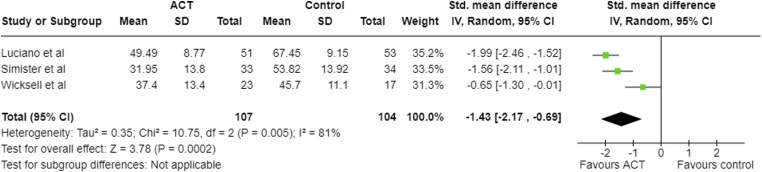
- ACT was superior to controls for fibromyalgia impact/quality of life (FIQ) at post-intervention (SMD −1.05, 95% CI −2.02 to −0.09) and follow-up (SMD −1.43, 95% CI −2.17 to −0.69).
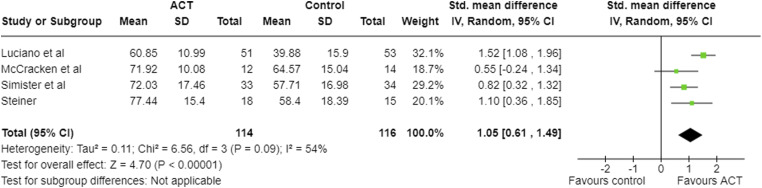
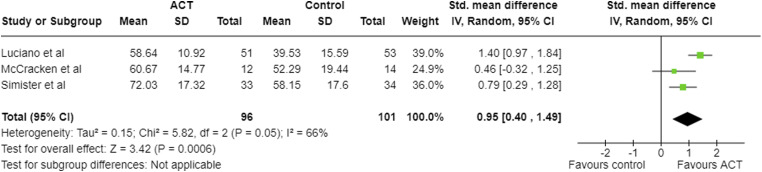
- ACT improved pain acceptance (CPAQ) at post-intervention (SMD 1.05, 95% CI 0.61 to 1.49) and follow-up (SMD 0.95, 95% CI 0.40 to 1.49).
- All secondary outcomes showed large-to-moderate pooled effect estimates post-intervention; fatigue also improved with a large negative effect. No adverse events were reported as attributable to ACT, and attrition was below 20% in 4/6 studies.
## Methods
- Systematic review and meta-analysis conducted according to PRISMA, searching PubMed, Embase, and PsychInfo; ACT RCTs in fibromyalgia were eligible if the intervention was ACT-based and not combined with another active therapy.
- Included studies could have any age or sex, with fibromyalgia diagnosed clinically or by self-report; controls included waitlist, attention control, treatment as usual, and other active therapy.
- Meta-analysis used random-effects models in RevMan, extracting means and SDs to compute Hedges’ g / SMD; risk of bias followed the Cochrane Handbook, and heterogeneity was assessed with I².
## Limitations
- The paper states the review was limited by the small body of evidence and differing methodologies across included studies.
- The authors note heterogeneity was high for several outcomes, with I² ranging from 0 to 92%, and that subgroup/meta-regression analyses could not be meaningfully conducted because there were too few studies.
- Evident from the text: small samples and underpowered studies were a problem; 3 of 6 studies had fewer than 50 participants and 3 studies were underpowered, which may inflate effect sizes.
Model-written summary. Check it against the paper before relying on it.
Integrity signals
Registry
Cites
Statistics
Figures
Verification
Claims the paper makes
4 Valid · 0 Not valid · 7 Not checked · 52 Own results and interpretations
Every source the paper cites for this claim was checked and supports it.
In the paper
“Interventions aimed at increasing psychological flexibility have been shown in randomised controlled trials (RCTs) to be effective in treating chronic pain 6 ; therefore, this review aims to explore the effectiveness of one such intervention, acceptance and commitment therapy (ACT), in fibromyalgia.”
§ The efficacy, acceptability and safety of acceptance and commitment therapy for fibromyalgia – a systematic review and meta-analysis > Introduction
What the sources say
- Supportedcites [6] McCracken LM Morley S. The psychological flexibility model: a basis for integration and progress in psychological approaches to chronic pain management. J Pain 2014; 15: 221– 234. DOI: 10.1016/j.jpain.2013.10.014. 24581630 source
The Introduction (page not available in our copy) identifies ACT as an intervention designed to increase psychological flexibility and says that studies support its efficacy and effectiveness for chronic pain. It reports six published RCTs in adults and one in young people, while cautioning that the controlled trials were generally small and preliminary. (LLM, conf=0.92)
boostedstates a cause- Asserted: passes — The authors put it forward as true.
- Checkable: passes — It can be checked against evidence.
- Load-bearing: passes — The paper’s conclusions depend on it.
- Based: passes — The paper gives a reason why it holds.
- Supported
The cited sources support only part of this claim — read each source’s verdict below.
In the paper
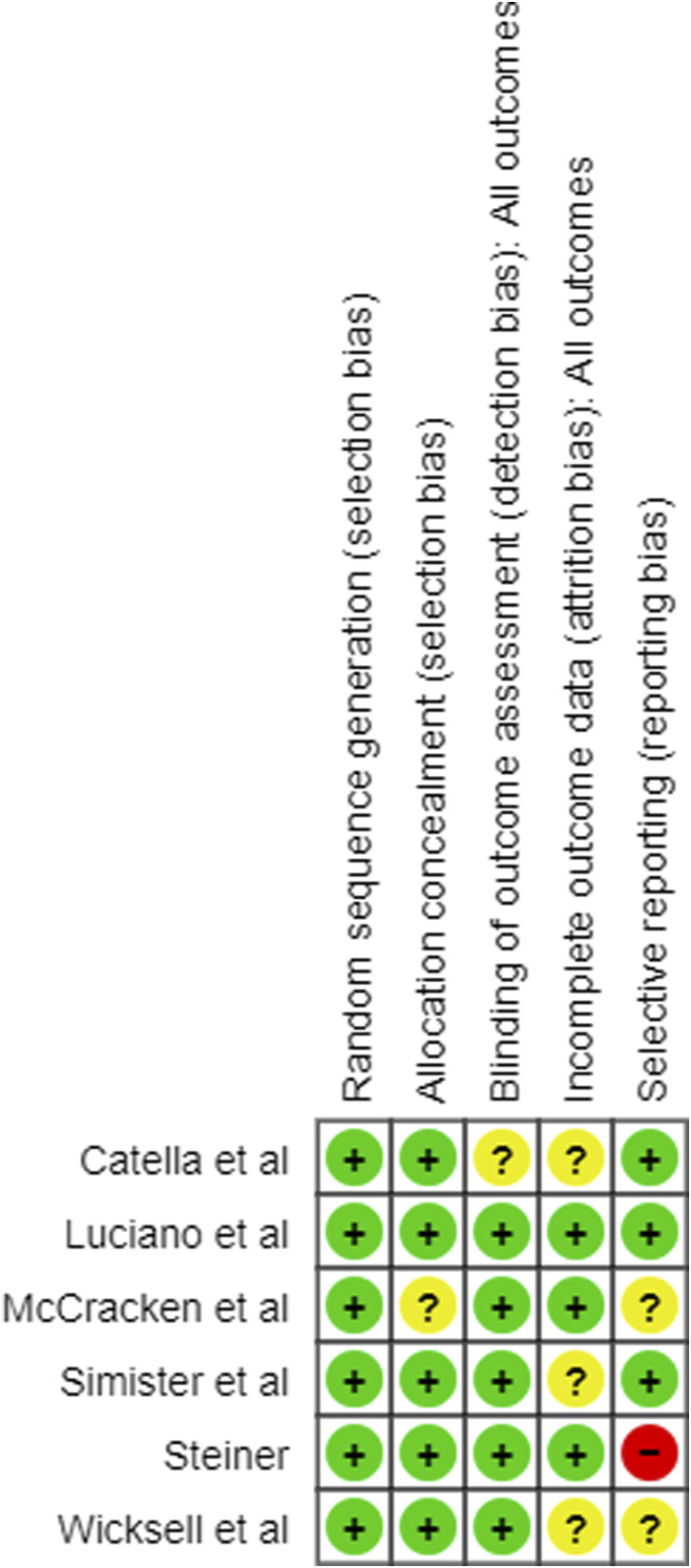
“One study reported potential conflict of interest, with many of the authors being paid consultants, shareholders and/or employees of the company which produced the app used to administer ACT, and funded the study. 25”
§ The efficacy, acceptability and safety of acceptance and commitment therapy for fibromyalgia – a systematic review and meta-analysis > Results > Risk of bias and conflict of interest
What the sources say
- Partly supportedcites [25] Catella S Gendreau RM Kraus AC, et al. Self-guided digital acceptance and commitment therapy for fibromyalgia management: results of a randomized, active-controlled, phase II pilot clinical trial. J Behav Med. 2023. DOI: 10.1007/s10865-023-00429-3. PMC10867073 37382794 sourceExperimental — accuracy not yet measured
The Introduction identifies Swing Therapeutics as the company behind the Stanza app used to deliver ACT. The passages from our copy do not substantiate the claim that many authors were paid consultants, shareholders, or employees, or that the company funded the study; searches for conflict-of-interest and funding disclosures did not locate those details. (LLM, conf=0.76)
plain- Asserted: passes — The authors put it forward as true.
- Checkable: passes — It can be checked against evidence.
- Load-bearing: unclear — It is unclear whether the paper’s conclusions depend on it.
- Based: passes — The paper gives a reason why it holds.
- Partly supported
A result the paper reports from its own data — it cites no other source for it, so there is none to check. The quote shows it is in the paper.
In the paper
“For CPAQ, effect sizes were 1.35 (0.92, 1.78) post-treatment and 1.16 (0.75, 1.58) at follow-up.”
§ The efficacy, acceptability and safety of acceptance and commitment therapy for fibromyalgia – a systematic review and meta-analysis > Results > Results of individual studies
plain- Asserted: passes — The authors put it forward as true.
- Checkable: passes — It can be checked against evidence.
- Load-bearing: passes — The paper’s conclusions depend on it.
- Based: passes — The paper gives a reason why it holds.
A result the paper reports from its own data — it cites no other source for it, so there is none to check. The quote shows it is in the paper.
In the paper
“for anxiety, SMD was −0.34 (−0.73, 0.05) and −0.42 (−0.81, −0.03), all in favour of GACT.”
§ The efficacy, acceptability and safety of acceptance and commitment therapy for fibromyalgia – a systematic review and meta-analysis > Results > Results of individual studies
plain- Asserted: passes — The authors put it forward as true.
- Checkable: passes — It can be checked against evidence.
- Load-bearing: unclear — It is unclear whether the paper’s conclusions depend on it.
- Based: passes — The paper gives a reason why it holds.
A result the paper reports from its own data — it cites no other source for it, so there is none to check. The quote shows it is in the paper.
In the paper
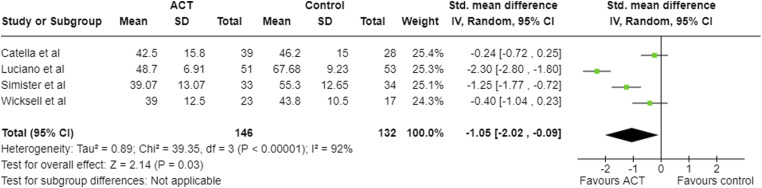
“ACT was superior to controls in improving FIQ score at post-intervention (SMD −1.05, 95% CI −2.02, −0.09) and follow-up (SMD −1.43, 95% CI −2.17, −0.69)”
- Also stated in: § Discussion · plain
“ACT was superior to controls (WL, TAU, and ED), with a large negative pooled effect (SMD −1.05, 95% CI −2.02, −0.09) for FIQ at post-intervention”
§ The efficacy, acceptability and safety of acceptance and commitment therapy for fibromyalgia – a systematic review and meta-analysis > Abstract > Results
plainstates a cause- Asserted: passes — The authors put it forward as true.
- Checkable: passes — It can be checked against evidence.
- Load-bearing: passes — The paper’s conclusions depend on it.
- Based: passes — The paper gives a reason why it holds.
- Also stated in: § Discussion · plain
26 more claims
Create a free account to see all 63 claims and every source verdict.
- Probably not a substantial claim. 11
- It may state two separate claims as one. 26
Citations
Cites
Statistical Power Analysis for the Behavioral Sciences
Muller, K. (1989) · Technometrics · doi:10.1080/00401706.1989.10488618 · Cited by 99,167
The CES-D Scale: A Self-Report Depression Scale for Research in the General Population
Radloff, L. S. (1977) · Applied Psychological Measurement · doi:10.1177/014662167700100306 · Cited by 53,267
The Hospital Anxiety and Depression Scale
Zigmond, A. S., & Snaith, R. P. (1983) · Acta Psychiatrica Scandinavica · doi:10.1111/j.1600-0447.1983.tb09716.x · Cited by 47,139
The PHQ-9: Validity of a brief depression severity measure
Kroenke, K., Spitzer, R. L., & Williams, J. B. W. (2001) · Journal of General Internal Medicine · doi:10.1046/j.1525-1497.2001.016009606.x · Cited by 44,910
An inventory for measuring depression
BECK, A. T. (1961) · Archives of General Psychiatry · doi:10.1001/archpsyc.1961.01710120031004 · Cited by 38,032 · cited 1×
“24,25,51,52 Anxiety was reported by two studies: Luciano and colleagues used the HADS, and Wicksell and colleagues the Spielberger Trait-State Anxiety Inventory – this review used the trait anxiety score.”
MethodDepression and quality of life in older persons: A review
Sivertsen, H., Bjørkløf, G. H., Engedal, K., Selbæk, G., & Helvik, A.-S. (2015) · Dementia and Geriatric Cognitive Disorders · doi:10.1159/000437299 · Cited by 14,152
The PRISMA 2020 statement: an updated guideline for reporting systematic reviews
Page, M. J., McKenzie, J. E., Bossuyt, P. M., Boutron, I., Hoffmann, T. C., Mulrow, C. D., Shamseer, L., Tetzlaff, J. M., Akl, E. A., Brennan, S. E., et al. (2021) · Systematic Reviews · doi:10.1186/s13643-021-01626-4 · Cited by 13,874
The american college of rheumatology 1990 criteria for the classification of fibromyalgia
Wolfe, F., Smythe, H. A., Yunus, M. B., Bennett, R. M., Bombardier, C., Goldenberg, D. L., Tugwell, P., Campbell, S. M., Abeles, M., Clark, P., et al. (1990) · Arthritis & Rheumatism · doi:10.1002/art.1780330203 · Cited by 9,563
Beck, A. T., Steer, R. A., & Brown, G. (2011) · PsycTESTS Dataset · doi:10.1037/t00742-000 · Cited by 7,535
Scoville, W. B. (1949) · Journal of neurosurgery · doi:10.3171/jns.1949.6.1.0065 · Cited by 7,381
Acceptance and commitment therapy: model, processes and outcomes
Hayes, S. C., Luoma, J. B., Bond, F. W., Masuda, A., & Lillis, J. (2006) · Behaviour Research and Therapy · doi:10.1016/j.brat.2005.06.006 · Cited by 6,587
The PRISMA 2020 statement: An updated guideline for reporting systematic reviews
Page, M. J., McKenzie, J. E., Bossuyt, P. M., Boutron, I., Hoffmann, T. C., Mulrow, C. D., Shamseer, L., Tetzlaff, J. M., Akl, E. A., Brennan, S. E., et al. (2021) · PLoS Medicine · doi:10.1371/journal.pmed.1003583 · Cited by 5,148
The short-form McGill pain questionnaire
Melzack, R. (1987) · Pain · doi:10.1016/0304-3959(87)91074-8 · Cited by 4,368
Wolfe, F., Clauw, D. J., Fitzcharles, M., Goldenberg, D. L., Katz, R. S., Mease, P., Russell, A. S., Russell, I. J., Winfield, J. B., & Yunus, M. B. (2010) · Arthritis Care & Research · doi:10.1002/acr.20140 · Cited by 3,952
State-Trait Anxiety Inventory for Adults
Spielberger, C. D. (2012) · PsycTESTS Dataset · doi:10.1037/t06496-000 · Cited by 3,479
2016 revisions to the 2010/2011 fibromyalgia diagnostic criteria
Wolfe, F., Clauw, D. J., Fitzcharles, M.-A., Goldenberg, D. L., Häuser, W., Katz, R. L., Mease, P. J., Russell, A. S., Russell, I. J., & Walitt, B. (2016) · Seminars in Arthritis and Rheumatism · doi:10.1016/j.semarthrit.2016.08.012 · Cited by 2,232
(1991) · PubMed · Cited by 1,837
Acceptance of chronic pain: component analysis and a revised assessment method
McCracken, L. M., Vowles, K. E., & Eccleston, C. (2004) · Pain · doi:10.1016/j.pain.2003.10.012 · Cited by 1,101
Worldwide epidemiology of fibromyalgia
Queiroz, L. P. (2013) · Current Pain and Headache Reports · doi:10.1007/s11916-013-0356-5 · Cited by 826
The Revised Fibromyalgia Impact Questionnaire (FIQR): validation and psychometric properties
Bennett, R. M., Friend, R., Jones, K. D., Ward, R., Han, B. K., & Ross, R. L. (2009) · Arthritis Research & Therapy · doi:10.1186/ar2783 · Cited by 814
(1987) · PubMed · Cited by 587
Wetherell, J. L., Afari, N., Rutledge, T., Sorrell, J. T., Stoddard, J. A., Petkus, A. J., Solomon, B. C., Lehman, D. H., Liu, L., Lang, A. J., et al. (2011) · PAIN · doi:10.1016/j.pain.2011.05.016 · Cited by 508
Häuser, W., Ablin, J., Fitzcharles, M.-A., Littlejohn, G., Luciano, J. V., Usui, C., & Walitt, B. (2015) · Nature Reviews Disease Primers · doi:10.1038/nrdp.2015.22 · Cited by 505
McCracken, L. M., & Morley, S. (2014) · The Journal of Pain · doi:10.1016/j.jpain.2013.10.014 · Cited by 464
A Study of the Natural History of Low-Back Pain: Part II
ROLAND, M., & MORRIS, R. (1983) · Spine · doi:10.1097/00007632-198303000-00005 · Cited by 462 · cited 1×
“22,45 Two studies reported disability; McCracken and colleagues used the Roland and Morris Disability Questionnaire, 17,46 whereas Wicksell and colleagues used the Pain Disability Index.”
MethodReporting attrition in randomised controlled trials
Dumville, J. C., Torgerson, D. J., & Hewitt, C. E. (2006) · BMJ · doi:10.1136/bmj.332.7547.969 · Cited by 443
Fitzcharles, M.-A., Ste-Marie, P. A., Goldenberg, D. L., Pereira, J. X., Abbey, S., Choinière, M., Ko, G., Moulin, D. E., Panopalis, P., Proulx, J., et al. (2013) · Pain Research and Management · doi:10.1155/2013/918216 · Cited by 409
Buhrman, M., Skoglund, A., Husell, J., Bergström, K., Gordh, T., Hursti, T., Bendelin, N., Furmark, T., & Andersson, G. (2013) · Behaviour Research and Therapy · doi:10.1016/j.brat.2013.02.010 · Cited by 285 · cited 1×
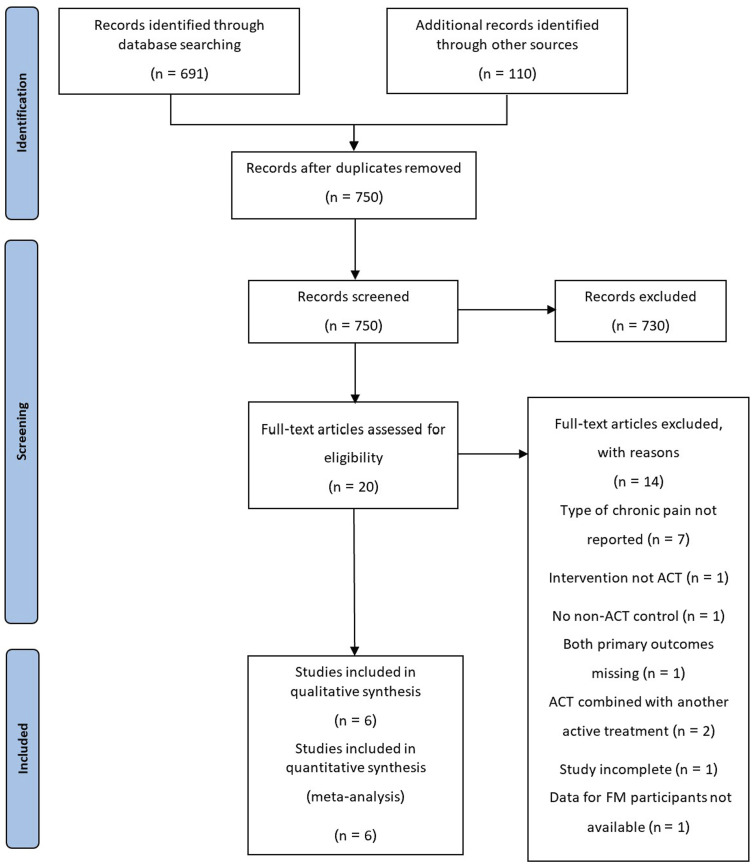
“25 The remaining 14 were excluded for the following reasons: 7 did not report the type of chronic pain, 26 – 32 1 had no ACT intervention, 33 1 had no non-ACT control, 34 1 did not report either primary outcome, 35 2 combined ACT with another active treatment, 36,37 1 was an incomplete study, 38…”
BackgroundBERNARDY, K., FÜBER, N., KÖLLNER, V., & HÄUSER, W. (2010) · The Journal of Rheumatology · doi:10.3899/jrheum.100104 · Cited by 266
Hann, K. E. J., & McCracken, L. M. (2014) · Journal of Contextual Behavioral Science · doi:10.1016/j.jcbs.2014.10.001 · Cited by 259
Trompetter, H. R., Bohlmeijer, E. T., Veehof, M. M., & Schreurs, K. M. G. (2015) · Journal of Behavioral Medicine · doi:10.1007/s10865-014-9579-0 · Cited by 255
Acceptance and commitment therapy for fibromyalgia: A randomized controlled trial.
Wicksell, R. K., Kemani, M., Jensen, K., Kosek, E., Kadetoff, D., Sorjonen, K., Ingvar, M., & Olsson, G. L. (2013) · European Journal of Pain · doi:10.1002/j.1532-2149.2012.00224.x · Cited by 244
Bernardy, K., Klose, P., Welsch, P., & Häuser, W. (2018) · European Journal of Pain · doi:10.1002/ejp.1121 · Cited by 217
Review of pharmacological therapies in fibromyalgia syndrome
Häuser, W., Walitt, B., Fitzcharles, M.-A., & Sommer, C. (2014) · Arthritis Research & Therapy · doi:10.1186/ar4441 · Cited by 188
Dear (2015) · doi:10.1097/j.pain.0000000000000251 · Cited by 187
Luciano, J. V., Guallar, J. A., Aguado, J., López-del-Hoyo, Y., Olivan, B., Magallón, R., Alda, M., Serrano-Blanco, A., Gili, M., & Garcia-Campayo, J. (2014) · PAIN · doi:10.1016/j.pain.2013.12.029 · Cited by 183
McCracken, L. M. (2013) · The Journal of Pain · doi:10.1016/j.jpain.2013.02.009 · Cited by 172
McCracken, L. M., Sato, A., & Taylor, G. J. (2013) · The Journal of Pain · doi:10.1016/j.jpain.2013.06.011 · Cited by 162 · cited 9×
“22,45 Two studies reported disability; McCracken and colleagues used the Roland and Morris Disability Questionnaire, 17,46 whereas Wicksell and colleagues used the Pain Disability Index.”
BackgroundMethodInfluentialRandomized Controlled Trial of Online Acceptance and Commitment Therapy for Fibromyalgia
Simister, H. D., Tkachuk, G. A., Shay, B. L., Vincent, N., Pear, J. J., & Skrabek, R. Q. (2018) · The Journal of Pain · doi:10.1016/j.jpain.2018.02.004 · Cited by 157
A scale for rating the quality of psychological trials for pain
Yates, S. L., Morley, S., Eccleston, C., & de C. Williams, A. C. (2005) · Pain · doi:10.1016/j.pain.2005.06.018 · Cited by 150 · cited 1×
“A score of 0 – 2 was considered as indicating poor, 3 – 5 as average and 6 – 9 as excellent, as per Bernardy et al. 20,43 All six studies had a high treatment quality: fi ve studies scored 8/9 on the scale 17,21,22,24,25 and one scored 7/9.”
BackgroundThe Effectiveness of an Acceptance and Commitment Therapy Self-help Intervention for Chronic Pain.
Johnston, M., Foster, M., Shennan, J., Starkey, N. J., & Johnson, A. (2010) · The Clinical Journal of Pain · doi:10.1097/ajp.0b013e3181cf59ce · Cited by 142
Herbert, M. S., Afari, N., Liu, L., Heppner, P., Rutledge, T., Williams, K., Eraly, S., VanBuskirk, K., Nguyen, C., Bondi, M., et al. (2017) · The Journal of Pain · doi:10.1016/j.jpain.2016.10.014 · Cited by 137
Acceptance and Commitment Therapy
Twohig, M. P. (2012) · Cognitive and Behavioral Practice · doi:10.1016/j.cbpra.2012.04.003 · Cited by 115
Alonso-Fernández, M., López-López, A., Losada, A., González, J. L., & Wetherell, J. L. (2016) · Pain Medicine · doi:10.1111/pme.12885 · Cited by 73
Scott, W., Chilcot, J., Guildford, B., Daly‐Eichenhardt, A., & McCracken, L. M. (2018) · European Journal of Pain · doi:10.1002/ejp.1236 · Cited by 69
Rickardsson, J., Gentili, C., Holmström, L., Zetterqvist, V., Andersson, E., Persson, J., Lekander, M., Ljótsson, B., & Wicksell, R. K. (2021) · European Journal of Pain · doi:10.1002/ejp.1723 · Cited by 64
Kemani, M. K., Olsson, G. L., Lekander, M., Hesser, H., Andersson, E., & Wicksell, R. K. (2015) · The Clinical Journal of Pain · doi:10.1097/ajp.0000000000000203 · Cited by 61
Probst, T., Baumeister, H., McCracken, L. M., & Lin, J. (2018) · Journal of Clinical Medicine · doi:10.3390/jcm8010024 · Cited by 38
Kanzler, K. E., Robinson, P. J., McGeary, D. D., Mintz, J., Kilpela, L. S., Finley, E. P., McGeary, C., Lopez, E. J., Velligan, D., Munante, M., et al. (2022) · BMC Primary Care · doi:10.1186/s12875-022-01690-2 · Cited by 29
Catella, S., Gendreau, R. M., Kraus, A. C., Vega, N., Rosenbluth, M. J., Soefje, S., Malhotra, S., Luciano, J. V., McCracken, L. M., Williams, D. A., et al. (2024) · Journal of Behavioral Medicine · doi:10.1007/s10865-023-00429-3 · Cited by 23
Varallo, G., Cattivelli, R., Giusti, E. M., Landi, G., Spatola, C. A. M., Ruggiero, G. M., Franceschini, C., Tossani, E., Grandi, S., Capodaglio, P., et al. (2023) · Clinical and Experimental Rheumatology · doi:10.55563/clinexprheumatol/7hvaya · Cited by 8
Kanzler, K. E., Robinson, P. J., McGeary, D. D., Mintz, J., Potter, J. S., Muñante, M., Lopez, E. J., Dougherty, D. M., Hale, W. J., & Velligan, D. I. (2018) · Contemporary Clinical Trials · doi:10.1016/j.cct.2018.01.004 · Cited by 7
Davis, C. H., Twohig, M. P., & Levin, M. E. (2024) · Cognitive Behaviour Therapy · doi:10.1080/16506073.2024.2346854 · Cited by 6
The rapid assessment of fatigue severity in cancer patients
Mendoza, T. R., Wang, X. S., Cleeland, C. S., Morrissey, M., Johnson, B. A., Wendt, J. K., & Huber, S. L. (1999) · Cancer · doi:10.1002/(sici)1097-0142(19990301)85:5 · Cited by 1
Research works printed but not linked: 3
- Geiser D. A comparison of acceptance-focused and control-focused psychological treatments in a chronic pain treatment center. PhD Thesis, University of Nevada, Reno, NV, 1992.
- IBM Corp. IBM SPSS Statistics for MacOS. Armonk, NY: IBM Corp, 2016; 24.0.
- Steiner JL. Assessing the efficacy of acceptance and commitment therapy in reducing schema-enmeshment in fibromyalgia syndrome. PhD Thesis, Purdue University, West Lafayette, Indiana, 2013.
Cited by
Gendreau, R. M., McCracken, L. M., Williams, D. A., Luciano, J. V., Dai, Y., Vega, N., Ghalib, Z., Guthrie, K., Kraus, A. C., Rosenbluth, M. J., et al. (2024) · The Lancet · doi:10.1016/s0140-6736(24)00909-7 · Cited by 40
Zou, Y., Wang, R., Xiong, X., Bian, C., Yan, S., & Zhang, Y. (2025) · BMC Psychiatry · doi:10.1186/s12888-025-07067-w · Cited by 31
Fibromyalgia and the painful self: A meta-analysis of resting-state fMRI data
Cavicchioli, M., Scalabrini, A., Nimbi, F. M., Torelli, A., Bottiroli, S., Pichiecchio, A., Prodi, E., Trentini, C., Sarzi‐Puttini, P., & Galli, F. (2025) · Journal of Psychiatric Research · doi:10.1016/j.jpsychires.2025.01.048 · Cited by 17
Perniola, S., Bruno, D., Mario, C. D., Campobasso, D., Calabretta, M., Gessi, M., Petricca, L., Tolusso, B., Alivernini, S., & Gremese, E. (2025) · Clinical Rheumatology · doi:10.1007/s10067-025-07331-0 · Cited by 15
Williams, D. A., & Clauw, D. J. (2026) · New England Journal of Medicine · doi:10.1056/nejmcp2411656 · Cited by 11
Metadata
- Authors
- Eastwood, F., & Godfrey, E.
- Affiliations
- King's College London (GB)
- Corresponding author
- Eastwood, Florence
- Venue
- British Journal of Pain
- Publisher
- SAGE Publications
- Published
- 2023-12-12
- Volume
- 18
- Issue
- 3
- Pages
- 243-256
- ISSN
- 2049-4637 (ISSN-L)
- 2049-4645
- PMC
- PMC11092929
- OpenAlex
- W4389640740
- Cited by
- 22
- References
- 52
- Citations by year
- 2026: 10 · 2025: 9 · 2024: 3
- FWCI
- 1.11
- Type
- journal article
- Language
- en
- Open access
- hybrid
- doi.org
- Locations
- British Journal of Pain (publishedVersion, cc-by)
- PubMed Central (publishedVersion, cc-by)
- PubMed (publishedVersion)
- Research Portal (King's College London) (submittedVersion, cc-by)
- Topics
- Social Sciences › Psychology › Clinical Psychology › Mindfulness and Compassion Interventions
- Health Sciences › Medicine › Psychiatry and Mental health › Fibromyalgia and Chronic Fatigue Syndrome Research
- Health Sciences › Health Professions › Physical Therapy, Sports Therapy and Rehabilitation › Musculoskeletal pain and rehabilitation
- Keywords
- acceptance and commitment therapy, fibromyalgia, chronic pain, pain acceptance, health-related quality of life, psychological flexibility, fatigue, depression, anxiety, disability, treatment efficacy, treatment safety, attrition
About these checks
Registry, retraction, Cites and statistics results are computed, not judged, with one exception: a printed reference that no index lists is read once by a model before it counts as a citation error. Claims are extracted by a model and kept only when their quote appears verbatim in the text; each cited source is then checked, with a model’s help, for whether it says what the claim relies on. Those verdicts can be wrong — read the claim’s quote and the cited source before relying on one.
The claim verdicts this report counts are experimental: their accuracy is not yet measured.
A language model drew the claims from the paper on 2026-10-11, under version 3 of the claim definition (model deepseek-v4.1-flash, prompt extract-v3).
A second model labelled each claim on 2026-10-11 (model jev-1.13-20260917, definition revision gold-guideline-v0.2).
Cited sources are checked with a language model’s help (gpt-6-sol).
Statistics and arithmetic are recomputed, not judged.
Confidence bands are shown only for fields calibrated on our annotated test set. None is calibrated yet, so no band is shown.
What counts as a claim ›How we measure confidence ›How we check this ›
Are you an author, or do you see a problem with this page? Request a review
Data sources
Bibliographic data: Semantic Scholar, OpenAlex, Crossref.
Contains information from the Semantic Scholar Academic Graph Datasets, made available under the ODC Attribution License (ODC-BY 1.0).
Semantic Scholar’s data is described in: Kinney, R., et al. (2023). The Semantic Scholar Open Data Platform. arXiv:2301.10140.
