

The conundrum of police officer-involved homicides: Counter-data in Los Angeles County
Open accessThe DOI matches its Crossref record; 32 of the 32 references it cites were found in a registry or an index.
Abstract
This paper draws from critical data studies and related fields to investigate police officer-involved homicide data for Los Angeles County. We frame police officer-involved homicide data as a rhetorical tool that can reify certain assumptions about the world and extend regimes of power. We highlight the possibility that this type of sensitive civic data can be investigated and employed within local communities through creative practice. Community involvement with data can create a countervailing force to powerful dominant narratives and supplement activist projects that hold local officials accountable for their actions. Our analysis examines four Los Angeles County police officer-involved homicide data sets. First, we provide accounts of the semantics, granularity, scale and transparency of this local data. Then, we describe a “counter data action,” an event that invited members of the community to identify the limits and challenges present in police officer-involved homicide data and to propose new methods for deriving meaning from these indicators and statistics.
Overview
The claims and statistics of this paper haven’t been checked yet.
Free: it reads the open-access text and checks the first 5 claims that cite a source we can check. Create a free account to check every claim.
Integrity signals
Registry
Cites
Statistics
Figures

Verification
Claims the paper makes
The claims and statistics of this paper haven’t been checked yet.
Free: it reads the open-access text and checks the first 5 claims that cite a source we can check. Create a free account to check every claim.
Claims other papers make about this one
Each is checked against this paper’s own text: does it say what the citing paper says it does?
In the citing paper
“Each of these practical choices can have profound ethical implications [10,13,24,31,40], of which data scientists are sometimes well aware.”
From Problem Formulation and Fairness (2019) · cites this paper as [10]
Self-check
Percentages, sums and reported differences re-computed from the paper’s own numbers.
The self-check needs the paper’s full text.
Citations
Cites
boyd, D., & Crawford, K. (2012) · Information, Communication & Society · doi:10.1080/1369118x.2012.678878 · Cited by 5,479 · cited 1×
“We take seriously the claim that ‘‘we are our tools,’’ as the quantification of human features and actions can both enable and place limits on knowledge and action (boyd & Crawford, 2012; Thatcher, 2015).”
BackgroundSorting Things Out: Classification and Its Consequences
(2000) · The Journal of Academic Librarianship · doi:10.1016/s0099-1333(00)00155-5 · Cited by 5,210
The Data Revolution: Big Data, Open Data, Data Infrastructures & Their Consequences
Kitchin, R. (2014) · doi:10.4135/9781473909472 · Cited by 1,469 · cited 2×
“Critical data studies generally critiques the widely held understanding of data as an objective set of facts that exist prior to ideology, politics, or interpretation (Kitchin, 2014).”
BackgroundSorting things out: classification and its consequences
(2000) · Choice Reviews Online · doi:10.5860/choice.37-5139 · Cited by 1,002
Reconstructing Individualism: Autonomy, Individuality, and the Self in Western Thought
Heller, T., & Brooke‐Rose, C. (1986) · Cited by 927
The Politics of Large Numbers: A History of Statistical Reasoning
Houser, J. A., Desrosieres, A., & Naish, C. (1999) · Contemporary Sociology · doi:10.2307/2654208 · Cited by 911 · cited 2×
“Scholars of critical data scholars, rather, set out to expose ‘‘the double role of statistics in representing as well as criticizing reality’’ (Desrosières and Naish, 2002).”
BackgroundToward Information Infrastructure Studies: Ways of Knowing in a Networked Environment
Bowker, G. C., Baker, K., Millerand, F., & Ribes, D. (2009) · International Handbook of Internet Research · doi:10.1007/978-1-4020-9789-8_5 · Cited by 654 · cited 1×
“Infrastructure studies works in tandem with critical data studies to offer a method for analyzing the decisions made at various steps of data gathering, management, design, and display (Bowker, 2007; Bowker et al., 2010).”
MethodMemory Practices in the Sciences
(2006) · Journal of Documentation · doi:10.1108/00220410610688804 · Cited by 603
Critical Making: Conceptual and Material Studies in Technology and Social Life
Ratto, M. (2011) · The Information Society · doi:10.1080/01972243.2011.583819 · Cited by 577 · cited 1×
“Critical making focuses on interrogations of the socio-technical through tracing back the ways ‘‘things are made’’ in order to produce, re-produce, or imagine various objects (Ratto, 2011).”
BackgroundInformation: A Very Short Introduction
Floridi, L. (2010) · Cited by 558
International Handbook of Internet Research
(2010) · Springer eBooks · doi:10.1007/978-1-4020-9789-8 · Cited by 557
Information: A Very Short Introduction
Floridi, L. (2010) · Oxford University Press eBooks · doi:10.1093/actrade/9780199551378.001.0001 · Cited by 490
Stein, E. V. (2013) · doi:10.4324/9780203760130-11 · Cited by 464
Memory Practices in the Sciences; Geoffrey C. Bowker
Albagli, S. (2007) · Reciis · doi:10.3395/reciis.v1i2.95en · Cited by 441
Memory Practices in the Sciences
Albagli, S. (2007) · Americanae (AECID Library) · doi:10.3395/reciis.v1i2.910 · Cited by 435
The Politics of Large Numbers: a History of Statistical Reasoning
Teugels, J. L. (2003) · Journal of the American Statistical Association · doi:10.1198/jasa.2003.s304 · Cited by 289 · cited 4×
“Scholars of critical data scholars, rather, set out to expose ‘‘the double role of statistics in representing as well as criticizing reality’’ (Desrosières and Naish, 2002).”
BackgroundInfluentialStatactivism: Forms of action between disclosure and affirmation
Bruno, I., Didier, E., & Vitale, T. (2014) · PARTECIPAZIONE E CONFLITTO · doi:10.1285/i20356609v7i2p198 · Cited by 202 · cited 1×
“In a similar vein, purveyors of ‘‘statactivism’’ use this term to describe ‘‘emerging forms of collective actions that use numbers, measurements, and indicators as a means of denunciation and criticism’’ (Bruno et al., 2014).”
BackgroundRosenberg, D. (2013) · "Raw Data" Is an Oxymoron · doi:10.7551/mitpress/9302.003.0003 · Cited by 167
Measuring Homicide by Police Officers
Sherman, L. W., & Langworthy, R. H. (1979) · The Journal of Criminal Law and Criminology (1973-) · doi:10.2307/1142641 · Cited by 147 · cited 6×
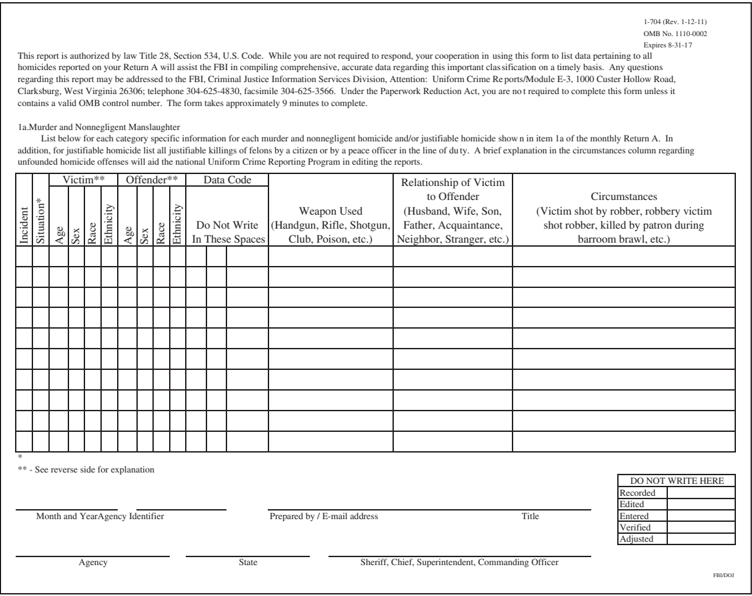
“, 2003) Studies have shown the inadequacy of this data, with underreporting as high as 51% in some cases (Sherman and Langworthy, 1979).”
BackgroundInfluentialThe Sociology of Crime and Delinquency
Duggan, T. J., Wolfgang, M. E., Savitz, L., & Johnston, N. (1963) · The American Catholic Sociological Review · doi:10.2307/3708513 · Cited by 117
Underreporting of Justifiable Homicides Committed by Police Officers in the United States, 1976–1998
Loftin, C., Wiersema, B., McDowall, D., & Dobrin, A. (2003) · American Journal of Public Health · doi:10.2105/ajph.93.7.1117 · Cited by 109 · cited 6×
“The numbers do not capture any subsequent legal procedures that might prove the contrary (Loftin et al., 2003).”
BackgroundResultInfluentialDigital methodologies of education governance: Pearson plc and the remediation of methods
Williamson, B. (2015) · European Educational Research Journal · doi:10.1177/1474904115612485 · Cited by 98 · cited 1×
“A growing body of research examines the labor and political economies entailed in the reproduction of these assemblages, focusing on practices as diverse as meteorological data (Bates, 2015); data produced by for-profit education companies (Williamson, 2016), and order security data (Ajana, 2015).”
BackgroundAugmented borders: Big Data and the ethics of immigration control
Ajana, B. (2015) · Journal of Information, Communication and Ethics in Society · doi:10.1108/jices-01-2014-0005 · Cited by 78 · cited 1×
“A growing body of research examines the labor and political economies entailed in the reproduction of these assemblages, focusing on practices as diverse as meteorological data (Bates, 2015); data produced by for-profit education companies (Williamson, 2016), and order security data (Ajana, 2015).”
BackgroundOn the Problems and Promise of Research on Lethal Police Violence: A Research Note
Klinger, D. A. (2012) · Homicide Studies · doi:10.1177/1088767911430861 · Cited by 77 · cited 2×
“Furthermore, all datasets failed to capture certain information, such as statistics about the number of officers who fired, number of bullets fired, or number of bullets hit—all details that could shed light on ‘‘on differential ‘kill ratios’’’ of certain police agencies compared to others (Klinger, 2012).”
Background“Education in Disguise”: Culture of a Hacker and Maker Space
Schrock, A. R. (2014) · InterActions UCLA Journal of Education and Information Studies · doi:10.5070/d4101020592 · Cited by 56
Nation's Two Measures of Homicide
Regoeczi, W. C., Banks, D., Planty, M., Langton, L. L., Annest, J. L., Warner, M., & Barnett‐Ryan, C. (2014) · EngagedScholarship @ Cleveland State University (Cleveland State University) · Cited by 31
DiSalvo, C. F., Louw, M., Holstius, D., Nourbakhsh, I., & Akin, A. (2012) · Design Issues · doi:10.1162/desi_a_00161 · Cited by 23 · cited 2×
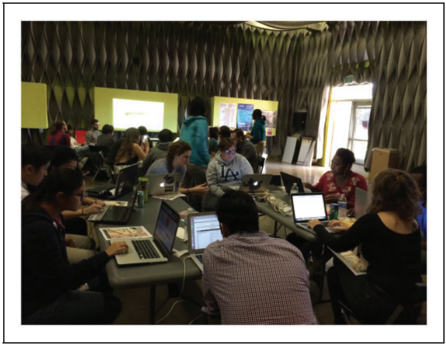
“We conceptualized the hackathon as a hacker-maker space (HMS), a context that generally focuses on openaccess workshops devoted to teaching and learning through creative and technical work (DiSalvo et al., 2012).”
BackgroundUrban indicators and dashboards: epistemology, contradictions and power/knowledge
Kitchin, R., Lauriault, T. P., & McArdle, G. (2015) · Regional Studies Regional Science · doi:10.1080/21681376.2014.991485 · Cited by 22 · cited 3×
“In the following section, we describe these four datasets and introduce each as a data assemblage with unique elements of institutional, legal, financial, and material support (Kitchin et al., 2015).”
BackgroundInfluentialVAM-Based Teacher Evaluation Policies: Ideological Foundations, Policy Mechanisms, and Implications
Holloway, J., & Collins, C. (2014) · InterActions UCLA Journal of Education and Information Studies · doi:10.5070/d4101020160 · Cited by 15
Conroy, A., & Scassa, T. (2016) · Canadian Journal of Women and the Law/Revue Femmes et Droit · doi:10.3138/cjwl.28.2.342 · Cited by 12 · cited 3×
“An example of this type of counter-data action related to crime reporting can be found in Conroy and Scassa’s discussion of a data collection model for sexual assault reporting developed in Philadelphia (Conroy and Scassa, 2015).”
BackgroundInfluentialThe Probabilistic Revolution, Volume 1
Krüger, L., Gigerenzer, G., & Morgan, M. S. (1987) · Cited by 8
Conroy, A., & Scassa, T. (2015) · SSRN Electronic Journal · doi:10.2139/ssrn.2696120 · Cited by 1
Research works printed but not linked: 5
- Currie M, Paris B, Pasquetto I, et al. (2015) The Police Officer Involved Homicide Database Project. iSchools. iConference Proceedings Newport Beach, CA, 2015. http://hdl.handle.net/2142/73781.
- Mumola CJ (2007) Arrest-Related Deaths in the United States, 2003-2005 . Washington, D.C: Bureau of Justice Statistics.
- Obama B (2015, March) Remarks by the President after meeting with task force on 21st century policing . Press Conference, Washington, D.C. Available at: www.white house.gov/the-press-office/2015/03/02/remarks-presidentafter-meeting-task-force-21st-century-policing (accessed 22 July 2016).
- Thatcher J (2015) Understanding Spatial Media: Locative and Sousveillant Media (SSRN Scholarly Paper No. ID 2657663). Rochester, NY: Social Science Research Network. Available at: http://papers.ssrn.com/abstract= 2657663 (accessed 22 July 2016).
- Uniform Crime Reporting Handbook (2004) 22 . Washington, DC: U.S. Department of Justice, Federal Bureau of Investigation.
Cited by
D'Ignazio, C., & Klein, L. F. (2020) · doi:10.7551/mitpress/11805.001.0001 · Cited by 1,738
Critical data studies: An introduction
Iliadis, A., & Russo, F. (2016) · Big Data & Society · doi:10.1177/2053951716674238 · Cited by 463
Problem Formulation and Fairness
Passi, S., & Barocas, S. (2019) · Proceedings of the Conference on Fairness, Accountability, and Transparency · doi:10.1145/3287560.3287567 · Cited by 283
“Each of these practical choices can have profound ethical implications [10,13,24,31,40], of which data scientists are sometimes well aware.”
BackgroundPlatformic Management, Boundary Resources for Gig Work, and Worker Autonomy
Jarrahi, M. H., Sutherland, W., Nelson, S. B., & Sawyer, S. (2020) · Computer Supported Cooperative Work (CSCW) · doi:10.1007/s10606-019-09368-7 · Cited by 230
Passi, S., & Jackson, S. J. (2018) · Proceedings of the ACM on Human-Computer Interaction · doi:10.1145/3274405 · Cited by 225
“Data science tools and techniques constitute an increasingly common and complex feature of contemporary work settings, impacting modes of knowledge and governance [27,66,67], shaping organizational practices [15,52,99], reconfiguring publics [20,50,56], and simultaneously enabling and constraining the possibilities of…”
Background
Metadata
- Authors
- Currie, M., Paris, B. S., Pasquetto, I., & Pierre, J.
- Affiliations
- University of California, Los Angeles (US)
- Corresponding author
- Paris, Britt S
- Venue
- Big Data & Society
- Publisher
- SAGE Publications
- Published
- 2016-08-10
- Volume
- 3
- Issue
- 2
- ISSN
- 2053-9517 (ISSN-L)
- OpenAlex
- W2483388053
- Cited by
- 86
- References
- 30
- Citations by year
- 2026: 10 · 2025: 7 · 2024: 9 · 2023: 5 · 2022: 10 · 2021: 10 · 2020: 9 · 2019: 8 · 2018: 11 · 2017: 5 · 2016: 2
- FWCI
- 43.85
- Type
- journal article
- Language
- en
- Open access
- gold
- doi.org
- Licence
- cc-by
- journals.sagepub.com/page/policies/text-and-data-mining-license (tdm)
- Locations
- Big Data & Society (publishedVersion, cc-by)
- DOAJ (DOAJ: Directory of Open Access Journals) (submittedVersion, cc-by-sa)
- Edinburgh Research Explorer (University of Edinburgh) (submittedVersion, cc-by)
- Funders
- Microsoft Research
- Topics
- Social Sciences › Political Science and International Relations › Policing Practices and Perceptions
- Physical Sciences › Computer Science › Artificial Intelligence › Ethics and Social Impacts of AI
- Social Sciences › Decision Sciences › Information Systems and Management › Big Data Technologies and Applications
- Keywords
- police killings, civic data, critical data studies, data transparency, police accountability, Los Angeles County
About these checks
Registry, retraction, Cites and statistics results are computed, not judged, with one exception: a printed reference that no index lists is read once by a model before it counts as a citation error. Claims are extracted by a model and kept only when their quote appears verbatim in the text; each cited source is then checked, with a model’s help, for whether it says what the claim relies on. Those verdicts can be wrong — read the claim’s quote and the cited source before relying on one.
Statistics and arithmetic are recomputed, not judged.
Confidence bands are shown only for fields calibrated on our annotated test set. None is calibrated yet, so no band is shown.
What counts as a claim ›How we measure confidence ›How we check this ›
Are you an author, or do you see a problem with this page? Request a review
Data sources
Bibliographic data: Semantic Scholar, OpenAlex, Crossref.
Contains information from the Semantic Scholar Academic Graph Datasets, made available under the ODC Attribution License (ODC-BY 1.0).
Semantic Scholar’s data is described in: Kinney, R., et al. (2023). The Semantic Scholar Open Data Platform. arXiv:2301.10140.
