

The DOI matches its Crossref record; 4 of the 4 references it cites were found in a registry or an index.
Prevalence, Characteristics, and Outcomes of People With A High Body Mass Index Across the Kidney Disease Spectrum: A Population-Based Cohort Study
Abstract
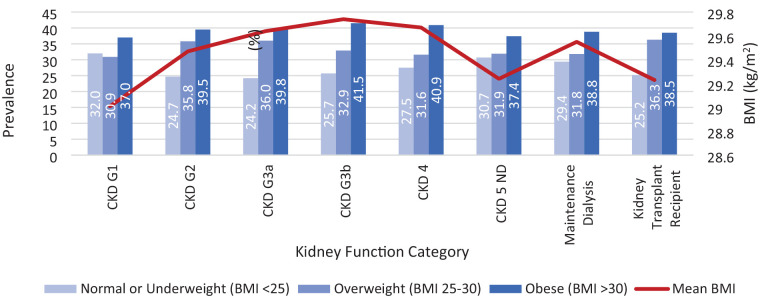
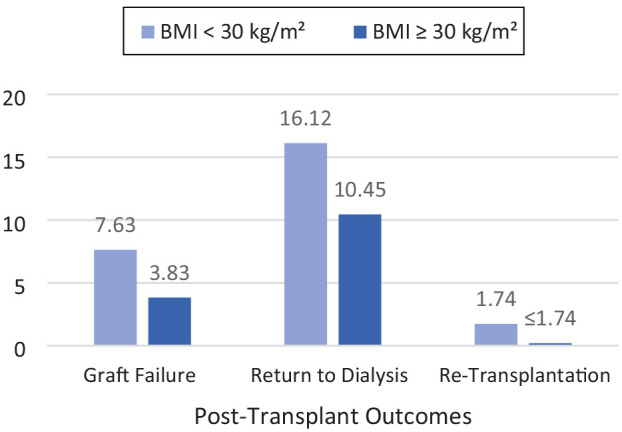
Background: Obesity has a major impact on health and health care, particularly in those with chronic kidney disease (CKD). Objective: The objective was to describe the prevalence, characteristics, and outcomes of people living with CKD and obesity (defined by a body mass index [BMI] ≥30 kg/m 2 ) in Canada. Design: Population-based cohort study using linked administrative health data (ICES). Patients: Adults aged 18 year and older with CKD G1-5D who had a height and weight recorded during a visit to an academic hospital in London Ontario Canada, between January 2010 and December 2019. Measures: CKD as defined by CKD 3A or higher. BMI as defined by weight kg/m 2 . Methods: As a primary interest, we described the percentage of patients with CKD across different BMI categories (<25 kg/m 2 , BMI 25-29.9 kg/m 2 , and BMI ≥30 kg/m 2 ), as well as their demographic and clinical profiles. As secondary interests, we followed patients until January 1, 2022 to summarize: (1) the percentage with CKD G3 who had kidney disease progression (50% decline from baseline estimated glomerular filtration rate [eGFR]) by BMI category, (2) the percentage with CKD G3-4 who developed kidney failure (initiation of maintenance dialysis or an eGFR of <15 mL/min/1.73 m 2 ) by BMI category, (3) the percentage with CKD G4-G5D who received a kidney transplant by BMI category, and (4) post-transplant outcomes in those transplanted over the study period, by BMI category. We performed similar analyses across CKD risk categories. Results: Of the 198 151 patients included, the percentage with obesity defined by a BMI ≥30 kg/m 2 increased from CKD G1 to CKD G4 (ie, 37% of those with CKD G1 had a BMI ≥30 kg/m 2 vs 40.9% of CKD G4). In CKD G5D and CKD T, the prevalence of high BMI appeared to drop (only ~38% had a BMI ≥30 kg/m 2 across groups). Across CKD categories, those with a BMI ≥30 kg/m 2 appeared to have more comorbidities, use more health care resources, and have more socioeconomic disparities than those with lower BMIs. Although secondary outcome events were limited, those with G3-4 with a BMI ≥30 kg/m 2 appeared to have a higher risk of CKD progression and those with CKD G5D with BMI ≥30 kg/m 2 were less likely to receive transplant over the study period. Interestingly those transplanted with a BMI ≥30 kg/m 2 appeared to have fewer post-transplant complications. We also observed an “obesity-paradox” in the risk of mortality, with high BMI appearing protective, particularly in the end stages of kidney disease. Limitations: We used BMI to capture obesity in this study but recognize its limitations as a measure of body composition. Secondary outcomes were descriptive and unadjusted due to small sample size and may have been subject to selection bias and confounding. Conclusions: Obesity defined by high BMI is highly prevalent in people with CKD, and patients have health, health care, and social disparity. Future studies to understand the impact of BMI on patients with CKD and how to individualize and manage BMI and obesity across the spectrum of CKD remain important.
Overview
The claims and statistics of this paper haven’t been checked yet.
Run the check — free, no account needed. It reads the open-access text and checks the sources it cites.
Integrity signals
Registry
Cites
Statistics
Figures
Verification
Claims the paper makes
The claims and statistics of this paper haven’t been checked yet.
Run the check — free, no account needed. It reads the open-access text and checks the sources it cites.
Claims other papers make about this one
Each is checked against this paper’s own text: does it say what the citing paper says it does?
The source backs part of the claim, not all of it — or backs it for a different population, condition or comparison.
In the citing paper
“but it also accelerates the development and progression of chronic kidney disease (CKD).4,5”
From Interplay of Chronic Kidney Disease and the Effects of Tirzepatide in Patients With Heart Failure, Preserved Ejection Fraction, and Obesity (2025) · cites this paper as [4]
Experimental — accuracy not yet measured
Self-check
Percentages, sums and reported differences re-computed from the paper’s own numbers.
The self-check needs the paper’s full text.
Citations
Cites
von Elm, E., Altman, D. G., Egger, M., Pocock, S. J., Gøtzsche, P. C., Vandenbroucke, J. P., & Initiative, F. T. S. (2007) · PLoS Medicine · doi:10.1371/journal.pmed.0040296 · Cited by 23,020
Obesity and chronic kidney disease
Jiang, Z., Wang, Y., Zhao, X., Cui, H., Han, M., Ren, X., Gang, X., & Wang, G. (2023) · American Journal of Physiology-Endocrinology and Metabolism · doi:10.1152/ajpendo.00179.2022 · Cited by 267
Recipient obesity and outcomes after kidney transplantation: a systematic review and meta-analysis
Hill, C. J., Courtney, A. E., Cardwell, C. R., Maxwell, A. P., Lucarelli, G., Veroux, M., Furriel, F., Cannon, R. M., Hoogeveen, E. K., Doshi, M., et al. (2015) · Nephrology Dialysis Transplantation · doi:10.1093/ndt/gfv214 · Cited by 201
Herrington, W. G., Smith, M., Bankhead, C., Matsushita, K., Stevens, S., Holt, T., Hobbs, F. D. R., Coresh, J., & Woodward, M. (2017) · PLOS ONE · doi:10.1371/journal.pone.0173515 · Cited by 141
Research works printed but not linked: 42
- 10.1097/TXD.0000000000001163 · DOI
- 10.1093/ckj/sfab139 · DOI
- 10.1681/ASN.2005111241 · DOI
- 10.1016/j.orcp.2023.09.006 · DOI
- 10.2105/AJPH.2016.303326 · DOI
- 10.1016/j.mce.2009.07.008 · DOI
- 10.1186/1478-7547-11-3 · DOI
- 10.1177/20543581231154185 · DOI
- 10.1016/j.semnephrol.2021.03.013 · DOI
- 10.1159/000228071 · DOI
- 10.1053/j.ajkd.2018.02.362 · DOI
- Than WH, 2020, Adv Biomark Sci Technol, 2, 24
- 10.1016/j.ajt.2023.04.025 · DOI
- 10.1371/journal.pone.0176616 · DOI
- 10.1111/j.1440-1797.2012.01621.x · DOI
- 10.1186/s12882-022-02668-z · DOI
- 10.1016/j.jclinepi.2007.11.008 · DOI · Paper page
- 10.1186/s12913-018-3148-0 · DOI
- 10.24095/hpcdp.33.3.06 · DOI
- 10.1186/1471-2474-15-216 · DOI
- CKD-EPI Creatinine Equation, 2021, National Kidney Foundation
- Member S, 2023, Obesity Canada
- 10.1503/cmaj.191707 · DOI · Paper page
- 10.1161/HYPERTENSIONAHA.110.160747 · DOI
- 10.1371/journal.pone.0034699 · DOI
- 10.1097/MNH.0b013e328358a02b · DOI
- 10.1371/journal.pone.0193559 · DOI
- 10.1016/j.jcjd.2018.06.005 · DOI
- 10.1371/journal.pone.0176230 · DOI
- Dierkes J, 2018, BMC Nephrol, 19
- 10.1159/000517597 · DOI
- 10.2215/CJN.02140214 · DOI
- 10.1177/20543581231183369 · DOI
- Kovesdy CP, 2017, Canadian Journal of Kidney Health and Disease, 4
- 10.1007/s00423-017-1584-7 · DOI
- 10.1111/ctr.13260 · DOI
- 10.1007/s00423-023-02836-1 · DOI
- 10.1053/j.jrn.2020.08.014 · DOI
- 10.1016/j.kisu.2021.11.003 · DOI
- 10.3390/jcm11102787 · DOI
- 10.1016/j.ekir.2019.01.003 · DOI
- 10.1681/ASN.2004080697 · DOI
Cited by
Sorted by citations
Packer, M., Zile, M. R., Kramer, C. M., Murakami, M., Ou, Y., & Borlaug, B. A. (2025) · Journal of the American College of Cardiology · doi:10.1016/j.jacc.2025.03.009 · Cited by 49
Metadata
- Authors
- Sahi, G., Reid, J., Moist, L., Chiu, M., Vinson, A., Stranges, S., Naylor, K., Zhu, Y., & Clemens, K. K.
- Affiliations
- Schulich School of Medicine & Dentistry, Western University, London, ON, Canada
- ICES, ON, Canada
- Lawson Health Research Institute, London, ON, Canada
- Division of Nephrology, Department of Medicine, Schulich School of Medicine & Dentistry, Western University, London, ON, Canada
- Division of Nephrology, Department of Medicine, Nova Scotia Health, Halifax, Canada
- Department of Epidemiology and Biostatistics, Schulich School of Medicine & Dentistry, Western University, London, ON, Canada
- Centre for Diabetes, Endocrinology and Metabolism, St. Joseph’s Health Care London, ON, Canada
- Venue
- Canadian Journal of Kidney Health and Disease
- Publisher
- SAGE Publications
- Published
- 2024-01
- Volume
- 11
- ISSN
- 2054-3581
- PMC
- PMC11552050
- Cited by
- 7
- References
- 4
- Language
- en
- Funders
- Lawson Health Research Institute
- Collaborative Research Seed Grant, Schulich School of Medicine and Dentistry
- Summer Research Training Program, Schulich School of Medicine and Dentistry
- Western Research, Western University
- Schulich School of Medicine and Dentistry, Western University
About these checks
Registry, retraction, Cites and statistics results are computed, not judged, with one exception: a printed reference that no index lists is read once by a model before it counts as a citation error. Claims are extracted by a model and kept only when their quote appears verbatim in the text; each cited source is then checked, with a model’s help, for whether it says what the claim relies on. Those verdicts can be wrong — read the claim’s quote and the cited source before relying on one.
Statistics and arithmetic are recomputed, not judged.
Confidence bands are shown only for fields calibrated on our annotated test set. None is calibrated yet, so no band is shown.
What counts as a claim ›How we measure confidence ›How we check this ›
Are you an author, or do you see a problem with this page? Request a review
