

Coping and adjustment in caregivers: A systematic review
Open accessThe DOI matches its Crossref record; 68 of the 68 references it cites were found in a registry or an index.
Abstract
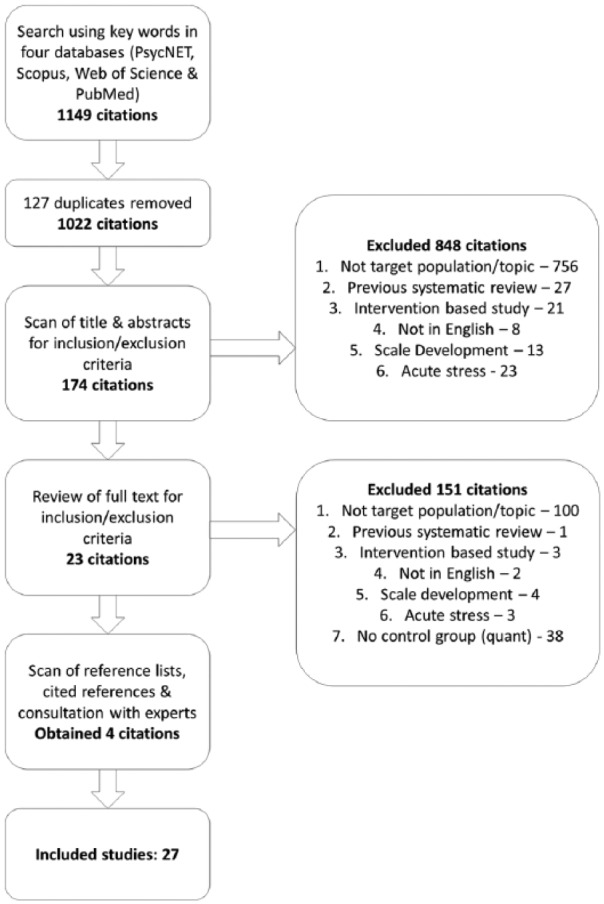
This systematic review assessed coping and adjustment in caregivers of all ages to provide a synthesis of existing literature in the context of methodological approaches and underlying theory. Four databases were searched. Reference lists, citations and experts were consulted. In total, 27 studies (13 quantitative and 14 qualitative) were included. Coping factors associated with adjustment (problem- versus emotion-focussed coping and cognitive strategies) and psychosocial factors associated with physiological adjustment (trait anxiety, coping style and social support) were identified. Results raised methodological issues. Future research requires physiological adjustment measures and longitudinal assessment of the long-term impact of childhood caregiving. Findings inform future caregiver research and interventions.
Overview
The claims and statistics of this paper haven’t been checked yet.
Free: it reads the open-access text and checks the first 5 claims that cite a source we can check. Create a free account to check every claim.
Integrity signals
Registry
Cites
Statistics
Figures
Verification
Claims the paper makes
The claims and statistics of this paper haven’t been checked yet.
Free: it reads the open-access text and checks the first 5 claims that cite a source we can check. Create a free account to check every claim.
Claims other papers make about this one
Each is checked against this paper’s own text: does it say what the citing paper says it does?
The source backs part of the claim, not all of it — or backs it for a different population, condition or comparison.
In the citing paper
“Although problem-focused coping is generally considered more beneficial and is associated with improved outcomes, such as reduced caregiver distress and enhanced quality of life, emotion-focused coping remains commonly utilized in many situations [25,57].”
From Coping strategies among family caregivers of community-dwelling older adults in Lebanon amid the economic crisis (2026) · cites this paper as [57]
Experimental — accuracy not yet measuredThe source backs part of the claim, not all of it — or backs it for a different population, condition or comparison.
In the citing paper
“Social support is widely recognized as a protective factor that correlates with positive outcomes, enhances health, and reduces psychological distress among caregivers [57].”
From Coping strategies among family caregivers of community-dwelling older adults in Lebanon amid the economic crisis (2026) · cites this paper as [57]
Experimental — accuracy not yet measuredThe cited source says what the claim attributes to it.
In the citing paper
“Although problem-focused coping is generally considered more beneficial and is associated with improved outcomes, such as reduced caregiver distress and enhanced quality of life, emotion-focused coping remains commonly utilized in many situations [25,57].”
From Coping strategies among family caregivers of community-dwelling older adults in Lebanon amid the economic crisis (2026) · cites this paper as [57]
The cited source says what the claim attributes to it.
In the citing paper
“This finding aligns with the dynamic nature of coping, whereby caregivers continually adjust their strategies based on evolving demands and individual circumstances [57].”
From Coping strategies among family caregivers of community-dwelling older adults in Lebanon amid the economic crisis (2026) · cites this paper as [57]
Self-check
Percentages, sums and reported differences re-computed from the paper’s own numbers.
The self-check needs the paper’s full text.
Citations
Cites
Using thematic analysis in psychology
Braun, V., & Clarke, V. (2006) · Qualitative Research in Psychology · doi:10.1191/1478088706qp063oa · Cited by 194,414 · cited 1×
“Findings from the 27 papers were synthesised using thematic analysis (Braun and Clarke, 2006).”
MethodEysenck, H. J. (1985) · Behaviour Research and Therapy · doi:10.1016/0005-7967(85)90087-7 · Cited by 31,975
Assessing coping strategies: A theoretically based approach.
Carver, C. S., Scheier, M. F., & Weintraub, J. K. (1989) · Journal of Personality and Social Psychology · doi:10.1037/0022-3514.56.2.267 · Cited by 11,507 · cited 1×
“Others have incorporated multi-dimensional approaches and highlight that the effectiveness of strategies may vary depending on the situation and stressor encountered (Carver et al., 1989).”
BackgroundStress, adaptation, and disease. Allostasis and allostatic load
McEWEN, B. S. (1998) · Annals of the New York Academy of Sciences · doi:10.1111/j.1749-6632.1998.tb09546.x · Cited by 5,092 · cited 1×
“At a physiological level, the concepts of allostasis and allostatic load are a well-accepted explanation for adjustment in underlying mechanisms resulting in differential health outcomes (McEwen, 1998; Sterling and Eyer, 1988).”
BackgroundPinquart, M., & Sörensen, S. (2003) · Psychology and Aging · doi:10.1037/0882-7974.18.2.250 · Cited by 2,857 · cited 1×
“Compared to non-caregivers, older adult carers report increased stress and depression, as well as lower levels of subjective well-being and self-efficacy (Pinquart and Sörensen, 2003; Revenson et al., 2016).”
BackgroundHandbook of Life Stress, Cognition and Health
PASTOR, L. H. (1989) · American Journal of Psychiatry · doi:10.1176/ajp.146.10.1347 · Cited by 1,404
Handbook of Coping: Theory, Research, Applications
Geller, J. L., & Herzog, A. (1997) · Psychiatric Services · doi:10.1176/ps.48.9.1213 · Cited by 1,120
Burnout, Perceived Stress, and Cortisol Responses to Awakening
Pruessner, J. C., Hellhammer, D. H., & Kirschbaum, C. (1999) · Psychosomatic Medicine · doi:10.1097/00006842-199903000-00012 · Cited by 822
Positive aspects of caregiving: rounding out the caregiver experience
Cohen, C. A., Colantonio, A., & Vernich, L. (2002) · International Journal of Geriatric Psychiatry · doi:10.1002/gps.561 · Cited by 689 · cited 1×
“While findings indicate the psychological and physical detriments of caregiving, many caregivers cope effectively without evidence of negative impacts (Cohen et al., 2002; Garity, 1997).”
BackgroundAranda, M. P., & Knight, B. G. (1997) · The Gerontologist · doi:10.1093/geront/37.3.342 · Cited by 595
Haley, W. E., Levine, E. G., Brown, S. L., & Bartolucci, A. A. (1987) · Psychology and Aging · doi:10.1037//0882-7974.2.4.323 · Cited by 588
Chronic stress in elderly carers of dementia patients and antibody response to influenza vaccination
Vedhara, K., Cox, N. K., Wilcock, G. K., Perks, P., Hunt, M., Anderson, S., Lightman, S. L., & Shanks, N. M. (1999) · The Lancet · doi:10.1016/s0140-6736(98)06098-x · Cited by 496
Haley, W. E., Roth, D. L., Coleton, M. I., Ford, G. R., West, C. A. C., Colllins, R. P., & Isobe, T. L. (1996) · Journal of Consulting and Clinical Psychology · doi:10.1037/0022-006x.64.1.121 · Cited by 444 · cited 3×
“High levels of social support correlated with higher positive outcomes, less distress and better health in caregivers (Haley et al., 1996; Pakenham and Bursnall, 2006).”
The impact of stroke on informal carers: a literature review
Low, J. T. S., Payne, S., & Roderick, P. (1999) · Social Science & Medicine · doi:10.1016/s0277-9536(99)00194-x · Cited by 275 · cited 1×
“Reviews that have considered coping and adjustment in caregivers are now outdated (Low et al., 1999) or focus on specific caregiving populations (e.”
BackgroundKnight, B. G., Silverstein, M., McCallum, T. J., & Fox, L. S. (2000) · The Journals of Gerontology Series B: Psychological Sciences and Social Sciences · doi:10.1093/geronb/55.3.p142 · Cited by 255 · cited 1×
“Of the 14 qualitative studies, 6 referenced theory, most often the ABCX Model of Family Adaptation (McCubbin and Patterson, 1983) and Stress Coping Frameworks (Knight et al., 2000; Lazarus and Folkman, 1984).”
Li, Q., & Loke, A. Y. (2013) · Psycho-Oncology · doi:10.1002/pon.3311 · Cited by 215 · cited 1×
“Positive consequences have been identified; spousal caregivers of cancer patients have reported enhanced relationships, feeling rewarded, experiencing a sense of personal growth and satisfaction (Li and Loke, 2013).”
BackgroundChronic Illness: Impact and Intervention
Larsen, P. D., & Lubkin, I. M. (2008) · Cited by 211
Caregiving in the Illness Context
Revenson, T. A., Griva, K., Luszczynska, A., Morrison, V., Panagopoulou, E., Vilchinsky, N., & Hagedoorn, M. (2016) · Palgrave Macmillan UK eBooks · doi:10.1057/9781137558985 · Cited by 184 · cited 1×
“Compared to non-caregivers, older adult carers report increased stress and depression, as well as lower levels of subjective well-being and self-efficacy (Pinquart and Sörensen, 2003; Revenson et al., 2016).”
BackgroundPakenham, K. I., Bursnall, S., Chiu, J., Cannon, T., & Okochi, M. (2006) · Rehabilitation Psychology · doi:10.1037/0090-5550.51.2.113 · Cited by 183 · cited 1×
“Carers can be any age (from young child to older adult) and may have various tasks and responsibilities including domestic care, general care, personal/intimate care and emotional support (Pakenham et al., 2006).”
Background‘Your friends don’t understand’: Invisibility and unmet need in the lives of ‘young carers’
Thomas, N., Stainton, T., Jackson, S., Cheung, W. Y., Doubtfire, S., & Webb, A. (2003) · Child & Family Social Work · doi:10.1046/j.1365-2206.2003.00266.x · Cited by 177 · cited 1×
“Although research has identified the potential negative impact of early caregiving (Thomas et al., 2003), not all young carers or children living with ill parents demonstrate these outcomes.”
BackgroundKim, H. W., Greenberg, J. S., Seltzer, M. M., & Krauss, M. W. (2003) · Journal of Intellectual Disability Research · doi:10.1046/j.1365-2788.2003.00493.x · Cited by 172 · cited 3×
“The first, a quantitative study (Kim et al., 2003) provided predictive data regarding problem- and emotion-focussed coping in mothers caring for an adult child.”
InfluentialImpact of caregiving: listening to the voice of informal caregivers
Sawatzky, J. E., & Fowler‐Kerry, S. (2003) · Journal of Psychiatric and Mental Health Nursing · doi:10.1046/j.1365-2850.2003.00601.x · Cited by 169
Ruiz‐Robledillo, N., Andrés-García, S. D., Pérez‐Blasco, J., González‐Bono, E., & Moya‐Albiol, L. (2014) · Research in Developmental Disabilities · doi:10.1016/j.ridd.2013.12.007 · Cited by 146 · cited 2×
“Some studies reported specific factors that are positively associated with better self-reported health in caregivers, and these included increased use of problem-solving coping and higher resilience (Figueiredo et al., 2014; Ruiz-Robledillo et al., 2014).”
BackgroundA Comparison of Psychosocial Outcomes in Elderly Alzheimer Caregivers and Noncaregivers
Mausbach, B. T., Chattillion, E. A., Roepke, S. K., Patterson, T. L., & Grant, I. (2013) · The American Journal of Geriatric Psychiatry · doi:10.1016/j.jagp.2012.10.001 · Cited by 142 · cited 1×
“Caregivers reported using fewer positive strategies and relied less on problem-focussed coping than non-caregivers (Mausbach et al., 2013; Pakenham and Bursnall, 2006).”
BackgroundThe psychosocial, endocrine and immune consequences of caring for a child with autism or ADHD
Lovell, B., Moss, M. C., & Wetherell, M. A. (2011) · Psychoneuroendocrinology · doi:10.1016/j.psyneuen.2011.08.003 · Cited by 137 · cited 1×
“Lovell et al. (2012) investigated psychosocial, endocrine and immune outcomes in young adults caring for a child with autism spectrum disorder or attention-deficit hyperactivity disorder.”
Positive Meaningful Events and Coping in the Context of HIV/AIDS
Folkman, S., Moskowitz, J. T., Ozer, E. M., & Park, C. L. (1997) · Springer eBooks · doi:10.1007/978-1-4757-9862-3_11 · Cited by 135 · cited 2×
“spouses of individuals with an illness or children living with parental illness) rather than identifying individuals as caregivers per se (Folkman et al., 1997; Westbom, 1992).”
Pakenham, K. I., & Bursnall, S. (2006) · Clinical Rehabilitation · doi:10.1191/0269215506cre976oa · Cited by 115 · cited 4×
“High levels of social support correlated with higher positive outcomes, less distress and better health in caregivers (Haley et al., 1996; Pakenham and Bursnall, 2006).”
BackgroundInfluentialApplication of a stress and coping model to caregiving in multiple sclerosis
Pakenham, K. I. (2001) · Psychology, Health and Medicine · doi:10.1080/13548500020021883 · Cited by 115
Chronic stress in nonelderly caregivers
Vedhara, K., McDermott, M., Evans, T. G., Treanor, J. J., Plummer, S., Tallon, D., Cruttenden, K., & Schifitto, G. (2002) · Journal of Psychosomatic Research · doi:10.1016/s0022-3999(02)00343-4 · Cited by 110 · cited 1×
“Since the immune system naturally deteriorates with age (termed immunosenescence), the impact of stress may be greater or more pronounced in older individuals (Vedhara et al., 2002).”
Background(1923) · BMJ · doi:10.1136/bmj.2.3285.1167 · Cited by 108
Sun, F. (2014) · Dementia · doi:10.1177/1471301213485593 · Cited by 104 · cited 2×
“Some of these strategies were actions the caregiver took to reduce their burden (reducing work hours, using paid carers, accepting financial hardship, integrating care into family culture, daily routines, incorporating risk management into daily life, utilising social support and effectively planning activities and ca…”
BackgroundSocial Stress and the Family: Advances and Developments in Family Stress Theory and Research.
Wolf, C., McCubbin, H. I., Sussman, M. B., & Patterson, J. M. (1984) · Contemporary Sociology A Journal of Reviews · doi:10.2307/2067613 · Cited by 103
Gallagher, S., Phillips, A. C., Drayson, M. T., & Carroll, D. (2009) · Brain, Behavior, and Immunity · doi:10.1016/j.bbi.2008.05.006 · Cited by 99 · cited 1×
“, 1999), and young parents caring for a child with developmental disabilities have demonstrated a poorer antibody response to influenza vaccination (Gallagher et al., 2009).”
BackgroundPredictors of psychological health in caregivers of patients with closed head injury
Sander, A. M., High Jr, W. M., Hannay, H. J., & Sherer, M. (1997) · Brain Injury · doi:10.1080/026990597123548 · Cited by 96
Young Carers in Australia:Understanding the Advantages and Disadvantages of Their Care GivingPreprint
Cass, B., Smith, C., Hill, T., Blaxland, M., & Hamilton, M. (2010) · SSRN Electronic Journal · doi:10.2139/ssrn.1703262 · Cited by 92 · cited 1×
“Young carers report feeling proud of their role, the development of valuable skills and increased maturity and independence (Cass et al., 2009).”
Journal of Intellectual Disability Research
(1998) · Journal of Intellectual Disability Research · doi:10.1046/j.1365-2788.1998.00140.x · Cited by 88
Laisné, F., Lecomte, C., & Corbière, M. (2012) · Disability and Rehabilitation · doi:10.3109/09638288.2012.729362 · Cited by 77
Barbosa, A., Figueiredo, D., Sousa, L., & Demain, S. (2011) · Aging & Mental Health · doi:10.1080/13607863.2010.543660 · Cited by 72 · cited 1×
“Despite this, the included studies were carried out in a range of countries, including the United Kingdom, United States, Portugal and Korea (Bachanas et al., 2001; Barbosa et al., 2011; Dickson et al., 2012; Kim and Knight, 2008), reducing the likelihood of cultural bias.”
BackgroundCaregivers’ support needs and factors promoting resiliency after brain injury
Kitter, B., & Sharman, R. R. (2015) · Brain Injury · doi:10.3109/02699052.2015.1018323 · Cited by 71 · cited 1×
“Some cognitive strategies involved perceptions of the caregiver role, and caregivers reported that valuing their role, retaining autonomy, identifying benefits and finding meaning in their experiences helped them adjust to their situation (Kitter and Sharman, 2015; Thornton and Hopp, 2011; Zegwaard et al., 2013).”
BackgroundCoping and subjective burden in caregivers of older relatives: a quantitative systematic review
del-Pino-Casado, R., Frías-Osuna, A., Palomino-Moral, P. A., & Pancorbo-Hidalgo, P. L. (2011) · Journal of Advanced Nursing · doi:10.1111/j.1365-2648.2011.05725.x · Cited by 70 · cited 1×
“, 1999) or focus on specific caregiving populations (e.g. stroke caregivers; Del-Pino-Casado et al., 2011).”
BackgroundThe Parentified Child: Early Competence or Childhood Deprivation?
Barnett, B., & Parker, G. (1998) · Child Psychology and Psychiatry Review · doi:10.1017/s1360641798001695 · Cited by 69
Stress, learning style, resilience factors, and ways of coping in Alzheimer family caregivers
Garity, J. (1997) · American Journal of Alzheimer's Disease · doi:10.1177/153331759701200405 · Cited by 67 · cited 1×
“While findings indicate the psychological and physical detriments of caregiving, many caregivers cope effectively without evidence of negative impacts (Cohen et al., 2002; Garity, 1997).”
BackgroundCaregiver coping with the mentally ill: a qualitative study
Azman, A., Jamir Singh, P. S., & Sulaiman, J. (2017) · Journal of Mental Health · doi:10.3109/09638237.2015.1124395 · Cited by 64 · cited 3×
“spirituality enabling them to cope with their caregiving responsibilities; having strong religious convictions enabled better stress management (Azman et al., 2017).”
BackgroundKim, J.-H., & Knight, B. G. (2008) · The Gerontologist · doi:10.1093/geront/48.3.287 · Cited by 63 · cited 4×
“Higher cortisol and blood pressure were reported in caregivers compared to non-caregivers (Kim and Knight, 2008; Ruiz-Robledillo and Moya-Albiol, 2013).”
InfluentialExploring caregiving experiences: caregiver coping and making sense of illness
Williams, K. L., Morrison, V., & Robinson, C. A. (2014) · Aging & Mental Health · doi:10.1080/13607863.2013.860425 · Cited by 61 · cited 6×
“In addition, caregivers reported making downward comparisons to others in similar circumstances, as well as considering themselves more fortunate and comparing their resources to others to feel efficient and capable (Williams et al., 2014).”
BackgroundInfluentialMerritt, M. M., & McCallum, T. J. (2013) · The American Journal of Geriatric Psychiatry · doi:10.1016/j.jagp.2012.10.006 · Cited by 60
Sandstedt, P., Littorin, S., Widsell, G. C., Johansson, S., Gottberg, K., Ytterberg, C., Olsson, M., Holmqvist, L. W., & Kierkegaard, M. (2018) · Journal of Clinical Nursing · doi:10.1111/jocn.14593 · Cited by 60 · cited 1×
“Furthermore, informal caregivers of patients with amyotrophic lateral sclerosis report both positive and negative experiences (Sandstedt et al., 2018).”
BackgroundDickson, A., O’Brien, G., Ward, R., Flowers, P., Allan, D., & O’Carroll, R. E. (2011) · Journal of Health Psychology · doi:10.1177/1359105311411115 · Cited by 55 · cited 4×
“Despite this, the included studies were carried out in a range of countries, including the United Kingdom, United States, Portugal and Korea (Bachanas et al., 2001; Barbosa et al., 2011; Dickson et al., 2012; Kim and Knight, 2008), reducing the likelihood of cultural bias.”
BackgroundInfluentialRuiz-Robledillo, N., & Moya-Albiol, L. (2013) · Psychology & Health · doi:10.1080/08870446.2013.800517 · Cited by 53 · cited 3×
“Higher cortisol and blood pressure were reported in caregivers compared to non-caregivers (Kim and Knight, 2008; Ruiz-Robledillo and Moya-Albiol, 2013).”
BackgroundBachanas, P. J. (2001) · Journal of Pediatric Psychology · doi:10.1093/jpepsy/26.6.331 · Cited by 48 · cited 2×
“Despite this, the included studies were carried out in a range of countries, including the United Kingdom, United States, Portugal and Korea (Bachanas et al., 2001; Barbosa et al., 2011; Dickson et al., 2012; Kim and Knight, 2008), reducing the likelihood of cultural bias.”
Backgroundde Figueiredo, D. M. P., Gabriel, R., Jácome, C. I. O., & Marques, A. S. P. D. D. (2013) · Journal of Clinical Nursing · doi:10.1111/jocn.12363 · Cited by 45 · cited 2×
“Some studies reported specific factors that are positively associated with better self-reported health in caregivers, and these included increased use of problem-solving coping and higher resilience (Figueiredo et al., 2014; Ruiz-Robledillo et al., 2014).”
BackgroundHard Lives, God’s Help, and Struggling Through: Caregiving in Arkansas Delta
Gerdner, L. A., Tripp‐Reimer, T., & Simpson, H. C. (2007) · Journal of Cross-Cultural Gerontology · doi:10.1007/s10823-007-9047-1 · Cited by 38 · cited 3×
“Practical support in the form of physical care often came from friends or family members, such as adult children (Gerdner et al., 2007; Kaplan, 2010).”
BackgroundZegwaard, M. I., Aartsen, M., Grypdonck, M. H. F., & Cuijpers, P. J. (2013) · BMC Psychiatry · doi:10.1186/1471-244x-13-103 · Cited by 37 · cited 3×
“In particular, taking a gain rather than a loss mentality was deemed helpful by those who chose to perceive their caregiving as a choice and voluntary act of compassion, rather than as a forced obligation (Zegwaard et al., 2013).”
BackgroundAfrican American and White Female Caregivers and the Sociocultural Stress and Coping Model
McCallum, T., Longmire, C. F., & Knight, B. G. (2007) · Clinical Gerontologist · doi:10.1300/j018v30n04_02 · Cited by 32
“So I Just Took Over”: African American Daughters Caregiving for Parents with Heart Failure
Thornton, N., & Hopp, F. P. (2011) · Families in Society The Journal of Contemporary Social Services · doi:10.1606/1044-3894.4103 · Cited by 31 · cited 2×
“…strategies involved perceptions of the caregiver role, and caregivers reported that valuing their role, retaining autonomy, identifying benefits and finding meaning in their experiences helped them adjust to their situation (Kitter and Sharman, 2015; Thornton and Hopp, 2011; Zegwaard et al., 2013).”
Dorze, G. L., Tremblay, V., & Croteau, C. (2008) · Aphasiology · doi:10.1080/02687030801890909 · Cited by 27
Kurz, J. M., & Cavanaugh, J. C. (2001) · Families Systems & Health · doi:10.1037/h0089448 · Cited by 26 · cited 7×
“Consistent positive social interaction which enabled individuals to feel supported in terms of their emotions and self-esteem was also deemed important for adjustment and promoted resilience (Kaplan, 2010; McCausland Kurz and Cavanaugh, 2001; Ruiz-Robledillo et al., 2014).”
InfluentialCaregiving mothers of children with impairments: coping and support in Russia
Kaplan, R. L. (2010) · Disability & Society · doi:10.1080/09687599.2010.505747 · Cited by 25 · cited 2×
“Practical support in the form of physical care often came from friends or family members, such as adult children (Gerdner et al., 2007; Kaplan, 2010).”
BackgroundWestbom, L. (1992) · Scandinavian Journal of Primary Health Care · doi:10.3109/02813439209014042 · Cited by 24 · cited 1×
“spouses of individuals with an illness or children living with parental illness) rather than identifying individuals as caregivers per se (Folkman et al., 1997; Westbom, 1992).”
BackgroundKita, M., & Ito, K. (2012) · International Journal of Older People Nursing · doi:10.1111/j.1748-3743.2012.00337.x · Cited by 24
Beck, L. (2007) · Health Psychology Review · doi:10.1080/17437190802217246 · Cited by 22 · cited 1×
“Caregivers highlighted that sharing their experiences and information with other carers was useful, confirming the protective nature of social support against social judgement and perceived stress (Beck, 2007).”
BackgroundLiving With Dementia: An Exploratory Study of Caregiving in a Chinese Family Context
Wong, O. L., Kwong, P. S., Ho, C. K. Y., Chow, S. M. Y., Kwok, T. C. Y., Wong, B., Ho, V., Lau, A., & Ho, F. (2015) · Social Work in Health Care · doi:10.1080/00981389.2015.1057355 · Cited by 19
Adjustment in patients with rheumatoid arthritis and their children.
Turner‐Cobb, J. M., Steptoe, A., Perry, L. A., & Axford, J. S. (1998) · PubMed · Cited by 19
Self-citationLife of the Second-Order Patient: Factors Impacting the Informal Caregiver
Matthews, B. L. (2018) · Journal of Loss and Trauma · doi:10.1080/15325024.2017.1419800 · Cited by 14 · cited 1×
“Providing informal care can impact social activities and marital dynamics in adult caregivers (Matthews, 2018).”
BackgroundLong-Term Management of Dementia
(2016) · CRC Press eBooks · doi:10.3109/9781420020250 · Cited by 8
Simon, C., & Slatcher, C. (2011) · InnovAiT Education and inspiration for general practice · doi:10.1093/innovait/inr040 · Cited by 7
Caring for the Family Caregiver
Schubart, J. R. (2014) · Wiley eBooks · doi:10.1002/9781118453940.ch43 · Cited by 4
Skinner, E. A. (2001) · Cambridge University Press eBooks · doi:10.1017/cbo9780511543579.054 · Cited by 3
Research works printed but not linked: 5
- *Bailey SJ Letiecq BL Erickson M et al (2013) Resilient grandparent caregivers: Pathways to positive adaptation. In: Hayslip B Smith GC (eds) Resilient Grandparent Caregivers: A Strengths-based Perspective. New York: Routledge, pp. 70– 87.
- Becker S Dearden C Aldridge J et al (2000) Young carers in the UK: Research, policy and practice. Research, Policy and Planning 8(2): 13– 22.
- Branscum AY (2011) Stress and coping model for family caregivers of older adults. Dissertation Abstracts International Section A: Humanities and Social Sciences 71(9–A): 3378.
- Kmet LM Lee RC Cook LS (2004) Standard Quality Assessment Criteria for Evaluating Primary Research from a Variety of Fields. AHFMR – HTA Initiative #13, February. Edmonton, AB, Canada: Alberta Heritage Foundaalberta Heritage Foundation for Medical Research (AHFMR), pp. 1– 28.
- Skinner EA (2007) Coping assessment. In: Cambridge Handbook of Psychology, Health and Medicine (2nd edn), pp. 245– 250.
Cited by
Yan, L., Gan, Y., Ding, X., Wu, J., & Duan, H. (2021) · Journal of Anxiety Disorders · doi:10.1016/j.janxdis.2020.102328 · Cited by 236
Xu, L., Liu, Y., He, H., Fields, N. L., Ivey, D. L., & Kan, C. (2021) · Archives of Gerontology and Geriatrics · doi:10.1016/j.archger.2020.104334 · Cited by 97
Resilience in Familial Caregivers of Children with Developmental Disabilities: A Meta-analysis
Iacob, C. I., Avram, E., Cojocaru, D., & Podina, I. R. (2020) · Journal of Autism and Developmental Disorders · doi:10.1007/s10803-020-04473-9 · Cited by 101
Lifetime and perceived stress, social support, loneliness, and health in autistic adults.
Moseley, R. L., Turner-Cobb, J. M., Spahr, C. M., Shields, G. S., & Slavich, G. M. (2021) · Health Psychology · doi:10.1037/hea0001108 · Cited by 71
“, 2019), with role change/disruption stressors such as caregiving responsibilities, in particular, being extensively linked with physical morbidity (Hawken et al., 2018).”
BackgroundSelf-citationParents’ Experience and Psychoeducation Needs When Supporting a Young Person Who Self-Harms
Krysinska, K. E., Curtis, S., Lamblin, M., Stefanac, N., Gibson, K. L., Byrne, S. J., Thorn, P., Rice, S., McRoberts, A., Ferrey, A. E., et al. (2020) · International Journal of Environmental Research and Public Health · doi:10.3390/ijerph17103662 · Cited by 52
“However, other research has found that more active and/or positive coping strategies, such as seeking support, are related to better mental health outcomes across diverse populations of carers [44,46,47].”
Background
Metadata
- Authors
- Hawken, T., Turner-Cobb, J., & Barnett, J.
- Affiliations
- University of Bath (GB)
- Bournemouth University, UK
- Corresponding author
- Hawken, Tamsyn
- ORCID
- Barnett, Julie
- Venue
- Health Psychology Open
- Publisher
- SAGE Publications
- Published
- 2018-07
- Volume
- 5
- Issue
- 2
- Pages
- 2055102918810659-2055102918810659
- ISSN
- 2055-1029 (ISSN-L)
- PMC
- PMC6236498
- OpenAlex
- W2900018116
- Cited by
- 128
- References
- 68
- Citations by year
- 2026: 19 · 2025: 20 · 2024: 21 · 2023: 17 · 2022: 24 · 2021: 12 · 2020: 12 · 2019: 3
- FWCI
- 1.67
- Type
- journal article
- Language
- en
- Open access
- gold
- doi.org
- Licence
- cc-by-nc
- journals.sagepub.com/page/policies/text-and-data-mining-license (tdm)
- Locations
- Health Psychology Open (publishedVersion, cc-by-nc)
- Europe PMC (PubMed Central) (publishedVersion, cc-by-nc)
- PubMed Central (publishedVersion, cc-by-nc)
- PubMed (publishedVersion)
- Bournemouth University Research Online (Bournemouth University) (submittedVersion)
- DOAJ (DOAJ: Directory of Open Access Journals) (submittedVersion, cc-by-sa)
- Funders
- Economic and Social Research Council
- Topics
- Health Sciences › Nursing › Research and Theory › Nursing care and research
- Social Sciences › Psychology › Clinical Psychology › Grief, Bereavement, and Mental Health
- Social Sciences › Psychology › Clinical Psychology › Family and Disability Support Research
- Keywords
- caregiver coping, caregiver adaptation, problem-focused coping, emotion-focused coping, cognitive coping, trait anxiety, coping styles, social support, physiological adaptation, childhood caregiving, caregiver interventions
About these checks
Registry, retraction, Cites and statistics results are computed, not judged, with one exception: a printed reference that no index lists is read once by a model before it counts as a citation error. Claims are extracted by a model and kept only when their quote appears verbatim in the text; each cited source is then checked, with a model’s help, for whether it says what the claim relies on. Those verdicts can be wrong — read the claim’s quote and the cited source before relying on one.
Statistics and arithmetic are recomputed, not judged.
Confidence bands are shown only for fields calibrated on our annotated test set. None is calibrated yet, so no band is shown.
What counts as a claim ›How we measure confidence ›How we check this ›
Are you an author, or do you see a problem with this page? Request a review
Data sources
Bibliographic data: Semantic Scholar, OpenAlex, Crossref.
Contains information from the Semantic Scholar Academic Graph Datasets, made available under the ODC Attribution License (ODC-BY 1.0).
Semantic Scholar’s data is described in: Kinney, R., et al. (2023). The Semantic Scholar Open Data Platform. arXiv:2301.10140.
