

Coping and adjustment in caregivers: A systematic review
Open accessThe DOI matches its Crossref record; 68 of the 68 references it cites were found in a registry or an index.
Abstract
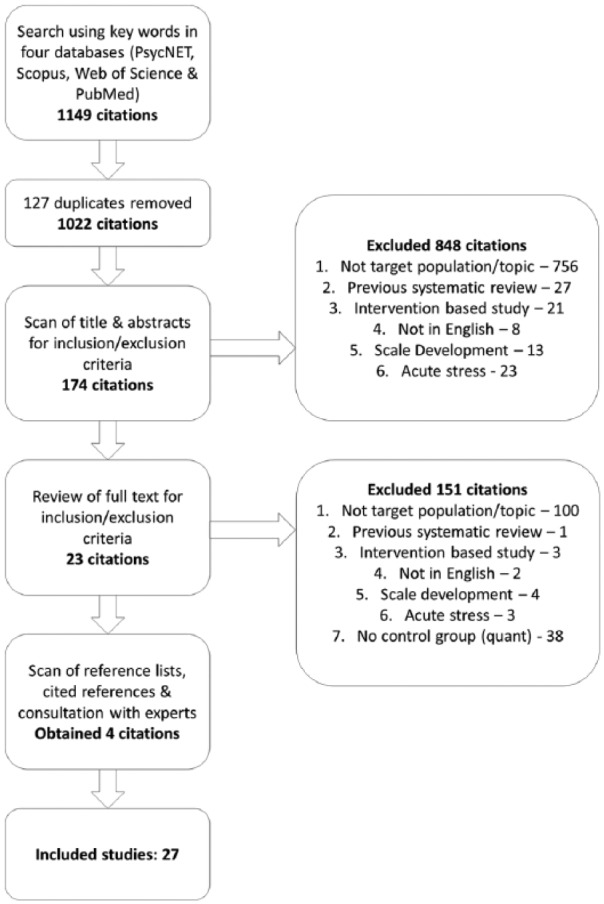
This systematic review assessed coping and adjustment in caregivers of all ages to provide a synthesis of existing literature in the context of methodological approaches and underlying theory. Four databases were searched. Reference lists, citations and experts were consulted. In total, 27 studies (13 quantitative and 14 qualitative) were included. Coping factors associated with adjustment (problem- versus emotion-focussed coping and cognitive strategies) and psychosocial factors associated with physiological adjustment (trait anxiety, coping style and social support) were identified. Results raised methodological issues. Future research requires physiological adjustment measures and longitudinal assessment of the long-term impact of childhood caregiving. Findings inform future caregiver research and interventions.
Overview
The claims and statistics of this paper haven’t been checked yet.
Free: it reads the open-access text and checks the first 5 claims that cite a source we can check. Create a free account to check every claim.
Integrity signals
Registry
Cites
Statistics
Figures
Verification
Claims the paper makes
The claims and statistics of this paper haven’t been checked yet.
Free: it reads the open-access text and checks the first 5 claims that cite a source we can check. Create a free account to check every claim.
Claims other papers make about this one
Each is checked against this paper’s own text: does it say what the citing paper says it does?
The source backs part of the claim, not all of it — or backs it for a different population, condition or comparison.
In the citing paper
“Although problem-focused coping is generally considered more beneficial and is associated with improved outcomes, such as reduced caregiver distress and enhanced quality of life, emotion-focused coping remains commonly utilized in many situations [25,57].”
From Coping strategies among family caregivers of community-dwelling older adults in Lebanon amid the economic crisis (2026) · cites this paper as [57]
Experimental — accuracy not yet measuredThe source backs part of the claim, not all of it — or backs it for a different population, condition or comparison.
In the citing paper
“Social support is widely recognized as a protective factor that correlates with positive outcomes, enhances health, and reduces psychological distress among caregivers [57].”
From Coping strategies among family caregivers of community-dwelling older adults in Lebanon amid the economic crisis (2026) · cites this paper as [57]
Experimental — accuracy not yet measuredThe cited source says what the claim attributes to it.
In the citing paper
“Although problem-focused coping is generally considered more beneficial and is associated with improved outcomes, such as reduced caregiver distress and enhanced quality of life, emotion-focused coping remains commonly utilized in many situations [25,57].”
From Coping strategies among family caregivers of community-dwelling older adults in Lebanon amid the economic crisis (2026) · cites this paper as [57]
The cited source says what the claim attributes to it.
In the citing paper
“This finding aligns with the dynamic nature of coping, whereby caregivers continually adjust their strategies based on evolving demands and individual circumstances [57].”
From Coping strategies among family caregivers of community-dwelling older adults in Lebanon amid the economic crisis (2026) · cites this paper as [57]
Self-check
Percentages, sums and reported differences re-computed from the paper’s own numbers.
The self-check needs the paper’s full text.
Citations
Cites
Using thematic analysis in psychology
Braun, V., & Clarke, V. (2006) · Qualitative Research in Psychology · doi:10.1191/1478088706qp063oa · Cited by 194,414 · cited 1×
“Findings from the 27 papers were synthesised using thematic analysis (Braun and Clarke, 2006).”
MethodEysenck, H. J. (1985) · Behaviour Research and Therapy · doi:10.1016/0005-7967(85)90087-7 · Cited by 31,975
Assessing coping strategies: A theoretically based approach.
Carver, C. S., Scheier, M. F., & Weintraub, J. K. (1989) · Journal of Personality and Social Psychology · doi:10.1037/0022-3514.56.2.267 · Cited by 11,507 · cited 1×
“Others have incorporated multi-dimensional approaches and highlight that the effectiveness of strategies may vary depending on the situation and stressor encountered (Carver et al., 1989).”
BackgroundStress, adaptation, and disease. Allostasis and allostatic load
McEWEN, B. S. (1998) · Annals of the New York Academy of Sciences · doi:10.1111/j.1749-6632.1998.tb09546.x · Cited by 5,092 · cited 1×
“At a physiological level, the concepts of allostasis and allostatic load are a well-accepted explanation for adjustment in underlying mechanisms resulting in differential health outcomes (McEwen, 1998; Sterling and Eyer, 1988).”
BackgroundPinquart, M., & Sörensen, S. (2003) · Psychology and Aging · doi:10.1037/0882-7974.18.2.250 · Cited by 2,857 · cited 1×
“Compared to non-caregivers, older adult carers report increased stress and depression, as well as lower levels of subjective well-being and self-efficacy (Pinquart and Sörensen, 2003; Revenson et al., 2016).”
BackgroundHandbook of Life Stress, Cognition and Health
PASTOR, L. H. (1989) · American Journal of Psychiatry · doi:10.1176/ajp.146.10.1347 · Cited by 1,404
Handbook of Coping: Theory, Research, Applications
Geller, J. L., & Herzog, A. (1997) · Psychiatric Services · doi:10.1176/ps.48.9.1213 · Cited by 1,120
Burnout, Perceived Stress, and Cortisol Responses to Awakening
Pruessner, J. C., Hellhammer, D. H., & Kirschbaum, C. (1999) · Psychosomatic Medicine · doi:10.1097/00006842-199903000-00012 · Cited by 822
Positive aspects of caregiving: rounding out the caregiver experience
Cohen, C. A., Colantonio, A., & Vernich, L. (2002) · International Journal of Geriatric Psychiatry · doi:10.1002/gps.561 · Cited by 689 · cited 1×
“While findings indicate the psychological and physical detriments of caregiving, many caregivers cope effectively without evidence of negative impacts (Cohen et al., 2002; Garity, 1997).”
BackgroundAranda, M. P., & Knight, B. G. (1997) · The Gerontologist · doi:10.1093/geront/37.3.342 · Cited by 595
Research works printed but not linked: 5
- *Bailey SJ Letiecq BL Erickson M et al (2013) Resilient grandparent caregivers: Pathways to positive adaptation. In: Hayslip B Smith GC (eds) Resilient Grandparent Caregivers: A Strengths-based Perspective. New York: Routledge, pp. 70– 87.
- Becker S Dearden C Aldridge J et al (2000) Young carers in the UK: Research, policy and practice. Research, Policy and Planning 8(2): 13– 22.
- Branscum AY (2011) Stress and coping model for family caregivers of older adults. Dissertation Abstracts International Section A: Humanities and Social Sciences 71(9–A): 3378.
- Kmet LM Lee RC Cook LS (2004) Standard Quality Assessment Criteria for Evaluating Primary Research from a Variety of Fields. AHFMR – HTA Initiative #13, February. Edmonton, AB, Canada: Alberta Heritage Foundaalberta Heritage Foundation for Medical Research (AHFMR), pp. 1– 28.
- Skinner EA (2007) Coping assessment. In: Cambridge Handbook of Psychology, Health and Medicine (2nd edn), pp. 245– 250.
Cited by
Yan, L., Gan, Y., Ding, X., Wu, J., & Duan, H. (2021) · Journal of Anxiety Disorders · doi:10.1016/j.janxdis.2020.102328 · Cited by 236
Xu, L., Liu, Y., He, H., Fields, N. L., Ivey, D. L., & Kan, C. (2021) · Archives of Gerontology and Geriatrics · doi:10.1016/j.archger.2020.104334 · Cited by 97
Resilience in Familial Caregivers of Children with Developmental Disabilities: A Meta-analysis
Iacob, C. I., Avram, E., Cojocaru, D., & Podina, I. R. (2020) · Journal of Autism and Developmental Disorders · doi:10.1007/s10803-020-04473-9 · Cited by 101
Lifetime and perceived stress, social support, loneliness, and health in autistic adults.
Moseley, R. L., Turner-Cobb, J. M., Spahr, C. M., Shields, G. S., & Slavich, G. M. (2021) · Health Psychology · doi:10.1037/hea0001108 · Cited by 71
“, 2019), with role change/disruption stressors such as caregiving responsibilities, in particular, being extensively linked with physical morbidity (Hawken et al., 2018).”
BackgroundSelf-citationParents’ Experience and Psychoeducation Needs When Supporting a Young Person Who Self-Harms
Krysinska, K. E., Curtis, S., Lamblin, M., Stefanac, N., Gibson, K. L., Byrne, S. J., Thorn, P., Rice, S., McRoberts, A., Ferrey, A. E., et al. (2020) · International Journal of Environmental Research and Public Health · doi:10.3390/ijerph17103662 · Cited by 52
“However, other research has found that more active and/or positive coping strategies, such as seeking support, are related to better mental health outcomes across diverse populations of carers [44,46,47].”
BackgroundCasaleiro, T., Caldeira, S., Cardoso, D., & Apóstolo, J. (2022) · Journal of Psychiatric and Mental Health Nursing · doi:10.1111/jpm.12816 · Cited by 43
Long, N. X., Ngoc, N. B., Tran, T. P., Linh, D. T. D., Anh, T. N., Hưng, N. V., Thang, N. T., Lan, N. T. M., Trang, V. T., Thương, N. H., et al. (2020) · AIMS Public Health · doi:10.3934/publichealth.2021001 · Cited by 43
“The coping process involves constant adaptations of people in their own circumstances [12,14].”
BackgroundBurden, satisfaction caregiving, and family relations in informal caregivers of older adults
Marinho, J. D. S., Batista, I. B., Nobre, R. A. D. S., Guimarães, M. S. A., Santos-Orlandi, A. A. D., Brito, T. R. P., Pagotto, V., Saidel, M. G. B., Fusco, S. D. F. B., Maia, F. D. O. M., et al. (2022) · Frontiers in Medicine · doi:10.3389/fmed.2022.1059467 · Cited by 39
Yuan, Q., Wang, P., Tan, T. H., Devi, F., Poremski, D., Magadi, H., Goveas, R., Ng, L. L., Chong, S. A., & Subramaniam, M. (2021) · The Gerontologist · doi:10.1093/geront/gnaa080 · Cited by 35
Bassi, M., Cilia, S., Falautano, M., Grobberio, M., Negri, L., Niccolai, C., Pattini, M., Pietrolongo, E., Quartuccio, M. E., Viterbo, R. G., et al. (2019) · Health & Social Care in the Community · doi:10.1111/hsc.12858 · Cited by 35
Cuidado na doença de Parkinson: padrões de resposta do cuidador familiar de idosos1
Nunes, S. F. L., Álvarez, Á. M., Valcarenghi, R. V., & Baptista, R. D. C. (2020) · Saúde e Sociedade · doi:10.1590/s0104-12902020200511 · Cited by 34
Online Educational Tools for Caregivers of People with Dementia: A Scoping Literature Review
Sztramko, R., Levinson, A. J., Wurster, A. E., Jezrawi, R., Sivapathasundaram, B., Παπαϊωάννου, Α., Cowan, D., Onge, J. S., Marr, S., Patterson, C., et al. (2021) · Canadian Geriatrics Journal · doi:10.5770/cgj.24.506 · Cited by 31
“(62) Understanding the relationship between outcomes of cognitive strategies/stress appraisal, caregiver adjustment, social support, and physiological health will help to contribute to the growing area of caregiver research, and with the development of educational interventions with relevant and impactful material.(63…”
BackgroundRosyanti, L., Hadi, I., Antari, I., & Ramlah, S. (2023) · Health Information Jurnal Penelitian · doi:10.36990/hijp.v15i2.1102 · Cited by 30
Spirituality among family caregivers of cancer patients: The Spiritual Perspective Scale
La, I. S., Johantgen, M., Storr, C. L., Cagle, J. G., Zhu, S., & Ross, A. C. (2020) · Research in Nursing & Health · doi:10.1002/nur.22044 · Cited by 29
Coping with Wolf-Hirschhorn syndrome: quality of life and psychosocial features of family carers
Berrocoso, S., Amayra, I., Lázaro, E., Martínez, Ó., Paz, J. F. L., García, M., Pérez, M., Al-Rashaida, M. A. H., Rodríguez, A. A., Luna, P. M., et al. (2020) · Orphanet Journal of Rare Diseases · doi:10.1186/s13023-020-01476-8 · Cited by 28
“As we said before, associating sociodemographic variables with QoL has become increasingly important, which also reflects the impact of the level of education on the total QoL perceived by the individual [50, 86].”
BackgroundShoman, Y., Rousson, V., Bianchi, R., & Canu, I. G. (2022) · International Journal of Environmental Research and Public Health · doi:10.3390/ijerph192013037 · Cited by 28
“One systematic review found that certain coping strategies can reduce stress in health professionals and caregivers [78].”
BackgroundFamily Perspectives on Newborn Screening for X-Linked Adrenoleukodystrophy in California
Schwan, K., Youngblom, J. H., Weisiger, K., Kianmahd, J., Waggoner, R., & Fanos, J. H. (2019) · International Journal of Neonatal Screening · doi:10.3390/ijns5040042 · Cited by 26
“Most hospitals provide chaplains who can engage with patients’ spiritual and religious beliefs [13].”
BackgroundOchoa, C. Y., Miller, K. A., Banegas, M. P., Minarim, D. S., & Chan, R. Y. (2023) · International Journal of Environmental Research and Public Health · doi:10.3390/ijerph20115928 · Cited by 25
“We used the Lazarus and Folkman’s Transactional Model of Stress and Coping framework and previous research to develop our initial codebook [18,19].”
Yuan, Q., Tan, T. H., Wang, P., Poremski, D., Abdin, E., Magadi, H., Goveas, R. R., Ng, L. L., & Subramaniam, M. (2024) · Scientific Reports · doi:10.1038/s41598-024-76339-4 · Cited by 24
“The transactional model of stress and coping 10 is one of the most supported theories for understanding this process 11 .”
BackgroundPromoting resilience among family caregiver of cancer through Islamic religious coping
Saputro, I., Nashori, F., & Sulistyarini, I. (2021) · Indigenous Jurnal Ilmiah Psikologi · doi:10.23917/indigenous.v6i2.13581 · Cited by 22
“Hawken, Turner-Cobb, and Barnett (2018) conducted a meta-analysis study on caregivers’ coping strategies and found a gap between commonly used coping stress strategies.”
BackgroundRead, J., Cable, S., Bartl, G., Löfqvist, C., Iwarsson, S., & Schrag, A. E. (2023) · Parkinson s Disease · doi:10.1155/2023/4483517 · Cited by 22
Hout, E. V., Contreras, M., Mioshi, E., & Kishita, N. (2024) · Dementia · doi:10.1177/14713012241286559 · Cited by 21
“There is an increasing interest in the signi fi cant effect dementia symptoms have on spousal relationships and the carers ’ wellbeing (Hawken et al., 2018).”
Caregivers’ voices: From the world of autism spectrum disorder
Dira, P. M. M., Machailo, R. M., & Scholtz, S. (2024) · Curationis · doi:10.4102/curationis.v47i1.2519 · Cited by 20
Grundberg, Å., Sandberg, J., & Craftman, Å. G. (2021) · Dementia · doi:10.1177/14713012211023653 · Cited by 20
“, 2016) such as social support networks and may also not develop coping skills (Hawken et al., 2018) such as acceptance, a problem-focused perspective – together with social-emotional support (Gilhooly et al.”
BackgroundHayes, A., Dempsey, M., Kells, M., & Murphy, M. F. (2023) · Borderline Personality Disorder and Emotion Dysregulation · doi:10.1186/s40479-023-00237-w · Cited by 20
Cheng, H., & Gan, T. (2022) · Palliative Medicine · doi:10.1177/02692163211058598 · Cited by 18
Azhar, S., Herrmann-Johns, A., Wolff, D., Rechenmacher, M., Kaiser, U., & Wasner, M. (2025) · BMC Palliative Care · doi:10.1186/s12904-025-01664-y · Cited by 16
“Marital bonds that are strong and positive can support good adjustment in caregivers [21].”
InfluentialCoping strategies of family caregivers in spinal cord injury: a qualitative study
Zanini, C., Fiordelli, M., Amann, J., Brach, M., Gemperli, A., & Rubinelli, S. (2020) · Disability and Rehabilitation · doi:10.1080/09638288.2020.1764638 · Cited by 16
“[44], our participants mostly use problem-focused and cognitive strategies.”
BackgroundMaximiano‐Barreto, M. A., Fabrício, D. D. M., de Moura, A. B., de Brito, T. R. P., Luchesi, B. M., & Chagas, M. H. N. (2021) · Health & Social Care in the Community · doi:10.1111/hsc.13607 · Cited by 16
Casaleiro, T., Martins, H. T., & Caldeira, S. (2024) · Healthcare · doi:10.3390/healthcare12131247 · Cited by 15
Lam, S. K., Chau, J. P. C., Lo, S. H. S., Siow, E. K. C., Lee, V. W. Y., Shum, E. W. C., & Lau, A. Y. L. (2021) · Disability and Rehabilitation · doi:10.1080/09638288.2021.1955305 · Cited by 15
Urizar, G. G., Miller, K., Saldaña, K., Garovoy, N. D., Castro, C. M., & King, A. C. (2021) · International Journal of Behavioral Medicine · doi:10.1007/s12529-021-09957-1 · Cited by 14
“, lack of a decline in cortisol throughout the day) relative to adults under 45 years of age [7, 8].”
BackgroundHow do family caregivers of older adults cope with relationship strain?
Meyer, K., Rath, L., Avent, E., Benton, D. M., Nash, P., & Wilber, K. H. (2023) · Aging & Mental Health · doi:10.1080/13607863.2023.2247353 · Cited by 13
“However, methods such as “planning ahead” and “blame the disease” appear more aligned with care management and general coping strategies used by caregivers (Hawken et al., 2018; Leggett et al., 2021).”
BackgroundChukwuemeka, N. A., & Obioha, W. C. (2024) · Discover Psychology · doi:10.1007/s44202-024-00178-7 · Cited by 13
How Do They Manage? Coping Strategies of the Working Sandwich Generation in Flanders
Timmers, M., & Lengeler, V. (2022) · Emerald Group Publishing Limited eBooks · doi:10.1108/978-1-80262-501-120221002 · Cited by 13
Coping and guilt in informal caregivers: a predictive model based on structural equations
Muro Pérez-Aradros, C., Navarro-Prados, A.-B., Satorres, E., Serra, E., & Meléndez, J. C. (2023) · Psychology, Health & Medicine · doi:10.1080/13548506.2022.2029917 · Cited by 12
“This result is consistent with what was obtained by Hawken et al. (2018), or Pérez-Cruz et al. (2019), who report that the most widely used cognitive strategy is acceptance, and that this acceptance of the situation is unchangeable and that life would never be the same again.”
ResultTetrahydrobiopterin and Its Multiple Roles in Neuropsychological Disorders
Midhun, T., Krishna, S. S., & WILSON, S. K. (2022) · Neurochemical Research · doi:10.1007/s11064-022-03543-x · Cited by 12
“This condition is frequently misdiagnosed by doctors [68, 69].”
BackgroundMarfil‐Gómez, R., Morales-Puerto, M., León‐Campos, Á., Morales‐Asencio, J. M., Herrera, J. C. M., Timonet-Andreu, E. M., Fernández‐Gallego, M. C., Martí‐García, C., López‐Leiva, I., & García‐Mayor, S. (2020) · International Journal of Environmental Research and Public Health · doi:10.3390/ijerph17207489 · Cited by 12
“These results correspond to the conceptual framework that has usually been used for analysis of the impact of family care, such as coping with stress of Lazarus and Folkman [8] and the physiological impact of prolonged stress [9].”
ResultRapiya, B., Khuzwayo, N., Asher, L., & Brooke‐Sumner, C. (2025) · BMC Psychiatry · doi:10.1186/s12888-025-06989-9 · Cited by 11
“(Caregiver PID 10, female [63])”
Heavey, E., Baxter, K., & Birks, Y. F. (2022) · Ageing and Society · doi:10.1017/s0144686x22000599 · Cited by 11
“…burden and coping strategies further suggests that, while problem-focused coping such as employing paid carers is associated with positive outcomes (Hawken et al ., 2018), family care-givers might avoid paid care for reasons including guilt, aversion to or mistrust of paid carers, the hassle…”
BackgroundFour-symptom model of medical-related posttraumatic stress among adult cancer patients.
Mitchell, H., Kim, Y., Llabre, M. M., & Ironson, G. H. (2022) · Health Psychology · doi:10.1037/hea0001187 · Cited by 11
Kaewwilai, L., Duggleby, W., O’Rourke, H. M., & Salas, A. S. (2022) · Journal of Advanced Nursing · doi:10.1111/jan.15185 · Cited by 10
Sprajcer, M., Owen, P. J., Crowther, M. E., Harper, K., Gupta, C. C., Ferguson, S. A., Gibson, R. H., & Vincent, G. E. (2022) · BMJ Open · doi:10.1136/bmjopen-2022-062089 · Cited by 9
Rushton, C. M., Kelly, P. J., Larance, B., Townsend, C., Thomas, T. H. T., & Beck, A. K. (2025) · Journal of Substance Use and Addiction Treatment · doi:10.1016/j.josat.2025.209710 · Cited by 9
Machado, B. C., Moreira, C. S., Correia, M., Veiga, E., & Gonçalves, S. F. (2023) · International Journal of Environmental Research and Public Health · doi:10.3390/ijerph20032504 · Cited by 9
Muñoz‐Cruz, J. C., López‐Martínez, C., Orgeta, V., & Casado, R. D. P. (2023) · Stress and Health · doi:10.1002/smi.3303 · Cited by 8
Ferraris, G., Gérain, P., Zarzycki, M., Elayan, S., Morrison, V., Sanderman, R., & Hagedoorn, M. (2024) · Journal of Health Psychology · doi:10.1177/13591053231223838 · Cited by 8
“Effective coping strategies employed by caregivers can enhance their willingness to continue caregiving and reduce caregiver burden, whereas ineffective coping may lead to reduced willingness and burnout (Hawken et al., 2018).”
BackgroundMcGlinchey, C., Harniess, P., Borek, A., Garrood, A., McDonald, A., Boyle, F., Logan, S., & Morris, C. (2024) · Health Expectations · doi:10.1111/hex.14085 · Cited by 8
“4,43 In our study, we also found that these outcomes were the result of a ‘ downward spiral ’ of thoughts, feelings and behaviours interacting with the common stressors outlined above.”
BackgroundKnight, F., Ridge, D., Loveday, C., Weidner, W. S., Roeser, J., Halton, C. C., & Cartwright, T. (2024) · International Journal of Geriatric Psychiatry · doi:10.1002/gps.6141 · Cited by 8
“Caregiver needs, which are rarely linear, may require different approaches at different times [4, 76].”
Muasher-Kerwin, C., Baumbach, A., Liu, Y., & Hughes, M. C. (2025) · Palliative & Supportive Care · doi:10.1017/s147895152500015x · Cited by 8
“Similar to previous research, participants utilized problem-focused coping, where the individual proactively and directly acts on the stressor to minimize stress (Ding et al. 2021; Hawken et al. 2018).”
A systematic review of coping and pre-death grief among dementia family caregivers
Wangliu, Y., & Che, R. (2025) · Palliative & Supportive Care · doi:10.1017/s1478951525000082 · Cited by 7
“These strategies are fundamentally concerned with the individual’s mental assessment of their capacity to manage a stressor (Hawken et al. 2018; Lazarus and Folkman 1984).”
Murphy, K. A., Corveleyn, A. E., Park, E. R., & Irwin, K. E. (2023) · Supportive Care in Cancer · doi:10.1007/s00520-023-07827-y · Cited by 7
“Although caregivers of patients with cancer have expressed the value of increased meaningfulness in patient relationships, caregivers for patients with SMI and cancer uniquely identified the opportunity to address previous relationship strain related to the patients’ mental health symptoms [19].”
BackgroundCampos, J. S., dos Anjos, A. C. Y., Neto, S. B. D. C., & Peres, R. S. (2021) · Investigación y Educación en Enfermería · doi:10.17533/udea.iee.v39n2e09 · Cited by 7
“(12) Another evident gap is that studies seldom address coping strategies adopted by family caregivers to facilitate the care provided to bedridden elderly patients affected by chronic degenerative diseases.(13-15)”
BackgroundCaregiving Outcomes of Sub/Urban and Rural Caregivers: The Powerful Tools for Caregivers Program
Kim, D., Peterson, N., & Lee, J. E. (2022) · Clinical Gerontologist · doi:10.1080/07317115.2022.2090878 · Cited by 7
Blackberry, I., Boak, J., Barclay, K., & Khalil, H. (2025) · Frontiers in Public Health · doi:10.3389/fpubh.2025.1540009 · Cited by 6
“There is a stigma associated with seeking care, being seen as a failure among others (2).”
Caring for parents with end‐stage renal disease: What do adult children face and how do they cope?
Sousa, H., Ribeiro, Ó. M., Christensen, A. J., & de Figueiredo, D. M. P. (2021) · Journal of Clinical Nursing · doi:10.1111/jocn.16172 · Cited by 6
Through the Eyes of a Young Carer: A Photo Elicitation Study of Protective Resilience
Hawken, T., Barnett, J. C., & Turner‐Cobb, J. M. (2024) · Qualitative Health Research · doi:10.1177/10497323231225167 · Cited by 6
“A systematic review (Hawken et al., 2018) identi fi ed only one study that had used a resilience approach with young carers (Pakenham & Bursnall, 2006), those providing support as children and adolescents.”
BackgroundSelf-citationThe Social and Emotional Experiences of Gen Z Who Are Caring For An Older Family Member
Norris, A. C. (2023) · ScholarWorks (Walden University) · Cited by 6
Mason, A. M., & Ashmore, A. (2025) · International Journal of Healthcare Management · doi:10.1080/20479700.2025.2535987 · Cited by 5
“As companions, MT caregivers not only assist with mobility, medication adherence, hygiene, and symptom monitoring, but also serve as knowledge brokers – retaining, translating, and relaying critical clinical information between providers and patients [47,49].”
Basheer, S., Radwan, H. M., Raigangar, V. L., Zeb, F., Zamrik, A., Adi, R. M., Faraj, T., Chaker, W., Osaili, T. M. I., & Hasan, H. A. (2025) · International Journal of Public Health · doi:10.3389/ijph.2025.1608551 · Cited by 6
“On the other hand, males showed higher STAI trait scores [48 (9.25)] than STAI state scores [44 (13)], whereas females had equal STAI trait and STAI state scores [46 (9) and 46 (14), respectively].”
InfluentialKubitza, J., Steinmaier, V., Lauer, N., Pendergrass, A., & Frick, E. (2025) · Health & Social Care in the Community · doi:10.1155/hsc/4904219 · Cited by 5
“One coping strategy used by FCs is spiritual coping [6].”
Rajahonka, M., Kwiatkowska-Ciotucha, D., Timmers, M., Załuska, U., Villman, K., Lengeler, V., & Gielens, T. (2022) · Emerald Group Publishing Limited eBooks · doi:10.1108/9781802625011 · Cited by 5
Lee, Y., Vance, D. E., & Batey, D. S. (2024) · Journal of the Association of Nurses in AIDS Care · doi:10.1097/jnc.0000000000000484 · Cited by 5
“The findings from the first theme, adjustment to the caregiving role, confirmed that OCWH ’ s adjusting to caregiving also largely depends on the health conditions of both the caregiver and care recipient as also found in the general caregiving literature (Hawken et al., 2018).”
Separation anxiety, adjustment and loss experiences among Overseas Filipino Workers
Quiroga, R. (2025) · International Review of Social Sciences Research · doi:10.53378/irssr.353149 · Cited by 5
De-Torres, I., Bustos, F., Arango‐Lasprilla, J. C., & Fernández‐Berrocal, P. (2022) · International Journal of Environmental Research and Public Health · doi:10.3390/ijerph192114050 · Cited by 5
“A coherent understanding of the mechanisms underlying coping, adjustment, and resilience is needed to develop appropriate interventions for the caregiver population [25].”
BackgroundZhang, R., Gao, L., Cheng, L., Lu, Z., & Yang, S. (2022) · Current Psychology · doi:10.1007/s12144-022-03791-8 · Cited by 5
Mahomed, A., & Pretorius, C. (2022) · Journal of Cross-Cultural Gerontology · doi:10.1007/s10823-022-09460-4 · Cited by 5
“Of interest, although social support has shown strong positive correlations to facilitating resilience among dementia caregivers (Hawken et al., 2018; Palacio et al., 2020; Senturk et al., 2018), the caregivers in this study demonstrated admirable emotional and psychological resilience with minimal social support as r…”
BackgroundHealth Related Quality of Life of Family Caregivers of Dependent Elderly
Aly, E. Z., Yousef, F. M. A., & elhameed, R. A. (2023) · Sohag Medical Journal · doi:10.21608/smj.2023.234839.1411 · Cited by 4
Osilla, K. C., Lean, M., Gallagher-Thompson, D. E., Atherton, D., & Watkins, K. E. (2025) · American Psychologist · doi:10.1037/amp0001663 · Cited by 4
Caring for a parent with dementia: The psychological well-being of adult children
Wangliu, Y., & Chen, J. (2024) · Geriatric Nursing · doi:10.1016/j.gerinurse.2024.05.037 · Cited by 4
Ninfa, A., Morandi, G., Schindler, A., & Fave, A. D. (2025) · International Journal of Language & Communication Disorders · doi:10.1111/1460-6984.70094 · Cited by 4
Dorante, M. I., Devine, E., & Talbot, S. G. (2019) · The AMA Journal of Ethic · doi:10.1001/amajethics.2019.943 · Cited by 4
Taneska, M. (2020) · Психологија наука и практика/Psychology science and practice · doi:10.37509/psyscip207-8093t · Cited by 4
Arbel, I., Cameron, J. I., Trentham, B., & DAWSON, D. R. (2023) · Ageing and Society · doi:10.1017/s0144686x23000673 · Cited by 4
“Care-giver coping has been identified as central to understanding care-giving outcomes and has received a lot of attention in the care-giving literature (Hawken et al ., 2018).”
Kirkegaard, A., Friedman, E. M., Edgington, S. E., & Kennedy, D. P. (2024) · The Journals of Gerontology Series B · doi:10.1093/geronb/gbae015 · Cited by 4
Kingir, Z. B., Sancar, M., Ay, P., Demirtunç, R., Nuhoğlu, Ç., Mısırlı, C. H., & Okuyan, B. (2023) · Family Practice · doi:10.1093/fampra/cmad040 · Cited by 4
Leung, M. S., & Ng, Y. H. (2026) · Palliative Medicine · doi:10.1177/02692163251411767 · Cited by 3
“…broader literature discussion of caregivers’ coping in the form of problem-focused (e.g. proactively maintaining personal activities to prevent burnout), emotion-focused coping (e.g. finding meaning and spiritual purpose), and dysfunctional coping (e.g. 31 However, coping is also a social process.”
Hutchinson, M., & Hurley, J. (2020) · Australian Journal of Rural Health · doi:10.1111/ajr.12651 · Cited by 3
Asian family carers of persons living with dementia: a stress and coping model
Kaewwilai, L., Duggleby, W., Salas, A. S., & O’Rourke, H. M. (2022) · International Journal of Care and Caring · doi:10.1332/239788221x16686072741415 · Cited by 3
PSYCHOEDUCATION FOR CAREGIVERS OF CHRONICALLY ILL SPOUSES
Mazurek, E. (2021) · Wydawnictwa Uniwersytetu Warszawskiego eBooks · doi:10.31338/uw.9788323552062.pp.245-253 · Cited by 3
Almuhde, D. (2024) · doi:10.2196/preprints.66304 · Cited by 3
Barakat, Z., Sacre, H., El Khatib, S., Abou Abbas, L., Barakat, M., Salameh, P., & Rachidi, S. (2026) · PLOS One · doi:10.1371/journal.pone.0340972 · Cited by 2
Veillard, D., Baumstarck, K., Hamonic, S., Ousmen, A., Hamidou, Z., Edan, G., & Auquier, P. (2023) · Revue Neurologique · doi:10.1016/j.neurol.2023.02.072 · Cited by 2
Andriany, R., Sari, S. M., & Moulisya, D. G. (2023) · International Journal Scientific and Professional (IJ-ChiProf) · doi:10.56988/chiprof.v2i1.48 · Cited by 2
Khait, A. F. A., Menger, A., Hamdan‐Mansour, A. M., Aldalaykeh, M., Hamaideh, S. H., Al‐Mrayat, Y. D., & Nusair, H. (2024) · Western Journal of Nursing Research · doi:10.1177/01939459241254782 · Cited by 2
“Another important finding, in contrast to previous studies, 53,54 was that participants who had an immediate family reported lower psychological distress than those who did not.”
Marchiș, M. (2024) · The Medical-Surgical Journal · doi:10.22551/msj.2024.02.16 · Cited by 2
“Thus, an approach based on accepting reality and being aware of the pre-sent period increases the QoL (28, 29).”
BackgroundMonteiro, R. D. O. P., Gomes, J. C., Caldeira, E. D. C. V., & Paulo, M. S. (2025) · Home Health Care Management & Practice · doi:10.1177/10848223251377754 · Cited by 2
“27,28 29-31 Literature highlights developing comprehensive programs with structured educational interventions for emotional support and fostering resilience, adaptable to diverse cultural contexts.”
Talbot, C. V., & Wezyk, A. B. (2025) · Feminism & Psychology · doi:10.1177/09593535251382745 · Cited by 3
“(P9) Using respite services (e.g., day care, home care) is a common coping strategy that reduces carer burden and improves well-being (Hawken et al., 2018).”
Ahn, A., Eldridge, T., Torres, D., & Ratcliff, C. G. (2025) · The Journal of Behavioral Health Services & Research · doi:10.1007/s11414-025-09976-w · Cited by 2
Kim, J., & Jang, H. (2025) · International Journal of Nursing Practice · doi:10.1111/ijn.70079 · Cited by 2
Aranda, M., Camacho, D., Liang, J., & Jang, Y. (2026) · Annual Review of Clinical Psychology · doi:10.1146/annurev-clinpsy-081423-032154 · Cited by 2
Cardwell, K. L., Awadia, Z., McKenna, O. J., Venasse, M., Hume, T. A., Ludgate, J., Freedman, M. S., Finlayson, M. L., Latimer‐Cheung, A. E., Pilutti, L. A., et al. (2023) · Multiple Sclerosis and Related Disorders · doi:10.1016/j.msard.2023.105399 · Cited by 2
Khait, A. F. A., Menger, A., Mahmoud, K. F., & Hamaideh, S. H. (2023) · Issues in Mental Health Nursing · doi:10.1080/01612840.2023.2232860 · Cited by 2
Lee, Y. T., Yuan, Q., Zhang, Y., Samari, E., Goveas, R. R., Ng, L. L., & Subramaniam, M. (2024) · PLoS ONE · doi:10.1371/journal.pone.0305729 · Cited by 2
Cai, H., Xin, M., & Tsang, H. W. H. (2025) · BMJ Open · doi:10.1136/bmjopen-2024-087397 · Cited by 2
Working Women in the Sandwich Generation
Rajahonka, M., Kwiatkowska-Ciotucha, D., Timmers, M., Załuska, U., Villman, K., Lengeler, V., & Gielens, T. (2022) · Directory of Open access Books (OAPEN Foundation) · Cited by 2
Elagamey, M., Shahbo, G. M. A. E. M., Gida, N. I. M., & Mohammed, M. M. (2022) · Port Said Scientific Journal of Nursing · doi:10.21608/pssjn.2022.120547.1175 · Cited by 2
Ko, E., Helsabeck, N. P., Yang, Y., & Rose, K. M. (2024) · Geriatric Nursing · doi:10.1016/j.gerinurse.2024.04.015 · Cited by 1
Ehwarieme, T. A., Josiah, U., & Emina, A. (2024) · Journal of Integrative Nursing · doi:10.4103/jin.jin_28_24 · Cited by 1
Metadata
- Authors
- Hawken, T., Turner-Cobb, J., & Barnett, J.
- Affiliations
- University of Bath (GB)
- Bournemouth University, UK
- Corresponding author
- Hawken, Tamsyn
- ORCID
- Barnett, Julie
- Venue
- Health Psychology Open
- Publisher
- SAGE Publications
- Published
- 2018-07
- Volume
- 5
- Issue
- 2
- Pages
- 2055102918810659-2055102918810659
- ISSN
- 2055-1029 (ISSN-L)
- PMC
- PMC6236498
- OpenAlex
- W2900018116
- Cited by
- 128
- References
- 68
- Citations by year
- 2026: 19 · 2025: 20 · 2024: 21 · 2023: 17 · 2022: 24 · 2021: 12 · 2020: 12 · 2019: 3
- FWCI
- 1.67
- Type
- journal article
- Language
- en
- Open access
- gold
- doi.org
- Licence
- cc-by-nc
- journals.sagepub.com/page/policies/text-and-data-mining-license (tdm)
- Locations
- Health Psychology Open (publishedVersion, cc-by-nc)
- Europe PMC (PubMed Central) (publishedVersion, cc-by-nc)
- PubMed Central (publishedVersion, cc-by-nc)
- PubMed (publishedVersion)
- Bournemouth University Research Online (Bournemouth University) (submittedVersion)
- DOAJ (DOAJ: Directory of Open Access Journals) (submittedVersion, cc-by-sa)
- Funders
- Economic and Social Research Council
- Topics
- Health Sciences › Nursing › Research and Theory › Nursing care and research
- Social Sciences › Psychology › Clinical Psychology › Grief, Bereavement, and Mental Health
- Social Sciences › Psychology › Clinical Psychology › Family and Disability Support Research
- Keywords
- caregiver coping, caregiver adaptation, problem-focused coping, emotion-focused coping, cognitive coping, trait anxiety, coping styles, social support, physiological adaptation, childhood caregiving, caregiver interventions
About these checks
Registry, retraction, Cites and statistics results are computed, not judged, with one exception: a printed reference that no index lists is read once by a model before it counts as a citation error. Claims are extracted by a model and kept only when their quote appears verbatim in the text; each cited source is then checked, with a model’s help, for whether it says what the claim relies on. Those verdicts can be wrong — read the claim’s quote and the cited source before relying on one.
Statistics and arithmetic are recomputed, not judged.
Confidence bands are shown only for fields calibrated on our annotated test set. None is calibrated yet, so no band is shown.
What counts as a claim ›How we measure confidence ›How we check this ›
Are you an author, or do you see a problem with this page? Request a review
Data sources
Bibliographic data: Semantic Scholar, OpenAlex, Crossref.
Contains information from the Semantic Scholar Academic Graph Datasets, made available under the ODC Attribution License (ODC-BY 1.0).
Semantic Scholar’s data is described in: Kinney, R., et al. (2023). The Semantic Scholar Open Data Platform. arXiv:2301.10140.
