

Artificial intelligence and the future of psychiatry: Qualitative findings from a global physician survey
Open accessThe DOI matches its Crossref record; 74 of the 74 references it cites were found in a registry or an index.
Abstract
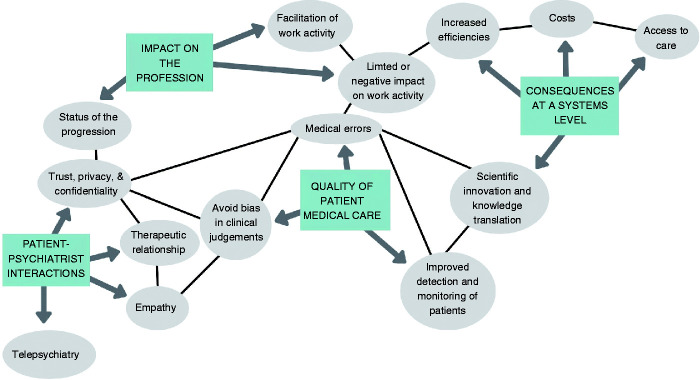
Background: The potential for machine learning to disrupt the medical profession is the subject of ongoing debate within biomedical informatics. Objective: This study aimed to explore psychiatrists’ opinions about the potential impact innovations in artificial intelligence and machine learning on psychiatric practice Methods: In Spring 2019, we conducted a web-based survey of 791 psychiatrists from 22 countries worldwide. The survey measured opinions about the likelihood future technology would fully replace physicians in performing ten key psychiatric tasks. This study involved qualitative descriptive analysis of written responses (“comments”) to three open-ended questions in the survey. Results: Comments were classified into four major categories in relation to the impact of future technology on: (1) patient-psychiatrist interactions; (2) the quality of patient medical care; (3) the profession of psychiatry; and (4) health systems. Overwhelmingly, psychiatrists were skeptical that technology could replace human empathy. Many predicted that ‘man and machine’ would increasingly collaborate in undertaking clinical decisions, with mixed opinions about the benefits and harms of such an arrangement. Participants were optimistic that technology might improve efficiencies and access to care, and reduce costs. Ethical and regulatory considerations received limited attention. Conclusions: This study presents timely information on psychiatrists’ views about the scope of artificial intelligence and machine learning on psychiatric practice. Psychiatrists expressed divergent views about the value and impact of future technology with worrying omissions about practice guidelines, and ethical and regulatory issues.
Overview
The claims and statistics of this paper haven’t been checked yet.
Free: it reads the open-access text and checks the first 5 claims that cite a source we can check. Create a free account to check every claim.
Integrity signals
Registry
Cites
Statistics
Figures
Verification
Claims the paper makes
The claims and statistics of this paper haven’t been checked yet.
Free: it reads the open-access text and checks the first 5 claims that cite a source we can check. Create a free account to check every claim.
Claims other papers make about this one
Each is checked against this paper’s own text: does it say what the citing paper says it does?
The cited source says what the claim attributes to it.
In the citing paper
“many studies reported an expected increase in overall efficiency [38, 41, 44, 45, 55, 56, 62, 67, 77–80] as a facilitating factor, a reduction in overall workload [82–84] or improved time management [52, 66].”
Self-check
Percentages, sums and reported differences re-computed from the paper’s own numbers.
The self-check needs the paper’s full text.
Citations
Cites
Using thematic analysis in psychology
Braun, V., & Clarke, V. (2006) · Qualitative Research in Psychology · doi:10.1191/1478088706qp063oa · Cited by 194,414 · cited 1×
“Descriptive content analysis was used to investigate these responses.(42,43) Responses were collated and imported into QCAmap (coUnity Software Development GmbH) for analysis.”
MethodPredicting the future - big data, machine learning, and clinical medicine
Obermeyer, Z., & Emanuel, E. J. (2016) · New England Journal of Medicine · doi:10.1056/nejmp1606181 · Cited by 3,652 · cited 4×
“Notwithstanding the wide spectrum of opinion, similar to the views of many experts, a dominant, overarching theme was speculation about a hybrid collaboration between ‘man and machine’ in undertaking psychiatric care.(18,25,26) Like informaticians, in particular, many participants highlighted the potential for AI in r…”
BackgroundInfluentialArtificial intelligence in healthcare
Yu, K.-H., Beam, A. L., & Kohane, I. S. (2018) · Nature Biomedical Engineering · doi:10.1038/s41551-018-0305-z · Cited by 2,817 · cited 1×
“Against the promise of pattern detection mediated by machine learning, many informaticians acknowledge that current AI is far from sufficient to fully undertake diagnostic decisions unaided, and significant breakthroughs will be necessary if machines are to avoid pitfalls in reasoning, and demonstrate causal and count…”
Background(2016) · Cited by 2,334
The Inevitable Application of Big Data to Health Care
Murdoch, T. B., & Detsky, A. S. (2013) · JAMA · doi:10.1001/jama.2013.393 · Cited by 1,664 · cited 2×
“Although a considerable number of participants conceived of clinical decisions as essentially and ineffably, a human “art”, biomedical informaticians argue that the ability to mine large scale health data for patterns in diagnosis and behavior is where machine learning presents unprecedented potential to disrupt diagn…”
BackgroundLin, L. Y., Sidani, J. E., Shensa, A., Radovic, A., Miller, E., Colditz, J. B., Hoffman, B. L., Giles, L. M., & Primack, B. A. (2016) · Depression and Anxiety · doi:10.1002/da.22466 · Cited by 1,111
Firth, J., Torous, J., Nicholas, J., Carney, R., Pratap, A., Rosenbaum, S., & Sarris, J. (2017) · World Psychiatry · doi:10.1002/wps.20472 · Cited by 1,097
Computer-based personality judgments are more accurate than those made by humans
Youyou, W., Kosinski, M., & Stillwell, D. (2015) · Proceedings of the National Academy of Sciences · doi:10.1073/pnas.1418680112 · Cited by 1,086 · cited 1×
“Going even further, and drawing on findings in the nascent field of affective computing, some informaticians speculate that in the long-term, computers may play a critical role in augmenting or replacing human-mediated empathy; for example, emerging studies suggest that under certain conditions, computers can surpass…”
Background(2019) · Cited by 986
Machine learning in medicine: Addressing ethical challenges
Vayena, E., Blasimme, A., & Cohen, I. G. (2018) · PLOS Medicine · doi:10.1371/journal.pmed.1002689 · Cited by 912 · cited 1×
“In light of high levels of patient interest in mental health apps, the effectiveness, reliability, and safety of machine learning technologies present serious ethical, legal, and regulatory considerations that require the sustained engagement of the psychiatric community.(72,73,76,77) So far, the efficacy and safety o…”
Background
Cited by
Items 101–134 of 134
Wu, R.-Y., Chen, D., Liu, C.-L., & Liu, Z. (2026) · Communications in computer and information science · doi:10.1007/978-981-95-6739-3_27
Noheda, S., Ramírez-Riveros, E., Rodriguez‐Moreno, S., Martín-Azañedo, C., Georgescu, A., & Roca, P. (2026) · Journal of Medical Internet Research · doi:10.2196/93893
“Existing research shows that clinicians generally perceive AI as useful for supporting tasks such as triage, symptom monitoring, or administrative processes, yet remain skeptical about its suitability for core therapeutic functions that rely on relational sensitivity and empathic attunement [8].”
Influential(2026) · Frontiers research topics · doi:10.3389/978-2-8325-8001-1
Chen, H., Chen, L., Yang, J., Tang, A., & Yang, Y. (2026) · Digital Health · doi:10.1177/20552076261455239
“38 Future research must therefore prioritize the development of “safety guardrails” specifically designed for psychiatric contexts before unsupervised use can be recommended.”
Involvement of artificial intelligence as a psychological education workforce in the “Internet+” era
Shen, S.-M., Huang, Z.-W., & Wang, W.-H. (2026) · World Journal of Psychiatry · doi:10.5498/wjp.115735
Abesadze, N., Fernandes, A., & Rubin, E. (2026) · Cureus · doi:10.7759/cureus.112306
Psychotherapists' attitudes toward the use of artificial intelligence in therapeutic practice
Gabrijelčič, E. (2026) · Repository of the University of Ljubljana (University of Ljubljana)
Who Teaches AI Ethics? Understanding the Gaps in AI Ethics Education in Computing Programs
Aljedaani, W., Parthasarathy, P. D., & Aljohani, A. (2026) · ACM/IEEE International Conference on Software Engineering: Companion Proceedings (ICSE-Companion) · doi:10.1145/3786580.3786966
“In addition, social challenges, including job displacement [5], emotional detachment [12], and ethical dilemmas such as plagiarism [45], highlight the broader societal implications of unchecked AI use.”
AI-enhanced trait modulation in high-stakes industries: a conceptual perspective
Kroyer, L., & Lütge, C. (2026) · AI and Ethics · doi:10.1007/s43681-026-01197-x
Zhang, Z., Cudjoe, T., Ashida, S., Massare, J., Chae, K., Phan, P., Abadir, P. M., Arbaje, A. I., Unberath, M., & Schoenborn, N. L. (2026) · JMIR Aging · doi:10.2196/86148
Supplementary Material for Evaluating AI-Based Mental Health Interventions
Sharma, A. (2026) · ACM eBooks · doi:10.1145/3749728.3749737
Human–AI Collaboration to Empower People Seeking Support
Sharma, A. (2026) · ACM eBooks · doi:10.1145/3749728.3749732
(2026) · ACM eBooks · doi:10.1145/3749728.3749738
(2026) · ACM eBooks · doi:10.1145/3749728.3749739
Supplementary Materials for Human–AI Collaboration to Empower People Providing Support
Sharma, A. (2026) · ACM eBooks · doi:10.1145/3749728.3749735
Human–AI Collaboration to Empower People Providing Support
Sharma, A. (2026) · ACM eBooks · doi:10.1145/3749728.3749731
Sharma, A. (2026) · ACM eBooks · doi:10.1145/3749728.3749730
(2026) · ACM eBooks · doi:10.1145/3749728.3749729
Supplementary Materials for Human–AI Collaboration to Empower People Seeking Support
Sharma, A. (2026) · ACM eBooks · doi:10.1145/3749728.3749736
(2026) · ACM eBooks · doi:10.1145/3749728.3749734
Mbiriri, M. (2026) · JOURNAL OF HUMANITIES AND SOCIAL POLICY · doi:10.56201/jhsp.vol.12.no6.2026.pg163.174
Gün, Z., & Çıvgın, U. (2026) · Journal of Technology in Behavioral Science · doi:10.1007/s41347-026-00720-5
Kearns, A., Moorhead, A., Mulvenna, M. D., & Bond, R. (2026) · European Conference on Cognitive Ergonomics · doi:10.1145/3822301.3822333
Manea, M. M., Crintea, A., Singalievici, P.-A., Codrea, M. I. M., & Coman, H. G. (2026) · Medicine and Pharmacy Reports · doi:10.15386/mpr-2975
Hanumanth, N., Prabha, K. J. S. S., Krishna, G. R., Kulkarni, V. P., & Bhuvaneswari, K. (2026) · International Journal of Health Sciences and Research · doi:10.52403/ijhsr.20260927
Bertayeva, B. S., Abdizhami, A., & Wang, H. (2026) · Bulletin of the Karaganda University “Law Series” · doi:10.31489/2026l3/88-100
Wróblewska, K., Koźlak, J., & Hybel, J. M. (2025) · Medicine and Public Health
Ethical Implications of Artificial Intelligence (AI) in Healthcare
Dr. Smitha V Shenoy, D. G. P. T. G., Govindaraj Pandith, T. G., & Tejus, B. (2025) · Journal of Neonatal Surgery
Li, X., He, H., Chien, C.-W., Luo, X., & Luo, Z. (2026) · Research Square · doi:10.21203/rs.3.rs-10127719/v1
Al-Abri, K., Saadi, A. A. A., Rashdi, A. Y. A., Nasseri, J. M. A., Mashaykhi, A. K. A., Maqbali, A. O. A., & Alharrasi, S. S. (2026) · Nursing Open · doi:10.1002/nop2.70939
“Digital interventions may help address workforce shortages, costs, stigma, and geographical barriers by extending support beyond conventional locations and times (Blease et al. 2020; Dugdale et al. 2019; Lattie et al. 2022).”
Gamaleldin, D. A., Rodda, J. E., Shergill, S. S., Ang, J., Hotham, S., Williams, V., Rice, R., Mansi, H., Bannet, S., & Olure, O. (2026) · medRxiv · doi:10.64898/2026.10.28.26366085
The role of artificial intelligence in spirituality and mental health
Alkhouri, K. I. (2026) · Journal of Spirituality in Mental Health · doi:10.1080/19349637.2026.2757056
Khaliq, F., Ali, H., & Khan, M. (2026) · Pakistan Journal of Positive Psychology · doi:10.67785/pjpp.10.423
Metadata
- Authors
- Blease, C., Locher, C., Leon-Carlyle, M., & Doraiswamy, M.
- Affiliations
- University College Dublin (IE)
- University of Basel (CH)
- University of Toronto (CA)
- Departments of Psychiatry and Behavioral Science, and Medicine, Duke University Medical School, Durham, NC, USA
- Corresponding author
- Blease, C
- Venue
- DIGITAL HEALTH
- Publisher
- SAGE Publications
- Published
- 2020-01
- Volume
- 6
- Pages
- 2055207620968355-2055207620968355
- ISSN
- 2055-2076 (ISSN-L)
- PMC
- PMC7597571
- OpenAlex
- W2981836947
- Cited by
- 121
- References
- 73
- Citations by year
- 2026: 29 · 2025: 26 · 2024: 29 · 2023: 17 · 2022: 15 · 2021: 4 · 2020: 1
- FWCI
- 2.72
- Type
- journal article
- Language
- en
- Open access
- gold
- doi.org
- Licence
- Locations
- Digital Health (publishedVersion, cc-by-nc)
- PubMed Central (publishedVersion, cc-by-nc)
- PubMed (publishedVersion)
- arXiv (Cornell University) (submittedVersion)
- DOAJ (DOAJ: Directory of Open Access Journals) (submittedVersion, cc-by-sa)
- arXiv (Cornell University)
- Sage Journals Data (cc-by)
- Funders
- Irish Research Council-Marie Skłodowska-Curie Actions (CLNE/2017/226)
- Topics
- Health Sciences › Medicine › Health Informatics › Artificial Intelligence in Healthcare and Education
- Physical Sciences › Computer Science › Artificial Intelligence › Ethics and Social Impacts of AI
- Health Sciences › Health Professions › Health Information Management › Artificial Intelligence in Healthcare
- Keywords
- artificial intelligence in psychiatry, machine learning, psychiatrists' attitudes, access to mental health care, health care costs, future of psychiatry
About these checks
Registry, retraction, Cites and statistics results are computed, not judged, with one exception: a printed reference that no index lists is read once by a model before it counts as a citation error. Claims are extracted by a model and kept only when their quote appears verbatim in the text; each cited source is then checked, with a model’s help, for whether it says what the claim relies on. Those verdicts can be wrong — read the claim’s quote and the cited source before relying on one.
Statistics and arithmetic are recomputed, not judged.
Confidence bands are shown only for fields calibrated on our annotated test set. None is calibrated yet, so no band is shown.
What counts as a claim ›How we measure confidence ›How we check this ›
Are you an author, or do you see a problem with this page? Request a review
Data sources
Bibliographic data: Semantic Scholar, OpenAlex, Crossref.
Contains information from the Semantic Scholar Academic Graph Datasets, made available under the ODC Attribution License (ODC-BY 1.0).
Semantic Scholar’s data is described in: Kinney, R., et al. (2023). The Semantic Scholar Open Data Platform. arXiv:2301.10140.
