

Software-related challenges in Swedish healthcare through the lens of incident reports: A desktop study
Open accessThe DOI matches its Crossref record; 35 of the 35 references it cites were found in a registry or an index.
Abstract
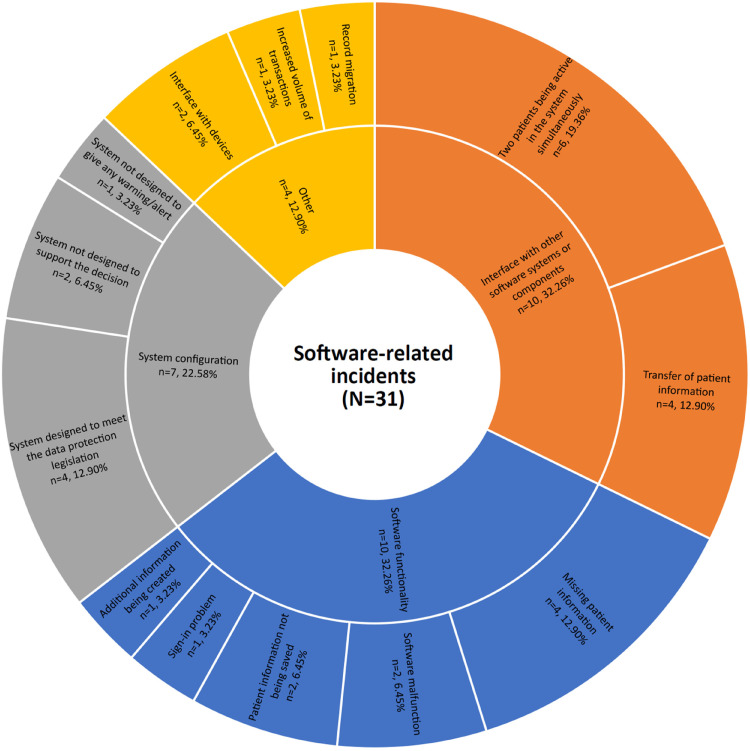
Objective: To identify a subset of software issues occurring in daily Swedish healthcare practice and devise a set of local solutions to overcome the challenges. Methods: A sample of 46 incident reports was collected from one of Sweden's national incident reporting repositories, ranging from June 2019 to December 2021. The reports were first subjected to an algorithm to identify if they were health information technology-related incidents and were analysed using an existing framework, i.e., the Health Information Technology Classification System, to identify the software-related incidents. The incidents associated with software issues were then subjected to thematic analysis, in which themes were extracted and presented under the category assigned by the existing framework used. Results: Of 46 reports, 45 (with one exception) were included using the algorithm. Of 45 incidents, 31 software-related incidents were identified using the classification system. Six types of software issues were identified, including software functionality ( n = 10), interface with other software systems or components ( n = 10), system configuration ( n = 7), interface with devices ( n = 2), record migration ( n = 1) and increased volume of transactions ( n = 1). Each issue was further categorised into different themes; for example, software interface-related problems were grouped into ‘two patients being active in the system simultaneously’ ( n = 6) and ‘transfer of patient information’ ( n = 4). Conclusions: The study provided some insights into software issues and relevant consequences. A set of local solutions were devised to overcome the present challenges encountered in Swedish healthcare in their daily clinical practice. Systematic identification and characterisation of such software challenges should be a routine part of clinical practice for all major health information technology implementations.
Overview
The claims and statistics of this paper haven’t been checked yet.
Free: it reads the open-access text and checks the first 5 claims that cite a source we can check. Create a free account to check every claim.
Integrity signals
Registry
Cites
Statistics
Figures
Verification
Claims the paper makes
The claims and statistics of this paper haven’t been checked yet.
Free: it reads the open-access text and checks the first 5 claims that cite a source we can check. Create a free account to check every claim.
Self-check
Percentages, sums and reported differences re-computed from the paper’s own numbers.
The self-check needs the paper’s full text.
Citations
Cites
What can “thematic analysis” offer health and wellbeing researchers?
Braun, V., & Clarke, V. (2014) · International Journal of Qualitative Studies on Health and Well-being · doi:10.3402/qhw.v9.26152 · Cited by 3,056 · cited 3×
“Six incidents were identi fi ed under this theme (IR 2,5,6,17,18,22 ).”
BackgroundMethodEnabling the implementation of evidence based practice: a conceptual framework.
Kitson, A., Harvey, G., & McCormack, B. (1998) · Quality in Health Care · doi:10.1136/qshc.7.3.149 · Cited by 1,985 · cited 2×
“Of these con fi g-uration issues, two incidents were reported as being associated with the system, which was not designed to support the decision of the care delivery (IR 3,23 ).”
BackgroundAsh, J. S. (2003) · Journal of the American Medical Informatics Association · doi:10.1197/jamia.m1471 · Cited by 1,789
Continuous Improvement as an Ideal in Health Care
Berwick, D. M. (1989) · New England Journal of Medicine · doi:10.1056/nejm198901053200110 · Cited by 1,716 · cited 3×
“From 10 software functionality-related problems (IR 4,8,9,10,12,13,19,21,28,31 ), fi ve themes were formed.”
BackgroundMethodHealth IT and Patient Safety: Building Safer Systems for Better Care
Chou, D. (2012) · JAMA · doi:10.1001/jama.308.21.2282-a · Cited by 503 · cited 2×
“Six incidents were identi fi ed under this theme (IR 2,5,6,17,18,22 ).”
Background(2013) · Europe PMC (PubMed Central) · Cited by 396
Innovating health care: key characteristics of human-centered design
Melles, M., Albayrak, A., & Goossens, R. (2021) · International Journal for Quality in Health Care · doi:10.1093/intqhc/mzaa127 · Cited by 365 · cited 1×
“37,38 For example, it is only sometimes possible that incorrect patient information from another care unit is sent from one patient information system to another due to human factors.”
BackgroundHorsky, J., Schiff, G. D., Johnston, D., Mercincavage, L., Bell, D., & Middleton, B. (2012) · Journal of Biomedical Informatics · doi:10.1016/j.jbi.2012.09.002 · Cited by 289 · cited 1×
“18,34 Using standardised terminology and colour schemes could further increase users ’ sensitivity to decisive information.”
BackgroundKim, M. O., Coiera, E., & Magrabi, F. (2017) · Journal of the American Medical Informatics Association · doi:10.1093/jamia/ocw154 · Cited by 263 · cited 4×
“From 10 software functionality-related problems (IR 4,8,9,10,12,13,19,21,28,31 ), fi ve themes were formed.”
BackgroundMethodInfluentialKetikidis, P., Dimitrovski, T., Lazuras, L., & Bath, P. A. (2012) · Health Informatics Journal · doi:10.1177/1460458211435425 · Cited by 244 · cited 1×
“26,39,40 When users misunderstood and were unaware of the software ’ s intended purpose, they did not regard some incidents as reportable cases, and thus certain issues remained.”
BackgroundHealth information technology and its impact on the quality and cost of healthcare delivery
Bardhan, I. R., & Thouin, M. F. (2013) · Decision Support Systems · doi:10.1016/j.dss.2012.10.003 · Cited by 213 · cited 3×
“Bardhan and Thouin 35 demonstrated in their study signi fi cant implications on the cost-quality trade-off related to using the HIT system.”
BackgroundAn analysis of electronic health record-related patient safety concerns
Meeks, D. W., Smith, M. W., Taylor, L., Sittig, D. F., Scott, J. M., & Singh, H. (2014) · Journal of the American Medical Informatics Association · doi:10.1136/amiajnl-2013-002578 · Cited by 207 · cited 2×
“Six incidents were identi fi ed under this theme (IR 2,5,6,17,18,22 ).”
BackgroundAnderson, J. E., Kodate, N., Walters, R., & Dodds, A. (2013) · International Journal for Quality in Health Care · doi:10.1093/intqhc/mzs081 · Cited by 180 · cited 2×
“From 10 software functionality-related problems (IR 4,8,9,10,12,13,19,21,28,31 ), fi ve themes were formed.”
BackgroundMethodMagrabi, F., Ong, M.-S., Runciman, W., & Coiera, E. (2010) · Journal of the American Medical Informatics Association · doi:10.1136/jamia.2009.002444 · Cited by 162 · cited 2×
“Six incidents were identi fi ed under this theme (IR 2,5,6,17,18,22 ).”
BackgroundRunciman, W. B. (2002) · Quality and Safety in Health Care · doi:10.1136/qhc.11.3.246 · Cited by 137 · cited 2×
“Four incidents were grouped under this theme (IR 1,11,16,20 ).”
BackgroundState of science: evolving perspectives on ‘human error’
Read, G. J. M., Shorrock, S., Walker, G. H., & Salmon, P. M. (2021) · Ergonomics · doi:10.1080/00140139.2021.1953615 · Cited by 126 · cited 1×
“32,33 A measure that can be taken to ensure that patient context is followed is adding a code for the ‘ patient change ’ function while handling mouse events that allow selecting a patient without triggering a patient change.”
BackgroundMagrabi, F., Baker, M., Sinha, I., Ong, M.-S., Harrison, S., Kidd, M. R., Runciman, W. B., & Coiera, E. (2015) · International Journal of Medical Informatics · doi:10.1016/j.ijmedinf.2014.12.003 · Cited by 100 · cited 5×
“21 After applying the HIT algorithm, the included incidents were then analysed using an existing classi fi cation system proposed by Magrabi et al., 8 namely the HIT-CS, to identify the software-related incidents.”
BackgroundMethodInfluentialRONQUILLO, J. G., & ZUCKERMAN, D. M. (2017) · The Milbank Quarterly · doi:10.1111/1468-0009.12278 · Cited by 81 · cited 3×
“From seven system con fi guration issues (IR 3,14,15,23,24,25,27 ), three themes were found.”
BackgroundRuss, A. L., & Saleem, J. J. (2018) · Journal of Biomedical Informatics · doi:10.1016/j.jbi.2018.01.001 · Cited by 71 · cited 1×
“32,33 A measure that can be taken to ensure that patient context is followed is adding a code for the ‘ patient change ’ function while handling mouse events that allow selecting a patient without triggering a patient change.”
BackgroundMagrabi, F., Ong, M.-S., Runciman, W. B., & Coiera, E. W. (2011) · Macquarie University · Cited by 68
Magrabi, F., Liaw, S. T., Arachi, D., Runciman, W., Coiera, E., & Kidd, M. R. (2016) · BMJ Quality & Safety · doi:10.1136/bmjqs-2015-004323 · Cited by 58
Eriksson, P., Hammar, T., Lagrosen, S. O., & Nilsson, E. (2022) · Scandinavian Journal of Primary Health Care · doi:10.1080/02813432.2022.2159200 · Cited by 48 · cited 4×
“Of these, two incidents comprised ‘ no transfer ’ (IR 16,20 ), one consisted of ‘ incorrect transfer ’ (IR 1 ), and another was caused by ‘ delayed transfer ’ (IR 11 ) of patient information.”
BackgroundInfluentialRahman Jabin, M. S., Steen, M., Wepa, D., & Bergman, P. (2023) · DIGITAL HEALTH · doi:10.1177/20552076231174307 · Cited by 44 · cited 5×
“From seven system con fi guration issues (IR 3,14,15,23,24,25,27 ), three themes were found.”
BackgroundInfluentialRahman Jabin, M. S., Pan, D., & Nilsson, E. (2022) · Health Informatics Journal · doi:10.1177/14604582221105440 · Cited by 40 · cited 5×
“26,39,40 When users misunderstood and were unaware of the software ’ s intended purpose, they did not regard some incidents as reportable cases, and thus certain issues remained.”
BackgroundInfluentialSelf-citationRahman Jabin, M. S., & Hammar, T. (2022) · DIGITAL HEALTH · doi:10.1177/20552076221131139 · Cited by 32 · cited 7×
“From 10 software interface-related identi fi ed problems (IR 1,2,5,6,11,16,17,18,20,22 ), two themes were generated, namely ‘ two patients being active in the system simultaneously ’ ( n = 6) and ‘ transfer of patient information ’ ( n = 4).”
BackgroundInfluentialAarts, J. (2012) · Health Policy and Technology · doi:10.1016/j.hlpt.2012.01.008 · Cited by 29 · cited 3×
“Of these con fi g-uration issues, two incidents were reported as being associated with the system, which was not designed to support the decision of the care delivery (IR 3,23 ).”
BackgroundJabin, M. S. R., Magrabi, F., Hibbert, P., Schultz, T., Bessen, T., & Runciman, W. (2019) · 2019 IEEE International Conference on Imaging Systems and Techniques (IST) · doi:10.1109/ist48021.2019.9010426 · Cited by 23
Towards Data Interoperability: Practical Issues in Terminology Implementation and Mapping
Lau, L. M., & Shakib, S. C. (2005) · Cited by 22
Jabin, M. S. R., Magrabi, F., Hibbert, P., Schultz, T., & Runciman, W. (2019) · 2019 IEEE International Conference on Imaging Systems and Techniques (IST) · doi:10.1109/ist48021.2019.9010280 · Cited by 20 · cited 4×
“13 Much research has been conducted on HIT incidents 4,8,14 – 18 ; however, no published articles were found that explored HIT-related issues in Sweden.”
BackgroundInfluentialWeb-based education of the elderly improves drug utilization literacy: A randomized controlled trial
Qvarfordt, M., Throfast, V., Petersson, G., Hammar, T., & Hellström, L. (2021) · Health Informatics Journal · doi:10.1177/1460458220977585 · Cited by 20
Jabin, M. S. R., Magrabi, F., Hibbert, P., Schultz, T., & Runciman, W. (2019) · 2019 IEEE International Conference on Imaging Systems and Techniques (IST) · doi:10.1109/ist48021.2019.9010109 · Cited by 19 · cited 6×
“From seven system con fi guration issues (IR 3,14,15,23,24,25,27 ), three themes were found.”
BackgroundMethodInfluentialJabin, M. S. R., Mandel, C., Schultz, T., Hibbert, P., Magrabi, F., & Runciman, W. (2019) · 2019 IEEE International Conference on Imaging Systems and Techniques (IST) · doi:10.1109/ist48021.2019.9010117 · Cited by 19 · cited 7×
“12”
BackgroundMethodInfluentialNdabu, T., Mulgund, P., Sharman, R., & Singh, R. K. P. G. (2021) · JMIR Human Factors · doi:10.2196/21884 · Cited by 19
Hammar, T., Hellström, L., & Ericson, L. (2020) · Pharmacy · doi:10.3390/pharmacy8030118 · Cited by 14 · cited 2×
“24,29 The interface issues also manifested in software – user interaction.”
BackgroundPatient safety problems from healthcare information technology in medical imaging
Schultz, T. J., Hannaford, N., & Mandel, C. (2016) · BJR|case reports · doi:10.1259/bjrcr.20150107 · Cited by 7 · cited 1×
“These systems should communicate with each other to ensure access to prior medical examinations.(37,38) For example, it is only sometimes possible that incorrect patient information from another care unit is sent from one patient information system to another due to human factors.”
Background
Research works printed but not linked: 3
- The Joint Commission. Moving quality improvement from a project to a way of leading an organization. J Qual Patient Saf 2016; 42: 42.
- Olaronke I Abimbola S Ishaya G, et al. Interoperability in healthcare: benefits, challenges and resolutions. Int J Innov Appl Stud 2013; 3: 262– 270.
- Jabin MSR. Identifying and Characterising Problems Arising from Interactions Between Medical Imaging and Health Information Technology as a Basis for Improvements in Practice. Adelaide: University of South Australia, 2019.
Cited by
Jabin, M. S. R. (2024) · Frontiers in Digital Health · doi:10.3389/fdgth.2024.1367431 · Cited by 43
Jabin, M. S. R., Pan, D., & Nilsson, E. (2024) · Frontiers in Digital Health · doi:10.3389/fdgth.2024.1260521 · Cited by 41
“Therefore, training healthcare professionals before integrating HIT systems and software updates and preparing them for unexpected system failures will result in better use of the HIT systems and greater user satisfaction, thus mitigating the risks of human problems (49).”
BackgroundSelf-citationPan, D., Nilsson, E., & Rahman Jabin, M. S. (2024) · Health Informatics Journal · doi:10.1177/14604582241270742 · Cited by 32
Self-citationJabin, M. S. R., Wepa, D., & Hassoun, A. (2024) · Frontiers in Digital Health · doi:10.3389/fdgth.2024.1371761 · Cited by 31
“Among all software issues, software functionality, and system con fi guration have been the most common software-related challenges (10, 11), including in medical imaging HIT systems (6).”
BackgroundJabin, M. S. R. (2024) · Frontiers in Digital Health · doi:10.3389/fdgth.2024.1422396 · Cited by 23
Metadata
- Authors
- Rahman Jabin, M. S., & Pan, D.
- Affiliations
- Department of Medicine and Optometry, Linnaeus University, Kalmar, Sweden
- Linnaeus University (SE)
- Venue
- DIGITAL HEALTH
- Publisher
- SAGE Publications
- Published
- 2023-01
- Volume
- 9
- Pages
- 20552076231203600-20552076231203600
- ISSN
- 2055-2076 (ISSN-L)
- PMC
- PMC10515578
- OpenAlex
- W4386938017
- Cited by
- 41
- References
- 35
- Citations by year
- 2026: 22 · 2025: 8 · 2024: 10 · 2023: 1
- FWCI
- 9.19
- Type
- journal article
- Language
- en
- Open access
- gold
- doi.org
- Locations
- Digital Health (publishedVersion, cc-by)
- PubMed Central (publishedVersion, cc-by)
- PubMed (publishedVersion)
- KTH Publication Database DiVA (KTH Royal Institute of Technology) (submittedVersion, other-oa)
- Bradford Scholars (University of Bradford) (submittedVersion, other-oa)
- DOAJ (DOAJ: Directory of Open Access Journals) (submittedVersion, cc-by-sa)
- Funders
- Linnéuniversitetet
- Topics
- Health Sciences › Health Professions › Health Information Management › Electronic Health Records Systems
- Health Sciences › Health Professions › Health Information Management › Medical Coding and Health Information
- Health Sciences › Medicine › Public Health, Environmental and Occupational Health › Patient Safety and Medication Errors
- Keywords
- incident reporting, software functionality, system configuration, patient information transfer, health information systems, Swedish healthcare system
About these checks
Registry, retraction, Cites and statistics results are computed, not judged, with one exception: a printed reference that no index lists is read once by a model before it counts as a citation error. Claims are extracted by a model and kept only when their quote appears verbatim in the text; each cited source is then checked, with a model’s help, for whether it says what the claim relies on. Those verdicts can be wrong — read the claim’s quote and the cited source before relying on one.
Statistics and arithmetic are recomputed, not judged.
Confidence bands are shown only for fields calibrated on our annotated test set. None is calibrated yet, so no band is shown.
What counts as a claim ›How we measure confidence ›How we check this ›
Are you an author, or do you see a problem with this page? Request a review
Data sources
Bibliographic data: Semantic Scholar, OpenAlex, Crossref.
Contains information from the Semantic Scholar Academic Graph Datasets, made available under the ODC Attribution License (ODC-BY 1.0).
Semantic Scholar’s data is described in: Kinney, R., et al. (2023). The Semantic Scholar Open Data Platform. arXiv:2301.10140.
