

Comparison of PHQ-9 and PHQ-2 as Screening Tools for Depression and School Related Stress in Inner City Adolescents
Open accessThe DOI matches its Crossref record; 26 of the 26 references it cites were found in a registry or an index.
Abstract
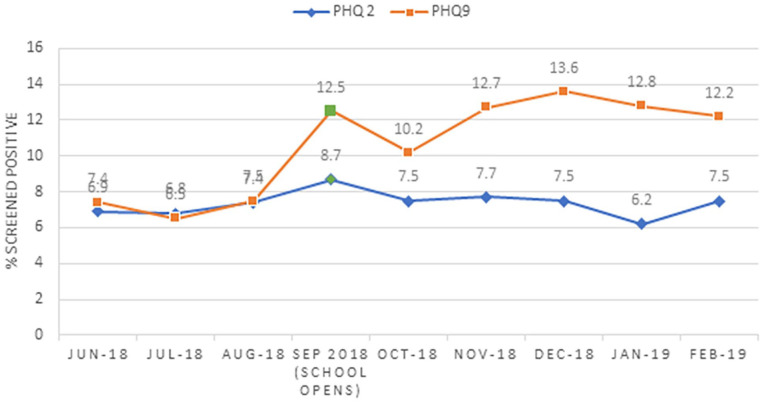
Background: Major depressive disorder is associated with significant morbidity and mortality in adolescents. Suicide is one of the leading causes of mortality between 15 and 19 years. Both AAP and USPSTF recommend routine depression screening of adolescents. Patient Health Questionnaire-2 (PHQ-2) and Patient Health Questionnaire-9 (PHQ-9) are widely used in primary care practice, however, PHQ-2 does not screen for suicidality. School-related factors are known to affect adolescent mental health. Purpose: To compare PHQ-2 and PHQ-9 for depression screening in adolescents, with respect to age, gender, chronic illness over the course of 9 months. Methods: As a QI initiative, we compared screening results in our inner-city pediatric practice using PHQ-2 and PHQ-9 from Jun’18 to Feb’19. EMR of 2364 patients 12 to 21 years were reviewed. We considered the PHQ-2 score of ≥2 and PHQ-9 of ≥10 as positive. Pre-existing chronic medical and mental illnesses were noted. Results: Of these 61.5% of patients were females, 95% were Black/Hispanic, and 96% were insured by Medicaid. About 10.6% of PHQ-9 tests were positive whereas 7.4% PHQ2 were positive. Logistic regression was performed to ascertain the effects of age, gender, and chronic illness. Females were more likely to have a positive screen, as were patients with chronic illness. Age had no effect on the outcome. The screening yield for both tests was comparable in the summer months. PHQ9 yield increased while schools were in session while PHQ 2 remained stable. Conclusion: PHQ9 is superior as a screening test compared to PHQ2. Repeat screening should be targeted toward patients with chronic medical conditions and/or mental health diagnoses. PHQ9 may be better at screening for school-related stress.
Overview
The claims and statistics of this paper haven’t been checked yet.
Free: it reads the open-access text and checks the first 5 claims that cite a source we can check. Create a free account to check every claim.
Integrity signals
Registry
Cites
Statistics
Figures
Verification
Claims the paper makes
The claims and statistics of this paper haven’t been checked yet.
Free: it reads the open-access text and checks the first 5 claims that cite a source we can check. Create a free account to check every claim.
Claims other papers make about this one
Each is checked against this paper’s own text: does it say what the citing paper says it does?
The cited source says what the claim attributes to it.
In the citing paper
“This could be because of limitations associated with the choice of self-report questionnaire (i.e., PHQ-2). 68”
From Virtual psychoeducation for improvement of pain catastrophizing in pediatric presurgical patients and caregivers: a proof-of-concept study (2023) · cites this paper as [68]
Self-check
Percentages, sums and reported differences re-computed from the paper’s own numbers.
The self-check needs the paper’s full text.
Citations
Cites
The PHQ-9: Validity of a brief depression severity measure
Kroenke, K., Spitzer, R. L., & Williams, J. B. W. (2001) · Journal of General Internal Medicine · doi:10.1046/j.1525-1497.2001.016009606.x · Cited by 44,910
Case-finding instruments for depression: Two questions are as good as many
Whooley, M. A., Avins, A. L., Miranda, J., & Browner, W. S. (1997) · Journal of General Internal Medicine · doi:10.1046/j.1525-1497.1997.00076.x · Cited by 1,826 · cited 1×
“01 Age, median (range) 16 (12-21) 16 (12-21) 17 (12-21) .”
Monitoring Depression Treatment Outcomes With the Patient Health Questionnaire-9
L??we, B., Un??tzer, J., Callahan, C. M., Perkins, A. J., & Kroenke, K. (2004) · Medical Care · doi:10.1097/00005650-200412000-00006 · Cited by 1,354 · cited 1×
“01 Age, median (range) 16 (12-21) 16 (12-21) 17 (12-21) .”
Mood disorders in children and adolescents: an epidemiologic perspective
Kessler, R. C., Avenevoli, S., & Ries Merikangas, K. (2001) · Biological Psychiatry · doi:10.1016/s0006-3223(01)01129-5 · Cited by 1,181
Children's Mental Health Service Use Across Service Sectors
Burns, B. J., Costello, E. J., Angold, A., Tweed, D., Stangl, D., Farmer, E. M. Z., & Erkanli, A. (1995) · Health Affairs · doi:10.1377/hlthaff.14.3.147 · Cited by 1,145
Richardson, L. P., McCauley, E., Grossman, D. C., McCarty, C. A., Richards, J., Russo, J. E., Rockhill, C., & Katon, W. (2010) · Pediatrics · doi:10.1542/peds.2010-0852 · Cited by 806 · cited 1×
“01 Age, median (range) 16 (12-21) 16 (12-21) 17 (12-21) .”
Suicide and Youth: Risk Factors
Bilsen, J. (2018) · Frontiers in Psychiatry · doi:10.3389/fpsyt.2018.00540 · Cited by 584 · cited 1×
“The logistic regression model was statistically significant χ2(4) = 46.”
Suicide Risk and Mental Disorders
Brådvik, L. (2018) · International Journal of Environmental Research and Public Health · doi:10.3390/ijerph15092028 · Cited by 483
Olfson, M., Blanco, C., Wang, S., Laje, G., & Correll, C. U. (2014) · JAMA Psychiatry · doi:10.1001/jamapsychiatry.2013.3074 · Cited by 449
Zuckerbrot, R. A., Cheung, A., Jensen, P. S., Stein, R. E. K., Laraque, D., GLAD-PC STEERING GROUP, Levitt, A., Birmaher, B., Campo, J., Clarke, G., et al. (2018) · Pediatrics · doi:10.1542/peds.2017-4081 · Cited by 446
Research works printed but not linked: 1
- Substance Abuse and Mental Health Services Administration. DSM-5 Changes: Implications for Child Serious Emotional Disturbance. Table 9, DSM-IV to DSM-5 Major Depressive Episode/Disorder Comparison. Substance Abuse and Mental Health Services Administration (US); 2016. Accessed August 30, 2021. https://www.ncbi.nlm.nih.gov/books/NBK519712/table/ch3.t5/ 30199184
Cited by
Mental disorders at the beginning of adolescence: Prevalence estimates in a sample aged 11-14 years
Scheiner, C., Grashoff, J., Kleindienst, N., & Buerger, A. (2022) · Public Health in Practice · doi:10.1016/j.puhip.2022.100348 · Cited by 65
“5% of adolescents screening positive for depressive symptoms is in line with findings from before the pandemic [65] and with a recent longitudinal German study [59].”
ResultLi, X., Jin, W., Han, L., Chen, X., & Li, L. (2025) · Child and Adolescent Psychiatry and Mental Health · doi:10.1186/s13034-025-00908-2 · Cited by 32
“It found that the probability of a positive screen with the PHQ-9 was 1.4 times higher than with the PHQ-2 [64].”
InfluentialSleep deprivation and suicide risk among minoritized US adolescents
Joseph, V. A., Kreski, N. T., & Keyes, K. M. (2023) · BMC Psychiatry · doi:10.1186/s12888-023-05074-3 · Cited by 26
“To our knowledge, current screening tools for the suicidality of Black and Hispanic adolescents include depression screeners such as the Patient Health Questionnaire (PHQ)-9 and PHQ-2 [26].”
MethodMental Health Among Sexual and Gender Minority Youth Incarcerated in Juvenile Corrections
Clark, K. A., Harvey, T. D., Hughto, J. M. W., & Meyer, I. H. (2022) · PEDIATRICS · doi:10.1542/peds.2022-058158 · Cited by 26
Oyenubi, A., Kim, A. W., & Kollamparambil, U. (2022) · Journal of Affective Disorders · doi:10.1016/j.jad.2022.04.072 · Cited by 22
Metadata
- Authors
- Anand, P., Bhurji, N., Williams, N., & Desai, N.
- Affiliations
- Kings County Hospital Center (US)
- Corresponding author
- Anand, Paridhi
- Venue
- Journal of Primary Care & Community Health
- Publisher
- SAGE Publications
- Published
- 2021-01
- Volume
- 12
- Pages
- 21501327211053750-21501327211053750
- ISSN
- 2150-1319 (ISSN-L)
- 2150-1327
- PMC
- PMC8679043
- OpenAlex
- W4200359141
- Cited by
- 49
- References
- 26
- Citations by year
- 2026: 10 · 2025: 10 · 2024: 10 · 2023: 11 · 2022: 8
- FWCI
- 4.94
- Type
- journal article
- Language
- en
- Open access
- gold
- doi.org
- Licence
- Locations
- Journal of Primary Care & Community Health (publishedVersion, cc-by-nc)
- PubMed Central (publishedVersion, cc-by-nc)
- PubMed (publishedVersion)
- DOAJ (DOAJ: Directory of Open Access Journals) (submittedVersion, cc-by-sa)
- Topics
- Social Sciences › Psychology › Clinical Psychology › Child and Adolescent Psychosocial and Emotional Development
- Health Sciences › Medicine › Psychiatry and Mental health › Mental Health Treatment and Access
- Social Sciences › Psychology › Experimental and Cognitive Psychology › Anxiety, Depression, Psychometrics, Treatment, Cognitive Processes
- Keywords
- PHQ-9, PHQ-2, depression screening, adolescents, academic stress, chronic disease, screening yield, gender differences, seasonal variation, suicide risk
- MeSH terms
- Patient Health Questionnaire, Adolescent, Child, Depression, Major Depressive Disorder, Female, Humans, Infant, Mass Screening, Surveys and Questionnaires, Schools
About these checks
Registry, retraction, Cites and statistics results are computed, not judged, with one exception: a printed reference that no index lists is read once by a model before it counts as a citation error. Claims are extracted by a model and kept only when their quote appears verbatim in the text; each cited source is then checked, with a model’s help, for whether it says what the claim relies on. Those verdicts can be wrong — read the claim’s quote and the cited source before relying on one.
Statistics and arithmetic are recomputed, not judged.
Confidence bands are shown only for fields calibrated on our annotated test set. None is calibrated yet, so no band is shown.
What counts as a claim ›How we measure confidence ›How we check this ›
Are you an author, or do you see a problem with this page? Request a review
How to cite
Cite CoChat for the checks on this page, and the paper for its own findings.
- This page
- CoChat. (2026). Citation check: Comparison of PHQ-9 and PHQ-2 as Screening Tools for Depression and School Related Stress in Inner City Adolescents. https://app.cochat.ai/papers/10.1177/21501327211053750
- The paper
- Anand, P., Bhurji, N., Williams, N., & Desai, N. (2021). Comparison of PHQ-9 and PHQ-2 as Screening Tools for Depression and School Related Stress in Inner City Adolescents. Journal of Primary Care & Community Health. https://doi.org/10.1177/21501327211053750
Data sources
Bibliographic data: Semantic Scholar, OpenAlex, Crossref.
Contains information from the Semantic Scholar Academic Graph Datasets, made available under the ODC Attribution License (ODC-BY 1.0).
Semantic Scholar’s data is described in: Kinney, R., et al. (2023). The Semantic Scholar Open Data Platform. arXiv:2301.10140.
