

Ageism and Psychological Well-Being Among Older Adults: A Systematic Review
Open accessThe DOI matches its Crossref record; 56 of the 57 references it cites were found in a registry or an index, and 1 are not checked yet.
Abstract
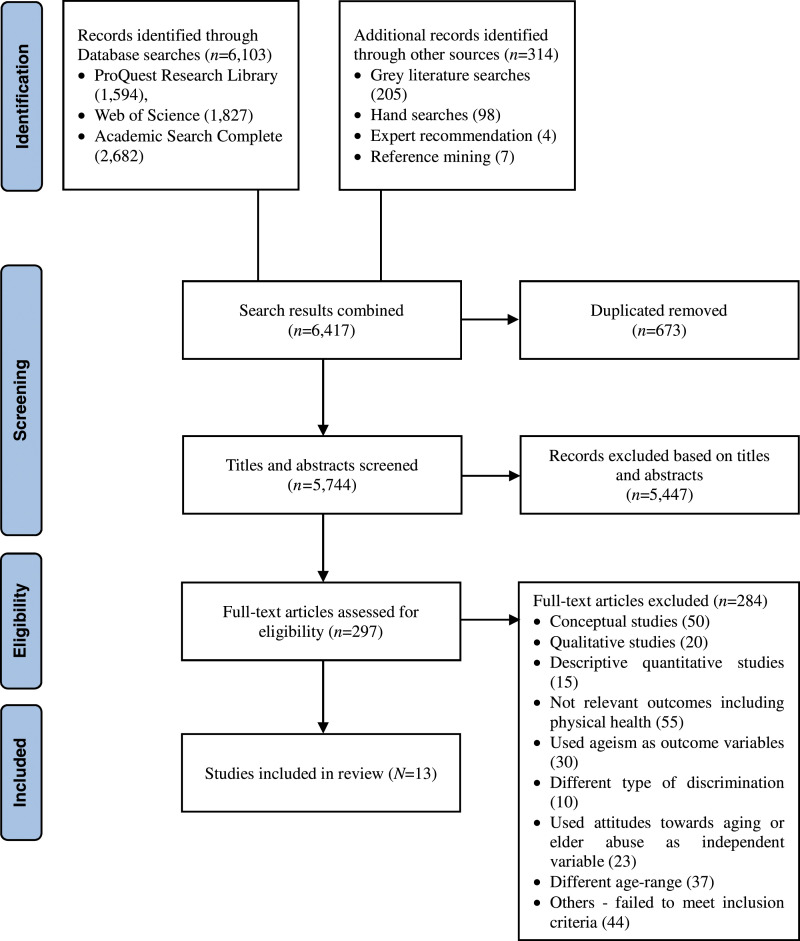
Ageism may have harmful effects on the psychological well-being of older adults, leading to mental health issues, such as depression and anxiety. However, there are insufficient data to establish this hypothesis, and most work on the subject has appeared only in the form of conceptual or theoretical papers. This study reviewed quantitative studies of the relationship between ageism and psychological well-being of older adults. We conducted a comprehensive review using searches of academic databases, the grey literature, hand searches, and reference mining. A total of thirteen articles were selected using the inclusion criteria. All the reviewed studies showed a negative association between ageism and the psychological well-being of older adults. The study confirmed a negative association between ageism and older adults’ psychological well-being, finding that older adults with a high level of psychological well-being may be less negatively affected by ageism, especially those who were proud of their age group, experienced less negative emotions, were more optimistic about aging and their future, were more self-confident about their bodies, and were flexible in setting goals. The identified mediators of the association can inform intervention development to the effects of ageism and improve older adults’ psychological well-being.
Overview
The claims and statistics of this paper haven’t been checked yet.
Free: it reads the open-access text and checks the first 5 claims that cite a source we can check. Create a free account to check every claim.
Integrity signals
Registry
Cites
Statistics
Figures
Verification
Claims the paper makes
The claims and statistics of this paper haven’t been checked yet.
Free: it reads the open-access text and checks the first 5 claims that cite a source we can check. Create a free account to check every claim.
Claims other papers make about this one
Each is checked against this paper’s own text: does it say what the citing paper says it does?
The source backs part of the claim, not all of it — or backs it for a different population, condition or comparison.
In the citing paper
“Indeed, topics such as ageism, elder maltreatment, loneliness, attitudes toward older adults, and social participation appear to be relatively less represented in the identified literature despite their well-established importance in international research [106,107,108,109].”
From Toward Holistic Aging in Lebanon: A Mapping of Gerontology and Geriatrics Research Trends, Gaps, and Future Directions (2026) · cites this paper as [108]
Experimental — accuracy not yet measured
Self-check
Percentages, sums and reported differences re-computed from the paper’s own numbers.
The self-check needs the paper’s full text.
Citations
Cites
The PRISMA 2020 statement: An updated guideline for reporting systematic reviews
Page, M. J., McKenzie, J. E., Bossuyt, P. M., Boutron, I., Hoffmann, T. C., Mulrow, C. D., Shamseer, L., Tetzlaff, J. M., Akl, E. A., Brennan, S. E., et al. (2021) · BMJ · doi:10.1136/bmj.n71 · Cited by 108,283
The satisfaction with life scale
Diener, E., Emmons, R. A., Larsen, R. J., & Griffin, S. (1985) · Journal of Personality Assessment · doi:10.1207/s15327752jpa4901_13 · Cited by 31,768
Happiness is everything, or is it? Explorations on the meaning of psychological well-being.
Ryff, C. D. (1989) · Journal of Personality and Social Psychology · doi:10.1037/0022-3514.57.6.1069 · Cited by 14,847 · cited 1×
“Further, it is an integrative construct that includes diverse affective and cognitive dimensions, such as life satisfaction, positive/negative affect, mental health, self-actualization, optimal functioning, happiness, and mood (Levin & Chatters, 1998; Ryff, 1989).”
BackgroundThe PRISMA 2020 statement: an updated guideline for reporting systematic reviews
Page, M. J., McKenzie, J., Bossuyt, P., Boutron, I., Hoffmann, T., mulrow, C., Shamseer, L., Tetzlaff, J., Akl, E., Brennan, S. E., et al. (2020) · doi:10.31222/osf.io/v7gm2_v1 · Cited by 8,090
The PRISMA 2020 statement: an updated guideline for reporting systematic reviews
Page, M. J., McKenzie, J., Bossuyt, P., Boutron, I., Hoffmann, T., mulrow, C., Shamseer, L., Tetzlaff, J., Akl, E., Brennan, S. E., et al. (2020) · doi:10.31222/osf.io/v7gm2 · Cited by 5,177
Perceived discrimination and health: A meta-analytic review.
Pascoe, E. A., & Smart Richman, L. (2009) · Psychological Bulletin · doi:10.1037/a0016059 · Cited by 4,427
Systematic reviews: CRD's guidance for undertaking reviews in health care
Tacconelli, E. (2010) · The Lancet Infectious Diseases · doi:10.1016/s1473-3099(10)70065-7 · Cited by 3,245
Stereotype Embodiment: A Psychosocial Approach to Aging
Levy, B. (2009) · Current Directions in Psychological Science · doi:10.1111/j.1467-8721.2009.01662.x · Cited by 1,822 · cited 2×
“Stereotype embodiment refers to a person’s internalization of age stereotypes through life-long exposure (Levy, 2009).”
BackgroundSystematic Reviews and Meta-Analysis
Littell, J. H., Corcoran, J., & Pillai, V. (2008) · doi:10.1093/acprof:oso/9780195326543.001.0001 · Cited by 1,293 · cited 2×
“The systematic review methodology was guided by two sources: Systematic Reviews from the Centre for Reviews and Dissemination (2009) and Systematic Reviews and MetaAnalysis from Littell et al. (2008).”
MethodChapter 7: Systematic reviews of etiology and risk
(2020) · JBI Manual for Evidence Synthesis · doi:10.46658/jbimes-20-08 · Cited by 1,268
Research works printed but not linked: 4
- Kang H. (2020). Ageism and productive engagement: The roles of self efficacy and intergenerational contact (Publication No. 28317888) [Doctoral dissertation, University of Kansas]. ProQuest Dissertations Publishing.
- Kim J. H. (2009). The change in the status of older people in Korea in terms of ageism. Society and History, 82(8), 361– 391.
- Lee S.S. Lee K.J. (2002). The stress, social support and psychological well-being of the elderly. Journal of the Korea Gerontological Society, 22(1), 1- 20.
- Raposo S. Carstensen L. L. (2015). Developing a research agenda to combat ageism. Generations, 39(3), 79– 85.
Cited by
Items 101–200 of 303
APPLICATION OF FUZZY LOGIC IN COMPUTER SYSTEMS OF MEDICAL DIAGNOSIS
Jabiyeva, A. J., & Khudaverdiyeva, M. (2023) · Socio World Social Research & Behavioral Sciences · doi:10.36962/swd12022023-17 · Cited by 5
Preretirees Retirement Planning as Precondition of Their Future Wellbeing: Review of Foreign Studies
Drobysheva, T. V., Викторович, Л. И., Tarasov, S. V., & Knigolyubova, A. N. (2025) · Journal of Modern Foreign Psychology · doi:10.17759/jmfp.2024130402 · Cited by 3
Li, Z., & Tang, Z. (2023) · Research Square · doi:10.21203/rs.3.rs-3219537/v1 · Cited by 8
Older adults’ perceptions of ageism, discrimination, and racism
Tice‐Brown, D., Kelly, P. L., Heyman, J. C., Phipps, C., White-Ryan, L., & Davis, H. J. (2024) · Social Work in Health Care · doi:10.1080/00981389.2024.2365136 · Cited by 5
“Ageism may influence societal perspectives and the self-perception of older adults, which has implications for their well-being as they navigate aging (Kang & Kim, 2022).”
Daştan, B., & Kulakaç, N. (2024) · Geriatric Nursing · doi:10.1016/j.gerinurse.2024.07.042 · Cited by 3
Sugisawa, H., Harada, K., Sugihara, Y., Yanagisawa, S., Shinmei, M., & Kitajima, H. (2024) · The International Journal of Aging and Human Development · doi:10.1177/00914150241297395 · Cited by 2
“Review articles indicate that PAD negatively affects the health and wellbeing of older adults (Chang et al., 2020; Kang & Kim, 2022), but its effects can be approached differently from the existing literature, which only examines its perspectives.”
Psychosexual Health and Sexual Satisfaction in Older Adults: Strategies for Holistic Well-being
Penhollow, T. M. (2025) · Journal of Psychosexual Health · doi:10.1177/26318318251324293 · Cited by 4
“14 Similarly, research conducted at The Villages — the largest 55+ active retirement community in the United States—demonstrated that higher sexual frequency and fewer chronic health conditions were linked to greater sexual satisfaction.”
Mainsbridge, C. P., Hookway, N. S., Cruickshank, V. J., & Dwyer, Z. (2025) · Annals of Leisure Research · doi:10.1080/11745398.2025.2503780 · Cited by 3
“Therefore, it might be that reaching the age of 50 imparts somewhat of a psychological declaration in some individuals, in this case, AMG participants, from which an augmented focus on health and fitness arises (Hou, Wu, and Huang 2024; Kang and Kim 2022; Kim et al. 2019).”
Nivestam, A., Edfors, E., Hedin, G., Westergren, A., & Haak, M. (2025) · Aging Clinical and Experimental Research · doi:10.1007/s40520-025-03069-6 · Cited by 2
“Previous research indicates that ageism can affect older adults' psychological well-being [24] and, consequently, their ability or willingness to participate in societal discussions.”
Cocota's Story: Life Lessons in Aging, Resilience, and End‐of‐Life Agency From a Brazilian Matriarch
Avelino‐Silva, T. J., & Moini, N. (2025) · Journal of the American Geriatrics Society · doi:10.1111/jgs.19566 · Cited by 2
Ageism within the nursing workforce and the role of nurse leaders
Pritchett, W., & Kinsley, K. (2025) · Nursing · doi:10.1097/nsg.0000000000000228 · Cited by 2
Stereotypes: Older adult representation in Australian newspaper advertising
Butson, M. L., & Wright, R. K. (2025) · Media International Australia · doi:10.1177/1329878x251375141 · Cited by 3
Perceptions of Aging and Control Beliefs: A Study on Older Patients’ Views of Aging
Schönenberg, A., Kobus, C., Günther, M., Umfermann, L., & Prell, T. (2025) · Geriatrics · doi:10.3390/geriatrics10060148 · Cited by 2
“These stereotypes are not only pervasive but are often internalized by individuals at an early age, thereby influencing their VoA as they mature [9].”
Patterson, I., & Balderas-Cejudo, A. (2025) · European journal of tourism, hospitality and recreation · doi:10.2478/ejthr-2025-0006 · Cited by 5
Shumet, S., & Zeleke, E. G. (2026) · International Journal of Mental Health Systems · doi:10.1186/s13033-026-00696-y · Cited by 3
“The discrepancy in our results may be attributed to age-related factors, such as declining physical health, loss of social support networks, and increased life stressors, which can hinder adaptive coping [58, 59].”
Ageism toward older workers and wellbeing at work: a systematic review
Marrero-Vega, A. L., Yeves, J., Bargsted, M., & Sáez, S. (2026) · Frontiers in Psychology · doi:10.3389/fpsyg.2026.1824641 · Cited by 3
“This matches broader criticism in the literature regarding the limited cross-cultural validity of ageism measures (Ayalon, 2018; Kang and Kim, 2022).”
InfluentialOthering Older People’s Housing: Gaming Ageing to Support Future-Planning
McCall, V., Rutherford, A., Bowes, A. M., Jagannath, S., Njoki, M., Quirke, M., Pemble, C., Lovatt, M., Davison, L., Maginn, K., et al. (2024) · International Journal of Environmental Research and Public Health · doi:10.3390/ijerph21030304 · Cited by 8
Dentists' perceptions of providing care to community‐dwelling older people
Friedlander, L. T., Hamadani, P., Chandler, N. P., & Daniel, B. K. (2024) · Gerodontology · doi:10.1111/ger.12795 · Cited by 2
Zwar, L., König, H., Delfin, E., & Hajek, A. (2024) · Archives of Gerontology and Geriatrics · doi:10.1016/j.archger.2024.105683 · Cited by 3
A Pilot and Feasibility Study of the Aging Together Anti-Ageism Peer Support Program
Steward, A. T., Keane, C. T., Lee, Y., & Cho, Y. S. (2025) · Journal of Applied Gerontology · doi:10.1177/07334648251340445 · Cited by 3
“…study align with recent research demonstrating that internalized ageism and negative age stereotypes are a signi fi cant risk factor for stress, depressive symptoms, anxiety symptoms, and suicidal ideation in later life (Gendron, Camp, Amateau, & Iwanaga, 2024; Kang & Kim, 2022; Lyons et al., 2018).”
Arsenault, K. A., MacNab, Y. C., Asmundson, G. J. G., & Hadjistavropoulos, T. (2025) · Journal of Aging and Health · doi:10.1177/08982643251345422 · Cited by 2
“Moreover, ageism is linked to higher levels of stress (Kang & Kim, 2022; Lyons et al., 2018).”
Ageist Stereotypes and Attitudes Towards Older People in Türkiye
Con, G. (2025) · OPUS Toplum Araştırmaları Dergisi · doi:10.26466/opusjsr.1663043 · Cited by 4
“Kang and Kim (2022) show that the impact of ageism on the psy-Gülçin chological well-being of older people is quite negative.”
Koçak, O., Çevık, O., & Yıldırım, M. (2025) · Geriatric Nursing · doi:10.1016/j.gerinurse.2025.103492 · Cited by 3
Hua, Z. (2025) · International Journal of Geriatric Psychiatry · doi:10.1002/gps.70171 · Cited by 5
New love, old stereotypes: ageism in social media discourses on the golden bachelor
Ménard, A., Chasteen, A. L., Gameren, M. V., Bedri, N., Yang, M., Belanger, C., & Fraser, S. (2025) · Journal of Social Media Research · doi:10.29329/jsomer.36 · Cited by 4
“Ageism can adversely impact the psychological health of older adults, potentially precipitating mental health challenges like depression and anxiety (Kang & Kim, 2022).”
Prevalence of depression among older people in Iraq
Jadoo, S. A. A., Al-Samarrai, M. A. M., Alhusseiny, A. H., Torun, P., Mohammed, A. S., & Latif, I. I. (2024) · Diyala Journal of Medicine · doi:10.26505/djm.26018290222 · Cited by 2
Younes, R. S., Ziade, C., Rajha, F., & Abboud Mzawak, M. (2026) · Healthcare · doi:10.3390/healthcare14172857 · Cited by 1
Wenn Abhängigkeit verletzlich macht: Ansprüche von Pflegeheimbewohnenden an eine würdevolle Pflege
Widmer, A., Wiegand, K., & Huber, E. (2023) · Pflege · doi:10.1024/1012-5302/a000929 · Cited by 1
Ageism: The Need for New Imagery for Growing Old
Paoletti, I. (2024) · Springer eBooks · doi:10.1007/978-981-97-5041-2_2 · Cited by 2
Empowering the Elderly: Assessing India's Legal framework and Policy Outlook for Older Persons
Singh, A. P. (2024) · GLS KALP: Journal of Multidisciplinary Studies. · doi:10.69974/glskalp.04.03.72 · Cited by 1
Wong, Y. C., Ng, F. S. K., Mak, K., Liang, Y., Luk, Y. T., & Lau, M. S. W. (2024) · Asia Pacific Journal of Social Work and Development · doi:10.1080/29949769.2024.2421961 · Cited by 1
Determine the psychosocial well-being of elderly residents living in old-age homes
Jabade, M., & Joshi, S. G. (2024) · Journal of Education and Health Promotion · doi:10.4103/jehp.jehp_476_24 · Cited by 3
Li, J., Xu, W., Wang, Q., Zhou, X., & Peng, C. (2025) · Aging & Mental Health · doi:10.1080/13607863.2024.2448212 · Cited by 4
“Negative self-definitions regarding losing autonomy and becoming a burden to others can be stressful (Kang & Kim, 2022).”
Does time matter? The role of time perspective and ageism in mental health along the lifespan
Miguel, I. C., von Humboldt, S., & Leal, I. M. P. (2025) · Current Psychology · doi:10.1007/s12144-025-07657-7 · Cited by 7
“…of negative ageism, the FTP-Limitation tends to have a significant negative impact on mental health variables like stress, anxiety, and depression, compared to the positive influence of FTP-Opportunity, which corroborates previ - ous literature (Barber & Strickland-Hughes, 2019 ; Kang & Kim, 2022).”
InfluentialExtending the Age-Friendly Movement to Long-Term Care
Oh, P. A., Ciolfi, M. L., & Snow, K. (2025) · Springer eBooks · doi:10.1007/978-3-031-91038-8_14 · Cited by 3
Ali, A., Bakhsh, I., & David, M. K. (2025) · Discourse & Society · doi:10.1177/09579265251341468 · Cited by 2
“In general terms, ageism refers to a pattern of bigotry against older persons (Kang and Kim, 2022).”
Religiosity in Community Living and Participation of Sub-Saharan Africa Older Adults
Mpofu, E., Mareverwa, A., Abude-Aribo, J. O., & Chemhaka, G. B. (2025) · Springer eBooks · doi:10.1007/978-3-031-62891-7_65-1 · Cited by 1
Self-Efficacy Beliefs and Discrimination in Older Adulthood
Hill, P. L., Cox, M. A., & Wolk, M. W. (2025) · GeroPsych · doi:10.1024/1662-9647/a000349 · Cited by 1
Wani, A. M., Jahangir, M. S., & Shafi, A. (2025) · Working with Older People · doi:10.1108/wwop-04-2025-0019 · Cited by 1
Houchin, D., Scott, J., & Booth, R. J. (2025) · European Journal of Sport Science · doi:10.1002/ejsc.70065 · Cited by 1
Wang, H., Wang, D., Yu, J., & Wang, J. (2025) · Frontiers in Public Health · doi:10.3389/fpubh.2025.1642496 · Cited by 3
“The improvement in self-rated health stems from the immediate strengthening of social support networks and enhanced life meaning (42), particularly within the Chinese cultural context, where grandchildren provide symbolic significance for older adults’ health (7).”
Ali, A., Singh, A., Dangroo, A. A., Sobhana, H., Deuri, S. P., & Mishra, S. K. (2025) · Discover Psychology · doi:10.1007/s44202-025-00422-8 · Cited by 1
“One major reason for the lag in mental health care for older adults is the tendency of healthcare professionals to overlook symptoms like subthreshold depression, often misattributing them to natural aging processes [8– 9].”
Contrasting negative stereotypes against aging through a silent disco event: an ecological study
Arenare, G., Giaquinto, F., Macchieraldo, G., Bottiroli, S., & Cavallini, E. (2025) · Aging Clinical and Experimental Research · doi:10.1007/s40520-025-03224-z · Cited by 1
“Expe - riencing ageism has been shown to be associated with poor mental health among older adults [ 8 ] and it is increasingly identified as a risk factor associated with anxiety, depres - sion, and lowered life satisfaction [ 3 ].”
Validation of the Everyday Ageism Scale Using Confirmatory Factor Analysis and Item Response Theory
Arsenault, K. A., MacNab, Y. C., & Hadjistavropoulos, T. (2025) · Research on Aging · doi:10.1177/01640275251400327 · Cited by 1
Microaggression Toward Older Adults Scale (MTOAS): Development, Validity and Reliability Study
Yıldırım, G., & Meydan, B. (2025) · Journal of Intergenerational Relationships · doi:10.1080/15350770.2025.2593326 · Cited by 1
Age perceptions and physical health: implications for physiology, function, and well-being
Williams, C., Gendron, T. L., & Waters, L. (2025) · Elsevier eBooks · doi:10.1016/b978-0-443-33827-4.00005-5 · Cited by 1
Every Fall Matters: Challenging Ageism and Negative Self-Perception of Aging
Thiamwong, L., & Shattell, M. M. (2025) · Journal of Psychosocial Nursing and Mental Health Services · doi:10.3928/02793695-20251106-02 · Cited by 2
Fair at Any Age? A Cross-Country Descriptive Study on Ageism in the European Workplace
Stecker, L., Filho, A. S., Tillmanns, T., Pouliopoulos, T., & Marques, T. M. A. P. (2025) · Merits · doi:10.3390/merits6010001 · Cited by 1
Impact of Climate Change on Older Adults: A Systematic Literature Review
Leo, D. D., Zammarrelli, J., Meda, N., Spisto, S., Paone, F., Carrozzino, J., & Giannotti, A. V. (2026) · GeroPsych · doi:10.1024/1662-9647/a000357 · Cited by 4
Heap, H. M. B., Greengross, G., & Musselwhite, C. (2026) · Cogent Gerontology · doi:10.1080/28324897.2026.2624184 · Cited by 1
Allen, J. O., Qin, W., Kiefer, M., & Cunnyngham, K. E. (2026) · Aging & Mental Health · doi:10.1080/13607863.2026.2625856 · Cited by 1
“The finding that psychological responses demonstrated the largest association echoes a recent systematic review on the adverse effects of ageism on emotional and psychological outcomes (Kang & Kim, 2022).”
Duplantier, S. C., Hayes, M. G., Sanchez-Zaragoza, N., Londoño, A. I., Hamilton, E., Markle, E. A., & Emmert‐Aronson, B. O. (2026) · Healthcare · doi:10.3390/healthcare14040510 · Cited by 1
von Humboldt, S., Miguel, I. C., & Leal, I. M. P. (2026) · Ageing and Society · doi:10.1017/s0144686x26100610 · Cited by 1
“Ageism can have harmful effects not only on individuals’ wellbeing but also on their outlook for the future (Kang and Kim 2022).”
InfluentialInsights Into Older Adults’ Preferences for Well‐Being Programs Through Co‐Design
Louend, C. J., Keage, H. A. D., Wong, S., Sharman, R. L. S., Smith, A. E., Shialis, M., Venuto, L. D., Loetscher, T., & Hull, M. J. (2026) · Health & Social Care in the Community · doi:10.1155/hsc/5284700 · Cited by 1
Ageism and Self-Perception of Ageing: Psychosocial Predictors of Attitudes Towards Ageing
Garrido, J. M. F., Conde, M. D. D., Soriano, L. R., & Nieto, A. R. (2026) · Behavioral Sciences · doi:10.3390/bs16040527 · Cited by 1
“…life satisfaction, higher prevalence of depression, anxiety and stress, poorer adherence to medical treatments, poorer self-care, and higher risk of cognitive decline (Burnes et al., 2019; Chang et al., 2020; Hajek & König, 2024; Hu et al., 2021; Kang & Kim, 2022; Levy, 2022; Shimizu et al., 2022).”
Qi, Y., Zhao, M., Chen, N., Zhao, K., Mu, D., Gong, J., 李幼平, Shi, L., & Yu, J. (2026) · Journal of Epidemiology · doi:10.2188/jea.je20250670 · Cited by 1
FIRAT, S., & Kurutkan, M. N. (2026) · Aging & Mental Health · doi:10.1080/13607863.2026.2656224 · Cited by 1
“This pattern is consistent with the established literature demonstrating the positive association between perceived ageism and depressive symptoms (Han & Richardson, 2015; Kang & Kim, 2022).”
Kalaitzaki, A. E., Vozikaki, M., & Werner, P. (2026) · Geriatric Nursing · doi:10.1016/j.gerinurse.2026.104182 · Cited by 1
Life Satisfaction Among Italian Migrants, Italian Stayers, and Swiss Natives: Who Fares Better?
Dones, I. (2023) · Comparative Population Studies · doi:10.12765/cpos-2023-18 · Cited by 3
Thomas, P., Billon, R., & Hazif‐Thomas, C. (2023) · Annales Médico-psychologiques revue psychiatrique · doi:10.1016/j.amp.2023.09.007 · Cited by 3
Selvaraj, F. J. (2024) · Medicina y Ética · doi:10.36105/mye.2024v35n1.02 · Cited by 1
Predictores en la calidad de vida de las personas mayores: una revisión sistemática
Rodas, M. S., Vargas, A. E. O., Luna, B. S. C., & de León, M. D. C. E. P. (2024) · Revista de Psicología y Ciencias del Comportamiento de la Unidad Académica de Ciencias Jurídicas y Sociales · doi:10.29059/rpcc.20240601-178 · Cited by 3
Impact of Mind-Body Interventions on Psychosocial and Bio Physiological Markers among Elderly
Lakshmanan, J., Gopalakrishnan, B., & Rajendran, S. S. (2024) · Journal of Pharmacy And Bioallied Sciences · doi:10.4103/jpbs.jpbs_577_24 · Cited by 1
“[1] Studies reveal that the elderly residing in care facilities report higher rates of stress, anxiety, and depression, affecting nearly 20% of the elderly population.”
InfluentialIbrahim, N., Sapiee, M. L., Sanuddin, N. D., Erhan, T., & Husain, F. C. (2024) · Environment and Social Psychology · doi:10.59429/esp.v9i8.2785 · Cited by 3
“The concept of emotional intelligence has an impact on happiness and mental well-being [29] .”
BackgroundComputer use and cardiovascular risk biomarkers in midlife and older adults
Hu, M., Diong, S. F., Kasturiratna, K. T. A. S., & Hartanto, A. (2024) · Computers in Human Behavior Reports · doi:10.1016/j.chbr.2024.100502 · Cited by 1
“Within this study, participants aged 35 to 65 were classified as midlife adults, while those aged above 65 years old were categorised as older adults (Hartanto et al., 2020; Infurna et al., 2020; Kang & Kim, 2022).”
MethodPromoting Good Living and Social Health in Dementia
Chattat, R., Trolese, S., & Chirico, I. (2024) · Springer eBooks · doi:10.1007/978-3-031-68881-2_7 · Cited by 2
Psychological Well-being of the Elderly in Yogyakarta City: Descriptive Study
Astuti, B., Rachmawati, I., Kurniasari, M., Sari, W. J., & Lestari, R. (2024) · Bulletin of Counseling and Psychotherapy · doi:10.51214/002024061103000 · Cited by 1
Bengtsson, L. (2025) · International Journal of Discrimination and the Law · doi:10.1177/13582291241308088 · Cited by 1
“Ageism in the workplace not only affects the wider society, but also has harmful effects on an individual ’ s wellbeing as it is a risk factor leading to depression, anxiety and increased stress (Chang et al., 2020; Kang and Kim, 2022; Lamont et al., 2015).”
The effectiveness of aquatic and leisure facility advertising: an older adult perspective
Butson, M. L., Jeanes, R., & O’Connor, J. P. (2025) · Annals of Leisure Research · doi:10.1080/11745398.2025.2450774 · Cited by 2
“Ageism is increasingly recognized as a risk factor associated with increased stress, anxiety, and depression (Kang and Kim 2022).”
Older People's Perceptions of Well-Being
Vasileva, I. V., & Chumakov, M. V. (2025) · Clinical Psychology and Special Education · doi:10.17759/cpse.2024130406 · Cited by 1
Culture and aging: The role of culture, race, and ethnicity
Madarasmi, S., Trinh, N., & Ahmed, I. I. K. (2025) · Oxford University Press eBooks · doi:10.1093/med/9780198874799.003.0001 · Cited by 1
Ageless bonds: reimagining ageing, family and digital connectedness
Ghosh, M. (2025) · Working with Older People · doi:10.1108/wwop-05-2025-0024 · Cited by 1
Ageism during the 2024 U.S. Presidential Election: thematic analysis of tweets
Bacsu, J.-D., Jamali, A. A., Ménard, A., Fiske, D., O’Connell, M. E., Funk, M., Vellani, S., D’Souza, M. S., Fehr, F. C., Mah, J. C., et al. (2025) · The Gerontologist · doi:10.1093/geront/gnaf166 · Cited by 3
Intergenerational Civics Programs to Combat Structural Ageism in Canada
Seeman, N. (2023) · Healthcare Quarterly · doi:10.12927/hcq.2023.27221 · Cited by 1
Bias-free language in research as a tool to prevent ageism
de Aquino, M. P. M., Hernandes, E. C. R., Alfonsi, M. D. A., & Perracini, M. R. (2025) · Brazilian Journal of Physical Therapy · doi:10.1016/j.bjpt.2025.101198 · Cited by 1
Ageism, Dementia Stigma, and Disability in Hospital Settings
Ménard, A., & Fraser, S. (2025) · Springer eBooks · doi:10.1007/978-3-031-40858-8_322-1 · Cited by 1
Ageism: A Social and Psychological Construct
Yeves, J., Bargsted, M., & Marrero-Vega, A. L. (2025) · Springer eBooks · doi:10.1007/978-3-031-70581-6_40-1 · Cited by 1
Seguridad en los multímetros: Criterios de aplicación
López, N. B. D. M. (1998) · Mundo electrónico
Cultural Image of Older People during the COVID-19 Pandemic
Jiménez-Etxebarria, E., Jaureguizar, J., & Bernarás, E. (2022) · International Journal of Environmental Research and Public Health · doi:10.3390/ijerph192214644
“Finally, the differentiation between the attitude towards older people based on whether they are close or not, highlights the importance of intergenerational interventions that bring people together [1,20].”
BackgroundResultInfluentialEconomic and Psychological Well-being in Pandemic Times
Besmira, L. A. H. I., & Nurja, I. (2023) · WSEAS TRANSACTIONS ON BUSINESS AND ECONOMICS · doi:10.37394/23207.2023.20.72
Impact of Ageism on the Mental and Physical Health of Construction Workforce
Kereri, J. O., & Nyang'Au, G. (2023) · Journal of Engineering Project and Production Management · doi:10.32738/jeppm-2024-0016
“A growing number of research has linked ageism to adverse effects on the mental and physical health of older adults (e.g., Ribeiro-Gonçalves et al., 2023; Kang and Kim, 2022; Ayalon, et al., 2019).”
BackgroundIdadismo no contexto da pandemia
Penteado, L. D. P., Blanco, A. L., & Nunes, D. P. (2023) · Oikos Família e Sociedade em Debate · doi:10.31423/oikos.v34i2.15259
CONTRIBUTIONS OF CAREGIVERS IN FOSTERING PSYCHOLOGICAL WELL-BEING AMONG ELDERLY INDIVIDUALS
Hossen, M. S., & Islam, M. S. I. M. S. (2023) · Socio World Social Research & Behavioral Sciences · doi:10.36962/swd12022023-50
MITOCHONDRIA – AS A TARGET OF ENVIRONMENTAL FACTORS
Giorgadze, T., & Giorgadze, S. (2023) · Socio World Social Research & Behavioral Sciences · doi:10.36962/swd12022023-44
ENDOTHELIAL GLYCOCALYX DAMAGE IN PATIENTS WITH SEVERE FUNCTIONAL INJURY
Sarkulova, A. T. Z. S. Z., Daniyarova, B. K. K. D. K., & Zhankulov, M. S. M. Z. M. (2023) · Socio World Social Research & Behavioral Sciences · doi:10.36962/swd12022023-57
Ageism during the Covid-19 Pandemic
Man, G. M., & Man, M. (2024) · Bulletin of the Transilvania University of Braşov Series VII Social Sciences • Law · doi:10.31926/but.ssl.2023.16.65.2.7
PERSPECTIVES ON MENTAL HEALTH: AGING AND CIVIC PARTICIPATION IN OLD ADULTHOOD
von Humboldt, S., Costa, A., Ilyas, N., & Leal, I. M. P. (2024) · Psicologia Saúde & Doenças · doi:10.15309/24psd250101 · Cited by 1
AGEISMO E ESTEREÓTIPOS DO ENVELHECIMENTO
da Silva, T. J. P., Lima, S. S. D. E., Leite, K. D. O., Silva, C. R. D. T., de Carvalho, K. M., Sá, G. G. D. M., & Pereira, J. D. C. N. (2024) · Revista Enfermagem Atual In Derme · doi:10.31011/reaid-2024-v.98-n.1-art.2117
Ertürk, N. O., Stefani, A. D., Onder, B., Kaygın, H., Ulus, İ. Ç., Ratkowska-Pasikowska, J., Pasikowski, S., & Bulun, Ş. N. (2024) · Journal of Qualitative Research in Education · doi:10.14689/enad.38.1906
“In the realm of research, ageism primarily focuses on older people or those in late adulthood (Nelson 2005, Kang, Kim 2022).”
BackgroundGhaderzadeh, S., & Caldwell, J. (2024) · Advances In Clinical And Medical Research · doi:10.52793/acmr.2024.5(2)-77
“This pervasive form of discrimination against older adults not only perpetuates stereotypes but also has tangible consequences on their psychological well-being [11,12].”
Effectiveness of Redecision Therapy on Rational Behavior and Psychological Well-being of Women
Tajabadi, F. T., Jafari, F., & Fariborzi, E. (2024) · doi:10.61838/kman.jayps.5.5.2 · Cited by 2
Caring for the Elderly in Trauma (Racism, Equity, and Disparities in Trauma)
Dhanani, H., & Cooper, Z. R. (2024) · Current Trauma Reports · doi:10.1007/s40719-024-00269-9
“Similar to racism, the assumptions made through ageist attitudes can impact employment and self-worth [26, 27].”
Perceived discrimination and relative deprivation as predictors for age differences in loneliness
Paat, Y., & Morales, D. X. (2024) · Social Work in Mental Health · doi:10.1080/15332985.2024.2357352
“This in turn can have implications for their mental health and social circle formations/interactions (Kang & Kim, 2022).”
Low, G., AliSher, A. N., Morero, J. A. P., Gao, Z., GUTMAN, G. M., França, A. B., & von Humboldt, S. (2024) · Healthcare · doi:10.3390/healthcare12181837
“Psychosocial stressors like unsafe living arrangements, being isolated from friends, and having unmet health-related needs can take a toll on our anxiety levels [6,89,90].”
BackgroundStock, M., & Craig, C. (2024) · OBM Integrative and Complementary Medicine · doi:10.21926/obm.icm.2403051
Kalaitzaki, A. E., Vozikaki, M., & Werner, P. (2024) · Research Square · doi:10.21203/rs.3.rs-5342214/v1
Elvira-Zorzo, M. N., Álvarez, M. L. V., & Lorenzo, M. (2024) · Sustainability · doi:10.3390/su17010088 · Cited by 1
Engagement or Enjoyment? Attitudes of Older Adults in Group Lunch vs. Lifelong Learning Programs
Hou, S.-I. (2025) · Advances in Geriatric Medicine and Research · doi:10.20900/agmr20250002
Lapointe, M., Veilleux, M., Simard, P., Nguyen, H. M., Labbé, A., Poulin, V., & Turcotte, S. (2025) · JMIR Research Protocols · doi:10.2196/66963
“The double stigma associated with ageism and disability can reduce the social participation of individuals aging with disabilities [17-21].”
Mazidi, E., Sabzi, Z., Vakili, M. A., Jouybari, L. M., & Mancheri, H. (2025) · BMC Psychology · doi:10.1186/s40359-025-02581-8 · Cited by 1
“Older adults are particularly vulnerable to the adverse effects of ageism, which can have significant consequences [15].”
Metadata
- Authors
- Kang, H., & Kim, H.
- Affiliations
- George Mason University (US)
- University of Pittsburgh (US)
- Corresponding author
- Kang, Hyun
- Venue
- Gerontology and Geriatric Medicine
- Publisher
- SAGE Publications
- Published
- 2022-01
- Volume
- 8
- Pages
- 23337214221087023-23337214221087023
- ISSN
- 2333-7214 (ISSN-L)
- PMC
- PMC9008869
- OpenAlex
- W4223519312
- Cited by
- 305
- References
- 54
- Citations by year
- 2026: 86 · 2025: 99 · 2024: 81 · 2023: 31 · 2022: 7
- FWCI
- 9.02
- Type
- journal article
- Language
- en
- Open access
- gold
- doi.org
- Licence
- Locations
- Gerontology and Geriatric Medicine (publishedVersion, cc-by-nc)
- PubMed Central (publishedVersion, cc-by-nc)
- PubMed (publishedVersion)
- JMU Scholoraly Commons (James Madison University) (submittedVersion)
- DOAJ (DOAJ: Directory of Open Access Journals) (submittedVersion)
- Topics
- Social Sciences › Psychology › Developmental and Educational Psychology › Aging and Gerontology Research
- Social Sciences › Demography › Retirement, Disability, and Employment
- Health Sciences › Medicine › Public Health, Environmental and Occupational Health › Aging, Health, and Disability
- Keywords
- ageism, psychological well-being, older adults, depression, anxiety, goal flexibility, anti-aging interventions
About these checks
Registry, retraction, Cites and statistics results are computed, not judged, with one exception: a printed reference that no index lists is read once by a model before it counts as a citation error. Claims are extracted by a model and kept only when their quote appears verbatim in the text; each cited source is then checked, with a model’s help, for whether it says what the claim relies on. Those verdicts can be wrong — read the claim’s quote and the cited source before relying on one.
Statistics and arithmetic are recomputed, not judged.
Confidence bands are shown only for fields calibrated on our annotated test set. None is calibrated yet, so no band is shown.
What counts as a claim ›How we measure confidence ›How we check this ›
Are you an author, or do you see a problem with this page? Request a review
Data sources
Bibliographic data: Semantic Scholar, OpenAlex, Crossref.
Contains information from the Semantic Scholar Academic Graph Datasets, made available under the ODC Attribution License (ODC-BY 1.0).
Semantic Scholar’s data is described in: Kinney, R., et al. (2023). The Semantic Scholar Open Data Platform. arXiv:2301.10140.
