

Effect of High-Fidelity Simulation on Self-Satisfaction and Self-Confidence Among Nursing Students
The DOI matches its Crossref record; 42 of the 42 references it cites were found in a registry or an index.
Abstract
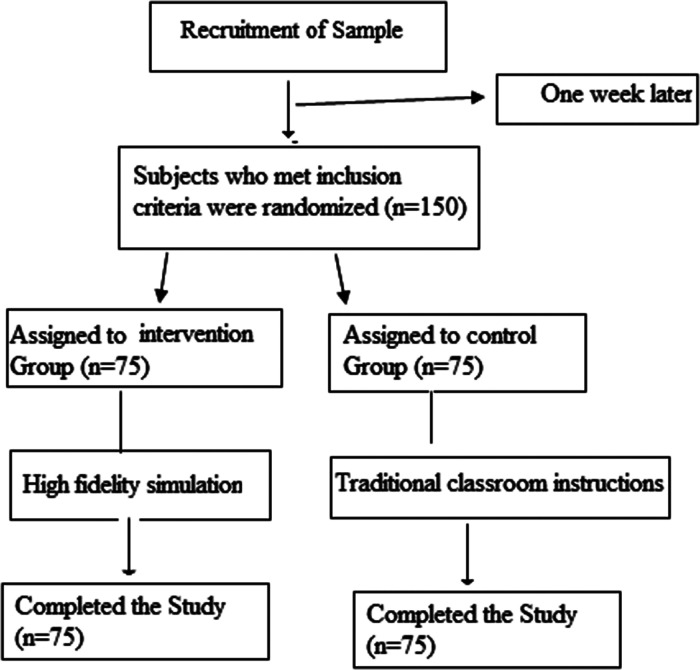
Introduction: Newly graduating nurses should be able to enter clinical practice as safe, accurate, competent, and compassionate professionals in health care settings that necessitate them to be learners who can easily get familiar with a broad diversity of clinical practice settings. Purposes: The purpose of this study was to evaluate the effect of high-fidelity simulation experiences on self-satisfaction and self-confidence among the pediatric nursing students. Methods: A quasi-experimental design, post-test, was carried out through the recruitment of a convenience sample of 150 nursing students from Arab American University. The students were randomly assigned to the study ( n = 75) or control ( n = 75) groups. Data were collected using learner satisfaction and self-confidence scales. Results: The results of the post-test revealed that there was a significant difference between both groups in self-satisfaction ( t (148) = 11.14, P < .001) and self-confidence ( t (148) = 13.04, P < .001). The mean score of self-satisfaction for the study group (22.45 ± 2.27) was higher than control group (16.80 ± 3.76). Also, the study group’ mean self-confidence score (35.72 ± 3.49) was higher than the control group (27.28 ± 4.39). Conclusion: High-fidelity simulation was confirmed to be an helpful tool to keep an effective and safe learning method for pediatric nursing students, thus increasing their satisfaction and confidence.
Overview
The claims and statistics of this paper haven’t been checked yet.
Free: it reads the open-access text and checks the first 5 claims that cite a source we can check. Create a free account to check every claim.
Integrity signals
Registry
Cites
Statistics
Figures
Verification
Claims the paper makes
The claims and statistics of this paper haven’t been checked yet.
Free: it reads the open-access text and checks the first 5 claims that cite a source we can check. Create a free account to check every claim.
Claims other papers make about this one
Each is checked against this paper’s own text: does it say what the citing paper says it does?
In the citing paper
“Studies have shown that repeated exposure to high-fidelity simulation improves learners’ confidence, particularly when sessions are well-structured and closely resemble real clinical situations [29, 37].”
From The impact of clinical simulation on bridging the theory–practice gap in nursing education: a systematic review (2025) · cites this paper as [29]
In the citing paper
“One study used the “Satisfaction and Self-confidence in Learning” Scale to assess perceptions after high-fidelity simulation among 150 nursing students, revealing statistically significant improvements in both domains [29].”
From The impact of clinical simulation on bridging the theory–practice gap in nursing education: a systematic review (2025) · cites this paper as [29]
In the citing paper
“High-fidelity simulations were particularly associated with enhanced clinical judgment and decision-making accuracy [17, 29, 30].”
From The impact of clinical simulation on bridging the theory–practice gap in nursing education: a systematic review (2025) · cites this paper as [29]
Self-check
Percentages, sums and reported differences re-computed from the paper’s own numbers.
The self-check needs the paper’s full text.
Citations
Cites
Journal of Education and Practice
(2017) · doi:10.7176/jep · Cited by 2,735
Establishing a Safe Container for Learning in Simulation: The Role of the Presimulation Briefing
Rudolph, J. W., Raemer, D. B., & Simon, R. (2014) · Simulation in Healthcare: The Journal of the Society for Simulation in Healthcare · doi:10.1097/sih.0000000000000047 · Cited by 915
Effectiveness of patient simulation in nursing education: Meta-analysis
Shin, S., Park, J.-H., & Kim, J.-H. (2015) · Nurse Education Today · doi:10.1016/j.nedt.2014.09.009 · Cited by 543 · cited 1×
“In addition, improvements have been obtained in learning (Shin et al., 2015), the acquisition of competences, and self-efficacy (Cant & Cooper, 2017).”
BackgroundAlinier, G., Hunt, B., Gordon, R., & Harwood, C. (2006) · Journal of Advanced Nursing · doi:10.1111/j.1365-2648.2006.03810.x · Cited by 515
Use of Simulation in Teaching and Learning in Health Sciences: A Systematic Review
Harder, B. N. (2010) · Journal of Nursing Education · doi:10.3928/01484834-20090828-08 · Cited by 312
High-Fidelity Nursing Simulation: Impact on Student Self-Confidence and Clinical Competence
Blum, C. A., Borglund, S., & Parcells, D. (2010) · International Journal of Nursing Education Scholarship · doi:10.2202/1548-923x.2035 · Cited by 267
Simulator Effects on Cognitive Skills and Confidence Levels
Brannan, J. D., White, A., & Bezanson, J. L. (2008) · Journal of Nursing Education · doi:10.3928/01484834-20081101-01 · Cited by 267
Franklin, A. E., Burns, P., & Lee, C. S. (2014) · Nurse Education Today · doi:10.1016/j.nedt.2014.06.011 · Cited by 258
Debriefing Using a Structured and Supported Approach
Phrampus, P. E., & O'Donnell, J. M. (2013) · Springer eBooks · doi:10.1007/978-1-4614-5993-4_6 · Cited by 250
A Review of Currently Published Evaluation Instruments for Human Patient Simulation
Kardong-Edgren, S., Adamson, K. A., & Fitzgerald, C. (2010) · Clinical Simulation in Nursing · doi:10.1016/j.ecns.2009.08.004 · Cited by 249
Research works printed but not linked: 11
- Bambini D. Washburn J. Perkins R. (2009). Outcomes of clinical simulation for novice nursing students: Communication, confidence, clinical judgment. Nursing Education Perspectives, 30(2), 79– 82. 19476069
- Campbell S. Daley K. (2013). Simulation scenarios for nursing educators. 2nd ed. Springer Publishing Company LLC.
- Curl E. D., et al. (2016). Effectiveness of integrated simulation and clinical experiences compared to traditional clinical experiences for nursing students. Nursing Education Perspectives, 37(2), 72– 77. 10.5480/15-1647 27209864 · doi:10.5480/15-1647
- Dağ G. S. Kılıç H. F. Görgülü R. S. (2019). Difficulties in clinical nursing education: Views of nurse instructors’. International Archives of Nursing and Health Care, 5(1), 114. 10.23937/2469-5823/1510114 · DOI
- INACSL Standards Committee. (2016b). INACSL Standards of best practice: SimulationSM debriefing. Clinical Simulation in Nursing 12, S21– S25.
- INACSL Standards Committee. (2016a). INACSL Standards of best practice: SimulationSM outcomes and objectives. Clinical Simulation in Nursing, 12, S13– S15.
- Jeffries P. R. (2005). A framework for designing, implementing, and evaluating: Simulations sed as teaching strategies in nursing. Nursing Education Perspectives, 26(2), 96– 103. 10.1043/1536-5026(2005)026b0096:AFWFDIN2.0.CO;2 15921126 · doi:10.1043/1536-5026(2005)026b0096:afwfdin2.0.co;2
- Kavanagh J. M. Sharpnack P. A. (2021). Crisis in competency: A defining moment in nursing education. Online Journal of Issues in Nursing, 26(1). 10.3912/OJIN.Vol26No01Man02 · DOI · Paper page
- Negrão-Baptista R. C. Amado- Martins J. C. Carneiro- Ribeiro Pereira M. F. Mazzo A. (2014). High-fidelity simulation in the nursing degree: Gains perceived by students. Revista de Enfermagem Referência, 4(1), 131– 140. 10.12707/RIII13169 · DOI
- Omer T. (2016). Nursing students’ perceptions of satisfaction and self-confidence with clinical simulation experience. Journal of Education and Practice, 7(5), 131– 138.
- Rushton M. (2015). Simulation and the student pathway to critical care. British Journal of Cardic Nursing, 10(2), 95– 98. 10.12968/bjca.2015.10.2.93 · DOI
Cited by
Daneshfar, M., & Moonaghi, H. K. (2025) · BMC Medical Education · doi:10.1186/s12909-025-07790-8 · Cited by 131
Jawabreh, N., Hamdan-Mansour, A., Harazne, L., & Ayed, A. (2025) · BMC Nursing · doi:10.1186/s12912-025-03300-9 · Cited by 44
Self-citationÖzgüven Öztornaci, B., Karakul, A., Ardahan Akgül, E., Doğan, P., Yildirim Sari, H., & Başbakkal, Z. (2025) · Medicine · doi:10.1097/md.0000000000046222 · Cited by 1
“[16,19,20] Students who receive simulation training before clinical practice gain experience and thus reduce the likelihood of making practice errors due to inexperience.”
Metadata
- Authors
- Toqan, D., Ayed, A., Khalaf, I. A., & Alsadi, M.
- Venue
- SAGE Open Nursing
- Publisher
- SAGE Publications
- Published
- 2023-01
- Volume
- 9
- ISSN
- 2377-9608
- PMC
- PMC10424544
- Cited by
- 55
- References
- 42
- Language
- en
About these checks
Registry, retraction, Cites and statistics results are computed, not judged, with one exception: a printed reference that no index lists is read once by a model before it counts as a citation error. Claims are extracted by a model and kept only when their quote appears verbatim in the text; each cited source is then checked, with a model’s help, for whether it says what the claim relies on. Those verdicts can be wrong — read the claim’s quote and the cited source before relying on one.
Statistics and arithmetic are recomputed, not judged.
Confidence bands are shown only for fields calibrated on our annotated test set. None is calibrated yet, so no band is shown.
What counts as a claim ›How we measure confidence ›How we check this ›
Are you an author, or do you see a problem with this page? Request a review
Data sources
Bibliographic data: Semantic Scholar, OpenAlex, Crossref.
Contains information from the Semantic Scholar Academic Graph Datasets, made available under the ODC Attribution License (ODC-BY 1.0).
Semantic Scholar’s data is described in: Kinney, R., et al. (2023). The Semantic Scholar Open Data Platform. arXiv:2301.10140.
