

Mindfulness Meditation Effects on Poststroke Spasticity: A Feasibility Study
Open accessThe DOI matches its Crossref record; 24 of the 24 references it cites were found in a registry or an index.
Abstract
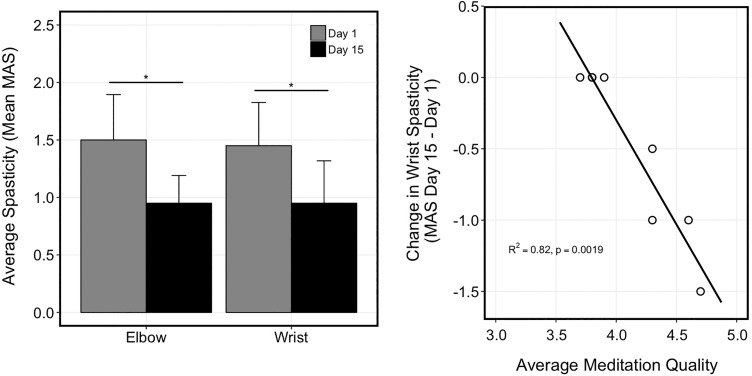
This study examined the feasibility of an adapted 2-week mindfulness meditation protocol for chronic stroke survivors. In addition, preliminary effects of this adapted intervention on spasticity and quality of life in individuals after stroke were explored. Ten chronic stroke survivors with spasticity listened to 2 weeks of short mindfulness meditation recordings, adapted from Jon Kabat-Zinn’s Mindfulness-Based Stress Reduction course, in a pre/post repeated measures design. Measures of spasticity, quality of life, mindfulness, and anxiety, along with qualitative data from participants’ daily journals, were assessed. On average, participants reported meditating 12.5 days of the full 15 days (mean 12.5 days, SD 0.94, range 8-15 days). Seven of the 10 participants wrote comments in their journals. In addition, there were no adverse effects due to the intervention. Exploratory preliminary analyses also showed statistically significant improvements in spasticity in both the elbow ( P = .032) and wrist ( P = .023) after 2 weeks of meditation, along with improvements in quality of life measures for Energy ( P = .013), Personality ( P = .026), and Work/Productivity ( P = .032). This feasibility study suggests that individuals with spasticity following stroke are able to adhere to a 2-week home-based mindfulness meditation program. In addition, preliminary results also suggest that this adapted, short mindfulness meditation program might be a promising approach for individuals with spasticity following stroke. Future research should expand on these preliminary findings with a larger sample size and control group.
Overview
The claims and statistics of this paper haven’t been checked yet.
Free: it reads the open-access text and checks the first 5 claims that cite a source we can check. Create a free account to check every claim.
Integrity signals
Registry
Cites
Statistics
Figures
Verification
Claims the paper makes
The claims and statistics of this paper haven’t been checked yet.
Free: it reads the open-access text and checks the first 5 claims that cite a source we can check. Create a free account to check every claim.
Claims other papers make about this one
Each is checked against this paper’s own text: does it say what the citing paper says it does?
The source backs part of the claim, not all of it — or backs it for a different population, condition or comparison.
In the citing paper
“They also reported improved quality of life.”
From Nursing Implications of Mindfulness-Informed Interventions for Stroke Survivors and Their Families. (2022) · cites this paper as Wathugala et al, 2019
Experimental — accuracy not yet measuredThe cited source says what the claim attributes to it.
In the citing paper
“Participants had improvements in spasticity in both elbow and wrist after 2 wk of meditation.”
From Nursing Implications of Mindfulness-Informed Interventions for Stroke Survivors and Their Families. (2022) · cites this paper as Wathugala et al, 2019
The cited source says what the claim attributes to it.
In the citing paper
“In this study, investigators examined a 2-week home intervention that involved listening to guided meditation based on the work of Kabat-Zinn and found improvements in spasticity in both the elbow and wrist suggesting that a short meditation program may be a promising approach for stroke patients with spasticity.”
From Nursing Implications of Mindfulness-Informed Interventions for Stroke Survivors and Their Families. (2022) · cites this paper as [21]
The cited source says what the claim attributes to it.
In the citing paper
“A small pilot study (N=10) found preliminary evidence that mindfulness may improve spasticity following stroke.21”
From Nursing Implications of Mindfulness-Informed Interventions for Stroke Survivors and Their Families. (2022) · cites this paper as [21]
Self-check
Percentages, sums and reported differences re-computed from the paper’s own numbers.
The self-check needs the paper’s full text.
Citations
Cites
The Hospital Anxiety and Depression Scale
Zigmond, A. S., & Snaith, R. P. (1983) · Acta Psychiatrica Scandinavica · doi:10.1111/j.1600-0447.1983.tb09716.x · Cited by 47,139 · cited 1×
“Three validated questionnaires were also given before and after the intervention to assess quality of life, mindfulness, anxiety, and depression: (1) the SSQoL survey was used to assess quality of life across several categories of Energy, Family Roles, Language, Mobility, Mood, Personality, Self-Care, Social Roles, Th…”
MethodDepression and quality of life in older persons: A review
Sivertsen, H., Bjørkløf, G. H., Engedal, K., Selbæk, G., & Helvik, A.-S. (2015) · Dementia and Geriatric Cognitive Disorders · doi:10.1159/000437299 · Cited by 14,152
The post-stroke hemiplegic patient. 1. a method for evaluation of physical performance
Fugl-Meyer, A., Jääskö, L., Leyman, I., Olsson, S., & Steglind, S. (1975) · Journal of Rehabilitation Medicine · doi:10.2340/1650197771331 · Cited by 5,564 · cited 1×
“In addition, the Fugl-Meyer Assessment was used to test upper limb sensorimotor impairments.(21) Assessments were conducted by trained experimenters.”
MethodInterrater Reliability of a Modified Ashworth Scale of Muscle Spasticity
Bohannon, R. W., & Smith, M. B. (1987) · Physical Therapy · doi:10.1093/ptj/67.2.206 · Cited by 5,424 · cited 1×
“Spasticity was measured using the MAS at the wrist and elbow.(20) In addition, the Fugl-Meyer Assessment was used to test upper limb sensorimotor impairments.”
MethodThe effect of mindfulness based therapy on anxiety and depression: A meta analytic review
Hofmann, S. G., Sawyer, A. T., Witt, A. A., & Oh, D. (2010) · Journal of Consulting and Clinical Psychology · doi:10.1037/a0018555 · Cited by 3,846
Meditation states and traits: EEG, ERP, and neuroimaging studies.
Cahn, B. R., & Polich, J. (2006) · Psychological Bulletin · doi:10.1037/0033-2909.132.2.180 · Cited by 1,734 · cited 1×
“Previous research shows that mindfulness is considered a skill that needs to be developed and that results occur with longer practice.(29) However, these results suggest that at least some gains can be achieved even with a low-intensity mindfulness program.”
BackgroundMeasuring mindfulness—The Freiburg Mindfulness Inventory (FMI)
Walach, H., Buchheld, N., Buttenmüller, V., Kleinknecht, N., & Schmidt, S. (2006) · Personality and Individual Differences · doi:10.1016/j.paid.2005.11.025 · Cited by 1,475
Development of a Stroke-Specific Quality of Life Scale
Williams, L. S., Weinberger, M., Harris, L. E., Clark, D. O., & Biller, J. (1999) · Stroke · doi:10.1161/01.str.30.7.1362 · Cited by 914
Carlson, L. E., Speca, M., Patel, K. D., & Goodey, E. (2004) · Psychoneuroendocrinology · doi:10.1016/s0306-4530(03)00054-4 · Cited by 740 · cited 1×
“Exploratory analyses also showed improvement in some aspects of quality of life, in line with previous mindfulness meditation studies in populations with chronic disease showing improvements in quality of life.(27,28) Three subscores of SSQoL (Energy, Personality, Work/Productivity) improved after mindfulness meditati…”
ResultWitek-Janusek, L., Albuquerque, K., Chroniak, K. R., Chroniak, C., Durazo-Arvizu, R., & Mathews, H. L. (2008) · Brain, Behavior, and Immunity · doi:10.1016/j.bbi.2008.01.012 · Cited by 506 · cited 1×
“Numerous mindfulness studies have implemented the full MBSR program or variations of the program using subsets of the recordings.(6,18,19) We specifically used recordings that mirrored the first 2 weeks of the highly successful MBSR program, using the MBSR Week 1 Body Scan audio recording to ready the participants for…”
MethodSpasticity after stroke: Physiology, assessment and treatment
Thibaut, A., Chatelle, C., Ziegler, E., Bruno, M.-A., Laureys, S., & Gosseries, O. (2013) · Brain Injury · doi:10.3109/02699052.2013.804202 · Cited by 447 · cited 2×
“If left untreated, stroke survivors may develop contractures, which can further impede motor recovery and participation in activities of daily living.(1) Spasticity is typically treated with medications, botox injections, baclofen intrathecal pumps, occupational therapy, and physical therapy, but current treatment opt…”
BackgroundCreswell, J. D., Pacilio, L. E., Lindsay, E. K., & Brown, K. W. (2014) · Psychoneuroendocrinology · doi:10.1016/j.psyneuen.2014.02.007 · Cited by 376 · cited 1×
“Recent studies have used active listening control groups to mimic the active thinking and listening, in order to isolate the effects of the mindfulness technique.(7) Future studies should engage this kind of control, which mimics the intervention condition, to better elucidate the mechanism by which any observed chang…”
BackgroundThe effects of brief mindfulness meditation training on experimentally induced pain
Zeidan, F., Gordon, N. S., Merchant, J., & Goolkasian, P. (2010) · The Journal of Pain · doi:10.1016/j.jpain.2009.07.015 · Cited by 364
Carlson, L. E., Doll, R., Stephen, J., Faris, P., Tamagawa, R., Drysdale, E., & Speca, M. (2013) · Journal of Clinical Oncology · doi:10.1200/jco.2012.47.5210 · Cited by 282 · cited 1×
“Exploratory analyses also showed improvement in some aspects of quality of life, in line with previous mindfulness meditation studies in populations with chronic disease showing improvements in quality of life.(27,28) Three subscores of SSQoL (Energy, Personality, Work/Productivity) improved after mindfulness meditati…”
ResultSpasticity: pathophysiology, evaluation and management
Kheder, A., & Nair, K. P. S. (2012) · Practical Neurology · doi:10.1136/practneurol-2011-000155 · Cited by 234 · cited 1×
“Spasticity is typically treated with medications, botox injections, baclofen intrathecal pumps, occupational therapy, and physical therapy, but current treatment options are often expensive and effectiveness is generally unsatisfactory.(3) Thus, there is a need to find low-cost, effective, and accessible methods that…”
BackgroundJohansson, B., Bjuhr, H., & Rönnbäck, L. (2012) · Brain Injury · doi:10.3109/02699052.2012.700082 · Cited by 218 · cited 3×
“MBSR has been used as a way to learn mindfulness and also as a mindfulness-based intervention in clinical populations.(6) In general, some studies have found that mindfulness meditation may be linked to the reduction of anxiety and pain, but it has not been directly connected to motor function or spasticity.”
MethodClinical Understanding of Spasticity: Implications for Practice
Bhimani, R., & Anderson, L. C. (2014) · Rehabilitation Research and Practice · doi:10.1155/2014/279175 · Cited by 162 · cited 2×
“Increased spasticity has been linked to emotion-based stress, such as anxiety.(4) Previous research has anecdotally linked mindfulness meditation, a technique that has been used to reduce anxiety, to decreased poststroke spasticity.”
BackgroundMethodLawrence, M., Booth, J., Mercer, S., & Crawford, E. (2013) · International Journal of Stroke · doi:10.1111/ijs.12135 · Cited by 132 · cited 1×
“In stroke and transient ischemic attack survivors, there is small but growing evidence that mindfulness promotes positive results for psychological and psychosocial health.(14) One study confirmed the feasibility of an MBSR intervention on individuals after stroke and their caregivers.”
BackgroundBédard, M., Felteau, M., Marshall, S., Cullen, N., Gibbons, C., Dubois, S., Maxwell, H., Mazmanian, D., Weaver, B., Rees, L., et al. (2014) · Journal of Head Trauma Rehabilitation · doi:10.1097/htr.0b013e3182a615a0 · Cited by 112 · cited 2×
“Furthermore, a randomized controlled trial investigated the effects of a 10-week Mindfulness-Based Cognitive Therapy (MBCT), which is a combination of MBSR with some insights from cognitive behavioral therapy, on individuals with TBI and symptoms of depression.(12) Results from this study indicated a reduction in symp…”
BackgroundResultBlankespoor, R. J., Schellekens, M. P. J., Vos, S. H., Speckens, A. E. M., & de Jong, B. A. (2017) · Mindfulness · doi:10.1007/s12671-017-0701-6 · Cited by 64
Jani, B. D., Simpson, R., Lawrence, M., Simpson, S., & Mercer, S. W. (2018) · Pilot and Feasibility Studies · doi:10.1186/s40814-018-0244-1 · Cited by 45
Altschuler, A., Rosenbaum, E., Gordon, P., Canales, S., & Avins, A. L. (2012) · Supportive Care in Cancer · doi:10.1007/s00520-011-1216-7 · Cited by 42 · cited 1×
“Numerous mindfulness studies have implemented the full MBSR program or variations of the program using subsets of the recordings.(6,18,19) We specifically used recordings that mirrored the first 2 weeks of the highly successful MBSR program, using the MBSR Week 1 Body Scan audio recording to ready the participants for…”
MethodKobeissy, F. H. (2015) · CRC Press eBooks · doi:10.1201/b18126-17 · Cited by 12
Russell, L., Ugalde, A., Milne, D., Krishnasamy, M., O, E., Austin, D. W., Chambers, R., Orellana, L., & Livingston, P. M. (2018) · Trials · doi:10.1186/s13063-018-2575-x · Cited by 11 · cited 1×
“Mindfulness-based interventions are also being tested for feasibility and stress reduction in individuals with melanoma.(13) In stroke and transient ischemic attack survivors, there is small but growing evidence that mindfulness promotes positive results for psychological and psychosocial health.”
Background
Research works printed but not linked: 3
- Kabat-Zinn J Mindfulness-based stress reduction (MBSR) standards of practice In: Haruki Y Ishii Y Suzuki M, eds. Comparative and Psychological Study on Meditation. Delft, Netherlands: Eburon; 1996: 161– 169.
- Moustgaard A Bedard M Felteau M Mindfulness-based cognitive therapy (MBCT) for individuals who had a stroke: results from a pilot study. J Cogn Rehab. 2007; 25: 4– 10.
- Shosha GA Employment of Coalizzi’s strategy in descriptive phenomenology: a reflection of a researcher. Eur Sci J. 2012; 8: 31– 43.
Cited by
Geng, H., Min, L., Tang, J. Y., Lv, Q., Li, R., & Wang, L. (2022) · International Journal of Molecular Sciences · doi:10.3390/ijms231810508 · Cited by 58
“In recent years, MBSR has been used to promote stroke recovery, especially for psychological and cognitive function [8,9].”
MethodKraemer, K. M., Jain, F. A., Mehta, D. H., & Fricchione, G. L. (2022) · Seminars in Neurology · doi:10.1055/s-0042-1742287 · Cited by 29
Nursing Implications of Mindfulness-Informed Interventions for Stroke Survivors and Their Families.
Saban, K. L., Tell, D., & De La Pena, P. (2022) · Stroke · doi:10.1161/strokeaha.122.038457 · Cited by 22
Mindfulness-based Embodied Tangible Interactions for Stroke Rehabilitation at Home
Nagaraj, P. M., Mo, W., & Holloway, C. (2024) · CHI Conference on Human Factors in Computing Systems · doi:10.1145/3613904.3642463 · Cited by 19
“Mindfulness-based interventions have also shown promise in stroke recovery, with positive effects observed in both physical and psychological aspects [73].”
Living the Full Catastrophe: A Mindfulness-Based Program to Support Recovery from Stroke
Gray, L. A. (2020) · Healthcare · doi:10.3390/healthcare8040498 · Cited by 17
“Two weeks of mindfulness meditation exercises were shown to improve post-stroke spasticity [35]; however, the study did not follow-up to assess lasting effects post-intervention.”
Background
Metadata
- Authors
- Wathugala, M., Saldana, D., Juliano, J. M., Chan, J., & Liew, S.-L.
- Affiliations
- University of Southern California (US)
- University of Southern California, Los Angeles, CA, USA
- Corresponding author
- Liew, Sook-Lei
- Venue
- Journal of Evidence-Based Integrative Medicine
- Publisher
- SAGE Publications
- Published
- 2019-01-01
- Volume
- 24
- Pages
- 2515690X19855941-2515690X19855941
- ISSN
- 2515-690X (ISSN-L)
- PMC
- PMC6585237
- OpenAlex
- W2952745340
- Semantic Scholar
- 7defb08a85997de5bb2034722ff2ca8a60d2230d
- Cited by
- 23
- References
- 24
- Citations by year
- 2026: 3 · 2025: 7 · 2024: 2 · 2023: 2 · 2022: 5 · 2021: 2 · 2020: 2
- FWCI
- 2.63
- Type
- journal article
- Language
- en
- Open access
- gold
- doi.org
- Licence
- cc-by-nc
- journals.sagepub.com/page/policies/text-and-data-mining-license (tdm)
- Locations
- Journal of Evidence-Based Integrative Medicine (publishedVersion, cc-by-nc)
- PubMed Central (publishedVersion, cc-by-nc)
- PubMed (publishedVersion)
- DOAJ (DOAJ: Directory of Open Access Journals) (submittedVersion, cc-by-sa)
- Funders
- National Institutes of Health (NIH) National Institute of Child Health and Development (NICHD) and National Center for Medical Rehabilitation Research (NCMRR) Extramural Program (K01HD091283)
- Topics
- Social Sciences › Psychology › Clinical Psychology › Mindfulness and Compassion Interventions
- Health Sciences › Medicine › Rehabilitation › Stroke Rehabilitation and Recovery
- Health Sciences › Medicine › Clinical Neurology › Botulinum Toxin and Related Neurological Disorders
- Keywords
- mindfulness meditation, spasticity, stroke, mindfulness-based stress reduction, home-based intervention, feasibility, quality of life, adherence, anxiety
- MeSH terms
- Aged, Feasibility Studies, Female, Humans, Male, Middle Aged, Muscle Spasticity, Quality of Life, Meditation, Stroke, Mindfulness
About these checks
Registry, retraction, Cites and statistics results are computed, not judged, with one exception: a printed reference that no index lists is read once by a model before it counts as a citation error. Claims are extracted by a model and kept only when their quote appears verbatim in the text; each cited source is then checked, with a model’s help, for whether it says what the claim relies on. Those verdicts can be wrong — read the claim’s quote and the cited source before relying on one.
Statistics and arithmetic are recomputed, not judged.
Confidence bands are shown only for fields calibrated on our annotated test set. None is calibrated yet, so no band is shown.
What counts as a claim ›How we measure confidence ›How we check this ›
Are you an author, or do you see a problem with this page? Request a review
Data sources
Bibliographic data: Semantic Scholar, OpenAlex, Crossref.
Contains information from the Semantic Scholar Academic Graph Datasets, made available under the ODC Attribution License (ODC-BY 1.0).
Semantic Scholar’s data is described in: Kinney, R., et al. (2023). The Semantic Scholar Open Data Platform. arXiv:2301.10140.
