

Long-term 3-year follow-up of mosunetuzumab in relapsed or refractory follicular lymphoma after ≥2 prior therapies
Open accessThe DOI matches its Crossref record; 39 of the 39 references it cites were found in a registry or an index.
Abstract
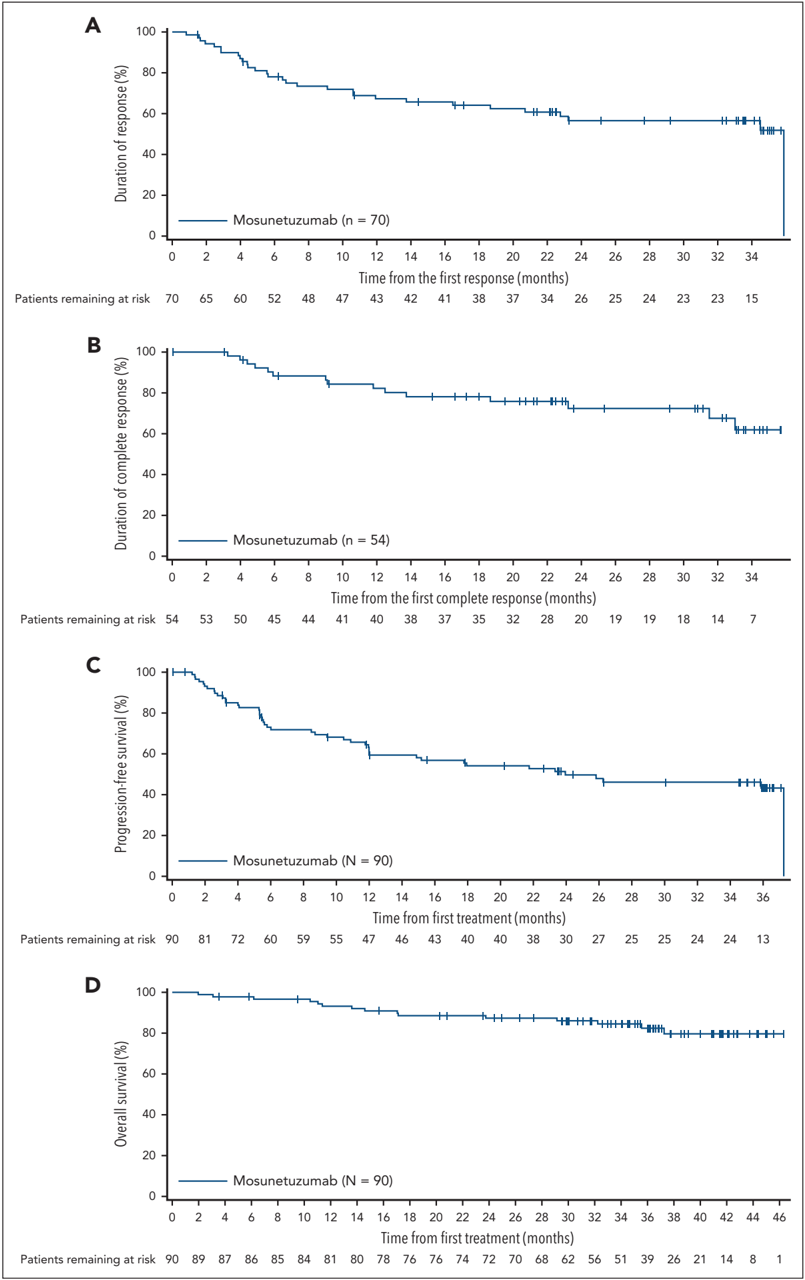
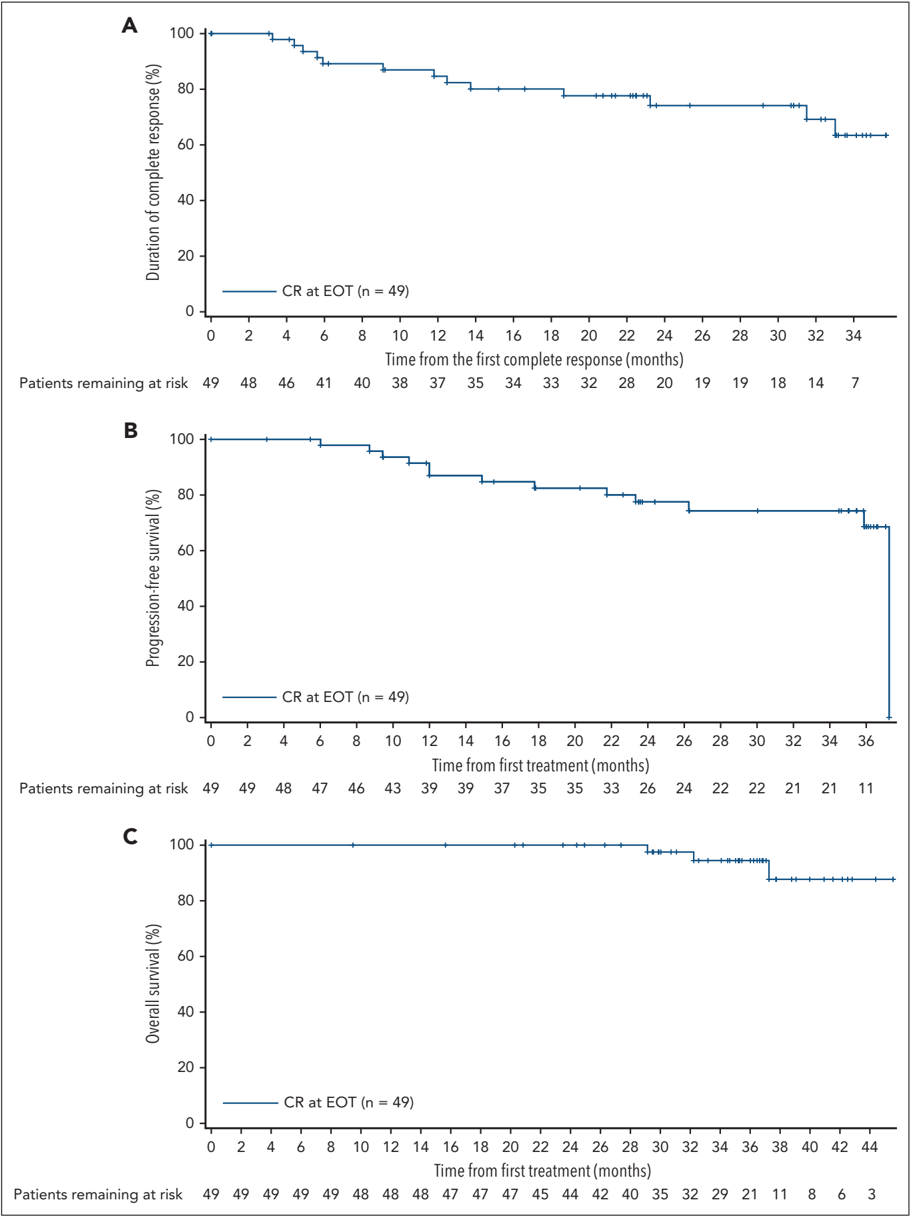
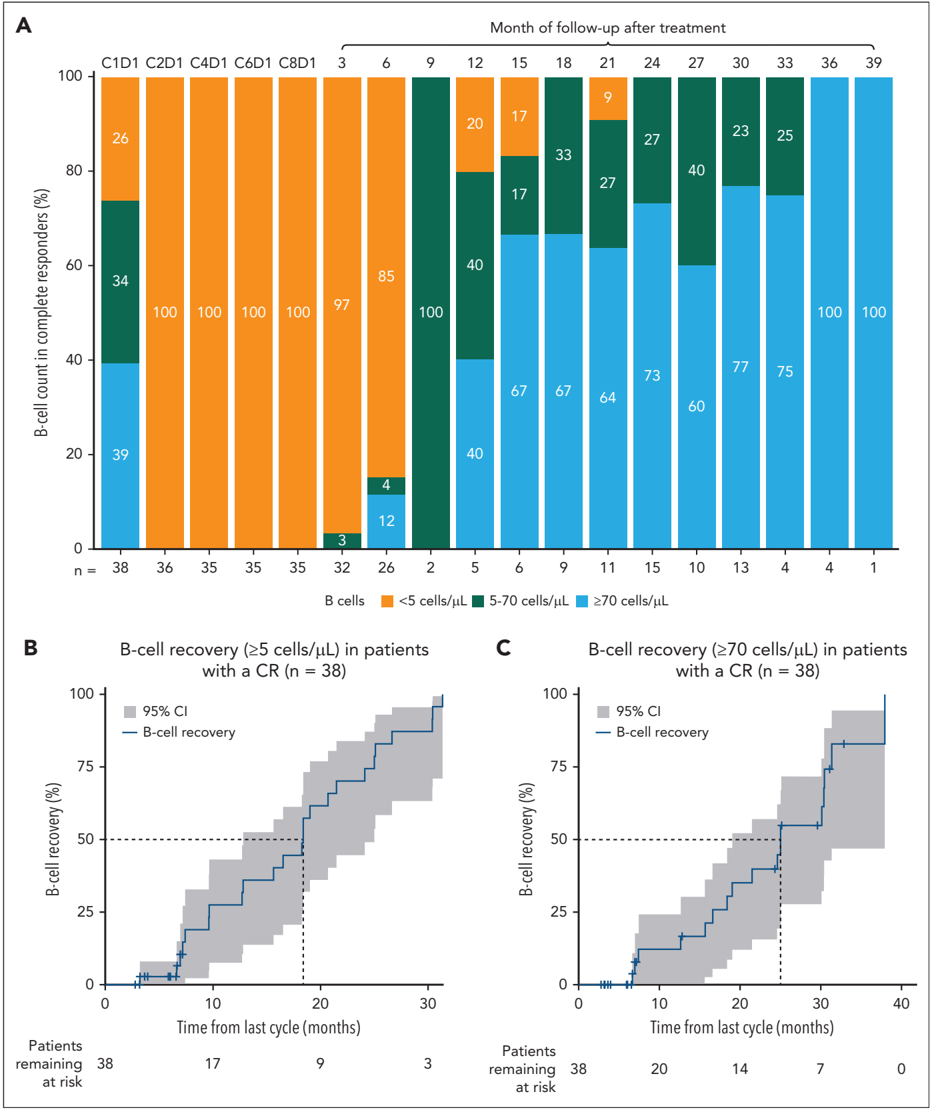
Mosunetuzumab, a CD20×CD3 T-cell engaging bispecific antibody, redirects T cells to eliminate malignant B cells. We present updated efficacy and safety data of a pivotal phase 1/2 study after a median follow-up of 37.4 months in 90 patients with relapsed/refractory (R/R) follicular lymphoma (FL) and ≥2 prior lines of therapy treated with fixed-duration mosunetuzumab. Investigator-assessed complete response (CR) rate and objective response rate were 60.0% (95% confidence interval [CI], 49.1-70.2) and 77.8% (95% CI, 67.8-85.9), respectively. Among 70 responders, median duration of response was 35.9 months (95% CI, 20.7 to not estimable [NE]). Among 54 patients who achieved CR, 49 remained in CR at the end of treatment; median duration of CR was not reached (NR; 95% CI, 33.0 to NE); Kaplan-Meier-estimated 30-month remission rate was 72.4% (95% CI, 59.2-85.6). Estimated 36-month overall survival (OS) rate was 82.4% (95% CI, 73.8-91.0); median OS was NR (95% CI, NE to NE). Median progression-free survival was 24.0 months (95% CI, 12.0 to NE). Median time to CD19+ B-cell recovery was 18.4 months (95% CI, 12.8-25.0) after 8 cycles of mosunetuzumab treatment. No new cytokine release syndrome events or fatal, serious, or grade ≥3 adverse events were reported. With extended follow-up, mosunetuzumab demonstrated high response rates, durable remissions, and manageable safety with no long-term concerns. This supports outpatient mosunetuzumab administration as an off-the-shelf, fixed-duration, safe, and effective treatment for patients with R/R FL, including those with high-risk disease. This trial was registered at www.clinicaltrials.gov as #NCT02500407.
Overview
The claims and statistics of this paper haven’t been checked yet.
Free: it reads the open-access text and checks the first 5 claims that cite a source we can check. Create a free account to check every claim.
Integrity signals
Registry
Cites
Statistics
Figures
Verification
Claims the paper makes
The claims and statistics of this paper haven’t been checked yet.
Free: it reads the open-access text and checks the first 5 claims that cite a source we can check. Create a free account to check every claim.
Claims other papers make about this one
Each is checked against this paper’s own text: does it say what the citing paper says it does?
The source backs part of the claim, not all of it — or backs it for a different population, condition or comparison.
In the citing paper
“which might represent a more treatment-resistant population than inMIND, where 7% of participants”
From Epcoritamab, lenalidomide, and rituximab versus lenalidomide and rituximab for relapsed or refractory follicular lymphoma (EPCORE FL-1): a global, open-label, randomised, phase 3 trial. (2026) · cites this paper as [26]
Experimental — accuracy not yet measuredThe source backs part of the claim, not all of it — or backs it for a different population, condition or comparison.
In the citing paper
“were higher for participants treated with epcoritamab plus R² due to overlapping toxicities in line with previous reports of T-cell engaging immunotherapies.”
From Epcoritamab, lenalidomide, and rituximab versus lenalidomide and rituximab for relapsed or refractory follicular lymphoma (EPCORE FL-1): a global, open-label, randomised, phase 3 trial. (2026) · cites this paper as [26]
Experimental — accuracy not yet measuredThe check wasn’t confident either way, so it gives no verdict — never disputed.
In the citing paper
“84% overall response rate”
From Epcoritamab, lenalidomide, and rituximab versus lenalidomide and rituximab for relapsed or refractory follicular lymphoma (EPCORE FL-1): a global, open-label, randomised, phase 3 trial. (2026) · cites this paper as [26]
Experimental — accuracy not yet measuredThe check wasn’t confident either way, so it gives no verdict — never disputed.
In the citing paper
“In the recently reported phase 3 inMIND trial, tafasitamab plus R² led to a 57% reduction in the risk of disease progression or death”
From Epcoritamab, lenalidomide, and rituximab versus lenalidomide and rituximab for relapsed or refractory follicular lymphoma (EPCORE FL-1): a global, open-label, randomised, phase 3 trial. (2026) · cites this paper as [26]
Experimental — accuracy not yet measuredThe check wasn’t confident either way, so it gives no verdict — never disputed.
In the citing paper
“minimal overlapping toxicities to R²”
From Epcoritamab, lenalidomide, and rituximab versus lenalidomide and rituximab for relapsed or refractory follicular lymphoma (EPCORE FL-1): a global, open-label, randomised, phase 3 trial. (2026) · cites this paper as [26]
Experimental — accuracy not yet measured
2 more claims about this paper
Create a free account to see every claim other papers make about this one.
Self-check
Percentages, sums and reported differences re-computed from the paper’s own numbers.
The self-check needs the paper’s full text.
Citations
Cites
Revised Response Criteria for Malignant Lymphoma
Cheson, B. D., Pfistner, B., Juweid, M. E., Gascoyne, R. D., Specht, L., Horning, S. J., Coiffier, B., Fisher, R. I., Hagenbeek, A., Zucca, E., et al. (2007) · Journal of Clinical Oncology · doi:10.1200/jco.2006.09.2403 · Cited by 4,426
Lee, D. W., Santomasso, B. D., Locke, F. L., Ghobadi, A., Turtle, C. J., Brudno, J. N., Maus, M. V., Park, J. H., Mead, E., Pavletic, S., et al. (2019) · Biology of Blood and Marrow Transplantation · doi:10.1016/j.bbmt.2018.12.758 · Cited by 3,675
Morin, R. D., Johnson, N. A., Severson, T. M., Mungall, A. J., An, J., Goya, R., Paul, J. E., Boyle, M., Woolcock, B. W., Kuchenbauer, F., et al. (2010) · Nature Genetics · doi:10.1038/ng.518 · Cited by 1,521
2016 US lymphoid malignancy statistics by World Health Organization subtypes
Teras, L. R., DeSantis, C. E., Cerhan, J. R., Morton, L. M., Jemal, A., & Flowers, C. R. (2016) · CA: A Cancer Journal for Clinicians · doi:10.3322/caac.21357 · Cited by 1,125
Inactivating mutations of acetyltransferase genes in B-cell lymphoma
Pasqualucci, L., Dominguez-Sola, D., Chiarenza, A., Fabbri, G., Grunn, A., Trifonov, V., Kasper, L. H., Lerach, S., Tang, H., Ma, J., et al. (2011) · Nature · doi:10.1038/nature09730 · Cited by 949
Obinutuzumab for the First-Line Treatment of Follicular Lymphoma
Marcus, R., Davies, A., Ando, K., Klapper, W., Opat, S., Owen, C., Phillips, E., Sangha, R., Schlag, R., Seymour, J. F., et al. (2017) · New England Journal of Medicine · doi:10.1056/nejmoa1614598 · Cited by 800
Jacobson, C. A., Chavez, J. C., Sehgal, A. R., William, B. M., Munoz, J., Salles, G., Munshi, P. N., Casulo, C., Maloney, D. G., de Vos, S., et al. (2022) · The Lancet Oncology · doi:10.1016/s1470-2045(21)00591-x · Cited by 666
Pastore, A., Jurinovic, V., Kridel, R., Hoster, E., Staiger, A. M., Szczepanowski, M., Pott, C., Kopp, N., Murakami, M., Horn, H., et al. (2015) · The Lancet Oncology · doi:10.1016/s1470-2045(15)00169-2 · Cited by 618
Self-citationMorschhauser, F., Tilly, H., Chaidos, A., McKay, P., Phillips, T., Assouline, S., Batlevi, C. L., Campbell, P., Ribrag, V., Damaj, G. L., et al. (2020) · The Lancet Oncology · doi:10.1016/s1470-2045(20)30441-1 · Cited by 604
Self-citationTisagenlecleucel in adult relapsed or refractory follicular lymphoma: the phase 2 ELARA trial
Fowler, N. H., Dickinson, M., Dreyling, M., Martinez-Lopez, J., Kolstad, A., Butler, J., Ghosh, M., Popplewell, L., Chavez, J. C., Bachy, E., et al. (2022) · Nature Medicine · doi:10.1038/s41591-021-01622-0 · Cited by 555
Self-citation
Research works printed but not linked: 2
- Assouline S, Bartlett NL, Matasar M, et al. Mosunetuzumab demonstrates clinically meaningful outcomes in high-risk patients with heavily pre-treated R/R FL after ≥3 years of follow-up: subgroup analysis of a pivotal phase II study. Hemasphere. 2024;8(S1): 288-289.
- van de Weil L, Hallard D, Ensari S, et al. Manufacturing commercial axicabtagene ciloleucel for European patients: a 2-year retrospective analysis [abstract]. Hemasphere. 2021;5(suppl 2):691.
Cited by
Bispecific antibodies: unleashing a new era in oncology treatment
Shui, L., Wu, D., Yang, K., Sun, C., Li, Q., & Yin, R. (2025) · Molecular Cancer · doi:10.1186/s12943-025-02390-y · Cited by 58
Falchi, L., Nijland, M., Huang, H., Linton, K. M., Seymour, J. F., Tao, R., Kwiatek, M., Costa, A., Vassilakopoulos, T. P., Greil, R., et al. (2026) · The Lancet · doi:10.1016/s0140-6736(25)02360-8 · Cited by 41
Reprogramming cancer immunity with next-generation combination therapies
Kyriakidis, N. C., Echeverría, C. E., Bautista, J., Rivera-Orellana, S., Ramos-Medina, M. J., Salazar-Santoliva, C., Izquierdo‐Condoy, J. S., Ortiz‐Prado, E., Guerrero, S. X., & López‐Cortés, A. (2025) · Frontiers in Cell and Developmental Biology · doi:10.3389/fcell.2025.1652047 · Cited by 33
Amoozgar, B., Bangolo, A., Habibi, M., Cho, C., & Goy, A. H. (2025) · International Journal of Molecular Sciences · doi:10.3390/ijms26115319 · Cited by 26
van Besien, H. J., Easwar, N., Demetres, M. R., Pasciolla, M. S., Shore, T. B., Leonard, J. P., Barker, J. N., Martin, P., & Yamshon, S. (2025) · Blood Advances · doi:10.1182/bloodadvances.2025016291 · Cited by 29
Caserta, S., Campo, C., Cancemi, G., Neri, S., Stagno, F., Mannina, D., & Allegra, A. (2025) · Cancers · doi:10.3390/cancers17152479 · Cited by 11
Bispecific Antibodies in Hematologic Malignancies: Attacking the Frontline
Shastri, T., Trabolsi, A., Arumov, A., & Schatz, J. H. (2025) · BioDrugs · doi:10.1007/s40259-025-00735-z · Cited by 18
“…2 multicenter single-arm trial with a median follow-up of 37.4 months, fixed-duration mosunetuzumab showed a 60% CR rate, which the investigators compared favorably to a historical CR rate of 14% for copanlisib, a PI3K inhibitor that was subsequently withdrawn from the market ( p 0.0001) [37].”
InfluentialCasulo, C., & Sehn, L. H. (2025) · Blood · doi:10.1182/blood.2024026018 · Cited by 12
Self-citationNahle, T., Shah, V., Farraj, S. A., & Atoui, A. (2025) · Journal of Pharmacology and Experimental Therapeutics · doi:10.1016/j.jpet.2025.103704 · Cited by 12
Xiao, A., Chen, L., Pak, S., Lee, B., Mei, M. G., Budde, L. E., Siddiqi, T., Godfrey, J. K., Herrera, A. F., Kallam, A., et al. (2025) · Leukemia & lymphoma/Leukemia and lymphoma · doi:10.1080/10428194.2025.2540442 · Cited by 10
“A similar phenomenon may be at work with BsAbs [6,14], where delayed B-cell recovery at a median of 18 months after completion of BsAbs has been described [15,16].”
InfluentialSelf-citationBorrelli, R., Brussino, L., Negrini, S., & Brizzi, M. F. (2025) · Pharmacological Research · doi:10.1016/j.phrs.2025.108000 · Cited by 7
Shah, N. N., Zinzani, P. L., Wang, M. L., Nasta, S. D., Lech‐Marańda, E., Ogawa, Y., Fakhri, B., Kuss, B. J., Miyashita, K., Patel, K., et al. (2025) · Blood Advances · doi:10.1182/bloodadvances.2024014975 · Cited by 6
“32,33 Tazemetostat, an enhancer of zeste homolog 2 inhibitor, is approved by the US Food and Drug Administration as a third-line treatment for patients with R/R FL, and has resulted in an ORR ranging from 35% to 69%, and durability of responses approximating a year, but again does not appear to…”
Self-citationNizamuddin, I. A., & Ghobadi, A. (2025) · American Society of Clinical Oncology Educational Book · doi:10.1200/edbk-25-473302 · Cited by 7
Martino, E. A., Caserta, S., Skafi, M., Alvaro, M. E., Bruzzese, A., Amodio, N., Lucia, E., Olivito, V., Labanca, C., Mendicino, F., et al. (2025) · European Journal Of Haematology · doi:10.1111/ejh.70105 · Cited by 5
Iacoboni, G., Kyvsgaard, E. R., Navarro, V., Russler‐Germain, D. A., Lewis, K. L., Martín, A., Carro, I., Thompson, P. A., Therwhanger, D., Quintela, D., et al. (2026) · Blood Advances · doi:10.1182/bloodadvances.2025018546 · Cited by 10
Self-citationPeñalver, F., Magnano, L., Álvarez, S. A., Jiménez-Ubieto, A., López‐Guillermo, A., & Sancho, J. (2026) · Cancers · doi:10.3390/cancers18030395 · Cited by 6
Follicular Lymphoma: Current Therapeutic Landscape and Future Prospects
Kumar, E. A., & Okosun, J. (2025) · Hematological Oncology · doi:10.1002/hon.70070 · Cited by 5
Towards a chemo‐free approach for follicular lymphoma
Luminari, S., Barbieri, E., & Nizzoli, M. E. (2025) · British Journal of Haematology · doi:10.1111/bjh.70126 · Cited by 6
T-cell engaging antibodies for B-cell lymphomas
Kim, D. H., & Kim, T. M. (2025) · Seminars in Hematology · doi:10.1053/j.seminhematol.2025.12.002 · Cited by 7
Poza, M., Martín-Muñoz, A., López‐Pereira, P., Figaredo, G., Zamanillo, I., Íñiguez, R., Oliveira, A. C., Baumann, T., Izquierdo, A. R., Grande, C., et al. (2025) · Cancers · doi:10.3390/cancers17071065 · Cited by 4
Ng, L. C. K., Lee, X. H., Tan, Y. C., Wong, K., Chow, J. C. Y., Ling, V. W. T., Thong, E. W. S., Chan, E. H. L., Chan, W. L., Samuel, M., et al. (2025) · Blood Cancer Journal · doi:10.1038/s41408-025-01439-x · Cited by 6
“Studies were then graded accordingly based on the NOS.”
Bartlett, N. L., Sehn, L. H., Assouline, S. E., Giri, P., Kuruvilla, J. G., Schuster, S. J., Yoon, S., Fay, K. C., Heß, G., Dreyling, M. H., et al. (2026) · American Journal of Hematology · doi:10.1002/ajh.70225 · Cited by 4
“In a pivotal Phase 2 study of 90 patients with R/R FL [9, 14, 15], mosunetuzumab IV demonstrated an objective response rate (ORR) of 80% with 60% of patients having complete responses (CR) and median PFS of 17.9 months, with consistent efficacy in patients with high-risk disease features and a…”
InfluentialSelf-citationMcCall, D. C., Catueno, S., Ramakrishnan, R., Tewari, P., Sheikh, I. N., Gibson, A., Núnêz, C., Garcia, M. B., & Cuglievan, B. (2025) · Acta Haematologica · doi:10.1159/000546249 · Cited by 5
“Glo fi tamab-gxbm and mosu-netuzumab-axgb, both targeting CD20, are examples of such agents; however, they are not currently being studied in B-ALL clinical trials [66, 67].”
Therapeutic Antibodies in Hematology: Advances in Malignant and Non-Malignant Disorders
Yasui, H., Idogawa, M., Ishida, T., & Imai, K. (2025) · Cells · doi:10.3390/cells15010046 · Cited by 5
“Mosunetuzumab, the first approved CD20 × CD3 bispecific antibody, induces serial T-cell–mediated cytotoxicity and has demonstrated high complete response rates in patients with heavily pretreated follicular lymphoma, including those refractory to anti-CD20 antibodies [5,6].”
Shadman, M. S., LeBlanc, M. L., Rimsza, L. M., Leonard, J. P., Smith, S. M., Li, H., & Friedberg, J. W. (2026) · JAMA Oncology · doi:10.1001/jamaoncol.2026.0042 · Cited by 6
Self-citationTen-Year Outcomes after CAR T-Cell Therapy for B-Cell Lymphomas
Ruella, M., Paruzzo, L., Chong, E. R., Chong, E. A., Landsburg, D. J., Nasta, S. D., Devi, P., Michener, P., Stella, F., Carturan, A., et al. (2026) · New England Journal of Medicine · doi:10.1056/nejmoa2518035 · Cited by 11
Self-citationCaracciolo, D., Lombardo, M. R., Reitano, G., Napoli, C., Fiorillo, L., Callerame, C., Garritano, M., Bulotta, A., Munir, M., Pensabene, G., et al. (2026) · British Journal of Haematology · doi:10.1111/bjh.70649 · Cited by 3
Zhuang, T., Zhang, C., & Strati, P. (2025) · Clinical Lymphoma Myeloma & Leukemia · doi:10.1016/j.clml.2025.01.021 · Cited by 4
T‐Cell Redirecting Strategies in Large B‐Cell Lymphoma and Follicular Lymphoma
Iacoboni, G. (2025) · Hematological Oncology · doi:10.1002/hon.70068 · Cited by 4
“Recently published long‐term follow‐up of mosunetuzumab showed a 36‐month PFS rate of 43%, among the 90 enrolled patients [126].”
Current landscape of frontline and relapsed follicular lymphoma trials
Ng, L. C. K., & Casulo, C. (2025) · Blood Neoplasia · doi:10.1016/j.bneo.2025.100131 · Cited by 3
“19 The phase 2 MorningSun trial (NCT05207670) supported mosunetuzumab use in the frontline setting for patients with low tumor burden FL. 22 Thirty patients were enrolled and the complete metabolic response rate was 83%.”
Giamaiou, P., Fioretzaki, R., Vassilakopoulos, T. P., & Dimou, M. (2026) · Medicina · doi:10.3390/medicina62061056 · Cited by 3
Lin, M.-H., Weiss, J., Phillips, T. J., Sano, D., Carty, S. A., Wilcox, R., Ghosh, M., Ahmed, I., Nachar, V. R., Hutton, D. W., et al. (2025) · Leukemia & lymphoma/Leukemia and lymphoma · doi:10.1080/10428194.2025.2506498 · Cited by 11
“…trial 2022 [13,20]; expert opinion for ranges Death after initial treatment mosun 0.01 (0.01–0.01) Dirichlet Calibrated to match clinical trial [12,17]; expert opinion for ranges axi-cel 0.01 (0.01–0.01) Dirichlet Calibrated to match clinical trial [14,18,19]; expert opinion tisa-cel 0.01…”
InfluentialSzymczyk, A., Drozd-Sokolowska, J. E., & Hus, I. (2025) · Cancers · doi:10.3390/cancers17152426 · Cited by 5
“In the next follow-up, Sehn et al. did not report any new AEs grade ≥ 3 [33].”
Kawasaki, N., Shu, S., Tomita, M., Liu, X., Yoshiura, S., & Yamashita‐Kashima, Y. (2025) · eJHaem · doi:10.1002/jha2.70169 · Cited by 5
“The efficacy and safety of mosunetuzumab in NHL has been studied in a single-arm, phase 2 study (NCT02500407) [12, 13].”
Ardah, M. T., Abdulsahib, W. K., Jasim, I. K., Malathi, H., Patro, P. S., Anand, D. A., Mukherjee, G., Sinha, A., & Aminqulov, S. (2026) · Discover Oncology · doi:10.1007/s12672-026-04735-5 · Cited by 2
“In non-Hodgkin lymphoma, updated 3-year follow-up data for mosunetuzumab in relapsed/refractory follicular lymphoma showed an estimated 36-month overall survival rate of 82.4%, with durable remissions persisting after the completion of fixed-duration therapy [70].”
InfluentialLuminari, S., Jiménez-Ubieto, A., Chong, G., Tucker, D., Ambati, S. R., Lin, C., Mohamed, H., Brouwer‐Visser, J., Otele, C. A., Antico, G., et al. (2026) · HemaSphere · doi:10.1002/hem3.70300 · Cited by 3
Owen, C., Lemieux, C., Bosch, M. J., Davison, K. L., Forward, N. A., Kanasara, R., Keating, M. M., Prica, A. A., Stewart, C., Vijenthira, A., et al. (2026) · Current Oncology · doi:10.3390/curroncol33080451 · Cited by 2
Self-citationPerspectives on T-cell engaging therapies in relapsed/refractory indolent non-Hodgkin lymphoma
Bakker, M., Kuipers, M. T., Kersten, M. J., Tonino, S. H., & Serroukh, Y. I. M. (2025) · Current Opinion in Oncology · doi:10.1097/cco.0000000000001160 · Cited by 1
Current state-of-the-art of immunotherapy in follicular lymphoma
McKeague, S. J., Thompson, P., & Seymour, J. F. (2025) · Expert Review of Hematology · doi:10.1080/17474086.2025.2522956 · Cited by 1
“[42,47].”
Immunotherapy in Chronic Lymphocytic Leukemia
Sworder, B. J., & Siddiqi, T. (2025) · Hematology/Oncology Clinics of North America · doi:10.1016/j.hoc.2025.05.010 · Cited by 1
Guarini, A., Bozzoli, V., Ciavarella, S., Cimminiello, M., Donatelli, F., Famà, A., Fesce, V. F., Fraticelli, V. L., Gaudio, F., Greco, G., et al. (2025) · Frontiers in Oncology · doi:10.3389/fonc.2025.1627175 · Cited by 1
Park, S. Y., & Min, G. J. (2025) · Blood Research · doi:10.1007/s44313-025-00105-2 · Cited by 1
Sadowska‐Klasa, A., Bełdzińska, K., Klein-Awerjanow, K., Naumiuk, Ł., & Zaucha, J. M. (2025) · International Journal of Infectious Diseases · doi:10.1016/j.ijid.2025.108231 · Cited by 1
KOBAYASHI, T. (2025) · Journal of the Japan Society of the Reticuloendothelial System · doi:10.3960/jslrt.25050 · Cited by 1
Akkad, N., & Flowers, C. R. (2026) · Clinical Lymphoma Myeloma & Leukemia · doi:10.1016/j.clml.2025.12.013 · Cited by 1
Makita, S., Izutsu, K., Mishima, Y. M., Kumode, T., Kuroda, J., Kanemura, N., Fukuhara, N., Shimada, K., Mori, C., Kawasaki, A., et al. (2026) · International Journal of Clinical Oncology · doi:10.1007/s10147-025-02957-1 · Cited by 1
Rajendraprasad, M., & Riches, J. C. (2026) · OncoTargets and Therapy · doi:10.2147/ott.s581821 · Cited by 1
“21 Notably, mosunetuzumab has gained provisional European Medicines Agency (EMA) clearance for R/R follicular lymphoma and is being studied in DLBCL. 22 These clinical results demonstrate the wide-ranging therapeutic potential of bsAbs in DLBCL, exhibiting effectiveness in a variety of patient demographics, including…”
InfluentialPrecision Immunotherapy: Revolutionizing Cancer Treatment With Targeted Innovations
Ahn, M., Szabados, B. E., Ince, W., Kim, J., Ku, B. M., & Keenan, B. P. (2026) · American Society of Clinical Oncology Educational Book · doi:10.1200/edbk-26-517508 · Cited by 1
Martins, E., Chindalore, V. L., Sheng, X. R., Schroeder, A., Chen, V., Mody, H. R., Arjomandi, A., Mao, H. A., Hassan, I., Dankiewicz-Fares, I., et al. (2026) · Lupus Science & Medicine · doi:10.1136/lupus-2026-002019 · Cited by 7
Saleh, L. H., Ata, A. A., Alshaboul, F., Alani, A., & Askar, M. Z. (2026) · Current Research in Translational Medicine · doi:10.1016/j.retram.2026.103601 · Cited by 1
Baron, J. A., Chelius, M. R., Singh, G., Schad, M. D., Berger, M., Chong, E. R., Thomas, C. J., Carter, J. S., Cook, M. R., Nasta, S. D., et al. (2026) · Clinical Lymphoma Myeloma & Leukemia · doi:10.1016/j.clml.2026.07.004 · Cited by 1
Self-citationAhmed, S., Martı́n, A., Reguera, J. L., Cartron, G., Rapoport, A. P., Izutsu, K., Ghesquières, H., Goto, H., Palomba, M. L., Abramson, J. S., et al. (2026) · Blood · doi:10.1182/blood.2026034327 · Cited by 1
Self-citationFollicular Lymphoma: Novel Therapies and Strategies for Optimal Therapeutic Sequencing
Fonseca, R., & Hilal, T. (2026) · Current Oncology Reports · doi:10.1007/s11912-026-01803-5 · Cited by 1
Next-generation immune cell engagers for B cell depletion in autoimmune diseases
Fu, Y., Robert, B., Bitoun, S., Martineau, P., Konig, M. F., Avouac, J., Tsokos, G. C., Ye, S., & Scherlinger, M. (2026) · Nature Reviews Drug Discovery · doi:10.1038/s41573-026-01534-z · Cited by 1
Mosunetuzumab next up to bat … is it a home run?
Karmali, R., & Winter, J. N. (2025) · Blood · doi:10.1182/blood.2024027223
Follikuläres Lymphom: Standardtherapien und aktuelle Entwicklungen
Meis, S., Hübel, K., & Pott, C. (2025) · Die Onkologie · doi:10.1007/s00761-025-01709-0
Peptidbasierte Immuntherapie: Gezielte T-Zell Aktivierung gegen Krebs
Maringer, Y., & Walz, J. S. (2025) · Forum · doi:10.1007/s12312-025-01459-5
Lossos, I. S. (2025) · Clinical Lymphoma Myeloma & Leukemia · doi:10.1016/j.clml.2025.05.021
Woodford, R. G., & Lim, K. H. J. (2025) · Elsevier eBooks · doi:10.1016/b978-0-12-824465-4.00236-2
EXABS-221-IBCL: Novel Immunotherapy Combinations in Indolent Lymphoma
Geva, M., & Falchi, L. (2025) · Clinical Lymphoma Myeloma & Leukemia · doi:10.1016/s2152-2650(25)00356-8
Cellular Therapy and Follicular Lymphoma: Where Do We Stand in 2025?
El-Haddad, H., & Cherniawsky, H. M. (2025) · Canadian Hematology Today · doi:10.58931/cht.2025.4271
Kungwankiattichai, S., & Maziarz, R. T. (2025) · Expert Opinion on Drug Discovery · doi:10.1080/17460441.2025.2567291
“However, no clear response plateau was observed at this point in the follow-up [72,77].”
Sequencing Cellular Therapies in the Management of Follicular Lymphoma
Jóna, Á., & Illés, Á. (2025) · Cells · doi:10.3390/cells14211671
Canichella, M., Cerretti, R., Trawinska, M. M., Cefalo, M., Cupelli, L., Mazzone, C., Checcoli, A., Rocco, A. D., de Fabritiis, P., & Abruzzese, E. (2025) · Targets · doi:10.3390/targets3040037
“%) with a more favorable hematologic and infectious toxicity profile [14,15], offering an off-the-shelf option suitable for rapid disease control to maintain transplant eligibility.”
Bispecific antibody combination regimens for B-cell non-Hodgkin’s lymphomas
Jhaveri, K. S., Saha, A., Salcedo, L. M. J., & Chávez, J. C. (2025) · Expert Opinion on Biological Therapy · doi:10.1080/14712598.2025.2597847
“At a median follow-up of 37.4 months, the ORR was 78%, with a CR rate of 60% (95% CI, 49.1–70.2), significantly exceeding historical benchmarks for the third-line FL ( p 0.0001) [21].”
InfluentialСергеевич, Б. Л., Sannikova, M. A., Krylova, Y. V., Vlasova, S. V., Babaeva, F., Sychevskaya, K. A., Анатольевна, Ж. В., Urnova, E. S., Bulusov, M. P., Kravchenko, S., et al. (2025) · Oncohematology · doi:10.17650/1818-8346-2025-20-4-24-31
Hämatologische Neoplasien und solide Tumore
Ganser, A., Hertenstein, B., & Ludwig, W. (2026) · Springer eBooks · doi:10.1007/978-3-662-72738-6_5
Wang, Y.-Q., Wang, K., Yu, H., Yang, K., Li, D.-Y., Wang, Y., Liu, Y., Jiao, M., & Wang, S.-Y. (2026) · Frontiers in Oncology · doi:10.3389/fonc.2026.1781821
Gezielte T-Zell-Aktivierung gegen Krebs
Walz, J. S., & Maringer, Y. (2026) · InFo Hämatologie + Onkologie · doi:10.1007/s15004-025-1228-y
Dyakov, I. N., & Константиновна, Б. К. (2026) · Kachestvennaya Klinicheskaya Praktika = Good Clinical Practice · doi:10.37489/2588-0519-gcp-0020
Сергеевич, К. И., Сергеевна, К. В., Ermakova, V. Y., Kurkin, D. V., Kolosov, Y. A., Смольянинова, А. К., Васильевна, П. Л., & Zvonkov, E. E. (2026) · Kachestvennaya Klinicheskaya Praktika = Good Clinical Practice · doi:10.37489/2588-0519-gcp-0019
Boardman, A. P., Ortega, J. L. R., Wang, P., Bar, M., Kumar, J., Farazi, T. A., García-Sancho, A. M., & Izutsu, K. (2026) · Advances in Therapy · doi:10.1007/s12325-026-03596-2
“…use in the 3L+ setting include chimeric antigen receptor (CAR) T cell therapies, CD20 × CD3 bispecific T cell‑ engaging monoclonal antibodies [14, 15], the Bruton tyrosine kinase inhibitor zanubrutinib Keywords: CAR T cell therapy; Lisocabtagene maraleucel; Axicabtagene ciloleucel;…”
Kawczak, P., & Bączek, T. (2026) · Journal of Clinical Medicine · doi:10.3390/jcm15124425
Odronextamab: a bispecific antibody for follicular lymphoma
García-Sancho, A. M., Cabero-Martínez, A., & Gutiérrez, N. C. (2026) · Expert Opinion on Investigational Drugs · doi:10.1080/13543784.2026.2689652 · Cited by 1
Burke, O. J., Peruzzo, N., Khan, N. T. A., & Kancharla, P. (2026) · Cureus · doi:10.7759/cureus.111312
“…with published KM curves and accompanying numbers-at-risk tables: axi-cel (ZUMA-5) [3,4], tisa-cel (ELARA) [5,6], liso-cel (TRANSCEND FL) [7], mosunetuzumab [8,9], epcoritamab (EPCORE NHL-1 follicular cohort) [10], and zanubrutinib plus obinutuzumab versus obinutuzumab monotherapy (ROSEWOOD) [11].”
Cheng, M., Li, W., Liu, M., & Zou, L. (2026) · International Journal of Cancer · doi:10.1002/ijc.70602
“Single-agent CD20 × CD3 BsAbs have demonstrated outstanding efficacy ( C o n t i n u e s ) in R/R FL, with ORRs around 80% and CR rates of 60%–73%, along with a favorable safety profile (mostly low-grade CRS, rare ICANS) [25, 89–91].”
Mao, Y., Jia, Z. S., Mu, X., Wang, R. L., Ma, J., Zhang, Q., & Deng, Y. (2026) · Advanced Science · doi:10.1002/advs.76656
Shouse, G. (2026) · Human Vaccines & Immunotherapeutics · doi:10.1080/21645515.2026.2712177
CAR T cells against the B cell receptor to precisely eliminate pathogenic B cells
Bochi-Layec, A. C., Cohen, I. J., Lemoine, J., & Ruella, M. (2026) · Molecular Therapy Oncology · doi:10.1016/j.omton.2026.201297
Exploring Bispecific Antibodies for Multifaceted Cancer Targeting
Singh, S., Saxena, S., Barnwal, A., Domadia, D., Thakur, S., & Shukla, S. (2026) · Springer eBooks · doi:10.1007/978-981-92-0477-9_8
Advances in Oncohematology Immunotherapy: Monoclonal Antibodies and CAR T-Cell Therapies
Mathias, F., Fersing, C., Bourgarel‐Rey, V., Gabert, J. A., & Peyron, F. (2026) · Cells · doi:10.3390/cells15161439
Lynch, R. C., Poh, C., Shadman, M. S., Till, B. G., Di, M., Ujjani, C. S., Raghunathan, V. M., Smith, S. D., Maloney, D. G., Gausman, D., et al. (2026) · Journal of Clinical Oncology · doi:10.1200/jco-25-02906
Self-citationLi, S., Huang, J., Fang, R., Zhang, M., Jin, Y., Zhu, Y., & Ma, C. (2026) · Seminars in Oncology · doi:10.1016/j.seminoncol.2026.152541
Chan, W. L., Chng, W. J., & Li, Q.-J. (2026) · Biomarker Research · doi:10.1186/s40364-026-00985-1
“The approval of three anti-CD19 CAR T-cell therapies [19–21], three CD3×CD20 bispecific antibodies [22–24], and numerous small molecule inhibitors [25–28] has further transformed clinical outcomes.”
Karr, M., & Patel, K. (2026) · Clinical Lymphoma Myeloma & Leukemia · doi:10.1016/s2152-2650(26)00348-4
EXABS-220-IBCL: How to Incorporate Bispecific Antibodies in Follicular Lymphoma
Burke, J. M. (2026) · Clinical Lymphoma Myeloma & Leukemia · doi:10.1016/s2152-2650(26)00338-1
Lou, J., & Lyu, Y. (2026) · Journal of Hematology & Oncology · doi:10.1186/s13045-026-01843-1
Advances in antibody-mediated rejection of renal allografts
Song, B., Sun, J., Hu, C., & Liu, X. (2026) · Frontiers in Immunology · doi:10.3389/fimmu.2026.1951717
“CD3-CD20 bispeci fi c antibodies are established in hematologic malignancies and provide a conceptual rationale for dual immune-cell targeting, but current lymphoma data should not be presented as direct evidence for AMR treatment (92).”
Law, Y. C., & Chan, J. Y. (2026) · Biomarker Research · doi:10.1186/s40364-026-01008-9
Yitzhak, L., Arbel, Y. S., Bronstein, Y., Katz, B., & Herishanu, Y. (2026) · Frontiers in Immunology · doi:10.3389/fimmu.2026.1948967
Advances in CAR-T and CAR-NK Cell Therapy in Follicular Lymphoma: A Review
Yan, S., Liu, W., Zhou, M., & Xiao, Y. (2026) · Transplantation and Cellular Therapy · doi:10.1016/j.jtct.2026.10.001
Fischer, C., Eugster, A., Besemer, B., Buchi, M., Bauer, M., Schultheiß, C., D’Arcangelo, E., Filipsky, F., Wickenhauser, C., Wilfer, A., et al. (2026) · bioRxiv (Cold Spring Harbor Laboratory) · doi:10.64898/2026.10.19.760040
“CD3-engaging bispecific antibodies (bsAbs) physically bridge tumor cells and T cells and have transformed the treatment of B cell lymphoma, multiple myeloma and small-cell lung cancer (16-18), and the engineering principles for such formats are well established (19).”
Ruben, J. M., Mousset, C. M., van de Berg, D., Hofman, K., de Jong, M., Brouwer, P., Graeve, S., Iglesias‐Guimarais, V., van Helden, P. M., Adang, A. E. P., et al. (2026) · Clinical Immunology · doi:10.1016/j.clim.2026.110786
Metadata
- Authors
- Sehn, L. H., Bartlett, N. L., Matasar, M. J., Schuster, S. J., Assouline, S. E., Giri, P., Kuruvilla, J., Shadman, M., Cheah, C. Y., Dietrich, S., Fay, K., Ku, M., Nastoupil, L. J., Wei, M. C., Yin, S., To, I., Kaufman, D., Kwan, A., Penuel, E., Bolen, C. R., & Budde, L. E.
- Affiliations
- BC Cancer Agency (CA)
- Washington University in St. Louis (US)
- Rutgers Cancer Institute (US)
- Abramson Cancer Center (US)
- Jewish General Hospital (CA)
- Royal Adelaide Hospital (AU)
- Princess Margaret Cancer Centre (CA)
- Fred Hutch Cancer Center (US)
- The University of Western Australia (AU)
- Heidelberg University (DE)
- Royal North Shore Hospital (AU)
- The University of Melbourne (AU)
- The University of Texas MD Anderson Cancer Center (US)
- Genentech (US)
- City Of Hope National Medical Center (US)
- Corresponding author
- Budde, Lihua E.
- ORCID
- Venue
- Blood
- Publisher
- American Society of Hematology
- Published
- 2025-02-13
- Volume
- 145
- Issue
- 7
- Pages
- 708-719
- ISSN
- 0006-4971 (ISSN-L)
- 1528-0020
- OpenAlex
- W4403709325
- Semantic Scholar
- 13ced44ed5d485e573f9c8fa6f133c3f15a6b8c5
- Cited by
- 94
- References
- 39
- Citations by year
- 2026: 48 · 2025: 46
- FWCI
- 28.58
- Type
- journal article
- Language
- en
- Open access
- hybrid
- doi.org
- Licence
- cc-by-nc-nd
- Locations
- Blood (publishedVersion, cc-by-nc-nd)
- PubMed (publishedVersion)
- PubMed Central (publishedVersion, cc-by-nc-nd)
- Digital Commons@Becker (Washington University School of Medicine) (submittedVersion, cc-by-nc-nd)
- UWA Profiles and Research Repository (UWA) (submittedVersion, cc-by-nc-nd)
- Minerva Access (University of Melbourne) (submittedVersion, cc-by-nc-nd)
- Funders
- Amgen
- Bristol-Myers Squibb
- Eli Lilly and Company
- Pfizer
- AstraZeneca
- Gilead Sciences
- Teva Pharmaceutical Industries
- Celgene
- F. Hoffmann-La Roche
- TG Therapeutics
- MEI Pharma
- BeiGene
- Incyte
- Royal Adelaide Hospital
- MorphoSys
- Genentech
- Kite Pharma
- Pharmacyclics
- Janssen Research and Development
- Daiichi Sankyo Europe
- Topics
- Health Sciences › Medicine › Pathology and Forensic Medicine › Lymphoma Diagnosis and Treatment
- Health Sciences › Medicine › Hematology › Chronic Lymphocytic Leukemia Research
- Health Sciences › Medicine › Dermatology › Cutaneous lymphoproliferative disorders research
- Keywords
- mosunetuzumab, relapsed/refractory follicular lymphoma, T-cell engagers, fixed-duration treatment, complete response, duration of response, overall survival, progression-free survival, B cell recovery, cytokine release syndrome, long-term safety, high-risk follicular lymphoma
- MeSH terms
- Antineoplastic Agents, Immunological, Adult, Aged, Aged, 80 and over, Female, Follow-Up Studies, Humans, Lymphoma, Follicular, Male, Middle Aged, Neoplasm Recurrence, Local, Recurrence, Antibodies, Bispecific
About these checks
Registry, retraction, Cites and statistics results are computed, not judged, with one exception: a printed reference that no index lists is read once by a model before it counts as a citation error. Claims are extracted by a model and kept only when their quote appears verbatim in the text; each cited source is then checked, with a model’s help, for whether it says what the claim relies on. Those verdicts can be wrong — read the claim’s quote and the cited source before relying on one.
Statistics and arithmetic are recomputed, not judged.
Confidence bands are shown only for fields calibrated on our annotated test set. None is calibrated yet, so no band is shown.
What counts as a claim ›How we measure confidence ›How we check this ›
Are you an author, or do you see a problem with this page? Request a review
Data sources
Bibliographic data: Semantic Scholar, OpenAlex, Crossref.
Contains information from the Semantic Scholar Academic Graph Datasets, made available under the ODC Attribution License (ODC-BY 1.0).
Semantic Scholar’s data is described in: Kinney, R., et al. (2023). The Semantic Scholar Open Data Platform. arXiv:2301.10140.
