

Clonal expansion of CAR T cells harboring lentivector integration in the CBL gene following anti-CD22 CAR T-cell therapy
The DOI matches its Crossref record; 32 of the 32 references it cites were found in a registry or an index.
Abstract
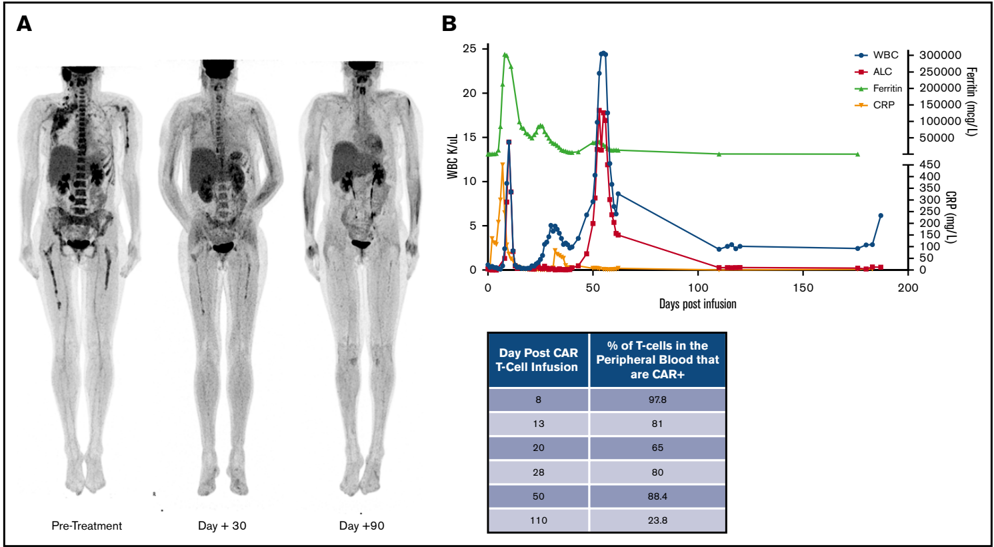
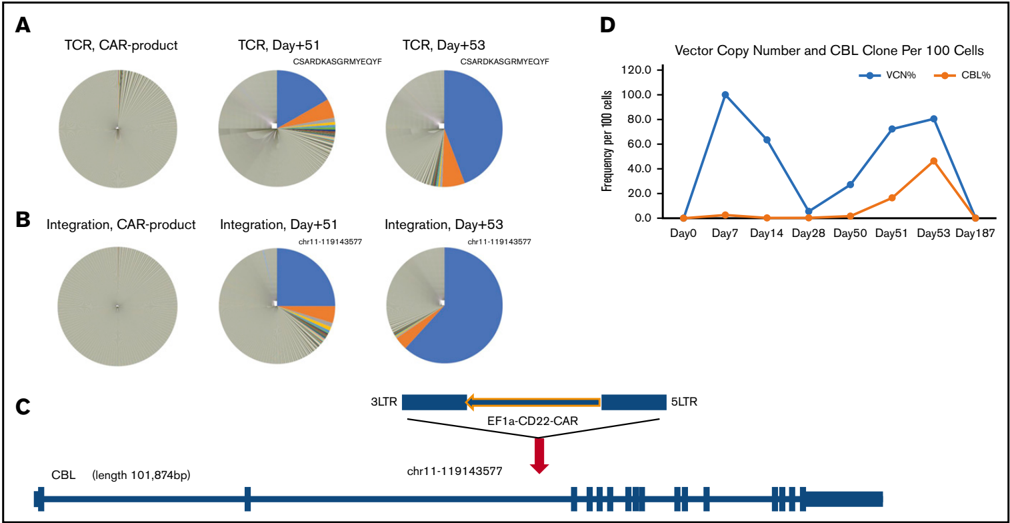
Key Points: Reexpansion of CAR T cells led to further investigations which confirmed the clonal nature of this expansion.
Overview
The claims and statistics of this paper haven’t been checked yet.
Free: it reads the open-access text and checks the first 5 claims that cite a source we can check. Create a free account to check every claim.
Integrity signals
Registry
Cites
Statistics
Figures
Verification
Claims the paper makes
The claims and statistics of this paper haven’t been checked yet.
Free: it reads the open-access text and checks the first 5 claims that cite a source we can check. Create a free account to check every claim.
Claims other papers make about this one
Each is checked against this paper’s own text: does it say what the citing paper says it does?
In the citing paper
“Lentiviral integrationmediated disruption of loci encoding genes mutated in CH has also been associated with cell-intrinsic alterations in CAR T cell expansion and differentiation [183][184][185] .”
From Clonal haematopoiesis and dysregulation of the immune system (2023) · cites this paper as [184]
Self-check
Percentages, sums and reported differences re-computed from the paper’s own numbers.
The self-check needs the paper’s full text.
Citations
Cites
Axicabtagene Ciloleucel CAR T-Cell Therapy in Refractory Large B-Cell Lymphoma
Neelapu, S. S., Locke, F. L., Bartlett, N. L., Lekakis, L. J., Miklos, D. B., Jacobson, C. A., Braunschweig, I., Oluwole, O. O., Siddiqi, T., Lin, Y., et al. (2017) · New England Journal of Medicine · doi:10.1056/nejmoa1707447 · Cited by 6,030
Tisagenlecleucel in children and young adults with B-cell lymphoblastic leukemia
Maude, S. L., Laetsch, T. W., Buechner, J., Rives, S., Boyer, M., Bittencourt, H., Bader, P., Verneris, M. R., Stefanski, H. E., Myers, G. D., et al. (2018) · New England Journal of Medicine · doi:10.1056/nejmoa1709866 · Cited by 5,735
LMO2 -Associated Clonal T Cell Proliferation in Two Patients after Gene Therapy for SCID-X1
Hacein-Bey-Abina, S., Von Kalle, C., Schmidt, M., McCormack, M. P., Wulffraat, N., Leboulch, P., Lim, A., Osborne, C. S., Pawliuk, R., Morillon, E., et al. (2003) · Science · doi:10.1126/science.1088547 · Cited by 3,587
Lee, D. W., Kochenderfer, J. N., Stetler-Stevenson, M., Cui, Y. K., Delbrook, C., Feldman, S. A., Fry, T. J., Orentas, R., Sabatino, M., Shah, N. N., et al. (2015) · The Lancet · doi:10.1016/s0140-6736(14)61403-3 · Cited by 2,898 · cited 1×
“Following this peak expansion, there is typically a contraction in the number of CAR T cells, potentially followed by low-level persistence.(1,7) Reexpansion of CAR T cells from the original infusion following the contraction phase, to a level exceeding the initial peak, is highly unusual, as is a clonal expansion.”
BackgroundInfluentialSelf-citationCurrent concepts in the diagnosis and management of cytokine release syndrome.
Lee, D. W., Gardner, R., Porter, D. L., Louis, C. U., Ahmed, N., Jensen, M., Grupp, S. A., & Mackall, C. L. (2014) · Blood · doi:10.1182/blood-2014-05-552729 · Cited by 2,806
Long-Term Follow-up of CD19 CAR Therapy in Acute Lymphoblastic Leukemia
Park, J. H., Rivière, I., Gonen, M., Wang, X., Sénéchal, B., Curran, K. J., Sauter, C., Wang, Y., Santomasso, B., Mead, E., et al. (2018) · New England Journal of Medicine · doi:10.1056/nejmoa1709919 · Cited by 2,688
HIV-1 Integration in the Human Genome Favors Active Genes and Local Hotspots
Schröder, A. R. W., Shinn, P., Chen, H., Berry, C., Ecker, J. R., & Bushman, F. (2002) · Cell · doi:10.1016/s0092-8674(02)00864-4 · Cited by 1,832 · cited 1×
“However, lentiviral vectors do preferentially integrate into actively transcribed genes, which still poses potential risk of mutagenesis.(14,17) This concern is enhanced by the demonstration that insertion of an HIV provirus within specific regions of the MKL2 and BACH2 genes in HIVinfected patients can cause a clonal…”
BackgroundSelf-Inactivating Lentivirus Vector for Safe and Efficient In Vivo Gene Delivery
Zufferey, R., Dull, T., Mandel, R. J., Bukovsky, A., Quiroz, D., Naldini, L., & Trono, D. (1998) · Journal of Virology · doi:10.1128/jvi.72.12.9873-9880.1998 · Cited by 1,815
Fry, T. J., Shah, N. N., Orentas, R. J., Stetler-Stevenson, M., Yuan, C. M., Ramakrishna, S., Wolters, P., Martin, S., Delbrook, C., Yates, B., et al. (2018) · Nature Medicine · doi:10.1038/nm.4441 · Cited by 1,335
Self-citationTranscription Start Regions in the Human Genome Are Favored Targets for MLV Integration
Wu, X., Li, Y., Crise, B., & Burgess, S. M. (2003) · Science · doi:10.1126/science.1083413 · Cited by 1,305 · cited 1×
“However, lentiviral vectors do preferentially integrate into actively transcribed genes, which still poses potential risk of mutagenesis.(14,17) This concern is enhanced by the demonstration that insertion of an HIV provirus within specific regions of the MKL2 and BACH2 genes in HIVinfected patients can cause a clonal…”
BackgroundSelf-citation
Cited by
Narayan, V., Barber-Rotenberg, J. S., Jung, I.-Y., Lacey, S. F., Rech, A. J., Davis, M. M., Hwang, W.-T., Lal, P., Carpenter, E. L., Maude, S. L., et al. (2022) · Nature Medicine · doi:10.1038/s41591-022-01726-1 · Cited by 533
Shah, N. N., Highfill, S. L., Shalabi, H., Yates, B., Jin, J., Wolters, P. L., Ombrello, A., Steinberg, S. M., Martin, S., Delbrook, C., et al. (2020) · Journal of Clinical Oncology · doi:10.1200/jco.19.03279 · Cited by 421
Self-citationImproving CAR-T immunotherapy: Overcoming the challenges of T cell exhaustion
Gumber, D., & Wang, L. D. (2022) · eBioMedicine · doi:10.1016/j.ebiom.2022.103941 · Cited by 396
CAR-T cell manufacturing: Major process parameters and next-generation strategies
Ayala Ceja, M., Khericha, M., Harris, C. M., Puig-Saus, C., & Chen, Y. Y. (2024) · Journal of Experimental Medicine · doi:10.1084/jem.20230903 · Cited by 303
T cell lymphoma and secondary primary malignancy risk after commercial CAR T cell therapy
Ghilardi, G., Fraietta, J. A., Gerson, J. N., Van Deerlin, V. M., Morrissette, J. J. D., Caponetti, G. C., Paruzzo, L., Harris, J. C., Chong, E. A., Susanibar Adaniya, S. P., et al. (2024) · Nature Medicine · doi:10.1038/s41591-024-02826-w · Cited by 270
Challenges and new technologies in adoptive cell therapy
Zhang, P., Zhang, G., & Wan, X. (2023) · Journal of Hematology & Oncology · doi:10.1186/s13045-023-01492-8 · Cited by 259
Micklethwaite, K. P., Gowrishankar, K., Gloss, B. S., Li, Z., Street, J. A., Moezzi, L., Mach, M. A., Sutrave, G., Clancy, L. E., Bishop, D. C., et al. (2021) · Blood · doi:10.1182/blood.2021010858 · Cited by 226
Ottaviano, G., Georgiadis, C., Gkazi, S. A., Syed, F., Zhan, H., Etuk, A., Preece, R., Chu, J., Kubat, A., Adams, S., et al. (2022) · Science Translational Medicine · doi:10.1126/scitranslmed.abq3010 · Cited by 199
“There have been two reports of lentiviral-induced T cell clonal expansion, both in the CAR setting (26, 27), and both were viewed as supporting leukemic clearance.”
BackgroundSleeping Beauty–engineered CAR T cells achieve antileukemic activity without severe toxicities
Magnani, C. F., Gaipa, G., Lussana, F., Belotti, D., Gritti, G., Napolitano, S., Matera, G., Cabiati, B., Buracchi, C., Borleri, G., et al. (2020) · Journal of Clinical Investigation · doi:10.1172/jci138473 · Cited by 195
“As documented in CAR T cell trials using viral vectors, vector insertion within the CBL oncogene and disruption of the normal TET2 allele were reported (56, 57).”
BackgroundClonal haematopoiesis and dysregulation of the immune system
Belizaire, R., Wong, W. J., Robinette, M. L., & Ebert, B. L. (2023) · Nature Reviews Immunology · doi:10.1038/s41577-023-00843-3 · Cited by 161
“Lentiviral integration-mediated disruption of loci encoding genes mutated in CH has also been associated with cell-intrinsic alterations in CAR T cell expansion and differentiation 183–185 .”
Li, D., Li, N., Zhang, Y.-F., Fu, H., Feng, M., Schneider, D., Su, L., Wu, X., Zhou, J., Mackay, S., et al. (2020) · Gastroenterology · doi:10.1053/j.gastro.2020.02.011 · Cited by 159
Self-citation
Metadata
- Authors
- Shah, N. N., Qin, H., Yates, B., Su, L., Shalabi, H., Raffeld, M., Ahlman, M. A., Stetler-Stevenson, M., Yuan, C., Guo, S., Liu, S., Hughes, S. H., Fry, T. J., & Wu, X.
- Affiliations
- Pediatric Oncology Branch, Center for Cancer Research, National Cancer Institute (NCI), National Institutes of Health (NIH), Bethesda, MD;
- Cancer Research Technology Program, Leidos Biomedical Research, Inc., Frederick National Laboratory for Cancer Research, Frederick, MD;
- Molecular Diagnostics Section, Laboratory of Pathology, Center for Cancer Research, NCI, NIH, Bethesda, MD;
- Radiology and Imaging Sciences, NIH Clinical Center, Bethesda, MD;
- Flow Cytometry, Department of Pathology, NCI, NIH, Bethesda, MD;
- HIV Dynamics and Replication Program, NCI, NIH, Frederick, MD;
- Venue
- Blood Advances
- Publisher
- American Society of Hematology
- Published
- 2019-08-06
- Volume
- 3
- Issue
- 15
- Pages
- 2317-2322
- ISSN
- 2473-9529
- 2473-9537
- Cited by
- 165
- References
- 32
- Language
- en
About these checks
Registry, retraction, Cites and statistics results are computed, not judged, with one exception: a printed reference that no index lists is read once by a model before it counts as a citation error. Claims are extracted by a model and kept only when their quote appears verbatim in the text; each cited source is then checked, with a model’s help, for whether it says what the claim relies on. Those verdicts can be wrong — read the claim’s quote and the cited source before relying on one.
Statistics and arithmetic are recomputed, not judged.
Confidence bands are shown only for fields calibrated on our annotated test set. None is calibrated yet, so no band is shown.
What counts as a claim ›How we measure confidence ›How we check this ›
Are you an author, or do you see a problem with this page? Request a review
Data sources
Bibliographic data: Semantic Scholar, OpenAlex, Crossref.
Contains information from the Semantic Scholar Academic Graph Datasets, made available under the ODC Attribution License (ODC-BY 1.0).
Semantic Scholar’s data is described in: Kinney, R., et al. (2023). The Semantic Scholar Open Data Platform. arXiv:2301.10140.
