

The DOI matches its Crossref record; 7 of the 7 references it cites were found in a registry or an index.
Variables affecting outcomes after allogeneic hematopoietic stem cell transplant for cerebral adrenoleukodystrophy
Abstract
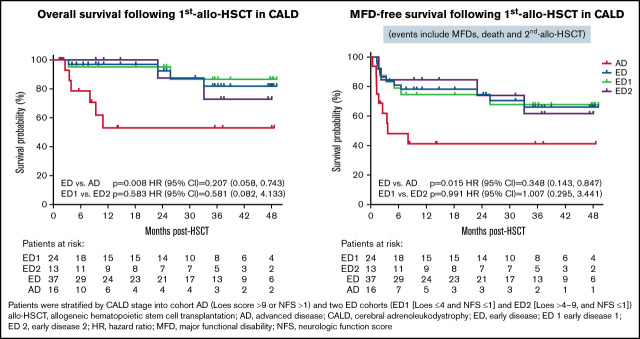
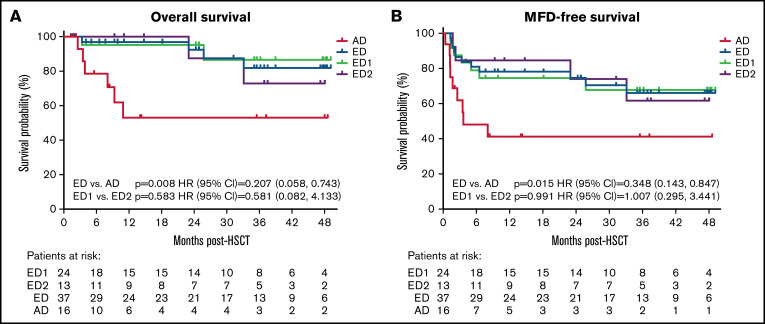
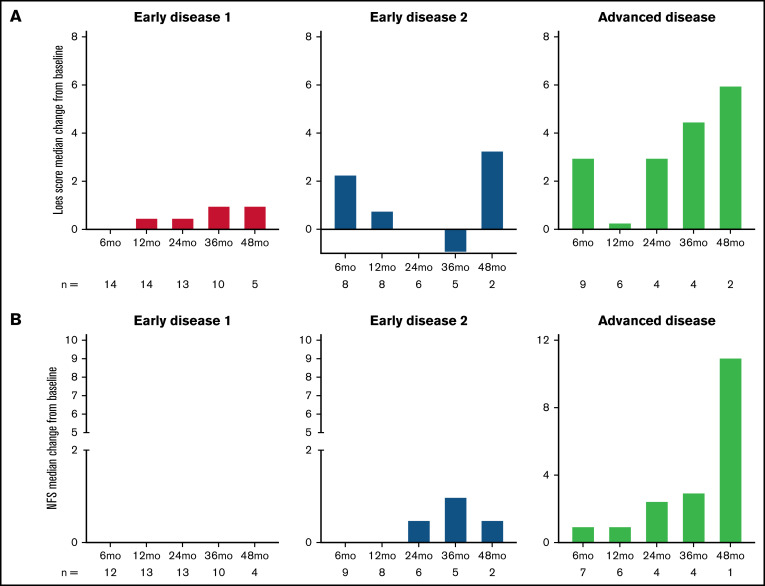
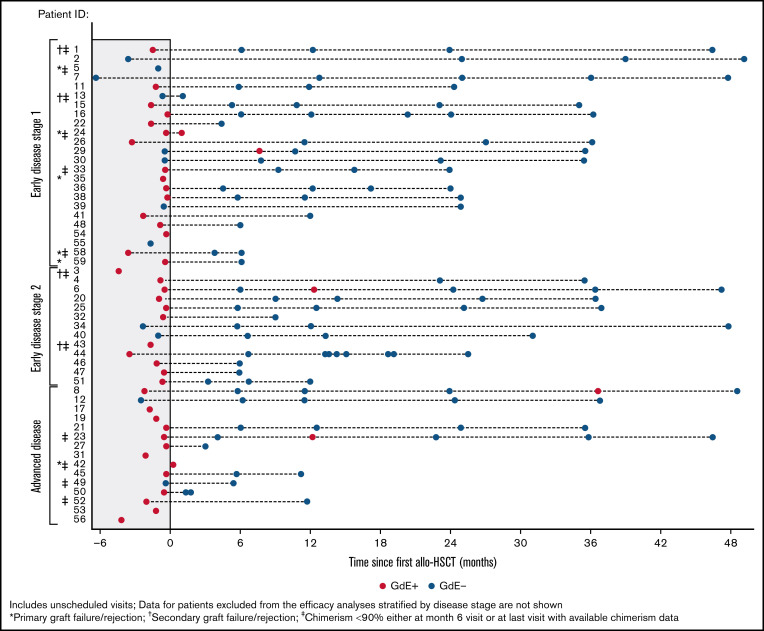
Allogeneic hematopoietic stem cell transplantation (allo-HSCT) in early cerebral adrenoleukodystrophy can stabilize neurologic function and improve survival but has associated risks including transplant-related mortality (TRM), graft failure, and graft-versus-host disease (GVHD). An observational study of 59 patients with median age at allo-HSCT of 8 years addressed impact of donor source, donor match, conditioning regimen, and cerebral disease stage on first allo-HSCT outcomes. Efficacy analyses included 53 patients stratified by disease category: advanced disease (AD; n = 16) with Loes score >9 or neurological function score (NFS) >1 and 2 early disease (ED) cohorts (ED1 [Loes ≤4 and NFS ≤1; n = 24] and ED2 [Loes >4-9 and NFS ≤1; n = 13]). Survival free of major functional disabilities and without second allo-HSCT at 4 years was significantly higher in the ED (66%) vs AD (41%) cohort (P = .015) and comparable between ED1 and ED2 cohorts (P = .991). The stabilization of neurologic function posttransplant was greater in the ED vs AD cohort, with a median change from baseline at 24 months after allo-HSCT in NFS and Loes score, respectively, of 0 and 0.5 in ED1 (n = 13), 0.5 and 0 in ED2 (n = 6), and 2.5 and 3.0 (n = 4) in AD cohort. TRM was lower in the ED (7%) compared with the AD (22%) cohort; however, the difference was not significant (P = .094). Transplant-related safety outcomes were also affected by transplant-related characteristics: graft failure incidence was significantly higher with unrelated umbilical cord grafts vs matched related donors (P = .039), and acute GVHD and graft failure incidences varied by conditioning regimen. This study was registered at www://clinicaltrials.gov as #NCT02204904.
Overview
The claims and statistics of this paper haven’t been checked yet.
Run the check — free, no account needed. It reads the open-access text and checks the sources it cites.
Integrity signals
Registry
Cites
Statistics
Figures
Verification
Claims the paper makes
The claims and statistics of this paper haven’t been checked yet.
Run the check — free, no account needed. It reads the open-access text and checks the sources it cites.
Claims other papers make about this one
Each is checked against this paper’s own text: does it say what the citing paper says it does?
In the citing paper
“HLA-matched sibling donors are available for less than 20% of patients but historically have led to longer survival than that with HSCT from unrelated donors.”
From Lentiviral Gene Therapy for Cerebral Adrenoleukodystrophy (2024) · cites this paper as [12]
In the citing paper
“Overall survival was 77.8% among patients who had undergone allogeneic HSCT 4 years previously in a matched cohort study38; the cumulative incidence estimate for acute grade II to IV GVHD was 11.1%, and the estimate for GVHD overall was 17.2%.”
From Hematologic Cancer after Gene Therapy for Cerebral Adrenoleukodystrophy (2024) · cites this paper as [38]
In the citing paper
“Moreover, the availability of HLA highly matched donors is limited and is a crucial determinant of outcomes in patients undergoing allogeneic HSCT.”
From Hematologic Cancer after Gene Therapy for Cerebral Adrenoleukodystrophy (2024) · cites this paper as [38]
In the citing paper
“However, comparative inferences cannot be drawn since these populations were not directly compared.”
From Lentiviral Gene Therapy for Cerebral Adrenoleukodystrophy (2024) · cites this paper as [12]
In the citing paper
“The rates that have been published with respect to allogeneic HSCT in patients with similar clinical status at baseline are 77.8% for 4-year overall survival and 63.2% for the percentage of patients with no major functional disabilities.”
From Lentiviral Gene Therapy for Cerebral Adrenoleukodystrophy (2024) · cites this paper as [12]
2 more claims about this paper
Create a free account to see every claim other papers make about this one.
Self-check
Percentages, sums and reported differences re-computed from the paper’s own numbers.
The self-check needs the paper’s full text.
Citations
Cites
Moser, H. W., Mahmood, A., & Raymond, G. V. (2007) · Nature Clinical Practice Neurology · doi:10.1038/ncpneuro0421 · Cited by 663
Hematopoietic stem-cell gene therapy for cerebral adrenoleukodystrophy
Eichler, F., Duncan, C., Musolino, P. L., Orchard, P. J., De Oliveira, S., Thrasher, A. J., Armant, M., Dansereau, C., Lund, T. C., Miller, W. P., et al. (2017) · New England Journal of Medicine · doi:10.1056/nejmoa1700554 · Cited by 604 · cited 2×
“Age at CALD dx, y 7 (0-14) 7 (5-11) 7 (0-14) 8 (6-12) 7 (0-14)”
Self-citationAdrenoleukodystrophy: Incidence, new mutation rate, and results of extended family screening
Bezman, L., Moser, A. B., Raymond, G. V., Rinaldo, P., Watkins, P. A., Smith, K. D., Kass, N. E., & Moser, H. W. (2001) · Annals of Neurology · doi:10.1002/ana.101 · Cited by 324
Analysis of MRI patterns aids prediction of progression in X-linked adrenoleukodystrophy
Loes, D. J., Fatemi, A., Melhem, E. R., Gupte, N., Bezman, L., Moser, H. W., & Raymond, G. V. (2003) · Neurology · doi:10.1212/01.wnl.0000079050.91337.83 · Cited by 268
Self-citationMoser, H. W., Loes, D. J., Melhem, E. R., Raymond, G. V., Bezman, L., Cox, C. S., & Lu, S.-E. (2000) · Neuropediatrics · doi:10.1055/s-2000-9236 · Cited by 210
Self-citationBerger, J., Wiesinger, C., & Eichler, F. (2015) · The Application of Clinical Genetics · doi:10.2147/tacg.s49590 · Cited by 140
Neurocognitive benchmarks following transplant for emerging cerebral adrenoleukodystrophy
Pierpont, E. I., Nascene, D. R., Shanley, R., Kenney-Jung, D. L., Ziegler, R. S., Miller, W. P., Gupta, A. O., Lund, T. C., Orchard, P. J., & Eisengart, J. B. (2020) · Neurology · doi:10.1212/wnl.0000000000009929 · Cited by 21
Self-citation
Research works printed but not linked: 26
- Raymond, 1999, GeneReviews((R)).
- Mahmood, 2007, Survival analysis of haematopoietic cell transplantation for childhood cerebral X-linked adrenoleukodystrophy: a comparison study, Lancet Neurol., 6, 687, 10.1016/S1474-4422(07)70177-1 · DOI · Paper page
- Raymond, 2019, Survival and functional outcomes in boys with cerebral adrenoleukodystrophy with and without hematopoietic stem cell transplantation, Biol Blood Marrow Transplant., 25, 538, 10.1016/j.bbmt.2018.09.036 · DOI · Paper page
- Aubourg, 1990, Reversal of early neurologic and neuroradiologic manifestations of X-linked adrenoleukodystrophy by bone marrow transplantation, N Engl J Med., 322, 1860, 10.1056/NEJM199006283222607 · DOI · Paper page
- Miller, 2011, Outcomes after allogeneic hematopoietic cell transplantation for childhood cerebral adrenoleukodystrophy: the largest single-institution cohort report, Blood., 118, 1971, 10.1182/blood-2011-01-329235 · DOI · Paper page
- Loes, 1994, Adrenoleukodystrophy: a scoring method for brain MR observations, AJNR Am J Neuroradiol., 15, 1761
- Beam, 2007, Outcomes of unrelated umbilical cord blood transplantation for X-linked adrenoleukodystrophy, Biol Blood Marrow Transplant., 13, 665, 10.1016/j.bbmt.2007.01.082 · DOI · Paper page
- Fernandes, 2018, Haploidentical bone marrow transplantation with post transplant cyclophosphamide for patients with X-linked adrenoleukodystrophy: a suitable choice in an urgent situation, Bone Marrow Transplant., 53, 392, 10.1038/s41409-017-0015-2 · DOI
- Bartelink, 2014, Fludarabine and exposure-targeted busulfan compares favorably with busulfan/cyclophosphamide-based regimens in pediatric hematopoietic cell transplantation: maintaining efficacy with less toxicity, Biol Blood Marrow Transplant., 20, 345, 10.1016/j.bbmt.2013.11.027 · DOI
- Gupta, 2020, Reduced-toxicity (BuFlu) conditioning is better tolerated but has a higher second transplantation rate compared to myeloablative conditioning (BuCy) in children with inherited metabolic disorders, Biol Blood Marrow Transplant., 26, 486, 10.1016/j.bbmt.2019.11.014 · DOI · Paper page
- Peters, 2004, Cerebral X-linked adrenoleukodystrophy: the international hematopoietic cell transplantation experience from 1982 to 1999, Blood., 104, 881, 10.1182/blood-2003-10-3402 · DOI · Paper page
- Barker, 2017, Optimal practices in unrelated donor cord blood transplantation for hematologic malignancies, Biol Blood Marrow Transplant., 23, 882, 10.1016/j.bbmt.2017.03.006 · DOI
- Glucksberg, 1974, Clinical manifestations of graft-versus-host disease in human recipients of marrow from HLA-matched sibling donors, Transplantation., 18, 295, 10.1097/00007890-197410000-00001 · DOI
- Lee, 2017, Classification systems for chronic graft-versus-host disease, Blood., 129, 30, 10.1182/blood-2016-07-686642 · DOI
- Kaplan, 1958, Nonparametric estimation from incomplete observations, J Am Stat Assoc., 53, 457, 10.1080/01621459.1958.10501452 · DOI · Paper page
- Kalbfleisch, 1980, The Statistical Analysis of Failure Time Data.
- Kühl, 2018, Potential risks to stable long-term outcome of allogeneic hematopoietic stem cell transplantation for children with cerebral X-linked adrenoleukodystrophy, JAMA Netw Open., 1, e180769, 10.1001/jamanetworkopen.2018.0769 · DOI · Paper page
- Pierpont, 2017, Neurocognitive trajectory of boys who received a hematopoietic stem cell transplant at an early stage of childhood cerebral adrenoleukodystrophy, JAMA Neurol., 74, 710, 10.1001/jamaneurol.2017.0013 · DOI · Paper page
- Engelen, 2012, X-linked adrenoleukodystrophy (X-ALD): clinical presentation and guidelines for diagnosis, follow-up and management, Orphanet J Rare Dis., 7, 51, 10.1186/1750-1172-7-51 · DOI · Paper page
- Mallack, 2021, MRI surveillance of boys with X-linked adrenoleukodystrophy identified by newborn screening: meta-analysis and consensus guidelines, J Inherit Metab Dis., 44, 728, 10.1002/jimd.12356 · DOI · Paper page
- Lee, 2020, Evaluation of X-linked adrenoleukodystrophy newborn screening in North Carolina, JAMA Netw Open., 3, e1920356, 10.1001/jamanetworkopen.2019.20356 · DOI · Paper page
- Wiens, 2019, A report on state-wide implementation of newborn screening for X-linked adrenoleukodystrophy, Am J Med Genet A., 179, 1205, 10.1002/ajmg.a.61171 · DOI · Paper page
- Lampret, 2020, Expanded newborn screening program in Slovenia using tandem mass spectrometry and confirmatory next generation sequencing genetic testing, Zdr Varst., 59, 256
- Barendsen, 2020, Adrenoleukodystrophy Newborn Screening in the Netherlands (SCAN Study): the X-factor [published correction appears in Front Cell Dev Biol. 2021;9:631655], Front Cell Dev Biol., 8, 499, 10.3389/fcell.2020.00499 · DOI · Paper page
- Chiesa, 2020, Hematopoietic cell transplantation in chronic granulomatous disease: a study of 712 children and adults, Blood., 136, 1201, 10.1182/blood.2020005590 · DOI
- Lum, 2017, Changes in the incidence, patterns and outcomes of graft failure following hematopoietic stem cell transplantation for Hurler syndrome, Bone Marrow Transplant., 52, 846, 10.1038/bmt.2017.5 · DOI
Cited by
Hematologic Cancer after Gene Therapy for Cerebral Adrenoleukodystrophy
Duncan, C. N., Bledsoe, J. R., Grzywacz, B., Beckman, A., Bonner, M., Eichler, F. S., Kühl, J.-S., Harris, M. H., Slauson, S., Colvin, R. A., et al. (2024) · New England Journal of Medicine · doi:10.1056/nejmoa2405541 · Cited by 164
Self-citationLentiviral Gene Therapy for Cerebral Adrenoleukodystrophy
Eichler, F., Duncan, C. N., Musolino, P. L., Lund, T. C., Gupta, A. O., De Oliveira, S., Thrasher, A. J., Aubourg, P., Kühl, J.-S., Loes, D. J., et al. (2024) · New England Journal of Medicine · doi:10.1056/nejmoa2400442 · Cited by 107
Self-citationTreatment of cerebral adrenoleukodystrophy: allogeneic transplantation and lentiviral gene therapy
Gupta, A. O., Raymond, G., Pierpont, E. I., Kemp, S., McIvor, R. S., Rayannavar, A., Miller, B., Lund, T. C., & Orchard, P. J. (2022) · Expert Opinion on Biological Therapy · doi:10.1080/14712598.2022.2124857 · Cited by 67
Self-citationGene therapy for the leukodystrophies: From preclinical animal studies to clinical trials.
Metovic, J., Li, Y., Gong, Y., & Eichler, F. (2024) · Neurotherapeutics · doi:10.1016/j.neurot.2024.e00443 · Cited by 16
Metadata
- Authors
- Chiesa, R., Boelens, J. J., Duncan, C. N., Kühl, J.-S., Sevin, C., Kapoor, N., Prasad, V. K., Lindemans, C. A., Jones, S. A., Amartino, H. M., Algeri, M., Bunin, N., Diaz-de-Heredia, C., Loes, D. J., Shamir, E., Timm, A., McNeil, E., Dietz, A. C., & Orchard, P. J.
- Affiliations
- Bone Marrow Transplant Department, Great Ormond Street Hospital for Children, London, UK;
- Stem Cell Transplantation andCellular Therapies, Department of Pediatrics, Memorial Sloan-Kettering Cancer Center, New York, NY;
- Department of Pediatric Oncology, Boston Children's Hospital and Dana-Farber Cancer Institute, Boston, MA;
- Stem Cell Transplantation, Department of Pediatric Oncology, Hematology and Hemostasis, University Hospital Leipzig, Leipzig, Germany;
- Pediatric Neurology Department, Leukodystrophies Reference Center, Hôpital Universitaire Hôpital Bicêtre-Hôpitaux Universitaires Paris Sud, Paris, France;
- Hematology, Oncology and Blood & Marrow Transplantation, Department of Pediatrics, Children's Hospital Los Angeles, Los Angeles, CA;
- Division of Pediatric Transplant and Cellular Therapy, Department of Pediatrics, Duke University Medical Center, Durham, NC;
- Pediatric Blood and Bone Marrow Transplantation Program, Princess Máxima Center for Pediatric Oncology, Utrecht, the Netherlands;
- Paediatric Inborn Errors of Metabolism, Manchester University NHS Foundation Trust, Manchester, UK;
- Child Neurology Service, Hospital Universitario Austral, Buenos Aires, Argentina;
- Department ofPediatric Hematology and Oncology, Cell and Gene Therapy,Bambino GesùChildren's Hospital,IRRCS, Rome, Italy;
- Cellular Therapy and Transplant Section, Division of Oncology, Children's Hospital of Philadelphia, Philadelphia, PA;
- Paediatric Oncology and Haematology Department, Hospital Universitari Vall d'Hebron and Vall d'Hebron Institut de Recerca, Barcelona, Spain;
- Midwest Radiology, Minneapolis, MN;
- bluebird bio, Inc., Cambridge, MA; and
- Blood and Marrow Transplantation Program, Department of Pediatrics, University of Minnesota
- Venue
- Blood Advances
- Publisher
- American Society of Hematology
- Published
- 2022-03-03
- Volume
- 6
- Issue
- 5
- Pages
- 1512-1524
- ISSN
- 2473-9529
- 2473-9537
- PMC
- PMC8905699
- Cited by
- 40
- References
- 7
- Language
- en
About these checks
Registry, retraction, Cites and statistics results are computed, not judged, with one exception: a printed reference that no index lists is read once by a model before it counts as a citation error. Claims are extracted by a model and kept only when their quote appears verbatim in the text; each cited source is then checked, with a model’s help, for whether it says what the claim relies on. Those verdicts can be wrong — read the claim’s quote and the cited source before relying on one.
Statistics and arithmetic are recomputed, not judged.
Confidence bands are shown only for fields calibrated on our annotated test set. None is calibrated yet, so no band is shown.
What counts as a claim ›How we measure confidence ›How we check this ›
Are you an author, or do you see a problem with this page? Request a review
