

Physiologically based serum ferritin thresholds for iron deficiency in women of reproductive age who are blood donors
Open accessThe DOI matches its Crossref record; 25 of the 25 references it cites were found in a registry or an index.
Abstract
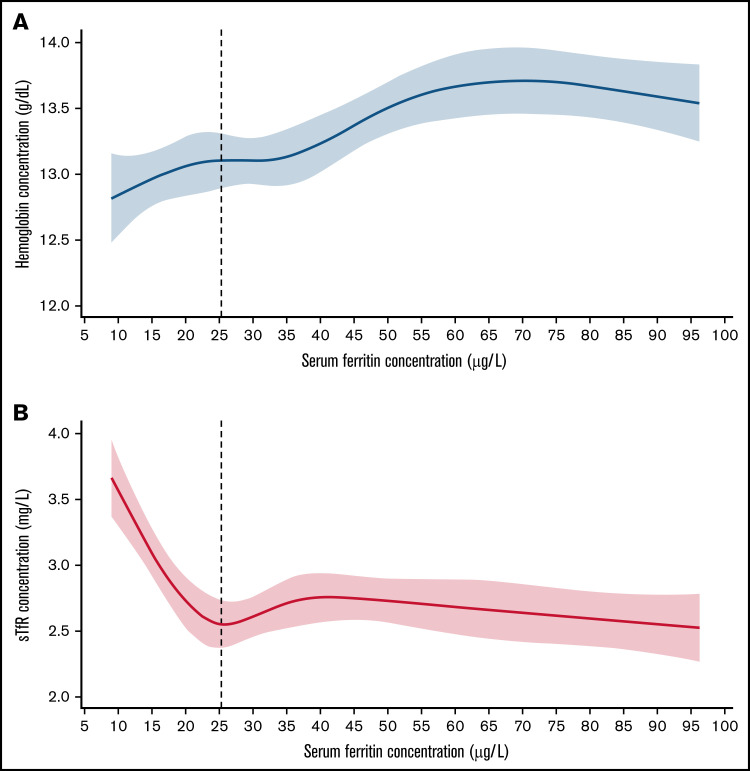
Our objective is to develop a physiologically based method to determine serum ferritin thresholds for iron deficiency in healthy individuals. The current World Health Organization threshold of <15 µg/L for iron deficiency in women is based on expert opinion. We examined the relationship between serum ferritin and 2 independently measured indicators of iron-deficient erythropoiesis, soluble transferrin receptor (sTfR) and hemoglobin, in baseline data from 286 women, 20 to 49 years, who were first-time or reactivated donors in the Retrovirus Epidemiology Donor Study-II Donor Iron Status Evaluation (REDS-RISE) study. At lower serum ferritin concentrations, median sTfR increased as hemoglobin decreased. Using restricted cubic spline regression analysis to determine thresholds for iron-deficient erythropoiesis, the thresholds identified by sTfR (serum ferritin < 25.4 µg/L) and hemoglobin (serum ferritin < 25.3 µg/L) did not differ significantly. The thresholds found in the REDS-RISE study do not differ from those identified by sTfR (serum ferritin < 25.5 µg/L) and hemoglobin (serum ferritin < 26.6 µg/L) in a previous study of 5442 women, 20 to 49 years, in the US National Health and Nutrition Examination Survey 2003 to 2018 (P = .98 and 0.83, respectively). Although international comparisons are needed, these results with US data provide additional evidence for the potential usefulness of a physiologically based method to identify serum ferritin thresholds for iron deficiency.
Overview
The claims and statistics of this paper haven’t been checked yet.
Free: it reads the open-access text and checks the first 5 claims that cite a source we can check. Create a free account to check every claim.
Integrity signals
Registry
Cites
Statistics
Figures
Verification
Claims the paper makes
The claims and statistics of this paper haven’t been checked yet.
Free: it reads the open-access text and checks the first 5 claims that cite a source we can check. Create a free account to check every claim.
Claims other papers make about this one
Each is checked against this paper’s own text: does it say what the citing paper says it does?
The cited source says what the claim attributes to it.
In the citing paper
“The authors concluded that the physiologically based method for the population studied showed a higher SF threshold for ID of <25 ng/mL, compared to the WHO SF guideline of <15 ng/mL [30].”
From Defining Global Thresholds for Serum Ferritin: A Challenging Mission in Establishing the Iron Deficiency Diagnosis in This Era of Striving for Health Equity (2025) · cites this paper as [30]
The cited source says what the claim attributes to it.
In the citing paper
“Addo et al. [30] determined SF thresholds for ID in healthy individuals based on data from 286 women, aged from 20 to 49 years old, who were first-time or reactivated donors in the Retrovirus Epidemiology Donor Study-II Donor Iron Status (REDS-RISE).”
From Defining Global Thresholds for Serum Ferritin: A Challenging Mission in Establishing the Iron Deficiency Diagnosis in This Era of Striving for Health Equity (2025) · cites this paper as [30]
Self-check
Percentages, sums and reported differences re-computed from the paper’s own numbers.
The self-check needs the paper’s full text.
Citations
Cites
Conducting Meta-Analyses in R with the metafor Package
Viechtbauer, W. (2010) · Journal of Statistical Software · doi:10.18637/jss.v036.i03 · Cited by 20,464 · cited 1×
“A 2-way test of differences comparing REDS-RISE and NHANES in ferritin threshold effect sizes (within and between) was evaluated using random-effect meta-analyses with 1 degree of freedom.(11,12) Statistical significance was set at a 2-tailed P , .”
MethodBootstrap confidence intervals
DiCiccio, T. J., & Efron, B. (1996) · Statistical Science · doi:10.1214/ss/1032280214 · Cited by 2,286 · cited 1×
“All CIs have been corrected for bias using the bias corrected acceleration (BCa) approach.(25) Column estimates with different superscripts indicate pairwise values that are statistically different from each other at P , .”
MethodBiomarkers of Nutrition for Development—Folate Review
Bailey, L. B., Stover, P. J., McNulty, H., Fenech, M. F., Gregory, J. F., Mills, J. L., Pfeiffer, C. M., Fazili, Z., Zhang, M., Ueland, P. M., et al. (2015) · The Journal of Nutrition · doi:10.3945/jn.114.206599 · Cited by 1,136
Soluble transferrin receptor for the evaluation of erythropoiesis and iron status
Beguin, Y. (2003) · Clinica Chimica Acta · doi:10.1016/s0009-8981(03)00005-6 · Cited by 454
Suominen, P., Punnonen, K., Rajamäki, A., & Irjala, K. (1998) · Blood · doi:10.1182/blood.v92.8.2934 · Cited by 337
Biomarkers of Nutrition for Development (BOND)—Iron Review
Lynch, S., Pfeiffer, C. M., Georgieff, M. K., Brittenham, G., Fairweather-Tait, S., Hurrell, R. F., McArdle, H. J., & Raiten, D. J. (2018) · The Journal of Nutrition · doi:10.1093/jn/nxx036 · Cited by 336
Self-citationIron deficiency in blood donors: the REDS‐II Donor Iron Status Evaluation (RISE) study
Cable, R. G., Glynn, S. A., Kiss, J. E., Mast, A. E., Steele, W. R., Murphy, E. L., Wright, D. J., Sacher, R. A., Gottschall, J. L., Tobler, L. H., et al. (2012) · Transfusion · doi:10.1111/j.1537-2995.2011.03401.x · Cited by 230
Cable, R. G., Glynn, S. A., Kiss, J. E., Mast, A. E., Steele, W. R., Murphy, E. L., Wright, D. J., Sacher, R. A., Gottschall, J. L., Vij, V., et al. (2011) · Transfusion · doi:10.1111/j.1537-2995.2010.02865.x · Cited by 197
Oral iron supplementation in iron-deficient women: How much and how often?
Stoffel, N. U., von Siebenthal, H. K., Moretti, D., & Zimmermann, M. B. (2020) · Molecular Aspects of Medicine · doi:10.1016/j.mam.2020.100865 · Cited by 187 · cited 1×
“Increasing iron intake can be effective.(20,21,24) With a higher serum ferritin threshold, future prospective clinical trials would be needed to determine optimal corrective management through dietary changes, iron supplementation, or both.”
BackgroundMansour, D., Hofmann, A., & Gemzell-Danielsson, K. (2021) · Advances in Therapy · doi:10.1007/s12325-020-01564-y · Cited by 167 · cited 1×
“Recognizing the need for iron in more women could help prevent iron deficiency from remaining untreated and could help prevent progression to a greater iron deficit and to anemia, especially before pregnancy,(20-22) and in the third of women worldwide with heavy menstrual bleeding.(23) Increasing iron intake can be ef…”
BackgroundThe second transferrin receptor regulates red blood cell production in mice
Nai, A., Lidonnici, M. R., Rausa, M., Mandelli, G., Pagani, A., Silvestri, L., Ferrari, G., & Camaschella, C. (2015) · Blood · doi:10.1182/blood-2014-08-596254 · Cited by 156
Mei, Z., Addo, O. Y., Jefferds, M. E., Sharma, A. J., Flores-Ayala, R. C., & Brittenham, G. M. (2021) · The Lancet Haematology · doi:10.1016/s2352-3026(21)00168-x · Cited by 155 · cited 9×
“We hypothesize that the onset of iron deficient erythropoiesis is identified by the serum ferritin concentration threshold at which the median sTfR begins to increase and the median hemoglobin concentration begins to decrease.(2) Here, we apply the physiologically based method to publicly available data from apparentl…”
BackgroundMethodResultInfluentialSelf-citationda Silva Lopes, K., Yamaji, N., Rahman, M. O., Suto, M., Takemoto, Y., Garcia-Casal, M. N., & Ota, E. (2021) · Cochrane Database of Systematic Reviews · doi:10.1002/14651858.cd013092.pub2 · Cited by 136
Riley, W., Schwei, M. J., & McCullough, J. (2007) · Transfusion · doi:10.1111/j.1537-2995.2007.01252.x · Cited by 132
Suominen, P., Punnonen, K. R. A., Rajamäki, A., et al. (1998) · Blood · doi:10.1182/blood.v92.8.2934.420k07_2934_2939 · Cited by 95
The Measurement of Serum Transferrin Receptor
Cook, J. D. (1999) · The American Journal of the Medical Sciences · doi:10.1016/s0002-9629(15)40630-5 · Cited by 73 · cited 1×
“The sTfR provides a sensitive, quantitative measure of erythroid marrow and tissue iron requirements that is independent of the hemoglobin concentration.(3) Iron deficient erythropoiesis develops as the iron mobilizable from stores can no longer support hemoglobin synthesis.”
BackgroundMoorthy, D., Merrill, R. D., Namaste, S. M. L., & Iannotti, L. L. (2020) · Advances in Nutrition · doi:10.1093/advances/nmaa070 · Cited by 60 · cited 1×
“Increasing iron intake can be effective.(20,21,24) With a higher serum ferritin threshold, future prospective clinical trials would be needed to determine optimal corrective management through dietary changes, iron supplementation, or both.”
BackgroundMechanisms of cellular iron sensing, regulation of erythropoiesis and mitochondrial iron utilization
Maio, N., Zhang, D., Ghosh, M. C., Jain, A., SantaMaria, A. M., & Rouault, T. A. (2021) · Seminars in Hematology · doi:10.1053/j.seminhematol.2021.06.001 · Cited by 56
Should we screen for iron deficiency anaemia? A review of the evidence and recent recommendations
Pasricha, S. (2011) · Pathology · doi:10.1097/pat.0b013e32834e8291 · Cited by 47
The Measurement of Serum Transferrin Receptor
Cook, J. D. (1999) · The American Journal of the Medical Sciences · doi:10.1097/00000441-199910000-00006 · Cited by 36
Kiss, J. E., Birch, R. J., Steele, W. R., Wright, D. J., & Cable, R. G. (2017) · Transfusion · doi:10.1111/trf.14133 · Cited by 29
To, L., Dunnington, T., Thomas, C., Love, K., McCullough, J., & Riley, W. (2019) · Transfusion · doi:10.1111/trf.15573 · Cited by 24
Brittenham, G. M. (2017) · Elsevier eBooks · doi:10.1016/b978-0-323-35762-3.00036-6 · Cited by 19
Self-citationPathophysiology of Iron Homeostasis
Brittenham, G. M. (2017) · Elsevier eBooks · doi:10.1016/b978-0-323-35762-3.00035-4 · Cited by 16
Self-citationFinding ferritin in the plateaus and valleys of iron deficiency
Braat, S., & Pasricha, S.-R. (2021) · The Lancet Haematology · doi:10.1016/s2352-3026(21)00196-4 · Cited by 5 · cited 2×
“A higher serum ferritin threshold would increase the proportion of women recognized as iron deficient.(2,7) Recognizing the need for iron in more women could help prevent iron deficiency from remaining untreated and could help prevent progression to a greater iron deficit and to anemia, especially before pregnancy,(20…”
BackgroundMethod
Research works printed but not linked: 3
- 9. Harrell FE. Regression Modeling Strategies: With Applications to Linear Models, Logistic Regression, and Survival Analysis. New York: Springer-Verlag; 2010.
- 10. Tukey JW. Exploratory Data Analysis. Reading, MA: Addison-Wesley; 1977.
- 11. Borenstein M, Hedges LV, Higgins JPT, Rothstein HR. Introduction to Meta-Analysis. Chichester, UK: John Wiley & Sons, Ltd.; 2009.
Cited by
The relationship between heavy menstrual bleeding, iron deficiency, and iron deficiency anemia
Munro, M. G., Mast, A. E., Powers, J. M., Kouides, P. A., O’Brien, S. H., Richards, T., Lavin, M., & Levy, B. S. (2023) · American Journal of Obstetrics and Gynecology · doi:10.1016/j.ajog.2023.01.017 · Cited by 167
Cohen, C. T., & Powers, J. M. (2024) · Advances in Nutrition · doi:10.1016/j.advnut.2024.100215 · Cited by 83
“Rather, serum ferritin should be obtained, with iron supplementation initiated for values 20 μ g/L [46].”
BackgroundHeavy menstrual bleeding, iron deficiency, and iron deficiency anemia: Framing the issue
Munro, M. G. (2023) · International Journal of Gynecology & Obstetrics · doi:10.1002/ijgo.14943 · Cited by 75
Iron Deficiency in the United States: Limitations in Guidelines, Data, and Monitoring of Disparities
Jefferds, M. E., Mei, Z., Addo, O. Y., Hamner, H. C., Perrine, C. G., Flores‐Ayala, R. C., Pfeiffer, C. M., & Sharma, A. J. (2022) · American Journal of Public Health · doi:10.2105/ajph.2022.306998 · Cited by 58
Self-citationHands, K., Daru, J., Evans, C., Kotzé, A., Lewis, C., Narayan, S., Richards, T., Taylor, C., Timmins, S., & Wilson, A. (2024) · British Journal of Haematology · doi:10.1111/bjh.19440 · Cited by 54
Metadata
- Authors
- Addo, O. Y., Mei, Z., Hod, E. A., Jefferds, M. E., Sharma, A. J., Flores-Ayala, R. C., Spitalnik, S. L., & Brittenham, G. M.
- Affiliations
- Centers for Disease Control and Prevention (US)
- Columbia University (US)
- 1Nutrition Branch, Division of Nutrition, Physical Activity, and Obesity, National Center for Chronic Disease Prevention and Health Promotion, Centers for Disease Control and Prevention, Atlanta , GA;
- Corresponding author
- Addo, O. Yaw
- ORCID
- Venue
- Blood Advances
- Publisher
- American Society of Hematology
- Published
- 2022-06-21
- Volume
- 6
- Issue
- 12
- Pages
- 3661-3665
- ISSN
- 2473-9529 (ISSN-L)
- 2473-9537
- PMC
- PMC9631565
- OpenAlex
- W4223590988
- Cited by
- 32
- References
- 23
- Citations by year
- 2026: 7 · 2025: 7 · 2024: 7 · 2023: 6 · 2022: 5
- FWCI
- 4.55
- Type
- journal article
- Language
- en
- Open access
- gold
- doi.org
- Licence
- cc-by-nc-nd
- Locations
- Blood Advances (publishedVersion, cc-by-nc-nd)
- PubMed Central (publishedVersion, cc-by-nc-nd)
- PubMed (publishedVersion)
- Topics
- Health Sciences › Medicine › Hematology › Iron Metabolism and Disorders
- Health Sciences › Medicine › Hematology › Blood donation and transfusion practices
- Health Sciences › Medicine › Hematology › Erythropoietin and Anemia Treatment
- Keywords
- serum ferritin, iron deficiency, diagnostic thresholds, soluble transferrin receptor, hemoglobin, iron-deficient erythropoiesis, women of reproductive age, blood donors
- MeSH terms
- Iron Deficiencies, Blood Donors, Female, Ferritins, Hemoglobins, Humans, Iron, Nutrition Surveys, Receptors, Transferrin, Anemia, Iron-Deficiency
About these checks
Registry, retraction, Cites and statistics results are computed, not judged, with one exception: a printed reference that no index lists is read once by a model before it counts as a citation error. Claims are extracted by a model and kept only when their quote appears verbatim in the text; each cited source is then checked, with a model’s help, for whether it says what the claim relies on. Those verdicts can be wrong — read the claim’s quote and the cited source before relying on one.
Statistics and arithmetic are recomputed, not judged.
Confidence bands are shown only for fields calibrated on our annotated test set. None is calibrated yet, so no band is shown.
What counts as a claim ›How we measure confidence ›How we check this ›
Are you an author, or do you see a problem with this page? Request a review
Data sources
Bibliographic data: Semantic Scholar, OpenAlex, Crossref.
Contains information from the Semantic Scholar Academic Graph Datasets, made available under the ODC Attribution License (ODC-BY 1.0).
Semantic Scholar’s data is described in: Kinney, R., et al. (2023). The Semantic Scholar Open Data Platform. arXiv:2301.10140.
