

Aspergillus-induced superoxide production by cystic fibrosis phagocytes is associated with disease severity
Open accessThe DOI matches its Crossref record; 39 of the 39 references it cites were found in a registry or an index.
Abstract
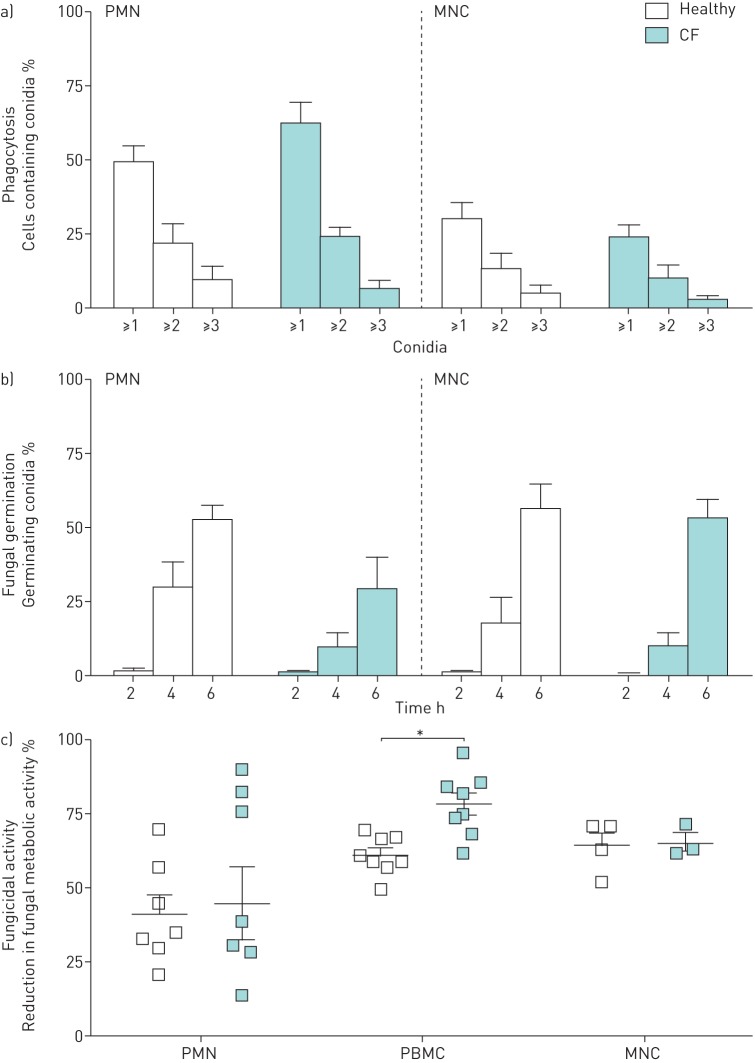
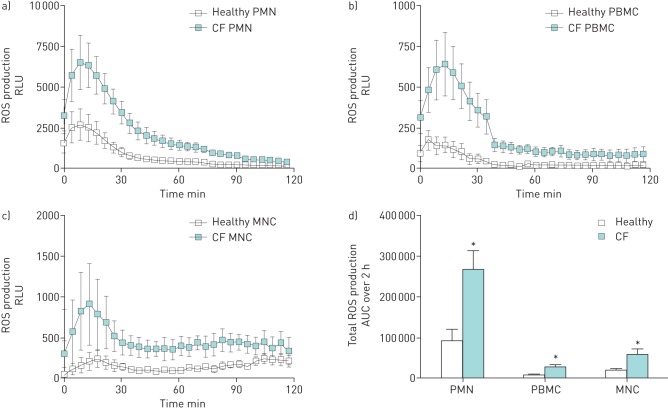
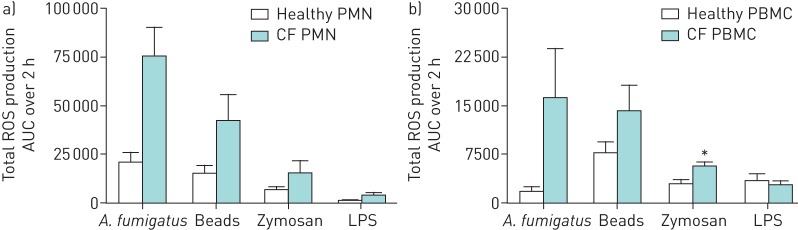
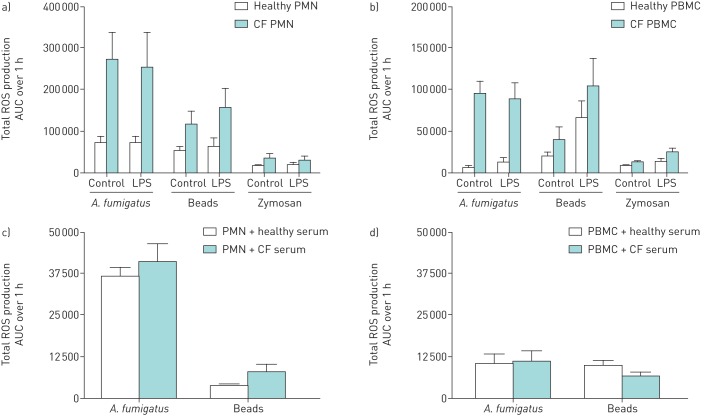
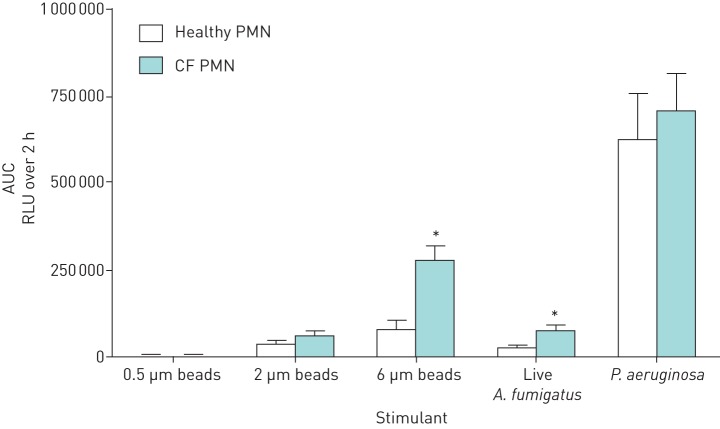
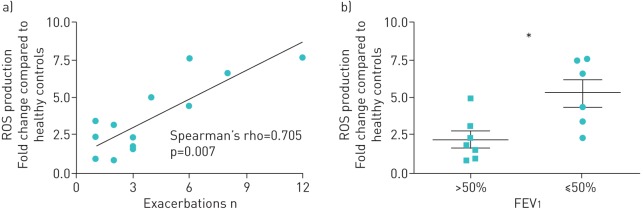
Aspergillus fumigatus infects up to 50% of cystic fibrosis (CF) patients and may play a role in progressive lung disease. As cystic fibrosis transmembrane conductance regulator is expressed in cells of the innate immune system, we hypothesised that impaired antifungal immune responses play a role in CF-related Aspergillus lung disease. Peripheral blood mononuclear cells, polymorphonuclear cells (PMN) and monocytes were isolated from blood samples taken from CF patients and healthy volunteers. Live-cell imaging and colorimetric assays were used to assess antifungal activity in vitro. Production of reactive oxygen species (ROS) was measured using luminol-induced chemiluminescence and was related to clinical metrics as collected by case report forms. CF phagocytes are as effective as those from healthy controls with regards to phagocytosis, killing and restricting germination of A. fumigatus conidia. ROS production by CF phagocytes was up to four-fold greater than healthy controls (p<0.05). This effect could not be replicated in healthy phagocytes by priming with lipopolysaccharide or serum from CF donors. Increased production of ROS against A. fumigatus by CF PMN was associated with an increased number of clinical exacerbations in the previous year (p=0.007) and reduced lung function (by forced expiratory volume in 1 s) (p=0.014). CF phagocytes mount an intrinsic exaggerated release of ROS upon A. fumigatus stimulation which is associated with clinical disease severity.
Overview
The claims and statistics of this paper haven’t been checked yet.
Free: it reads the open-access text and checks the first 5 claims that cite a source we can check. Create a free account to check every claim.
Integrity signals
Registry
Cites
Statistics
Figures
Verification
Claims the paper makes
The claims and statistics of this paper haven’t been checked yet.
Free: it reads the open-access text and checks the first 5 claims that cite a source we can check. Create a free account to check every claim.
Claims other papers make about this one
Each is checked against this paper’s own text: does it say what the citing paper says it does?
In the citing paper
“Moreover, increased ROS production is associated with disease severity in CF patients (420).”
From Aspergillus fumigatus and Aspergillosis in 2019 (2019) · cites this paper as [420]
Self-check
Percentages, sums and reported differences re-computed from the paper’s own numbers.
The self-check needs the paper’s full text.
Citations
Cites
Meijer, L., Nelson, D. J., Riazanski, V., Gabdoulkhakova, A. G., Hery-Arnaud, G., Le Berre, R., Loaëc, N., Oumata, N., Galons, H., Nowak, E., et al. (2016) · Journal of Innate Immunity · doi:10.1159/000444256 · Cited by 4,992
Reactive oxygen species in cell signaling
Thannickal, V. J., & Fanburg, B. L. (2000) · American Journal of Physiology-Lung Cellular and Molecular Physiology · doi:10.1152/ajplung.2000.279.6.l1005 · Cited by 2,927
Aspergillus fumigatus and Aspergillosis
Latgé, J.-P. (1999) · Clinical Microbiology Reviews · doi:10.1128/cmr.12.2.310 · Cited by 2,307
Epigenetic programming of monocyte-to-macrophage differentiation and trained innate immunity
Saeed, S., Quintin, J., Kerstens, H. H. D., Rao, N. A., Aghajanirefah, A., Matarese, F., Cheng, S.-C., Ratter, J., Berentsen, K., van der Ent, M. A., et al. (2014) · Science · doi:10.1126/science.1251086 · Cited by 1,761
Taylor, P. R., Brown, G. D., Reid, D. M., Willment, J. A., Martinez-Pomares, L., Gordon, S., & Wong, S. Y. C. (2002) · The Journal of Immunology · doi:10.4049/jimmunol.169.7.3876 · Cited by 655
Self-citationBauernfeind, F., Bartok, E., Rieger, A., Franchi, L., Núñez, G., & Hornung, V. (2011) · The Journal of Immunology · doi:10.4049/jimmunol.1100613 · Cited by 617
Cystic fibrosis: a mucosal immunodeficiency syndrome
Cohen, T. S., & Prince, A. (2012) · Nature Medicine · doi:10.1038/nm.2715 · Cited by 484
Requisite Role for the Dectin-1 β-Glucan Receptor in Pulmonary Defense against Aspergillus fumigatus
Werner, J. L., Metz, A. E., Horn, D., Schoeb, T. R., Hewitt, M. M., Schwiebert, L. M., Faro-Trindade, I., Brown, G. D., & Steele, C. (2009) · The Journal of Immunology · doi:10.4049/jimmunol.0804250 · Cited by 412
Self-citationThe prevalence of cystic fibrosis in the European Union
Farrell, P. M. (2008) · Journal of Cystic Fibrosis · doi:10.1016/j.jcf.2008.03.007 · Cited by 399
Amin, R., Dupuis, A., Aaron, S. D., & Ratjen, F. (2010) · Chest · doi:10.1378/chest.09-1103 · Cited by 376
Cited by
Aspergillus fumigatus and Aspergillosis in 2019
Latgé, J.-P., & Chamilos, G. (2019) · Clinical Microbiology Reviews · doi:10.1128/cmr.00140-18 · Cited by 1,400
Dissemination of Mycobacterium abscessus via global transmission networks
Ruis, C., Bryant, J. M., Bell, S. C., Thomson, R. M., Davidson, R. M., Hasan, N. A., van Ingen, J., Strong, M., Floto, R. A., & Parkhill, J. (2021) · Nature Microbiology · doi:10.1038/s41564-021-00963-3 · Cited by 118
Coinfection with Pseudomonas aeruginosa and Aspergillus fumigatus in cystic fibrosis
Keown, K., Reid, A. J. M., Moore, J. E., Taggart, C. C., & Downey, D. G. (2020) · European Respiratory Review · doi:10.1183/16000617.0011-2020 · Cited by 69
Aspergilluscolonization and antifungal immunity in cystic fibrosis patients
Warris, A., Bercusson, A., & Armstrong-James, D. P. H. (2019) · Medical Mycology · doi:10.1093/mmy/myy074 · Cited by 54
Self-citationIn vitroinfection models to study fungal–host interactions
Last, A., Maurer, M., Mosig, A. S., Gresnigt, M. S., & Hube, B. (2021) · FEMS Microbiology Reviews · doi:10.1093/femsre/fuab005 · Cited by 49
Metadata
- Authors
- Brunel, S. F., Willment, J. A., Brown, G. D., Devereux, G., & Warris, A.
- Affiliations
- University of Aberdeen (GB)
- Aberdeen Royal Infirmary (GB)
- Venue
- ERJ Open Research
- Publisher
- European Respiratory Society (ERS)
- Published
- 2018-04
- Volume
- 4
- Issue
- 2
- Pages
- 00068-2017
- ISSN
- 2312-0541 (ISSN-L)
- PMC
- PMC5890024
- OpenAlex
- W2797734082
- Cited by
- 17
- References
- 39
- Citations by year
- 2025: 2 · 2024: 1 · 2023: 1 · 2022: 2 · 2021: 5 · 2020: 2 · 2019: 2 · 2018: 2
- FWCI
- 2.07
- Type
- journal article
- Language
- en
- Open access
- gold
- doi.org
- Licence
- cc-by-nc
- Locations
- ERJ Open Research (publishedVersion, cc-by-nc)
- Europe PMC (PubMed Central) (publishedVersion, cc-by-nc)
- PubMed Central (publishedVersion, cc-by-nc)
- PubMed (publishedVersion)
- Aberdeen University Research Archive (Aberdeen University) (submittedVersion)
- DOAJ (DOAJ: Directory of Open Access Journals) (submittedVersion, cc-by-sa)
- Funders
- Wellcome Trust (097377)
- Medical Research Council (MR/N006364/1)
- Topics
- Health Sciences › Medicine › Pulmonary and Respiratory Medicine › Cystic Fibrosis Research Advances
- Health Sciences › Medicine › Infectious Diseases › Antifungal resistance and susceptibility
- Life Sciences › Immunology and Microbiology › Immunology › Neutrophil, Myeloperoxidase and Oxidative Mechanisms
- Keywords
- Aspergillus fumigatus, cystic fibrosis, reactive oxygen species, superoxide production, phagocytes, neutrophils, monocytes, antifungal immunity, disease severity, disease exacerbation, lung function, CFTR, phagocytosis, conidial germination
About these checks
Registry, retraction, Cites and statistics results are computed, not judged, with one exception: a printed reference that no index lists is read once by a model before it counts as a citation error. Claims are extracted by a model and kept only when their quote appears verbatim in the text; each cited source is then checked, with a model’s help, for whether it says what the claim relies on. Those verdicts can be wrong — read the claim’s quote and the cited source before relying on one.
Statistics and arithmetic are recomputed, not judged.
Confidence bands are shown only for fields calibrated on our annotated test set. None is calibrated yet, so no band is shown.
What counts as a claim ›How we measure confidence ›How we check this ›
Are you an author, or do you see a problem with this page? Request a review
How to cite
Cite CoChat for the checks on this page, and the paper for its own findings.
- This page
- CoChat. (2026). Citation check: Aspergillus-induced superoxide production by cystic fibrosis phagocytes is associated with disease severity. https://app.cochat.ai/papers/10.1183/23120541.00068-2017
- The paper
- Brunel, S. F., Willment, J. A., Brown, G. D., Devereux, G., & Warris, A. (2018). Aspergillus-induced superoxide production by cystic fibrosis phagocytes is associated with disease severity. ERJ Open Research. https://doi.org/10.1183/23120541.00068-2017
Data sources
Bibliographic data: Semantic Scholar, OpenAlex, Crossref.
Contains information from the Semantic Scholar Academic Graph Datasets, made available under the ODC Attribution License (ODC-BY 1.0).
Semantic Scholar’s data is described in: Kinney, R., et al. (2023). The Semantic Scholar Open Data Platform. arXiv:2301.10140.
