

Non-dipping nocturnal blood pressure correlates with obstructive sleep apnoea severity in normotensive subjects and may reverse with therapy
Open accessThe DOI matches its Crossref record; 34 of the 34 references it cites were found in a registry or an index.
Abstract
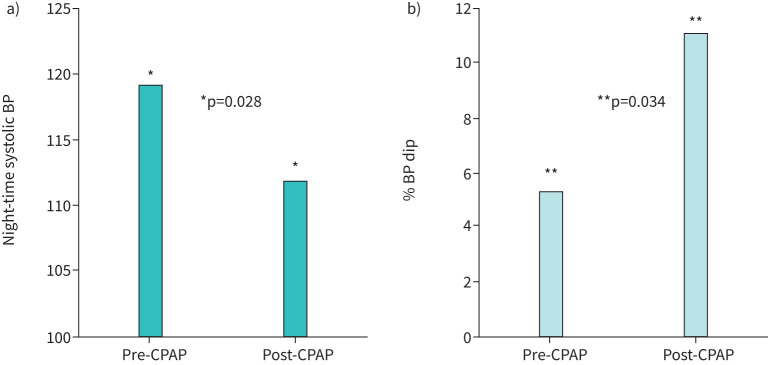
Background: Obstructive sleep apnoea (OSA) is strongly associated with systemic hypertension, but there are limited data on the relationship with blood pressure (BP) in normotensive subjects. Here, we examined the relationship of OSA with nocturnal BP in a documented diurnal normotensive cohort, explored potential intermediate pathways and assessed the effects on BP of continuous positive airways pressure (CPAP) therapy. Methods: 65 males referred for assessment of possible OSA and normotensive on 24-hour BP monitoring underwent overnight inpatient polysomnography (age 41±7 years, body mass index (BMI) 34±6 kg·m−2, apnoea–hypopnoea index (AHI) 14 (interquartile range 5–26)). Urine and serum were assessed for markers of sympathetic activation, renin–angiotensin–aldosterone system activity, oxidative stress, endothelial function and systemic inflammation. In a subset of patients, 24-hour BP monitoring was repeated after CPAP therapy. Results: Within this normotensive cohort, night-time systolic and diastolic BP and nocturnal BP dip were highest in the fourth OSA severity quartile (p<0.05). Nocturnal BP dip correlated with AHI (r=−0.327, p<0.05) and oxygen desaturation index (ODI) (r=−0.371, p<0.05), but only ODI was an independent predictor of BP dip (B=–0.351, p<0.01) and non-dipping status (B=0.046, p<0.05). Overnight urinary norepinephrine correlated with nocturnal systolic BP (r=0.387, p<0.01) with a trend towards correlation with systolic dipping (p=0.087). In 20 CPAP-treated patients, night-time systolic BP decreased (p<0.05) and mean nocturnal BP dip increased (p≤0.05). Conclusion: In this normotensive cohort, OSA severity was associated with higher nocturnal BP, which improved following CPAP therapy, and intermittent hypoxia was the most important OSA-related variable in this relationship.
Overview
The claims and statistics of this paper haven’t been checked yet.
Free: it reads the open-access text and checks the first 5 claims that cite a source we can check. Create a free account to check every claim.
Integrity signals
Registry
Cites
Statistics
Figures
Verification
Claims the paper makes
The claims and statistics of this paper haven’t been checked yet.
Free: it reads the open-access text and checks the first 5 claims that cite a source we can check. Create a free account to check every claim.
Claims other papers make about this one
Each is checked against this paper’s own text: does it say what the citing paper says it does?
The cited source says what the claim attributes to it.
In the citing paper
“Sympathetic excitation appears to be the principal pathogenic mechanism with possible additional involvement of renin–angiotensin–aldosterone system dysfunction (Crinion et al., 2021).”
From Obstructive sleep apnea: transition from pathophysiology to an integrative disease model (2022) · cites this paper as Crinion et al., 2021
The cited source says what the claim attributes to it.
In the citing paper
“CPAP may also restore the nocturnal dipping pattern in normotensive patients with OSA (Crinion et al., 2021; Sapina‐Beltran et al., 2019).”
From Obstructive sleep apnea: transition from pathophysiology to an integrative disease model (2022) · cites this paper as Crinion et al., 2021
Self-check
Percentages, sums and reported differences re-computed from the paper’s own numbers.
The self-check needs the paper’s full text.
Citations
Cites
Berry, R. B., Budhiraja, R., Gottlieb, D. J., Gozal, D., Iber, C., Kapur, V. K., Marcus, C. L., Mehra, R., Parthasarathy, S., Quan, S. F., et al. (2012) · Journal of Clinical Sleep Medicine · doi:10.5664/jcsm.2172 · Cited by 5,302
Benjafield, A. V., Ayas, N. T., Eastwood, P. R., Heinzer, R., Ip, M. S. M., Morrell, M. J., Nunez, C. M., Patel, S. R., Penzel, T., Pépin, J.-L., et al. (2019) · The Lancet Respiratory Medicine · doi:10.1016/s2213-2600(19)30198-5 · Cited by 4,326
CPAP for Prevention of Cardiovascular Events in Obstructive Sleep Apnea
McEvoy, R. D., Antic, N. A., Heeley, E., Luo, Y., Ou, Q., Zhang, X., Mediano, O., Chen, R., Drager, L. F., Liu, Z., et al. (2016) · New England Journal of Medicine · doi:10.1056/nejmoa1606599 · Cited by 2,101
Cutler, J. A., Sorlie, P. D., Wolz, M., Thom, T., Fields, L. E., & Roccella, E. J. (2008) · Hypertension · doi:10.1161/hypertensionaha.108.113357 · Cited by 917
McNicholas, W. T., Bonsignore, M. R., & the Management Committee of EU COST ACTION B26 (2007) · European Respiratory Journal · doi:10.1183/09031936.00027406 · Cited by 911
Self-citationBarbé, F., Durán-Cantolla, J., Sánchez-de-la-Torre, M., Martínez-Alonso, M., Carmona, C., Barceló, A., Chiner, E., Masa, J. F., Gonzalez, M., Marín, J. M., et al. (2012) · JAMA · doi:10.1001/jama.2012.4366 · Cited by 792
Augmented Resting Sympathetic Activity in Awake Patients With Obstructive Sleep Apnea
Carlson, J. T., Hedner, J., Elam, M., Ejnell, H., Sellgren, J., & Wallin, B. G. (1993) · Chest · doi:10.1378/chest.103.6.1763 · Cited by 680
Barbé, F., Durán-Cantolla, J., Sánchez de la Torre, M., Martínez-Alonso, M., Carmona, C., Barceló, A., Chiner, E., Masa, J. F., Gonzalez, M., Marín, J. M., et al. (2013) · Survey of Anesthesiology · doi:10.1097/01.sa.0000431218.95299.07 · Cited by 386
Duran-Cantolla, J., Aizpuru, F., Montserrat, J. M., Ballester, E., Teran-Santos, J., Aguirregomoscorta, J. I., Gonzalez, M., Lloberes, P., Masa, J. F., De La Pena, M., et al. (2010) · BMJ · doi:10.1136/bmj.c5991 · Cited by 257
The sympathetic nervous system and obstructive sleep apnea: implications for hypertension
Narkiewicz, K., & Somers, V. K. (1997) · Journal of Hypertension · doi:10.1097/00004872-199715120-00062 · Cited by 254
Cited by
Bidirectional relationships of comorbidity with obstructive sleep apnoea
Gleeson, M., & McNicholas, W. T. (2022) · European Respiratory Review · doi:10.1183/16000617.0256-2021 · Cited by 203
Self-citationObstructive sleep apnea: transition from pathophysiology to an integrative disease model
McNicholas, W. T., & Pevernagie, D. (2022) · Journal of Sleep Research · doi:10.1111/jsr.13616 · Cited by 153
“Figure reproduced from (Randerath et al., 2018) with permission from the publisher system dysfunction (Crinion et al., 2021).”
BackgroundSelf-citationDiagnosis and Treatment of Sleep Apnea in Children: A Future Perspective Is Needed
Solano-Pérez, E., Coso, C., Castillo-García, M., Romero-Peralta, S., López-Monzoni, S., Laviña, E., Pumarega, I. C., Sánchez‐de‐la‐Torre, M., Rio, F. G., & Mediano, O. (2023) · Biomedicines · doi:10.3390/biomedicines11061708 · Cited by 61
Chazova, I. E., Михайловна, Ч. Н., Blinova, N. V., Владимировна, А. А., Alekseeva, T. A., Ambatiello, L. G., Balanova, Y. А., Bragina, A. E., Danilov, N. M., Drapkina, O. M., et al. (2024) · Systemic Hypertension · doi:10.38109/2075-082x-2024-4-5-109 · Cited by 28
Influence of sleep on physiological systems in atherosclerosis
Kiss, M. G., Cohen, O., McAlpine, C. S., & Świrski, F. K. (2024) · Nature Cardiovascular Research · doi:10.1038/s44161-024-00560-7 · Cited by 25
Litvin, A. Y., Chazova, I. E., Elfimova, E. M., Pevzner, A. V., Poluektov, M. G., Danilov, N. M., Mikhailova, O. O., & Владимировна, А. А. (2024) · Eurasian heart journal · doi:10.38109/2225-1685-2024-3-6-27 · Cited by 24
Nagai, M., Dote, K., Park, S., Turana, Y., Buranakitjaroen, P., Cheng, H., Soenarta, A. A., Li, Y., Kario, K., & on behalf of the HOPE Asia Network (2023) · Hypertension Research · doi:10.1038/s41440-023-01440-6 · Cited by 10
Sleep Apnea: The Slept-Upon Cardiovascular Risk Factor
Pintilie, A.-L., Marcu, D. T. M., Antal, A. Z., Arcana, R. I., Iosep, D. G., Miron, M., Afloarei, C. A., Zabara, M., & Crișan-Dabija, R. A. (2025) · Biomedicines · doi:10.3390/biomedicines13102529 · Cited by 9
Pregnancy-onset obstructive sleep apnea and ambulatory blood pressure
Sanapo, L., Raker, C., Merhi, B. O., Guillen, M., Avalos, A., Aldana, A., Bublitz, M. H., Bai, A., & Bourjeily, G. R. (2024) · SLEEP · doi:10.1093/sleep/zsae277 · Cited by 9
Lipski, D., Marzyńska, D., Sytek, P., Rzesoś, P., Rabiza, A., Żurek, S., Radziemski, A., Stryczyński, Ł., Tykarski, A., & Uruski, P. (2024) · Journal of Clinical Medicine · doi:10.3390/jcm13020371 · Cited by 9
Targa, A., Torres, G., Benitez, I. D., Henríquez‐Beltrán, M., Vaca, R., Arnó, L. P., Mínguez, O., Aguilà, M., Martínez, D., Pinilla, L., et al. (2025) · European Respiratory Journal · doi:10.1183/13993003.01954-2024 · Cited by 7
Ohira, A., Yamakawa, T., Iwahashi, N., Tanaka, S., Sugiyama, M., Harada, M., Ichikawa, M., Akiyama, T., Orime, K., & Terauchi, Y. (2022) · Endocrine Journal · doi:10.1507/endocrj.ej22-0308 · Cited by 3
Tong, B., Stewart, G. M., Mohammadieh, A. M., Lee, C., & Cistulli, P. A. (2026) · Expert Review of Medical Devices · doi:10.1080/17434440.2025.2612116
Beyond the Breath: Exploring the Complex Nexus of Obstructive Sleep Apnea and Comorbid Conditions
Kumar, R., Rathi, V., Ish, P., Gupta, N., Mohan, S., & Vaghasia, N. (2024) · Indian Journal of Sleep Medicine · doi:10.5005/jp-journals-10069-0133
Cheng, P., Carvalho, D. Z., Karim, S., Chahal, C. A. A., & Somers, V. K. (2026) · Annals of Clinical and Translational Neurology · doi:10.1002/acn3.70393
Wang, H., Cheng, A.-R., Li, Y., Zhang, H.-N., Fan, S., Shen, R., Zhang, W., Li, H., & Wang, J. (2026) · JMIR mhealth and uhealth · doi:10.2196/84506
Pathogenetic aspects of comorbidity of obstructive sleep apnea syndrome (scientific review)
Ermakova, E. A., Kuspanalieva, D. S., Bulatetsky, S. V., & Vanina, D. S. (2026) · Siberian Journal of Life Sciences and Agriculture · doi:10.12731/2658-6649-2026-18-1-1750
Nocturnal blood pressure profile in obstructive sleep apnea syndrome patients without hypertension
Farghaly, S., & Bakkar, L. M. (2022) · Pneumon · doi:10.18332/pne/144107
Frohnhofen, H. (2023) · Springer eBooks · doi:10.1007/978-3-662-60290-4_18
拉, 文. (2023) · Advances in Clinical Medicine · doi:10.12677/acm.2023.134851
Stratification by Nocturnal BP Dipping Phenotype
Sheng, T., Qiu, Y., & Luo, G. (2026) · CHEST Journal · doi:10.1016/j.chest.2026.04.055
Metadata
- Authors
- Crinion, S. J., Kleinerova, J., Kent, B., Nolan, G., Taylor, C. T., Ryan, S., & McNicholas, W. T.
- Affiliations
- Queen's University (CA)
- St. James's Hospital (IE)
- St. Vincent's University Hospital (IE)
- University College Dublin (IE)
- Corresponding author
- McNicholas, Walter T.
- Venue
- ERJ Open Research
- Publisher
- European Respiratory Society (ERS)
- Published
- 2021-06-25
- Volume
- 7
- Issue
- 3
- Pages
- 00338-2021
- ISSN
- 2312-0541 (ISSN-L)
- PMC
- PMC8365144
- OpenAlex
- W3174465871
- Semantic Scholar
- 2b9c836d6e8567a3850025ef58be0f8e8ff20964
- Cited by
- 18
- References
- 34
- Citations by year
- 2026: 2 · 2025: 2 · 2024: 6 · 2023: 4 · 2022: 4
- FWCI
- 2.20
- Type
- journal article
- Language
- en
- Open access
- gold
- doi.org
- Licence
- Locations
- ERJ Open Research (publishedVersion, cc-by-nc)
- PubMed Central (publishedVersion, cc-by-nc)
- PubMed (publishedVersion)
- DOAJ (DOAJ: Directory of Open Access Journals) (submittedVersion, cc-by-sa)
- Funders
- Health Research Board (HPF-2012-17)
- Topics
- Health Sciences › Medicine › Physiology (medical) › Obstructive Sleep Apnea Research
- Health Sciences › Medicine › Cardiology and Cardiovascular Medicine › Blood Pressure and Hypertension Studies
- Social Sciences › Psychology › Experimental and Cognitive Psychology › Sleep and related disorders
- Keywords
- obstructive sleep apnea, nocturnal blood pressure, non-dipping blood pressure, CPAP therapy, intermittent hypoxia, oxygen desaturation index, apnea-hypopnea index, normotensive subjects, sympathetic activation, norepinephrine, renin-angiotensin-aldosterone system, oxidative stress, endothelial function, systemic inflammation
About these checks
Registry, retraction, Cites and statistics results are computed, not judged, with one exception: a printed reference that no index lists is read once by a model before it counts as a citation error. Claims are extracted by a model and kept only when their quote appears verbatim in the text; each cited source is then checked, with a model’s help, for whether it says what the claim relies on. Those verdicts can be wrong — read the claim’s quote and the cited source before relying on one.
Statistics and arithmetic are recomputed, not judged.
Confidence bands are shown only for fields calibrated on our annotated test set. None is calibrated yet, so no band is shown.
What counts as a claim ›How we measure confidence ›How we check this ›
Are you an author, or do you see a problem with this page? Request a review
Data sources
Bibliographic data: Semantic Scholar, OpenAlex, Crossref.
Contains information from the Semantic Scholar Academic Graph Datasets, made available under the ODC Attribution License (ODC-BY 1.0).
Semantic Scholar’s data is described in: Kinney, R., et al. (2023). The Semantic Scholar Open Data Platform. arXiv:2301.10140.
