

The DOI matches its Crossref record; 109 of the 110 references it cites were found in a registry or an index.
Phylogeography of the reef fish Cephalopholis argus (Epinephelidae) indicates Pleistocene isolation across the indo-pacific barrier with contemporary overlap in the coral triangle
Open accessAbstract
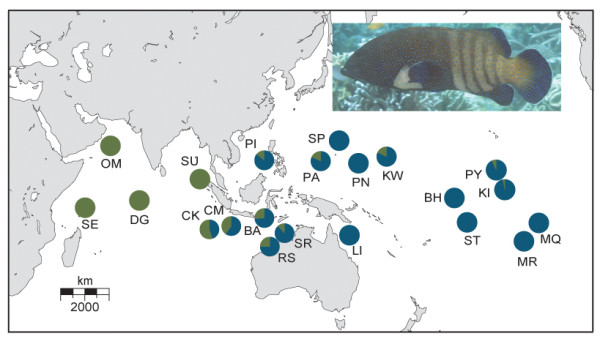
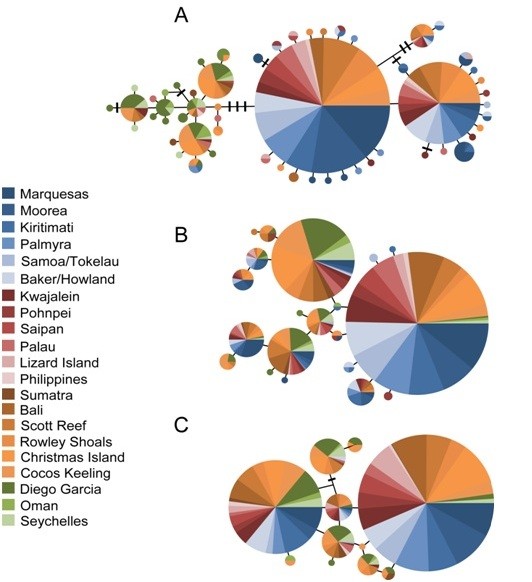
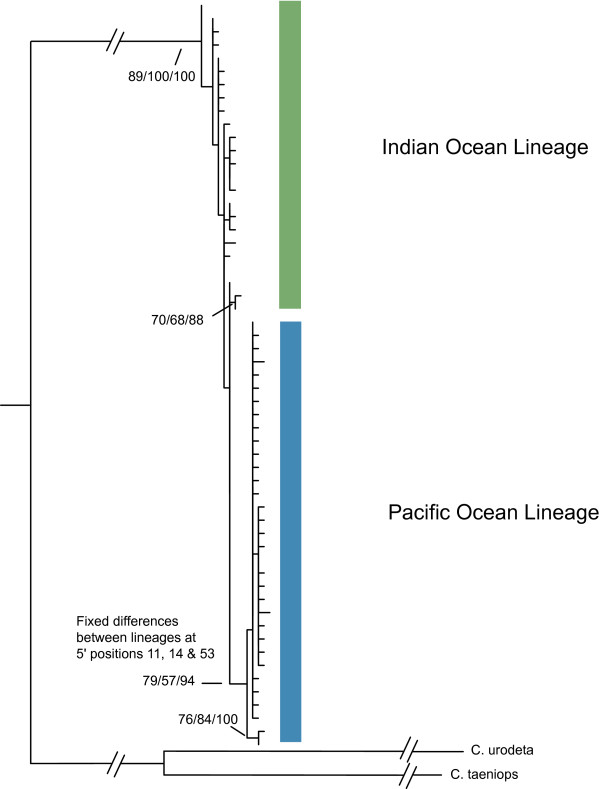
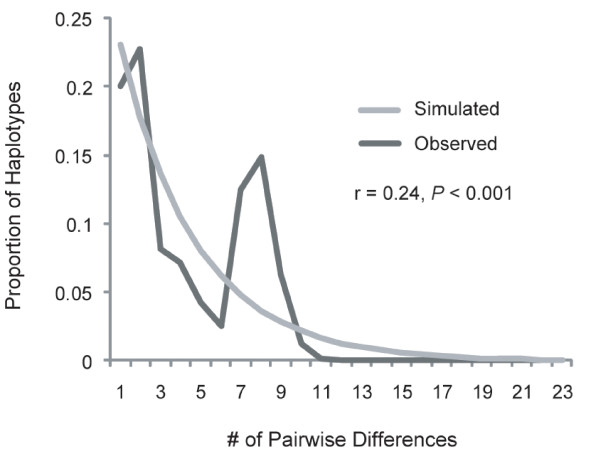
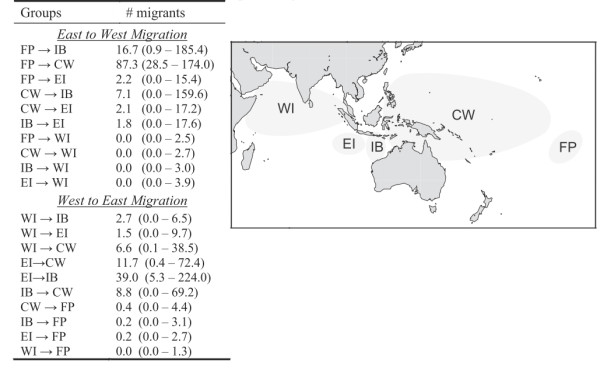
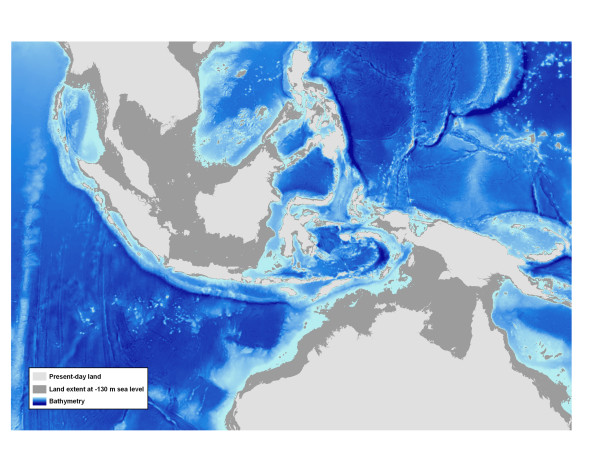
BACKGROUND: The Coral Triangle (CT), bounded by the Philippines, the Malay Peninsula, and New Guinea, is the epicenter of marine biodiversity. Hypotheses that explain the source of this rich biodiversity include 1) the center of origin, 2) the center of accumulation, and 3) the region of overlap. Here we contribute to the debate with a phylogeographic survey of a widely distributed reef fish, the Peacock Grouper (Cephalopholis argus; Epinephelidae) at 21 locations (N = 550) using DNA sequence data from mtDNA cytochrome b and two nuclear introns (gonadotropin-releasing hormone and S7 ribosomal protein). RESULTS: Population structure was significant (ΦST = 0.297, P < 0.001; FST = 0.078, P < 0.001; FST = 0.099, P < 0.001 for the three loci, respectively) among five regions: French Polynesia, the central-west Pacific (Line Islands to northeastern Australia), Indo-Pacific boundary (Bali and Rowley Shoals), eastern Indian Ocean (Cocos/Keeling and Christmas Island), and western Indian Ocean (Diego Garcia, Oman, and Seychelles). A strong signal of isolation by distance was detected in both mtDNA (r = 0.749, P = 0.001) and the combined nuclear loci (r = 0.715, P < 0.001). We detected evidence of population expansion with migration toward the CT. Two clusters of haplotypes were detected in the mtDNA data (d = 0.008), corresponding to the Pacific and Indian Oceans, with a low level of introgression observed outside a mixing zone at the Pacific-Indian boundary. CONCLUSIONS: We conclude that the Indo-Pacific Barrier, operating during low sea level associated with glaciation, defines the primary phylogeographic pattern in this species. These data support a scenario of isolation on the scale of 105 year glacial cycles, followed by population expansion toward the CT, and overlap of divergent lineages at the Pacific-Indian boundary. This pattern of isolation, divergence, and subsequent overlap likely contributes to species richness at the adjacent CT and is consistent with the region of overlap hypothesis.
Overview
The claims and statistics of this paper haven’t been checked yet.
Run the check — free, no account needed. It reads the open-access text and checks the sources it cites.
Integrity signals
Registry
Cites
Statistics
Figures
Verification
Claims the paper makes
The claims and statistics of this paper haven’t been checked yet.
Run the check — free, no account needed. It reads the open-access text and checks the sources it cites.
Claims other papers make about this one
Each is checked against this paper’s own text: does it say what the citing paper says it does?
The cited source says what the claim attributes to it.
In the citing paper
“The geographical range of C. porosus encompasses a well-known phylogeographic boundary, the Indo-Pacific Barrier, that affects many Indo-Pacific species (e.g., gastropods [56]; reef fish [57]).”
From Mitogenomic Crocodylia phylogeny and population structure of Crocodylus porosus including the extinct Seychelles crocodile (2026) · cites this paper as [57]
Self-check
Percentages, sums and reported differences re-computed from the paper’s own numbers.
The self-check needs the paper’s full text.
Citations
Cites
MEGA4: Molecular Evolutionary Genetics Analysis (MEGA) Software Version 4.0
Tamura, K., Dudley, J. T., Nei, M., & Kumar, S. (2007) · Molecular Biology and Evolution · doi:10.1093/molbev/msm092 · Cited by 28,734 · cited 1×
“05 among all pairwise tests by controlling for the false discovery [51,52].”
BackgroundMRBAYES: Bayesian inference of phylogenetic trees.
Huelsenbeck, J. P., & Ronquist, F. (2001) · Bioinformatics · doi:10.1093/bioinformatics/17.8.754 · Cited by 21,937 · cited 1×
“The ML tree topology was confirmed by neighbor-joining (NJ) and Bayesian Markov Chain Monte Carlo (MCMC) analysis using MEGA 4.0 [52] and MRBAYES 3.1.1 [ 53 ], respectively.”
MethodInfluentialA Simple, Fast, and Accurate Algorithm to Estimate Large Phylogenies by Maximum Likelihood
Guindon, S., & Gascuel, O. (2003) · Systematic Biology · doi:10.1080/10635150390235520 · Cited by 16,923 · cited 1×
“We used default priors under the HKY + G model of mutation (jMODELTEST) [61,62] and ran simulations for 10 million generations with sampling every 1000 generations.”
MethodMolecular Evolutionary Genetics
Nei, M. (1987) · Columbia University Press eBooks · doi:10.7312/nei-92038 · Cited by 16,583
Excoffier, L., & Lischer, H. E. L. (2010) · Molecular Ecology Resources · doi:10.1111/j.1755-0998.2010.02847.x · Cited by 16,266
DnaSP v5: a software for comprehensive analysis of DNA polymorphism data
Librado, P., & Rozas, J. (2009) · Bioinformatics · doi:10.1093/bioinformatics/btp187 · Cited by 16,147
RAxML-VI-HPC: maximum likelihood-based phylogenetic analyses with thousands of taxa and mixed models
Stamatakis, A. (2006) · Bioinformatics · doi:10.1093/bioinformatics/btl446 · Cited by 15,582
BEAST: Bayesian evolutionary analysis by sampling trees
Drummond, A. J., & Rambaut, A. (2007) · BMC Evolutionary Biology · doi:10.1186/1471-2148-7-214 · Cited by 13,104
Median-joining networks for inferring intraspecific phylogenies
Bandelt, H. J., Forster, P., & Rohl, A. (1999) · Molecular Biology and Evolution · doi:10.1093/oxfordjournals.molbev.a026036 · Cited by 11,742 · cited 1×
“5 with default settings [50].”
Tamura, K., & Nei, M. (1993) · Molecular Biology and Evolution · doi:10.1093/oxfordjournals.molbev.a040023 · Cited by 11,267 · cited 2×
“Because the TPM1uf+G model of sequence evolution is not implemented in ARLEQUIN, we used the most similar model available [54] with a gamma value of 0.”
Method
Research works printed but not linked: 13
- Veron JEM: Corals in space and time: The biogeography and evolution of the Scleratinia. 1995, Sydney: University of New South Wales Press
- Randall JE: Zoogeography of shorefishes of the Indo-Pacific region. Zool Studies. 1998, 37: 227-268.
- McManus JW: Marine speciation, tectonics, and sea-level changes in southeast Asia. Proceedings of the Fifth International Coral Reef Congress. Edited by: Gabrie C, Vivien MH. 1985, Moorea: Antenne Museum-Ephe, 133-138. 27 May-1 June 1985; Tahiti
- Ladd HS: Origin of the Pacific Island molluscan fauna. Am J Sci. 1960, 258A: 137-150.
- Woodland DJ: Zoogeography of the Siganidae (Pisces): an interpretation of distribution and richness patterns. Bull Mar Sci. 1983, 33: 713-717.
- Briggs JC: Marine zoogeography. 1974, New York: McGraw-Hill
- Randall JE: Reef and Shore Fishes of the South Pacific. 2005, Honolulu: Sea Grant College Program University of Hawaii
- Linderman KC, Lee TM, Wilson WD, Claro R, Ault JS: Transport of larvae originating in southwest Cuba and the Dry Tortugas: evidence for partial retention in grunts and snappers. Proc Gulf Carib Fish Inst. 2000, 52: 253-278.
- Fleminger A: The Pleistocene equatorial barrier between the Indian and Pacific Oceans and a likely cause for Wallace's line. UNESCO Technical Papers in Marine Science. 1986, 49: 84-97.
- Chappell J: Relative and average sea level changes, and endo-, epi-, and exogenic processes on the earth. Sea level, ice, and climatic change Int Ass Hydrol Sci Publ. 1981, 131: 411-430.
- Potts DC: Evolutionary disequilibrium among Indo-Pacific corals. Bull Mar Sci. 1983, 33: 619-632.
- Eble JA, Rocha LA, Craig MT, Bowen BW: Not all larvae stay close to home: Long-distance dispersal in Indo-Pacific reef fishes, with a focus on the Brown Surgeonfish (Acanthurus nigrofuscus). J Mar Bio. 2011
- Donaldson TJ: Distribution and species richness patterns of Indo-West Pacific Cirrhitidae: support for Woodland's hypothesis. Proceedings of the Second International Conference on Indo-Pacific fishes. Edited by: Uyeno T, Arai R, Taniuchi T, Matsuura K. 1986, Tokyo: Ichthyological Society of Japan, 623-628. 1986; Tokyo
Cited by
Sorted by citations
Items 101–190 of 190
Gomes, G., Oliveira, J., Miranda, J., Lutz, Í., Veneza, I., da Silva, R., Silva, D., Martins, K. C. P., & Sampaio, I. (2020) · Research Society and Development · doi:10.33448/rsd-v9i9.8320 · Cited by 13
Lane, H. S., Symonds, J. E., & Ritchie, P. A. (2015) · Fisheries Research · doi:10.1016/j.fishres.2015.08.009 · Cited by 13
Comparative phylogeography of three host sea anemones in the Indo‐Pacific
Emms, M. A., Saenz‐Agudelo, P., Giles, E. C., Gatins, R., Nanninga, G. B., Scott, A., Hobbs, J., Frisch, A. J., Mills, S. C., Beldade, R., et al. (2019) · Journal of Biogeography · doi:10.1111/jbi.13775 · Cited by 13
“…between the eastern and western Indian Ocean in different taxa including coral reef fishes (Bay, Choat, van Herwerden, & Robertson, 2004; Gaither et al., 2011; Huyghe & Kochzius, 2017; Leray et al., 2010) and invertebrates such as echinoderms (Otwoma & Kochzius, 2016; Vogler et al.,…”
Backgroundvan der Zee, J. P., Christianen, M. J. A., Bérubé, M., Nava, M. I., Schut, K., Humber, F., Alfaro‐Núñez, A., Becking, L. E., & Palsbøll, P. J. (2021) · Heredity · doi:10.1038/s41437-021-00475-0 · Cited by 13
“✉email: jurjanvanderzee@gmail.com www.nature.com/hdy 1 2 3 4 5 6 7 8 9 0 () ;,: connectivity and subsequent secondary contact among previously isolated populations (Gaither et al. 2011).”
The genetics and genomics of marine fish invasions: a global review
Chiesa, S., Azzurro, E., & Bernardi, G. (2019) · Reviews in Fish Biology and Fisheries · doi:10.1007/s11160-019-09586-8 · Cited by 12
Cleaning up the biogeography of Labroides dimidiatus using phylogenetics and morphometrics
Sims, C. A., Riginos, C., Blomberg, S. P., Huelsken, T., Drew, J., & Grutter, A. S. (2013) · Coral Reefs · doi:10.1007/s00338-013-1093-2 · Cited by 12
Biogeographic origins of the viviparous sea snake assemblage (Elapidae) of the Indian Ocean
Ukuwela, K. D. B., Lee, M. S. Y., Rasmussen, A. R., de Silva, A., & Sanders, K. L. (2017) · Ceylon Journal of Science · doi:10.4038/cjs.v46i5.7457 · Cited by 15
“Further, the ‘Coral triangle’ in the IAA (Kochzius et al., 2009), Southern Thai-Malay peninsula, and the islands of Java and Sumatra have been shown to be regions of hybridization for many allopatric populations of fish in the IO an WP (Marie et al., 2007; Hobbs et al., 2009; Gaither et al., 2011).”
BackgroundUkuwela, K. D. B., de Silva, A., Mumpuni, Fry, B. G., & Sanders, K. L. (2014) · Zoologica Scripta · doi:10.1111/zsc.12070 · Cited by 11
“…in the region is the clear genetic break between the IO and WP seen in marine invertebrates (e.g. Lavery et al. 1996; Benzie 1998; Duda & Palumbi 1999; Crandall et al. 2008a) and numerous fish groups (e.g. Magsino & JuinioMe~nez 2008; Drew & Barber 2009; Leray et al. 2010; Gaither et al. 2011).”
BackgroundResultPhylogeography and historical demography of Sicydium salvini in the eastern Pacific
Chabarria, R. E., & PEZOLD, F. L. (2013) · Ichthyological Research · doi:10.1007/s10228-013-0363-x · Cited by 11
“No structure was found among populations of Sicyopterus lagocephalus within large biogeographic haplogroups by Hoareau et al. (2012). This finding was also mirrored in a larger analysis of S.”
BackgroundResultLiu, S. V., Tuanmu, M., Rachmawati, R., Mahardika, G. N., & Barber, P. H. (2019) · PeerJ · doi:10.7717/peerj.7384 · Cited by 10
“Many phylogeographic studies in the Indo-Pacific find highly divergent clades, often with regions of sympatry (Barber et al., 2002; Barber, Erdmann & Palumbi, 2006; Crandall et al., 2008; Gaither et al., 2011; Liu et al., 2012; DeBoer et al., 2014a; Bowen, Karl & Pfeiler, 2007).”
BackgroundCommunity assembly of coral reef fishes along the Melanesian biodiversity gradient
Drew, J., & Amatangelo, K. L. (2017) · PLoS ONE · doi:10.1371/journal.pone.0186123 · Cited by 10
Comparative phylogeography of widespread and endemic damselfishes in the Hawaiian Archipelago
Tenggardjaja, K. A., Bowen, B. W., & Bernardi, G. (2018) · Marine Biology · doi:10.1007/s00227-018-3395-y · Cited by 10
Self-citationOosting, T., Martínez-García, L., Ferrari, G., Verry, A. J. F., Scarsbrook, L., Rawlence, N. J., Wellenreuther, M., Star, B., & Ritchie, P. A. (2022) · Heredity · doi:10.1038/s41437-022-00579-1 · Cited by 9
“For example, populations of scalloped hammerhead Sphyrna lewini, bigscale soldierfish Myripristis berndti, and peacock hind Cephalopholis argus are thought to have been separated on either side of the Indo-Pacific barrier (what is now Indonesia), after which distinct mitochondrial lineages intermixed during secondary…”
BackgroundBanerjee, A. K., Wu, H., Guo, W., Ng, W. L., Li, W., Ma, Y., Feng, H., & Huang, Y. (2021) · Journal of Systematics and Evolution · doi:10.1111/jse.12746 · Cited by 8
Otwoma, L. M., Diemel, V., Reuter, H., Kochzius, M., & Meyer, A. (2018) · Journal of Fish Biology · doi:10.1111/jfb.13686 · Cited by 8
Loera-Padilla, F. J., Piñeros, V. J., Baldwin, C. C., Cox, C., Simões, N., Ribeiro, E. D., Lasso-Alcalá, Ó. M., & Domínguez‐Domínguez, O. (2021) · Coral Reefs · doi:10.1007/s00338-020-02036-z · Cited by 8
Grouper DNA barcoding studies in Indonesia: A short review
Razi, N. M., Muchlisin, Z. A., Maulida, S., Ramadhaniaty, M., Nur, F. M., Damora, A., Manalu, S. L. B., & Fadli, N. (2021) · DEPIK · doi:10.13170/depik.10.2.21255 · Cited by 8
“The studied genera were Anyperodon (Ariyanti and Farajallah, 2019a), Cephalopholis (Andriyono et al., 2020; Andriyono and Suciyono, 2020; Ariyanti and Farajallah, 2019a; Ariyanti et al., 2015; Fadli et al., 2021; Fadli et al., 2020; Gaither et al., 2011; Kamal et al., 2019; Sari et al., 2015), Cromileptes (Nuryanto et…”
BackgroundInfluentialGenetic connectivity in Sparisoma aurofrenatum (redband parrotfish): an unexpected journey
Velasco-Montoya, D. A., Millán-Márquez, A. M., & Tavera, J. J. (2022) · Hydrobiologia · doi:10.1007/s10750-022-04806-y · Cited by 8
Ning, P., Sha, Z., Hebert, P. D. N., & Russell, B. C. (2015) · Journal of Ocean University of China · doi:10.1007/s11802-015-2609-x · Cited by 8
“Although the timing of diversification in Nemipterus remains uncertain, the congruent phylogeographic patterns in other Indo-Pacific marine fishes clearly indicate the role of shifting sea levels linked to climatic oscillations during the Pleistocene as an important cause of population isolation and differentiation (G…”
BackgroundHuang, M., Lawes, M. J., Zhou, W., & Wei, F. (2025) · Marine Life Science & Technology · doi:10.1007/s42995-025-00313-w · Cited by 7
“…Sahul shelves—spanning Indonesia, Malaysia, and northern Australia—potentially delineating a marine Wallace Line and supporting this overlap hypothesis (Barber et al. 2000; Bowen et al. 2016; Gaither et al. 2011; Gaither and Rocha 2013; Hsu et al. 2025; Puckridge et al. 2013; Sorenson et al. 2014).”
Andriyono, S., Damora, A., & Kim, H. (2022) · Journal of Tropical Biodiversity and Biotechnology · doi:10.22146/jtbb.71955 · Cited by 6
Alotaibi, A. S. (2023) · Aquaculture Research · doi:10.1155/2023/6761331 · Cited by 6
Smith‐Vaniz, W. F. (2023) · Zootaxa · doi:10.11646/zootaxa.5252.1.1 · Cited by 6
Chen, W., Ho, H.-C. H., & Borsa, P. (2016) · Frontiers in Marine Science · doi:10.3389/fmars.2016.00107 · Cited by 6
Indo-Pacific Phylogeography of the Lemon Sponge Leucetta chagosensis
Pasnin, O., Voigt, O., Wörheide, G., Murillo‐Rincón, A. P., & von der Heyden, S. (2020) · Diversity · doi:10.3390/d12120466 · Cited by 6
“[54] showed that the IP barrier at the glacial maxima and the ensuing lowered sea levels contributed towards shaping the evolutionary patterns of the reef fish Cephalopholis argus, showing two main haplogroups, one characterizing the IO and one characterizing the PO.”
Backgroundda Silva, R., Silva, D., Veneza, I., Sampaio, I., Schneider, H., & Gomes, G. (2017) · Anais da Academia Brasileira de Ciências · doi:10.1590/0001-3765201720150476 · Cited by 6
“Given the high rate of substitution for the majority of introns, EPIC-PCR has been used to investigate patterns of intraspecific genetic variation in many taxa, including teleosts (Gaither et al. 2010, 2011, Li et al. 2010, Silva-Oliveira et al. 2012, Chow and Yanagimoto 2016).”
BackgroundOrigin and evolution of a new tetraploid mangrove species in an intertidal zone
Feng, H., Banerjee, A. K., Guo, W., Yuan, Y., Duan, F., Ng, W. L., Zhao, X., Liu, Y., Li, C., Liu, Y., et al. (2024) · Acta Botanica Yunnanica · doi:10.1016/j.pld.2024.04.007 · Cited by 5
Torres-García, R. Q., Gaither, M. R., Robertson, D. R., Torres-Hernández, E., Caselle, J. E., Durand, J.-D., Angulo, A., Espinoza-Herrera, E., León, F. J. G.-D., Valdiviezo‐Rivera, J., et al. (2024) · PeerJ · doi:10.7717/peerj.18058 · Cited by 5
“Second, the Indo-Paci fi c Barrier, a recognized partition in the Indo-Malayan Archipelago that separates the Indian and Paci fi c Oceans ( Briggs, 1974 ; Gaither et al., 2011b ; Gaither & Rocha, 2013 ), re fl ects effects of repeated episodes of lowered sea level during the Plio-Pleistocene…”
Self-citationVignon, M. (2016) · Evolutionary Biology · doi:10.1007/s11692-016-9386-3 · Cited by 5
“The high level of specificity in groupers, may rely on the relatively long divergence time among species (Craig and Hastings 2007) with relatively reduced geographic genetic structure (Gaither et al. 2011) compared to the two snapper species under consideration (Gaither et al.”
BackgroundGenetic diversity mirrors trophic ecology in coral reef fish feeding guilds
Gajdzik, L., Bernardi, G., Lepoint, G., & Frédérich, B. (2018) · Molecular Ecology · doi:10.1111/mec.14936 · Cited by 5
“…we acknowledge the reduced ge‐ netic diversity of reef fishes in French Polynesia compared to New Caledonia and the Great Barrier Reef (e.g., Gaither et al., 2011; Liu, Chang, Borsa, Chen, & Dai, 2014; Messmer, Jones, Munday, & Planes, 2012), which was further confirmed by the heterozygo‐…”
BackgroundGenetic diversity of Hilsa kelee collected from the Bay of Bengal and the Arabian Sea
Sarker, A., Naher, H., Huang, J., Sarker, K. K., Baki, M. A., & Li, C. (2020) · Marine Biodiversity · doi:10.1007/s12526-020-01114-3 · Cited by 5
“As for example, the Indo-pacific barrier resulted in significant differences in the populations of several species, like Peacock Grouper (Cephalopholis argus) (Gaither et al. 2011).”
BackgroundGenetic diversity and life‐history traits of bonefish Albula spp. from the Red Sea
Williams, C. T., McIvor, A. J., Wallace, E., Lin, Y., & Berumen, M. L. (2020) · Journal of Fish Biology · doi:10.1111/jfb.14638 · Cited by 5
Hardianto, E., Fukuchi, J., Hanamura, Y., Wijayanti, D. P., Sabdono, A., & Imai, H. (2022) · Marine Ecology · doi:10.1111/maec.12695 · Cited by 4
High gene flow in reef fishes and its implications for ad-hoc no-take marine reserves
Matias, A. M. A., Anticamara, J. A., & Quilang, J. P. (2013) · Mitochondrial DNA · doi:10.3109/19401736.2013.772147 · Cited by 4
“lineages—perhaps a similar case to Cephalopholis argus, which was shown to have two distinct lineages (the Indian Ocean Lineage and the Pacific Ocean Lineage) that appeared mixed in the coral triangle (Gaither et al. 2011).”
BackgroundResultInfluentialEcological genetic connectivity between and within southeast African marginal coral reefs.
Montoya-Maya, P. H. (2014) · ResearchSpace (University of KwaZulu-Natal) · Cited by 4
Construction and analysis of a coral reef trophic network for Qilianyu Islands, Xisha Islands
Hong, X., Chen, Z., Zhang, J., Jiang, Y., Gong, Y., Cai, Y., & Yang, Y. (2022) · Acta Oceanologica Sinica · doi:10.1007/s13131-022-2047-8 · Cited by 3
“…were estimated based on parameters in Fishbase (https://www.fishbase.org) and other tropical coral reef models from similar latitudes (Chen et al., 2015; Liu et al., 2009) or with similar ecosystem characteristics (Bozec et al., 2004; Cáceres et al., 2016; Gaither et al., 2011; Ruiz et al., 2016).”
BackgroundMethodInfluentialDiversifying of Two Pampus Species across the Indo–Pacific Barrier and the Origin of the Genus
Fan, G., Yin, G., Sarker, A., & Li, C. (2022) · Diversity · doi:10.3390/d14030180 · Cited by 3
“gaimard in the Pacific [4]; (2) two separated lineages of the same species, such as the reef fish Cephalopholis argus [5], the bigscale soldierfish Myripristis berndti [6], the snapper Lutjanus fulvus [7] and the scalloped hammerhead shark Sphyrna lewini [8]; and (3) no population structure or ongoing high gene flow b…”
BackgroundWilson, A., Harris, J., de Nys, R., & Jerry, D. R. (2025) · Algal Research · doi:10.1016/j.algal.2025.104182 · Cited by 3
Phylogeography of Long-spined Sea Urchin Diadema setosum Across the Indo-Malay Archipelago.
Vimono, I. B., Borsa, P., Hocdé, R., & Pouyaud, L. (2023) · PubMed Central · doi:10.6620/zs.2023.62-39 · Cited by 3
“The Sunda shelf (which extends along the western half of the archipelago) and the Sahul shelf (at its eastern margin) were repeatedly above sea level, forming the Indo-Pacific barrier (Voris 2000; Gaither et al. 2011; Crandall et al. 2012; DeBoer et al. 2014; Bertrand et al. 2017; Lim et al. 2021).”
Phylogeography pattern of Lutjanus bengalensis (bloch, 1790) in indonesia waters and south china sea
Rahayu, S. R., Muchlisin, Z. A., Fadli, N., Rizal, S., Raza, I., Lazuardi, M. I., Razi, N. M., Handayani, L. S., & Nur, F. M. (2024) · BIO Web of Conferences · doi:10.1051/bioconf/20248703031 · Cited by 3
Banerjee, A. K., Feng, H., Guo, W., Harms, N. E., Xie, H., Liang, X., Xing, F., Lin, Y., Shao, H., Guo, Z., et al. (2022) · American Journal of Botany · doi:10.1002/ajb2.1851 · Cited by 3
Hsiao, S., Ju, Y., Hsu, K., & Kuo, P. (2025) · Marine Biodiversity · doi:10.1007/s12526-025-01529-w · Cited by 2
“…patterns of divergent mtDNA lineages have been observed in various marine fish species in the northwestern Pacific, including Cephalopholis argus (Gaither et al. 2011), Pampus minor (Li et al. 2020), Scatophagus argus (Yan et al. 2020), Tri-dentiger bifasciatus (Wang et al. 2022), and…”
InfluentialWaheed, Z., Bos, A. R., Kochzius, M., & Hoeksema, B. W. (2022) · Hydrobiologia · doi:10.1007/s10750-022-05044-y · Cited by 2
Payet, S. D., DiBattista, J. D., Newman, S. J., Rushworth, K. J. W., Wakefield, C. B., Evans, R. D., & Travers, M. J. (2023) · Reviews in Fish Biology and Fisheries · doi:10.1007/s11160-023-09809-z · Cited by 2
“Despite its location in the eastern Indian Ocean, several studies have identified biogeographic and genetic affinities of the Row-ley Shoals and other Western Australian fauna to the west Pacific (Debelius et al. 2003; Gaither et al. 2011; Vogler et al. 2008).”
Self-citationHsu, L.-L., Borsa, P., & Chen, W. (2025) · Biological Journal of the Linnean Society · doi:10.1093/biolinnean/blaf002 · Cited by 2
Pontes, A. I., Loeb, M. V., Mai, A. C. G., Mott, T., Batalha‐Filho, H., & Jacobina, U. P. (2024) · Estuarine Coastal and Shelf Science · doi:10.1016/j.ecss.2024.108628 · Cited by 2
Agne, S., Arnold, P., Belle, B., Straube, N., Hofreiter, M., & Glaw, F. (2026) · Royal Society Open Science · doi:10.1098/rsos.251546 · Cited by 1
Deli, T. (2024) · Acta Oceanologica Sinica · doi:10.1007/s13131-023-2265-8 · Cited by 1
“…among allopatric populations resulting in high genetic structuring and marked phylo-geographic breaks (Timm and Kochzius, 2008; Timm et al., 2008, 2012; Wörheide et al., 2008; Knittweis et al., 2009; Gaither et al., 2011; Dohna et al., 2015; Farhadi et al., 2017; Yamamoto et al., 2019).”
Speciation of coral-associated barnacles: generalists versus specialists in the Indo-West Pacific
Lin, H., Halasan, L. C., Nozawa, Y., & Chan, B. K. K. (2025) · Coral Reefs · doi:10.1007/s00338-025-02687-w · Cited by 1
“…resulted in the genetic separation of a variety of marine populations ranging from corals (Richards et al. 2016) to fishes (Chenoweth et al. 1998; Gaither et al. 2011; Ishikawa et al. 2004) and many invertebrates (Benzie 1999; Crandall et al. 2008; Duda Jr & Palumbi, 1999; Lal et al. 2017;…”
Awhida-Robinson, A. K., Torres-Hernández, E., Pérez‐Rodríguez, R., Piñeros, V. J., Solís‐Guzmán, M. G., Angulo, A., Simões, N., Lasso-Alcalá, Ó. M., Monroy, M., & Domínguez‐Domínguez, O. (2025) · PeerJ · doi:10.7717/peerj.19415 · Cited by 1
“The nuclear markers were chosen to try to have a high arrange of mutation rate, and the possibility to detect both, recent and ancestral events, as have been show in previous studies ( Gaither et al., 2011 ; Sandoval-Huerta et al., 2019 ; Palmerín-Serrano et al., 2021 ).”
Shahdadi, A., Tsao, Y.-F., Paulay, G., & Chan, B. K. (2026) · Marine Ecology Progress Series · doi:10.3354/meps15097 · Cited by 1
Hobbs, J., Coker, D. J., Green, P. T., James, D. J., Humphreys, W. F., McAllan, I. A. W., Newman, S. J., Pratchett, M. S., Staeudle, T. M., & Whiting, S. D. (2014) · ResearchOnline at James Cook University (James Cook University) · doi:10.5281/zenodo.20250136 · Cited by 1
Self-citationSPESIASI DAN BIOGEOGRAFI IKAN DI KAWASAN SEGITIGA TERUMBU KARANG
Yalindua, F. Y. (2021) · OSEANA · doi:10.14203/oseana.2021.vol.46no.1.101 · Cited by 1
Bernardi, G., Cohn, F., Domínguez‐Domínguez, O., Kingon, K., Tornabene, L. M., & Robertson, D. R. (2023) · Biological Invasions · doi:10.1007/s10530-023-03226-w · Cited by 2
“…that were once described as widespread Indo-Pacific species, are now recognized as pairs of sister species or very distinct populations from each ocean (Choat et al. 2012; Gaither et al. 2011; Salas et al. 2020; Tornabene et al. 2016), with some notable exceptions however (Gaither et al. 2009).”
Hardianto, E., Wijayanti, D. P., & Imai, H. (2024) · Marine Ecology · doi:10.1111/maec.12793 · Cited by 1
Galal‐Khallaf, A., Elberri, A. I., Hasieb, H. E., Said, R. E. M., Mohammed-AbdAllah, E., Osman, A. G. M., & Mohammed-Geba, K. (2024) · Marine Biodiversity · doi:10.1007/s12526-024-01477-x · Cited by 1
“For example, Pleistocene sea levels led to the separation of the grouper Cephalopholis argus into two genetically fixed lineages in the Indian and Pacific Oceans (Gaither et al. 2011).”
Ernawati, T., Boer, M., Kamal, M. M., Butet, N. A., Satria, F., & Mous, P. J. (2025) · Continental Shelf Research · doi:10.1016/j.csr.2025.105563 · Cited by 1
Tenggardjaja, K. A. (2014) · eScholarship (California Digital Library)
Schwartz, S. A. (2012) · eScholarship (California Digital Library)
Vulnerability, resilience and adaptation: the future for the seagrass, Zostera capensis
Phair, N. L. (2018) · SUNScholar (Stellenbosch University)
Simmonds, S. E., Cheng, S. H., Fritts-Penniman, A. L., Mahardika, G. N., & Barber, P. H. (2021) · bioRxiv (Cold Spring Harbor Laboratory) · doi:10.1101/2021.06.15.448144
Papel de la las nuevas técnicas de imagen (RMN y TAC) en la enfermedad inflamatoria intestinal
Ojea, J. C. G. (2009) · Dialnet (Universidad de la Rioja)
Brito, A. J. (2018) · doi:10.26686/wgtn.17072060.v1
“Significant levels of genetic differentiation among populations have been reported among the Atlantic, the Indian and the Pacific Oceans (Rossi et al. 1998a; Rocha-Olivares et al. 2000; Livi et al. 2011).”
BackgroundInfluentialBioactive Natural Products from the Red Sea
Rateb, M. E., & Abdelmohsen, U. R. (2021) · MDPI eBooks · doi:10.3390/books978-3-0365-1587-8 · Cited by 1
Marko, P. B. (2018) · Elsevier eBooks · doi:10.1016/b978-0-12-409548-9.11127-3
Basith, A., Abinawanto, A., Kusrini, E., & Yasman, Y. (2022) · HAYATI Journal of Biosciences · doi:10.4308/hjb.29.6.733-741
“However, additional sequence numbers are necessary to obtain a complete interpretation of the species' distribution, migration, and biogeography patterns, as conducted by Gaither et al. (2011) on C. argus.”
BackgroundResultDiversity hotspots on the benthos—Case studies highlight hidden treasures
Lopez, J. V. (2024) · Elsevier eBooks · doi:10.1016/b978-0-12-824112-7.00003-0
Global Distribution and Biodiversity of Brachyuran Crabs in the Persian GulfPreprint
Hashemian, N., Naderloo, R., Shahdadi, A., & Saeedi, H. (2024) · Research Square · doi:10.21203/rs.3.rs-3741593/v1
Xie, Z., Peng, C. Y., Wang, D., Wang, Q., Li, S., Lin, H., & Zhang, Y. (2024) · doi:10.22541/au.170666462.29170621/v1
Ha, N. H. T., & Tuấn, N. T. (2025) · GSC Biological and Pharmaceutical Sciences · doi:10.30574/gscbps.2025.31.1.0144
Woods, M., Zgliczynski, B., Sandin, S. A., Betz, D., & Burton, R. S. (2025) · Marine Biology · doi:10.1007/s00227-025-04656-x
“…of reef fishes between the Line Islands and other Pacific archipelagos suggest that some species may have limited dispersal between the Line Islands and other Pacific reefs, as would be predicted based simply on geographic proximity (Charles and Sandin 2009; Gaither et al. 2011; Szabó et al. 2014).”
Species richness patterns of brachyuran crabs in the Persian Gulf and the Gulf of Oman
Hashemian, N., Naderloo, R., Shahdadi, A., & Saeedi, H. (2025) · Deep Sea Research Part II Topical Studies in Oceanography · doi:10.1016/j.dsr2.2025.105508
Jhuang, W., Nañola, C. L., Li, X. F., & Liao, T. (2025) · Journal of Fish Biology · doi:10.1111/jfb.70277
“This pattern of isolation, differentiation and subsequent overlap possibly enriches speciation in the adjacent Indo-Pacific region (Gaither et al., 2011).”
Amirthalingam, P., Greaves, S. E., O’Malley, J. M., Schemmel, E. M., Marciante, V., & Gaither, M. R. (2025) · Frontiers in Marine Science · doi:10.3389/fmars.2025.1665295
Self-citationDiversité globale des poissons coralliens : histoire évolutive et influence de l'environnement passé
Gaboriau, T. (2018) · theses.fr (ABES) · doi:10.70675/98c36434za02ez46b7zb628z3b08e3325812
Fadli, N., Muchlisin, Z. A., Damora, A., Jamaluddin, J. A. F., & Siti-Azizah, M. N. (2026) · Ecological Genetics and Genomics · doi:10.1016/j.egg.2026.100467
DNA barcoding and Phylogeography of groupers across Indo-Pacific
Banjarsari, A. A., Musyari, N. Z., Arafat, D., Subhan, B., Chen, K.-S., Gammanpila, G. D. N. P., Faiqoh, E., & Liu, S. P. (2026) · Regional Studies in Marine Science · doi:10.1016/j.rsma.2026.104982
Sheaves, M. J., Bradley, M., Abrantes, K. G., Baker, R. J., Johnston, R., Nelson, P. N., Mattone, C., Venkataraman, A. A., & Barnett, A. (2026) · Marine and Freshwater Research · doi:10.1071/mf25142
Phan, G. H., Dinh, Q. M., Lam, T. T. H., & Nguyen, T. H. D. (2026) · The European Zoological Journal · doi:10.1080/24750263.2026.2690739
Jamaludin, N. A., Jamaluddin, J. A. F., Hassan, M. M., Shuhaimi, H., Fatah, N. N. A., Mustafha, N., Omaruddin, N. B., Siow, R., & Wahab, H. A. (2026) · Research Square · doi:10.21203/rs.3.rs-10324186/v1
Marko, P. B. (2019) · Elsevier eBooks · doi:10.1016/b978-0-443-21964-1.40023-6
Gan, J., Chen, K., Zhang, J., Lei, X., Lin, L., Hu, X., Zhou, G., Xie, D., & Xu, P. (2026) · Sustainability · doi:10.3390/su18157538
Alam, M. M. M., Westfall, K. M., & Pálsson, S. (2026) · Journal of Genetics · doi:10.1007/s12041-026-01534-3
“Across the IWP, many marine species show clear east– west genetic discontinuities (Gaither et al .”
Malambugi, A. B., Chuhila, Y. J., Ulime, A. J., & Mwita, C. J. (2026) · Marine Biology Research · doi:10.1080/17451000.2026.2720111
Damadi, E., Moghaddam, F. Y., GILAK, M. G. C., & Ghanbarifardi, M. (2026) · TURKISH JOURNAL OF ZOOLOGY · doi:10.55730/1300-0179.3361
Sijad, B., Mohamed, N. T., Ameri, S., & Thomas, T. (2026) · SSRN Electronic Journal · doi:10.2139/ssrn.7670059
Metadata
- Authors
- Gaither, M. R., Bowen, B. W., Bordenave, T.-R., Rocha, L. A., Newman, S. J., Gomez, J. A., van Herwerden, L., & Craig, M. T.
- Affiliations
- University of Hawaii System (US)
- University of Hawaiʻi at Mānoa (US)
- California Academy of Sciences (US)
- Government of Western Australia (AU)
- James Cook University (AU)
- University of Puerto Rico-Mayaguez (PR)
- Corresponding author
- Gaither, Michelle R
- ORCID
- Venue
- BMC Evolutionary Biology
- Published
- 2011-07-01
- Volume
- 11
- Issue
- 1
- Pages
- 189-189
- ISSN
- 1471-2148 (ISSN-L)
- PMC
- PMC3145601
- OpenAlex
- W1989413030
- Cited by
- 191
- References
- 110
- Citations by year
- 2026: 12 · 2025: 12 · 2024: 11 · 2023: 5 · 2022: 11 · 2021: 13 · 2020: 15 · 2019: 9 · 2018: 14 · 2017: 8 · 2016: 16 · 2015: 14 · 2014: 12 · 2013: 17 · 2012: 17
- FWCI
- 9.98
- Type
- journal article
- Language
- en
- Open access
- gold
- doi.org
- Licence
- Locations
- BMC Evolutionary Biology (publishedVersion, cc-by)
- Europe PMC (PubMed Central) (publishedVersion, cc-by)
- PubMed Central (publishedVersion, cc-by)
- PubMed (publishedVersion)
- ResearchOnline at James Cook University (James Cook University) (submittedVersion)
- DOAJ (DOAJ: Directory of Open Access Journals) (submittedVersion, cc-by-sa)
- eSpace (Curtin University) (submittedVersion)
- Funders
- National Science Foundation (2005-008/66882, 0554657, OCE#09‐29031, 8208-07, 0929031, 0453167)
- U.S. Department of Commerce
- National Geographic Society (0453167, 0929031, 8208-07)
- Nature Conservancy
- National Oceanic and Atmospheric Administration (09-29031, 2005-008/66882, OCE-0929031, 0453167, NA09OAR4170060)
- U.S. Fish and Wildlife Service
- Hawai'i Sea Grant, University of Hawai'i (NA09OAR4170060, 2005-008/66882)
- Topics
- Life Sciences › Biochemistry, Genetics and Molecular Biology › Genetics › Genetic diversity and population structure
- Physical Sciences › Environmental Science › Ecology › Coral and Marine Ecosystems Studies
- Life Sciences › Agricultural and Biological Sciences › Aquatic Science › Fish Biology and Ecology Studies
- Keywords
- Cephalopholis argus, phylogeography, Pleistocene isolation, Coral Triangle, reef fish, population structure, isolation by distance, population growth, introgression, center of origin, Epinephelidae, cytochrome b, nuclear introns
- MeSH terms
- Animals, Bass, DNA, Mitochondrial, Molecular Sequence Data, Pacific Ocean, Phylogeny, Evolution, Molecular, Indian Ocean, Animal Migration, Fish Proteins, Phylogeography
About these checks
Registry, retraction, Cites and statistics results are computed, not judged, with one exception: a printed reference that no index lists is read once by a model before it counts as a citation error. Claims are extracted by a model and kept only when their quote appears verbatim in the text; each cited source is then checked, with a model’s help, for whether it says what the claim relies on. Those verdicts can be wrong — read the claim’s quote and the cited source before relying on one.
Statistics and arithmetic are recomputed, not judged.
Confidence bands are shown only for fields calibrated on our annotated test set. None is calibrated yet, so no band is shown.
What counts as a claim ›How we measure confidence ›How we check this ›
Are you an author, or do you see a problem with this page? Request a review
