

The DOI matches its Crossref record; 158 of the 159 references it cites were found in a registry or an index.
Phylogenetic diversity of stress signalling pathways in fungi
Open accessAbstract
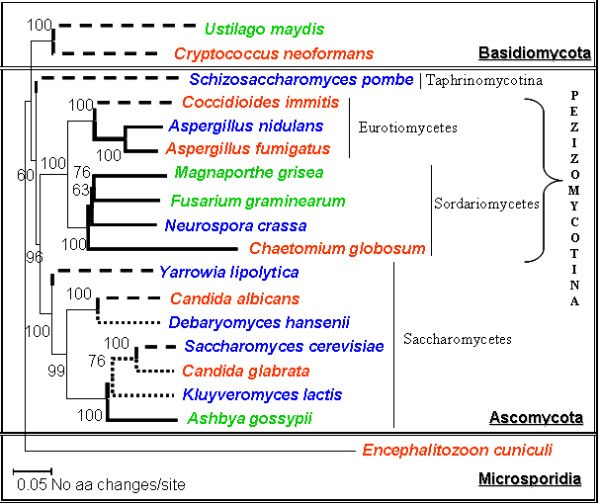
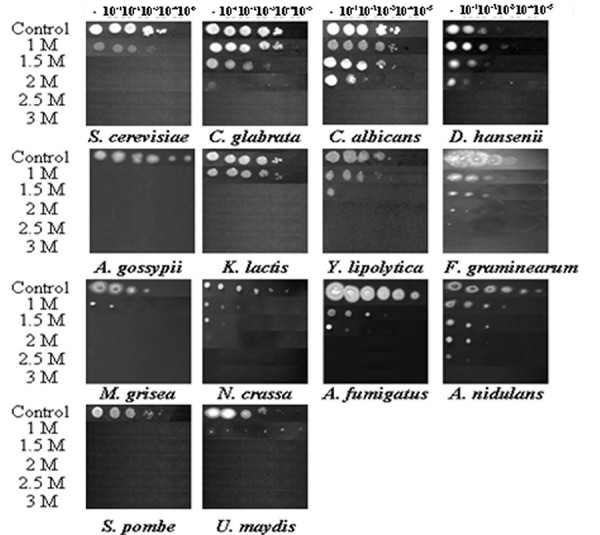
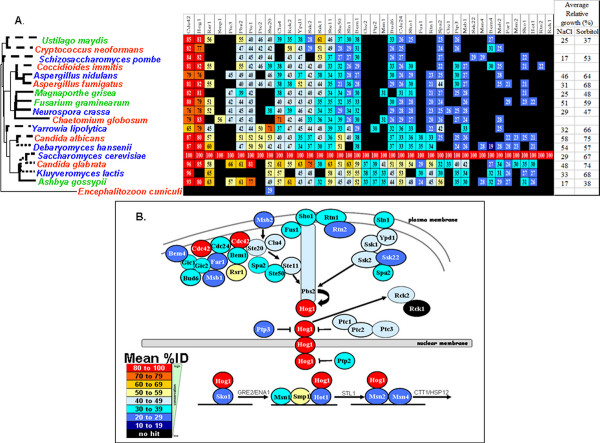
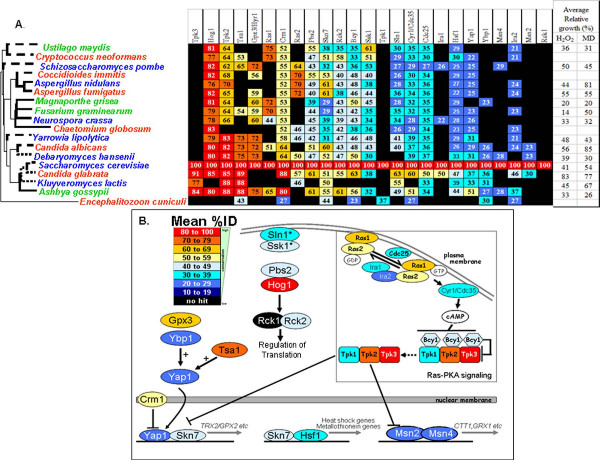
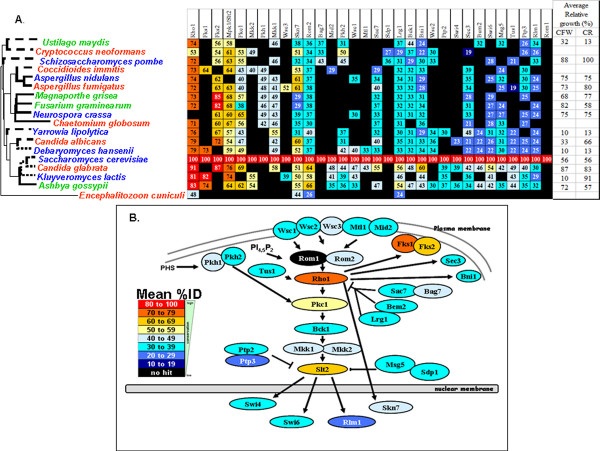
BACKGROUND: Microbes must sense environmental stresses, transduce these signals and mount protective responses to survive in hostile environments. In this study we have tested the hypothesis that fungal stress signalling pathways have evolved rapidly in a niche-specific fashion that is independent of phylogeny. To test this hypothesis we have compared the conservation of stress signalling molecules in diverse fungal species with their stress resistance. These fungi, which include ascomycetes, basidiomycetes and microsporidia, occupy highly divergent niches from saline environments to plant or mammalian hosts. RESULTS: The fungi displayed significant variation in their resistance to osmotic (NaCl and sorbitol), oxidative (H2O2 and menadione) and cell wall stresses (Calcofluor White and Congo Red). There was no strict correlation between fungal phylogeny and stress resistance. Rather, the human pathogens tended to be more resistant to all three types of stress, an exception being the sensitivity of Candida albicans to the cell wall stress, Calcofluor White. In contrast, the plant pathogens were relatively sensitive to oxidative stress. The degree of conservation of osmotic, oxidative and cell wall stress signalling pathways amongst the eighteen fungal species was examined. Putative orthologues of functionally defined signalling components in Saccharomyces cerevisiae were identified by performing reciprocal BLASTP searches, and the percent amino acid identities of these orthologues recorded. This revealed that in general, central components of the osmotic, oxidative and cell wall stress signalling pathways are relatively well conserved, whereas the sensors lying upstream and transcriptional regulators lying downstream of these modules have diverged significantly. There was no obvious correlation between the degree of conservation of stress signalling pathways and the resistance of a particular fungus to the corresponding stress. CONCLUSION: Our data are consistent with the hypothesis that fungal stress signalling components have undergone rapid recent evolution to tune the stress responses in a niche-specific fashion.
Overview
The claims and statistics of this paper haven’t been checked yet.
Run the check — free, no account needed. It reads the open-access text and checks the sources it cites.
Integrity signals
Registry
Cites
Statistics
Figures
Verification
Claims the paper makes
The claims and statistics of this paper haven’t been checked yet.
Run the check — free, no account needed. It reads the open-access text and checks the sources it cites.
Claims other papers make about this one
Each is checked against this paper’s own text: does it say what the citing paper says it does?
In the citing paper
“C. glabrata is highly tolerant to oxidative, cell wall, osmotic and endoplasmic reticulum (ER) stress [79].”
From Candida glabrata: A Lot More Than Meets the Eye (2019) · cites this paper as [79]
In the citing paper
“For example, an experimental E. coli culture could evolve the ability to aerobically utilize citrate [37], or the ability to use the non-natural carbon source 1,2-propanediol [71]; also, a strain deficient in glutathione biosynthesis was able to develop compensatory mutations to restore this function [147].”
From Adaptive laboratory evolution—Principles and applications for biotechnology (2013) · cites this paper as [147]
Self-check
Percentages, sums and reported differences re-computed from the paper’s own numbers.
The self-check needs the paper’s full text.
Citations
Cites
Gapped BLAST and PSI-BLAST: a new generation of protein database search programs
Altschul, S. (1997) · Nucleic Acids Research · doi:10.1093/nar/25.17.3389 · Cited by 73,302
Thompson, J. D., Higgins, D. G., & Gibson, T. J. (1994) · Nucleic Acids Research · doi:10.1093/nar/22.22.4673 · Cited by 64,617
The neighbor-joining method: a new method for reconstructing phylogenetic trees.
Saitou, N., & Nei, M. (1987) · Molecular Biology and Evolution · doi:10.1093/oxfordjournals.molbev.a040454 · Cited by 59,959
MEGA3: Integrated software for Molecular Evolutionary Genetics Analysis and sequence alignment
Kumar, S. (2004) · Briefings in Bioinformatics · doi:10.1093/bib/5.2.150 · Cited by 11,674
Database resources of the National Center for Biotechnology Information: update
Wheeler, D. L. (2003) · Nucleic Acids Research · doi:10.1093/nar/gkh073 · Cited by 10,695
Tree View: An application to display phylogenetic trees on personal computers
Page, R. (1996) · Computer applications in the biosciences · doi:10.1093/bioinformatics/12.4.357 · Cited by 10,223
Sherman, F., Fink, G. R., & Hicks, J. B. (1979) · Cold Spring Harbor Laboratory eBooks · Cited by 7,430
Jacob, H. (1988) · Bioelectrochemistry and Bioenergetics · doi:10.1016/0302-4598(88)80052-7 · Cited by 4,911
Genomic Expression Programs in the Response of Yeast Cells to Environmental Changes
Gasch, A. P., Spellman, P. T., Kao, C. M., Carmel-Harel, O., Eisen, M. B., Storz, G., Botstein, D., & Brown, P. O. (2000) · Molecular Biology of the Cell · doi:10.1091/mbc.11.12.4241 · Cited by 4,815
The COG database: a tool for genome-scale analysis of protein functions and evolution
Tatusov, R. L. (2000) · Nucleic Acids Research · doi:10.1093/nar/28.1.33 · Cited by 4,480
Research works printed but not linked: 5
- Selitrennikoff CP: Calcofluor white inhibits Neurospora chitin synthetase activity [bleaching agent for fabrics]. Plant Physiol Bioch. 1984, 8 (3): 269-272.
- Fleet GH: Cell walls. The Yeasts. Edited by: Rose AH, Harrison JS. 1991, New York: Academic Press, 199-277.
- Vogel HJ: Vogel, A convenient medium for Neurospora (medium N). Microb Genet Bull. 1956, 13: 42-43.
- Selitrennikoff C, Sachs MS: Lipofectin increases transformation of Neurospora crassa. Fungal Genet Newsl. 1991, 38: 90-91.
- Perkins DD: How to convert wild-type spreading growth to colonial. 2006, [http://www.fgsc.net/Neurospora/NeurosporaProtocolGuide.htm]
Cited by
Sorted by citations
Items 201–206 of 206
Assessment of the metabolome in genomically diverse Candida albicans isolates
Alaban, L. R. (2022) · theses.fr (ABES) · doi:10.70675/6127ebd7z2b67z4728z960dzdc64762b4c70
Campanella, J. E. M., Barbugli, P. A., Gomes, A. A. S., Freitas, F. Z., Malavazi, I., & Bertolini, M. C. (2026) · FEBS Journal · doi:10.1111/febs.70643
Haroun, M., Addala, S., BOUHDJER, M. L., Bouhdjer, A., Abdelouahed, K., Selmi, N., Sahnoune, D., & Bouhdjer, L. (2026) · Ceramics International · doi:10.1016/j.ceramint.2026.07.559
Schruefer, S., Hu, Y., & Ebel, F. (2026) · FEMS Microbiology Reviews · doi:10.1093/femsre/fuag037
Neumann, C., Bielčik, M., & Rillig, M. C. (2026) · Fungal ecology · doi:10.1016/j.funeco.2026.101541
Gómez-Gaviria, M., Ramírez-Sotelo, U., & Mora-Montes, H. M. (2026) · Journal of Fungi · doi:10.3390/jof12100791
Metadata
- Authors
- Nikolaou, E., Agrafioti, I., Stumpf, M., Quinn, J., Stansfield, I., & Brown, A. J.
- Affiliations
- University of Aberdeen (GB)
- Imperial College London (GB)
- Newcastle University (GB)
- Corresponding author
- Brown, Alistair JP
- Venue
- BMC Evolutionary Biology
- Published
- 2009-02-21
- Volume
- 9
- Issue
- 1
- Pages
- 44-44
- ISSN
- 1471-2148 (ISSN-L)
- PMC
- PMC2666651
- OpenAlex
- W1985831723
- Cited by
- 206
- References
- 159
- Citations by year
- 2026: 12 · 2025: 13 · 2024: 7 · 2023: 9 · 2022: 9 · 2021: 7 · 2020: 14 · 2019: 13 · 2018: 8 · 2017: 13 · 2016: 15 · 2015: 17 · 2014: 18 · 2013: 16 · 2012: 13
- FWCI
- 4.69
- Type
- journal article
- Language
- en
- Open access
- gold
- doi.org
- Licence
- cc-by
- Locations
- BMC Evolutionary Biology (publishedVersion, cc-by)
- PubMed Central (publishedVersion, cc-by)
- PubMed (publishedVersion)
- Aberdeen University Research Archive (Aberdeen University) (submittedVersion)
- Minerva Access (University of Melbourne) (submittedVersion, cc-by)
- DOAJ (DOAJ: Directory of Open Access Journals) (submittedVersion, cc-by-sa)
- Newcastle University ePrints (Newcastle Univesity)
- Funders
- Wellcome Trust (080088)
- University of Exeter
- Imperial College London
- University of Aberdeen
- Biotechnology and Biological Sciences Research Council (BB/D009308/1, BB/C510391/1, BB/F00513X/1, BB/F013566/1)
- Topics
- Life Sciences › Biochemistry, Genetics and Molecular Biology › Molecular Biology › Fungal and yeast genetics research
- Life Sciences › Biochemistry, Genetics and Molecular Biology › Genetics › Bacterial Genetics and Biotechnology
- Health Sciences › Medicine › Infectious Diseases › Antifungal resistance and susceptibility
- Keywords
- stress tolerance, osmotic stress, oxidative stress, cell wall stress, phylogenetic conservation, orthologs, human fungal pathogens, plant pathogenic fungi, Candida albicans, Ascomycota, Basidiomycota, microsporidia, signal transduction
- MeSH terms
- Benzenesulfonates, Candida albicans, Cell Wall, Congo Red, DNA, Fungal, Fungal Proteins, Hydrogen Peroxide, Osmotic Pressure, Phylogeny, Saccharomyces cerevisiae, Sodium Chloride, Sorbitol, Signal Transduction, Gene Expression Regulation, Fungal, Genome, Fungal, Oxidative Stress, Evolution, Molecular, Vitamin K 3
About these checks
Registry, retraction, Cites and statistics results are computed, not judged, with one exception: a printed reference that no index lists is read once by a model before it counts as a citation error. Claims are extracted by a model and kept only when their quote appears verbatim in the text; each cited source is then checked, with a model’s help, for whether it says what the claim relies on. Those verdicts can be wrong — read the claim’s quote and the cited source before relying on one.
Statistics and arithmetic are recomputed, not judged.
Confidence bands are shown only for fields calibrated on our annotated test set. None is calibrated yet, so no band is shown.
What counts as a claim ›How we measure confidence ›How we check this ›
Are you an author, or do you see a problem with this page? Request a review
