

The DOI matches its Crossref record; 52 of the 52 references it cites were found in a registry or an index.
Canine tumor cross-species genomics uncovers targets linked to osteosarcoma progression
Open accessAbstract
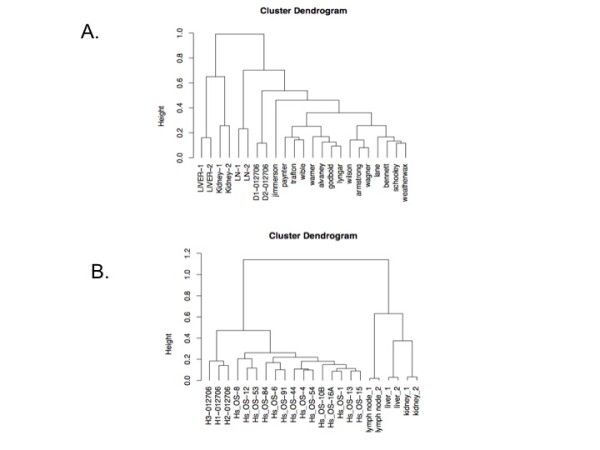
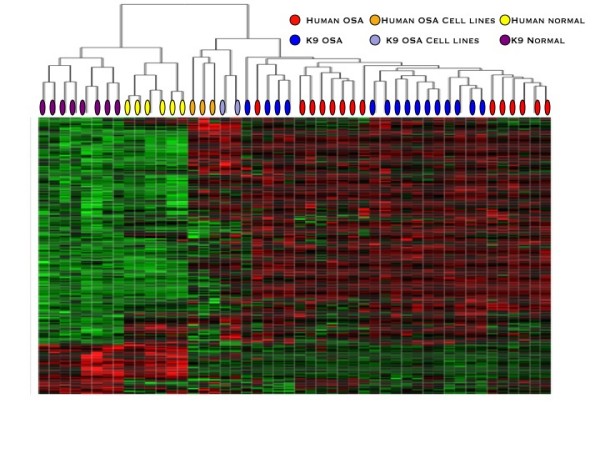
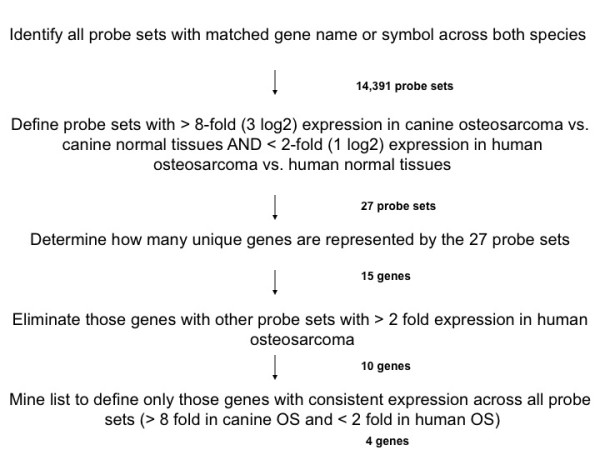
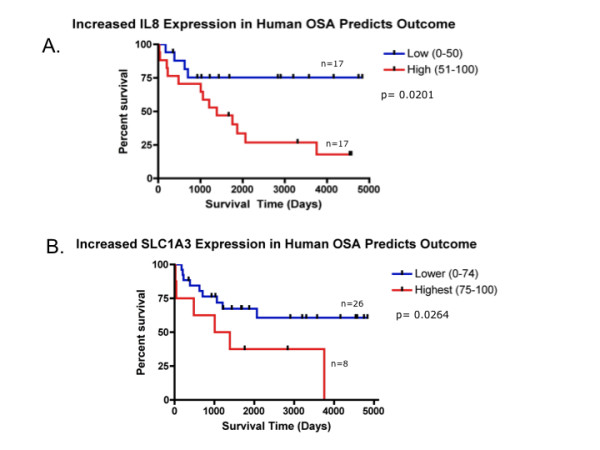
BACKGROUND: Pulmonary metastasis continues to be the most common cause of death in osteosarcoma. Indeed, the 5-year survival for newly diagnosed osteosarcoma patients has not significantly changed in over 20 years. Further understanding of the mechanisms of metastasis and resistance for this aggressive pediatric cancer is necessary. Pet dogs naturally develop osteosarcoma providing a novel opportunity to model metastasis development and progression. Given the accelerated biology of canine osteosarcoma, we hypothesized that a direct comparison of canine and pediatric osteosarcoma expression profiles may help identify novel metastasis-associated tumor targets that have been missed through the study of the human cancer alone. RESULTS: Using parallel oligonucleotide array platforms, shared orthologues between species were identified and normalized. The osteosarcoma expression signatures could not distinguish the canine and human diseases by hierarchical clustering. Cross-species target mining identified two genes, interleukin-8 (IL-8) and solute carrier family 1 (glial high affinity glutamate transporter), member 3 (SLC1A3), which were uniformly expressed in dog but not in all pediatric osteosarcoma patient samples. Expression of these genes in an independent population of pediatric osteosarcoma patients was associated with poor outcome (p = 0.020 and p = 0.026, respectively). Validation of IL-8 and SLC1A3 protein expression in pediatric osteosarcoma tissues further supported the potential value of these novel targets. Ongoing evaluation will validate the biological significance of these targets and their associated pathways. CONCLUSIONS: Collectively, these data support the strong similarities between human and canine osteosarcoma and underline the opportunities provided by a comparative oncology approach as a means to improve our understanding of cancer biology and therapies.
Overview
The claims and statistics of this paper haven’t been checked yet.
Run the check — free, no account needed. It reads the open-access text and checks the sources it cites.
Integrity signals
Registry
Cites
Statistics
Figures
Verification
Claims the paper makes
The claims and statistics of this paper haven’t been checked yet.
Run the check — free, no account needed. It reads the open-access text and checks the sources it cites.
Claims other papers make about this one
Each is checked against this paper’s own text: does it say what the citing paper says it does?
In the citing paper
“This integrated approach has been particularly promising for the evaluation of anti-metastatic 99,234 and immune-based therapeutics 69,235 .”
From Osteosarcoma (2022) · cites this paper as [234]
Self-check
Percentages, sums and reported differences re-computed from the paper’s own numbers.
The self-check needs the paper’s full text.
Citations
Cites
Exploration, normalization, and summaries of high density oligonucleotide array probe level data
Irizarry, R. A. (2003) · Biostatistics · doi:10.1093/biostatistics/4.2.249 · Cited by 10,603
limma: Linear Models for Microarray Data
Smyth, G. K. (2005) · Statistics for Biology and Health · doi:10.1007/0-387-29362-0_23 · Cited by 5,796
A gene atlas of the mouse and human protein-encoding transcriptomes
Su, A. I., Wiltshire, T., Batalov, S., Lapp, H., Ching, K. A., Block, D., Zhang, J., Soden, R., Hayakawa, M., Kreiman, G., et al. (2004) · Proceedings of the National Academy of Sciences · doi:10.1073/pnas.0400782101 · Cited by 3,475
Genome sequence, comparative analysis and haplotype structure of the domestic dog
members, B. S. P., Lindblad-Toh, K., Wade, C. M., Mikkelsen, T. S., Karlsson, E. K., Jaffe, D. B., Kamal, M., Clamp, M., Chang, J. L., Kulbokas, E. J., et al. (2005) · Nature · doi:10.1038/nature04338 · Cited by 2,568
Huang, D. W., Sherman, B. T., Tan, Q., Kir, J., Liu, D., Bryant, D., Guo, Y., Stephens, R. M., Baseler, M., Lane, H. C., et al. (2007) · Nucleic Acids Research · doi:10.1093/nar/gkm415 · Cited by 2,216
Rosen, G., Caparros, B., Huvos, A. G., Kosloff, C., Nirenberg, A., Cacavio, A., Marcove, R. C., Lane, J. M., Mehta, B. M., & Urban, C. (1982) · Cancer · doi:10.1002/1097-0142(19820315)49:6 · Cited by 1,082
Biology and Therapeutic Advances for Pediatric Osteosarcoma
Marina, N. M., Gebhardt, M. C., Teot, L. A., & Gorlick, R. G. (2004) · The Oncologist · doi:10.1634/theoncologist.9-4-422 · Cited by 670
Translation of new cancer treatments from pet dogs to humans
Paoloni, M., & Khanna, C. (2008) · Nature Reviews Cancer · doi:10.1038/nrc2273 · Cited by 668
Self-citationWithrow & Macewen's Small Animal Clinical Oncology
Withrow, S. J., Vail, D. M., & Page, R. L. (2019) · Medical Entomology and Zoology · Cited by 637
Self-citationLee, J.-S., Chu, I.-S., Mikaelyan, A., Calvisi, D., Heo, J., Reddy, J., & Thorgeirsson, S. (2004) · Nature Genetics · doi:10.1038/ng1481 · Cited by 472
Cited by
Sorted by citations
Beird, H. C., Bielack, S. S., Flanagan, A. M., Gill, J., Heymann, D., Janeway, K. A., Livingston, J. A., Roberts, R. D., Strauss, S. J., & Gorlick, R. (2022) · Nature Reviews Disease Primers · doi:10.1038/s41572-022-00409-y · Cited by 660
Comparative oncology: what dogs and other species can teach us about humans with cancer
Schiffman, J. D., & Breen, M. (2015) · Philosophical Transactions of the Royal Society B Biological Sciences · doi:10.1098/rstb.2014.0231 · Cited by 445
Dog models of naturally occurring cancer
Rowell, J., McCarthy, D. O., & Alvarez, C. E. (2011) · Trends in Molecular Medicine · doi:10.1016/j.molmed.2011.02.004 · Cited by 413
Breed-Predispositions to Cancer in Pedigree Dogs
Dobson, J. M. (2013) · ISRN Veterinary Science · doi:10.1155/2013/941275 · Cited by 373
Canine Osteosarcoma: A Naturally Occurring Disease to Inform Pediatric Oncology
Fenger, J. M., London, C. A., & Kisseberth, W. C. (2014) · ILAR Journal · doi:10.1093/ilar/ilu009 · Cited by 248
Metadata
- Authors
- Paoloni, M., Davis, S., Lana, S., Withrow, S., Sangiorgi, L., Picci, P., Hewitt, S., Triche, T., Meltzer, P., & Khanna, C.
- Affiliations
- National Institutes of Health (US)
- Colorado State University (US)
- Istituto Ortopedico Rizzoli (IT)
- University of Southern California (US)
- Corresponding author
- Paoloni, Melissa
- Venue
- BMC Genomics
- Published
- 2009
- Volume
- 10
- Issue
- 1
- Pages
- 625
- ISSN
- 1471-2164 (ISSN-L)
- PMC
- PMC2803201
- OpenAlex
- W2116599555
- Cited by
- 291
- References
- 52
- Citations by year
- 2026: 10 · 2025: 18 · 2024: 13 · 2023: 24 · 2022: 15 · 2021: 22 · 2020: 32 · 2019: 16 · 2018: 17 · 2017: 11 · 2016: 18 · 2015: 18 · 2014: 17 · 2013: 13 · 2012: 19
- FWCI
- 13.23
- Type
- journal article
- Language
- en
- Open access
- gold
- doi.org
- Licence
- cc-by
- Locations
- BMC Genomics (publishedVersion, cc-by)
- PubMed Central (publishedVersion, cc-by)
- PubMed (publishedVersion)
- DOAJ (DOAJ: Directory of Open Access Journals) (submittedVersion)
- Funders
- Colorado State University
- National Human Genome Research Institute
- National Cancer Institute
- Topics
- Health Sciences › Veterinary › Small Animals › Veterinary Oncology Research
- Health Sciences › Medicine › Oncology › Sarcoma Diagnosis and Treatment
- Life Sciences › Agricultural and Biological Sciences › Animal Science and Zoology › Human-Animal Interaction Studies
- Keywords
- canine osteosarcoma, pediatric osteosarcoma, lung metastasis, comparative oncology, cross-species gene expression, interleukin-8, GLAST, prognostic factors, orthologs
- MeSH terms
- Animals, Child, Dogs, Humans, RNA, Neoplasm, Osteosarcoma, Cluster Analysis, Interleukin-8, Oligonucleotide Array Sequence Analysis, Gene Expression Profiling, Genomics, Excitatory Amino Acid Transporter 1, Cell Line, Tumor, Comparative Genomic Hybridization
About these checks
Registry, retraction, Cites and statistics results are computed, not judged, with one exception: a printed reference that no index lists is read once by a model before it counts as a citation error. Claims are extracted by a model and kept only when their quote appears verbatim in the text; each cited source is then checked, with a model’s help, for whether it says what the claim relies on. Those verdicts can be wrong — read the claim’s quote and the cited source before relying on one.
Statistics and arithmetic are recomputed, not judged.
Confidence bands are shown only for fields calibrated on our annotated test set. None is calibrated yet, so no band is shown.
What counts as a claim ›How we measure confidence ›How we check this ›
Are you an author, or do you see a problem with this page? Request a review
