

The DOI matches its Crossref record; 114 of the 114 references it cites were found in a registry or an index.
Phylogenetic distribution of translational GTPases in bacteria
Open accessAbstract
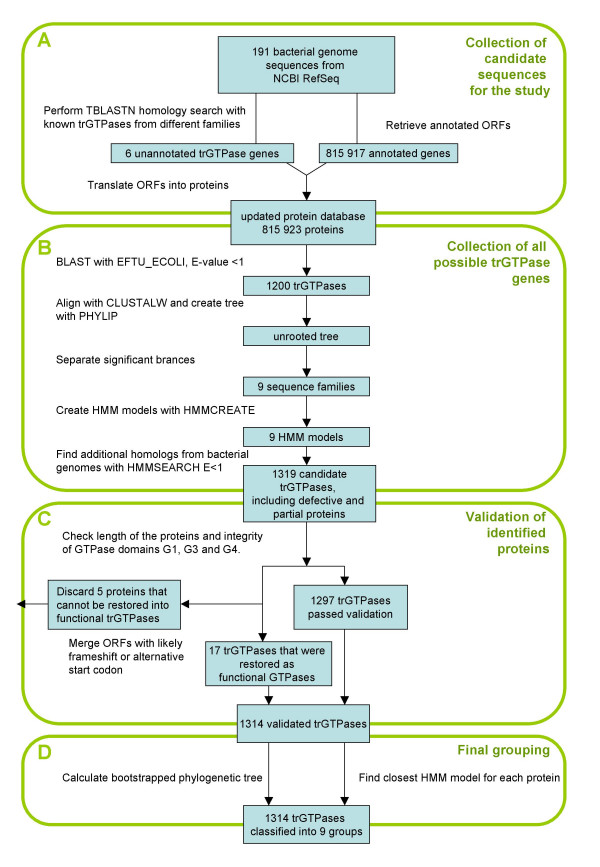
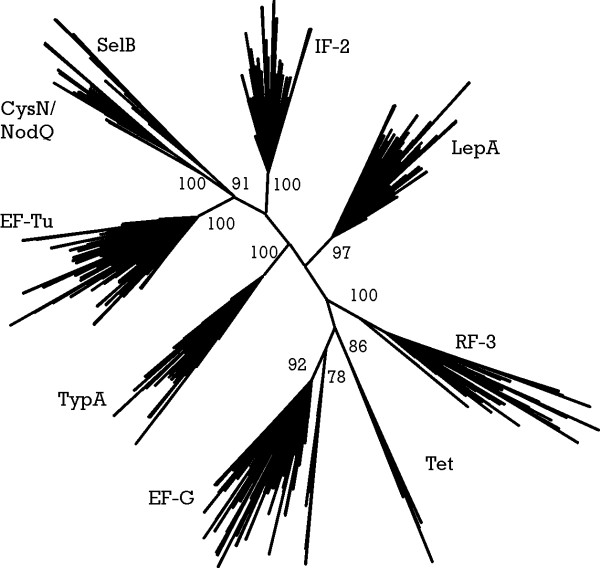
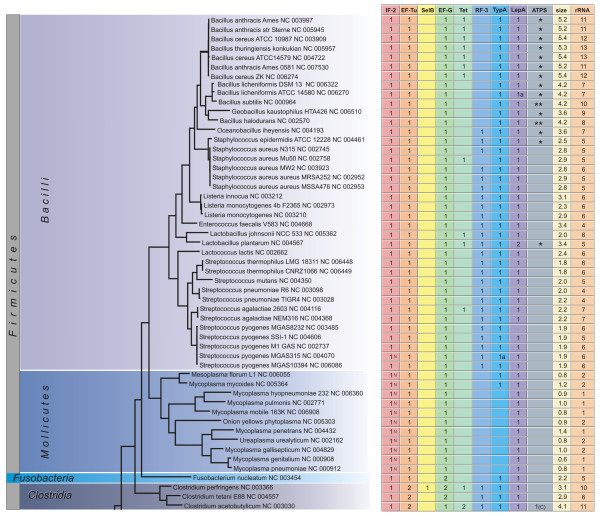
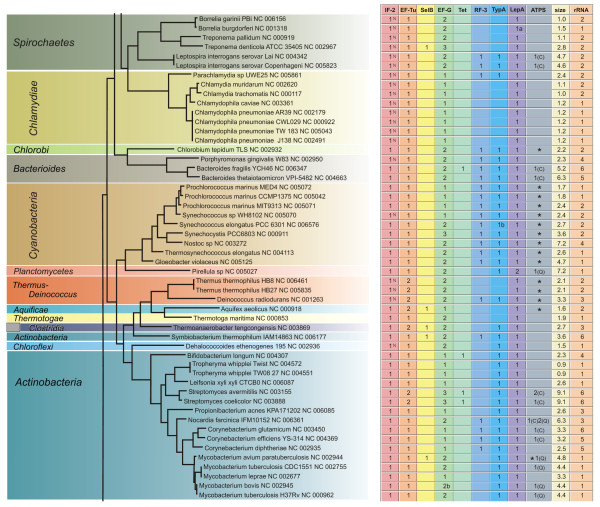
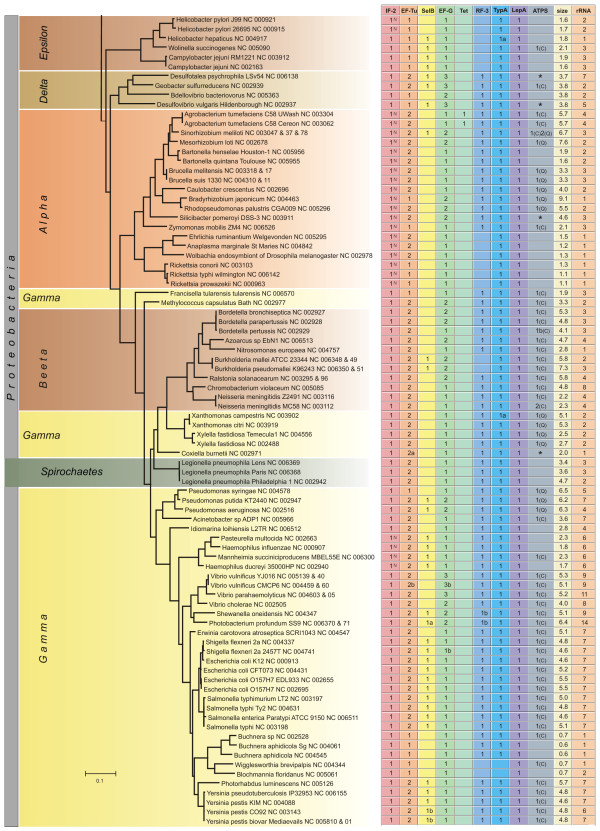
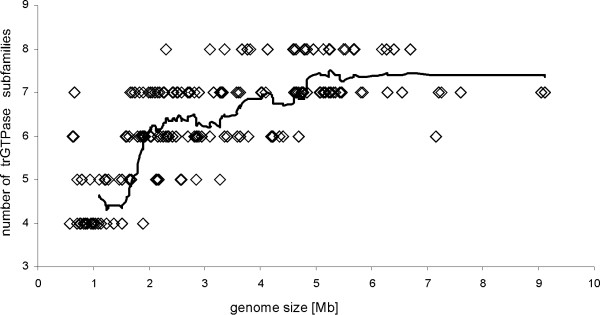
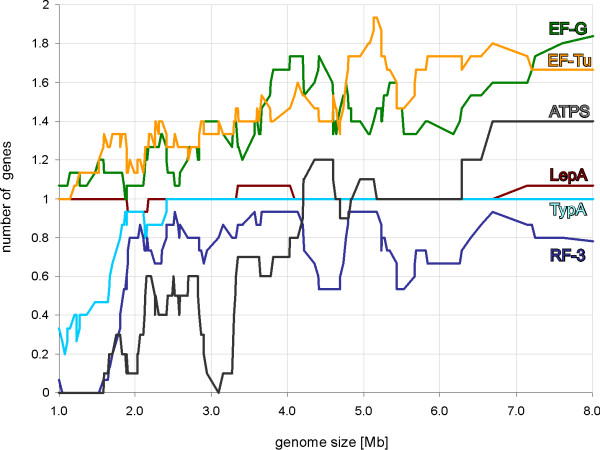
Background: Translational GTPases are a family of proteins in which GTPase activity is stimulated by the large ribosomal subunit. Conserved sequence features allow members of this family to be identified. Results: To achieve accurate protein identification and grouping we have developed a method combining searches with Hidden Markov Model profiles and tree based grouping. We found all the genes for translational GTPases in 191 fully sequenced bacterial genomes. The protein sequences were grouped into nine subfamilies. Analysis of the results shows that three translational GTPases, the translation factors EF-Tu, EF-G and IF2, are present in all organisms examined. In addition, several copies of the genes encoding EF-Tu and EF-G are present in some genomes. In the case of multiple genes for EF-Tu, the gene copies are nearly identical; in the case of multiple EF-G genes, the gene copies have been considerably diverged. The fourth translational GTPase, LepA, the function of which is currently unknown, is also nearly universally conserved in bacteria, being absent from only one organism out of the 191 analyzed. The translation regulator, TypA, is also present in most of the organisms examined, being absent only from bacteria with small genomes. Surprisingly, some of the well studied translational GTPases are present only in a very small number of bacteria. The translation termination factor RF3 is absent from many groups of bacteria with both small and large genomes. The specialized translation factor for selenocysteine incorporation – SelB – was found in only 39 organisms. Similarly, the tetracycline resistance proteins (Tet) are present only in a small number of species. Proteins of the CysN/NodQ subfamily have acquired functions in sulfur metabolism and production of signaling molecules. The genes coding for CysN/NodQ proteins were found in 74 genomes. This protein subfamily is not confined to Proteobacteria, as suggested previously but present also in many other groups of bacteria. Conclusion: Four of the translational GTPase subfamilies (IF2, EF-Tu, EF-G and LepA) are represented by at least one member in each bacterium studied, with one exception in LepA. This defines the set of translational GTPases essential for basic cell functions.
Overview
The claims and statistics of this paper haven’t been checked yet.
Run the check — free, no account needed. It reads the open-access text and checks the sources it cites.
Integrity signals
Registry
Cites
Statistics
Figures
Verification
Claims the paper makes
The claims and statistics of this paper haven’t been checked yet.
Run the check — free, no account needed. It reads the open-access text and checks the sources it cites.
Claims other papers make about this one
Each is checked against this paper’s own text: does it say what the citing paper says it does?
In the citing paper
“Tetracycline resistance protein Tet(O), which protects the bacterial ribosome from binding the antibiotic tetracycline, is a translational GTPase with significant similarity in both sequence and structure to the elongation factor EF-G.”
From Mechanism of tetracycline resistance by ribosomal protection protein Tet(O) (2013) · cites this paper as [6]
In the citing paper
“Several of these proteins–the best-known being Tet(M) and Tet(O) – are paralogs of the translational GTPase EF-G 6 and actively remove Tc from the ribosome in a GTP-hydrolysis-dependent fashion 7,8.”
From Mechanism of tetracycline resistance by ribosomal protection protein Tet(O) (2013) · cites this paper as [6]
Self-check
Percentages, sums and reported differences re-computed from the paper’s own numbers.
The self-check needs the paper’s full text.
Citations
Cites
1 retracted
A dedicated translation factor controls the synthesis of the global regulator Fis
Owens, R. M., Pritchard, G., Skipp, P. J. S., Hodey, M., Connell, S. R., Nierhaus, K. H., & O’Connor, C. D. (2004) · The EMBO Journal · doi:10.1038/sj.emboj.7600343 · Cited by 51
RetractedGapped BLAST and PSI-BLAST: a new generation of protein database search programs
Altschul, S. (1997) · Nucleic Acids Research · doi:10.1093/nar/25.17.3389 · Cited by 73,302
Thompson, J. D., Higgins, D. G., & Gibson, T. J. (1994) · Nucleic Acids Research · doi:10.1093/nar/22.22.4673 · Cited by 64,617
PHYLIP-Phylogeny inference package (Version 3.2)
Felsenstein, J. (1989) · Cladistics · Cited by 17,682
The Pfam Protein Families Database
Bateman, A. G. (2002) · Nucleic Acids Research · doi:10.1093/nar/30.1.276 · Cited by 14,075
MEGA3: Integrated software for Molecular Evolutionary Genetics Analysis and sequence alignment
Kumar, S. (2004) · Briefings in Bioinformatics · doi:10.1093/bib/5.2.150 · Cited by 11,674
EMBOSS: the European molecular biology open software suite.
Rice, P., Longden, I., & Bleasby, A. (2000) · Trends in Genetics · doi:10.1016/s0168-9525(00)02024-2 · Cited by 9,466
Eddy, S. R. (1998) · Bioinformatics · doi:10.1093/bioinformatics/14.9.755 · Cited by 5,515
Chopra, I., & Roberts, M. (2001) · Microbiology and Molecular Biology Reviews · doi:10.1128/mmbr.65.2.232-260.2001 · Cited by 4,517
Pruitt, K. D., Tatusova, T. A., & Maglott, D. R. (2006) · Nucleic Acids Research · doi:10.1093/nar/gkl842 · Cited by 4,441
Research works printed but not linked: 1
- Garrity GM Bell, J. A., Lilburn, T. G.: Taxonomic Outline of the Procaryotes. Bergey's Manual of Systematic Bacteriology, Second Edition. 2004, Springer-Verlag, 5:
Cited by
Sorted by citations
Items 101–126 of 126
Zhao, L., Zeng, X., Hu, X., Sheng, J., Zhu, F., Zhong, L., Zhou, F., Jin, S., Hu, Z., & Diao, Y. (2020) · Acta Physiologiae Plantarum · doi:10.1007/s11738-020-03071-7 · Cited by 1
A temperature-dependent translational switch controls biofilm development in Vibrio choleraePreprint
Santos, T. D. P., Blake, J., Sit, B., Warr, A. R., Beneš, V., Waldor, M. K., & Cava, F. (2020) · bioRxiv (Cold Spring Harbor Laboratory) · doi:10.1101/2020.05.07.082040
Chen, P., Zhou, H., Huang, Y., Xie, Z., Zhang, M., Wei, Y., Li, J., Ma, Y., Luo, M., Ding, W., et al. (2021) · Figshare · doi:10.6084/m9.figshare.14978052
Chen, P., Zhou, H., Huang, Y., Xie, Z., Zhang, M., Wei, Y., Li, J., Ma, Y., Luo, M., Ding, W., et al. (2021) · Figshare · doi:10.6084/m9.figshare.14978049
Chen, P., Zhou, H., Huang, Y., Xie, Z., Zhang, M., Wei, Y., Li, J., Ma, Y., Luo, M., Ding, W., et al. (2021) · Figshare · doi:10.6084/m9.figshare.14978016
Chen, P., Zhou, H., Huang, Y., Xie, Z., Zhang, M., Wei, Y., Li, J., Ma, Y., Luo, M., Ding, W., et al. (2021) · Figshare · doi:10.6084/m9.figshare.14978046
Chen, P., Zhou, H., Huang, Y., Xie, Z., Zhang, M., Wei, Y., Li, J., Ma, Y., Luo, M., Ding, W., et al. (2021) · Figshare · doi:10.6084/m9.figshare.14978001
Chen, P., Zhou, H., Huang, Y., Xie, Z., Zhang, M., Wei, Y., Li, J., Ma, Y., Luo, M., Ding, W., et al. (2021) · Figshare · doi:10.6084/m9.figshare.14978055
Chen, P., Zhou, H., Huang, Y., Xie, Z., Zhang, M., Wei, Y., Li, J., Ma, Y., Luo, M., Ding, W., et al. (2021) · Figshare · doi:10.6084/m9.figshare.14978004
Chen, P., Zhou, H., Huang, Y., Xie, Z., Zhang, M., Wei, Y., Li, J., Ma, Y., Luo, M., Ding, W., et al. (2021) · Figshare · doi:10.6084/m9.figshare.14977998
Chen, P., Zhou, H., Huang, Y., Xie, Z., Zhang, M., Wei, Y., Li, J., Ma, Y., Luo, M., Ding, W., et al. (2021) · Figshare · doi:10.6084/m9.figshare.14978007
Chen, P., Zhou, H., Huang, Y., Xie, Z., Zhang, M., Wei, Y., Li, J., Ma, Y., Luo, M., Ding, W., et al. (2021) · Figshare · doi:10.6084/m9.figshare.14978010
Chen, P., Zhou, H., Huang, Y., Xie, Z., Zhang, M., Wei, Y., Li, J., Ma, Y., Luo, M., Ding, W., et al. (2021) · Figshare · doi:10.6084/m9.figshare.14978013
Role of the sarcin-ricin loop of 23S rRNA in biogenesis of the 50S ribosomal subunit
Aval, S. F., Seffouh, A., Moon, K., Foster, L. J., Ortega, J., & Fredrick, K. (2025) · RNA · doi:10.1261/rna.080335.124
Structural insights of the first elongation factor EF-Tu complexes from mycoplasma
Liu, Y., Ma, D., Yao, H., Gong, W., Xie, L., Zhao, Y., Zhao, Y., Wang, W., & Wang, H. (2025) · Journal of Molecular Structure · doi:10.1016/j.molstruc.2025.144131
Chen, P., Zhou, H., Huang, Y., Xie, Z., Zhang, M., Wei, Y., Li, J., Ma, Y., Luo, M., Ding, W., et al. (2021) · Figshare · doi:10.6084/m9.figshare.14978022
Chen, P., Zhou, H., Huang, Y., Xie, Z., Zhang, M., Wei, Y., Li, J., Ma, Y., Luo, M., Ding, W., et al. (2021) · Figshare · doi:10.6084/m9.figshare.14978040
Chen, P., Zhou, H., Huang, Y., Xie, Z., Zhang, M., Wei, Y., Li, J., Ma, Y., Luo, M., Ding, W., et al. (2021) · Figshare · doi:10.6084/m9.figshare.14978034
Chen, P., Zhou, H., Huang, Y., Xie, Z., Zhang, M., Wei, Y., Li, J., Ma, Y., Luo, M., Ding, W., et al. (2021) · Figshare · doi:10.6084/m9.figshare.14978043
Chen, P., Zhou, H., Huang, Y., Xie, Z., Zhang, M., Wei, Y., Li, J., Ma, Y., Luo, M., Ding, W., et al. (2021) · Figshare · doi:10.6084/m9.figshare.14978019
Chen, P., Zhou, H., Huang, Y., Xie, Z., Zhang, M., Wei, Y., Li, J., Ma, Y., Luo, M., Ding, W., et al. (2021) · Figshare · doi:10.6084/m9.figshare.14978028
Chen, P., Zhou, H., Huang, Y., Xie, Z., Zhang, M., Wei, Y., Li, J., Ma, Y., Luo, M., Ding, W., et al. (2021) · Figshare · doi:10.6084/m9.figshare.14978031
Chen, P., Zhou, H., Huang, Y., Xie, Z., Zhang, M., Wei, Y., Li, J., Ma, Y., Luo, M., Ding, W., et al. (2021) · Figshare · doi:10.6084/m9.figshare.14978037
Максимова, Е. М., Корепанов, А. П., & Столбоушкина, Е. А. (2025) · Bulletin of Udmurt University Series Biology Earth Sciences · doi:10.35634/2412-9518-2025-35-4-483-491
The contribution of LepA to virulence and host cell invasion in Salmonella Typhimurium
Braetz, S., Nerlich, A., & Fulde, M. (2026) · BMC Microbiology · doi:10.1186/s12866-026-05826-7
Metadata
- Authors
- Margus, T., Remm, M., & Tenson, T.
- Affiliations
- University of Tartu (EE)
- Corresponding author
- Tenson, Tanel
- Venue
- BMC Genomics
- Published
- 2007-01-10
- Volume
- 8
- Issue
- 1
- Pages
- 15-15
- ISSN
- 1471-2164 (ISSN-L)
- PMC
- PMC1780047
- OpenAlex
- W1939105798
- Cited by
- 115
- References
- 114
- Citations by year
- 2026: 1 · 2025: 5 · 2024: 2 · 2023: 3 · 2022: 5 · 2021: 14 · 2020: 8 · 2019: 1 · 2018: 5 · 2017: 7 · 2016: 11 · 2015: 8 · 2014: 6 · 2013: 8 · 2012: 4
- FWCI
- 2.51
- Type
- journal article
- Language
- en
- Open access
- gold
- doi.org
- Licence
- Locations
- BMC Genomics (publishedVersion, cc-by)
- PubMed Central (publishedVersion, cc-by)
- PubMed (publishedVersion)
- DOAJ (DOAJ: Directory of Open Access Journals) (submittedVersion)
- Funders
- Wellcome Trust (070210)
- Eesti Teadusfondi
- Topics
- Life Sciences › Biochemistry, Genetics and Molecular Biology › Molecular Biology › RNA and protein synthesis mechanisms
- Life Sciences › Biochemistry, Genetics and Molecular Biology › Molecular Biology › Genomics and Phylogenetic Studies
- Life Sciences › Biochemistry, Genetics and Molecular Biology › Genetics › Bacterial Genetics and Biotechnology
- Keywords
- translational GTPases, bacterial phylogeny, elongation factor Tu, elongation factor G, initiation factor 2, Lepas, Rf3, Selb, selenocysteine incorporation, essential genes, gene family evolution
- MeSH terms
- Amino Acid Sequence, Bacteria, Base Sequence, DNA, Bacterial, Markov Chains, Molecular Sequence Data, Phylogeny, Sequence Homology, Nucleic Acid, Protein Biosynthesis, Genome, Bacterial, GTP Phosphohydrolases
About these checks
Registry, retraction, Cites and statistics results are computed, not judged, with one exception: a printed reference that no index lists is read once by a model before it counts as a citation error. Claims are extracted by a model and kept only when their quote appears verbatim in the text; each cited source is then checked, with a model’s help, for whether it says what the claim relies on. Those verdicts can be wrong — read the claim’s quote and the cited source before relying on one.
Statistics and arithmetic are recomputed, not judged.
Confidence bands are shown only for fields calibrated on our annotated test set. None is calibrated yet, so no band is shown.
What counts as a claim ›How we measure confidence ›How we check this ›
Are you an author, or do you see a problem with this page? Request a review
