

ABC transporter FtsABCD of Streptococcus pyogenes mediates uptake of ferric ferrichrome.
Open accessThe DOI matches its Crossref record; 36 of the 36 references it cites were found in a registry or an index.
Abstract
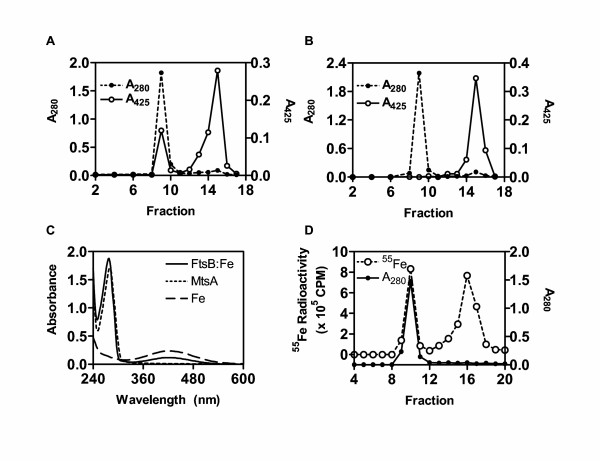
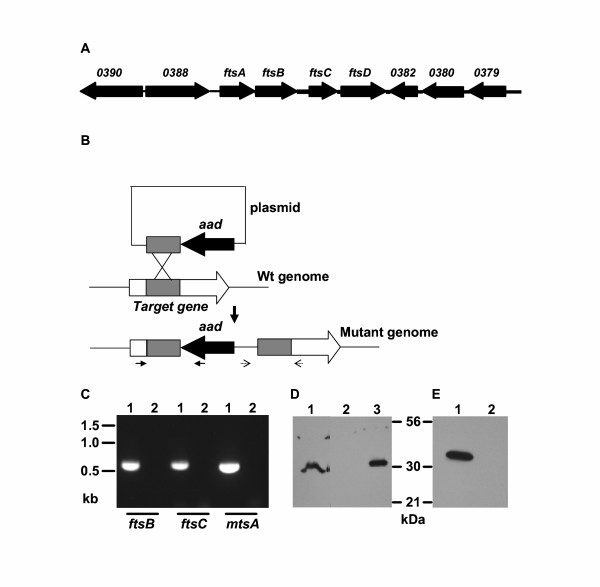
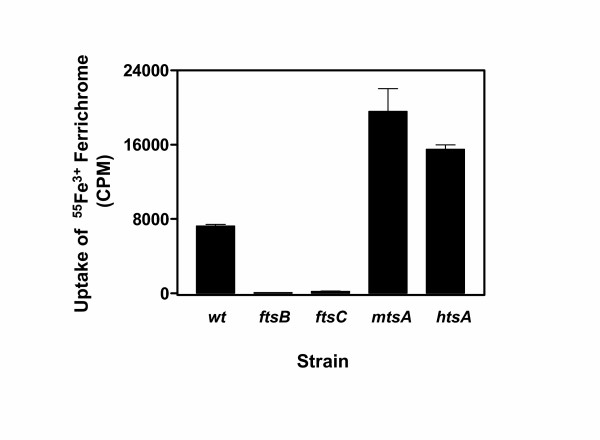
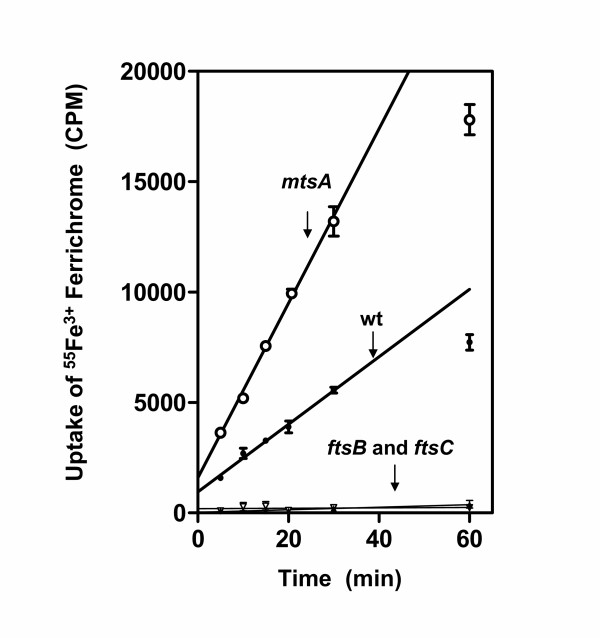
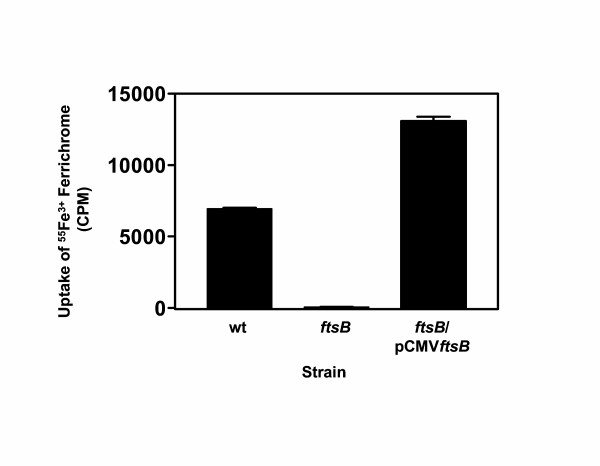
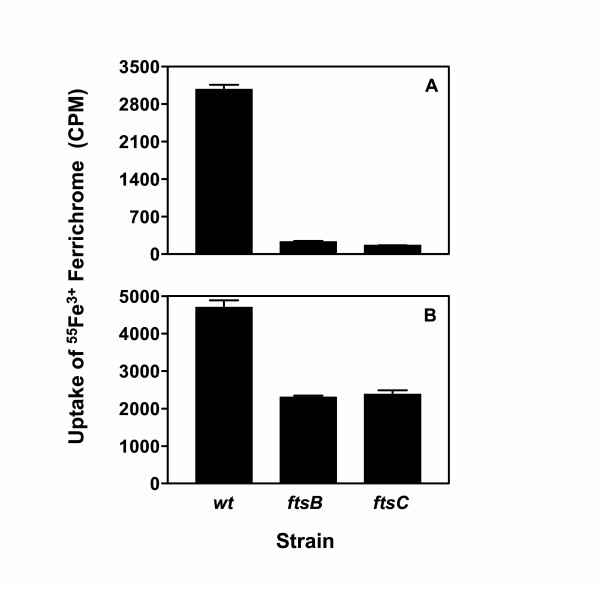
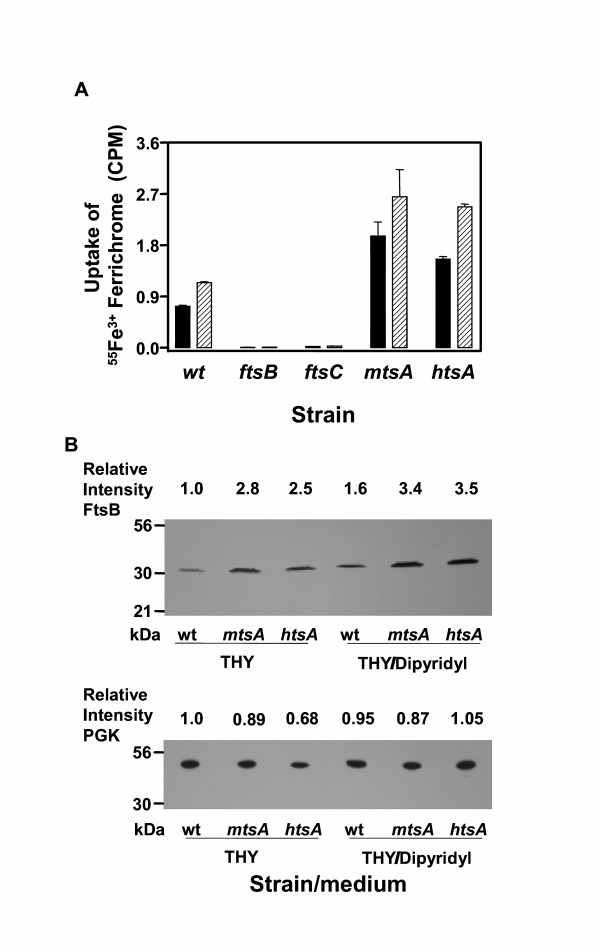
BACKGROUND: The Streptococcus pyogenes or Group A Streptococcus (GAS) genome encodes three ABC transporters, namely, FtsABCD, MtsABC, and HtsABC, which share homology with iron transporters. MtsABC and HtsABC are believed to take up ferric (Fe3+) and manganese ions and heme, respectively, while the specificity of FtsABCD is unknown. RESULTS: Recombinant FtsB, the lipoprotein component of FtsABCD, was found to bind Fe3+ ferrichrome in a 1:1 stoichiometry. To investigate whether FtsABCD transports Fe3+ ferrichrome, GAS isogenic strains defective in lipoprotein gene ftsB and permease gene ftsC were generated, and the effects of the mutations on uptake of Fe3+ ferrichrome were examined using radioactive 55Fe3+ ferrichrome. FtsB was produced in the wild-type strain but not in the ftsB mutant, confirming the ftsB inactivation. While wild-type GAS took up 3.6 x 10(4) Fe3+ ferrichrome molecules per bacterium per min at room temperature, the ftsB and ftsC mutants did not have a detectable rate of Fe3+ ferrichrome uptake. The inactivation of ftsB or ftsC also decreased 55Fe3+ ferrichrome uptake by >90% under growth conditions in the case of limited uptake time. Complementation of the ftsB mutant with a plasmid carrying the ftsB gene restored FtsB production and 55Fe3+ ferrichrome association at higher levels compared with the parent strain. The inactivation of mtsA and htsA and Fe-restricted conditions enhanced the production of FtsB and Fe3+ ferrichrome uptake. CONCLUSION: The FtsB protein bound Fe3+ ferrichrome, and inactivation of ftsB or ftsC, but not htsA or mtsA, diminished Fe3+ ferrichrome uptake, indicating that FtsABCD, but not HtsABC and MtsABC, is the transporter that takes up Fe3+ ferrichrome in GAS. Fe acquisition systems are virulence factors in many bacterial pathogens and are attractive vaccine candidates. The elucidation of the FtsABCD specificity advances the understanding of Fe acquisition processes in GAS and may help evaluating the GAS Fe acquisition systems as vaccine candidates.
Overview
The claims and statistics of this paper haven’t been checked yet.
Free: it reads the open-access text and checks the first 5 claims that cite a source we can check. Create a free account to check every claim.
Integrity signals
Registry
Cites
Statistics
Figures
Verification
Claims the paper makes
The claims and statistics of this paper haven’t been checked yet.
Free: it reads the open-access text and checks the first 5 claims that cite a source we can check. Create a free account to check every claim.
Claims other papers make about this one
Each is checked against this paper’s own text: does it say what the citing paper says it does?
The source backs part of the claim, not all of it — or backs it for a different population, condition or comparison.
In the citing paper
“Following hemolysis, heme is taken up by a molecular machinery that consists of streptococcal hemoprotein receptor (Shr), streptococcal heme binding protein (Shp) and streptococcal heme-specific ABC (HtsABC) transporter (Bates et al., 2003;Hanks et al., 2005;Lei et al., 2003;Montanez et al., 2005;Zhu et al., 2008).”
From Iron in infection and immunity (2020) · cites this paper as Hanks et al., 2005
Experimental — accuracy not yet measuredThe cited source says what the claim attributes to it.
In the citing paper
“GAS genomes encode three transporters that can take up iron: MtsABC, FtsABCD, and HtsABC. Only the HtsABC transporter binds and acquires heme, while the other two transporters, MtsABC and FtsABCD, are involved in the acquisition of Fe3+ and Mn2+ and Fe3+ ferrichrome, respectively (Janulczyk et al., 2003; Hanks et al., 2005).”
From The Heme Transporter HtsABC of Group A Streptococcus Contributes to Virulence and Innate Immune Evasion in Murine Skin Infections (2018) · cites this paper as Hanks et al., 2005
Self-check
Percentages, sums and reported differences re-computed from the paper’s own numbers.
The self-check needs the paper’s full text.
Citations
Cites
ABC Transporters: From Microorganisms to Man
Higgins, C. F. (1992) · Annual Review of Cell Biology · doi:10.1146/annurev.cb.08.110192.000435 · Cited by 3,985 · cited 1×
“ABC transporters consist of a solute-binding protein, a membrane protein (permease) encoded by one or two genes, and an ATPase [4].”
BackgroundPathogenesis of Group A Streptococcal Infections
Cunningham, M. W. (2000) · Clinical Microbiology Reviews · doi:10.1128/cmr.13.3.470 · Cited by 2,261 · cited 1×
“Streptococcus pyogenes or Group A Streptococcus (GAS) is an important Gram-positive human pathogen causing both invasive and non-invasive infections [6].”
BackgroundNeilands, J. B. (1981) · Annual Review of Biochemistry · doi:10.1146/annurev.bi.50.070181.003435 · Cited by 1,231 · cited 2×
“Siderophores can be divided into several types based on chemical structures [3].”
BackgroundComplete genome sequence of an M1 strain of Streptococcus pyogenes
Ferretti, J. J., McShan, W. M., Ajdic, D., Savic, D. J., Savic, G., Lyon, K., Primeaux, C., Sezate, S., Suvorov, A. N., Kenton, S., et al. (2001) · Proceedings of the National Academy of Sciences · doi:10.1073/pnas.071559398 · Cited by 936 · cited 2×
“GAS is not known to produce siderophores, and GAS genomes [15-17] do not have genes encoding homologues of siderphore-production systems.”
BackgroundBeres, S. B., Sylva, G. L., Barbian, K. D., Lei, B., Hoff, J. S., Mammarella, N. D., Liu, M.-Y., Smoot, J. C., Porcella, S. F., Parkins, L. D., et al. (2002) · Proceedings of the National Academy of Sciences · doi:10.1073/pnas.152298499 · Cited by 499 · cited 2×
“GAS is not known to produce siderophores, and GAS genomes [15-17] do not have genes encoding homologues of siderphore-production systems.”
BackgroundSelf-citationSmoot, J. C., Barbian, K. D., Van Gompel, J. J., Smoot, L. M., Chaussee, M. S., Sylva, G. L., Sturdevant, D. E., Ricklefs, S. M., Porcella, S. F., Parkins, L. D., et al. (2002) · Proceedings of the National Academy of Sciences · doi:10.1073/pnas.062526099 · Cited by 429 · cited 2×
“GAS is not known to produce siderophores, and GAS genomes [15-17] do not have genes encoding homologues of siderphore-production systems.”
BackgroundTransferrins and Heme-Compounds as Iron Sources for Pathogenic Bacteria
Otto, B. R., Verweij-van Vught, A. M. J. J., & Maclaren, D. M. (1992) · Critical Reviews in Microbiology · doi:10.3109/10408419209114559 · Cited by 395 · cited 1×
“The major sources of iron in vivo for bacteria are host heme-proteins and other iron complexes [1,2].”
BackgroundVelayudhan, J., Hughes, N. J., McColm, A. A., Bagshaw, J., Clayton, C. L., Andrews, S. C., & Kelly, D. J. (2000) · Molecular Microbiology · doi:10.1046/j.1365-2958.2000.01987.x · Cited by 301 · cited 1×
“Fe acquisition systems are virulence factors in many bacterial pathogens [20-24] and are attractive vaccine targets [25-30].”
BackgroundBrown, J. S., Gilliland, S. M., & Holden, D. W. (2001) · Molecular Microbiology · doi:10.1046/j.1365-2958.2001.02414.x · Cited by 288 · cited 1×
“Fe acquisition systems are virulence factors in many bacterial pathogens [20-24] and are attractive vaccine targets [25-30].”
BackgroundImpact of Siderophore Production on Pseudomonas aeruginosa Infections in Immunosuppressed Mice
Takase, H., Nitanai, H., Hoshino, K., & Otani, T. (2000) · Infection and Immunity · doi:10.1128/iai.68.4.1834-1839.2000 · Cited by 269 · cited 1×
“Fe acquisition systems are virulence factors in many bacterial pathogens [20-24] and are attractive vaccine targets [25-30].”
Background
Cited by
Streptococcus Adherence and Colonization
Nobbs, A. H., Lamont, R. J., & Jenkinson, H. F. (2009) · Microbiology and Molecular Biology Reviews · doi:10.1128/mmbr.00014-09 · Cited by 657
Iron in infection and immunity
Nairz, M., & Weiss, G. (2020) · Molecular Aspects of Medicine · doi:10.1016/j.mam.2020.100864 · Cited by 359
Recent developments in understanding the iron acquisition strategies of gram positive pathogens
Sheldon, J. R., & Heinrichs, D. E. (2015) · FEMS Microbiology Reviews · doi:10.1093/femsre/fuv009 · Cited by 272
Bacterial siderophores: diversity, uptake pathways and applications
Schalk, I. J. (2025) · Nature Reviews Microbiology · doi:10.1038/s41579-024-01090-6 · Cited by 227
Beres, S. B., Richter, E. W., Nagiec, M. J., Sumby, P., Porcella, S. F., DeLeo, F. R., & Musser, J. M. (2006) · Proceedings of the National Academy of Sciences · doi:10.1073/pnas.0510279103 · Cited by 214
Akhtar, A. A., & Turner, D. P. (2022) · Microbial Pathogenesis · doi:10.1016/j.micpath.2022.105734 · Cited by 205
Sztajer, H., Lemme, A., Vilchez, R., Schulz, S., Geffers, R., Yip, C. Y. Y., Levesque, C. M., Cvitkovitch, D. G., & Wagner-Döbler, I. (2008) · Journal of Bacteriology · doi:10.1128/jb.01086-07 · Cited by 128
“, transcriptional regulators (64, 77), sigma factors, iron acquisition systems (25), and PTS transporters (2).”
BackgroundThe role of ATP-binding cassette transporters in bacterial pathogenicity
Lewis, V. G., Ween, M. P., & McDevitt, C. A. (2012) · PROTOPLASMA · doi:10.1007/s00709-011-0360-8 · Cited by 130
“pyogenes (Hanks et al. 2005), the HtsABC, FhuCBG-D1D2, SirABC and SstABCD ABC permeases of Sta.”
BackgroundAlbomycin Uptake via a Ferric Hydroxamate Transport System of Streptococcus pneumoniae R6
Pramanik, A., & Braun, V. (2006) · Journal of Bacteriology · doi:10.1128/jb.00205-06 · Cited by 103
Mechanisms of group A Streptococcus resistance to reactive oxygen species
Henningham, A., Döhrmann, S., Nizet, V., & Cole, J. N. (2015) · FEMS Microbiology Reviews · doi:10.1093/femsre/fuu009 · Cited by 90
“…in the uptake and transport of a variety of cations in GAS (Fe3+, Zn2+ and Mn2+) (Janulczyk, Pallon and Bjorck 1999; Janulczyk, Ricci and Bjorck 2003); 2) SiaABC/HtsABC transports heme (Payne 1993); and 3) FtsABC is the principal transporter of Fe3+ and heme (Hanks et al., 2005; Ge and Sun 2014).”
Liu, M., Hanks, T. S., Zhang, J., McClure, M. J., Siemsen, D. W., Elser, J. L., Quinn, M. T., & Lei, B. (2006) · Microbiology · doi:10.1099/mic.0.28706-0 · Cited by 88
“The vector pFWaad, derived from the streptococcal gene-inactivation vector pFW14 (Podbielski et al., 1996) by replacing its cat gene with the spectinomycin-resistance gene aad (LeBlanc et al., 1991), has been described previously (Hanks et al., 2005).”
BackgroundMethodSelf-citationZhu, H., Liu, M., & Lei, B. (2008) · BMC Microbiology · doi:10.1186/1471-2180-8-15 · Cited by 82
“The human pathogen Streptococcus pyogenes produces three ABC transporters, FtsABCD [2], HtsABC or SiaABC [3,4], and MtsABC [5], which acquire ferric ferrichrome, heme, and Fe3+ and Mn2+, respectively.”
BackgroundSelf-citationA novel streptococcal integrative conjugative element involved in iron acquisition
Heather, Z., Holden, M. T. G., Steward, K. F., Parkhill, J., Song, L., Challis, G. L., Robinson, C., Davis‐Poynter, N., & Waller, A. S. (2008) · Molecular Microbiology · doi:10.1111/j.1365-2958.2008.06481.x · Cited by 70
“Recently, a siderophore-iron(III) transport gene was identified in S. pyogenes, S. agalactiae and S. pneumoniae (Hanks et al., 2005; Clancy et al., 2006; Pramanik and Braun, 2006), but siderophore biosynthesis has not been previously identified in any streptococci (Eichenbaum et al., 1996).”
BackgroundInfluentialZhu, H. F., Liu, M., Sumby, P., & Lei, B. (2009) · Infection and Immunity · doi:10.1128/iai.00636-09 · Cited by 67
Self-citationStreptococcus equi: a pathogen restricted to one host
Waller, A. S., Paillot, R., & Timoney, J. F. (2011) · Journal of Medical Microbiology · doi:10.1099/jmm.0.028233-0 · Cited by 69
“…a putative MtsABC Mn2+ and Fe3+ metal transport system with 80 to 91 % amino acid sequence identity to that of S. pyogenes (Janulczyk et al., 1999) and a putative FtsABCD Fe3+ ferrichrome transport system with 59 to 77 % amino acid sequence identity to that of S. pyogenes (Hanks et al., 2005).”
BackgroundLi, W., Liu, L., Chen, H., & Zhou, R. (2009) · FEMS Microbiology Letters · doi:10.1111/j.1574-6968.2008.01476.x · Cited by 60
Hanks, T. S., Liu, M., McClure, M. J., Fukumura, M., Duffy, A., & Lei, B. (2006) · Infection and Immunity · doi:10.1128/iai.00176-06 · Cited by 53
“Three ATP-binding cassette type (ABC) transporters of GAS, MtsABC, FtsABCD, and HtsABC, take up Fe3 and Mn2 (14), ferric ferrichrome ( 8 ), and heme (3, 17, 18, 20, 24), respectively.”
BackgroundMethodSelf-citationXiao, Q., Jiang, X., Moore, K. J., Shao, Y., Pi, H., Dubail, I., Charbit, A., Newton, S. M., & Klebba, P. E. (2011) · Molecular Microbiology · doi:10.1111/j.1365-2958.2011.07667.x · Cited by 51
Peroxide Stimulon and Role of PerR in Group A Streptococcus
Grifantini, R., Toukoki, C., Colaprico, A., & Gryllos, I. (2011) · Journal of Bacteriology · doi:10.1128/jb.05924-11 · Cited by 53
“(Spy1791, SPy1793-SPy1796, and SPy1798; siaABC is also known as htsABC) involved in hemoglobin acquisition (3, 24, 30, 39, 40, 62).”
BackgroundIron acquisition and regulation systems in Streptococcus species
Ge, R., & Sun, X. (2014) · Metallomics · doi:10.1039/c4mt00011k · Cited by 48
Toukoki, C., Gold, K. M., McIver, K. S., & Eichenbaum, Z. (2010) · Molecular Microbiology · doi:10.1111/j.1365-2958.2010.07157.x · Cited by 39
Comparative genomics of Sphingopyxis spp. unravelled functional attributes
Verma, H., Dhingra, G. G., Sharma, M., Gupta, V., Negi, R. K., Singh, Y. P., & Lal, R. (2019) · Genomics · doi:10.1016/j.ygeno.2019.11.008 · Cited by 49
Sun, X., Ge, R., Chiu, J.-F., Sun, H., & He, Q.-Y. (2008) · FEBS Letters · doi:10.1016/j.febslet.2008.03.020 · Cited by 35
“pyogenes, as HtsA and FtsB prefer binding to heme [6] and ferrichrome [15], respectively.”
BackgroundTransition Metal Homeostasis in Streptococcus pyogenes and Streptococcus pneumoniae
Turner, A. G., Ong, C. Y., Walker, M. J., Djoko, K. Y., & McEwan, A. G. (2017) · Advances in microbial physiology/Advances in Microbial Physiology · doi:10.1016/bs.ampbs.2017.01.002 · Cited by 40
Oxidative stress and metal ions regulate a ferritin-like gene, dpr, in Streptococcus pyogenes
Tsou, C.-C., Chiang-Ni, C., Lin, Y.-S., Chuang, W., Lin, M.-T., Liu, C., & Wu, J.-J. (2009) · International Journal of Medical Microbiology · doi:10.1016/j.ijmm.2009.09.002 · Cited by 31
Extracellular Heme Uptake and the Challenges of Bacterial Cell Membranes
Smith, A. D., & Wilks, A. (2012) · Current topics in membranes · doi:10.1016/b978-0-12-394390-3.00013-6 · Cited by 40
Turner, A. G., Djoko, K. Y., Ong, C.-L. Y., Barnett, T. C., Walker, M. J., & McEwan, A. G. (2019) · Biochemical Journal · doi:10.1042/bcj20180902 · Cited by 29
Nygaard, T. K., Liu, M., McClure, M. J., & Lei, B. (2006) · BMC Microbiology · doi:10.1186/1471-2180-6-82 · Cited by 29
“Unlike many other pathogenic bacteria, no streptococci have been reported to produce siderophores [5], though it was recently shown that the ABC transporter FtsABCD of Streptococcus pyogenes takes up ferric ferrichrome [6].”
Self-citationChlamydia trachomatis YtgA is an iron-binding periplasmic protein induced by iron restriction
Miller, J. D., Sal, M. S., Schell, M., Whittimore, J. D., & Raulston, J. E. (2009) · Microbiology · doi:10.1099/mic.0.030247-0 · Cited by 30
Turner, A. G., Ong, C.-L. Y., Djoko, K. Y., West, N. P., Davies, M. R., McEwan, A. G., & Walker, M. J. (2017) · Infection and Immunity · doi:10.1128/iai.00140-17 · Cited by 26
Do, H., Makthal, N., Chandrangsu, P., Olsen, R. J., Helmann, J. D., Musser, J. M., & Kumaraswami, M. (2019) · Nucleic Acids Research · doi:10.1093/nar/gkz524 · Cited by 28
“Heme acquisition is carried out by the HtsABC transporter and shp/shr protein (32–35), and FtsABCD importer is implicated in ferric ferrichrome acquisition (36).”
BackgroundGanguly, T., Kajfasz, J. K., Miller, J. H., Rabinowitz, E., Galvão, L. C. D. C., Rosalen, P. L., Abranches, J., & Lemos, J. A. C. (2018) · Journal of Bacteriology · doi:10.1128/jb.00062-18 · Cited by 20
“Interestingly, both GAS and GBS carry siderophore-iron transport genes that appear to mediate transport of siderophores produced by other bacteria, a mechanism known as siderophore piracy (22, 23).”
BackgroundStreptococcus pyogenes Metabolism
Pancholi, V., & Caparon, M. G. (2016) · Europe PMC (PubMed Central) · Cited by 19
Metal Homeostasis in Pathogenic Streptococci
Akbari, M. S., Doran, K. S., & Burcham, L. R. (2022) · Microorganisms · doi:10.3390/microorganisms10081501 · Cited by 21
Song, Y., Zhang, X., Cai, M., Lv, C., Zhao, Y., Wei, D., & Zhu, H. (2018) · Frontiers in Microbiology · doi:10.3389/fmicb.2018.01105 · Cited by 14
“Only the HtsABC transporter binds and acquires heme, while the other two transporters, MtsABC and FtsABCD, are involved in the acquisition of Fe3+ and Mn2+ and Fe3+ ferrichrome, respectively (Janulczyk et al., 2003; Hanks et al., 2005).”
BackgroundSaroj, S. D., Holmer, L., Berengueras, J. M., & Jonsson, A. (2017) · Scientific Reports · doi:10.1038/srep44902 · Cited by 14
Chatterjee, N., Cook, L. C., Lyles, K. V. M., Nguyen, H. A. T., Devlin, D. J., Thomas, L. S., & Eichenbaum, Z. (2020) · Journal of Bacteriology · doi:10.1128/jb.00205-20 · Cited by 14
“In GAS, the two typical ABC systems that import heme are SiaABC and SiuADBG (which may also take up ferrichrome) (10, 23, 24).”
BackgroundReglinski, M., & Sriskandan, S. (2014) · Elsevier eBooks · doi:10.1016/b978-0-12-397169-2.00038-x · Cited by 18
Characterization of the haem-uptake system of the equine pathogen Streptococcus equi subsp. equi
Meehan, M., Burke, F. M., Macken, S., & Owen, P. (2010) · Microbiology · doi:10.1099/mic.0.036087-0 · Cited by 13
“Indeed, the S. equi genome possesses homologues of the S. pyogenes MtsABC and SuiADEF systems and also expresses a potential siderophore termed equibactin (Hanks et al., 2005; Heather et al., 2008; Holden et al., 2009; Janulczyk et al., 2003).”
Backgroundda Silva, W. M., Carvalho, R. D. D. O., Dorella, F. A., Folador, E. L., Souza, G. H. M. F., Pimenta, A. M. C., Figueiredo, H. C. P., Loir, Y. L., Silva, A., & Azevedo, V. (2017) · Frontiers in Cellular and Infection Microbiology · doi:10.3389/fcimb.2017.00325 · Cited by 11
“The uptake of ferric ferrichrome is described in pathogens such as L. monocytogenes (Jin et al., 2006; Xiao et al., 2011), Streptococcus pyogenes (Hanks et al., 2005) and S. aureus (Sebulsky and Heinrichs, 2001).”
BackgroundLi, H., Li, N., Xu, Q., Xiao, C., Wang, H., Guo, Z., Zhang, J., Sun, X., & He, Q. (2013) · PLoS ONE · doi:10.1371/journal.pone.0065682 · Cited by 12
“The expression level of FtsB increases when both htsA and mtsA genes were knocked out in an iron deficient environment [10,11].”
BackgroundIron acquisition by Streptococcus species: An updated review
Ge, R., Sun, X., & He, Q. (2009) · Frontiers in Biology · doi:10.1007/s11515-009-0035-4 · Cited by 13
Liu, M., McClure, M. J., Zhu, H. F., Xie, G., & Lei, B. (2008) · The Open Microbiology Journal · doi:10.2174/1874285800802010089 · Cited by 9
“The PCR products of the upstream and downstream fragments were sequentially cloned into pGRV [19] at the HindIII/BglII and BamHI/SalI sites, respectively, to yield pGRV- vicK.”
MethodSelf-citationBenfang Lei’s research on heme acquisition in Gram-positive pathogens and bacterial pathogenesis
Lei, B. (2010) · World Journal of Biological Chemistry · doi:10.4331/wjbc.v1.i9.286 · Cited by 9
Self-citationLiu, M., Feng, W., Zhu, H. F., & Lei, B. (2015) · Infection and Immunity · doi:10.1128/iai.00073-15 · Cited by 7
“An internal 512-bp fragment (bases 73 to 591) of the srtA gene was PCR amplified using primers 5=-ACCATGGTTAATTCTA GGTTTAGCATTGC-3= and 5=-ACCATGGTGTATCATCGATAACATC AAC-3= and cloned into pFWaad (26) at the NcoI site to yield the suicide plasmid pFWaad-srtA mutant.”
MethodSelf-citationXu, T., & Zhang, W. (2024) · Elsevier eBooks · doi:10.1016/b978-0-12-818619-0.00123-4 · Cited by 9
Global spread of Streptococcus pyogenes A genomics-supported narrative review
Arcari, G., Colombini, L., Castelli, M., Novazzi, F., Clementi, N., Santoro, F., & Mancini, N. (2025) · FEMS Microbiology Reviews · doi:10.1093/femsre/fuaf058 · Cited by 10
Microarray Analysis of Temperature-Induced Transcriptome of Streptococcus suis Serotype 2
Zeng, X., Yuan, Y., Wei, Y., Jiang, H., Zheng, Y., Guo, Z., Tang, J., Yang, R., Zhou, D., & Jiang, Y. (2010) · Vector-Borne and Zoonotic Diseases · doi:10.1089/vbz.2009.0225 · Cited by 6
“…was repressed at 40 8 C. ABC transporters meet the fundamental requirement of cellular homeostasis to import and concentrate extracellular nutrients or other molecules (Schneider and Hunke 1998), and they are required for the virulence of many pathogens (Hanks et al. 2005, Sanguinetti et al. 2006).”
He, L., Yu, Y.-B., Liu, Y., Le, Y.-J., Li, S., & Yang, X.-Y. (2022) · Frontiers in Microbiology · doi:10.3389/fmicb.2022.969490 · Cited by 7
“In S. pyogenes, there are three iron uptake systems involved in iron uptake, including HtsABC, FtsABCD, and MtsABC (Janulczyk et al., 2003; Lei et al., 2003; Hanks et al., 2005).”
BackgroundInfluentialA novel iron transporter in S treptococcus iniae
Wang, J., Zou, L., & Li, A. X. (2013) · Journal of Fish Diseases · doi:10.1111/j.1365-2761.2012.01439.x · Cited by 5
Fernandez‐Perez, J., Senoo, A., Caaveiro, J. M. M., Nakakido, M., de Vega, S., Nakagawa, I., & Tsumoto, K. (2024) · Structure · doi:10.1016/j.str.2024.09.018 · Cited by 3
Eraso, J. M., Olsen, R. J., Long, S. W., Faili, A., Kayal, S., & Musser, J. M. (2025) · mBio · doi:10.1128/mbio.01349-25 · Cited by 2
Marimuthu, S. C. V., Thangamariappan, E., Kunjiappan, S., Pandian, S. R. K., & Sundar, K. (2025) · Archives of Microbiology · doi:10.1007/s00203-025-04284-5 · Cited by 3
“HtsABC/SiaABC, MtsABC, and FtsABCD are some of the transporters found in S. pyogenes (Montañez et al. 2005; Hanks et al. 2005).”
Fernandez‐Perez, J., de Vega, S., Caaveiro, J. M. M., Nakakido, M., Nagatoishi, S., Senoo, A., Tanoi, K., Nozawa, T., Nakagawa, I., & Tsumoto, K. (2026) · Journal of Biological Chemistry · doi:10.1016/j.jbc.2026.111224 · Cited by 1
Regulation of Virulence by Iron in Gram-Positive Bacteria
Farrand, A. J., & Skaar, E. P. (2016) · ASM Press eBooks · doi:10.1128/9781555818524.ch5
Group A Streptococcus Peroxide Stimulon and Role of PerR in
Gryllos, I., Grifantini, R., Toukoki, C., & Colaprico, A. (2011)
Gram-positive heme acquisition
Shipelskiy, Y. (2017) · K-State Research Exchange (Kansas State University)
Lipoproteins in Staphylococcus aureus infections
Mohammad, M. (2020) · Gothenburg University Publications Electronic Archive (Gothenburg University)
Earhart, C. F., & Lei, B. (2015) · Elsevier eBooks · doi:10.1016/b978-0-12-801238-3.02443-0
Self-citationLi, J., Ju, Y., Jiang, M., Wang, J., Li, S., & Xiao-yan, Y. (2025) · Microbiology and Immunology · doi:10.1111/1348-0421.13217 · Cited by 1
“The survival and infection of S. pyogenes require the participation of iron, including heme, siderophores/ferrichromes, and iron ions [18, 34 – 36].”
Iron Dynamics in Pathogens and their Inhibition for Anti-pathogenic Drug Design
Nakakido, M., Nakagawa, I., & Tsumoto, K. (2025) · Royal Society of Chemistry eBooks · doi:10.1039/9781837677979-00058
Ferrichrome: bacterial function, synthetic mimics, and biomedical applications
Raether, N., Wojciechowska, M., Trylska, J., & Patenge, N. (2026) · Frontiers in Microbiology · doi:10.3389/fmicb.2026.1932981
Metadata
- Authors
- Hanks, T. S., Liu, M., McClure, M. J., & Lei, B.
- Affiliations
- Montana State University (US)
- Corresponding author
- Lei, Benfang
- Venue
- BMC Microbiology
- Published
- 2005-10-14
- Volume
- 5
- Issue
- 1
- Pages
- 62-62
- ISSN
- 1471-2180 (ISSN-L)
- PMC
- PMC1276799
- OpenAlex
- W1856734764
- Cited by
- 63
- References
- 36
- Citations by year
- 2026: 2 · 2025: 5 · 2024: 3 · 2022: 3 · 2020: 3 · 2019: 3 · 2018: 2 · 2017: 5 · 2016: 2 · 2015: 4 · 2014: 2 · 2013: 2 · 2012: 2
- FWCI
- 1.98
- Type
- journal article
- Language
- en
- Open access
- gold
- doi.org
- Licence
- cc-by
- Locations
- BMC Microbiology (publishedVersion, cc-by)
- PubMed Central (publishedVersion)
- PubMed (publishedVersion)
- DOAJ (DOAJ: Directory of Open Access Journals) (submittedVersion, cc-by-sa)
- Funders
- Montana State University
- National Institutes of Health
- National Institute of Allergy and Infectious Diseases (K22AI057347)
- National Center for Research Resources (P20RR020185, P20RR016455, P20-RR-16455)
- Topics
- Life Sciences › Biochemistry, Genetics and Molecular Biology › Genetics › Bacterial Genetics and Biotechnology
- Health Sciences › Medicine › Hematology › Iron Metabolism and Disorders
- Health Sciences › Medicine › Infectious Diseases › Streptococcal Infections and Treatments
- Keywords
- Streptococcus pyogenes, iron acquisition, iron transporters, iron limitation, virulence factors, vaccine candidate, complementation
- MeSH terms
- Bacterial Proteins, Biological Transport, Ferrichrome, Iron, Streptococcus pyogenes, ATP-Binding Cassette Transporters, Symporters
About these checks
Registry, retraction, Cites and statistics results are computed, not judged, with one exception: a printed reference that no index lists is read once by a model before it counts as a citation error. Claims are extracted by a model and kept only when their quote appears verbatim in the text; each cited source is then checked, with a model’s help, for whether it says what the claim relies on. Those verdicts can be wrong — read the claim’s quote and the cited source before relying on one.
Statistics and arithmetic are recomputed, not judged.
Confidence bands are shown only for fields calibrated on our annotated test set. None is calibrated yet, so no band is shown.
What counts as a claim ›How we measure confidence ›How we check this ›
Are you an author, or do you see a problem with this page? Request a review
Data sources
Bibliographic data: Semantic Scholar, OpenAlex, Crossref.
Contains information from the Semantic Scholar Academic Graph Datasets, made available under the ODC Attribution License (ODC-BY 1.0).
Semantic Scholar’s data is described in: Kinney, R., et al. (2023). The Semantic Scholar Open Data Platform. arXiv:2301.10140.
