

ABC transporter FtsABCD of Streptococcus pyogenes mediates uptake of ferric ferrichrome.
Open accessThe DOI matches its Crossref record; 36 of the 36 references it cites were found in a registry or an index.
Abstract
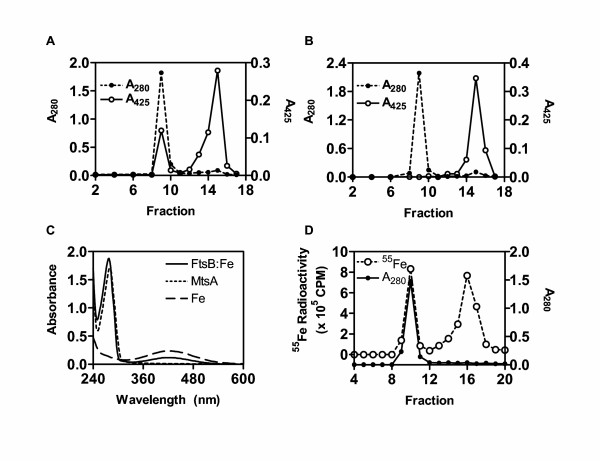
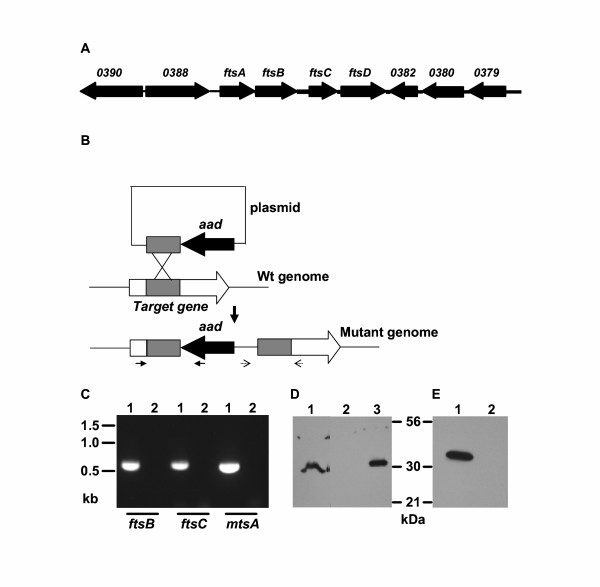
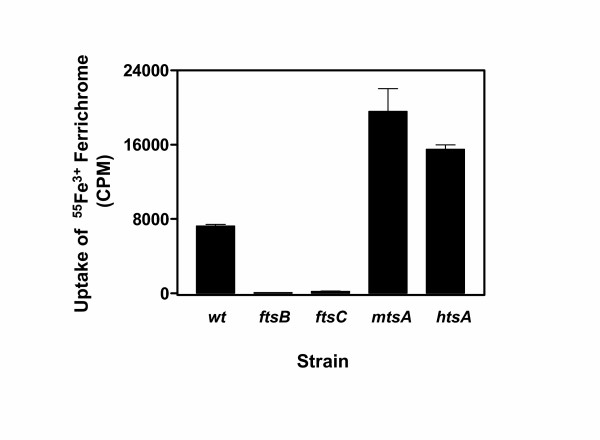
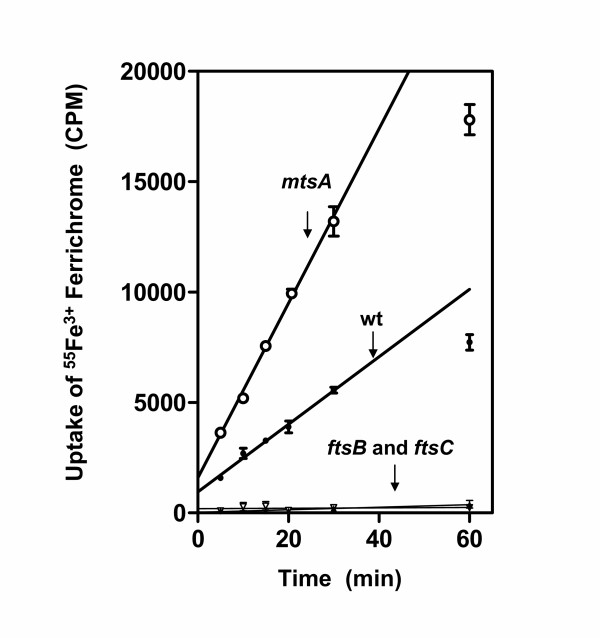
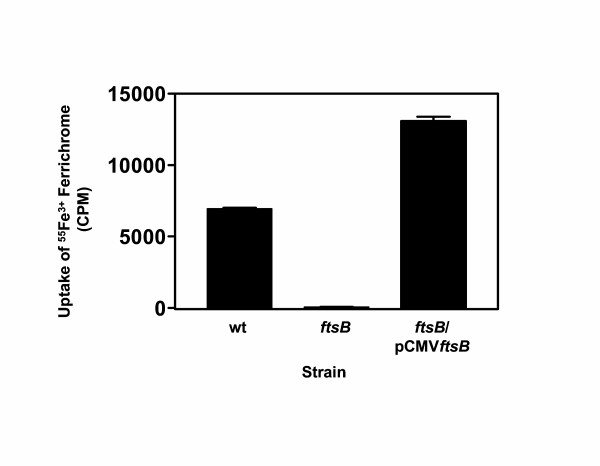
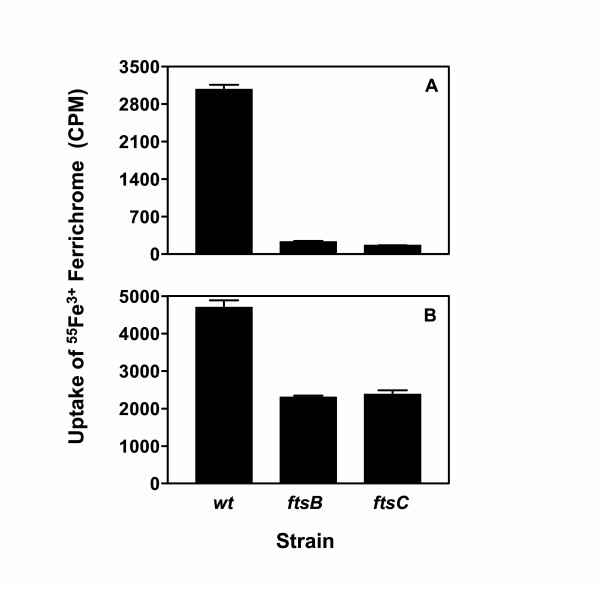
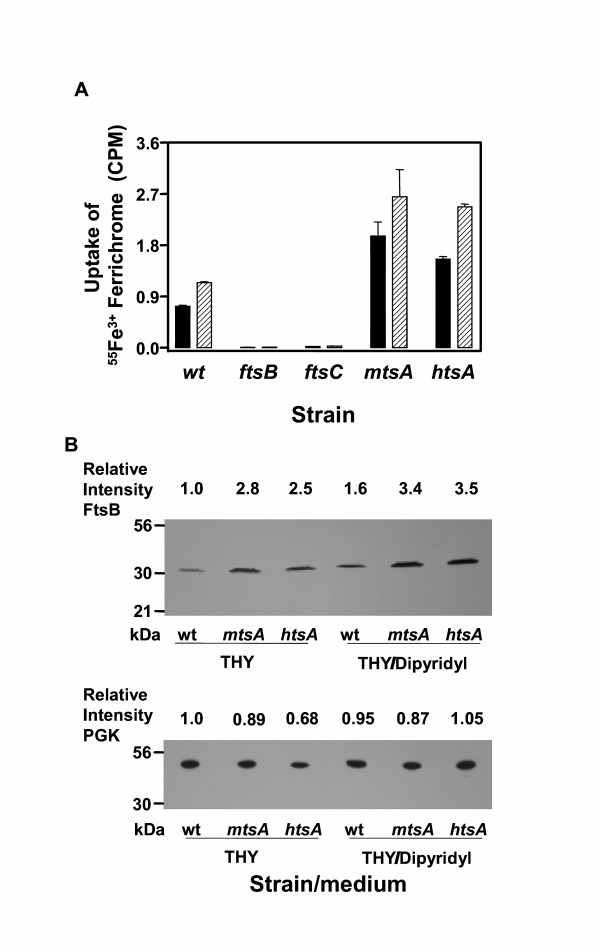
BACKGROUND: The Streptococcus pyogenes or Group A Streptococcus (GAS) genome encodes three ABC transporters, namely, FtsABCD, MtsABC, and HtsABC, which share homology with iron transporters. MtsABC and HtsABC are believed to take up ferric (Fe3+) and manganese ions and heme, respectively, while the specificity of FtsABCD is unknown. RESULTS: Recombinant FtsB, the lipoprotein component of FtsABCD, was found to bind Fe3+ ferrichrome in a 1:1 stoichiometry. To investigate whether FtsABCD transports Fe3+ ferrichrome, GAS isogenic strains defective in lipoprotein gene ftsB and permease gene ftsC were generated, and the effects of the mutations on uptake of Fe3+ ferrichrome were examined using radioactive 55Fe3+ ferrichrome. FtsB was produced in the wild-type strain but not in the ftsB mutant, confirming the ftsB inactivation. While wild-type GAS took up 3.6 x 10(4) Fe3+ ferrichrome molecules per bacterium per min at room temperature, the ftsB and ftsC mutants did not have a detectable rate of Fe3+ ferrichrome uptake. The inactivation of ftsB or ftsC also decreased 55Fe3+ ferrichrome uptake by >90% under growth conditions in the case of limited uptake time. Complementation of the ftsB mutant with a plasmid carrying the ftsB gene restored FtsB production and 55Fe3+ ferrichrome association at higher levels compared with the parent strain. The inactivation of mtsA and htsA and Fe-restricted conditions enhanced the production of FtsB and Fe3+ ferrichrome uptake. CONCLUSION: The FtsB protein bound Fe3+ ferrichrome, and inactivation of ftsB or ftsC, but not htsA or mtsA, diminished Fe3+ ferrichrome uptake, indicating that FtsABCD, but not HtsABC and MtsABC, is the transporter that takes up Fe3+ ferrichrome in GAS. Fe acquisition systems are virulence factors in many bacterial pathogens and are attractive vaccine candidates. The elucidation of the FtsABCD specificity advances the understanding of Fe acquisition processes in GAS and may help evaluating the GAS Fe acquisition systems as vaccine candidates.
Overview
The claims and statistics of this paper haven’t been checked yet.
Free: it reads the open-access text and checks the first 5 claims that cite a source we can check. Create a free account to check every claim.
Integrity signals
Registry
Cites
Statistics
Figures
Verification
Claims the paper makes
The claims and statistics of this paper haven’t been checked yet.
Free: it reads the open-access text and checks the first 5 claims that cite a source we can check. Create a free account to check every claim.
Claims other papers make about this one
Each is checked against this paper’s own text: does it say what the citing paper says it does?
The source backs part of the claim, not all of it — or backs it for a different population, condition or comparison.
In the citing paper
“Following hemolysis, heme is taken up by a molecular machinery that consists of streptococcal hemoprotein receptor (Shr), streptococcal heme binding protein (Shp) and streptococcal heme-specific ABC (HtsABC) transporter (Bates et al., 2003;Hanks et al., 2005;Lei et al., 2003;Montanez et al., 2005;Zhu et al., 2008).”
From Iron in infection and immunity (2020) · cites this paper as Hanks et al., 2005
Experimental — accuracy not yet measuredThe cited source says what the claim attributes to it.
In the citing paper
“GAS genomes encode three transporters that can take up iron: MtsABC, FtsABCD, and HtsABC. Only the HtsABC transporter binds and acquires heme, while the other two transporters, MtsABC and FtsABCD, are involved in the acquisition of Fe3+ and Mn2+ and Fe3+ ferrichrome, respectively (Janulczyk et al., 2003; Hanks et al., 2005).”
From The Heme Transporter HtsABC of Group A Streptococcus Contributes to Virulence and Innate Immune Evasion in Murine Skin Infections (2018) · cites this paper as Hanks et al., 2005
Self-check
Percentages, sums and reported differences re-computed from the paper’s own numbers.
The self-check needs the paper’s full text.
Citations
Cites
ABC Transporters: From Microorganisms to Man
Higgins, C. F. (1992) · Annual Review of Cell Biology · doi:10.1146/annurev.cb.08.110192.000435 · Cited by 3,985 · cited 1×
“ABC transporters consist of a solute-binding protein, a membrane protein (permease) encoded by one or two genes, and an ATPase [4].”
BackgroundPathogenesis of Group A Streptococcal Infections
Cunningham, M. W. (2000) · Clinical Microbiology Reviews · doi:10.1128/cmr.13.3.470 · Cited by 2,261 · cited 1×
“Streptococcus pyogenes or Group A Streptococcus (GAS) is an important Gram-positive human pathogen causing both invasive and non-invasive infections [6].”
BackgroundNeilands, J. B. (1981) · Annual Review of Biochemistry · doi:10.1146/annurev.bi.50.070181.003435 · Cited by 1,231 · cited 2×
“Siderophores can be divided into several types based on chemical structures [3].”
BackgroundComplete genome sequence of an M1 strain of Streptococcus pyogenes
Ferretti, J. J., McShan, W. M., Ajdic, D., Savic, D. J., Savic, G., Lyon, K., Primeaux, C., Sezate, S., Suvorov, A. N., Kenton, S., et al. (2001) · Proceedings of the National Academy of Sciences · doi:10.1073/pnas.071559398 · Cited by 936 · cited 2×
“GAS is not known to produce siderophores, and GAS genomes [15-17] do not have genes encoding homologues of siderphore-production systems.”
BackgroundBeres, S. B., Sylva, G. L., Barbian, K. D., Lei, B., Hoff, J. S., Mammarella, N. D., Liu, M.-Y., Smoot, J. C., Porcella, S. F., Parkins, L. D., et al. (2002) · Proceedings of the National Academy of Sciences · doi:10.1073/pnas.152298499 · Cited by 499 · cited 2×
“GAS is not known to produce siderophores, and GAS genomes [15-17] do not have genes encoding homologues of siderphore-production systems.”
BackgroundSelf-citationSmoot, J. C., Barbian, K. D., Van Gompel, J. J., Smoot, L. M., Chaussee, M. S., Sylva, G. L., Sturdevant, D. E., Ricklefs, S. M., Porcella, S. F., Parkins, L. D., et al. (2002) · Proceedings of the National Academy of Sciences · doi:10.1073/pnas.062526099 · Cited by 429 · cited 2×
“GAS is not known to produce siderophores, and GAS genomes [15-17] do not have genes encoding homologues of siderphore-production systems.”
BackgroundTransferrins and Heme-Compounds as Iron Sources for Pathogenic Bacteria
Otto, B. R., Verweij-van Vught, A. M. J. J., & Maclaren, D. M. (1992) · Critical Reviews in Microbiology · doi:10.3109/10408419209114559 · Cited by 395 · cited 1×
“The major sources of iron in vivo for bacteria are host heme-proteins and other iron complexes [1,2].”
BackgroundVelayudhan, J., Hughes, N. J., McColm, A. A., Bagshaw, J., Clayton, C. L., Andrews, S. C., & Kelly, D. J. (2000) · Molecular Microbiology · doi:10.1046/j.1365-2958.2000.01987.x · Cited by 301 · cited 1×
“Fe acquisition systems are virulence factors in many bacterial pathogens [20-24] and are attractive vaccine targets [25-30].”
BackgroundBrown, J. S., Gilliland, S. M., & Holden, D. W. (2001) · Molecular Microbiology · doi:10.1046/j.1365-2958.2001.02414.x · Cited by 288 · cited 1×
“Fe acquisition systems are virulence factors in many bacterial pathogens [20-24] and are attractive vaccine targets [25-30].”
BackgroundImpact of Siderophore Production on Pseudomonas aeruginosa Infections in Immunosuppressed Mice
Takase, H., Nitanai, H., Hoshino, K., & Otani, T. (2000) · Infection and Immunity · doi:10.1128/iai.68.4.1834-1839.2000 · Cited by 269 · cited 1×
“Fe acquisition systems are virulence factors in many bacterial pathogens [20-24] and are attractive vaccine targets [25-30].”
BackgroundJanakiraman, A., & Slauch, J. M. (2000) · Molecular Microbiology · doi:10.1046/j.1365-2958.2000.01783.x · Cited by 234
Smoot, L. M., Smoot, J. C., Graham, M. R., Somerville, G. A., Sturdevant, D. E., Migliaccio, C. A. L., Sylva, G. L., & Musser, J. M. (2001) · Proceedings of the National Academy of Sciences · doi:10.1073/pnas.191267598 · Cited by 210 · cited 3×
“The transcription of ftsABCD is up-regulated under Fereduced conditions [18].”
BackgroundPodbielski, A., Spellerberg, B., Woischnik, M., Pohl, B., & Lütticken, R. (1996) · Gene · doi:10.1016/0378-1119(96)84178-3 · Cited by 198 · cited 1×
“and cloned into pFW14 [34] at the SalI and NcoI restriction sites.”
BackgroundJanulczyk, R., Ricci, S., & Björck, L. (2003) · Infection and Immunity · doi:10.1128/iai.71.5.2656-2664.2003 · Cited by 182 · cited 4×
“Iron acquisition processes in GAS are poorly understood, although progress has recently been made by us [9-11] and other groups [12-14].”
BackgroundInfluentialLeBlanc, D. J., Lee, L. N., & Inamine, J. M. (1991) · Antimicrobial Agents and Chemotherapy · doi:10.1128/aac.35.9.1804 · Cited by 168 · cited 1×
“To obtain pFWaad, the spectinomycin-resistant gene aad [33] was amplified with primers 5'-AGTGTCGACTATAACTAATAACGTAACGTG-3' and 5'ACCATGGGAATTCTATAATTTTTTTAATCTGTTATTTA-3' Complementation of the ftsB mutant Figure 5 Complementation of the ftsB mutant.”
MethodBrown, J. S., Ogunniyi, A. D., Woodrow, M. C., Holden, D. W., & Paton, J. C. (2001) · Infection and Immunity · doi:10.1128/iai.69.11.6702-6706.2001 · Cited by 164 · cited 1×
“Fe acquisition systems are virulence factors in many bacterial pathogens [20-24] and are attractive vaccine targets [25-30].”
BackgroundBates, C. S., Montañez, G. E., Woods, C. R., Vincent, R. M., & Eichenbaum, Z. (2003) · Infection and Immunity · doi:10.1128/iai.71.3.1042-1055.2003 · Cited by 154 · cited 9×
“The evidences include the binding of Fe3+ ferrichrome to FtsB, the effect of the insertional disruption of ftsB or ftsC on uptake of 55Fe3+ ferrichrome, and the non-involvement of MtsABC and HtsABC in Fe3+ ferrichrome uptake.”
BackgroundInfluentialIdentification and Immunogenicity of Group A Streptococcus Culture Supernatant Proteins
Lei, B., Mackie, S., Lukomski, S., & Musser, J. M. (2000) · Infection and Immunity · doi:10.1128/iai.68.12.6807-6818.2000 · Cited by 149 · cited 1×
“The proteins were detected by Western blotting using specific mouse antiserum as previously described [36].”
MethodSelf-citationRole of mga in growth phase regulation of virulence genes of the group A streptococcus
McIver, K. S., & Scott, J. R. (1997) · Journal of Bacteriology · doi:10.1128/jb.179.16.5178-5187.1997 · Cited by 141 · cited 1×
“Plasmid pJRS525 [35] was modified to replace the spectinomycin-resistant gene with the chloramphenicol-resistance gene.”
MethodLei, B., Smoot, L. M., Menning, H. M., Voyich, J. M., Kala, S. V., Deleo, F. R., Reid, S. D., & Musser, J. M. (2002) · Infection and Immunity · doi:10.1128/iai.70.8.4494-4500.2002 · Cited by 113 · cited 9×
“The evidences include the binding of Fe3+ ferrichrome to FtsB, the effect of the insertional disruption of ftsB or ftsC on uptake of 55Fe3+ ferrichrome, and the non-involvement of MtsABC and HtsABC in Fe3+ ferrichrome uptake.”
BackgroundSelf-citationCellular Iron Metabolism in Health and Diseased
Weinberg, E. D. (1990) · Drug Metabolism Reviews · doi:10.3109/03602539008991450 · Cited by 112
Janulczyk, R., Pallon, J., & Björck, L. (1999) · Molecular Microbiology · doi:10.1046/j.1365-2958.1999.01626.x · Cited by 109 · cited 8×
“The evidences include the binding of Fe3+ ferrichrome to FtsB, the effect of the insertional disruption of ftsB or ftsC on uptake of 55Fe3+ ferrichrome, and the non-involvement of MtsABC and HtsABC in Fe3+ ferrichrome uptake.”
BackgroundInfluentialWest, D., Reddin, K., Matheson, M., Heath, R., Funnell, S., Hudson, M., Robinson, A., & Gorringe, A. (2001) · Infection and Immunity · doi:10.1128/iai.69.3.1561-1567.2001 · Cited by 104 · cited 1×
“Fe acquisition systems are virulence factors in many bacterial pathogens [20-24] and are attractive vaccine targets [25-30].”
BackgroundRapid Molecular Genetic Subtyping of Serotype M1 Group A Streptococcus Strains
Hoe, N., Nakashima, K., Grigsby, D., Pan, X., Dou, S. J., Naidich, S., Garcia, M., Kahn, E., Bergmire-Sweat, D., & Musser, J. M. (1999) · Emerging Infectious Diseases · doi:10.3201/eid0502.990210 · Cited by 101 · cited 1×
“Serotype M1 GAS strain MGAS5005 has been described previously [32].”
BackgroundAcquisition of iron from host proteins by the group A streptococcus.
Eichenbaum, Z., Muller, E., Morse, S. A., & Scott, J. R. (1996) · Infection and Immunity · doi:10.1128/iai.64.12.5428-5429.1996 · Cited by 94
Lei, B., Liu, M., Voyich, J. M., Prater, C. I., Kala, S. V., DeLeo, F. R., & Musser, J. M. (2003) · Infection and Immunity · doi:10.1128/iai.71.10.5962-5969.2003 · Cited by 92
Self-citationMyers, L. E., Yang, Y., Du, R.-P., Wang, Q., Harkness, R. E., Schryvers, A. B., Klein, M. H., & Loosmore, S. M. (1998) · Infection and Immunity · doi:10.1128/.66.9.4183-4192.1998 · Cited by 90 · cited 1×
“Fe acquisition systems are virulence factors in many bacterial pathogens [20-24] and are attractive vaccine targets [25-30].”
BackgroundRokbi, B., Mignon, M., Maitre-Wilmotte, G., Lissolo, L., Danve, B., Caugant, D. A., & Quentin-Millet, M. J. (1997) · Infection and Immunity · doi:10.1128/iai.65.1.55-63.1997 · Cited by 85
Lei, B., Liu, M., Chesney, G. L., & Musser, J. M. (2004) · The Journal of Infectious Diseases · doi:10.1086/380491 · Cited by 80
Self-citationViswanathan, V. K., Edelstein, P. H., Pope, C. D., & Cianciotto, N. P. (2000) · Infection and Immunity · doi:10.1128/iai.68.3.1069-1079.2000 · Cited by 76 · cited 1×
“Fe acquisition systems are virulence factors in many bacterial pathogens [20-24] and are attractive vaccine targets [25-30].”
BackgroundUptake of iron from hemoglobin and the haptoglobin-hemoglobin complex by hemolytic bacteria
Francis, R. T., Booth, J. W., & Becker, R. R. (1985) · International Journal of Biochemistry · doi:10.1016/0020-711x(85)90262-9 · Cited by 72
Heme Transfer from Streptococcal Cell Surface Protein Shp to HtsA of Transporter HtsABC
Liu, M., & Lei, B. (2005) · Infection and Immunity · doi:10.1128/iai.73.8.5086-5092.2005 · Cited by 72 · cited 9×
“The evidences include the binding of Fe3+ ferrichrome to FtsB, the effect of the insertional disruption of ftsB or ftsC on uptake of 55Fe3+ ferrichrome, and the non-involvement of MtsABC and HtsABC in Fe3+ ferrichrome uptake.”
BackgroundSelf-citationPotter, A. A., Schryvers, A. B., Ogunnariwo, J. A., Hutchins, W., Lo, R. Y. C., & Watts, T. C. (1999) · Microbial Pathogenesis · doi:10.1006/mpat.1999.0297 · Cited by 59 · cited 1×
“Fe acquisition systems are virulence factors in many bacterial pathogens [20-24] and are attractive vaccine targets [25-30].”
BackgroundKuboniwa, M., Amano, A., Shizukuishi, S., Nakagawa, I., & Hamada, S. (2001) · Infection and Immunity · doi:10.1128/iai.69.5.2972-2979.2001 · Cited by 51 · cited 1×
“Fe acquisition systems are virulence factors in many bacterial pathogens [20-24] and are attractive vaccine targets [25-30].”
BackgroundRole of two siderophores in Ustilago sphaerogena
Ecker, D. J., Passavant, C. W., & Emery, T. F. (1982) · Biochimica et Biophysica Acta (BBA) - Molecular Cell Research · doi:10.1016/0167-4889(82)90047-7 · Cited by 31 · cited 1×
“Ferrichrome [5] belongs to the hydroxamate type.”
[Utilization of exogenous siderophores by enterococci].
Szarapińska-Kwaszewska, J., & Mikucki, J. (2001) · PubMed · Cited by 5
Cited by
Streptococcus Adherence and Colonization
Nobbs, A. H., Lamont, R. J., & Jenkinson, H. F. (2009) · Microbiology and Molecular Biology Reviews · doi:10.1128/mmbr.00014-09 · Cited by 657
Iron in infection and immunity
Nairz, M., & Weiss, G. (2020) · Molecular Aspects of Medicine · doi:10.1016/j.mam.2020.100864 · Cited by 359
Recent developments in understanding the iron acquisition strategies of gram positive pathogens
Sheldon, J. R., & Heinrichs, D. E. (2015) · FEMS Microbiology Reviews · doi:10.1093/femsre/fuv009 · Cited by 272
Bacterial siderophores: diversity, uptake pathways and applications
Schalk, I. J. (2025) · Nature Reviews Microbiology · doi:10.1038/s41579-024-01090-6 · Cited by 227
Beres, S. B., Richter, E. W., Nagiec, M. J., Sumby, P., Porcella, S. F., DeLeo, F. R., & Musser, J. M. (2006) · Proceedings of the National Academy of Sciences · doi:10.1073/pnas.0510279103 · Cited by 214
Metadata
- Authors
- Hanks, T. S., Liu, M., McClure, M. J., & Lei, B.
- Affiliations
- Montana State University (US)
- Corresponding author
- Lei, Benfang
- Venue
- BMC Microbiology
- Published
- 2005-10-14
- Volume
- 5
- Issue
- 1
- Pages
- 62-62
- ISSN
- 1471-2180 (ISSN-L)
- PMC
- PMC1276799
- OpenAlex
- W1856734764
- Cited by
- 63
- References
- 36
- Citations by year
- 2026: 2 · 2025: 5 · 2024: 3 · 2022: 3 · 2020: 3 · 2019: 3 · 2018: 2 · 2017: 5 · 2016: 2 · 2015: 4 · 2014: 2 · 2013: 2 · 2012: 2
- FWCI
- 1.98
- Type
- journal article
- Language
- en
- Open access
- gold
- doi.org
- Licence
- cc-by
- Locations
- BMC Microbiology (publishedVersion, cc-by)
- PubMed Central (publishedVersion)
- PubMed (publishedVersion)
- DOAJ (DOAJ: Directory of Open Access Journals) (submittedVersion, cc-by-sa)
- Funders
- Montana State University
- National Institutes of Health
- National Institute of Allergy and Infectious Diseases (K22AI057347)
- National Center for Research Resources (P20RR020185, P20RR016455, P20-RR-16455)
- Topics
- Life Sciences › Biochemistry, Genetics and Molecular Biology › Genetics › Bacterial Genetics and Biotechnology
- Health Sciences › Medicine › Hematology › Iron Metabolism and Disorders
- Health Sciences › Medicine › Infectious Diseases › Streptococcal Infections and Treatments
- Keywords
- Streptococcus pyogenes, iron acquisition, iron transporters, iron limitation, virulence factors, vaccine candidate, complementation
- MeSH terms
- Bacterial Proteins, Biological Transport, Ferrichrome, Iron, Streptococcus pyogenes, ATP-Binding Cassette Transporters, Symporters
About these checks
Registry, retraction, Cites and statistics results are computed, not judged, with one exception: a printed reference that no index lists is read once by a model before it counts as a citation error. Claims are extracted by a model and kept only when their quote appears verbatim in the text; each cited source is then checked, with a model’s help, for whether it says what the claim relies on. Those verdicts can be wrong — read the claim’s quote and the cited source before relying on one.
Statistics and arithmetic are recomputed, not judged.
Confidence bands are shown only for fields calibrated on our annotated test set. None is calibrated yet, so no band is shown.
What counts as a claim ›How we measure confidence ›How we check this ›
Are you an author, or do you see a problem with this page? Request a review
Data sources
Bibliographic data: Semantic Scholar, OpenAlex, Crossref.
Contains information from the Semantic Scholar Academic Graph Datasets, made available under the ODC Attribution License (ODC-BY 1.0).
Semantic Scholar’s data is described in: Kinney, R., et al. (2023). The Semantic Scholar Open Data Platform. arXiv:2301.10140.
