

Diagnosis of invasive candidiasis by enzyme-linked immunosorbent assay using the N-terminal fragment of Candida albicans hyphal wall protein 1
Open accessThe DOI matches its Crossref record; 34 of the 35 references it cites were found in a registry or an index.
Abstract
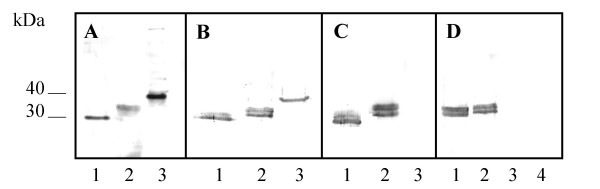
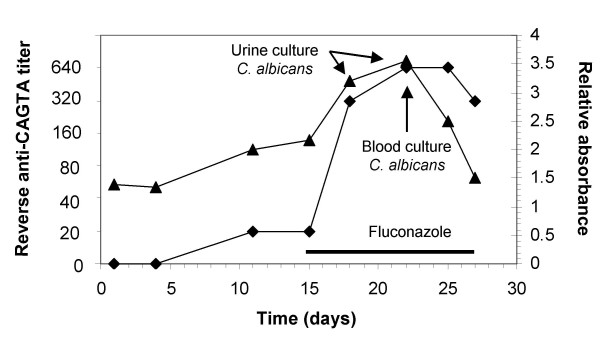
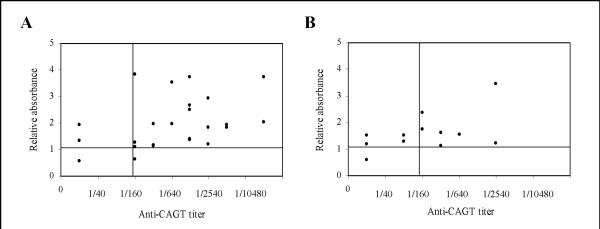
Background: The diagnosis of invasive candidiasis is difficult because there are no specific clinical manifestations of the disease and colonization and infection are difficult to distinguish. In the last decade, much effort has been made to develop reliable tests for rapid diagnosis of invasive candidiasis, but none of them have found widespread clinical use. Results: Antibodies against a recombinant N-terminal fragment of the Candida albicans germ tube-specific antigen hyphal wall protein 1 (Hwp1) generated in Escherichia coli were detected by both immunoblotting and ELISA tests in a group of 36 hematological or Intensive Care Unit patients with invasive candidiasis and in a group of 45 control patients at high risk for the mycosis who did not have clinical or microbiological data to document invasive candidiasis. Results were compared with an immunofluorescence test to detect antibodies to C. albicans germ tubes (CAGT). The sensitivity, specificity, positive and negative predictive values of a diagnostic test based on the detection of antibodies against the N-terminal fragment of Hwp1 by immunoblotting were 27.8 %, 95.6 %, 83.3 % and 62.3 %, respectively. Detection of antibodies to the N-terminal fragment of Hwp1 by ELISA increased the sensitivity (88.9 %) and the negative predictive value (90.2 %) but slightly decreased the specificity (82.6 %) and positive predictive values (80 %). The kinetics of antibody response to the N-terminal fragment of Hwp1 by ELISA was very similar to that observed by detecting antibodies to CAGT. Conclusion: An ELISA test to detect antibodies against a recombinant N-terminal fragment of the C. albicans germ tube cell wall antigen Hwp1 allows the diagnosis of invasive candidiasis with similar results to those obtained by detecting antibodies to CAGT but without the need of treating the sera to adsorb the antibodies against the cell wall surface of the blastospore.
Overview
The claims and statistics of this paper haven’t been checked yet.
Free: it reads the open-access text and checks the first 5 claims that cite a source we can check. Create a free account to check every claim.
Integrity signals
Registry
Cites
Statistics
Figures
Verification
Claims the paper makes
The claims and statistics of this paper haven’t been checked yet.
Free: it reads the open-access text and checks the first 5 claims that cite a source we can check. Create a free account to check every claim.
Claims other papers make about this one
Each is checked against this paper’s own text: does it say what the citing paper says it does?
The cited source says what the claim attributes to it.
In the citing paper
“Specific antibodies directed toward the hyphal wall protein 1 (Hwp1) were developed and compared with CAGT antibodies [54].Detection of these antigens needs additional clinical confirmation.”
From Management of invasive candidiasis and candidemia in adult non-neutropenic intensive care unit patients: part I. Epidemiology and diagnosis (2009) · cites this paper as [54]
Self-check
Percentages, sums and reported differences re-computed from the paper’s own numbers.
The self-check needs the paper’s full text.
Citations
Cites
Cleavage of Structural Proteins during the Assembly of the Head of Bacteriophage T4
LAEMMLI, U. K. (1970) · Nature · doi:10.1038/227680a0 · Cited by 249,961
Raza, H., John, A., & Nemmar, A. (2013) · Cellular Physiology and Biochemistry · doi:10.1159/000350087 · Cited by 47,221
Nonfilamentous C. albicans Mutants Are Avirulent
Lo, H.-J., Köhler, J. R., DiDomenico, B., Loebenberg, D., Cacciapuoti, A., & Fink, G. R. (1997) · Cell · doi:10.1016/s0092-8674(00)80358-x · Cited by 1,809 · cited 1×
“Candida albicans is a fungus that can grow in either the yeast form or the hyphal form, and the ability to germinate and form hyphae may be a factor for the virulence of this organism in vivo [7,8].”
BackgroundGillum, A. M., Tsay, E. Y. H., & Kirsch, D. R. (1984) · Molecular and General Genetics MGG · doi:10.1007/bf00328721 · Cited by 1,251
Calderone, R. (2012) · ASM Press eBooks · Cited by 912
Ostrosky-Zeichner, L., Alexander, B. D., Kett, D. H., Vazquez, J., Pappas, P. G., Saeki, F., Ketchum, P. A., Wingard, J., Schiff, R., Tamura, H., et al. (2005) · Clinical Infectious Diseases · doi:10.1086/432470 · Cited by 669 · cited 1×
“These techniques include the detection of fungal nucleic acid by PCR [3], (1→3) β-D-glucan [4], D-arabinitol [5] and a number of circulating antigens and antibodies [6].”
MethodBrandt, M. E. (2002) · Emerging Infectious Diseases · doi:10.3201/eid0808.020059 · Cited by 644
PUTATIVE VIRULENCE FACTORS OF CANDIDA ALBICANS
Cutler, J. E. (1991) · Annual Review of Microbiology · doi:10.1146/annurev.mi.45.100191.001155 · Cited by 615
Adhesive and Mammalian Transglutaminase Substrate Properties of Candida albicans Hwp1
Staab, J. F., Bradway, S. D., Fidel, P. L., & Sundstrom, P. (1999) · Science · doi:10.1126/science.283.5407.1535 · Cited by 607
Birse, C. E., Irwin, M. Y., Fonzi, W. A., & Sypherd, P. S. (1993) · Infection and Immunity · doi:10.1128/iai.61.9.3648-3655.1993 · Cited by 248
Cited by
Guery, B. P., Arendrup, M. C., Auzinger, G., Azoulay, É., Borges Sá, M., Johnson, E. M., Müller, E., Putensen, C., Rotstein, C., Sganga, G., et al. (2009) · Intensive Care Medicine · doi:10.1007/s00134-008-1338-7 · Cited by 173
Fungal Cell Wall Proteins and Signaling Pathways Form a Cytoprotective Network to Combat Stresses
Ibe, C., & Munro, C. A. (2021) · Journal of Fungi · doi:10.3390/jof7090739 · Cited by 85
Candida Species: New Insights into Biofilm Formation
Cuéllar-Cruz, M., López-Romero, E., Villagómez-Castro, J. C., & Ruiz-Baca, E. (2012) · Future Microbiology · doi:10.2217/fmb.12.48 · Cited by 80
Current Status and Future Perspectives on Molecular and Serological Methods in Diagnostic Mycology
Lau, A. F., Chen, W., Sleiman, S., & Sorrell, T. C. (2009) · Future Microbiology · doi:10.2217/fmb.09.70 · Cited by 80
“Detection of fungal antibodies Methods of antibody detection range from precipitin detection to antibody quantification by EIA [309,311–319].”
MethodMass spectrometry-based proteomics of fungal wall glycoproteins
Yin, Q. Y., de Groot, P. W. J., de Koster, C. G., & Klis, F. M. (2007) · Trends in Microbiology · doi:10.1016/j.tim.2007.10.011 · Cited by 75
“This suggests that fungalwallglycoproteins mightalsobeusefulasdiagnostic agents [26, 28 ,29].”
BackgroundClancy, C. J., Nguyen, M.-L., Cheng, S., Huang, H., Fan, G., Jaber, R. A., Wingard, J. R., Cline, C., & Nguyen, M. H. (2008) · Journal of Clinical Microbiology · doi:10.1128/jcm.02018-07 · Cited by 62
Advances in Candida detection platforms for clinical and point-of-care applications
Safavieh, M., Coarsey, C., Esiobu, N., Memic, A., Vyas, J. M., Shafiee, H., & Asghar, W. (2017) · Critical Reviews in Biotechnology · doi:10.3109/07388551.2016.1167667 · Cited by 57
“9% sensitivity to IgG antibody against an Nterminal hyphal wall protein.[98] The ease and practicality of these tests for anti-Candida IgG antibodies enables the development of a sensitive tool for early diagnosis of infection.”
MethodFungicidal Monoclonal Antibody C7 Binds to Candida albicans Als3
Brena, S., Omaetxebarría, M. J., Elguezabal, N., Cabezas, J., Moragues, M. D., & Pontón, J. (2007) · Infection and Immunity · doi:10.1128/iai.01840-06 · Cited by 57
Self-citationPotential role of Candida albicans germ tube antibody in the diagnosis of deep-seated candidemia
Martínez‐Jiménez, M. D. C., Muñóz, P., Guinea, J., Valerio, M., Alonso, R., Escribano, P., & Bouza, E. (2014) · Medical Mycology · doi:10.1093/mmy/myt025 · Cited by 62
“krusei, are able to produce CAGTA to a greater or lesser degree [3,7,16,17].”
CandidaInfections and Their Prevention
Kabir, M. A., & Ahmad, Z. (2012) · ISRN Preventive Medicine · doi:10.5402/2013/763628 · Cited by 72
Li, F., Chun-fang, M., Shi, L.-N., Lu, J., Wang, Y., Huang, M., & Kong, Q. (2013) · BMC Infectious Diseases · doi:10.1186/1471-2334-13-253 · Cited by 48
“Detection of Candida antigens and antibodies in serum samples are of practical clinical value [7-18].”
BackgroundHumoral Immunity Links Candida albicans Infection and Celiac Disease
Corouge, M., Loridant, S., Fradin, C., Salleron, J., Damiens, S., Moragues, M. D., Souplet, V., Jouault, T., Robert, R., Dubucquoi, S., et al. (2015) · PLoS ONE · doi:10.1371/journal.pone.0121776 · Cited by 53
“It was produced in Escherichia coli, a procedure previously shown to reveal antibodies specifically associated with CI [26].”
BackgroundMethodResultSelf-citationFradin, C., Slomianny, M. C., Mille, C., Masset, A., Robert, R., Sendid, B., Ernst, J. F., Michalski, J. C., & Poulain, D. (2008) · Infection and Immunity · doi:10.1128/iai.00368-08 · Cited by 40
Use of Recombinant Antigens for the Diagnosis of Invasive Candidiasis
Laín, A., Elguezábal, N., Amutio, E., Fernandez-de-Larrinoa, Í., Moragues, M. D., & Pontón, J. (2008) · Clinical and Developmental Immunology · doi:10.1155/2008/721950 · Cited by 35
“His-tag strategy has been employed for Hwp1 purification [15].”
BackgroundMethodInfluentialSelf-citationPini, P., Colombari, B., Marchi, E., Castagnoli, A., Venturelli, C., Sarti, M., & Blasi, E. (2018) · Diagnostic Microbiology and Infectious Disease · doi:10.1016/j.diagmicrobio.2018.07.007 · Cited by 28
Utilidad de los marcadores biológicos en el diagnóstico de la candidiasis invasora
Pontón, J. (2009) · Revista Iberoamericana de Micología · doi:10.1016/s1130-1406(09)70003-8 · Cited by 38
Self-citationSatała, D., Juszczak, M., Wronowska, E., Surowiec, M., Kulig, K., Kozik, A., Rąpała‐Kozik, M., & Karkowska‐Kuleta, J. (2022) · Cellular Microbiology · doi:10.1155/2022/2599136 · Cited by 28
Díez, A., Carrano, G., Bregón-Villahoz, M., Cuétara, M. S., García‐Ruiz, J. C., Fernandez-de-Larrinoa, Í., & Moragues, M. D. (2021) · Diagnostic Microbiology and Infectious Disease · doi:10.1016/j.diagmicrobio.2021.115509 · Cited by 27
Self-citationAvances y limitaciones del diagnóstico precoz de las infecciones invasoras causadas por levaduras
Pontón, J., & del Palacio, A. (2007) · Revista Iberoamericana de Micología · doi:10.1016/s1130-1406(07)70041-4 · Cited by 32
“[14] han detectado anticuerpos anti-Hwp1 en pacientes con candidemia por, C.”
BackgroundSelf-citationPemán, J., & Zaragoza, R. (2012) · Expert Review of Anti-infective Therapy · doi:10.1586/eri.12.128 · Cited by 21
Sendid, B., Salvetat, N., Sarter, H., Loridant, S., Cunisse, C., François, N., Aijjou, R., Gelé, P., Leroy, J., Deplanque, D., et al. (2021) · Journal of Fungi · doi:10.3390/jof7050324 · Cited by 21
Candida-Reactive T Cells for the Diagnosis of Invasive Candida Infection—A Prospective Pilot Study
Koehler, F. C., Cornely, O. A., Wisplinghoff, H., Schauss, A. C., Salmanton‐García, J., Ostermann, H., Ziegler, M., Bächer, P., Scheffold, A., Alex, R., et al. (2018) · Frontiers in Microbiology · doi:10.3389/fmicb.2018.01381 · Cited by 17
Contribution of serum biomarkers to the diagnosis of invasive candidiasis
Laín, A., Elguezábal, N., Moragues, M. D., García‐Ruiz, J. C., del Palacio, A., & Pontón, J. (2008) · Expert Review of Molecular Diagnostics · doi:10.1586/14737159.8.3.315 · Cited by 16
Self-citationAn Antibody Reactivity-Based Assay for Diagnosis of Invasive Candidiasis Using Protein Array
Ardizzoni, A., Posteraro, B., Baschieri, M. C., Bugli, F., Sáez‐Rosón, A., Manca, L., Cacaci, M., Sterbini, F. P., de Waure, C., Sevilla, M.-J., et al. (2014) · International Journal of Immunopathology and Pharmacology · doi:10.1177/039463201402700310 · Cited by 15
Self-citation[Nosocomial candidemia: new challenges of an emergent problem].
Gómez, J. G., Vázquez, E. G., Hernández, A., Espinosa, C., & Pardo, J. R. (2010) · PubMed · Cited by 21
Biomarker-guided antifungal stewardship policies for patients with invasive candidiasis
Honarvar, B., Lankarani, K. B., Taghavi, M., Vahedi, G., & Mortaz, E. (2019) · Current Medical Mycology · doi:10.18502/cmm.4.4.385 · Cited by 8
Vahedi, F., Ghasemi, Y., Atapour, A., Zomorodian, K., Ranjbar, M., Monabati, A., Nezafat, N., & Savardashtaki, A. (2022) · International Journal of Peptide Research and Therapeutics · doi:10.1007/s10989-022-10413-1 · Cited by 7
Non-conventional diagnostic methods for invasive fungal infections
Rosam, K., Steixner, S. J. M., Bauer, A., & Lass‐Flörl, C. (2025) · Expert Review of Molecular Diagnostics · doi:10.1080/14737159.2025.2509026 · Cited by 9
“These antibodies are anti-mycelium antibodies formed against different Candida species and a positive result could suggest a deep-seated, invasive candidiasis [22,23].”
Carrano, G., Arrieta-Aguirre, I., Díez, A., Bregón-Villahoz, M., Fernandez-de-Larrinoa, Í., & Moragues, M. D. (2024) · Mycopathologia · doi:10.1007/s11046-023-00819-w · Cited by 6
“In this line, sera from patients infected with C. parapsilosis , C. tropicalis , C. glabrata or C. dubliniensis reacted with a recombinant amino terminal section of hyphal wall protein (Hwp1N), a well-characterized cell surface protein expressed only in C. albicans hyphae [13, 47].”
Self-citationShukla, M., Chandley, P., Kaur, H., Ghosh, A. K., Rudramurthy, S. M., & Rohatgi, S. (2021) · Journal of Fungi · doi:10.3390/jof7120999 · Cited by 7
Wong, S. F., Mak, J. W., & Pook, C. K. P. (2008) · Hybridoma · doi:10.1089/hyb.2008.0021 · Cited by 5
“albicans germ tube specific antigen hyphal cell wall protein 1 (38 kDa) has been used for the development of ELISA test for the diagnosis of invasive candidiasis in hematological or intensive care unit patients.(42) This ELISA test was as sensitive as the C.”
Nouveaux marqueurs pour le diagnostic de la maladie fongique invasive
Poissy, J., Parmentier-Decrucq, E., Sendid, B., Mathieu, D., & Poulain, D. (2014) · Réanimation · doi:10.1007/s13546-014-0866-4 · Cited by 3
Bendel, C. M. (2010) · Elsevier eBooks · doi:10.1016/b978-1-4160-6400-8.00033-x · Cited by 3
Physiopathologie des candidoses invasives
Poissy, J. (2015) · Réanimation · doi:10.1007/s13546-015-1069-z · Cited by 6
Prince, H. E., Yeh, C., Alem, N., Asalkhou, M., Hamedi, N., Alem, N., & Alem, M. (2008) · Journal of Clinical Laboratory Analysis · doi:10.1002/jcla.20242 · Cited by 2
Emergence of Invasive Fungal Infection: Diagnosis and Treatment in Humans
Kumar, R., & Ruhel, R. (2019) · Fungal biology · doi:10.1007/978-3-030-18586-2_9 · Cited by 2
Quindós, G. (2011) · Gaceta Médica de Bilbao · doi:10.1016/j.gmb.2011.02.008
Faculty Opinions recommendation of Fungicidal monoclonal antibody C7 binds to Candida albicans Als3.
Wendland, J. (2007) · Faculty Opinions – Post-Publication Peer Review of the Biomedical Literature · doi:10.3410/f.1086002.538957
Al-Tuwaijri, M. (2023) · Egyptian Academic Journal of Biological Sciences. G, Microbiology · doi:10.21608/eajbsg.2023.317456
Hadi, M. K., AL‐Janabi, A. A. H. S., & Abdulwahid, H. H. (2026) · Microbiology and Biotechnology Letters · doi:10.48022/mbl.2512.12016
Metadata
- Authors
- Laín, A., Elguezabal, N., Brena, S., García-Ruiz, J. C., del Palacio, A., Moragues, M. D., & Pontón, J.
- Affiliations
- University of the Basque Country (ES)
- Corresponding author
- Pontón, José
- ORCID
- Laín, Ana
- Venue
- BMC Microbiology
- Published
- 2007-04-21
- Volume
- 7
- Issue
- 1
- Pages
- 35-35
- ISSN
- 1471-2180 (ISSN-L)
- PMC
- PMC1868733
- OpenAlex
- W2047659549
- Cited by
- 40
- References
- 35
- Citations by year
- 2026: 1 · 2025: 1 · 2024: 1 · 2023: 1 · 2022: 2 · 2021: 4 · 2019: 2 · 2018: 2 · 2016: 1 · 2015: 2 · 2014: 3 · 2013: 1 · 2012: 3
- FWCI
- 3.15
- Type
- journal article
- Language
- en
- Open access
- gold
- doi.org
- Licence
- cc-by
- Locations
- BMC Microbiology (publishedVersion, cc-by)
- PubMed Central (publishedVersion, cc-by)
- PubMed (publishedVersion)
- Communities in ADDI (Universidad del Pais Vasco) (submittedVersion, other-oa)
- Communities in ADDI (University of the Basque Country) (submittedVersion, cc-by)
- LA Referencia (Red Federada de Repositorios Institucionales de Publicaciones Científicas) (submittedVersion, other-oa)
- DOAJ (DOAJ: Directory of Open Access Journals) (submittedVersion, cc-by-sa)
- Hispana (submittedVersion, cc-by)
- Funders
- Fundación Mutua Madrileña
- Topics
- Health Sciences › Medicine › Infectious Diseases › Antifungal resistance and susceptibility
- Health Sciences › Medicine › Infectious Diseases › Fungal Infections and Studies
- Life Sciences › Biochemistry, Genetics and Molecular Biology › Molecular Biology › Fungal and yeast genetics research
- Keywords
- invasive candidiasis, Candida albicans, HWP1, antibody detection, serological diagnosis, ELISA, Western blot, immunofluorescence, hematologic patients, intensive care unit patients, sensitivity and specificity, antibody kinetics
- MeSH terms
- Amino Acid Sequence, Antibodies, Fungal, Antigens, Fungal, Candida albicans, Candidiasis, Enzyme-Linked Immunosorbent Assay, Fungal Proteins, Humans, Membrane Glycoproteins, Molecular Sequence Data, Immunoblotting, Sequence Alignment
About these checks
Registry, retraction, Cites and statistics results are computed, not judged, with one exception: a printed reference that no index lists is read once by a model before it counts as a citation error. Claims are extracted by a model and kept only when their quote appears verbatim in the text; each cited source is then checked, with a model’s help, for whether it says what the claim relies on. Those verdicts can be wrong — read the claim’s quote and the cited source before relying on one.
Statistics and arithmetic are recomputed, not judged.
Confidence bands are shown only for fields calibrated on our annotated test set. None is calibrated yet, so no band is shown.
What counts as a claim ›How we measure confidence ›How we check this ›
Are you an author, or do you see a problem with this page? Request a review
Data sources
Bibliographic data: Semantic Scholar, OpenAlex, Crossref.
Contains information from the Semantic Scholar Academic Graph Datasets, made available under the ODC Attribution License (ODC-BY 1.0).
Semantic Scholar’s data is described in: Kinney, R., et al. (2023). The Semantic Scholar Open Data Platform. arXiv:2301.10140.
