

The DOI matches its Crossref record; 49 of the 49 references it cites were found in a registry or an index.
Restorative effect of endurance exercise on behavioral deficits in the chronic mouse model of Parkinson's disease with severe neurodegeneration
Open accessAbstract
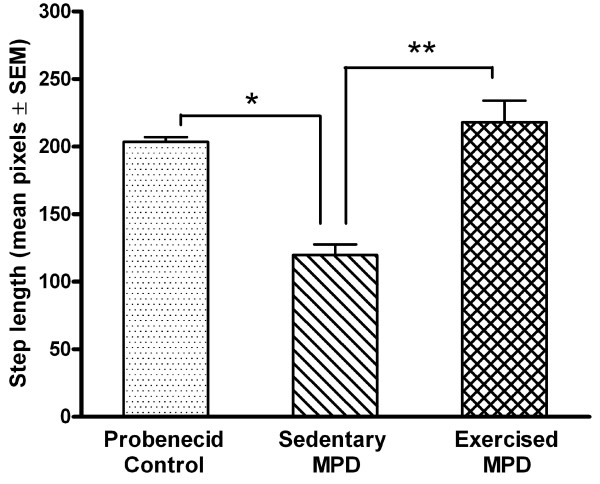
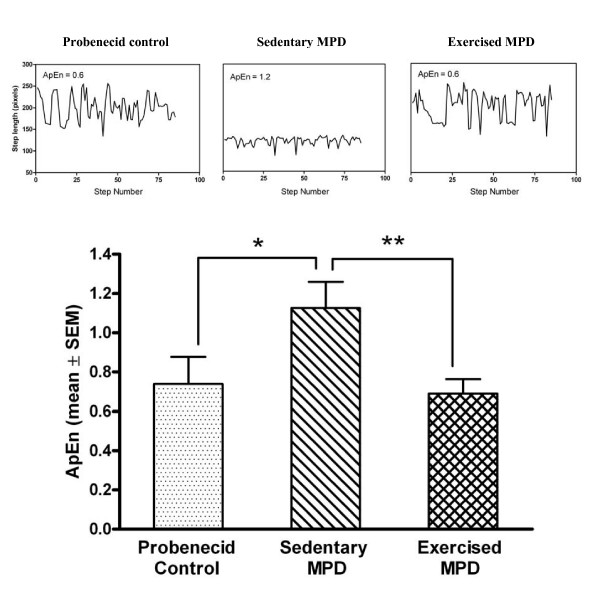
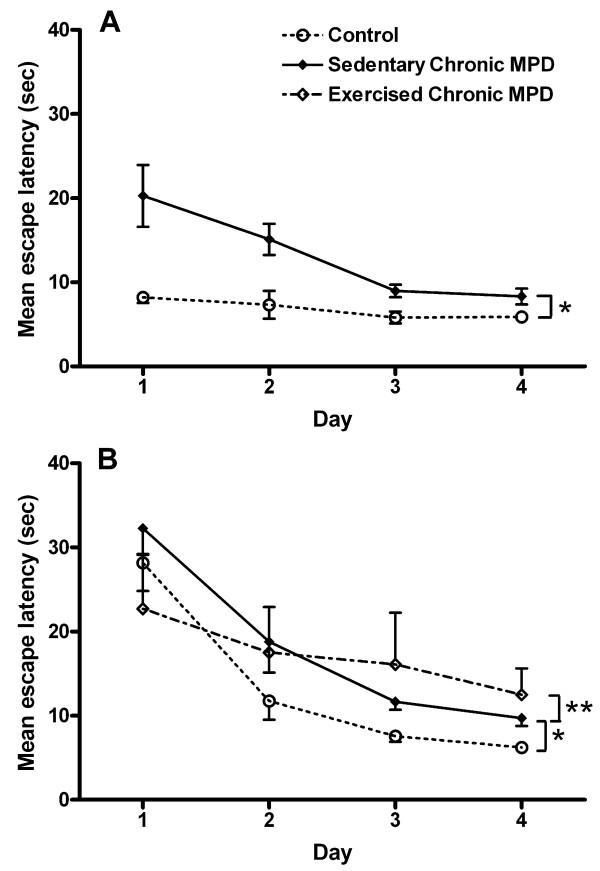
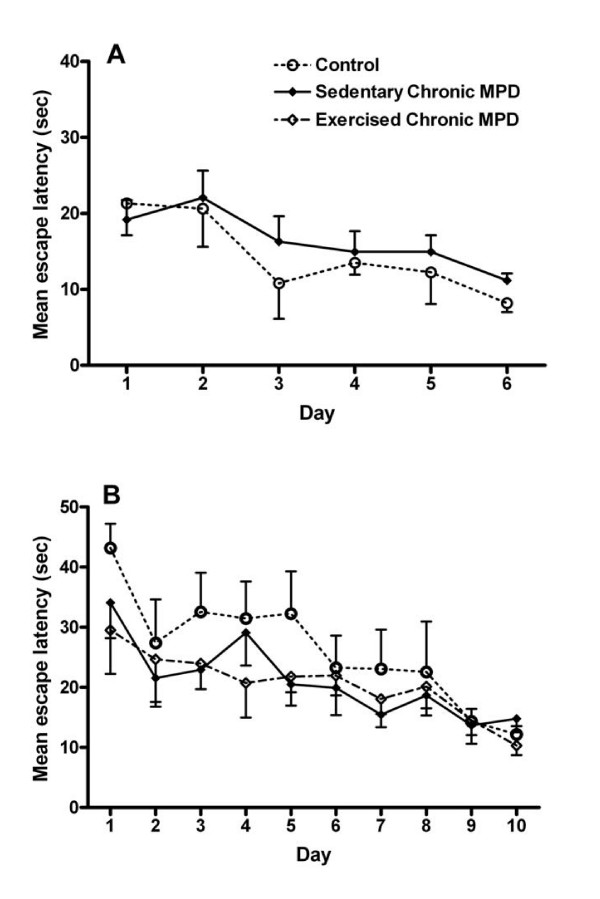
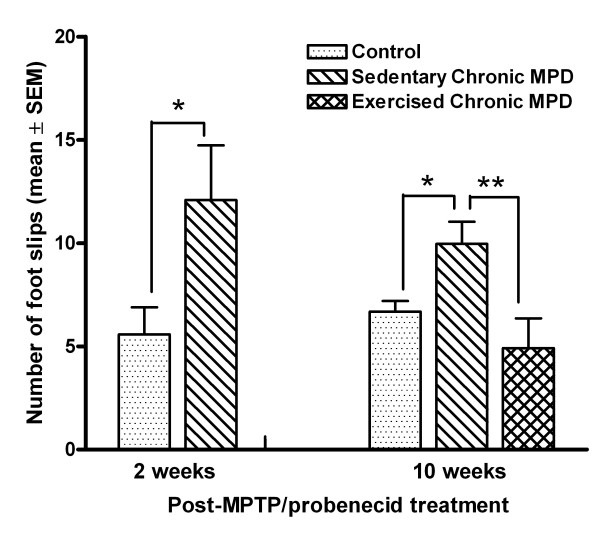
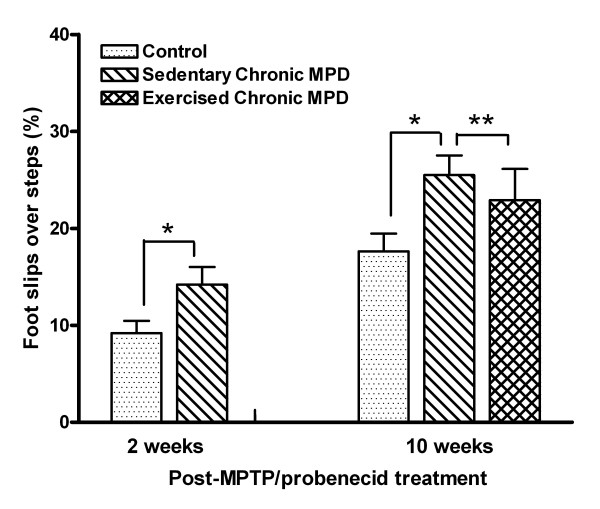
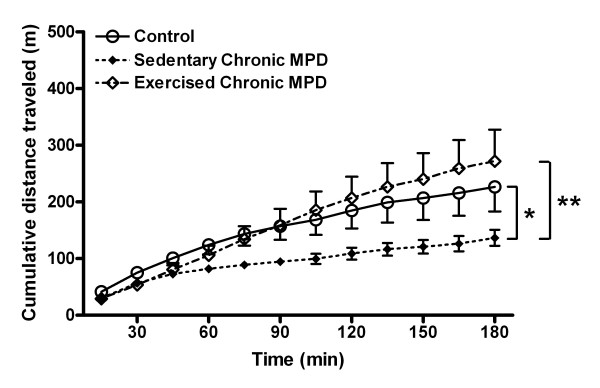
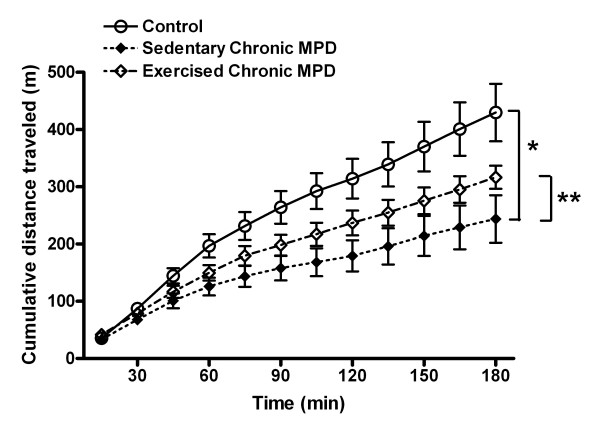
BACKGROUND: Animal models of Parkinson's disease have been widely used for investigating the mechanisms of neurodegenerative process and for discovering alternative strategies for treating the disease. Following 10 injections with 1-methyl-4-phenyl-1,2,3,6-tetrahydropyridine (MPTP, 25 mg/kg) and probenecid (250 mg/kg) over 5 weeks in mice, we have established and characterized a chronic mouse model of Parkinson's disease (MPD), which displays severe long-term neurological and pathological defects resembling that of the human Parkinson's disease in the advanced stage. The behavioral manifestations in this chronic mouse model of Parkinson's syndrome remain uninvestigated. The health benefit of exercise in aging and in neurodegenerative disorders including the Parkinson's disease has been implicated; however, clinical and laboratory studies in this area are limited. In this research with the chronic MPD, we first conducted a series of behavioral tests and then investigated the impact of endurance exercise on the identified Parkinsonian behavioral deficits. RESULTS: We report here that the severe chronic MPD mice showed significant deficits in their gait pattern consistency and in learning the cued version of the Morris water maze. Their performances on the challenging beam and walking grid were considerably attenuated suggesting the lack of balance and motor coordination. Furthermore, their spontaneous and amphetamine-stimulated locomotor activities in the open field were significantly suppressed. The behavioral deficits in the chronic MPD lasted for at least 8 weeks after MPTP/probenecid treatment. When the chronic MPD mice were exercise-trained on a motorized treadmill 1 week before, 5 weeks during, and 8-12 weeks after MPTP/probenecid treatment, the behavioral deficits in gait pattern, spontaneous ambulatory movement, and balance performance were reversed; whereas neuronal loss and impairment in cognitive skill, motor coordination, and amphetamine-stimulated locomotor activity were not altered when compared to the sedentary chronic MPD animals. CONCLUSION: This study indicates that in spite of the drastic loss of dopaminergic neurons and depletion of dopamine in the severe chronic MPD, endurance exercise training effectively reverses the Parkinson's like behavioral deficits related to regular movement, balance and gait performance.
Overview
The claims and statistics of this paper haven’t been checked yet.
Run the check — free, no account needed. It reads the open-access text and checks the sources it cites.
Integrity signals
Registry
Cites
Statistics
Figures
Verification
Claims the paper makes
The claims and statistics of this paper haven’t been checked yet.
Run the check — free, no account needed. It reads the open-access text and checks the sources it cites.
Claims other papers make about this one
Each is checked against this paper’s own text: does it say what the citing paper says it does?
In the citing paper
“In these toxin models, neuroprotection has been principally attributed to an exercise-induced increase of neurotrophic factors such as brain-derived neurotrophic factor (BDNF) or glial-derived neurotrophic factor (GDNF) 78–81.”
From Exercise-enhanced neuroplasticity targeting motor and cognitive circuitry in Parkinson's disease (2013) · cites this paper as [81]
Self-check
Percentages, sums and reported differences re-computed from the paper’s own numbers.
The self-check needs the paper’s full text.
Citations
Cites
Place navigation impaired in rats with hippocampal lesions
Morris, R. G. M., Garrud, P., Rawlins, J. N. P., & O'Keefe, J. (1982) · Nature · doi:10.1038/297681a0 · Cited by 6,340
Chronic Parkinsonism in Humans Due to a Product of Meperidine-Analog Synthesis
Langston, J. W., Ballard, P., Tetrud, J. W., & Irwin, I. (1983) · Science · doi:10.1126/science.6823561 · Cited by 4,914
A neostriatal habit learning system in humans
Knowlton, B. J., Mangels, J. A., & Squire, L. R. (1996) · Science · doi:10.1126/science.273.5280.1399 · Cited by 1,777
Learning and Memory Functions of the Basal Ganglia
Packard, M. G., & Knowlton, B. J. (2002) · Annual Review of Neuroscience · doi:10.1146/annurev.neuro.25.112701.142937 · Cited by 1,717
Physiological time-series analysis: what does regularity quantify?
Pincus, S. M., & Goldberger, A. L. (1994) · American Journal of Physiology-Heart and Circulatory Physiology · doi:10.1152/ajpheart.1994.266.4.h1643 · Cited by 1,322
Hausdorff, J. M., Cudkowicz, M., Firtion, R., Wei, J. Y., & Goldberger, A. L. (1998) · Movement Disorders · doi:10.1002/mds.870130310 · Cited by 897
McDonald, R. J., & White, N. M. (1994) · Behavioral and Neural Biology · doi:10.1016/s0163-1047(05)80009-3 · Cited by 740
Packard, M. G., & McGaugh, J. L. (1992) · Behavioral Neuroscience · doi:10.1037//0735-7044.106.3.439 · Cited by 663
Parkinsonian-like locomotor impairment in mice lacking dopamine D2 receptors
Baik, J., Picetti, R., Saiardi, A., Thiriet, G., Dierich, A., Depaulis, A., LeMeur, M., & Borrelli, E. (1995) · Nature · doi:10.1038/377424a0 · Cited by 646
Schaafsma, J. D., Giladi, N., Balash, Y., Bartels, A. L., Gurevich, T., & Hausdorff, J. M. (2003) · Journal of the Neurological Sciences · doi:10.1016/s0022-510x(03)00104-7 · Cited by 480
Early and Progressive Sensorimotor Anomalies in Mice Overexpressing Wild-Type Human α-Synuclein
Fleming, S. M., Salcedo, J. D., Fernagut, P., Rockenstein, E. M., Masliah, E., Levine, M. S., & Chesselet, M. (2004) · Journal of Neuroscience · doi:10.1523/jneurosci.3080-04.2004 · Cited by 477
Hirsch, M. A., Toole, T., Maitland, C., & Rider, R. A. (2003) · Archives of Physical Medicine and Rehabilitation · doi:10.1016/s0003-9993(03)00046-7 · Cited by 464
Behavioral phenotyping of the MPTP mouse model of Parkinson's disease
Sedelis, M., Schwarting, R. K. W., & Huston, J. P. (2001) · Behavioural Brain Research · doi:10.1016/s0166-4328(01)00309-6 · Cited by 436
Tillerson, J. L., Caudle, W. M., Reverón, M. E., & Miller, G. W. (2003) · Neuroscience · doi:10.1016/s0306-4522(03)00096-4 · Cited by 399
Quantitative analysis of gait in Parkinson patients: increased variability of stride length
Blin, O. J., Ferrandez, A., & Serratrice, G. (1990) · Journal of the Neurological Sciences · doi:10.1016/0022-510x(90)90184-o · Cited by 378
Innovative Analyses of Human Movement
Stergiou, N. (2003) · Medical Entomology and Zoology · Cited by 372
Petroske, E., Meredith, G. E., Callen, S. E., Totterdell, S., & Lau, Y.-S. (2001) · Neuroscience · doi:10.1016/s0306-4522(01)00295-0 · Cited by 334
Self-citationTreadmill training with body weight support: Its effect on Parkinson's disease
Miyai, I., Fujimoto, Y., Ueda, Y., Yamamoto, H., 野崎, 園., Saito, T., & Kang, J. K. (2000) · Archives of Physical Medicine and Rehabilitation · doi:10.1053/apmr.2000.4439 · Cited by 314
Fisher, B. E., Petzinger, G. M., Nixon, K., Hogg, E., Bremmer, S., Meshul, C. K., & Jakowec, M. W. (2004) · Journal of Neuroscience Research · doi:10.1002/jnr.20162 · Cited by 311
Neuroprotective effects of prior limb use in 6-hydroxydopamine-treated rats: possible role of GDNF
Cohen, A. D., Tillerson, J. L., Smith, A. D., Schallert, T., & Zigmond, M. J. (2003) · Journal of Neurochemistry · doi:10.1046/j.1471-4159.2003.01657.x · Cited by 243
Gallagher, M., & Nicolle, M. M. (1993) · Behavioural Brain Research · doi:10.1016/0166-4328(93)90131-9 · Cited by 191
Starkey, M. L., Barritt, A. W., Yip, P. K., Davies, M., Hamers, F. P. T., McMahon, S. B., & Bradbury, E. J. (2005) · Experimental Neurology · doi:10.1016/j.expneurol.2005.06.017 · Cited by 170
Gait dynamics in mouse models of Parkinson's disease and Huntington's disease
Amende, I., Kale, A., McCue, S., Glazier, S., Morgan, J. P., & Hampton, T. (2005) · Journal of NeuroEngineering and Rehabilitation · doi:10.1186/1743-0003-2-20 · Cited by 167
Auclair, A., Drouin, C., Cotecchia, S., Glowinski, J., & Tassin, J. (2004) · European Journal of Neuroscience · doi:10.1111/j.1460-9568.2004.03805.x · Cited by 163
Miyoshi, E., Wietzikoski, S., Camplessei, M., Silveira, R., Takahashi, R. N., & Cunha, C. D. (2002) · Brain Research Bulletin · doi:10.1016/s0361-9230(02)00754-2 · Cited by 161
Baskin, Y. K., Dietrich, W. D., & Green, E. J. (2003) · Journal of Neuroscience Methods · doi:10.1016/s0165-0270(03)00212-7 · Cited by 147
Bergen, J. L., Toole, T., Elliott, R. G., III, Wallace, B., Robinson, K. M., & Maitland, C. (2002) · Neurorehabilitation · doi:10.3233/nre-2002-17209 · Cited by 140
Prediger, R. D., BATISTA, L., Medeiros, R., Pandolfo, P., Flório, J. C., & TAKAHASHI, R. (2006) · Experimental Neurology · doi:10.1016/j.expneurol.2006.07.001 · Cited by 122
Viggiano, D., Ruocco, L. A., & Sadile, A. G. (2003) · Neuroscience & Biobehavioral Reviews · doi:10.1016/j.neubiorev.2003.08.006 · Cited by 110
Treadmill training ameliorates dopamine loss but not behavioral deficits in hemi-Parkinsonian rats
Poulton, N. P., & Muir, G. D. (2005) · Experimental Neurology · doi:10.1016/j.expneurol.2004.12.006 · Cited by 104
Cunha, C. D., Wietzikoski, S., Lovato, E. C. W., Miyoshi, E., Ferro, M. M., Anselmo-Franci, J. A., & Canteras, N. S. (2003) · Neurobiology of Learning and Memory · doi:10.1016/s1074-7427(03)00008-x · Cited by 99
Attention and executive function deficits in chronic low‐dose MPTP‐treated non‐human primates
Decamp, E., & Schneider, J. S. (2004) · European Journal of Neuroscience · doi:10.1111/j.1460-9568.2004.03586.x · Cited by 99
Novikova, L., Garris, B. L., Garris, D. R., & Lau, Y.-S. (2006) · Neuroscience · doi:10.1016/j.neuroscience.2006.02.007 · Cited by 95
Self-citationMabandla, M. V., Kellaway, L. A., Gibson, A. S. C., & Russell, V. A. (2004) · Metabolic Brain Disease · doi:10.1023/b:mebr.0000027416.13070.c3 · Cited by 88
Viggiano, D., Vallone, D., Ruocco, L. A., & Sadile, A. G. (2003) · Neuroscience & Biobehavioral Reviews · doi:10.1016/j.neubiorev.2003.08.011 · Cited by 88
Lau, Y., Trobough, K. L., Crampton, J. M., & Wilson, J. A. (1990) · General Pharmacology The Vascular System · doi:10.1016/0306-3623(90)90898-v · Cited by 75
Self-citationCognitive Changes in Mice Following Moderate MPTP Exposure
Tanila, H., Björklund, M., & Riekkinen, P. J. (1998) · Brain Research Bulletin · doi:10.1016/s0361-9230(97)00452-8 · Cited by 69
Al-Jarrah, M. D., Pothakos, K., Novikova, L., Smirnova, I. V., Kurz, M. J., Stehno‐Bittel, L., & Lau, Y.-S. (2007) · Neuroscience · doi:10.1016/j.neuroscience.2007.07.038 · Cited by 69
Self-citationSchimanski, L. A., & Nguyen, P. (2004) · Neuroscience & Biobehavioral Reviews · doi:10.1016/j.neubiorev.2004.04.002 · Cited by 66
Dluzen, D. E., & Kreutzberg, J. D. (1993) · Brain Research · doi:10.1016/0006-8993(93)90860-p · Cited by 63
Hay, J. F., Moscovitch, M., & Levine, B. (2002) · Neuropsychologia · doi:10.1016/s0028-3932(01)00214-7 · Cited by 48
Dopamine and extrapyramidal motor function and dysfunction.
Hornykiewicz, O. (1972) · PubMed · Cited by 48
Lau, Y., Novikova, L., & Roels, C. (2005) · Neuroscience Research · doi:10.1016/j.neures.2005.04.010 · Cited by 28
Self-citationA chronic mouse model of Parkinson's disease has a reduced gait pattern certainty
Kurz, M. J., Pothakos, K., Jamaluddin, S., Scott-Pandorf, M. M., Arellano, C., & Lau, Y. (2007) · Neuroscience Letters · doi:10.1016/j.neulet.2007.09.060 · Cited by 26
Self-citationGeracitano, R., Federici, M., Bernardi, G., & Mercuri, N. B. (2006) · Annals of the New York Academy of Sciences · doi:10.1196/annals.1369.029 · Cited by 18
West, B. D., Shughrue, P. J., Vanko, A., Ransom, R. W., & Kinney, G. G. (2006) · Pharmacology Biochemistry and Behavior · doi:10.1016/j.pbb.2006.04.022 · Cited by 17
Increased sensitivity of mice to tremorogenic agents following MPP+
Wagner, G. C., & WALSH, S. L. (1987) · Psychopharmacology · doi:10.1007/bf00176480 · Cited by 12
Progressive Neurodegeneration in the Chronic MPTP/Probenecid Model of Parkinson’s Disease
Lau, Y. (2004) · CRC Press eBooks · doi:10.1201/9780203508596.ch11 · Cited by 10
Self-citationPhysiology of the basal ganglia in relation to dystonia.
Grossman, R. G., & Kelly, P. J. (1976) · PubMed · Cited by 4
Research works printed but not linked: 1
- Tetrud JW, Langston JW, Redmond DE, Roth RH, Sladek JR, Angel RW: MPTP-induced tremor in human and non-human primates. Neurology. 1986, 36 (Suppl 1): 308.
Cited by
Sorted by citations
Exercise-enhanced neuroplasticity targeting motor and cognitive circuitry in Parkinson's disease
Petzinger, G. M., Fisher, B. E., McEwen, S., Beeler, J. A., Walsh, J. P., & Jakowec, M. W. (2013) · The Lancet Neurology · doi:10.1016/s1474-4422(13)70123-6 · Cited by 798
Duty, S., & Jenner, P. G. (2011) · British Journal of Pharmacology · doi:10.1111/j.1476-5381.2011.01426.x · Cited by 796
Does vigorous exercise have a neuroprotective effect in Parkinson disease?
Ahlskog, J. E. (2011) · Neurology · doi:10.1212/wnl.0b013e318225ab66 · Cited by 463
“Control” laboratory rodents are metabolically morbid: Why it matters
Martin, B., Ji, S., Maudsley, S., & Mattson, M. P. (2010) · Proceedings of the National Academy of Sciences · doi:10.1073/pnas.0912955107 · Cited by 354
Yang, Z., Zhang, Y., Yang, Y., Sun, L., Han, D., Li, H., & Wang, C. (2010) · Nanomedicine Nanotechnology Biology and Medicine · doi:10.1016/j.nano.2009.11.007 · Cited by 311
Metadata
- Authors
- Pothakos, K., Kurz, M. J., & Lau, Y.-S.
- Affiliations
- University of Houston (US)
- Corresponding author
- Lau, Yuen-Sum
- Venue
- BMC Neuroscience
- Published
- 2009-01-20
- Volume
- 10
- Issue
- 1
- Pages
- 6-6
- ISSN
- 1471-2202 (ISSN-L)
- PMC
- PMC2640401
- OpenAlex
- W1968954752
- Cited by
- 134
- References
- 49
- Citations by year
- 2026: 1 · 2025: 1 · 2024: 2 · 2023: 3 · 2022: 5 · 2021: 6 · 2020: 12 · 2019: 7 · 2018: 8 · 2017: 4 · 2016: 8 · 2015: 12 · 2014: 7 · 2013: 15 · 2012: 10
- FWCI
- 9.17
- Type
- journal article
- Language
- en
- Open access
- gold
- doi.org
- Licence
- cc-by
- Locations
- BMC Neuroscience (publishedVersion, cc-by)
- Europe PMC (PubMed Central) (publishedVersion, cc-by)
- PubMed Central (publishedVersion, cc-by)
- PubMed (publishedVersion)
- DOAJ (DOAJ: Directory of Open Access Journals) (submittedVersion)
- Funders
- National Institute of Neurological Disorders and Stroke (NS47920, R01NS047920)
- Topics
- Health Sciences › Medicine › Clinical Neurology › Parkinson's Disease Mechanisms and Treatments
- Health Sciences › Medicine › Clinical Neurology › Deep Brain Stimulation and Movement Disorders
- Life Sciences › Biochemistry, Genetics and Molecular Biology › Molecular Biology › Nuclear Receptors and Signaling
- Keywords
- Parkinson's disease, endurance exercise, exercise training, behavioral deficits, gait, balance, motor coordination, locomotor activity, dopaminergic neuron loss, dopamine depletion, cognitive impairment, neurodegeneration
- MeSH terms
- Amphetamine, Animals, Ataxia, Disease Models, Animal, Postural Balance, Gait, Male, Mice, Inbred C57BL, Motor Activity, Nerve Degeneration, Parkinson Disease, Physical Conditioning, Animal, Probenecid, 1-Methyl-4-phenyl-1,2,3,6-tetrahydropyridine, Maze Learning, MPTP Poisoning, Mice
About these checks
Registry, retraction, Cites and statistics results are computed, not judged, with one exception: a printed reference that no index lists is read once by a model before it counts as a citation error. Claims are extracted by a model and kept only when their quote appears verbatim in the text; each cited source is then checked, with a model’s help, for whether it says what the claim relies on. Those verdicts can be wrong — read the claim’s quote and the cited source before relying on one.
Statistics and arithmetic are recomputed, not judged.
Confidence bands are shown only for fields calibrated on our annotated test set. None is calibrated yet, so no band is shown.
What counts as a claim ›How we measure confidence ›How we check this ›
Are you an author, or do you see a problem with this page? Request a review
