

The DOI matches its Crossref record; 79 of the 79 references it cites were found in a registry or an index.
Left auditory cortex gamma synchronization and auditory hallucination symptoms in schizophrenia
Open accessAbstract
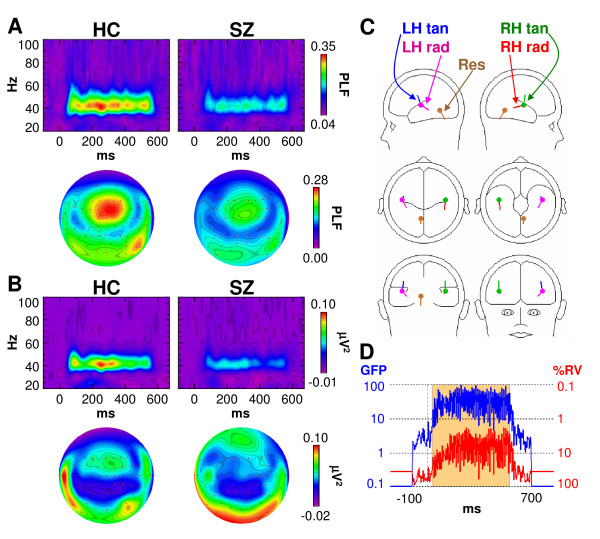
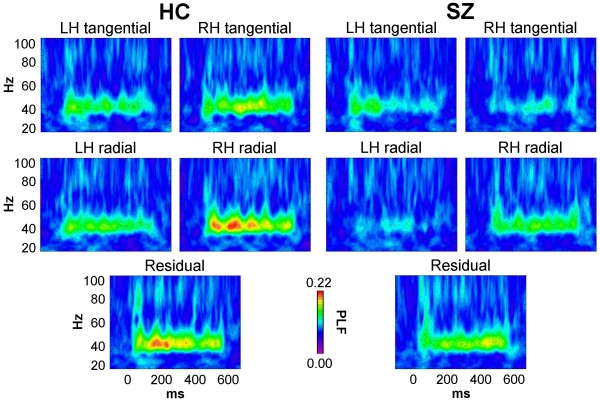
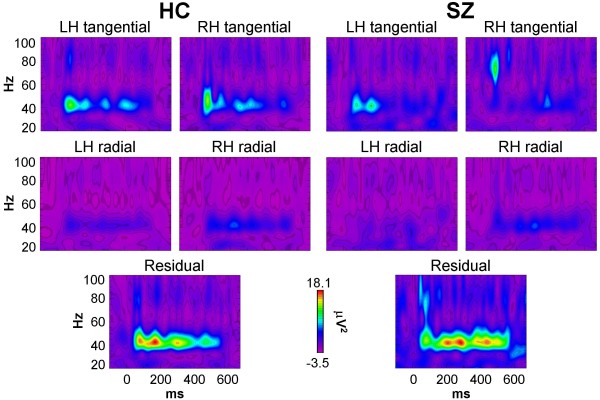
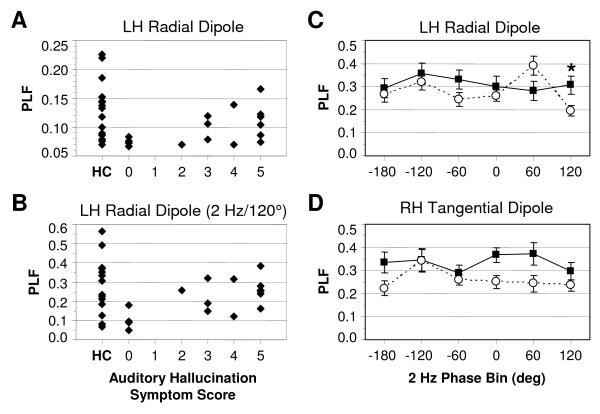
BACKGROUND: Oscillatory electroencephalogram (EEG) abnormalities may reflect neural circuit dysfunction in neuropsychiatric disorders. Previously we have found positive correlations between the phase synchronization of beta and gamma oscillations and hallucination symptoms in schizophrenia patients. These findings suggest that the propensity for hallucinations is associated with an increased tendency for neural circuits in sensory cortex to enter states of oscillatory synchrony. Here we tested this hypothesis by examining whether the 40 Hz auditory steady-state response (ASSR) generated in the left primary auditory cortex is positively correlated with auditory hallucination symptoms in schizophrenia. We also examined whether the 40 Hz ASSR deficit in schizophrenia was associated with cross-frequency interactions. Sixteen healthy control subjects (HC) and 18 chronic schizophrenia patients (SZ) listened to 40 Hz binaural click trains. The EEG was recorded from 60 electrodes and average-referenced offline. A 5-dipole model was fit from the HC grand average ASSR, with 2 pairs of superior temporal dipoles and a deep midline dipole. Time-frequency decomposition was performed on the scalp EEG and source data. RESULTS: Phase locking factor (PLF) and evoked power were reduced in SZ at fronto-central electrodes, replicating prior findings. PLF was reduced in SZ for non-homologous right and left hemisphere sources. Left hemisphere source PLF in SZ was positively correlated with auditory hallucination symptoms, and was modulated by delta phase. Furthermore, the correlations between source evoked power and PLF found in HC was reduced in SZ for the LH sources. CONCLUSION: These findings suggest that differential neural circuit abnormalities may be present in the left and right auditory cortices in schizophrenia. In addition, they provide further support for the hypothesis that hallucinations are related to cortical hyperexcitability, which is manifested by an increased propensity for high-frequency synchronization in modality-specific cortical areas.
Overview
The claims and statistics of this paper haven’t been checked yet.
Run the check — free, no account needed. It reads the open-access text and checks the sources it cites.
Integrity signals
Registry
Cites
Statistics
Figures
Verification
Claims the paper makes
The claims and statistics of this paper haven’t been checked yet.
Run the check — free, no account needed. It reads the open-access text and checks the sources it cites.
Claims other papers make about this one
Each is checked against this paper’s own text: does it say what the citing paper says it does?
In the citing paper
“a variety of evidence exists indicating subtle cortical hyperexcitability in patients with schizophrenia”
From Perineuronal nets and schizophrenia: The importance of neuronal coatings (2014) · cites this paper as Spencer et al., 2009
Self-check
Percentages, sums and reported differences re-computed from the paper’s own numbers.
The self-check needs the paper’s full text.
Citations
Cites
The assessment and analysis of handedness: The Edinburgh inventory
Oldfield, R. C. (1971) · Neuropsychologia · doi:10.1016/0028-3932(71)90067-4 · Cited by 35,900
Neural Mechanisms of Selective Visual Attention
Desimone, R., & Duncan, J. (1995) · Annual Review of Neuroscience · doi:10.1146/annurev.ne.18.030195.001205 · Cited by 8,388
Two Factor Index of Social Position
Hollingshead, A. B. (1957) · Cited by 3,757
Visual Feature Integration and the Temporal Correlation Hypothesis
Singer, W., & Gray, C. M. (1995) · Annual Review of Neuroscience · doi:10.1146/annurev.ne.18.030195.003011 · Cited by 3,217
Recent advances in the phencyclidine model of schizophrenia
(1991) · American Journal of Psychiatry · doi:10.1176/ajp.148.10.1301 · Cited by 2,904
Scale for the Assessment of Negative Symptoms (SANS)*
(1989) · The British Journal of Psychiatry · doi:10.1192/s0007125000291502 · Cited by 2,710
Scale for Assessment of Positive Symptoms (SAPS) 1984
Andreasen, N. C. (1995) · Open Scholarship Institutional Repository (Washington University in St. Louis) · Cited by 2,423
Independent Component Analysis of Electroencephalographic Data
Makeig, S., Bell, A. J., Jung, T., & B, T. J. S. A. (1995) · Cited by 1,957
The Scale for the Assessment of Negative Symptoms (SANS): Conceptual and Theoretical Foundations
Andreasen, N. C. (1989) · The British Journal of Psychiatry · doi:10.1192/s0007125000291496 · Cited by 1,532
Stimulus Specificity of Phase-Locked and Non-Phase-Locked 40 Hz Visual Responses in Human
Tallon‐Baudry, C., Bertrand, O., Delpuech, C., & Pernier, J. (1996) · Journal of Neuroscience · doi:10.1523/jneurosci.16-13-04240.1996 · Cited by 1,526
Research works printed but not linked: 1
- Stoll AL: The Psychopharmacology Reference Card. 2001, Belmont, Massachusetts, McLean Hospital
Cited by
Sorted by citations
Abnormal neural oscillations and synchrony in schizophrenia
Uhlhaas, P. J., & Singer, W. (2010) · Nature Reviews Neuroscience · doi:10.1038/nrn2774 · Cited by 2,120
Buzsáki, G., & Watson, B. O. (2012) · Dialogues in Clinical Neuroscience · doi:10.31887/dcns.2012.14.4/gbuzsaki · Cited by 579
GABAergic Interneurons Shape the Functional Maturation of the Cortex
Le Magueresse, C., & Monyer, H. (2013) · Neuron · doi:10.1016/j.neuron.2013.01.011 · Cited by 425
Cho, K. K. A., Hoch, R., Lee, A. T., Patel, T., Rubenstein, J. L. R., & Sohal, V. S. (2015) · Neuron · doi:10.1016/j.neuron.2015.02.019 · Cited by 329
The 40-Hz Auditory Steady-State Response in Patients With Schizophrenia: A Meta-analysis
Thuné, H., Recasens, M., & Uhlhaas, P. J. (2016) · JAMA Psychiatry · doi:10.1001/jamapsychiatry.2016.2619 · Cited by 292
Metadata
- Authors
- Spencer, K. M., Niznikiewicz, M. A., Nestor, P. G., Shenton, M. E., & McCarley, R. W.
- Affiliations
- Harvard University (US)
- Brigham and Women's Hospital (US)
- Corresponding author
- Spencer, Kevin M
- Venue
- BMC Neuroscience
- Published
- 2009-07-20
- Volume
- 10
- Issue
- 1
- Pages
- 85-85
- ISSN
- 1471-2202 (ISSN-L)
- PMC
- PMC2719648
- OpenAlex
- W2124019844
- Cited by
- 253
- References
- 79
- Citations by year
- 2026: 6 · 2025: 6 · 2024: 12 · 2023: 16 · 2022: 17 · 2021: 16 · 2020: 13 · 2019: 11 · 2018: 13 · 2017: 17 · 2016: 16 · 2015: 23 · 2014: 20 · 2013: 22 · 2012: 18
- FWCI
- 7.26
- Type
- journal article
- Language
- en
- Open access
- gold
- doi.org
- Licence
- Locations
- BMC Neuroscience (publishedVersion, cc-by)
- PubMed Central (publishedVersion, cc-by)
- PubMed (publishedVersion)
- Digital Access to Scholarship at Harvard (DASH) (Harvard University) (submittedVersion, cc-by)
- DOAJ (DOAJ: Directory of Open Access Journals) (submittedVersion)
- Funders
- U.S. Department of Veterans Affairs (R01 MH080187, I01 CX000154)
- National Alliance for Research on Schizophrenia and Depression
- U.S. Public Health Service (R0140799, R03 076760)
- National Institute of Mental Health (MH080187, R01MH080187)
- Topics
- Life Sciences › Neuroscience › Cognitive Neuroscience › Neural dynamics and brain function
- Health Sciences › Medicine › Psychiatry and Mental health › Schizophrenia research and treatment
- Life Sciences › Neuroscience › Cognitive Neuroscience › Hallucinations in medical conditions
- Keywords
- schizophrenia, auditory hallucinations, gamma oscillations, 40 Hz auditory steady-state response, cross-frequency coupling, delta phase, cortical hyperexcitability
- MeSH terms
- Adult, Auditory Cortex, Brain Mapping, Electroencephalography, Evoked Potentials, Auditory, Hallucinations, Humans, Functional Laterality, Male, Middle Aged, Schizophrenia, Signal Processing, Computer-Assisted
About these checks
Registry, retraction, Cites and statistics results are computed, not judged, with one exception: a printed reference that no index lists is read once by a model before it counts as a citation error. Claims are extracted by a model and kept only when their quote appears verbatim in the text; each cited source is then checked, with a model’s help, for whether it says what the claim relies on. Those verdicts can be wrong — read the claim’s quote and the cited source before relying on one.
Statistics and arithmetic are recomputed, not judged.
Confidence bands are shown only for fields calibrated on our annotated test set. None is calibrated yet, so no band is shown.
What counts as a claim ›How we measure confidence ›How we check this ›
Are you an author, or do you see a problem with this page? Request a review
