

Gene expression changes following extinction testing in a heroin behavioral incubation model
Open accessThe DOI matches its Crossref record; 58 of the 59 references it cites were found in a registry or an index.
Abstract
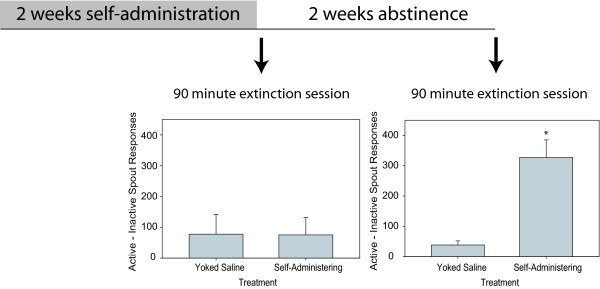
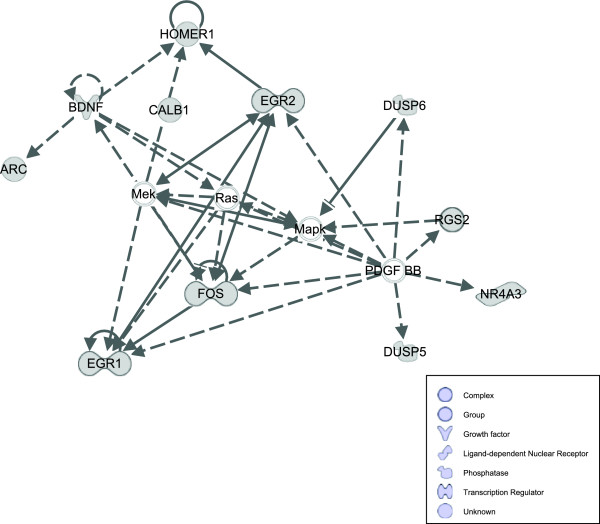
Background: A number of gene expression studies have investigated changes induced by drug exposure, but few reports describe changes that persist following relapse. In this study, genome-wide analysis of gene expression was conducted following an extinction session (90 min) in rats that expressed behavioral incubation of heroin-seeking and goal-directed behavior. As an important modulator of goal-directed behavior, the medial prefrontal cortex (mPFC) was the target of genomic analysis. Rats were trained to self-administer heroin during 3 h daily sessions for 14 d. Following the self-administration period, rats were reintroduced to the self-administration chambers for a 90-minute extinction session in which they could seek heroin, but received none. Extinction sessions were conducted on groups after either 1 d or 14 d of drug-free enforced abstinence to demonstrate behavioral incubation. Results: Behavioral data demonstrated incubation (increased expression) of heroin-seeking and goal-directed behavior after the 14 d abstinent period. That is, following 14 d of enforced abstinence, animals displayed heightened drug-seeking behavior when returned to the environment where they had previously received heroin. This increased drug-seeking took place despite the fact that they received no drug during this extinction session. Whole genome gene expression analysis was performed and results were confirmed by quantitative real-time PCR (RT-qPCR). Microarrays identified 66 genes whose expression was identified as changed by at least 1.4 fold (p < 0.02) following 14 d of abstinence and the 90-minute extinction session compared to the saline treated controls. Orthogonal confirmation by RT-qPCR demonstrated significant alterations in bdnf, calb1, dusp5, dusp6, egr1, npy, rgs2. Conclusion: Ontological analysis indicates that several of the genes confirmed to be changed are important for neuroplasticity, and through that role may impact learning and behavior. The importance of drug-seeking behavior and memory of previous drug-taking sessions suggest that such genes may be important for relapse. The global gene expression analysis adds to the knowledge of heroin-induced changes and further highlights similarities between heroin and other drugs of abuse.
Overview
The claims and statistics of this paper haven’t been checked yet.
Free: it reads the open-access text and checks the first 5 claims that cite a source we can check. Create a free account to check every claim.
Integrity signals
Registry
Cites
Statistics
Figures

Verification
Claims the paper makes
The claims and statistics of this paper haven’t been checked yet.
Free: it reads the open-access text and checks the first 5 claims that cite a source we can check. Create a free account to check every claim.
Self-check
Percentages, sums and reported differences re-computed from the paper’s own numbers.
The self-check needs the paper’s full text.
Citations
Cites
Analysis of Relative Gene Expression Data Using Real-Time Quantitative PCR and the 2−ΔΔCT Method
Livak, K. J., & Schmittgen, T. D. (2001) · Methods · doi:10.1006/meth.2001.1262 · Cited by 180,860
What is the role of dopamine in reward: hedonic impact, reward learning, or incentive salience?
Berridge, K. C., & Robinson, T. E. (1998) · Brain Research Reviews · doi:10.1016/s0165-0173(98)00019-8 · Cited by 4,127
Dopamine, learning and motivation.
Wise, R. A. (2004) · Nature Reviews Neuroscience · doi:10.1038/nrn1406 · Cited by 3,379 · cited 1×
“Increased drug-seeking has been inferred to represent the craving that drives humans to relapse [2,14,15].”
BackgroundMicroarray data analysis: from disarray to consolidation and consensus
Allison, D. B., Cui, X., Page, G. P., & Sabripour, M. (2006) · Nature Reviews Genetics · doi:10.1038/nrg1749 · Cited by 1,339 · cited 1×
“4 fold and greater differences in expression in accordance with standards for microarray analysis [28].”
ResultGOstat: find statistically overrepresented Gene Ontologies within a group of genes
Beißbarth, T., & Speed, T. P. (2004) · Bioinformatics · doi:10.1093/bioinformatics/bth088 · Cited by 1,257
Differential regulation of MAP kinase signalling by dual-specificity protein phosphatases
Owens, D. M., & Keyse, S. M. (2007) · Oncogene · doi:10.1038/sj.onc.1210412 · Cited by 777 · cited 1×
“Dusp5 preferentially dephosphorylates ERK [36,37] and is intranuclear, while dusp6 is cytoplasmic [38].”
BackgroundChomczyński, P., & Mackey, K. (1995) · PubMed · Cited by 590
Infralimbic Prefrontal Cortex Is Responsible for Inhibiting Cocaine Seeking in Extinguished Rats
Peters, J., LaLumiere, R. T., & Kalivas, P. W. (2008) · Journal of Neuroscience · doi:10.1523/jneurosci.1045-08.2008 · Cited by 537 · cited 1×
“Additionally, the ventral mPFC is believed to play an essential role for expression of incubation of cocaine-seeking [19] and reinstatement of cocaine-seeking [20].”
BackgroundNeurobiological substrates for the dark side of compulsivity in addiction
Koob, G. F. (2009) · Neuropharmacology · doi:10.1016/j.neuropharm.2008.07.043 · Cited by 458 · cited 2×
“Although npy is a neurotransmitter most recognized for its role in regulating food intake [49], it has been hypothesized that npy may contribute to the negative motivational state of withdrawal [50].”
BackgroundIncubation of cocaine craving after withdrawal: a review of preclinical data
Lu, L., Grimm, J. W., Hope, B. T., & Shaham, Y. (2004) · Neuropharmacology · doi:10.1016/j.neuropharm.2004.06.027 · Cited by 446 · cited 1×
“Incubation is a behavioral phenomenon that is characterized by increased drug seeking following increasing periods of abstinence after the last self-administration session [13].”
Background
Cited by
Brain-Derived Neurotrophic Factor and Neuropsychiatric Disorders
Autry, A. E., & Monteggia, L. M. (2012) · Pharmacological Reviews · doi:10.1124/pr.111.005108 · Cited by 1,390
“BDNF mRNA expression is also enhanced after long-term withdrawal from self-administered heroin (Kuntz-Melcavage et al., 2009).”
BackgroundNeurobiology of the incubation of drug craving
Pickens, C. L., Airavaara, M., Theberge, F., Fanous, S., Hope, B. T., & Shaham, Y. (2011) · Trends in Neurosciences · doi:10.1016/j.tins.2011.06.001 · Cited by 642
The Role of Early Growth Response 1 (EGR1) in Brain Plasticity and Neuropsychiatric Disorders
Duclot, F., & Kabbaj, M. (2017) · Frontiers in Behavioral Neuroscience · doi:10.3389/fnbeh.2017.00035 · Cited by 363
Drug Addiction: Hyperkatifeia/Negative Reinforcement as a Framework for Medications Development
Koob, G. F. (2021) · Pharmacological Reviews · doi:10.1124/pharmrev.120.000083 · Cited by 337
Epigenetic Mechanisms of Opioid Addiction
Browne, C. J., Godino, A., Salery, M., & Nestler, E. J. (2020) · Biological Psychiatry · doi:10.1016/j.biopsych.2019.06.027 · Cited by 223
Metadata
- Authors
- Kuntz-Melcavage, K. L., Brucklacher, R. M., Grigson, P. S., Freeman, W. M., & Vrana, K. E.
- Affiliations
- Pennsylvania State University (US)
- Corresponding author
- Vrana, Kent E
- Venue
- BMC Neuroscience
- Published
- 2009-08-07
- Volume
- 10
- Issue
- 1
- Pages
- 95-95
- ISSN
- 1471-2202 (ISSN-L)
- PMC
- PMC2733140
- OpenAlex
- W2001351304
- Cited by
- 53
- References
- 57
- Citations by year
- 2026: 1 · 2025: 2 · 2024: 2 · 2023: 8 · 2022: 5 · 2021: 3 · 2020: 2 · 2019: 3 · 2018: 6 · 2017: 2 · 2016: 2 · 2015: 4 · 2014: 1 · 2013: 1 · 2012: 6
- FWCI
- 1.52
- Type
- journal article
- Language
- en
- Open access
- gold
- doi.org
- Licence
- cc-by
- Locations
- BMC Neuroscience (publishedVersion, cc-by)
- PubMed Central (publishedVersion, cc-by)
- PubMed (publishedVersion)
- DOAJ (DOAJ: Directory of Open Access Journals) (submittedVersion, cc-by-sa)
- Funders
- National Institute on Drug Abuse (DA12473, DA021450, R01DA012473, R01DA013770, F31DA021450, DA13770)
- Topics
- Life Sciences › Neuroscience › Cellular and Molecular Neuroscience › Neurotransmitter Receptor Influence on Behavior
- Health Sciences › Medicine › Epidemiology › Substance Abuse Treatment and Outcomes
- Life Sciences › Neuroscience › Cellular and Molecular Neuroscience › Neuropeptides and Animal Physiology
- Keywords
- heroin, extinction, drug-seeking behavior, relapse, self-administration, goal-directed behavior, medial prefrontal cortex, gene expression, brain-derived neurotrophic factor, calbindin-D28k, DUSP5, DUSP6, EGR1, neuropeptide Y, RGS2, neuroplasticity, drug memory
- MeSH terms
- Animals, Conditioning, Operant, Heroin, Extinction, Psychological, Heroin Dependence, Nerve Tissue Proteins, Self Administration, Up-Regulation, Behavior, Addictive, Prefrontal Cortex, Reverse Transcriptase Polymerase Chain Reaction, Oligonucleotide Array Sequence Analysis, Gene Expression Profiling, Rats
About these checks
Registry, retraction, Cites and statistics results are computed, not judged, with one exception: a printed reference that no index lists is read once by a model before it counts as a citation error. Claims are extracted by a model and kept only when their quote appears verbatim in the text; each cited source is then checked, with a model’s help, for whether it says what the claim relies on. Those verdicts can be wrong — read the claim’s quote and the cited source before relying on one.
Statistics and arithmetic are recomputed, not judged.
Confidence bands are shown only for fields calibrated on our annotated test set. None is calibrated yet, so no band is shown.
What counts as a claim ›How we measure confidence ›How we check this ›
Are you an author, or do you see a problem with this page? Request a review
How to cite
Cite CoChat for the checks on this page, and the paper for its own findings.
- This page
- CoChat. (2026). Citation check: Gene expression changes following extinction testing in a heroin behavioral incubation model. https://app.cochat.ai/papers/10.1186/1471-2202-10-95
- The paper
- Kuntz-Melcavage, K. L., Brucklacher, R. M., Grigson, P. S., Freeman, W. M., & Vrana, K. E. (2009). Gene expression changes following extinction testing in a heroin behavioral incubation model. BMC Neuroscience. https://doi.org/10.1186/1471-2202-10-95
Data sources
Bibliographic data: Semantic Scholar, OpenAlex, Crossref.
Contains information from the Semantic Scholar Academic Graph Datasets, made available under the ODC Attribution License (ODC-BY 1.0).
Semantic Scholar’s data is described in: Kinney, R., et al. (2023). The Semantic Scholar Open Data Platform. arXiv:2301.10140.
