

The DOI matches its Crossref record; 41 of the 41 references it cites were found in a registry or an index.
Error-dependent modulation of speech-induced auditory suppression for pitch-shifted voice feedback
Open accessAbstract
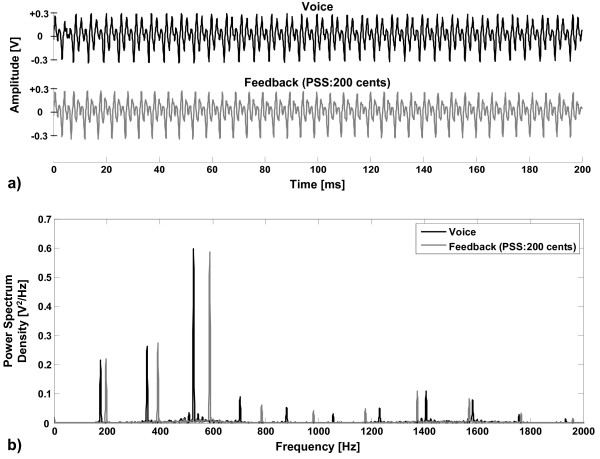
BACKGROUND: The motor-driven predictions about expected sensory feedback (efference copies) have been proposed to play an important role in recognition of sensory consequences of self-produced motor actions. In the auditory system, this effect was suggested to result in suppression of sensory neural responses to self-produced voices that are predicted by the efference copies during vocal production in comparison with passive listening to the playback of the identical self-vocalizations. In the present study, event-related potentials (ERPs) were recorded in response to upward pitch shift stimuli (PSS) with five different magnitudes (0, +50, +100, +200 and +400 cents) at voice onset during active vocal production and passive listening to the playback. RESULTS: Results indicated that the suppression of the N1 component during vocal production was largest for unaltered voice feedback (PSS: 0 cents), became smaller as the magnitude of PSS increased to 200 cents, and was almost completely eliminated in response to 400 cents stimuli. CONCLUSIONS: Findings of the present study suggest that the brain utilizes the motor predictions (efference copies) to determine the source of incoming stimuli and maximally suppresses the auditory responses to unaltered feedback of self-vocalizations. The reduction of suppression for 50, 100 and 200 cents and its elimination for 400 cents pitch-shifted voice auditory feedback support the idea that motor-driven suppression of voice feedback leads to distinctly different sensory neural processing of self vs. non-self vocalizations. This characteristic may enable the audio-vocal system to more effectively detect and correct for unexpected errors in the feedback of self-produced voice pitch compared with externally-generated sounds.
Overview
The claims and statistics of this paper haven’t been checked yet.
Run the check — free, no account needed. It reads the open-access text and checks the sources it cites.
Integrity signals
Registry
Cites
Statistics
Figures
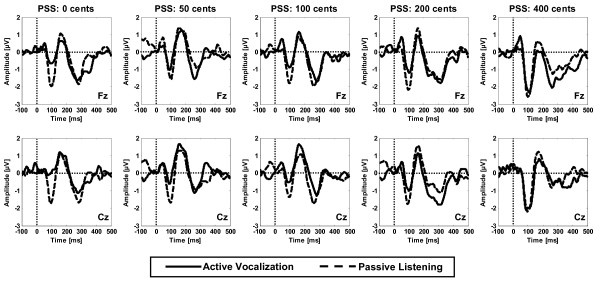
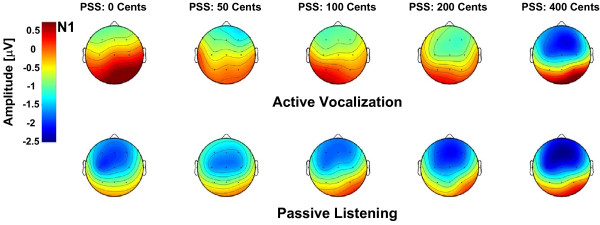
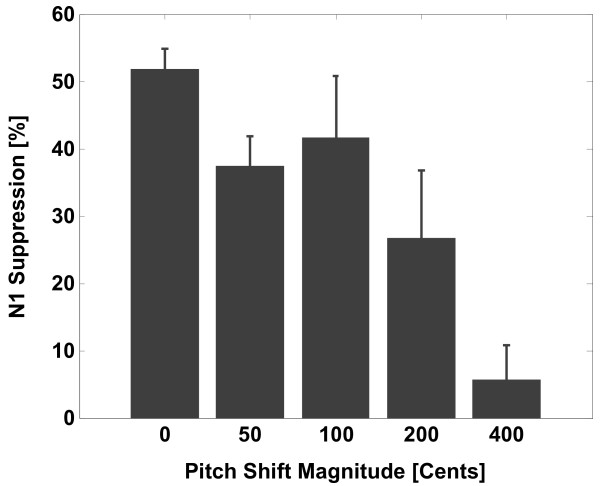
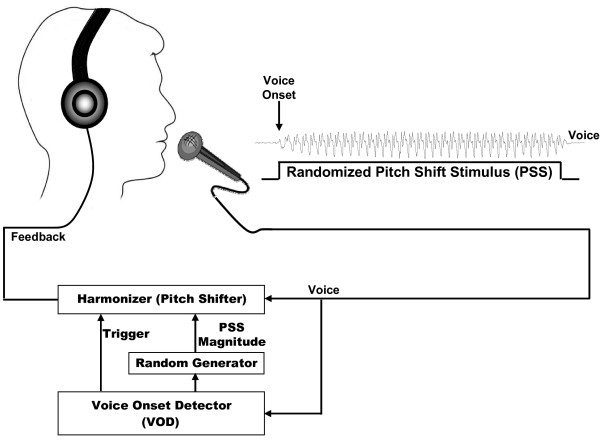
Verification
Claims the paper makes
The claims and statistics of this paper haven’t been checked yet.
Run the check — free, no account needed. It reads the open-access text and checks the sources it cites.
Claims other papers make about this one
Each is checked against this paper’s own text: does it say what the citing paper says it does?
The cited source says what the claim attributes to it.
In the citing paper
“The results of the inner speech experiment mirror those of previous studies which have found sensory attenuation to overt speech to be reduced or eliminated if auditory feedback deviates from what would normally be expected; e.g., by pitch-shifting the feedback or providing foreign-language feedback (Heinks-Maldonado et al., 2006; Behroozmand and Larson, 2011; Behroozmand et al., 2011; Behroozmand”
From Neurophysiological evidence of efference copies to inner speech (2017) · cites this paper as Behroozmand and Larson, 2011
The cited source says what the claim attributes to it.
In the citing paper
“The results of the inner speech experiment mirror those of previous studies which have found sensory attenuation to overt speech to be reduced or eliminated if auditory feedback deviates from what would normally be expected; e.g., by pitch-shifting the feedback or providing foreign-language feedback (Heinks-Maldonado et al., 2006; Behroozmand and Larson, 2011; Behroozmand et al., 2011; Behroozmand”
From Neurophysiological evidence of efference copies to inner speech (2017) · cites this paper as Behroozmand et al., 2011
The cited source says what the claim attributes to it.
In the citing paper
“This result, which is consistent with numerous previous studies in the sensory attenuation literature (Heinks-Maldonado et al., 2006; Behroozmand and Larson, 2011; Behroozmand et al., 2011; Behroozmand et al., 2016; Larson and Robin, 2016), was identical to the corresponding contrast in the inner speech experiment, in which participants had to produce phonemes in inner, as opposed to overt, speech”
From Neurophysiological evidence of efference copies to inner speech (2017) · cites this paper as Behroozmand and Larson, 2011
Self-check
Percentages, sums and reported differences re-computed from the paper’s own numbers.
The self-check needs the paper’s full text.
Citations
Cites
The cortical organization of speech processing
Hickok, G., & Poeppel, D. (2007) · Nature Reviews Neuroscience · doi:10.1038/nrn2113 · Cited by 5,495
An internal model for sensorimotor integration
Wolpert, D. M., Ghahramani, Z., & Jordan, M. I. (1995) · Science · doi:10.1126/science.7569931 · Cited by 3,553
Hickok, G., & Poeppel, D. (2004) · Cognition · doi:10.1016/j.cognition.2003.10.011 · Cited by 2,212
Neural basis of the spontaneous optokinetic response produced by visual inversion
Sperry, R. W. (1950) · Journal of Comparative and Physiological Psychology · doi:10.1037/h0055479 · Cited by 1,789
Central cancellation of self-produced tickle sensation
Blakemore, S.-J., Wolpert, D. M., & Frith, C. D. (1998) · Nature Neuroscience · doi:10.1038/2870 · Cited by 1,467
Relations between the central Nervous System and the peripheral organs
Holst, E. V. (1954) · The British Journal of Animal Behaviour · doi:10.1016/s0950-5601(54)80044-x · Cited by 1,104
Why canʼt you tickle yourself?
Blakemore, S.-J., Wolpert, D., & Frith, C. (2000) · NeuroReport · doi:10.1097/00001756-200008030-00002 · Cited by 904
Spatio-Temporal Prediction Modulates the Perception of Self-Produced Stimuli
Blakemore, S.-J., Frith, C. D., & Wolpert, D. M. (1999) · Journal of Cognitive Neuroscience · doi:10.1162/089892999563607 · Cited by 829
Neural mechanisms underlying auditory feedback control of speech
Tourville, J. A., Reilly, K. J., & Guenther, F. H. (2008) · NeuroImage · doi:10.1016/j.neuroimage.2007.09.054 · Cited by 649
Neuronal mechanisms of visual stability
Wurtz, R. H. (2008) · Vision Research · doi:10.1016/j.visres.2008.03.021 · Cited by 619
Cited by
Sorted by citations
The Encoding of Speech Sounds in the Superior Temporal Gyrus
Yi, H. G., Leonard, M. K., & Chang, E. F. (2019) · Neuron · doi:10.1016/j.neuron.2019.04.023 · Cited by 424
What does motor efference copy represent? Evidence from speech production
Niziolek, C. A., Nagarajan, S. S., & Houde, J. F. (2013) · The Journal of Neuroscience · doi:10.1523/jneurosci.2137-13.2013 · Cited by 222
Sensory-motor networks involved in speech production and motor control: an fMRI study
Behroozmand, R., Shebek, R., Hansen, D. R., Oya, H., Robin, D. A., Howard, M. A., & Greenlee, J. D. W. (2015) · NeuroImage · doi:10.1016/j.neuroimage.2015.01.040 · Cited by 194
Self-citationZheng, Z. Z., Munhall, K. G., & Johnsrude, I. S. (2010) · Journal of Cognitive Neuroscience · doi:10.1162/jocn.2009.21324 · Cited by 177
Tian, X., & Poeppel, D. (2013) · Journal of Cognitive Neuroscience · doi:10.1162/jocn_a_00381 · Cited by 172
Metadata
- Authors
- Behroozmand, R., & Larson, C. R.
- Affiliations
- Northwestern University (US)
- Corresponding author
- Behroozmand, Roozbeh
- Venue
- BMC Neuroscience
- Published
- 2011-06-06
- Volume
- 12
- Issue
- 1
- Pages
- 54-54
- ISSN
- 1471-2202 (ISSN-L)
- PMC
- PMC3120724
- OpenAlex
- W2085269432
- Cited by
- 158
- References
- 41
- Citations by year
- 2026: 8 · 2025: 16 · 2024: 13 · 2023: 11 · 2022: 10 · 2021: 6 · 2020: 11 · 2019: 9 · 2018: 14 · 2017: 6 · 2016: 10 · 2015: 11 · 2014: 6 · 2013: 15 · 2012: 10
- FWCI
- 5.04
- Type
- journal article
- Language
- en
- Open access
- gold
- doi.org
- Licence
- Locations
- BMC Neuroscience (publishedVersion, cc-by)
- PubMed Central (publishedVersion, cc-by)
- PubMed (publishedVersion)
- DOAJ (DOAJ: Directory of Open Access Journals) (submittedVersion, cc-by-sa)
- Funders
- National Institutes of Health
- National Institute on Deafness and Other Communication Disorders (R01DC006243)
- Topics
- Life Sciences › Neuroscience › Cognitive Neuroscience › Neuroscience and Music Perception
- Life Sciences › Neuroscience › Cognitive Neuroscience › Neurobiology of Language and Bilingualism
- Social Sciences › Psychology › Experimental and Cognitive Psychology › Phonetics and Phonology Research
- Keywords
- efference copy, phonation, N1 component, event-related potentials
- MeSH terms
- Acoustic Stimulation, Adult, Brain Mapping, Electroencephalography, Evoked Potentials, Female, Humans, Male, Pitch Perception, Speech, Speech Acoustics, Feedback, Physiological
About these checks
Registry, retraction, Cites and statistics results are computed, not judged, with one exception: a printed reference that no index lists is read once by a model before it counts as a citation error. Claims are extracted by a model and kept only when their quote appears verbatim in the text; each cited source is then checked, with a model’s help, for whether it says what the claim relies on. Those verdicts can be wrong — read the claim’s quote and the cited source before relying on one.
Statistics and arithmetic are recomputed, not judged.
Confidence bands are shown only for fields calibrated on our annotated test set. None is calibrated yet, so no band is shown.
What counts as a claim ›How we measure confidence ›How we check this ›
Are you an author, or do you see a problem with this page? Request a review
