

Neurotrophins regulate ApoER2 proteolysis through activation of the Trk signaling pathway
Open accessThe DOI matches its Crossref record; 103 of the 103 references it cites were found in a registry or an index.
Abstract
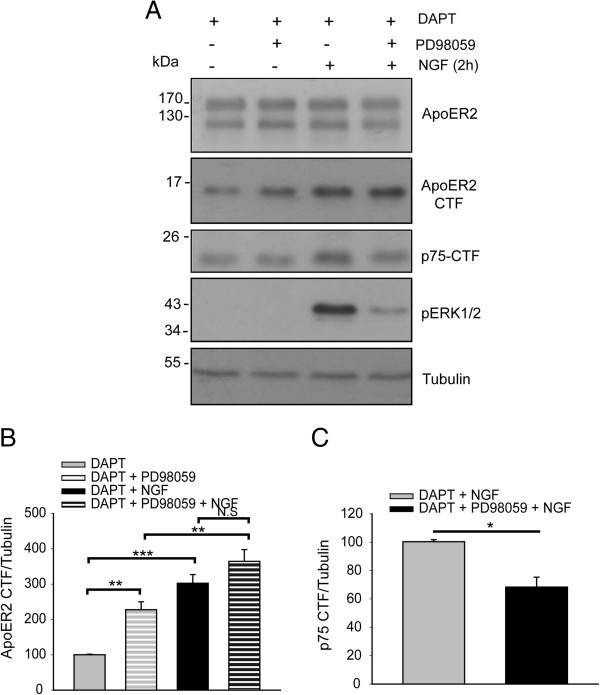
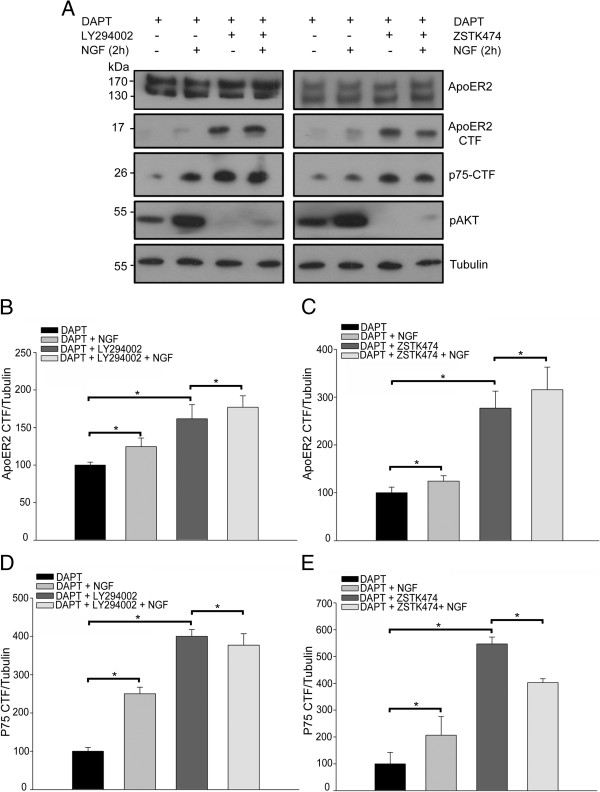
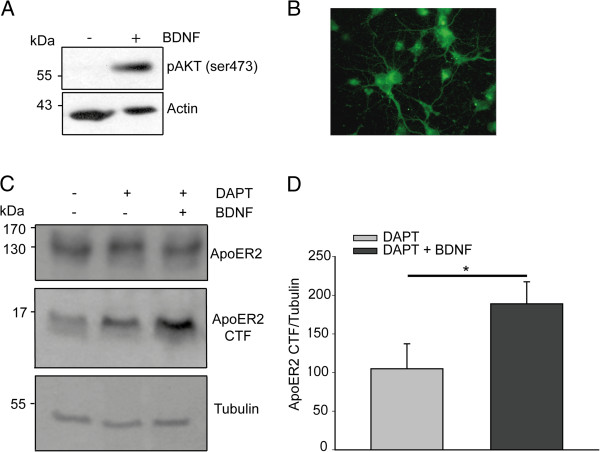
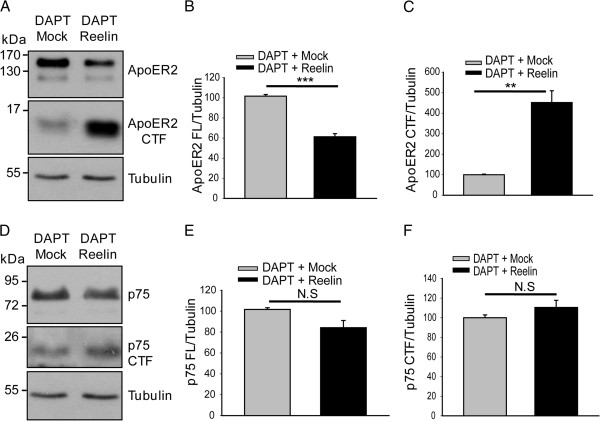
BACKGROUND: ApoER2 and the neurotrophin receptors Trk and p75(NTR) are expressed in the CNS and regulate key functional aspects of neurons, including development, survival, and neuronal function. It is known that both ApoER2 and p75(NTR) are processed by metalloproteinases, followed by regulated intramembrane proteolysis. TrkA activation by nerve growth factor (NGF) increases the proteolytic processing of p75(NTR) mediated by ADAM17. Reelin induces the sheeding of ApoER2 ectodomain depending on metalloproteinase activity. However, it is not known if there is a common regulation mechanism for processing these receptors. RESULTS: We found that TrkA activation by NGF in PC12 cells induced ApoER2 processing, which was dependent on TrkA activation and metalloproteinases. NGF-induced ApoER2 proteolysis was independent of mitogen activated protein kinase activity and of phosphatidylinositol-3 kinase activity. In contrast, the basal proteolysis of ApoER2 increased when both kinases were pharmacologically inhibited. The ApoER2 ligand reelin regulated the proteolytic processing of its own receptor but not of p75(NTR). Finally, in primary cortical neurons, which express both ApoER2 and TrkB, we found that the proteolysis of ApoER2 was also regulated by brain-derived growth factor (BDNF). CONCLUSIONS: Our results highlight a novel relationship between neurotrophins and the reelin-ApoER2 system, suggesting that these two pathways might be linked to regulate brain development, neuronal survival, and some pathological conditions.
Overview
The claims and statistics of this paper haven’t been checked yet.
Free: it reads the open-access text and checks the first 5 claims that cite a source we can check. Create a free account to check every claim.
Integrity signals
Registry
Cites
Statistics
Figures
Verification
Claims the paper makes
The claims and statistics of this paper haven’t been checked yet.
Free: it reads the open-access text and checks the first 5 claims that cite a source we can check. Create a free account to check every claim.
Claims other papers make about this one
Each is checked against this paper’s own text: does it say what the citing paper says it does?
The cited source says what the claim attributes to it.
In the citing paper
“This neurotrophin can increase the expression of extracellular metalloproteinases (46) and induces ApoER2 cleavage through binding TrkB receptors (47) (Fig. 2B, 5).”
From Reelin: Neurodevelopmental Architect and Homeostatic Regulator of Excitatory Synapses (2017) · cites this paper as [47]
In the citing paper
“Both Reelin binding and TrkB/BDNF signaling can inhibit Reelin-mediated NMDAR phosphorylation by inducing the proteolytic processing of ApoER2 (5) (36, 47), whereby the ECD acts as a dominant negative receptor (6) (37) and the ICD can inhibit the transcription of Reelin (7) (38).”
From Reelin: Neurodevelopmental Architect and Homeostatic Regulator of Excitatory Synapses (2017) · cites this paper as [47]
Self-check
Percentages, sums and reported differences re-computed from the paper’s own numbers.
The self-check needs the paper’s full text.
Citations
Cites
1 retracted
Survival of Cholinergic Forebrain Neurons in Developing p75 NGFR -Deficient Mice
Van der Zee, C. E. E. M., Ross, G. M., Riopelle, R. J., & Hagg, T. (1996) · Science · doi:10.1126/science.274.5293.1729 · Cited by 222
RetractedGreene, L. A., & Tischler, A. S. (1976) · Proceedings of the National Academy of Sciences · doi:10.1073/pnas.73.7.2424 · Cited by 5,553 · cited 3×
“PC12 cells endogenously express TrkA and p75NTR and, in response to the exogenous NGF, differentiate into a “neuronal cell phenotype” similar to sympathetic neurons found in the PNS [68,69].”
BackgroundPhosphoinositides in cell regulation and membrane dynamics
Di Paolo, G., & De Camilli, P. (2006) · Nature · doi:10.1038/nature05185 · Cited by 2,790
Neurotrophin-regulated signalling pathways
Reichardt, L. F. (2006) · Philosophical Transactions of the Royal Society B: Biological Sciences · doi:10.1098/rstb.2006.1894 · Cited by 2,195 · cited 1×
“Both the reelin-ApoER2 and the neurotrophin signaling systems are expressed in neurons of the hippocampus, cerebellum, and cerebral cortex [13,44-47] and share functions associated with brain development and adult neuronal functions, including participation in some pathological conditions such as schizophrenia [66].”
BackgroundThe trk proto-oncogene encodes a receptor for nerve growth factor
Klein, R., Jing, S., Nanduri, V., O'Rourke, E., & Barbacid, M. (1991) · Cell · doi:10.1016/0092-8674(91)90419-y · Cited by 1,401 · cited 20×
“As it was reported previously, p75NTR proteolysis is regulated by the activation of TrkA receptor.”
BackgroundInfluentialThe yin and yang of neurotrophin action
Lu, B., Pang, P. T., & Woo, N. H. (2005) · Nature Reviews Neuroscience · doi:10.1038/nrn1726 · Cited by 1,356 · cited 1×
“and regulate development and adult neuronal processes, such as neuronal survival or apoptosis [7], the outgrowth”
BackgroundTrommsdorff, M., Gotthardt, M., Hiesberger, T., Shelton, J., Stockinger, W., Nimpf, J., Hammer, R. E., Richardson, J. A., & Herz, J. (1999) · Cell · doi:10.1016/s0092-8674(00)80782-5 · Cited by 1,261
Patterson, S. L., Abel, T., Deuel, T. A. S., Martin, K. C., Rose, J. C., & Kandel, E. R. (1996) · Neuron · doi:10.1016/s0896-6273(00)80140-3 · Cited by 1,233 · cited 4×
“Abbreviations ADAM17: A Disintegrin and metalloproteinase 17; ApoER2: Apolipoprotein E receptor 2; APP: Amyloid precursor protein; BDNF: Brain-derived neurotrophic factor; CTF: C-terminal fragment; ICD: Intracellular domain; JNK: c-Jun N- terminal kinase; LTD: Long term depression; LTP: Long-term potentiation; LDLR: L…”
BackgroundInfluentialtrkC, a new member of the trk family of tyrosine protein kinases, is a receptor for neurotrophin-3
Lamballe, F., Klein, R., & Barbacid, M. (1991) · Cell · doi:10.1016/0092-8674(91)90442-2 · Cited by 1,080 · cited 1×
“Nerve growth factor (NGF) binds to TrkA [14], brain-derived neurotrophic factor (BDNF) binds to TrkB [15], and neurotrophin 3 (NT3) binds to TrkC [16].”
BackgroundKlein, R., Nanduri, V., Jing, S., Lamballe, F., Tapley, P., Bryant, S., Cordon-Cardo, C., Jones, K. R., Reichardt, L. F., & Barbacid, M. (1991) · Cell · doi:10.1016/0092-8674(91)90628-c · Cited by 958
Cited by
Reelin: Neurodevelopmental Architect and Homeostatic Regulator of Excitatory Synapses
Wasser, C. R., & Herz, J. (2017) · Journal of Biological Chemistry · doi:10.1074/jbc.r116.766782 · Cited by 111
“This neurotrophin can increase the expression of extracellular metalloproteinases (46) and induces ApoER2 cleavage through binding TrkB receptors (47) (Fig.”
BackgroundCanonical and non-canonical Reelin signaling
Bock, H. H., & May, P. (2016) · Frontiers in Cellular Neuroscience · doi:10.3389/fncel.2016.00166 · Cited by 107
“Still another scenario was described for hypothalamic gonadotropin releasing hormone (GnRH)-positive neurons, with a reduction in number and aberrant position of GnRH neurons in the hypothalamus of reeler, but not Dab1 or Apoer2/Vldlrdeficient neurons (Cariboni et al., 2005).”
BackgroundSantana, J., & Marzolo, M. (2017) · Biochemical Journal · doi:10.1042/bcj20160628 · Cited by 80
Self-citationNeurotrophins as Key Regulators of Cell Metabolism: Implications for Cholesterol Homeostasis
Colardo, M., Martella, N., Pensabene, D., Siteni, S., Bartolomeo, S. D., Pallottini, V., & Segatto, M. (2021) · International Journal of Molecular Sciences · doi:10.3390/ijms22115692 · Cited by 44
Reelin in Alzheimer’s Disease, Increased Levels but Impaired Signaling: When More is Less
Cuchillo‐Ibáñez, I., Balmaceda, V., Mata‐Balaguer, T., López‐Font, I., & Sáez‐Valero, J. (2016) · Journal of Alzheimer s Disease · doi:10.3233/jad-151193 · Cited by 37
“2-macroglobulin [55], and neurotrophins like BDNF can modulate this process [134].”
Pasten, C., Cerda, J., Jausoro, I., Court, F. A., Cáceres, A., & Marzolo, M.-P. (2015) · Molecular and Cellular Neuroscience · doi:10.1016/j.mcn.2015.09.004 · Cited by 29
“ApoER2 proteolysis is also inhibited by the broad MMP inhibitor GM6001 (Larios et al., 2014; Larios and Marzolo, 2012).”
Self-citationSheddomeDB: the ectodomain shedding database for membrane-bound shed markers
Tien, W.-S., Chen, J., & Wu, K. (2017) · BMC Bioinformatics · doi:10.1186/s12859-017-1465-7 · Cited by 35
Kaihola, H., Olivier, J., Poromaa, I. S., & Åkerud, H. (2015) · PLoS ONE · doi:10.1371/journal.pone.0116459 · Cited by 31
“These results are interesting since it has been shown that Reelin-deficient mice express lower levels of NGF [68] and the proteolysis of the ApoER2 receptor, after binding to its ligand Reelin, is regulated by NGF and also dependent on TrkA signaling [69].”
BackgroundWang, R., Yan, F., Liao, R., Wan, P. T., Little, P. J., & Zheng, W. (2017) · Molecular and Cellular Endocrinology · doi:10.1016/j.mce.2017.02.040 · Cited by 16
Jausoro, I., & Marzolo, M. (2020) · Journal of Neuroscience Research · doi:10.1002/jnr.24688 · Cited by 13
“Previous studies from our laboratory have shown that Reelin induces neurite outgrowth in PC12 cells in an ApoER2-dependent way, but the role of TC10 and of Exo70 was not investigated (Larios et al., 2014).”
BackgroundSelf-citationContinual reelin signaling by the prime neurogenic niche of the adult brainPreprint
Pérez-Martínez, F. J., Cifuentes, M., & Luque, J. M. (2021) · bioRxiv (Cold Spring Harbor Laboratory) · doi:10.1101/2021.12.12.472284
“In turn, neurotrophins, including BDNF, are able to regulate the proteolytic processing of ApoER2 by activating the Trk signaling pathway (Larios et al., 2014).”
BackgroundReelin Signaling by the Prime Neurogenic Niche of the Adult Brain
Pérez-Martínez, F. J., Cifuentes, M., & Luque, J. M. (2025) · Neuroglia · doi:10.3390/neuroglia6040043
“In turn, neurotrophins, including BDNF, can regulate the proteolytic processing of ApoER2 through activation of Trk signaling [97].”
Metadata
- Authors
- Larios, J. A., Jausoro, I., Benitez, M.-L., Bronfman, F. C., & Marzolo, M.-P.
- Affiliations
- University of Geneva (CH)
- Pontificia Universidad Católica de Chile (CL)
- Venue
- BMC Neuroscience
- Published
- 2014-09-19
- Volume
- 15
- Issue
- 1
- Pages
- 108-108
- ISSN
- 1471-2202 (ISSN-L)
- PMC
- PMC4177048
- OpenAlex
- W2061916545
- Cited by
- 12
- References
- 102
- Citations by year
- 2025: 1 · 2021: 2 · 2020: 1 · 2017: 3 · 2016: 3 · 2015: 2
- FWCI
- 1.22
- Type
- journal article
- Language
- en
- Open access
- gold
- doi.org
- Licence
- cc-by
- Locations
- BMC Neuroscience (publishedVersion, cc-by)
- Europe PMC (PubMed Central) (publishedVersion, cc-by)
- PubMed Central (publishedVersion, cc-by)
- PubMed (publishedVersion)
- Americanae (AECID Library) (submittedVersion, other-oa)
- LA Referencia (Red Federada de Repositorios Institucionales de Publicaciones Científicas) (submittedVersion, other-oa)
- Funders
- University of Pennsylvania
- Fondo Nacional de Ciencia y Tecnología
- Topics
- Life Sciences › Neuroscience › Cellular and Molecular Neuroscience › Nerve injury and regeneration
- Life Sciences › Neuroscience › Developmental Neuroscience › Neurogenesis and neuroplasticity mechanisms
- Life Sciences › Neuroscience › Cellular and Molecular Neuroscience › Alzheimer's disease research and treatments
- Keywords
- ApoER2, neurotrophins, TrkA, TrkB, p75 neurotrophin receptor, regulated intramembrane proteolysis, metalloproteinases, ADAM17, nerve growth factor, reelin, brain-derived neurotrophic factor, receptor proteolysis, PC12 cells, cortical neurons, neuronal survival
- MeSH terms
- Phosphoinositide-3 Kinase Inhibitors, Reelin Protein, Animals, Cells, Cultured, Cerebral Cortex, Nerve Growth Factors, Nerve Tissue Proteins, Neurons, Serine Endopeptidases, Signal Transduction, Cell Adhesion Molecules, Neuronal, Extracellular Matrix Proteins, PC12 Cells, Rats, Sprague-Dawley, Receptors, Nerve Growth Factor, Receptors, Growth Factor, Brain-Derived Neurotrophic Factor, Phosphatidylinositol 3-Kinases, Receptor, trkB, Receptor, trkA, Nerve Growth Factor, LDL-Receptor Related Proteins, Metalloproteases, Extracellular Signal-Regulated MAP Kinases, Rats, Proteolysis
About these checks
Registry, retraction, Cites and statistics results are computed, not judged, with one exception: a printed reference that no index lists is read once by a model before it counts as a citation error. Claims are extracted by a model and kept only when their quote appears verbatim in the text; each cited source is then checked, with a model’s help, for whether it says what the claim relies on. Those verdicts can be wrong — read the claim’s quote and the cited source before relying on one.
Statistics and arithmetic are recomputed, not judged.
Confidence bands are shown only for fields calibrated on our annotated test set. None is calibrated yet, so no band is shown.
What counts as a claim ›How we measure confidence ›How we check this ›
Are you an author, or do you see a problem with this page? Request a review
Data sources
Bibliographic data: Semantic Scholar, OpenAlex, Crossref.
Contains information from the Semantic Scholar Academic Graph Datasets, made available under the ODC Attribution License (ODC-BY 1.0).
Semantic Scholar’s data is described in: Kinney, R., et al. (2023). The Semantic Scholar Open Data Platform. arXiv:2301.10140.
