

The DOI matches its Crossref record; 93 of the 93 references it cites were found in a registry or an index.
A coordinate-based ALE functional MRI meta-analysis of brain activation during verbal fluency tasks in healthy control subjects
Open accessAbstract
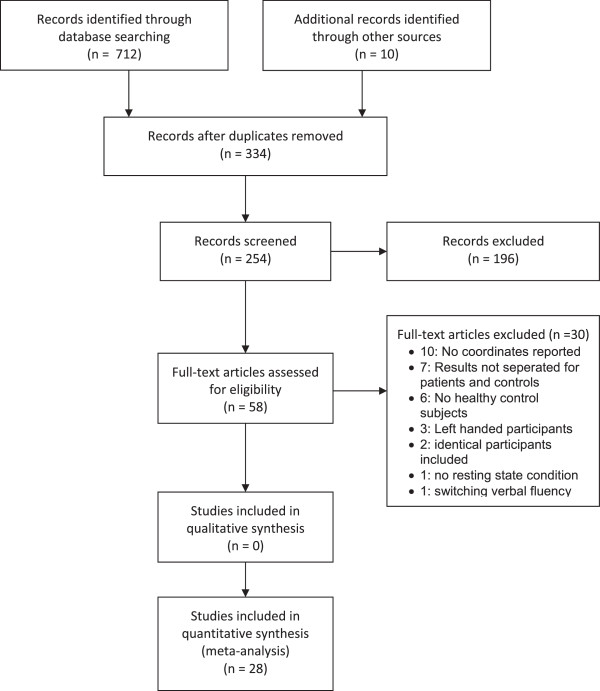
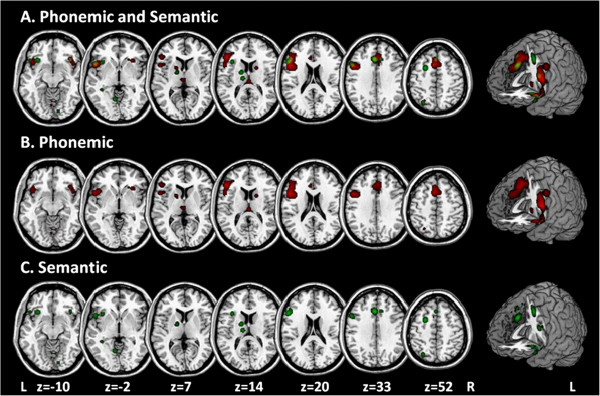
BACKGROUND: The processing of verbal fluency tasks relies on the coordinated activity of a number of brain areas, particularly in the frontal and temporal lobes of the left hemisphere. Recent studies using functional magnetic resonance imaging (fMRI) to study the neural networks subserving verbal fluency functions have yielded divergent results especially with respect to a parcellation of the inferior frontal gyrus for phonemic and semantic verbal fluency. We conducted a coordinate-based activation likelihood estimation (ALE) meta-analysis on brain activation during the processing of phonemic and semantic verbal fluency tasks involving 28 individual studies with 490 healthy volunteers. RESULTS: For phonemic as well as for semantic verbal fluency, the most prominent clusters of brain activation were found in the left inferior/middle frontal gyrus (LIFG/MIFG) and the anterior cingulate gyrus. BA 44 was only involved in the processing of phonemic verbal fluency tasks, BA 45 and 47 in the processing of phonemic and semantic fluency tasks. CONCLUSIONS: Our comparison of brain activation during the execution of either phonemic or semantic verbal fluency tasks revealed evidence for spatially different activation in BA 44, but not other regions of the LIFG/LMFG (BA 9, 45, 47) during phonemic and semantic verbal fluency processing.
Overview
The claims and statistics of this paper haven’t been checked yet.
Run the check — free, no account needed. It reads the open-access text and checks the sources it cites.
Integrity signals
Registry
Cites
Statistics
Figures
Verification
Claims the paper makes
The claims and statistics of this paper haven’t been checked yet.
Run the check — free, no account needed. It reads the open-access text and checks the sources it cites.
Claims other papers make about this one
Each is checked against this paper’s own text: does it say what the citing paper says it does?
In the citing paper
“This number of studies is consistent with prior ALE analyses (Silverman et al., 2015; Wagner et al., 2014).”
From Neural correlates of social exclusion across ages: A coordinate-based meta-analysis of functional MRI studies (2017) · cites this paper as Wagner et al., 2014
In the citing paper
“A minimum of 8–10 studies is required to obtain valid results from ALE analysis (as reported in Wagner et al., 2014)”
From Neural correlates of social exclusion across ages: A coordinate-based meta-analysis of functional MRI studies (2017) · cites this paper as Wagner et al., 2014
Self-check
Percentages, sums and reported differences re-computed from the paper’s own numbers.
The self-check needs the paper’s full text.
Citations
Cites
Preferred Reporting Items for Systematic Reviews and Meta-Analyses: the PRISMA statement
Moher, D., Liberati, A., Tetzlaff, J., Altman, D. G., & for the PRISMA Group (2009) · BMJ · doi:10.1136/bmj.b2535 · Cited by 83,823
Preferred reporting items for systematic reviews and meta-analyses: the PRISMA Statement.
(2009) · PubMed Central · Cited by 44,859
Preferred Reporting Items for Systematic Reviews and Meta-Analyses: The PRISMA Statement
Moher, D., Liberati, A., Tetzlaff, J., & Altman, D. G. (2009) · Journal of Clinical Epidemiology · doi:10.1016/j.jclinepi.2009.06.005 · Cited by 19,575
Contributions of anterior cingulate cortex to behaviour
Devinsky, O., Morrell, M. J., & Vogt, B. A. (1995) · Brain · doi:10.1093/brain/118.1.279 · Cited by 3,377
Storage and Executive Processes in the Frontal Lobes
Smith, E. E., & Jonides, J. (1999) · Science · doi:10.1126/science.283.5408.1657 · Cited by 2,834
Role of left inferior prefrontal cortex in retrieval of semantic knowledge: A reevaluation
Thompson‐Schill, S. L., D’Esposito, M., Aguirre, G. K., & Farah, M. J. (1997) · Proceedings of the National Academy of Sciences · doi:10.1073/pnas.94.26.14792 · Cited by 2,137
Eickhoff, S. B., Laird, A. R., Grefkes, C., Wang, L. E., Zilles, K., & Fox, P. T. (2009) · Human Brain Mapping · doi:10.1002/hbm.20718 · Cited by 1,924
Ventral and dorsal pathways for language
Saur, D., Kreher, B. W., Schnell, S., Kümmerer, D., Kellmeyer, P., Vry, M., Umarova, R. M., Musso, M., Glauche, V., Abel, S., et al. (2008) · Proceedings of the National Academy of Sciences · doi:10.1073/pnas.0805234105 · Cited by 1,617
Meta-analysis of the functional neuroanatomy of single-word reading: method and validation
Turkeltaub, P. E., Eden, G. F., Jones, K. M., & Zeffiro, T. A. (2002) · NeuroImage · doi:10.1006/nimg.2002.1131 · Cited by 1,604
Handedness and hemispheric language dominance in healthy humans
Knecht, S. (2000) · Brain · doi:10.1093/brain/123.12.2512 · Cited by 1,560
Cited by
Sorted by citations
Items 201–205 of 205
Chan, M. M. Y., Ralph, M. A. L., & Robinson, G. A. (2026) · Cortex · doi:10.1016/j.cortex.2026.06.022 · Cited by 2
Zhang, S., Feng, Z., Han, L., Li, J., Gao, Y., Jiang, P., Zhao, M., Wang, D., & 段莉 (2026) · Journal of Affective Disorders · doi:10.1016/j.jad.2026.122435
Akazawa, K., Kuriyama, N., Ozaki, E., Matsui, D., Koyama, T., Izumi, Y., Watanabe, K., Sakai, K., Marunaka, Y., Takada, A., et al. (2026) · Brain Structure and Function · doi:10.1007/s00429-026-03183-9
Animal naming as an effective screening tool for aphasia in brain tumor patients
Tsai, Y.-C., Chen, K., Wei, K., Chen, M.-H., Chen, P.-Y., Wu, Y.-Y., & Chang, W. (2026) · Aphasiology · doi:10.1080/02687038.2026.2738601
Illingworth, C. H., Baig, S. S., Swalwell, J., Holowacz, M., Dorney, S., Burr, S. D. L., Butters, E., Blackburn, D. J., Ali, A., Majid, A., et al. (2026) · Frontiers in Human Neuroscience · doi:10.3389/fnhum.2026.1964706
Metadata
- Authors
- Wagner, S., Sebastian, A., Lieb, K., Tüscher, O., & Tadić, A.
- Affiliations
- University Medical Center of the Johannes Gutenberg University Mainz (DE)
- Corresponding author
- Wagner, Stefanie
- Venue
- BMC Neuroscience
- Published
- 2014-01-24
- Volume
- 15
- Issue
- 1
- Pages
- 19-19
- ISSN
- 1471-2202 (ISSN-L)
- PMC
- PMC3903437
- OpenAlex
- W2043303983
- Cited by
- 205
- References
- 93
- Citations by year
- 2026: 11 · 2025: 20 · 2024: 14 · 2023: 21 · 2022: 24 · 2021: 23 · 2020: 19 · 2019: 15 · 2018: 12 · 2017: 19 · 2016: 16 · 2015: 10 · 2014: 1
- FWCI
- 1.49
- Type
- journal article
- Language
- en
- Open access
- gold
- doi.org
- Licence
- Locations
- BMC Neuroscience (publishedVersion, cc-by)
- Europe PMC (PubMed Central) (publishedVersion, cc-by)
- PubMed Central (publishedVersion, cc-by)
- PubMed (publishedVersion)
- Topics
- Life Sciences › Neuroscience › Cognitive Neuroscience › Neurobiology of Language and Bilingualism
- Life Sciences › Neuroscience › Cognitive Neuroscience › Neural and Behavioral Psychology Studies
- Social Sciences › Psychology › Developmental and Educational Psychology › Reading and Literacy Development
- Keywords
- verbal fluency, phonemic fluency, semantic fluency, brain activation, left inferior frontal gyrus, middle frontal gyrus, anterior cingulate cortex, Brodmann area 44, Brodmann area 45, left hemisphere, artificial neural networks, healthy controls
- MeSH terms
- Action Potentials, Cerebral Cortex, Computer Simulation, Humans, Models, Neurological, Nerve Net, Reference Values, Speech, Models, Statistical, Likelihood Functions, Connectome
About these checks
Registry, retraction, Cites and statistics results are computed, not judged, with one exception: a printed reference that no index lists is read once by a model before it counts as a citation error. Claims are extracted by a model and kept only when their quote appears verbatim in the text; each cited source is then checked, with a model’s help, for whether it says what the claim relies on. Those verdicts can be wrong — read the claim’s quote and the cited source before relying on one.
Statistics and arithmetic are recomputed, not judged.
Confidence bands are shown only for fields calibrated on our annotated test set. None is calibrated yet, so no band is shown.
What counts as a claim ›How we measure confidence ›How we check this ›
Are you an author, or do you see a problem with this page? Request a review
