

The DOI matches its Crossref record; 15 of the 16 references it cites were found in a registry or an index.
Characteristics of meta-analyses and their component studies in the Cochrane Database of Systematic Reviews: a cross-sectional, descriptive analysis
Open accessAbstract
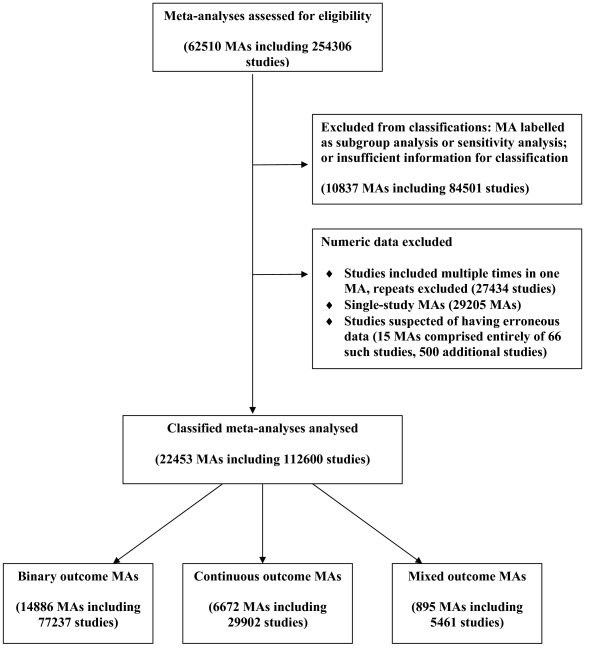
BACKGROUND: Cochrane systematic reviews collate and summarise studies of the effects of healthcare interventions. The characteristics of these reviews and the meta-analyses and individual studies they contain provide insights into the nature of healthcare research and important context for the development of relevant statistical and other methods. METHODS: We classified every meta-analysis with at least two studies in every review in the January 2008 issue of the Cochrane Database of Systematic Reviews (CDSR) according to the medical specialty, the types of interventions being compared and the type of outcome. We provide descriptive statistics for numbers of meta-analyses, numbers of component studies and sample sizes of component studies, broken down by these categories. RESULTS: We included 2321 reviews containing 22,453 meta-analyses, which themselves consist of data from 112,600 individual studies (which may appear in more than one meta-analysis). Meta-analyses in the areas of gynaecology, pregnancy and childbirth (21%), mental health (13%) and respiratory diseases (13%) are well represented in the CDSR. Most meta-analyses address drugs, either with a control or placebo group (37%) or in a comparison with another drug (25%). The median number of meta-analyses per review is six (inter-quartile range 3 to 12). The median number of studies included in the meta-analyses with at least two studies is three (inter-quartile range 2 to 6). Sample sizes of individual studies range from 2 to 1,242,071, with a median of 91 participants. DISCUSSION: It is clear that the numbers of studies eligible for meta-analyses are typically very small for all medical areas, outcomes and interventions covered by Cochrane reviews. This highlights the particular importance of suitable methods for the meta-analysis of small data sets. There was little variation in number of studies per meta-analysis across medical areas, across outcome data types or across types of interventions being compared.
Overview
The claims and statistics of this paper haven’t been checked yet.
Run the check — free, no account needed. It reads the open-access text and checks the sources it cites.
Integrity signals
Registry
Cites
Statistics
Figures
Verification
Claims the paper makes
The claims and statistics of this paper haven’t been checked yet.
Run the check — free, no account needed. It reads the open-access text and checks the sources it cites.
Claims other papers make about this one
Each is checked against this paper’s own text: does it say what the citing paper says it does?
The source backs part of the claim, not all of it — or backs it for a different population, condition or comparison.
In the citing paper
“However, the majority of published meta-analyses contain ten or fewer studies (48) .”
From Effects of low-carbohydrate diets v. low-fat diets on body weight and cardiovascular risk factors: a meta-analysis of randomised controlled trials (2016) · cites this paper as [48]
Experimental — accuracy not yet measuredThe cited source says what the claim attributes to it.
In the citing paper
“although small numbers appear to be typical [38”
From Assessing the feasibility and impact of clinical trial trustworthiness checks via an application to Cochrane Reviews: Stage 2 of the INSPECT-SR project (2025) · cites this paper as [38]
In the citing paper
“Altogether, these are common statistical limitations of most meta-analyses (Davey et al., 2011;Ioannidis et al., 2007).”
From Does loneliness contribute to mild cognitive impairment and dementia? A systematic review and meta-analysis of longitudinal studies (2019) · cites this paper as Davey et al., 2011
Self-check
Percentages, sums and reported differences re-computed from the paper’s own numbers.
The self-check needs the paper’s full text.
Citations
Cites
2 retracted
Drugs for preventing postoperative nausea and vomiting
Carlisle, J. B., & Stevenson, C. A. (2006) · Cochrane Database of Systematic Reviews · doi:10.1002/14651858.cd004125.pub2 · Cited by 265
RetractedDrugs for preventing postoperative nausea and vomiting
Carlisle, J. B., & Stevenson, C. A. (2017) · Cochrane Database of Systematic Reviews · doi:10.1002/14651858.cd004125.pub3 · Cited by 244
RetractedMeasuring inconsistency in meta-analyses
Higgins, J. P. T., Thompson, S. G., Deeks, J. J., & Altman, D. G. (2003) · BMJ · doi:10.1136/bmj.327.7414.557 · Cited by 63,139
Self-citationPharmacological interventions for somatoform disorders in adults
Kleinstäuber, M., Witthöft, M., Steffanowski, A., van Marwijk, H., Hiller, W., & Lambert, M. J. (2014) · Cochrane Database of Systematic Reviews · doi:10.1002/14651858.cd010628.pub2 · Cited by 11,369
The cochrane database of systematic reviews
Geddes, J. R. (1996) · Journal of Psychosomatic Research · doi:10.1016/s0022-3999(96)90063-x · Cited by 5,988
A Re-Evaluation of Random-Effects Meta-Analysis
Higgins, J. P. T., Thompson, S. G., & Spiegelhalter, D. J. (2009) · Journal of the Royal Statistical Society Series A: Statistics in Society · doi:10.1111/j.1467-985x.2008.00552.x · Cited by 2,569
Self-citationWood, L., Egger, M., Gluud, L. L., Schulz, K. F., Jüni, P., Altman, D. G., Gluud, C., Martin, R. M., Wood, A. J. G., & Sterne, J. A. C. (2008) · BMJ · doi:10.1136/bmj.39465.451748.ad · Cited by 2,538
Epidemiology and reporting characteristics of systematic reviews.
Moher, D., Tetzlaff, J., Tricco, A. C., Sampson, M., & Altman, D. G. (2007) · PLoS Medicine · doi:10.1371/journal.pmed.0040078 · Cited by 891
Turner, R. M., Davey, J., Clarke, M. J., Thompson, S. G., & Higgins, J. P. (2012) · International Journal of Epidemiology · doi:10.1093/ije/dys041 · Cited by 837
Self-citationTechniques for preventing hypotension during spinal anaesthesia for caesarean section
Cyna, A. M., Andrew, M. I., Emmett, R. S., Middleton, P., & Simmons, S. W. (2006) · Cochrane Database of Systematic Reviews · doi:10.1002/14651858.cd002251.pub2 · Cited by 424
Research works printed but not linked: 3
- Higgins JPT, Green Se: Cochrane Handbook for Systematic Reviews of Interventions Version 5.0.2 [updated September 2009]. 2009, The Cochrane Collaboration
- Review Manager (RevMan) [Computer Program]. Version 5.0. 2008, Copenhagen, The Nordic Cochrane Centre, The Cochrane Collaboration
- Wood L: The epidemiology of bias in randomized (clinical) controlled trials: a meta-epidemiological study. 2006, University of Bristol
Cited by
Sorted by citations
How to perform a meta-analysis with R: a practical tutorial
Balduzzi, S., Rücker, G., & Schwarzer, G. (2019) · Evidence Based Mental Health · doi:10.1136/ebmental-2019-300117 · Cited by 5,827
IntHout, J., Ioannidis, J. P., & Borm, G. F. (2014) · BMC Medical Research Methodology · doi:10.1186/1471-2288-14-25 · Cited by 2,419
The COMET Handbook: version 1.0
Williamson, P. R., Altman, D. G., Bagley, H., Barnes, K. L., Blazeby, J. M., Brookes, S. T., Clarke, M., Gargon, E., Gorst, S., Harman, N., et al. (2017) · Trials · doi:10.1186/s13063-017-1978-4 · Cited by 2,011
Self-citationCompas, B. E., Jaser, S. S., Bettis, A. H., Watson, K. H., Gruhn, M. A., Dunbar, J. P., Williams, E., & Thigpen, J. C. (2017) · Psychological Bulletin · doi:10.1037/bul0000110 · Cited by 1,555
The heterogeneity statistic I2 can be biased in small meta-analyses
von Hippel, P. T. (2015) · BMC Medical Research Methodology · doi:10.1186/s12874-015-0024-z · Cited by 1,229
Metadata
- Authors
- Davey, J., Turner, R. M., Clarke, M. J., & Higgins, J. P.
- Affiliations
- MRC Biostatistics Unit (GB)
- Queen's University Belfast (GB)
- Corresponding author
- Turner, Rebecca M
- Venue
- BMC Medical Research Methodology
- Published
- 2011-11-24
- Volume
- 11
- Issue
- 1
- Pages
- 160-160
- ISSN
- 1471-2288 (ISSN-L)
- PMC
- PMC3247075
- OpenAlex
- W1965385672
- Cited by
- 404
- References
- 16
- Citations by year
- 2026: 27 · 2025: 32 · 2024: 38 · 2023: 30 · 2022: 23 · 2021: 37 · 2020: 26 · 2019: 29 · 2018: 37 · 2017: 41 · 2016: 31 · 2015: 13 · 2014: 22 · 2013: 9 · 2012: 9
- FWCI
- 3.11
- Type
- journal article
- Language
- en
- Open access
- gold
- doi.org
- Licence
- Locations
- BMC Medical Research Methodology (publishedVersion, cc-by)
- Europe PMC (PubMed Central) (publishedVersion, cc-by)
- PubMed Central (publishedVersion, cc-by)
- PubMed (publishedVersion)
- DOAJ (DOAJ: Directory of Open Access Journals) (submittedVersion, cc-by-sa)
- UCL Discovery (University College London) (submittedVersion)
- Research Portal (Queen's University Belfast) (submittedVersion)
- Explore Bristol Research (submittedVersion)
- Apollo (University of Cambridge) (submittedVersion, cc-by)
- Funders
- Medical Research Council (U1052.00.011)
- Topics
- Social Sciences › Decision Sciences › Statistics, Probability and Uncertainty › Meta-analysis and systematic reviews
- Social Sciences › Library and Information Sciences › scientometrics and bibliometrics research
- Social Sciences › Psychology › Experimental and Cognitive Psychology › Psychology Research and Bibliometrics
- Keywords
- meta-analysis, Cochrane Database of Systematic Reviews, sample size, health interventions
- MeSH terms
- Cross-Sectional Studies, Humans, Review Literature as Topic, Meta-Analysis as Topic, Databases, Factual, Outcome Assessment, Health Care
About these checks
Registry, retraction, Cites and statistics results are computed, not judged, with one exception: a printed reference that no index lists is read once by a model before it counts as a citation error. Claims are extracted by a model and kept only when their quote appears verbatim in the text; each cited source is then checked, with a model’s help, for whether it says what the claim relies on. Those verdicts can be wrong — read the claim’s quote and the cited source before relying on one.
Statistics and arithmetic are recomputed, not judged.
Confidence bands are shown only for fields calibrated on our annotated test set. None is calibrated yet, so no band is shown.
What counts as a claim ›How we measure confidence ›How we check this ›
Are you an author, or do you see a problem with this page? Request a review
