

The DOI matches its Crossref record; 41 of the 41 references it cites were found in a registry or an index.
Exploratory randomized controlled trial evaluating the impact of a waiting list control design
Open accessAbstract
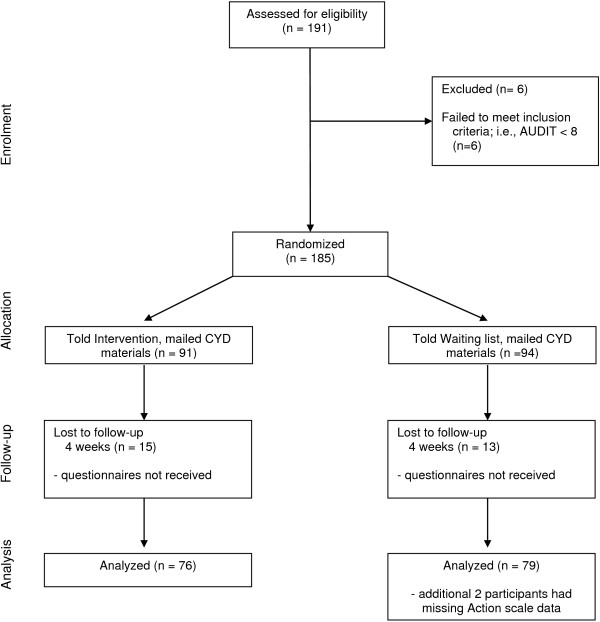
BACKGROUND: Employing waiting list control designs in psychological and behavioral intervention research may artificially inflate intervention effect estimates. This exploratory randomized controlled trial tested this proposition in a study employing a brief intervention for problem drinkers, one domain of research in which waiting list control designs are used. METHODS: All participants (N = 185) were provided with brief personalized feedback intervention materials after being randomly allocated either to be told that they were in the intervention condition and that this was the intervention or to be told that they were in the waiting list control condition and that they would receive access to the intervention in four weeks with this information provided in the meantime. RESULTS: A total of 157 participants (85%) were followed-up after 4 weeks. Between-group differences were found in one of four outcomes (proportion within safe drinking guidelines). An interaction was identified between experimental manipulation and stage of change at study entry such that participant change was arrested among those more ready to change and told they were on the waiting list. CONCLUSIONS: Trials with waiting list control conditions may overestimate treatment effects, though the extent of any such bias appears likely to vary between study populations. Arguably they should only be used where this threat to valid inference has been carefully assessed.
Overview
The claims and statistics of this paper haven’t been checked yet.
Run the check — free, no account needed. It reads the open-access text and checks the sources it cites.
Integrity signals
Registry
Cites
Statistics
Figures
Verification
Claims the paper makes
The claims and statistics of this paper haven’t been checked yet.
Run the check — free, no account needed. It reads the open-access text and checks the sources it cites.
Claims other papers make about this one
Each is checked against this paper’s own text: does it say what the citing paper says it does?
The cited source says what the claim attributes to it.
In the citing paper
“The literature reports growing concerns over the use of waitlist style control groups in psychotherapy research, as the outcomes of the interventions may be over-estimated with this type of control.64”
From Workplace interventions to improve well-being and reduce burnout for nurses, physicians and allied healthcare professionals: a systematic review. (2023) · cites this paper as [64]
The cited source says what the claim attributes to it.
In the citing paper
“Intervention outcomes should also be interpreted with caution because of the potential for overestimation of effect sizes when a waitlist comparison group is used in behavior change research [106].”
From Evaluation of an App-Delivered Psychological Flexibility Skill Training Intervention for Medical Student Burnout and Well-being: Randomized Controlled Trial (2023) · cites this paper as [106]
The cited source says what the claim attributes to it.
In the citing paper
“previous research suggests that waitlist participants’ expectations of receiving support at a later time could hinder the self-driven behavior change that they might otherwise have made during the same period [106].”
From Evaluation of an App-Delivered Psychological Flexibility Skill Training Intervention for Medical Student Burnout and Well-being: Randomized Controlled Trial (2023) · cites this paper as [106]
The cited source says what the claim attributes to it.
In the citing paper
“it has been noted that such designs may overestimate intervention effects [84].”
Self-check
Percentages, sums and reported differences re-computed from the paper’s own numbers.
The self-check needs the paper’s full text.
Citations
Cites
SAUNDERS, J. B., AASLAND, O. G., BABOR, T. F., DE LA FUENTE, J. R., & GRANT, M. (1993) · Addiction · doi:10.1111/j.1360-0443.1993.tb02093.x · Cited by 13,597 · cited 1×
“The outcome variables were: number of drinks in a typical recent week, largest number of drinks on one occasion, and the AUDIT-C [28], the consumption subscale of the Alcohol Use Disorders Identification Test AUDIT, [29,30], which includes three items (frequency of drinking, number of drinks per drinking day, and freq…”
(1979) · Medical Entomology and Zoology · Cited by 11,252
Quasi-experimentation: Design and analysis issues for field settings
Shrout, P. E. (1980) · Evaluation and Program Planning · doi:10.1016/0149-7189(80)90063-4 · Cited by 6,091
(2001) · Cited by 5,455
(1991) · Medical Entomology and Zoology · Cited by 4,438
Framework for design and evaluation of complex interventions to improve health
Campbell, M. (2000) · BMJ · doi:10.1136/bmj.321.7262.694 · Cited by 3,474
ROLLNICK, S., HEATHER, N., GOLD, R., & HALL, W. (1992) · British Journal of Addiction · doi:10.1111/j.1360-0443.1992.tb02720.x · Cited by 818
Dawson, D. A., Grant, B. F., Stinson, F. S., & Zhou, Y. (2005) · Alcoholism Clinical and Experimental Research · doi:10.1097/01.alc.0000164374.32229.a2 · Cited by 704
Mohr, D. C., Spring, B., Freedland, K. E., Beckner, V., Arean, P., Hollon, S. D., Ockene, J., & Kaplan, R. (2009) · Psychotherapy and Psychosomatics · doi:10.1159/000228248 · Cited by 565
Motivational Interviewing: Preparing People to Change Addictive Behavior
Rotgers, F. (1993) · Journal of Studies on Alcohol · doi:10.15288/jsa.1993.54.507a · Cited by 398
Research works printed but not linked: 1
- McCambridge J, Kypri K, Elbourne D: In randomisation we trust? Possible problems in experimenting with people in behavioural intervention trials. J Clin Epidemiol. -in press
Cited by
Sorted by citations
A systematic review and meta-analysis of psychological interventions to improve mental wellbeing
van Agteren, J., Iasiello, M., Lo, L., Bartholomaeus, J., Kopsaftis, Z., Carey, M., & Kyrios, M. (2021) · Nature Human Behaviour · doi:10.1038/s41562-021-01093-w · Cited by 510
Cohen, C., Pignata, S., Bezak, E., Tie, M., & Childs, J. (2023) · BMJ open · doi:10.1136/bmjopen-2022-071203 · Cited by 514
Riper, H., Blankers, M., Hadiwijaya, H., Cunningham, J., Clarke, S., Wiers, R., Ebert, D., & Cuijpers, P. (2014) · PLoS ONE · doi:10.1371/journal.pone.0099912 · Cited by 265
“Other studies have similarly reported higher effect sizes for intervention studies that used waitlisted groups as comparators [73].”
ResultSelf-citationTürk, F., & Waller, G. (2020) · Clinical Psychology Review · doi:10.1016/j.cpr.2020.101856 · Cited by 290
Aday, J. S., Heifets, B. D., Pratscher, S. D., Bradley, E., Rosen, R., & Woolley, J. D. (2022) · Psychopharmacology · doi:10.1007/s00213-022-06123-7 · Cited by 237
Metadata
- Authors
- Cunningham, J. A., Kypri, K., & McCambridge, J.
- Affiliations
- Australian National University (AU)
- University of Newcastle Australia (AU)
- London School of Hygiene & Tropical Medicine (GB)
- Corresponding author
- Cunningham, John A
- Venue
- BMC Medical Research Methodology
- Published
- 2013-12
- Volume
- 13
- Issue
- 1
- Pages
- 150-150
- ISSN
- 1471-2288 (ISSN-L)
- PMC
- PMC4029562
- OpenAlex
- W2132268984
- Cited by
- 321
- References
- 40
- Citations by year
- 2026: 18 · 2025: 29 · 2024: 35 · 2023: 41 · 2022: 42 · 2021: 37 · 2020: 33 · 2019: 28 · 2018: 15 · 2017: 17 · 2016: 11 · 2015: 5 · 2014: 10
- FWCI
- 7.62
- Type
- journal article
- Language
- en
- Open access
- gold
- doi.org
- Licence
- Locations
- BMC Medical Research Methodology (publishedVersion, cc-by)
- Europe PMC (PubMed Central) (publishedVersion, cc-by)
- PubMed Central (publishedVersion, cc-by)
- PubMed (publishedVersion)
- LSHTM Research Online (London School of Hygiene and Tropical Medicine) (acceptedVersion)
- Figshare (submittedVersion, cc-by)
- ANU Open Research (Australian National University) (submittedVersion, cc-by)
- NOVA (University of Newcastle Australia) (submittedVersion)
- Funders
- Wellcome Trust (WT086516MA)
- Medical Research Council
- Topics
- Physical Sciences › Mathematics › Statistics and Probability › Statistical Methods in Clinical Trials
- Health Sciences › Medicine › Epidemiology › Substance Abuse Treatment and Outcomes
- Social Sciences › Decision Sciences › Statistics, Probability and Uncertainty › Meta-analysis and systematic reviews
- Keywords
- overestimation of treatment effects, brief intervention, problem drinking, personalized feedback, stages of change, alcohol consumption, drinking guidelines
- MeSH terms
- Adult, Alcohol Drinking, Behavior Therapy, Female, Humans, Male, Middle Aged, Research Design, Waiting Lists, Bias, Alcohol-Related Disorders
About these checks
Registry, retraction, Cites and statistics results are computed, not judged, with one exception: a printed reference that no index lists is read once by a model before it counts as a citation error. Claims are extracted by a model and kept only when their quote appears verbatim in the text; each cited source is then checked, with a model’s help, for whether it says what the claim relies on. Those verdicts can be wrong — read the claim’s quote and the cited source before relying on one.
Statistics and arithmetic are recomputed, not judged.
Confidence bands are shown only for fields calibrated on our annotated test set. None is calibrated yet, so no band is shown.
What counts as a claim ›How we measure confidence ›How we check this ›
Are you an author, or do you see a problem with this page? Request a review
