

The DOI matches its Crossref record; 41 of the 41 references it cites were found in a registry or an index.
Exploratory randomized controlled trial evaluating the impact of a waiting list control design
Open accessAbstract
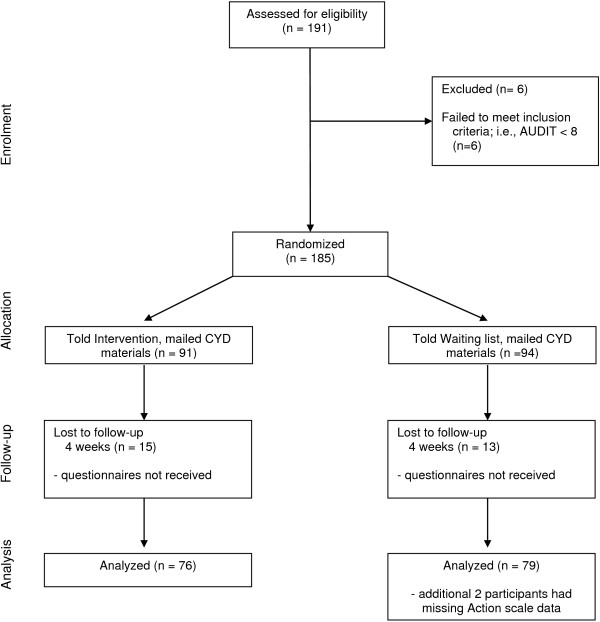
BACKGROUND: Employing waiting list control designs in psychological and behavioral intervention research may artificially inflate intervention effect estimates. This exploratory randomized controlled trial tested this proposition in a study employing a brief intervention for problem drinkers, one domain of research in which waiting list control designs are used. METHODS: All participants (N = 185) were provided with brief personalized feedback intervention materials after being randomly allocated either to be told that they were in the intervention condition and that this was the intervention or to be told that they were in the waiting list control condition and that they would receive access to the intervention in four weeks with this information provided in the meantime. RESULTS: A total of 157 participants (85%) were followed-up after 4 weeks. Between-group differences were found in one of four outcomes (proportion within safe drinking guidelines). An interaction was identified between experimental manipulation and stage of change at study entry such that participant change was arrested among those more ready to change and told they were on the waiting list. CONCLUSIONS: Trials with waiting list control conditions may overestimate treatment effects, though the extent of any such bias appears likely to vary between study populations. Arguably they should only be used where this threat to valid inference has been carefully assessed.
Overview
The claims and statistics of this paper haven’t been checked yet.
Run the check — free, no account needed. It reads the open-access text and checks the sources it cites.
Integrity signals
Registry
Cites
Statistics
Figures
Verification
Claims the paper makes
The claims and statistics of this paper haven’t been checked yet.
Run the check — free, no account needed. It reads the open-access text and checks the sources it cites.
Claims other papers make about this one
Each is checked against this paper’s own text: does it say what the citing paper says it does?
The cited source says what the claim attributes to it.
In the citing paper
“The literature reports growing concerns over the use of waitlist style control groups in psychotherapy research, as the outcomes of the interventions may be over-estimated with this type of control.64”
From Workplace interventions to improve well-being and reduce burnout for nurses, physicians and allied healthcare professionals: a systematic review. (2023) · cites this paper as [64]
The cited source says what the claim attributes to it.
In the citing paper
“Intervention outcomes should also be interpreted with caution because of the potential for overestimation of effect sizes when a waitlist comparison group is used in behavior change research [106].”
From Evaluation of an App-Delivered Psychological Flexibility Skill Training Intervention for Medical Student Burnout and Well-being: Randomized Controlled Trial (2023) · cites this paper as [106]
The cited source says what the claim attributes to it.
In the citing paper
“previous research suggests that waitlist participants’ expectations of receiving support at a later time could hinder the self-driven behavior change that they might otherwise have made during the same period [106].”
From Evaluation of an App-Delivered Psychological Flexibility Skill Training Intervention for Medical Student Burnout and Well-being: Randomized Controlled Trial (2023) · cites this paper as [106]
The cited source says what the claim attributes to it.
In the citing paper
“it has been noted that such designs may overestimate intervention effects [84].”
Self-check
Percentages, sums and reported differences re-computed from the paper’s own numbers.
The self-check needs the paper’s full text.
Citations
Cites
SAUNDERS, J. B., AASLAND, O. G., BABOR, T. F., DE LA FUENTE, J. R., & GRANT, M. (1993) · Addiction · doi:10.1111/j.1360-0443.1993.tb02093.x · Cited by 13,597 · cited 1×
“The outcome variables were: number of drinks in a typical recent week, largest number of drinks on one occasion, and the AUDIT-C [28], the consumption subscale of the Alcohol Use Disorders Identification Test AUDIT, [29,30], which includes three items (frequency of drinking, number of drinks per drinking day, and freq…”
(1979) · Medical Entomology and Zoology · Cited by 11,252
Quasi-experimentation: Design and analysis issues for field settings
Shrout, P. E. (1980) · Evaluation and Program Planning · doi:10.1016/0149-7189(80)90063-4 · Cited by 6,091
(2001) · Cited by 5,455
(1991) · Medical Entomology and Zoology · Cited by 4,438
Framework for design and evaluation of complex interventions to improve health
Campbell, M. (2000) · BMJ · doi:10.1136/bmj.321.7262.694 · Cited by 3,474
ROLLNICK, S., HEATHER, N., GOLD, R., & HALL, W. (1992) · British Journal of Addiction · doi:10.1111/j.1360-0443.1992.tb02720.x · Cited by 818
Dawson, D. A., Grant, B. F., Stinson, F. S., & Zhou, Y. (2005) · Alcoholism Clinical and Experimental Research · doi:10.1097/01.alc.0000164374.32229.a2 · Cited by 704
Mohr, D. C., Spring, B., Freedland, K. E., Beckner, V., Arean, P., Hollon, S. D., Ockene, J., & Kaplan, R. (2009) · Psychotherapy and Psychosomatics · doi:10.1159/000228248 · Cited by 565
Motivational Interviewing: Preparing People to Change Addictive Behavior
Rotgers, F. (1993) · Journal of Studies on Alcohol · doi:10.15288/jsa.1993.54.507a · Cited by 398
Research works printed but not linked: 1
- McCambridge J, Kypri K, Elbourne D: In randomisation we trust? Possible problems in experimenting with people in behavioural intervention trials. J Clin Epidemiol. -in press
Cited by
Sorted by citations
A systematic review and meta-analysis of psychological interventions to improve mental wellbeing
van Agteren, J., Iasiello, M., Lo, L., Bartholomaeus, J., Kopsaftis, Z., Carey, M., & Kyrios, M. (2021) · Nature Human Behaviour · doi:10.1038/s41562-021-01093-w · Cited by 510
Cohen, C., Pignata, S., Bezak, E., Tie, M., & Childs, J. (2023) · BMJ open · doi:10.1136/bmjopen-2022-071203 · Cited by 514
Riper, H., Blankers, M., Hadiwijaya, H., Cunningham, J., Clarke, S., Wiers, R., Ebert, D., & Cuijpers, P. (2014) · PLoS ONE · doi:10.1371/journal.pone.0099912 · Cited by 265
“Other studies have similarly reported higher effect sizes for intervention studies that used waitlisted groups as comparators [73].”
ResultSelf-citationTürk, F., & Waller, G. (2020) · Clinical Psychology Review · doi:10.1016/j.cpr.2020.101856 · Cited by 290
Aday, J. S., Heifets, B. D., Pratscher, S. D., Bradley, E., Rosen, R., & Woolley, J. D. (2022) · Psychopharmacology · doi:10.1007/s00213-022-06123-7 · Cited by 237
Effects of lavender on anxiety: A systematic review and meta-analysis
Donelli, D., Antonelli, M., Bellinazzi, C., Gensini, G. F., & Firenzuoli, F. (2019) · Phytomedicine · doi:10.1016/j.phymed.2019.153099 · Cited by 231
Increasing Psychological Capital: A Pre‐Registered Meta‐Analysis of Controlled Interventions
Lupșa, D., Vîrgă, D., Maricutoiu, L. P., & Rusu, A. (2019) · Applied Psychology · doi:10.1111/apps.12219 · Cited by 227
A Systematic Review of Treatments for Anxiety in Youth with Autism Spectrum Disorders
Vasa, R. A., Carroll, L. M., Nozzolillo, A. A., Mahajan, R., Mazurek, M. O., Bennett, A. E., Wink, L. K., & Bernal, M. P. (2014) · Journal of Autism and Developmental Disorders · doi:10.1007/s10803-014-2184-9 · Cited by 168
Wijma, E. M., Veerbeek, M., Prins, M., Pot, A. M., & Willemse, B. M. (2017) · Aging & Mental Health · doi:10.1080/13607863.2017.1348470 · Cited by 164
The challenges of control groups, placebos and blinding in clinical trials of dietary interventions
Staudacher, H. M., Irving, P. M., Lomer, M. C. E., & Whelan, K. (2017) · Proceedings of The Nutrition Society · doi:10.1017/s0029665117000350 · Cited by 167
“Furthermore, at least according to behavioural research, the use of wait-list controls can overestimate treatment effect, as they change less than expected for individuals who are concerned about their behaviour((11)).”
BackgroundJamil, M. S., Prestage, G., Fairley, C. K., Grulich, A. E., Smith, K. S., Chen, M. Y., Holt, M., McNulty, A. M., Bavinton, B. R., Conway, D. P., et al. (2017) · The Lancet HIV · doi:10.1016/s2352-3018(17)30023-1 · Cited by 155
Effectiveness of a Brief Preventive Parenting Intervention Based in Self-Determination Theory
Grolnick, W. S., Levitt, M. R., Caruso, A. J., & Lerner, R. E. (2021) · Journal of Child and Family Studies · doi:10.1007/s10826-021-01908-4 · Cited by 140
Brosseau, L., Taki, J., Desjardins, B., Thevenot, O., Fransen, M., Wells, G. A., Imoto, A. M., Toupin‐April, K., Westby, M. D., Álvarez‐Gallardo, I. C., et al. (2017) · Clinical Rehabilitation · doi:10.1177/0269215517691083 · Cited by 130
Psychosocial interventions for recurrent abdominal pain in childhood
Abbott, R. A., Martin, A. E., Newlove-Delgado, T. V., Bethel, A. C., Coon, J. T., Whear, R., & Logan, S. (2017) · Cochrane Database of Systematic Reviews · doi:10.1002/14651858.cd010971.pub2 · Cited by 110
Zhang, M., Murphy, B., Cabanilla, A., & Yidi, C. (2021) · Journal of Occupational Health · doi:10.1002/1348-9585.12243 · Cited by 125
Poppe, L., De Bourdeaudhuij, I., Verloigne, M., Shadid, S., Van Cauwenberg, J., Compernolle, S., & Crombez, G. (2019) · Journal of Medical Internet Research · doi:10.2196/13363 · Cited by 104
Does Video Gaming Have Impacts on the Brain: Evidence from a Systematic Review
Denilson Brilliant, T., Nouchi, R., & Kawashima, R. (2019) · Brain Sciences · doi:10.3390/brainsci9100251 · Cited by 120
“Additionally, the waiting-list control group might overestimate the outcome of training [84].”
BackgroundHarvey, A. G., Dong, L., Hein, K., Yu, S. H., Martinez, A. J., Gumport, N. B., Smith, F. L., Chapman, A., Lisman, M., Mirzadegan, I. A., et al. (2021) · Journal of Consulting and Clinical Psychology · doi:10.1037/ccp0000650 · Cited by 108
The use of waitlists as control conditions in anxiety disorders research
Patterson, B., Boyle, M. H., Kivlenieks, M., & Van Ameringen, M. (2016) · Journal of Psychiatric Research · doi:10.1016/j.jpsychires.2016.08.015 · Cited by 94
Pilot randomized trial of self-guided virtual reality exposure therapy for social anxiety disorder
Zainal, N. H., Chan, W. W., Saxena, A. P., Taylor, C. B., & Newman, M. G. (2021) · Behaviour Research and Therapy · doi:10.1016/j.brat.2021.103984 · Cited by 84
Ong, A. M., Chua, L. T.-T., Khor, C., Asokkumar, R., Namasivayam, V., & Wang, Y. (2017) · Clinical Gastroenterology and Hepatology · doi:10.1016/j.cgh.2017.10.038 · Cited by 86
Morina, N., Malek, M., Nickerson, A., & Bryant, R. A. (2017) · Depression and Anxiety · doi:10.1002/da.22618 · Cited by 85
Bischof, G., Iwen, J., Freyer-Adam, J., & Rumpf, H.-J. (2016) · Drug and Alcohol Dependence · doi:10.1016/j.drugalcdep.2016.04.015 · Cited by 81
Wilkes‐Gillan, S., Bundy, A. C., Cordier, R., Lincoln, M., & Chen, Y.-W. R. (2016) · PLoS ONE · doi:10.1371/journal.pone.0160558 · Cited by 95
“Parents allocated to a waitlist control may have an expectation that they are to wait to change until receiving the intervention; which could enhance the lack of change seen in the control-first group over their 10-week wait period [49].”
Bhattacharya, S., Goicoechea, C., Heshmati, S., Carpenter, J. K., & Hofmann, S. G. (2023) · Current Psychiatry Reports · doi:10.1007/s11920-022-01402-8 · Cited by 82
Wider impacts of a 10-week community cooking skills program - Jamie’s Ministry of Food, Australia
Herbert, J., Flego, A., Gibbs, L. F., Waters, E., Swinburn, B. A., Reynolds, J., & Moodie, M. (2014) · BMC Public Health · doi:10.1186/1471-2458-14-1161 · Cited by 80
“Another issue is the possibility of biases related to “Readiness to change” that may impact on the comparison of wait-list control groups with intervention groups, a recent paper [44] has attempted to investigate this (in the context of problem drinking).”
BackgroundBendtsen, M., McCambridge, J., Åsberg, K., & Bendtsen, P. (2021) · Addiction · doi:10.1111/add.15294 · Cited by 71
Self-citationCraig, S. L., Eaton, A. D., Leung, V. W. Y., Iacono, G., Pang, N., Dillon, F., Austin, A., Pascoe, R., & Dobinson, C. (2021) · BMC Psychology · doi:10.1186/s40359-021-00595-6 · Cited by 88
“Further, as participants were waitlisted based on factors such as immediate availability of the group in their rural location or changes to their schedule, they may have felt some sense of apathy about ever being offered AFFIRM which could have contributed to attrition once they were eventually offered the interventio…”
BackgroundA Guideline for Randomized Controlled Trials of Acupuncture
Chen, H., Yang, M., Ning, Z., Lam, W. L., Zhao, Y. K., Yeung, W., Ng, B. F. L., Ziea, E. T.-C., & Lao, L. (2019) · The American Journal of Chinese Medicine · doi:10.1142/s0192415x19500010 · Cited by 73
Furukawa, T. A., Weitz, E. S., Tanaka, S., Hollon, S. D., Hofmann, S. G., Andersson, G., Twisk, J., DeRubeis, R. J., Dimidjian, S., Hegerl, U., et al. (2017) · British Journal of Psychiatry · doi:10.1192/bjp.bp.116.187773 · Cited by 73
Can Mindfulness Help to Alleviate Loneliness? A Systematic Review and Meta-Analysis
Teoh, S. L., Letchumanan, V., & Lee, L. (2021) · Frontiers in Psychology · doi:10.3389/fpsyg.2021.633319 · Cited by 79
Spahrkäs, S. S., Looijmans, A., Sanderman, R., & Hagedoorn, M. (2020) · Psycho-Oncology · doi:10.1002/pon.5492 · Cited by 70
“A drawback of this design is that it might artificially inflate intervention effect estimates since participants in the control group could have been influenced by design to literally “wait-tochange” and thus do not improve.(37) However, this does not seem to be the case in our study, since control participants also s…”
BackgroundTrombka, M., Demarzo, M., Campos, D., Antonio, S. B., Cicuto, K., Walcher, A. L., García-Campayo, J., Schuman-Olivier, Z., & Rocha, N. S. (2021) · Frontiers in Psychiatry · doi:10.3389/fpsyt.2021.624876 · Cited by 69
“While there are ethical advantages to a waitlist design because it allows for the provision of care to research participants who are seeking help while permitting a non-intervention evaluation, such design may overestimate intervention effects (163).”
BackgroundNouchi, R., & Kawashima, R. (2014) · Advances in Neuroscience · doi:10.1155/2014/235479 · Cited by 74
“A recent study demonstrated that waiting list control conditions may overestimate beneficial effects of interventions [84].”
BackgroundHadwin, J. A., & Richards, H. J. (2016) · Frontiers in Psychology · doi:10.3389/fpsyg.2016.00047 · Cited by 75
“In addition, several researchers have highlighted that wait-list groups can overestimate treatment effects (e.g., Cunningham et al., 2013).”
BackgroundJakubovski, E., Reichert, C., Karch, A., Buddensiek, N., Breuer, D., & Müller‐Vahl, K. (2016) · Frontiers in Psychiatry · doi:10.3389/fpsyt.2016.00119 · Cited by 61
“Due to the well-known disadvantages of waiting list designs, we decided against using it in our study (21).”
MethodEmezue, C., Chase, J. D., Udmuangpia, T., & Bloom, T. (2022) · Campbell Systematic Reviews · doi:10.1002/cl2.1271 · Cited by 82
Nielsen, P., Christensen, M., Henderson, C., Liddle, H. A., Croquette-Krokar, M., Favez, N., & Rigter, H. (2021) · Journal of Behavioral Addictions · doi:10.1556/2006.2021.00022 · Cited by 60
Karyotaki, E., Klein, A. M., Ciharova, M., Bolinski, F., Krijnen, L., de Koning, L., de Wit, L., van der Heijde, C. M., Ebert, D. D., Riper, H., et al. (2022) · Behaviour Research and Therapy · doi:10.1016/j.brat.2021.104028 · Cited by 60
“First, it is well known that waiting list controls may artificially inflate the outcomes (Cunningham et al., 2013; Furukawa et al., 2014).”
Cuijpers, P. J., Miguel, C., Harrer, M., Čihařová, M., & Karyotaki, E. (2024) · Epidemiology and Psychiatric Sciences · doi:10.1017/s2045796024000611 · Cited by 57
“Overall, there is very little research on WLs in clinical settings (Cunningham and McCambridge, 2013), and many questions have not yet been answered.”
Rickhi, B., Kania‐Richmond, A., Moritz, S., Cohen, J., Paccagnan, P., Dennis, C., Liu, M., Malhotra, S., Steele, P., & Toews, J. (2015) · BMC Complementary and Alternative Medicine · doi:10.1186/s12906-015-0968-x · Cited by 57
Schotanus-Dijkstra, M., Pieterse, M. E., Drossaert, C. H. C., Walburg, J. A., & Bohlmeijer, E. T. (2017) · The Journal of Positive Psychology · doi:10.1080/17439760.2017.1388430 · Cited by 65
Mindfulness-based eating disorder prevention programs: A systematic review and meta-analysis
Beccia, A. L., Dunlap, C., Hanes, D. A., Courneene, B. J., & Zwickey, H. L. (2017) · Mental Health & Prevention · doi:10.1016/j.mhp.2017.11.001 · Cited by 56
Rewald, S., Lenssen, A. F., Emans, P. J., de Bie, R. A., van Breukelen, G., & Mesters, I. (2020) · Archives of Physical Medicine and Rehabilitation · doi:10.1016/j.apmr.2019.12.023 · Cited by 56
Gajecki, M., Andersson, C. R., Rosendahl, I. K., Sinadinovic, K., Fredriksson, M., & Berman, A. H. (2017) · International Journal of Behavioral Medicine · doi:10.1007/s12529-016-9629-9 · Cited by 57
“It has previously been demonstrated that being in a wait list may cause participants to suspend changing their behavior until they receive the intervention [29].”
BackgroundKubota, Y., Okuyama, T., Uchida, M., Umezawa, S., Nakaguchi, T., Sugano, K., Ito, Y., Katsuki, F., Nakano, Y., Nishiyama, T., et al. (2015) · Psycho-Oncology · doi:10.1002/pon.4000 · Cited by 54
“Second, the fact that we utilized a WCG might have caused overestimation of the effectiveness of the intervention because participants assigned to a waiting list control appeared to improve less than would be expected for people who are concerned about their behavior [27,28].”
MethodRajiah, K., & Saravanan, C. (2014) · American Journal of Pharmaceutical Education · doi:10.5688/ajpe789163 · Cited by 53
Charry-Sánchez, J. D., Pradilla, I. F., & Talero‐Gutiérrez, C. (2018) · Journal of Developmental & Behavioral Pediatrics · doi:10.1097/dbp.0000000000000594 · Cited by 61
“Previous research by Cunningham et al.(69) shows that subjects assigned to waitlist controls often adopt an attitude of “waiting to change,” taking on additional positive conducts only once the treatment period has started, which inflates treatment effect estimators.”
MethodLooyestyn, J., Kernot, J., Boshoff, K., & Maher, C. A. (2018) · Journal of Medical Internet Research · doi:10.2196/jmir.7862 · Cited by 51
“Second, the comparison group were provided with an alternative intervention (hard copy of the running program), which allowed comparison of the two intervention delivery methods (hard copy vs Facebook group delivery) [44].”
MethodWhat Is the Impact of Online Training in Mind–Body Skills?
Kemper, K. J., Lynn, J., & Mahan, J. D. (2015) · Journal of Evidence-Based Complementary & Alternative Medicine · doi:10.1177/2156587215580882 · Cited by 53
“Similarly, many studies of mindfulness training use a waiting list control group, but waiting lists themselves may contribute to frustration and stress, making the study intervention appear better than it might compared with a non–waiting list control group.(23) In-person MBS training may not be feasible to deliver to…”
BackgroundEffects of a COPD self-management support intervention: a randomized controlled trial
Bringsvor, H., Langeland, E., Oftedal, B., Skaug, K., Assmus, J., & Bentsen, S. (2018) · International Journal of COPD · doi:10.2147/copd.s181005 · Cited by 36
“Being informed that they would be offered the intervention after ~6 months could have had an impact on participants’ experience of the usual care provided.(103) In addition, this study only explored short-term effects possibly affected by In te rn at io na l J ou rn al o f C hr on ic O bs tr uc tiv e P ul m on ar y D…”
BackgroundBalci, S., Spanhel, K., Sander, L., & Baumeister, H. (2022) · npj Digital Medicine · doi:10.1038/s41746-022-00569-x · Cited by 52
The science of leadership: A journey from survey research to field experimentation
Eden, D. (2020) · The Leadership Quarterly · doi:10.1016/j.leaqua.2020.101472 · Cited by 58
Svärdman, F., Sjöwall, D., & Lindsäter, E. (2022) · Internet Interventions · doi:10.1016/j.invent.2022.100553 · Cited by 47
“The dominant use of waitlist control conditions might generate measurement bias and overstate treatment effects (Cunningham et al., 2013).”
BackgroundAmris, K., Wæhrens, E. E., Christensen, R., Bliddal, H., & Danneskiold‐Samsøe, B. (2014) · Pain · doi:10.1016/j.pain.2014.04.012 · Cited by 45
“It is possible that such designs may overestimate intervention effects; in contrast with studies using active control (placebo) designs, participants assigned to a waiting list control condition appear to improve little or not at all [4].”
ResultNinomiya, A., Sado, M., Park, S., Fujisawa, D., Kosugi, T., Nakagawa, A., Shirahase, J., & Mimura, M. (2020) · Psychiatry and Clinical Neurosciences · doi:10.1111/pcn.12960 · Cited by 42
“Cunningham et al.35 state that ‘this is because participants assigned to a waiting list control condition appear to improve less than expected for people who are concerned about their behavior and who are taking steps to change.’”
Whitelock, V., Kersbergen, I., Higgs, S., Aveyard, P., Halford, J., & Robinson, E. (2019) · BMC Public Health · doi:10.1186/s12889-019-6923-x · Cited by 35
Trombka, M., Demarzo, M., Bacas, D. C., Antonio, S. B., Cicuto, K., Salvo, V., Claudino, F. C. A., Ribeiro, L., Christopher, M., Garcia-Campayo, J., et al. (2018) · BMC Psychiatry · doi:10.1186/s12888-018-1726-7 · Cited by 51
“While there are ethical advantages to a waitlist design because it allows for the provision of care to research participants who are seeking help whilst permitting a non-intervention evaluation, specially in a non-clinical population as ours, it has been noted that such designs may overestimate intervention effects [8…”
BackgroundControl interventions in randomised trials among people with mental health disorders
Faltinsen, E., Todorovac, A., Staxen Bruun, L., Hróbjartsson, A., Gluud, C., Kongerslev, M. T., Simonsen, E., & Storebø, O. J. (2022) · Cochrane Database of Systematic Reviews · doi:10.1002/14651858.mr000050.pub2 · Cited by 40
Stuttard, L., Beresford, B., Clarke, S., Beecham, J. K., Todd, S., & Bromley, J. (2014) · Research in Developmental Disabilities · doi:10.1016/j.ridd.2014.05.021 · Cited by 42
van Passel, B., Danner, U. N., Dingemans, A. E., Aarts, E., Sternheim, L. C., Becker, E. S., Elburg, A. A. V., van Furth, E. F., Hendriks, G., & Cath, D. C. (2020) · Psychotherapy and Psychosomatics · doi:10.1159/000505733 · Cited by 45
Johansson, M., Berman, A. H., Sinadinovic, K., Lindner, P., Hermansson, U., & Andréasson, S. (2021) · Journal of Medical Internet Research · doi:10.2196/29666 · Cited by 50
“This might be explained by the fact that the participants in this trial were blinded to group allocation, which reduced the risk of being negatively affected by being put in a control group [36,73].”
Universal depression prevention: An umbrella review of meta-analyses
Hoare, E., Collins, S., Marx, W., Callaly, E., Moxham‐Smith, R., Cuijpers, P. J., Holte, A., Nierenberg, A. A., Reavley, N. J., Christensen, H. M., et al. (2021) · Journal of Psychiatric Research · doi:10.1016/j.jpsychires.2021.10.006 · Cited by 48
From question-behaviour effects in trials to the social psychology of research participation
McCambridge, J. (2014) · Psychology and Health · doi:10.1080/08870446.2014.953527 · Cited by 46
Self-citationRees, J., Fu, S. C., Lo, J., Sambell, R., Lewis, J. R., Christophersen, C. T., Byrne, M. F., Newton, R. U., Boyle, S., & Devine, A. (2022) · Frontiers in Nutrition · doi:10.3389/fnut.2022.802940 · Cited by 48
“Concerns have been raised that this type of study design can lead to over-estimated intervention effects (120).”
BackgroundSadavoy, J., Sajedinejad, S., & Chiu, M. (2020) · International Journal of Geriatric Psychiatry · doi:10.1002/gps.5481 · Cited by 40
“This study was not designed as a classic randomized trial and the waiting list control methodology theoretically may inflate effectiveness of the intervention, although data in this regard is quite thin.(48) Generalizability of these findings may be restricted since the method was not developed to actively include and…”
ResultChang, T. F. H., Ley, B. L., Ramburn, T. T., Srinivasan, S., Hariri, S., Purandare, P., & Subramaniam, B. (2022) · Applied Psychology: Health and Well-Being · doi:10.1111/aphw.12341 · Cited by 38
Grohmann, D., & Laws, K. R. (2021) · Journal of Psychosomatic Research · doi:10.1016/j.jpsychores.2021.110592 · Cited by 46
Dawson, A., Yeomans, E., & Brown, E. R. (2018) · Educational Research · doi:10.1080/00131881.2018.1500079 · Cited by 40
Bendtsen, M., Åsberg, K., & McCambridge, J. (2022) · BMC Medicine · doi:10.1186/s12916-022-02374-5 · Cited by 39
“Therefore, concerns about possible biases in waiting list designs arising out of disappointment cannot be ruled out [28, 45].”
BackgroundSelf-citationScott, W., Guildford, B. J., Badenoch, J., Driscoll, E., Chilcot, J., Norton, S., Kemp, H. I., Lee, M. J., Lwanga, J., Boffito, M., et al. (2021) · European Journal of Pain · doi:10.1002/ejp.1762 · Cited by 36
Reuther, S., Holle, D., Buscher, I., Dortmann, O., Müller, R., Bartholomeyczik, S., & Halek, M. (2014) · Trials · doi:10.1186/1745-6215-15-319 · Cited by 34
“The traditional waiting-list designs seem to overestimate the effect of interventions [46].”
BackgroundOgba, F. N., Onyishi, C. N., Ede, M. O., Ugwuanyi, C. S., Nwokeoma, B. N., Victor-Aigbodion, V., Eze, U. N., Omeke, F. C., Okorie, C. O., & Ossai, O. V. (2019) · Journal of Rational-Emotive & Cognitive-Behavior Therapy · doi:10.1007/s10942-019-00334-2 · Cited by 35
Castro-Camacho, L., Barlow, D. H., Mejía, N. G., Farchione, T. J., Idrobo, F., Rattner, M., Quant, D. M., González, L., & Moreno-Villamizar, J. D. (2023) · JAMA Psychiatry · doi:10.1001/jamapsychiatry.2023.2392 · Cited by 34
Maciel, L. P. A. A., Pomares, A. G., Day, C., & Basto-Pereira, M. (2023) · Clinical Psychology Review · doi:10.1016/j.cpr.2023.102274 · Cited by 36
Hendriks, T., Schotanus-Dijkstra, M., Hassankhan, A., Sardjo, W., Graafsma, T., Bohlmeijer, E., & de Jong, J. (2020) · The Journal of Positive Psychology · doi:10.1080/17439760.2019.1590624 · Cited by 30
Tan, Z. Y. A., Wong, S. H., Cheng, L. J., & Lau, S. T. (2022) · Mindfulness · doi:10.1007/s12671-022-01962-z · Cited by 33
“1 3 to wait to change until they receive mMBIs (Cunningham et al., 2013).”
BackgroundFriedrich, A., Claßen, M., & Schlarb, A. A. (2018) · BMC Psychiatry · doi:10.1186/s12888-018-1860-2 · Cited by 33
Abreu, L. G., dos Santos, T. R., Melgaço, C. A., de Abreu, M. H. N. G., Lages, E. M. B., & Paiva, S. M. (2018) · Quality of Life Research · doi:10.1007/s11136-018-1830-7 · Cited by 29
“The literature has expressed concern with the use of waiting list design in intervention research [31].”
BackgroundRitzert, T. R., Forsyth, J. P., Sheppard, S. C., Boswell, J. F., Berghoff, C. R., & Eifert, G. H. (2016) · Behavior Therapy · doi:10.1016/j.beth.2016.03.001 · Cited by 28
Finlay‐jones, A. L., Parkinson, A., Sirois, F. M., Perry, Y., Boyes, M. E., & Rees, C. S. (2023) · Journal of Medical Internet Research · doi:10.2196/44016 · Cited by 34
“Although this was appropriate given the early stage of testing of the SCO-CMC program and the minimal-contact nature of the program, the use of the waitlist control group can artificially inflate the estimates of treatment effects [82].”
MethodThe Inflating Impact of Waiting-List Controls on Effect Size Estimates
Laws, K. R., Pellegrini, L., Reid, J. E., Drummond, L. M., & Fineberg, N. A. (2022) · Frontiers in Psychiatry · doi:10.3389/fpsyt.2022.877089 · Cited by 27
“As with our own meta-analysis (2), our re-analysis of the data here shows that waiting list control groups inflate effect sizes [see (10, 11)].”
Guided web-based treatment program for reducing cannabis use: a randomized controlled trial
Sinadinovic, K., Johansson, M., Johansson, A.-S., Lundqvist, T., Lindner, P., & Hermansson, U. (2020) · Addiction Science & Clinical Practice · doi:10.1186/s13722-020-00185-8 · Cited by 35
“group allocation as well as waiting times which hopefully reduced the risk of being negatively affected by being allocated to the control group [38, 39].”
BackgroundSchaub, M. P., Tiburcio, M., Martinez, N., Ambekar, A., Balhara, Y. P. S., Wenger, A., Monezi Andrade, A. L., Padruchny, D., Osipchik, S., Gehring, E., et al. (2018) · Addiction · doi:10.1111/add.14034 · Cited by 25
Vluggen, S., Candel, M., Hoving, C., Schaper, N. C., & de Vries, H. (2021) · Journal of Medical Internet Research · doi:10.2196/18524 · Cited by 26
Zainal, N. H., & Newman, M. G. (2023) · European Psychiatry · doi:10.1192/j.eurpsy.2023.2 · Cited by 28
“To this end, the SMP was intended to control for credibility and expectancy effects and regression to the mean and prevent inflated effect sizes as would occur with a no-treatment or waitlist control group [50].”
Bendtsen, M., & McCambridge, J. (2019) · JMIR Research Protocols · doi:10.2196/13119 · Cited by 25
“Attention to the design of control conditions in trials is underdeveloped [33-35].”
Self-citationSchuling, R., Huijbers, M. J., van Ravesteijn, H., Donders, R., Cillessen, L., Kuyken, W., & Speckens, A. E. M. (2020) · Journal of Affective Disorders · doi:10.1016/j.jad.2020.03.182 · Cited by 24
Klaperski, S., & Fuchs, R. (2021) · Mental health and physical activity · doi:10.1016/j.mhpa.2021.100408 · Cited by 25
Overcoming obstacles in the design of cancer anorexia/weight loss trials
Le‐Rademacher, J. G., Crawford, J., Evans, W. J., & Jatoi, A. (2017) · Critical Reviews in Oncology/Hematology · doi:10.1016/j.critrevonc.2017.06.008 · Cited by 23
Lindfors, E., Magnusson, T., & Ernberg, M. M. (2020) · Journal of Oral & Facial Pain and Headache · doi:10.11607/ofph.2670 · Cited by 23
Fineberg, N. A., Pellegrini, L., Clarke, A., Perera, U., Drummond, L. M., Albert, U., & Laws, K. R. (2022) · Comprehensive Psychiatry · doi:10.1016/j.comppsych.2022.152334 · Cited by 25
Methodological Aspects in Randomized Clinical Trials of Nutritional Interventions
Martínez‐López, E., Pérez-Guerrero, E. E., Torres-Carrillo, N. M., López-Quintero, A., Betancourt‐Núñez, A., & Gutiérrez-Hurtado, I. A. (2022) · Nutrients · doi:10.3390/nu14122365 · Cited by 24
“In the first instance, the waiting list control has an ethical advantage because all study subjects will receive the intervention; however, there is concern that using this type of control may overestimate the effects of the intervention, particularly in research whose goal is to modify behavior; in this sense, it has…”
BackgroundA randomized controlled trial on a self-guided Internet-based intervention for gambling problems
Bücker, L., Gehlenborg, J., Moritz, S., & Westermann, S. (2021) · Scientific Reports · doi:10.1038/s41598-021-92242-8 · Cited by 23
Ditton, E., Knott, B., Hodyl, N., Horton, G., Oldmeadow, C., Walker, F. R., & Nilsson, M. (2023) · JMIR Mental Health · doi:10.2196/42566 · Cited by 22
Müssener, U., Thomas, K., Linderoth, C., Leijon, M. E., & Bendtsen, M. (2018) · JMIR Human Factors · doi:10.2196/humanfactors.9641 · Cited by 21
“Concern regarding the ethics of assigning participants actively ready for change to control groups has been raised [22] and asking participants in control groups to wait to seek treatment may lessen their natural help-seeking behaviors [23].”
BackgroundVivas-Fernandez, M., Garcia-Lopez, L.-J., Piqueras, J. A., Muela-Martinez, J.-A., Canals-Sans, J., Espinosa-Fernandez, L., Jimenez-Vazquez, D., Diaz-Castela, M. D. M., Morales-Hidalgo, P., Rivera, M., et al. (2023) · Child and Adolescent Psychiatry and Mental Health · doi:10.1186/s13034-023-00616-9 · Cited by 20
“The use of waitlist control conditions (WLCs) in RCTs may also overestimate treatment effects and thus artificially inflate the effect sizes of prevention programs [1, 26, 31, 36, 74].”
BackgroundBendtsen, M., & McCambridge, J. (2021) · Journal of Clinical Epidemiology · doi:10.1016/j.jclinepi.2021.03.008 · Cited by 20
Self-citationHughes, Z. D., Ball, L. J., Richardson, C., & Judge, J. (2023) · Psychonomic Bulletin & Review · doi:10.3758/s13423-023-02327-w · Cited by 23
“There are, however, concerns that employing wait-ing-list control designs may artificially inflate intervention effect estimates (Cunningham et al., 2013).”
BackgroundMethodInfluentialFrühauf, A., Sevecke, K., & Kopp, M. (2018) · Neuropsychiatrie · doi:10.1007/s40211-018-0283-0 · Cited by 19
Metadata
- Authors
- Cunningham, J. A., Kypri, K., & McCambridge, J.
- Affiliations
- Australian National University (AU)
- University of Newcastle Australia (AU)
- London School of Hygiene & Tropical Medicine (GB)
- Corresponding author
- Cunningham, John A
- Venue
- BMC Medical Research Methodology
- Published
- 2013-12
- Volume
- 13
- Issue
- 1
- Pages
- 150-150
- ISSN
- 1471-2288 (ISSN-L)
- PMC
- PMC4029562
- OpenAlex
- W2132268984
- Cited by
- 321
- References
- 40
- Citations by year
- 2026: 18 · 2025: 29 · 2024: 35 · 2023: 41 · 2022: 42 · 2021: 37 · 2020: 33 · 2019: 28 · 2018: 15 · 2017: 17 · 2016: 11 · 2015: 5 · 2014: 10
- FWCI
- 7.62
- Type
- journal article
- Language
- en
- Open access
- gold
- doi.org
- Licence
- Locations
- BMC Medical Research Methodology (publishedVersion, cc-by)
- Europe PMC (PubMed Central) (publishedVersion, cc-by)
- PubMed Central (publishedVersion, cc-by)
- PubMed (publishedVersion)
- LSHTM Research Online (London School of Hygiene and Tropical Medicine) (acceptedVersion)
- Figshare (submittedVersion, cc-by)
- ANU Open Research (Australian National University) (submittedVersion, cc-by)
- NOVA (University of Newcastle Australia) (submittedVersion)
- Funders
- Wellcome Trust (WT086516MA)
- Medical Research Council
- Topics
- Physical Sciences › Mathematics › Statistics and Probability › Statistical Methods in Clinical Trials
- Health Sciences › Medicine › Epidemiology › Substance Abuse Treatment and Outcomes
- Social Sciences › Decision Sciences › Statistics, Probability and Uncertainty › Meta-analysis and systematic reviews
- Keywords
- overestimation of treatment effects, brief intervention, problem drinking, personalized feedback, stages of change, alcohol consumption, drinking guidelines
- MeSH terms
- Adult, Alcohol Drinking, Behavior Therapy, Female, Humans, Male, Middle Aged, Research Design, Waiting Lists, Bias, Alcohol-Related Disorders
About these checks
Registry, retraction, Cites and statistics results are computed, not judged, with one exception: a printed reference that no index lists is read once by a model before it counts as a citation error. Claims are extracted by a model and kept only when their quote appears verbatim in the text; each cited source is then checked, with a model’s help, for whether it says what the claim relies on. Those verdicts can be wrong — read the claim’s quote and the cited source before relying on one.
Statistics and arithmetic are recomputed, not judged.
Confidence bands are shown only for fields calibrated on our annotated test set. None is calibrated yet, so no band is shown.
What counts as a claim ›How we measure confidence ›How we check this ›
Are you an author, or do you see a problem with this page? Request a review
