

Methods for the thematic synthesis of qualitative research in systematic reviews
Open accessThe DOI matches its Crossref record; 60 of the 64 references it cites were found in a registry or an index; 3 of the 48 sources its claims cite were checked for support.
Abstract
BACKGROUND: There is a growing recognition of the value of synthesising qualitative research in the evidence base in order to facilitate effective and appropriate health care. In response to this, methods for undertaking these syntheses are currently being developed. Thematic analysis is a method that is often used to analyse data in primary qualitative research. This paper reports on the use of this type of analysis in systematic reviews to bring together and integrate the findings of multiple qualitative studies. METHODS: We describe thematic synthesis, outline several steps for its conduct and illustrate the process and outcome of this approach using a completed review of health promotion research. Thematic synthesis has three stages: the coding of text 'line-by-line'; the development of 'descriptive themes'; and the generation of 'analytical themes'. While the development of descriptive themes remains 'close' to the primary studies, the analytical themes represent a stage of interpretation whereby the reviewers 'go beyond' the primary studies and generate new interpretive constructs, explanations or hypotheses. The use of computer software can facilitate this method of synthesis; detailed guidance is given on how this can be achieved. RESULTS: We used thematic synthesis to combine the studies of children's views and identified key themes to explore in the intervention studies. Most interventions were based in school and often combined learning about health benefits with 'hands-on' experience. The studies of children's views suggested that fruit and vegetables should be treated in different ways, and that messages should not focus on health warnings. Interventions that were in line with these suggestions tended to be more effective. Thematic synthesis enabled us to stay 'close' to the results of the primary studies, synthesising them in a transparent way, and facilitating the explicit production of new concepts and hypotheses. CONCLUSION: We compare thematic synthesis to other methods for the synthesis of qualitative research, discussing issues of context and rigour. Thematic synthesis is presented as a tried and tested method that preserves an explicit and transparent link between conclusions and the text of primary studies; as such it preserves principles that have traditionally been important to systematic reviewing.
Overview
CoChat Summary
TL;DR
This paper describes thematic synthesis, a three-stage method for integrating qualitative findings in systematic reviews: line-by-line coding, descriptive themes, and analytical themes. It illustrates the method with a review of children’s views on healthy eating and argues it preserves transparency while enabling new interpretive constructs.
Key findings
- Thematic synthesis has three overlapping stages: free line-by-line coding, development of descriptive themes, and generation of analytical themes; descriptive themes remain close to primary studies, while analytical themes go beyond them.
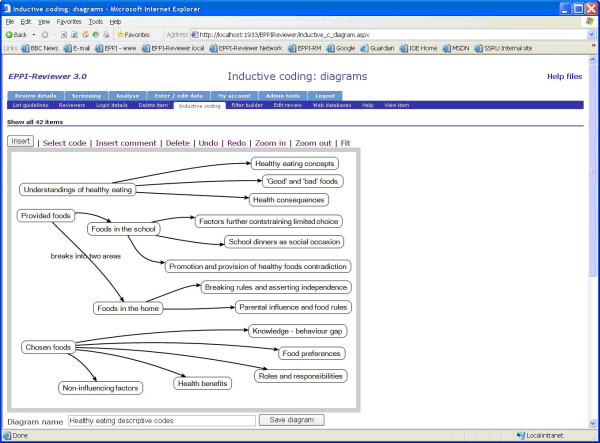
- In the example review, eight relevant qualitative studies yielded 36 initial codes, 12 descriptive themes, six analytical themes, and ten intervention recommendations.
- Six main issues emerged from children’s views: children do not see it as their role to be interested in health; future-health messages are not personally relevant or credible; fruit, vegetables and confectionery have different meanings; children seek food choices; eating is valued as a social occasion; and children see contradictions between promoted theory and adult practice.
- Most interventions were school-based and combined health-benefit learning with hands-on experience; interventions aligned with children’s views tended to be more effective, while multi-component physical activity plus healthy eating interventions worked less well than healthy-eating-only ones.
Methods
- Methodological paper describing thematic synthesis, illustrated with a completed systematic review of barriers to and facilitators of healthy eating among children aged four to 10 years.
- Searching involved extensive grey literature, author contact, and manual journal screening; quality was assessed using 12 criteria covering reporting, validity/reliability strategies, and appropriateness for children’s perspectives.
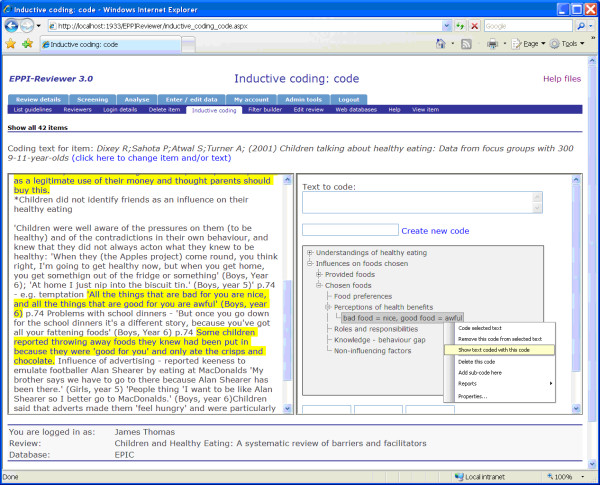
- Findings text labelled results/findings was entered verbatim into NVivo/EPPI-Reviewer; three reviewers independently coded line-by-line, grouped codes into descriptive themes, then generated analytical themes through group discussion and review questions.
Limitations
- Stated: contextual information in primary reports was very restricted, making it difficult to use context fully; there is little consensus on assessing qualitative quality and no accepted or empirically tested methods for excluding studies on quality, so all studies were included regardless of quality.
- Stated: the analytical-theme stage depends on reviewers’ judgement and insights and is potentially controversial; sensitivity analysis was done after synthesis by examining relative contributions of studies, finding poorer-quality studies contributed comparatively little and contained few unique themes.
- Evident: the method is illustrated with a single example review rather than compared empirically with other synthesis methods; the paper does not report a formal validation or inter-rater reliability for the synthesis.
Model-written summary. Check it against the paper before relying on it.
Integrity signals
Registry
Cites
Statistics
Figures
Verification
Claims the paper makes
3 Valid · 1 Not valid · 20 Not checked · 63 Own results and interpretations
A result the paper reports from its own data — it cites no other source for it, so there is none to check. The quote shows it is in the paper.
In the paper
“we found that there was very little difference in the methods we had to use to find qualitative studies compared to the methods we use when searching for studies for inclusion in a meta-analysis.”
§ Methods for the thematic synthesis of qualitative research in systematic reviews > Methods > Searching
plain- Asserted: passes — The authors put it forward as true.
- Checkable: passes — It can be checked against evidence.
- Load-bearing: unclear — It is unclear whether the paper’s conclusions depend on it.
- Based: passes — The paper gives a reason why it holds.
A result the paper states — it cites no source for it, so there is none to check. The quote shows it is in the paper.
In the paper
“Interventions that were in line with these suggestions tended to be more effective.”
§ Methods for the thematic synthesis of qualitative research in systematic reviews > Abstract > Results
hedgedstates an association- Asserted: passes — The authors put it forward as true.
- Checkable: passes — It can be checked against evidence.
- Load-bearing: passes — The paper’s conclusions depend on it.
- Based: passes — The paper gives a reason why it holds.
A result the paper states — it cites no source for it, so there is none to check. The quote shows it is in the paper.
In the paper
“In our review, it was not possible to rely on simple electronic searches of databases.”
§ Methods for the thematic synthesis of qualitative research in systematic reviews > Methods > Searching
plain- Asserted: passes — The authors put it forward as true.
- Checkable: passes — It can be checked against evidence.
- Load-bearing: unclear — It is unclear whether the paper’s conclusions depend on it.
- Based: passes — The paper gives a reason why it holds.
A result the paper reports from its own data — it cites no other source for it, so there is none to check. The quote shows it is in the paper.
In the paper
“In the event, we did not find any themes that belonged to a specific group, but another outcome of this process was a realisation that the contextual information given in the reports of studies was very restricted indeed.”
§ Methods for the thematic synthesis of qualitative research in systematic reviews > Discussion > Context and rigour in thematic synthesis
plain- Asserted: passes — The authors put it forward as true.
- Checkable: passes — It can be checked against evidence.
- Load-bearing: unclear — It is unclear whether the paper’s conclusions depend on it.
- Based: passes — The paper gives a reason why it holds.
A result the paper states — it cites no source for it, so there is none to check. The quote shows it is in the paper.
In the paper
“Interventions targeted at people with particular risk factors worked better than others, and multi-component interventions that combined the promotion of physical activity with healthy eating did not work as well as those that only concentrated on healthy eating.”
§ Methods for the thematic synthesis of qualitative research in systematic reviews > Results
plainstates a cause- Asserted: passes — The authors put it forward as true.
- Checkable: passes — It can be checked against evidence.
- Load-bearing: passes — The paper’s conclusions depend on it.
- Based: passes — The paper gives a reason why it holds.
25 more claims
Create a free account to see all 87 claims and to verify the 9 references still open.
- It may state two separate claims as one. 26
- Probably not a substantial claim. 45
Claims other papers make about this one
Each is checked against this paper’s own text: does it say what the citing paper says it does?
The source backs part of the claim, not all of it — or backs it for a different population, condition or comparison.
In the citing paper
“A thematic synthesis approach was used to integrate findings from studies with diverse methodological designs, following three key stages (Thomas & Harden, 2008).”
From Mind the gap: a systematic review of barriers, facilitators, and experiences of care transitions for people living with dementia and their informal caregivers. (2026) · cites this paper as Thomas & Harden, 2008
Experimental — accuracy not yet measuredThe source backs part of the claim, not all of it — or backs it for a different population, condition or comparison.
In the citing paper
“The thematic coding frame in Table 2 was applied to all included studies and reviewed for consistency of interpretation. This process, known as “axial coding,” ensured coded themes remained connected to and understood within the context of the source studies [13].”
From Patient-Perceived Factors Influencing Physical Activity Sensor Use in Stroke Prevention and Rehabilitation: Systematic Review of Qualitative Studies Using Thematic Synthesis (2026) · cites this paper as [13]
Experimental — accuracy not yet measuredThe source backs part of the claim, not all of it — or backs it for a different population, condition or comparison.
In the citing paper
“These data will be analysed following a three-step process. First, study data will be coded line by line by the first reviewer and checked by a second reviewer with a coding frame developed from codes derived from the data.”
From Effectiveness and acceptability of cognitive-behavioural therapy based interventions for maternal peripartum depression: A systematic review, meta-analysis and thematic synthesis protocol (2019) · cites this paper as [104]
Experimental — accuracy not yet measuredThe cited source says what the claim attributes to it.
In the citing paper
“The data coding, extraction and synthesis process was an iterative process, aligned with the thematic synthesis process outlined by Thomas 2008.”
From Health workers' perceptions and experiences of using mHealth technologies to deliver primary healthcare services: a qualitative evidence synthesis (2020) · cites this paper as Thomas 2008
The cited source says what the claim attributes to it.
In the citing paper
“To ensure the scientific reliability and trustworthiness of the findings, the qualitative analysis followed a thematic synthesis approach [25].”
From Sustainable Value Creation in Nonprofit Organizations: Processes, Determinants, and Strategic Dimensions (2026) · cites this paper as [25]
31 more claims about this paper
Create a free account to see every claim other papers make about this one.
Citations
Cites
Using thematic analysis in psychology
Braun, V., & Clarke, V. (2006) · Qualitative Research in Psychology · doi:10.1191/1478088706qp063oa · Cited by 194,414
(1997) · Cited by 4,204
Systematic reviews in the social sciences: a practical guide
(2006) · Choice Reviews Online · doi:10.5860/choice.43-5664 · Cited by 4,089
The Handbook of Research Synthesis.
Howel, D., Cooper, H., & Hedges, L. V. (1995) · Biometrics · doi:10.2307/2533295 · Cited by 3,642
Systematic Reviews in the Social Sciences: A Practical Guide
Petticrew, M., & Roberts, H. (2006) · doi:10.1002/9780470754887 · Cited by 3,586
Assessing the quality of controlled clinical trials
Jüni, P., Altman, D. G., & Egger, M. (2001) · BMJ · doi:10.1136/bmj.323.7303.42 · Cited by 3,309
Noblit, G., & Hare, R. (1988) · doi:10.4135/9781412985000 · Cited by 2,723
Qualitative Research: Rigour and qualitative research
Mays, N., & Pope, C. (1995) · BMJ · doi:10.1136/bmj.311.6997.109 · Cited by 2,715
Systematic Reviews in Health Care : Meta-Analysis in Context
Egger, M., Smith, G. D., & Altman, D. G. (2000) · Cited by 2,417
Dixon-Woods, M., Cavers, D., Agarwal, S., Annandale, E., Arthur, A., Harvey, J., Hsu, R., Katbamna, S., Olsen, R., Smith, L., et al. (2006) · BMC Medical Research Methodology · doi:10.1186/1471-2288-6-35 · Cited by 2,289
Research works printed but not linked: 9
- EPPI-Centre EPPI-Centre Methods for Conducting Systematic Reviews 2006 London: EPPI-Centre, Social Science Research Unit, Institute of Education, University of London
- Higgins J Green S (Eds) Cochrane Handbook for Systematic Reviews of Interventions 426 2006 Updated September 2006. Accessed 24th January 2007
- Sandelowski M Barroso J Handbook for Synthesising Qualitative Research 2007 New York: Springer
- Oakley A Experiments in Knowing: Gender and methods in the social sciences 2000 Cambridge: Polity Press
- Shepherd J Harden A Rees R Brunton G Oliver S Oakley A Young People and Healthy Eating: A systematic review of barriers and facilitators 2001 London: EPPI-Centre, Social Science Research Unit, Institute of Education, University of London
- Popay J Moving Beyond Effectiveness in Evidence Synthesis 2006 London: National Institute for Health and Clinical Excellence
- Boyatzis RE Transforming Qualitative Information 1998 Sage: Cleveland
- Medical Sociology Group Criteria for the evaluation of qualitative research papers Med Sociol News 1996 22 68 71
- Thomas J Brunton J EPPI-Reviewer 30: Analysis and management of data for research synthesis EPPI-Centre software 2006 London: EPPI-Centre, Social Science Research Unit, Institute of Education
Cited by
Items 8,901–9,000 of 9,166
Zhang, J., Gao, X., Fraser, M., & Duursma, E. (2026) · Current Issues in Language Planning · doi:10.1080/14664208.2026.2722041
Ju, X., zhang, Y., Wang, X., Lu, Q., Li, Y., & Hong, J. (2026) · Frontiers in Public Health · doi:10.3389/fpubh.2026.1921838
More Than Just Information: The Human Impact of Adverse News
Dien, M., & Dedieu, P. (2026) · International Journal of Business Communication · doi:10.1177/23294884261476057
A Systematic Assessment of Maturity Models for AI/ML-Based Software Development
Okay, E., & Özcan‐Top, Ö. (2026) · Lecture notes in computer science · doi:10.1007/978-3-032-36587-3_18
Bralić, N., Bandić, R., Vuković, M., Matijaca, D., Valsami, R., Zoumpoulakis, P., Schnitzer, K., Levula, M., Roine, R., Viitala, A., et al. (2026) · Frontiers in Medicine · doi:10.3389/fmed.2026.1917208
Vernon-Elliot, J., Hollo, Z., Amaratunge, L., Sadka, N., & Rao, P. (2026) · British Journal of Anaesthesia · doi:10.1016/j.bja.2026.07.027
Parents’ and Caregivers’ Understanding of Self-Harm in Young People: A Systematic Review
Boughey, H., Poole, J., & Mezes, B. (2026) · Adolescent Research Review · doi:10.1007/s40894-026-00289-3
Khosravi, M., Zahrayi, F., Beiky, F., Miri, A., Nakhaei, M., Ghoddoosi-Nejad, D., & Saadatjoo, S. A. (2026) · Digital Health · doi:10.1177/20552076261485226
Li, J., Guo, P., Liu, H., & Efstathiou, N. (2026) · Palliative Medicine · doi:10.1177/02692163261476455
Li, J., Mahayanti, N. W. S., Dantes, G. R., & Margunayasa, I. G. (2026) · International Journal of Learning Teaching and Educational Research · doi:10.26803/ijlter.25.8.30
Sahiti, A., & Çollaku, L. (2026) · International Journal of Ethics and Systems · doi:10.1108/ijoes-10-2025-0561
Abubakar, M., ABDULKAREEM, Y., Manir Kanoma, U. M. A. R., & SULEMAN, S. (2026) · Federal University Gusau Faculty of Education Journal · doi:10.64348/zije.2026522
Equity, governance and the co-creation of value: an integrative framework and research agenda
Lima, A. A., Ramos, H. R., Ribeiro, T. D. L. S., Oliveira, M. A. M. L., & Rizzo, L. A. (2026) · Journal of Hospitality and Tourism Horizons · doi:10.1108/jhth-03-2026-0057
Xie, R., Xing, Q., Han, Q., Yang, Z., Fu, Y., Wang, X., Cao, X., Xian, A., Wang, R., Qiu, Z., et al. (2026) · Atmospheric Environment X · doi:10.1016/j.aeaoa.2026.100510
Determinants of Family Caregiver Well-Being in Home-Based End-of-Life Care: A Qualitative Synthesis
Shankar, R., Ng, Y. X., Teo, R. F., Yu, J., Devi, F., Foo, T. H., & Qian, X. (2026) · Journal of Pain and Symptom Management · doi:10.1016/j.jpainsymman.2026.08.016
Kouroupi, N., & Aiosi, V. (2026) · Tourism and Hospitality · doi:10.3390/tourhosp7090268
Grov, E. K., Chiduo, M. G., Emidi, B., Lutambi, A. M., Kısa, S., Sawhney, M. S., Hovland, O. J., Thorvik, C., Ødemark, I. L., & Schippert, A. C. (2026) · International Journal of Africa Nursing Sciences · doi:10.1016/j.ijans.2026.101165
Tarrayo, V. N. (2026) · Australian Review of Applied Linguistics · doi:10.1075/aral.26004.tar · Cited by 1
Jôrgensen, B. N., & Ma, Z. G. (2026) · Algorithms · doi:10.3390/a19090733
Osman, N. H., Osman, H. M., Rage, A. N., Abdi, A. M., Iman, M. I., Moallim, A. A., Jimale, A. M., Ali, M. A., Ahmed, I. D., Adam, A. A., et al. (2026) · Frontiers in Health Services · doi:10.3389/frhs.2026.1934074 · Cited by 1
The Barriers to Women’s Leadership Progression Within the Retail Sector in Gauteng, South Africa
Noah, S., & Lebambo, M. (2026) · Springer eBooks · doi:10.1007/978-981-95-9489-4_22
AI-Assisted Genetic Diagnosis and Its Ethical, Legal and Social Implications: A Scoping ReviewPreprint
Shan, L., & Yanfeng, 鲁. L. (2026) · Research Square · doi:10.21203/rs.3.rs-10723773/v1
Zainuddin, N. M., Mohamad, M. B., & You, H. W. (2026) · SSRN Electronic Journal · doi:10.2139/ssrn.7389911
Self-Care Experiences of Individuals with Heart Failure: A Systematic Review and Metasynthesis
Ahmad, I., Bielecka-Dabrowa, A. M., Subashi, B., & chen, Y. (2026) · Journal of Clinical Medicine · doi:10.3390/jcm15176723
Kaigugu, S., Yusuf, A. H., Khan, W. A., et al. (2026) · Recycling · doi:10.3390/recycling11090158
Fletcher, K., Freestone, J., Ezard, N., Knock, E., & Siefried, K. J. (2026) · Current Addiction Reports · doi:10.1007/s40429-026-00783-7
Buonamassa, R., Markou-Pappas, N., Matteelli, A., Farkas, F. B., Asaduzzaman, M., Frallonardo, L., Lakatos, B., Saracino, A., Cuxart‐Graell, A., Bertelsen, N. S., et al. (2026) · Annals of Global Health · doi:10.5334/aogh.5363
Nwachukwu, E. L., Unegbu, L. I., Nwokorie, G. C., et al. (2026) · Journal of Educational Research and Practice. · doi:10.70376/jerp.v4i2.445
Mickelsson, M., & Oljans, E. (2026) · Global Public Health · doi:10.1080/17441692.2026.2725374
Ooi, K. H., Ooi, P. B., Teng, H. J. J., & Phan, C. W. (2026) · Discover Global Society · doi:10.21203/rs.3.rs-8292062/v1 · Cited by 1
Ali, J., Daril, M. A. M., Hussein, S. H., & Khan, N. (2026) · Research Square · doi:10.21203/rs.3.rs-10437879/v1
A Systematic Review of Health Literacy in People Living With Parkinson's Disease
Mahomed-Kola, S., Watermeyer, J., & Ferreira‐Correia, A. (2026) · Health Science Reports · doi:10.1002/hsr2.73176
Determinants of Public Trust in Digital Media: A Systematic Literature Review
Kalumba, C., Siluonde, M., & Mwiiya, C. (2026) · African Journal of Commercial Studies · doi:10.59413/ajocs/v7.i5.10
Badenhorst, A. (2026) · Journal of Transport and Supply Chain Management · doi:10.4102/jtscm.v20i0.1405
Mutanga, C. N., Gandiwa, E., & Gondo, R. (2026) · Frontiers in Sustainable Resource Management · doi:10.3389/fsrma.2026.1861347
Evolving aspects of oral care in older adults: a systematic review and Meta-synthesis
Neshati, A., Ardejanie, N. F., Naeimi, S., Pashmforosh, M., Askari, Z., & Rafi, A. (2026) · BMC Oral Health · doi:10.1186/s12903-026-09781-7
Liu, S., & Koh, K. (2026) · European Journal of Psychology of Education · doi:10.1007/s10212-026-01177-z
Positive Self-Talk as a Cognitive Control Mechanism in Sport Performance: A Systematic Review
Vargas, E. (2026) · Journal of interdisciplinary perspectives · doi:10.69569/jip.2026.328
Clarke, M., Stephen, B., Frecklington, M., Zeng, I. S. L., Carroll, M., Siegert, R. J., & Stewart, S. (2026) · Frontiers in Organizational Psychology · doi:10.3389/forgp.2026.1777186 · Cited by 1
Kim, Y. J. (2026) · Journal of Curriculum and Evaluation · doi:10.29221/jce.2026.29.3.335
Parenting concerns among patients with cancer: a qualitative meta-synthesis
Jiao, Y., Zhu, P., Zhang, L., & Wu, B. (2026) · Frontiers in Psychology · doi:10.3389/fpsyg.2026.1801763
Sustaining collegiate recovery programs: a literature review and SWOT analysis
Strong, M. K., & Lewis, L. E. (2026) · Frontiers in Public Health · doi:10.3389/fpubh.2026.1898555
Chian, W. M., & Nor, A. M. (2026) · OMEGA - Journal of Death and Dying · doi:10.1177/00302228261486068
Process Intelligence in the Digital Age: A Systematic Review of BPM-Driven Transformation
Dharmalingam, R., Shivashankarappa, A. N., Dharmalingam, V., Baskar, S., & Sudesh, S. (2026) · SHS Web of Conferences · doi:10.1051/shsconf/202623708001
SHRIVASTAVA, R. K., & Biswas, A. (2026) · Engineering Construction & Architectural Management · doi:10.1108/ecam-06-2026-1212
Ochoa, F. J. M., Martínez, J. C. R., & Hernández‐Salinas, G. (2026) · Tendencias en energías renovables y sustentabilidad . · doi:10.56845/terys.v5i2.730
Wang, M., Wang, J., Shi, X., & Wang, H. (2026) · International Journal of Nursing Studies Advances · doi:10.1016/j.ijnsa.2026.100672
Lost in Translation: A Typology of Multi-Level Responsible AI Governance
Symeonidis, D., & Nikiforova, A. (2026) · Lecture notes in computer science · doi:10.1007/978-3-032-36676-4_26 · Cited by 1
Kang, H. (2026) · Journal of Lifelong Learning Society · doi:10.26857/jlls.2026.8.22.3.160
Kaşarcı, İ. (2026) · International Journal of Current Educational Studies · doi:10.46328/ijces.315 · Cited by 1
How Patients Define Quality in Dental Care: A Qualitative Systematic Review
Tay, A. H. C., Chow, D. Y., Ng, E., Chen, S. M. S., Ong, Y. J., & Tay, J. R. H. (2026) · Journal of Dental Research · doi:10.1177/00220345261474417
Khorasgani, A. T., & Khorasgani, A. T. (2026) · Discover Education · doi:10.1007/s44217-026-02128-y
Violence and Its Associated Factors Among Migrant Women: A Scoping Review
Badanta, B., Rodríguez-Rico, A., García-Plata, T., Marichal-Pérez, C., Martínez-Sarmiento, A., Lucchetti, G., Catone, M., & Pérez‐Jiménez, J. M. (2026) · Journal of International Migration and Integration / Revue de l integration et de la migration internationale · doi:10.1007/s12134-026-01439-1
Maguiña, I. V., & Etesse, M. (2026) · Letras (Lima) · doi:10.30920/letras.97.146.14
Marino, F. E., Obohwemu, K. O., & Quao, A. J. (2026) · Journal of Water Sanitation and Hygiene for Development · doi:10.2166/washdev.2026.282 · Cited by 1
Kotze, C. (2026) · Journal of ExoTechnology and Education · doi:10.36615/k5bt2774
Cuzco, E. G., Velasco, J. S., & Tapia, J. L. J. (2026) · Frontiers in Sustainability · doi:10.3389/frsus.2026.1859463
Omodan, B. I., & Ngubane, S. A. (2026) · Trends in Higher Education · doi:10.3390/higheredu5030092 · Cited by 2
Zhang, H., Wu, D., & Mustafa, M. (2026) · Event Management · doi:10.3727/152599525x17640248309364
Sari, N., Azizan, F. A., & Filipović, V. (2026) · Hydrology · doi:10.3390/hydrology13090239
Understanding Perceived Value in Wellness Tourism: Insights from a Systematic Review
Sui, Q., Wu, H., & Goh, H. C. (2026) · SAGE Open · doi:10.1177/21582440261454797
Su, W., & Yoon, W. (2026) · Journal of theoretical and applied electronic commerce research · doi:10.3390/jtaer21090305
Li, X., & Razak, R. A. (2026) · Interactive Learning Environments · doi:10.1080/10494820.2026.2729788 · Cited by 1
Vickackaite, A., & Tarvydas, D. (2026) · Sustainability · doi:10.3390/su18189210
Pandarakutty, S., Poku, B. A., Ramasubramaniam, S., Nalubega, S., Mansour, M., Varghese, M., Renganathan, L., Chandu, V., Varghese, V., Zadjali, F. A. A., et al. (2026) · JMIR Research Protocols · doi:10.2196/96342
Ashley, L., McCourt, C., Daniele, M., Olander, E. K., Waterfall, K., & Yeh, D. (2026) · Ethnicity and Health · doi:10.1080/13557858.2026.2726767
Cultural adaptation of Mainland Chinese migrants in the post-COVID era: A systematic review
Hu, S., & Croucher, S. M. (2026) · International Journal of Intercultural Relations · doi:10.1016/j.ijintrel.2026.102489
NWambo, J. C., Bifarin, O. O., & Higginbotham, K. (2026) · Nursing Inquiry · doi:10.1111/nin.70164
Thomas, I., Kelly, H. K., Bantoft, E., DeDios-Stern, S., & Stott, J. C. H. (2026) · Ageing Research Reviews · doi:10.1016/j.arr.2026.103371
Jacobs, S., Gibbs, D., Smith, C. H., Hui, K., & Davies, N. (2026) · International Breastfeeding Journal · doi:10.1186/s13006-026-00893-y
Swithenbank, Z., Irizar, P., Halsall, L., Puddephatt, J., Parkes, P., O'Donnell, A. J., Angus, C., Drummond, C., Jackson, K., & Goodwin, L. (2026) · Journal of Dual Diagnosis · doi:10.1080/15504263.2026.2726794
Yucra, R. B. R., & Mareño, P. N. R. (2026) · Ajayu Órgano de Difusión Científica del Departamento de Psicología UCBSP · doi:10.35319/ajayu.242383
SCMS, C., & Sahdev, S. L. (2026) · Research Square · doi:10.21203/rs.3.rs-10798157/v1
One Size Does Not Fit All in Qualitative Research Synthesis
Beck, C. T. (2026) · Journal of Obstetric, Gynecologic & Neonatal Nursing · doi:10.1016/j.jogn.2026.07.001
Ecological restoration legitimacy and scaling: socio-cultural microcosms as structural determinants
Duguma, L. A., Minang, P. A., Muthee, K., Alemagi, D., Piabuo, S. M., & Ayana, A. N. (2026) · Frontiers in Environmental Science · doi:10.3389/fenvs.2026.1884898
Pérez, S. M., Lizarbe-Chocarro, M., Domingo‐Osle, M., Carvajal, A., & Rosa‐Salas, V. L. (2026) · European Journal of Oncology Nursing · doi:10.1016/j.ejon.2026.103325
Improving Tourist Experiences by Intelligent Chatbots and Virtual Assistants
Patil, D. S., & Patil, A. (2026) · Advances in computational intelligence and robotics book series · doi:10.4018/979-8-3373-9700-9.ch005
Neuroeducational strategies in English language learning: a systematic review
Valdivieso, A. D. S., & Patiño, A. (2026) · Remulci · doi:10.65835/remulci.4.1.1832
Sauceda, R. R., Sauceda, E. N. R., & Romanillo, A. L. Q. (2026) · Ra Ximhai · doi:10.35197/rx.22.02.2026.22.er
Abu-Bakar, H., & Charnley, F. (2026) · Resources Conservation & Recycling Advances · doi:10.1016/j.rcradv.2026.200386
Alviz-Meza, A., Valencia-Arias, A., Rojas-Flores, S., & Díaz, F. (2026) · Processes · doi:10.3390/pr14182917 · Cited by 1
Chong, J., Wang, N., Yi, B., Zhu, X., Yang, Y., & Huang, Q. (2026) · Sustainable Chemistry · doi:10.3390/suschem7030053
Thirty Years of Changes: A Systematic Literature Review on Curriculum Reform in Indonesia
Syam, S., & Faridah, F. (2026) · Jurnal Riset dan Inovasi Pembelajaran · doi:10.51574/jrip.v6i2.5594
Chovanec, S., Appel, L., Varissara, V., Szabó, P. T., Sosity, B. P., & Bakk, Á. K. (2026) · Proceedings of the International Conference on Disability Virtual Reality & Associated Technologies · doi:10.54337/aau.icdvrat26.33
Setiadi, B. R., Sutopo, S., Prasetya, T. A., Harjanto, C. T., Saprıatı, A., Putri, H. E., & Abdulmajid, N. W. (2026) · Research Square · doi:10.21203/rs.3.rs-10758652/v1
Alhuzail, N. A. (2026) · International Journal of Environmental Research and Public Health · doi:10.3390/ijerph23091208
Reflective teaching in Vietnamese EFL contexts: a systematic review of empirical studies (2020–2025)
Thùy, P. T., & Nguyen, A. T. (2026) · Reflective Practice · doi:10.1080/14623943.2026.2734439
Jeni, J. M., Swami, P., Patil, K., & Pawar, R. (2026) · Environmental Management · doi:10.1007/s00267-026-02612-z
Systematic review protocol on COVID-19 vaccine hesitancy among lactating people
Senkyire, E. K., Senkyire, G., Asiedua, E., et al. (2026) · Frontiers in Global Women s Health · doi:10.3389/fgwh.2026.1828078
Davis, I., James, S., Harris, M., Torres, J. L., Greenwell, K., Santer, M., Godfrey, K. M., Fisher, S., Davies, N., & Schoenaker, D. A. J. M. (2026) · Research Square · doi:10.21203/rs.3.rs-11010292/v1
Hepworth, L. R., Labinjo, T., Riley, A., Williams, C., Ravenscroft, J., Helliwell, B., Curtis, F., Maden, M., Croft, C., GC, V. S., et al. (2026) · Disability and Rehabilitation · doi:10.1080/09638288.2026.2731077
Bondinuba, F. K. (2026) · Journal of Engineering Design and Technology · doi:10.1108/jedt-04-2026-0245
Jahangiri-Manesh, N., Rezaeizadeh, M., Khorsani, A., & Bandali, B. (2026) · SSRN Electronic Journal · doi:10.2139/ssrn.7467925
Digital Marketing Platforms for Agricultural Products in Developing Countries: A Systematic ReviewPreprint
Mira, K. J., Hoque, M. N., Prodhan, F. A., & Hasan, M. N. (2026) · SSRN Electronic Journal · doi:10.2139/ssrn.7467110
Harriott, S. A.-M. (2026) · IGI Global eBooks · doi:10.4018/979-8-3373-8382-8.ch008
Chowdhury, S. P., & Reza, S. M. A. (2026) · Social Sciences & Humanities Open · doi:10.1016/j.ssaho.2026.103679
Measured treatment differences between sexes and genders: A scoping review
Veenhuizen, M., & O’Malley, A. (2026) · PLoS ONE · doi:10.1371/journal.pone.0356176
Osife-Kurex, P. O., Ipori, L. O., Oghenetega, J. V., & Ajirioghene, O. (2026) · SSRN Electronic Journal · doi:10.2139/ssrn.7478278
Sharing transparently: Caring for trustworthiness in qualitative data analysis in L2 research
Rezvani, R., & Riazi, A. M. (2026) · Studies in Second Language Acquisition · doi:10.1017/s0272263126101934
Metadata
- Authors
- Thomas, J., & Harden, A.
- Affiliations
- University of London (GB)
- Corresponding author
- Thomas, James
- Venue
- BMC Medical Research Methodology
- Published
- 2008-07-10
- Volume
- 8
- Issue
- 1
- Pages
- 45-45
- ISSN
- 1471-2288 (ISSN-L)
- PMC
- PMC2478656
- OpenAlex
- W2109305774
- Cited by
- 9,312
- References
- 64
- Citations by year
- 2026: 1606 · 2025: 1253 · 2024: 1082 · 2023: 899 · 2022: 903 · 2021: 852 · 2020: 606 · 2019: 472 · 2018: 404 · 2017: 318 · 2016: 275 · 2015: 179 · 2014: 141 · 2013: 122 · 2012: 91
- FWCI
- 38.28
- Type
- journal article
- Language
- en
- Open access
- gold
- doi.org
- Licence
- cc-by
- creativecommons.org/licenses/by/2.0 (tdm)
- Locations
- BMC Medical Research Methodology (publishedVersion, cc-by)
- PubMed Central (publishedVersion, cc-by)
- PubMed (publishedVersion)
- UEL Research Repository (University of East London) (acceptedVersion)
- City Research Online (City University London) (acceptedVersion)
- IOE EPrints (submittedVersion)
- UEL Research Repository (University of East London) (submittedVersion, cc-by-nd)
- DOAJ (DOAJ: Directory of Open Access Journals) (submittedVersion, cc-by-sa)
- UCL Discovery (University College London) (submittedVersion)
- Funders
- National Institute for Health and Care Research
- Economic and Social Research Council (RES-576-25-5008)
- Topics
- Social Sciences › Education › Qualitative Research Methods and Applications
- Social Sciences › Decision Sciences › Statistics, Probability and Uncertainty › Meta-analysis and systematic reviews
- Social Sciences › Sociology and Political Science › Delphi Technique in Research
- Keywords
- thematic synthesis, thematic analysis, health promotion interventions, children's perspectives, school-based intervention, fruit and vegetable intake, health messaging
- MeSH terms
- Humans, Methods, Review Literature as Topic, Statistics as Topic, Qualitative Research
About these checks
Registry, retraction, Cites and statistics results are computed, not judged, with one exception: a printed reference that no index lists is read once by a model before it counts as a citation error. Claims are extracted by a model and kept only when their quote appears verbatim in the text; each cited source is then checked, with a model’s help, for whether it says what the claim relies on. Those verdicts can be wrong — read the claim’s quote and the cited source before relying on one.
The claim verdicts this report counts are experimental: their accuracy is not yet measured.
A language model drew the claims from the paper on 2026-10-04, under version 3 of the claim definition (model deepseek-v4.1-flash, prompt extract-v3).
A second model labelled each claim on 2026-10-04 (model jev-1.13-20260917, definition revision gold-guideline-v0.2).
Statistics and arithmetic are recomputed, not judged.
Confidence bands are shown only for fields calibrated on our annotated test set. None is calibrated yet, so no band is shown.
What counts as a claim ›How we measure confidence ›How we check this ›
Are you an author, or do you see a problem with this page? Request a review
Data sources
Bibliographic data: Semantic Scholar, OpenAlex, Crossref.
Contains information from the Semantic Scholar Academic Graph Datasets, made available under the ODC Attribution License (ODC-BY 1.0).
Semantic Scholar’s data is described in: Kinney, R., et al. (2023). The Semantic Scholar Open Data Platform. arXiv:2301.10140.
